Most of the feedback people receive in the workplace isn’t feedback at all, it’s what I fondly refer to as Cap’n Crunch – vague and unhelpful words that put people on the defensive but don’t change behavior. If you want people to do something differently, give specific feedback.
Most of the fake Cap’n Crunchfeedback people get sounds like this:
“You did a great job on that.”
“You’re doing really good work.”
“You’re dressing inappropriately.”
“You’re difficult to work with.”
None of this is feedback. It’s all Cap’n Crunch. Vague, vague, and more vague.
The first words out of your mouth will invariably be Cap’n Crunch. Follow those words with, “for example” and you’ll be headed in the right direction.
“You did a great job on that. For example, I never had to ask about the status of the project. You gave me an update every Friday, and that made me feel comfortable that we were on track.”
“You dressed inappropriately for that meeting. For example, the client was dressed in business casual; you wore jeans and a t-shirt. Next time, please dress as the client dresses or a step above in khaki pants or slacks and a jacket.”
Most people are afraid to give feedback because they don’t want to deal with the defensive reaction they anticipate. The more vague you are, the more defensive people will be, because they don’t know what you’re talking about and they feel judged. Vague feedback is subjective. Subjective is judgmental. Feeling judged puts people on the defensive.
If employees shop your feedback around, asking what others think of the feedback you provided, it’s because you were vague, they disagree with you, or they’re being defensive. Feedback will be received better and resisted less if you’re specific.
Specific feedback can be captured on video. Meaning, you can video someone calling into a meeting late, rolling their eyes, and texting on their phone. I dare you to video “you were disrespectful in the meeting, you dressed inappropriately, or you’re difficult to work with.” If you can’t capture the feedback on video, you don’t yet have specific feedback. You have Cap’n Crunch.
When I teach managers to give feedback I ask the managers to, “Describe the situation to me. What did the person do?” Managers often reply with, “They were negative.” This is Cap’n Crunch. So, I keep asking questions. “What did they do that was negative? What did it look like?” After two or three questions the manager tells me, “I overheard them complaining to other employees about the decisions the company is making. I’d rather they ask me questions about the direction we’re going versus gossip to peers.” Now we have specific feedback.
Wait to give feedback until you have a specific example. If you don’t have a specific example, go get one. Without an example, employees will look at you in a confused way, question the validity of what you’re saying, and become defensive. And they’ll be justified in doing all of these things.
Most of us dread giving feedback because we don’t want to deal with people’s defensive responses. If you want more help, chapters nine through twelve of How to Say Anything to Anyone provide a clear and easy-to-follow formula for giving specific feedback.
Remember, if you’re not using the words “for example” you’re not giving specific feedback.
Wearing too much perfume, cologne, or other scented products will make people scatter or wish they could. Unfortunately, rather than tell you that you’re wearing too much, people will just avoid sitting near you. Scent is such a personal thing, like clothing choices, that people are hesitant to comment on it.
I suggest not wearing anything scented at work, on airplanes, or when you’ll be in close proximity with other people you don’t know well. But if I can’t persuade you to skip the scent, here are a few guidelines when putting on cologne and perfume:
• Spray the air ten inches in front of you, and walk through the mist, rather than spraying your skin.
• If you can smell the scent on yourself or people who are more than a few inches from you can smell it, you’re wearing too much.
• You should never be able to smell a person’s cologne after they’ve left a room.
No, I’m not an expert on how to wear perfume. I googled it. I’m an expert at how to talk about how scents impact you and your work environment.
The next step is to ask a few people you trust to tell you when you wear too much perfume or cologne. Give people permission to give you this feedback and promise you won’t bite their head off when they do. This could sound something like, “I want to be sure I’m not wearing too much perfume/cologne. Would you be willing to tell me when I do? I promise I won’t freak out or jump down your throat. I really want to know.”
Let’s say you work with someone who wears too much perfume, cologne or other scented products. They haven’t asked if they’re wearing too much, and you want to say something. You could say something like, “This is a bit awkward, but the perfume/cologne you wear is a bit overwhelming. Would you be willing to wear less or none when you’re in the office?” This is an awkward conversation that most people don’t want to have. Consider that you’re doing the person a favor. Would you rather know the amount of scent you wear keeps other people away, or would you rather alienate the people around you?
If the relationship is a personal one, you could say, “You wear the most lovely cologne/perfume. I’m very sensitive to scents. Would you be willing not to wear perfume/cologne when we’re together?” Again, this is an awkward conversation. But you won’t die from having it and the other person won’t either. When they get over being embarrassed and defensive, your relationship will be fine. And if it’s not, you didn’t have much of a relationship to begin with.
When I get an email that has multiple paragraphs I look at it, decide I don’t have time to read it, and close it out, promising to go back to it later when I have more time, which never happens. If you want your emails read, shorter is better.
Here are a few tips for writing effective emails that are more likely to be read:
Put a specific subject in the subject line that says what the email is about.
This does not include your name. We already know your name.
Example: “Meeting” (that’s not specific). Instead try: “Meeting to agree upon Q3 goals.”
Highlight and bold important parts of the email.
Limit this practice so what’s bolded and highlighted stands out.
If everything is bold, nothing stands out.
Use bullets.
Use the fewest number of words possible.
Use links that send readers to relevant information.
Offer to provide additional information, if desired.
The shorter your emails are, the more likely they are to get read. You can always offer additional information, but readers won’t get to the detail if they never read the email. When it comes to writing effective emails, shorter is better.
We have all worked hard on a project, only to find out that what we created was not what our manager was expecting. When this happens, everyone is frustrated. Managers question whether or not employees listen. Employees wonder why managers weren’t clearer about what they wanted at the beginning.
Giving negative feedback is hard. Asking for what you want will always be easier. Managers would be well served by setting clear expectations at the beginning of working relationships and projects. Tell your employees what a good job looks like. Don’t make them guess.
If you want a weekly status update, tell employees that rather than being frustrated when you don’t know where projects stand. If you want a bulleted summary, tell people that rather than being annoyed when five paragraphs land in your inbox. If you envision a report with tables and charts, tell employees that versus being disappointed when they create a bulleted list. Setting clear expectations applies to all internal and external working relationships – up, down, and lateral.
Most of us assume people will do things the way we do. They won’t. Save time and reduce frustration by being crystal clear when you set expectations at the beginning of anything new.
When people see the title of my book How to Say Anything to Anyone, they think it’s a book about giving feedback and having difficult conversations. It’s not. How to Say Anything to Anyone is about asking more questions, so you know what your direct supervisor, coworkers, and customers need and don’t have to guess. How to Say Anything to Anyone is not about giving people bad news. It is about asking for what you want before challenges occur and then talking about how you’ll deal with challenges when they arise.
If you work for or with someone who does not set expectations that are clear, then you, the employee, needs to set those expectations.
Set expectations by asking your manager and coworkers:
• When do you want to see this, in what format, with how much detail?
• What does a good job look like?
• What’s your expectation of how this should look when it’s complete?
• Where does this fit, as a priority, in relation to other projects?
• How does this project fit into the department’s or organization’s goals?
Asking questions and telling people what you want is always easier than giving negative feedback. Everyone – employees and managers alike – are accountable for ensuring that expectations are clear and that work is done right the first time Ask more. Assume less.
Download the five questions managers must ask their employees to set expectations that are clear:
Most of the feedback we give and receive puts people on the defensive. We don’t do this intentionally. It just happens. We say how we feel, usually when we’re upset, and the other person responds.
Most of the feedback we give and receive is judgy, like the examples below.
Judgy – Not Real Feedback
Just the Facts – Actual Feedback
“You ignore me in meetings.”
“When I raise my hand to participate in meetings, you don’t call on me.”
“You’re rude to me.”
“When you pass me in the hallway, you don’t say hello.”
“You won’t work with me. You go around me.”
“We were supposed to screen potential vendors together. You scheduled and held the appointments without me.”
“You’re not responsive.”
“You usually reply to emails a week after they were sent.”
“It’s hard to get time on your calendar.”
“It takes three weeks to schedule time to meet with you.”
Becoming defensive when receiving feedback is a hard-wired response, like slamming on your brakes when the car in front of your does the same. The more people feel judged, the more defensive they become. If you want to be sure people become defensive when you give feedback, be vague. If you want people to be able to hear you and take action on your feedback, strip out the opinion (judgment) and give people just the facts.
Referring to the chart above, the sentences on the left are opinions. And opinions can be debated. The sentences on the right are facts. Facts are harder to debate. When giving feedback give just the facts, not your opinion. This will take practice.
The first thing out of our mouths will invariably be judgment/opinion. People who have participated in feedback training with me or who have read How to Say Anything to Anyone know I call the tendency to be vague Cap’n Crunch. Cap’n Crunch: “You’re doing a good job.” That’s sweet but useless.
When someone upsets you and you want to tell the person, prepare for the conversation by asking yourself these questions:
What did the person do that frustrated me?
What behaviors did they exhibit?
What actions did they take?
What was the impact on me?
Then practice giving feedback to someone outside of your workplace to reduce gossip and drama and ask the person with whom you’re practicing what they heard. If your feedback is specific and clear, any lay person will interpret the feedback as you intended it.
Giving feedback, that others can hear, isn’t easy to do. It requires you to put your emotions aside, strip out judgments and opinions, and tell the other person the facts of what happened. The more you focus on the facts and less on how you feel about what happened, the better your conversations and relationships will go.
You’ve undoubtedly heard that it takes fewer than 30 seconds to form a first impression. The question is how frequently is your first impression wrong?
If the person sitting next to you on a plane doesn’t speak to you during the entire flight, you may initially think they are unfriendly, only to strike up a conversation as the plane is landing and find out that’s not the case. If a job candidate is outgoing, you may decide the person has good people skills, only to experience contrary behavior when they start the job. If someone is late to arrive for an initial meeting, you may decide they have an issue with time management, versus they were just running late that day.
Your first impression may be right, and it may be wrong, but it takes more than 30 seconds to be sure.
If you’ve participated in job interview training, you were probably trained to look for contrary evidence when forming an opinion about a candidate. Looking for contrary evidence is an attempt to disprove your first impression. If you quickly dismiss a candidate for lacking knowledge of your industry, you should ask interview questions to disprove your opinion before making a final decision.
Why not follow this practice in all settings? If you initially decide someone is trustworthy and reliable, spend more time with that person to be sure. If you quickly decide someone is unhelpful and uncommitted, give the person additional opportunities to behave differently before making a final judgment.
Snap judgments eliminate lots of great people and experiences from our lives.
Unfortunately, just as we prematurely exclude potential employees, friends, and life partners without having enough information, people do this to us as well, which is why it’s important to know the first impression you, your department, and your company make. If you don’t know the first impression you create, there’s nothing you can do to shift behaviors that may be costing you friends and customers.
When I was new to a job, early in my career, I asked my new coworkers to give me feedback if they saw me do anything that got in the way of my being successful at work. They agreed. But when they had negative feedback, they didn’t give it to me, they told my boss instead. That’s when I got the hard and painful lesson that people have a tendency to talk about us, not to us. It’s also when I began asking the people closest to me, who I know love me and care enough to tell me the truth, the first impression I create.
Opinions are formed quickly and they’re hard to break. Give people more than one chance and see how they show up. And know that many people will eliminate you, your department, and your company after just one interaction. So, find out the impression you create, giving you the power to do something about that impression.
Download some of the questions I ask to learn my reputation.
Someone asks if you can (fill in the blank). You look at your calendar. That hour is open. You say, “yes.” You forgot that hour was designed for something you’ve been meaning to do, for yourself. You’re angry for forgetting. You promise to do better tomorrow.
The next day… repeat.
A way out of tired-inducing-people-pleasing is to set boundaries and stick to them. And this is hard, for me.
Examples of boundaries: Putting an hour in your calendar during the day to exercise; blocking 30-minutes between meetings to work on projects; only scheduling 80% of your workday to allow for last-minute requests and emergencies. Putting a boundary in place doesn’t mean saying no. Boundaries create the conditions that tell us, without struggle, when to say yes.
Before I had my son, I traveled for work constantly. Some weeks I was on the road for six consecutive days, in three different states. And I loved every second of it. Audience + microphone = happiness. When I had a child, I knew that schedule wasn’t going to work. So, I set boundaries. I decided how many nights per week I would travel and the time I needed to arrive home from each trip. And I didn’t violate those boundaries for 8 years. If a piece of work would require me to violate my travel boundaries, I said no without struggle, no matter how much I wanted to do that piece of work. The boundaries made the decisions easy. There was no deliberating or debating.
I’ll admit, I’m not as effective as setting boundaries in other areas of my life. Last week, I had a yoga class on my calendar. When I learned a repair person was able to be at my house during that hour, the yoga class was quickly deleted from my calendar. Yesterday, I asked my son what he wanted for breakfast, before flag football. He wanted scrambled eggs and a smoothie. I made both, knowing there wasn’t time. We were late for flag football. What was missing in both situations? Boundaries.
How does this apply to work? The key to preventing tired, burnt-out employees is to make it safe to speak up. Burnout is a systemic issue, not a personal one. Burnout at work comes from too much to do, over time. One way out is to make it safe to tell the truth at work.
For the most part, no one wants to admit to their boss that they are overextended or overwhelmed. Doing so feels like failure, and who wants to admit failure? If you want employees who are energized versus exhausted, focus on making it safe to tell the truth at work.
Five ways to make it safe to tell the truth at work:
Leaders and managers share their own strategies for managing time and priorities.
Ask your employees and coworkers meaningful questions. “How’s it going?” is not a meaningful question. Try: “What are your preferred working hours? What times a day would you prefer not to be contacted?”
Show appreciation when employees risk and say hard things.
Reward the truth. Make employees who are willing to say hard things a positive example.
Help employees problem solve to manage their time and priorities. Be ‘in it’ with them.
The good news about violating your own boundaries is you will get another chance to do it differently tomorrow. You can always reset a boundary. This time, tell the other people in your life about your boundaries. Tell your coworkers if you don’t do happy hours, 7:00 am Zoom calls, and back-to-back meetings, and tell them why. Then offer an alternative. Everything in life is a negotiation.
When my son started school, I went to new parent orientation. At the orientation I sat next to parents who told me their questions about the program, but they never asked the people running the meeting their questions. They wondered in silence, whispering to seat mates who didn’t know any more than they knew. I’m always flabbergasted by these situations until I remind myself that people don’t like to admit they don’t know something. No one wants to look stupid.
Most of us aren’t eager to admit when we don’t know something, need help, or make a mistake. We fear these things will damage our reputation and make us appear less than to others. But neither are true. It takes strength and self-confidence to admit mistakes, accept feedback, and ask for help. Strong, self-confident people do all of these things.
When someone who works for me is willing to admit mistakes, I think more of them. When employees ask for help rather than spin their wheels unnecessarily, I’m appreciative. When they’re open to feedback, I’m grateful they’re easy to work with. And the same is likely true for you.
Before launching Candid Culture, I worked for a CEO who frequently led with, “I may not be the smartest guy in the room, but…” The CEO was trying to appear humble and relatable, but he was the smartest guy in the room, and we all knew it, thus his attempts were false and came off as such. Arrogance masquerades as self-confidence. People who are arrogant come off as strong and self-confident, but it’s a façade.
It may seem like your personal power and reputation will be diminished by admitting mistakes and accepting help. But this couldn’t be further from the truth. It takes strength to say you don’t know how to do something, to embrace feedback that stings, and to admit bad choices. And strong, self-confident people do all of these things, regularly.
You won’t lose credibility or damage your reputation by being humble, instead you’ll be seen as real, relatable, and willing to admit a lack of perfection. And all of those things take strength that ingratiate you to others. So be yourself. Don’t pretend you’re better or more knowledgeable than you are. Authenticity goes a long way.
I’m embarrassed how often I do things I don’t want to do because I’m afraid of looking bad. I agree to things I don’t want to do. I even suggest doing things I don’t want to do, because I think it will look bad if I don’t. Then I have deep regrets.
If I’m aware of this practice, why do I keep doing it, over and over and over? I suspect the need to look good and be liked is so pervasive, it over-powers reason and self-talk. Telling myself, “Don’t do it. You will regret this,” doesn’t help. The need for approval is all-powerful (to me).
My old boss told me many years ago, “Your need to be liked will kill you as a manager,” and he was right. It’s why I can’t interview my own candidates. I want them to like me too.
I suspect I’m not alone here. I lot of us say yes when we want to say no. We extend ourselves and regret it later.
What can be done, at an organizational level, to prevent ourselves and fellow employees from over-extending?
Sanction, at a team and organizational level, that sometimes it’s ok to say no.
Try saying, “Here’s what I can do…” or “Here is what we will do” when you don’t want to say “no”.
Suggest that at times people take 24-hours before agreeing to take on a new task or project. Pause before committing.
Make room for negotiation, so people can say yes on terms that work for them.
Speak your truth and know that it’s ok to set boundaries. Boundaries prevent burnout.
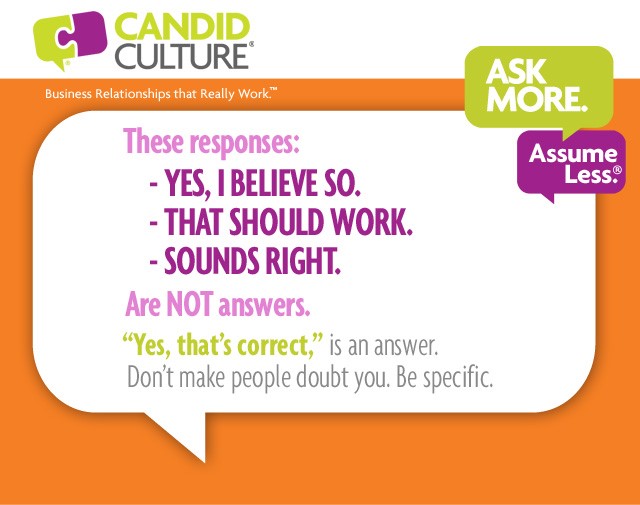
When a customer service agent answers my questions with words like, “That sounds right, I think so, or that should work,” I hang up and call back, hoping to get someone who can give me an affirmative answer. People do this to you too; they just don’t tell you about it.
Vague communication is unhelpful. Being vague instills doubt in the people around you and reduces your credibility.
Pay attention to your language. If the answer is yes, say “Yes.” If the answer is no, say “No.” “I think so,” says neither yes nor no. Saying, “I think so” tells people you don’t really know.
A few phrases to avoid and what to say instead:
Avoid: “That should be done by Friday.”
Instead, be specific and give a final date. “That will be complete by Friday. If I can’t get it done by Friday, I’ll call you to let you know by 5:00 pm on Thursday.”
Avoid: “Sounds right.”
Instead, be specific and say, “That’s correct.”
Avoid: “We should be able to do that.”
Instead, be specific and say, “We can do that.”
Avoid: “I guess.”
Instead, be specific and say, “Yes” or “No.”
When I teach feedback training, the biggest thing training participants struggle with is specificity. “You’re difficult to work with.” “Your clothing is inappropriate.” “I just find you to be negative.” “You did a good job on that.” “It’s a pleasure to have you on the team.” All of this is vague and thus unhelpful to the feedback recipient. And the same is true when answering questions and making promises.
Tell people exactly what to expect. Be specific. Even if they don’t like your answer, they’ll be happy to have a clear answer.