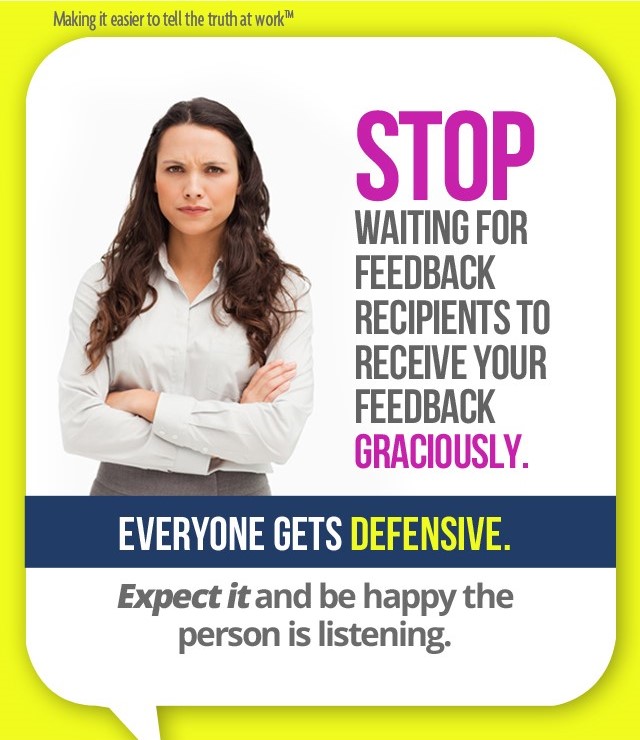
Most of us avoid giving negative feedback because we don’t want to deal with the recipient’s defensive behavior. We’re waiting for what I call, The Freak Out. The Freak Out is the predictable response to negative feedback.
Everyone wants to be seen as competent and adding value. When we give people negative feedback, we call those two things into question and the brain instinctively reacts. It’s as if you were driving down the road and the person in front of you slammed on their brakes. As an act of survival, you’d hit your brakes too. Becoming defensive when receiving negative feedback is the same instinctual response. We (almost) can’t help ourselves. So rather than dread and avoid others’ defensive behavior, expect it and have a plan.
Here are five ways to deal with defensive behavior:
Plan your conversation by writing notes and bringing them to your conversation. I’m a fan of typed, double-spaced bullets that are easy to follow.
Practice what you want to say out loud. What you say in your head is often different than what comes out of your mouth.
Ask others for help. Change names and details to protect the feedback recipient and ask how someone else might deliver the feedback. Someone who is not emotionally involved will likely handle the conversation better.
When the feedback recipient exhibits defensive behavior, take a breath and pause. Remember that you expected this. Don’t retract what you’ve said. Just let the person speak.
Stay on track. Defensive behavior is designed to derail conversations. Keep the conversation focused on the feedback. Don’t become distracted.
What to say when people respond to feedback defensively:
Defensive behavior: “Why are you talking to me? I’m not the only one doing this.”
Appropriate response: “If others are doing this, I promise you that I’m managing it. Right now we’re talking about you. I know this is difficult. Let’s stay here.”
Defensive behavior: “You’re wrong. Everyone else has given me positive feedback.”
Appropriate response: “I know this is difficult. I’m asking you to __________. Please do that.”
Defensive behavior: “You don’t like me and you’re picking on me.”
Appropriate response: “I’m sorry you feel that way. The reason I’m asking you to ________ is _______.”
Defensive behavior: “I disagree.”
Appropriate response: “I know that we disagree. And I’m asking you to __________.”
The key is not to get baited by defensive behavior. This is why I suggest preparing and bringing notes. When I’m having a particularly difficult conversation and the other person becomes defensive, I often become flustered and either forget what I want to say or back pedal. Do neither. Expect defensive behavior. Don’t get distracted. Stay on track. You can handle anything someone says.
I’m often asked, “Can I give my boss or the people above me feedback? Is that really realistic?” Giving people ‘above’ you feedback has everything to do with the quality of your relationship and less to do with the person’s title. If your relationship is good and your boss is open to feedback, then yes, you can practice the feedback formula with them. If your relationship isn’t that solid or your boss isn’t open to your feedback, practice managing up by asking for what you want instead of giving direct feedback.
No one likes to be criticized or told that they are wrong. When giving someone direct feedback, no matter how kind the delivery, you are telling someone, “You’re doing ______ wrong. Please do _____ instead.” Being that direct is challenging when you don’t have a trusting relationship or when people are highly defensive. You can achieve the same desired results by simply asking for what you want.
Asking for what you want is less judgmental than giving direct feedback and is a subtle way of telling someone they are not giving you what you need. And people who are paying attention will get that. They don’t need it spelled out.
Here are a few ways to practice managing up with your boss and other leaders in your organization:
Example One:
Giving Direct Feedback: “You don’t make time for me. I’m getting behind on projects because you don’t take the time to review my work.”
Managing Up by Asking: “How can we ensure you get to review my work each week, so I can finish the projects I’m working on?”
Example Two:
Giving Direct Feedback: “Every time we have a meeting scheduled, you cancel it.”
Managing Up by Asking: “If meetings get cancelled, is it ok if I reschedule them?
Example Three:
Giving Direct Feedback: “You’re a micromanager. I feel like I can’t make a move without your permission.”
Managing Up by Asking: “I’d like to manage ________ project. What do you need to feel comfortable with me doing that?”
Telling someone at any level s/he is doing something wrong, which will likely evoke defensiveness. And being direct requires both courage and a good relationship. If you don’t have the relationship to be so direct, simply ask for what you want.
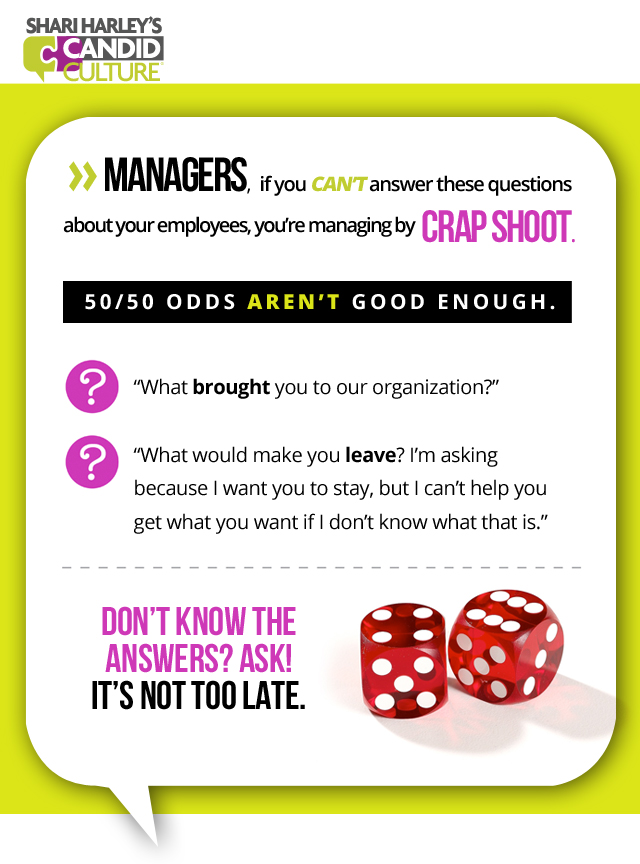
Most employees need only a handful of things to be satisfied and productive at work. The key is getting employees to tell you what those things are. And they might just tell you, if you ask.
Effective management involves asking questions during the interview process, after an employee starts, and again 90-days to six months into the job.
I recommend asking the seven questions below. I call the questions, Candor Questions.
Candor Question number one: “What brought you to this company? Why did you accept this job? What are you hoping the job will provide?” Ask one of these three questions. Pick the one you like best.
Candor Question number two: “What would make you leave this job? What are your career deal breakers, things you just can’t tolerate at work?” Ask either of these questions.
Candor Question number three: “What type of work, skills, and/or areas of our business do you want to learn more about?”
Candor Question number four: “Tell me about the best manager you ever had. What made him/her the best manager?” This will tell you what the employee needs from you as a manager and is a much better question than, “What do you need from me as your manager?” That is a hard question to answer. Telling you the best manager s/he ever had is easy.
Candor Question number five: “Tell me about the worst manager you ever had? What made him/her the worst manager?”
Candor Question number six: “What are your pet peeves at work? What will frustrate you?” Why find out the hard way what frustrates employees when it’s so easy to ask. This question demonstrates that you want your employees to be happy and that you will flex your own preferences, when possible, to meet employees’ needs.
Candor Question number seven: “How do you feel about being contacted via cell phone or text outside of business hours? How do you feel about receiving emails during the evenings and weekends?”
Regardless of age, work, and educational background, employees have a few things in common.
Employees want to:
• Work for someone who takes an interest in and knows them
• Feel valued and appreciated for their contributions
• Be part of and contribute to something greater than themselves
• Feel respected as a person. Managers respect their time, expertise, and needs
Taking the time to get to know employees throughout your working relationship accomplishes many employee needs.
If you have long time employees, it’s never too late to ask these questions. Regardless of for how long employees have worked for you, they’ll appreciate you asking. Don’t worry that employees will raise an eyebrow and wonder why you’re asking now. They’ll just be happy you’re asking. You can simply say, “I realized that I’ve never overtly asked these questions. I just assume I know. But I don’t want to do that. During our next one-on-one meeting I’d like to ask you these questions and you can ask me anything you’d like.”
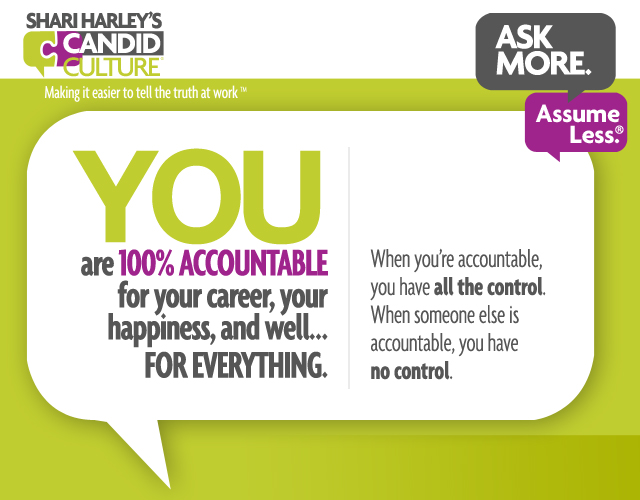
If you have a manager who will never ask you these questions, provide him/her the information. Don’t wait to be asked. You’re 100% accountable for your career. Tell your manager, “There are a few things about myself I want to share with you. I think this information will help ensure I do great work for the organization for a long time.”
Managers, the better your relationship with your employees and the more you know about what your employees need from you, the organization, and the job, the easier employees are to engage, retain, and manage. Stop guessing and start asking.
Breakdowns happen. There will be days people won’t give you what you need to complete projects. Things will break. And you will look bad. When breakdowns happen, I always ask myself, “What could I have done to prevent this situation?” or “What did I do to help create this situation?” I see myself as accountable for whatever breakdowns occur.
It may sound odd that I always look at myself when breakdowns occur, even when it’s someone else who didn’t do their job, but it’s just easier. I can’t control anyone else. But I can control me (admittedly, some days I do a better job at this than others). When I can identify something I could have done to make a situation go differently, I feel more in control – aka better.
It’s like getting off a highway versus sitting in bumper-to-bumper traffic. The alternate route may take longer, but at least I’m moving. I feel like I’m doing something and thus have more control. Taking responsibility for everything that happens to you is similar. When you’re accountable, you can do something to improve your situation. When someone else is accountable, you’re at the mercy of other people and have very little control.
There are, of course, exceptions to the practice that “we’re always accountable.” Terrible acts of violence, crime, and illness happen to people, about which they have no control. But in general, in our day-to-day lives, there is typically something we did to contribute to a bad situation or something we can do to improve it.
Here are five practices for improving difficult situations, even when you didn’t create the mess (alone).
1) Ask more questions. If you’re not clear about what someone is expecting from you, ask. You’re responsible for doing good work, regardless of the type of direction you receive.
2) Tell people what you think they’re expecting and how you’re planning to approach a project or task, to ensure everyone’s expectations are aligned. Clarifying expectations beats doing several weeks worth of work, only to discover what you created isn’t what someone else had it mind.
3) Ask for specific feedback as projects progress. Don’t wait until the end of a project to find out how you performed.
4) Say “thank you” to whatever feedback you receive versus defending yourself. People will be pleasantly surprised and their upset will dissipate more quickly. That could sound like, “That’s good feedback. I’m sorry that happened. Thank you for telling me.”
5) Admit when you make a mistake or when you wish you had done something differently. Don’t wait for someone to tell you. Saying, “I’m sorry. How can I make this right with you?” goes a long way.
I consistently ask the following questions:
“What could I have done differently?”
“What did I do to contribute to this situation?”
“What can I do now to make this situation better?”
I encourage you to ask these questions, even when someone else drops the ball. You can’t control others, but you can control you. And your happiness and success is your responsibility.
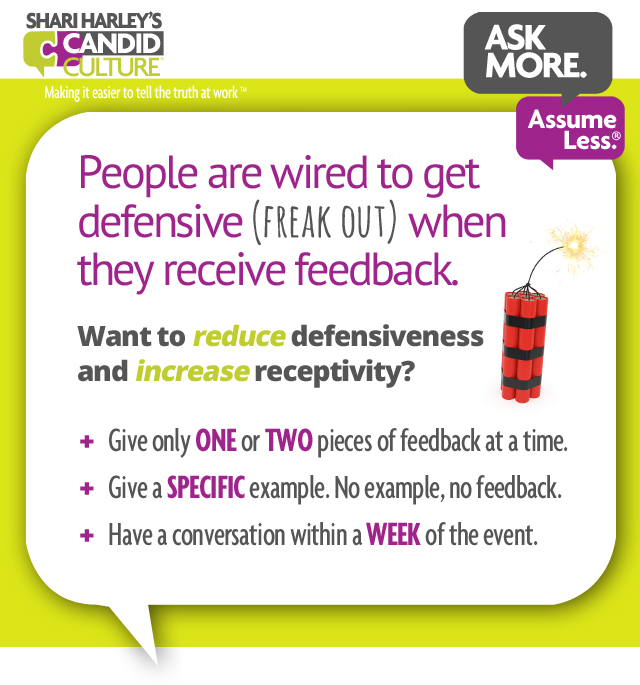
The normal, natural reaction to negative feedback is to become defensive, a response I’ve labeled as The Freak Out.
Everyone, even the people you think do little work, wants to be seen as good – competent, hardworking, and adding value. When anyone calls our competence into question, we get defensive. Becoming defensive is an automatic response that we have to train out of ourselves.
Until the people you work with train themselves not to become visibly defensive when receiving feedback, just expect it. And be happy when you get a defensive response. It means the person is breathing and cares enough about what you’re saying to get upset.
While you can’t get rid of a defensive response to feedback, you can reduce it by following a few feedback practices. Practice these methods of giving feedback and your input will be heard and acted on, more often than not.
Employee feedback practice one: Don’t wait. Give feedback shortly after something happens. But do wait until you’re not upset. Practice the 24-hour guideline and the one week rule. If you’re upset, wait at least 24-hours to give feedback, but not longer than a week. If the feedback recipient can’t remember the situation you’re talking about, you waited too long to give feedback, and you will appear to be someone who holds a grudge.
Employee feedback practice two: Be specific. Provide examples. If you don’t have an example, you’re not ready to give feedback.
Employee feedback practice three: Praise in public. Criticize in private. Have all negative feedback discussions privately.
Employee feedback practice four: Effective feedback discussions are a dialogue; both people talk. When the feedback recipient responds defensively, don’t be thwarted by their reaction. Listen to what they have to say and keep talking. Don’t get distracted.
Employee feedback practice five: Give small amounts of feedback at a time – one or two strengths and areas for improvement during a conversation. People cannot focus on more than one or two things at a time.
Employee feedback practice six: Give feedback on the recipient’s schedule and in their workspace, if you are working in person and the recipient has a door. It will give the other person a sense of control and they will be more receptive.
Employee feedback practice seven: Talk with people – either in person or via phone. Don’t send an email or voicemail. Email is for wimps and will only damage your relationships.
Employee feedback practice eight: Prepare. Make notes of what you plan to say and practice out loud. Articulating a message and thinking about it in your head are not the same thing.
Employee feedback practice nine: Avoid The Empathy Sandwich – positive feedback before and after negative feedback. Separate the delivery of positive and negative feedback, so your message is clear.
Employee feedback practice ten: Offer an alternative. Suggest other ways to approach challenges. If people knew another way to do something, they would do it that way.
You can deal with whatever reaction to negative feedback you get. The other person’s response might make you uncomfortable, but that’s ok. You’ll survive. Try to practice the guidelines above, and if you don’t, and you ‘do it all wrong,’ at least you said something. Just opening your mouth is half the battle. When you come from a good place of truly wanting to make a difference for the other person, and you have both the trust and permission to give feedback, you really can’t go wrong.
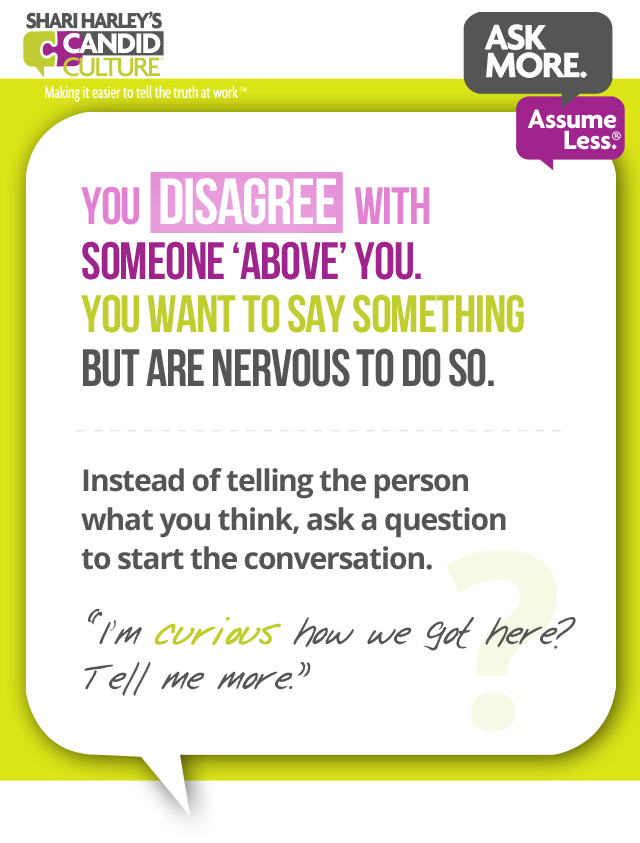
You disagree with something someone above you said or did. How do you tell the person without actually telling him?
Lots of people think they can’t give direct feedback when talking to someone at a higher level. I’m here to tell you that that’s not true. The ability to speak freely has little to do with titles and more to do with the quality of your relationship. When you’re comfortable with people and have mutual trust, you can say (almost) anything, regardless of titles and levels. But that’s not the true purpose of today’s blog. So I’m going to stick to the topic at hand –what to say when you feel like you can’t say very much.
When you don’t have the relationship to say what you really think, manage up by asking a question instead. Engage the person in a conversation. At some point during the conversation, you’ll be able to say what you think.
For example, you question a decision but don’t want to overtly say you question the decision.
Here’s how the conversation could go:
“I wasn’t involved in the conversations to select our new payroll software. Can you give me a little history? What had us choose our current provider?”
“What software features were important when selecting the software?”
“What problem were we trying to solve that drove the need to make a change?”
“What do you like about the software we picked? What don’t you like?”
** Obviously this is meant to be a discussion, not an interrogation. Ask one question at a time and see where the conversation goes. You may ask all of these questions and you may ask only one.
The point is to gather more information. Manage up by seeking to understand before you express an opinion. As the conversation progresses, you might see opportunities to express your point of view.
Here are three suggestions if you’re going to practice the technique of asking questions as a way to manage up and eventually give feedback:
1. When you ask a question, come from a place of genuine curiosity. If you aren’t truly curious and asking questions is just a technique you found in some blog, it will show.
2. Watch your tone of voice. If you can safely add the words “you dummy” to a question, you have a tone issue.
3. Be patient. Asking questions may feel easier than giving direct feedback, but it also takes more patience and time.
As the conversation progresses, you might be asked for your opinion. Before saying what you think, remember, no one likes to be told that s/he is wrong. And the person you’re talking to likely had a hand in making the decision you’re questioning. Be careful not to judge.
Instead of overtly judging, consider saying something like:
“I think the new system has potential and also has some limitations. Do you want feedback as we use the system and get to know it better?”
“What specifically would you like feedback on? What are you not looking for feedback on?”
“What’s the best way to provide input and to whom?”
You can speak more freely when you have the relationship to do so and have permission. Until you have both, earn the right to give feedback by asking questions from a place of genuine curiosity. And only provide your point of view when you’re asked and are certain you have all the information to defend your position.
Companies want people who make things happen. And to make things happen, you have to speak up. Anticipating the train wreck and commenting after the train goes off the tracks doesn’t count.
What if you said what you thought, in a way other people could hear you, when you had the right to do so? Meaning, you have the relationship with the other person to tell the truth and you’ve asked permission to be candid?
6 Courageous Steps to Advance Your Career:
Look for opportunities to make things better.
Ask for permission to take the ball and run with it.
Find a way to say no, while engaging the other person in a conversation so a new approach is generated.
Be willing to go out on a limb, work hard, and fail.
Here’s how to speak up for change without being labeled as the problem person who finds flaws in everything:
Look for and present solutions, not just problems.
Offer to do the work to move towards a better way of doing things. Don’t drop problems at other people’s doors.
Ask questions versus overtly say that something is wrong. That could sound something like, “I’d love to help. Tell me more about how this works. Maybe we can insert a step to make the process better. What do you think of trying ________?” No one likes to be told he’s wrong. Asking questions elicits participation more than overtly saying, “This is broken. We need to fix it.”
Many people are afraid to speak up at work and believe that people who speak up get fired. I haven’t found this to be the case. People who work hard and produce results are typically the last people to be let go.
Say what you think in a way that is not critical. Offer solutions not just problems. Be a force for good and take an active role in making things better. And my hunch is your career will accelerate faster than you ever thought possible.
Covid-19 has shown many of us our edge – working from home for many months, not traveling, missing people we’re used to seeing, and for me, being silent when I would normally speak up.
Earlier in the fall, a friend came to bring my son a birthday present. We hadn’t seen my friend for many months. We visited outside. He didn’t wear a mask, gave Grayson a high five, and then a hug. It seemed like terrible judgment and it happened so fast before I could say anything. Then he went into my house to get a glass of water without wearing a mask while we stayed outside.
I was shocked by all of this. It didn’t seem smart or respectful. And I didn’t say anything. I still haven’t said anything. I could give you ten similar examples of instances in these past months when I was uncomfortable but didn’t say anything – sometimes with people I know, sometimes with people I don’t know.
It feels risky to write this because wearing masks and physical distancing has been so politicized. This blog post isn’t about the coronavirus and anyone’s personal choices. It’s about when we don’t speak up and why.
I think the way to handle potentially tough situations is to anticipate the unexpected and have a setting-expectation conversation before a challenge occurs. What I could have said to my friend, before he visited, was, “We are excited to see you. Let’s stay outside and let’s all wear masks.” I should have set expectations before being confronted with a difficult and awkward situation. Setting expectations is always easier than addressing behavior after it has happened.
Sometimes you can’t anticipate another person’s behavior or how a situation might go. You can’t plan for everything. And telling someone you don’t know in a store, office, or elevator that you’re uncomfortable may feel risky.
Here are four practices for making harder conversations easier and for taking care of yourself when you don’t know what to say:
Anticipate everything that can happen.
Decide how you want to manage situations before they happen.
Set clear expectations before seeing people or going someplace. My son knows that if we go to a park and it’s crowded, we will leave. I tell him this before we go so, he isn’t surprised.
Set boundaries. It’s ok to ask people in line at the grocery store to back up a few feet. “I’m trying to keep a six feet distance. Would you mind stepping back a few feet?” Yes, this likely feels very hard in the moment.
I worry about what people will think of me. I want people to like me. I’m consumed by both of these thoughts way more than you would ever guess. But what’s more important – protecting ourselves and our family or not offending a person in line at the grocery store you’ll never see again?
It needs to be ok to respectfully and kindly speak up on our own behalf. And speaking up starts by opening our mouths and saying what makes us uncomfortable again and again and again.
I want each of my employees to be happy and to enjoy their jobs and enjoy working for me, every day. That can’t and won’t happen, especially right now. Some days are hard. Some are dull. Sometimes I’m fun and easy to work for. Lots of days I’m not.
I had a manager years ago who told me that my need to be liked by my employees would take me down. He was right. Unfortunately, I’m not the only manager with this challenge.
Lots of managers tell me they’re hesitant to give feedback because they’re afraid employees will quit. Other managers do work they know they shouldn’t be doing because they don’t want to burden their employees.
Not every day will be great. And that’s ok. Work is a roller coaster. Some days are awesome. Others are the pits. Your job isn’t to make people happy at every moment, it’s to create a supportive environment and ensure people have the tools to be successful.
My employees have all the tools they need to be successful. I work hard to set clear expectations and give timely positive and upgrade feedback. The rest is up to them. Some days I’m sure they’re happy. Most days, hopefully. And I’m sure there are days that other jobs sound appealing.
Here are five actions to create a positive culture at work:
Office culture tip #1: Set clear expectations at the beginning of every new project and task. The root of frustration and unhappiness is thwarted expectations.
Office culture tip #2: Ask for and be open to feedback from your employees and coworkers. Ask for feedback regularly and work to respond with, “Thank you for telling me that.”
Office culture tip #3: Respond to feedback by changing what it makes sense to change. Giving feedback that is never acted upon creates cynicism and distrust.
Office culture tip #4: Provide a rationale for your decisions. It’s fine to do things the way you want to do them, even if others disagree. Explain your rationale. You’ll get more buy-in.
Office culture tip #5: Don’t be afraid to make decisions that are unpopular. There is a reason that you want to do what you want to do, the way you want to do it. Vet your plans, when appropriate. Be open to others’ input. And then do what you think is right (within the scope of your role).
Your job isn’t to please everyone and trying to do so will likely produce lesser results and be exhausting.
When leaving a job, the late nights and all-consuming projects quickly become history. What we take with us, are the people we worked with and the friendships we formed.
Much of what contributes to job satisfaction or dissatisfaction are our workplace relationships. “I just can’t work with this person. We don’t see eye to eye. We can’t get along,” are the types of challenges that often motivate people to job hunt.
I’m a believer that suffering at work is optional. You deserve and can have a job doing work you love, with people you enjoy. If your workplace relationships are strained, there are several things you can do to improve them.
Four steps to improve workplace relationships:
1. Make a list of the people you need a good working relationship with.
2. If you’re not sure who you need to work well with, ask your boss, peers, and internal customers. They know.
3. Ensure you know what your internal customers are expecting from you. Ask what a good job looks like, how they’re evaluating your results, and how they like to communicate.
4. Tell people you’re struggling with, “I think we both know this relationship is strained. I’d really like a good working relationship with you. Would you be willing to have coffee or lunch with me, and we can talk about what has gone on, and perhaps start in a different way?”
Fixing a broken relationship needs to be a phone or in-person conversation. Sending someone an email, telling him you want a good working relationship, won’t do the job.
Damaged workplace relationships can be fixed. We often don’t know what the other person is really upset about. We may think we know or assume, but may be surprised when we have the conversation.
You spend way too much time at work not to enjoy the people you work with. Don’t assume strained relationships will remain strained. Identify who is most important to your success, tell those people you want a good working relationship, and then ask questions to learn what they are expecting from you. Good relationships don’t just happen.
You have more influence over your relationships than you may think. Don’t accept the status quo. Suffering is optional.
Click here to take advantage of our holiday special. Get everyone in your organization a copy of How to Say Anything to Anyone, and get more peace at work. Buy five books. Get one free. No limit on quantities.







 6 Courageous Steps to Advance Your Career: