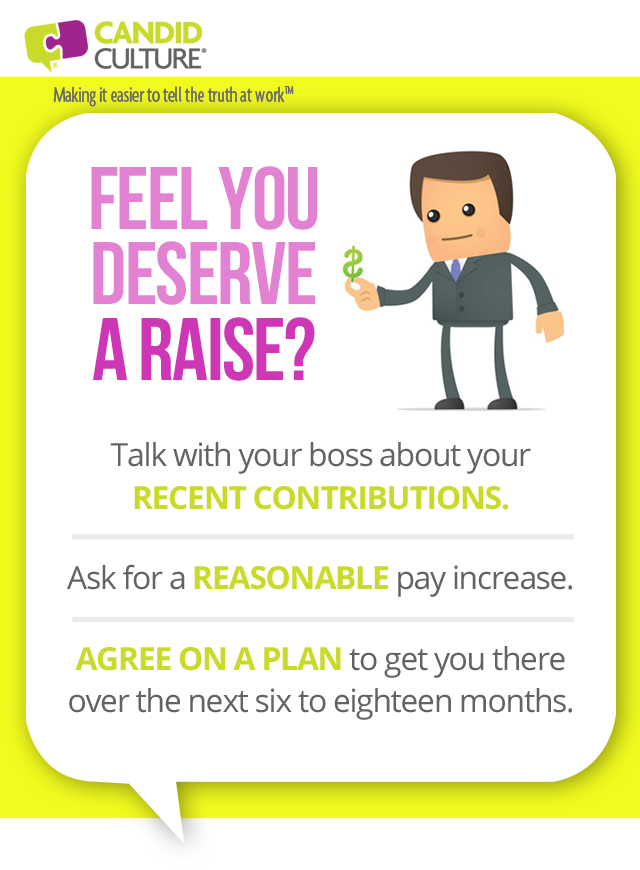
The best way to get your next job is to be great at your current job and ask for more. And the same goes for asking for a raise. Do a great job, make your contributions known, and work with your boss to create a plan to help you get to the salary you want.
Saying or acting as if you’ve been treated unfairly and that your talents aren’t being recognized may be true, but it may also get you the reputation as a negative whiner. People want to work with positive and appreciative people. Demonstrate both when asking for more.
Below are eight steps for asking for a raise:
How to ask for a raise step one: Write down the accomplishments you’re proud of since your last significant pay increase.
How to ask for a raise step two: Find out what your job pays on the open market. Jobs are assigned a value and a pay zone that is often transferable across industries. For example, if an entry level accountant at a big four accounting firm is earning $60,000, the pay zone is likely $50,000 – $70,000. If said employee asks for $64,000, that’s realistic. If they ask for $85,000, they’ll be seen as out to lunch. If an employee wants to earn $85,000, with their current level of education and experience, they’ll have to switch careers.
How to ask for a raise step three: Learn your company’s philosophy on compensation. Companies often deliberately decide to pay in the top, middle, or lower part of pay zones. For example, if an industry like sports or entertainment is glamorous and lots of people want to work in that industry, jobs are likely to pay less. Perhaps a company has great perks and benefits, and in exchange, pays less. Alternatively, some companies want to be known as providing the highest compensation and will pay for it. Knowing where your company falls on the compensation spectrum will help you determine a realistic number to ask for. Your Human Resources representative can answer these questions.
How to ask for a raise step four: Be prepared to present and talk about the impact you’ve made on your organization. Focus on accomplishments and how you’ve changed the business, not on how hard you’ve worked. Results get rewarded.
How to ask for a raise step five: Don’t give an ultimatum, unless you’ve already discussed a pay increase a few times, nothing has changed, and you’re ready to leave. Instead, work with your manager to create a realistic plan to get you to an agreed-upon pay rate. Put the plan, with specific milestones you need to hit, in writing and agree to discuss results quarterly. Managers may be hesitant to promise a future pay increase, but will support written work-related goals, which will help you make the case for a pay increase.
How to ask for a raise step six: Don’t be afraid to ask for a raise. You may not get the raise you want, but nothing bad will happen for asking, providing you do so appropriately. The initial conversation could sound something like, “I love working here and am really enjoying my job. Because of my contributions to our organization, I feel I’m worthy of a pay increase. Can we schedule a time to talk about what might make sense? And with your permission, I’d like to send a list of my most recent accomplishments. Would that be ok?”
How to ask for a raise step seven: Discover who needs to support your pay increase. Your boss may not have the ability or authority to give you an increase. Subtly ask what they can do. That could sound something like, “Who needs to participate in the decision to grant me a pay increase? Is there anything I can do to assist with sharing my accomplishments or making the case for an increase?”
How to ask for a raise step eight: Once you know what your job pays across industries and your company’s philosophy on compensation, ask for a realistic number that will make you happy. If you’re asking for large increase, consider incremental raises over a period of months. Ask for something that’s easy to say yes to.
If you think you deserve a pay increase, don’t be afraid to ask. Ask in a positive way, focusing on the value you’re adding to the business. Be patient and work with your boss to create a plan to get where you want to be. The worse you’ll hear is “no.” And if the answer is no, you’ve planted a seed and opened the door to the next conversation.
No one likes giving people negative feedback. Giving negative feedback often makes both the feedback deliverer and the recipient feel badly. To make everyone feel better, we dress negative feedback up with pickles and relish, otherwise known as The Empathy Sandwich.
The Empathy Sandwich in action: “You’re doing really great. Now you did almost cost the company $50,000, but in general, things are going great.”
The Empathy Sandwich leaves people unclear, wondering if there is a problem. Instead of softening negative feedback with positive platitudes on both ends, tell people you’ll be providing positive and negative feedback as things happen, and then separate both types of feedback.
Giving feedback to people you manage: “As your manager, my job is to help you be successful. As a result, I’ll tell you what I see, as I see it. I’ll give you both positive and upgrade (negative) feedback in a timely way. Because if I don’t, you won’t grow as a result of working with me.”
Paving the way to give feedback to peers and those at a higher level: “We see each other work and are in a unique position to provide each other with feedback. If you see me do something positive or not so positive, I’d like to know. I promise I’ll be receptive.”
Delivering feedback and avoiding The Empathy Sandwich: When you give feedback, separate the positive from the negative. You could say something like, “I want to talk about a few things today. Here are some things that are going well… Now, I also have something to talk with you about that is not going as well… After you deliver the negative feedback, say something like, “I know there is a tendency to dwell on negative feedback. I want to remind you of the positive things we talked about today.”
People can handle negative feedback. They won’t quit if you’re honest about their performance. They will likely become defensive and get upset for a time. That’s ok! Your job when giving feedback is to be clear, timely, and specific. Prepare and practice your delivery out loud. Ensure you have the relationship to deliver the feedback. Don’t worry so much about the response.
Last week we had movers in our warehouse moving products in and out of storage. The movers charged by the hour. Shortly after they arrived, I noticed one of the movers on his phone. Then I noticed another on his phone. I didn’t say anything. The phone use continued. So, I politely asked the two movers to only use their phones when they were on a break. And then I felt badly about saying something and spent the rest of the day apologizing. I didn’t want them to think I was ‘mean’.
I know it was ok to hold them accountable. I was paying a lot of money for their time. It was completely reasonable to expect them to be working. But I want to be liked and approved of (yes, even by the movers who I’ll never see again).
Every time I apologized or sought to justify my message, my communication lost power. Why say anything if I’m going to spend the day regretting and retracting my message?
After the experience with the movers, I realized how often I apologize for making requests, even perfectly legitimate and modest requests. And I’m wondering why I do this? Are we taught it’s not ok to ask for things?
Making requests is a subtle form of giving feedback. It’s less direct than what I call the “tell method.”
It’s ok to have expectations. It’s ok to make requests. And it’s ok to hold people accountable. I know this. You know this. And yet, I see how often I and others apologize for making requests and giving feedback. I feel like we need a regular pep talk – a little bird whispering in our ear each time we ask someone to do what we hired them to do. “It’s ok to ask. You aren’t mean. It’s ok to hold people accountable. If people don’t want to do the work they agreed to or can’t accept feedback, they’re not the right people.”
I’ll just keep giving myself that pep talk, because it’s ok to ask and not feel badly about it.
You receive a meeting request for April 5th. Your calendar is open, so you accept the request. You get asked to visit an out-of-state client on April 12th. Your calendar is open, so you say yes. You’re asked to make a presentation in place of a team member who is out of town, on April 14th. You want to be a team player, so you say yes. And soon what was a relatively slow month is booked with meetings, travel, and other commitments. Mid-month you’re tired, over-extended, and resentful. You want to be a good team member and a responsive professional. How do you do both without feeling tired and resentful?
One of the best pieces of advice I heard many years ago was to decide how to handle something before the situation presents itself. For example, if you’re trying to lose weight and you’re going to an event that will have an amazing buffet, decide what you will and won’t eat before you arrive. Choosing not to eat the desserts will be much easier if you’ve made that decision before the event rather than when you’re standing in front of temptation. Managing commitments and schedules can work the same way.
Before having a child, I worked 80 hours a week and traveled up to six days a week. After having my son, I realized that I didn’t want to keep that kind of schedule anymore. I needed to cut back. So, I created clear and specific boundaries for myself. I decided how many days a month I would travel, by what time I needed to arrive home from a trip, and how many speaking engagements I would commit to each month. When I received speaking requests, I honored my pre-established boundaries. If I was already on the road the maximum number of days, I told myself I would travel, I asked if the client could do a different month and if the answer was no, I turned the work down.
I never deviated from my established boundaries. And when speaking requests came in, the decision-making wasn’t a struggle. I didn’t have to decide if accepting a request would be too much. I’d already made the hard decisions about the schedule I would keep. So, each incoming request either fit into my already-decided-schedule or it didn’t.
I work for myself. I have latitude to make decisions about my schedule that I might not if I still had corporate job. So how do you make and share decisions when you’re not your own boss?
Decide what you want your schedule to look like. How many hours do you want to work a week? What time would you like to start and stop working on most days? How much travel are you willing and able to do? How many meetings can you attend a day and still get your work done, so you’re not working each evening or weekend?
Then communicate your desired schedule to the person you work for. Tell your manager how much travel you would like to do and the hours you would like to work. Then negotiate. You may not be able to maintain the schedule you want all the time, but you certainly won’t if you don’t make your desires known.
The time to tell your manager that you want to reduce your travel is before you’re asked to take a trip, not after. But it’s never too late. If you find yourself too busy or on the road too much, you can always have a conversation and renegotiate.
It’s been two years since I’ve traveled for work or done an in-person speaking engagement. I’m just now accepting speaking engagements that will put me back on the road. And I’ve realized that I need to reset my boundaries. Life has changed in the past two years. I need to re-adjust my commitments to myself. And the time to do that is before the next speaking requests comes in, not after.
Many people worry about giving feedback because they fear they don’t have the ‘right’ words. They’re concerned they’ll say ‘it’ wrong and damage their relationships.
Feedback is hard enough to give without worrying about saying everything perfectly. Worry less about having all the right words and more about whether or not people trust your motives.
When people trust your motives – why you’re giving feedback – you can say almost anything. When they don’t trust your motives, you can say almost nothing.
Getting negative feedback is hard. It’s easier to listen to feedback when we trust the person who’s giving us the feedback – we know their intentions are to help versus to judge or hurt us.
Speak from the heart, be authentic, and worry less. Be yourself. If you’re nervous to say what you want to say, tell the other person you’re nervous. If you’re struggling to find the right words, say so. If you’re worried you’ll damage the relationship or that it isn’t your role to give the feedback, say that. Authenticity goes a long way.
How’s how to give feedback you’re apprehensive about:
How to give feedback example one: Consider saying, “There’s something I need to talk with you about, but I’m concerned that I won’t use the right words and will damage our relationship.”
How to give feedback example two: “There’s something I want to talk with you about, but I’m concerned how it will come across. Is it ok if I say what I need to say?”
How to give feedback example three: “I want to give you my thoughts on something, but I’m concerned that it’s not my place to do so. Is it ok if I share my ideas about _________?”
Other people aren’t expecting you to be perfect. But they do want to know they’re working with a human being. And human beings are fallible. We have fears. We make mistakes. And sometimes we don’t say things perfectly.
You don’t have to be perfect; you just have to be real.
People have a tendency to talk about us, not to us. If you haven’t been gossiped about, you just need to meet more people.
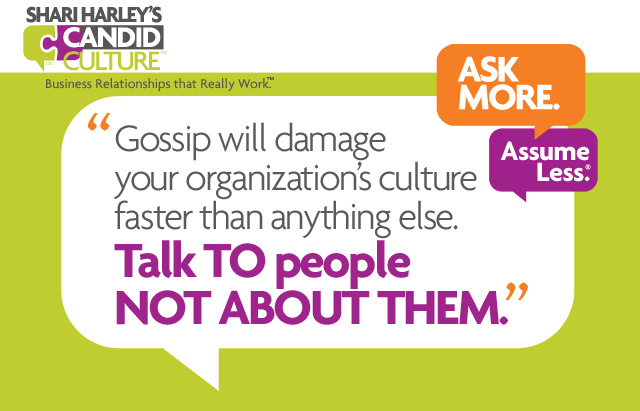
If you have something to say, say it directly to the person involved. If you’re not going to speak to the person directly, say nothing at all. As we all know, this is easier said than done. Gossip will destroy relationships, organizational cultures, and careers faster than anything else. And we are all tempted to gossip.
Most of us consider gossip to be saying something bad about someone else when that person isn’t there. But what if we say something good?
The strictest definition of gossip is talking about another person while she is not present. But for our purposes, let’s say gossip is talking about another person so as to alter how others think about that person.
Several years ago, I took a year-long class with about eighty other people. The class met one weekend a quarter over twelve months and had a few ground rules, one of which was no gossip. Participants couldn’t gossip anywhere, at any time, during the class’s entire duration. No gossip with friends, family, or coworkers for a year.
When the class started, I assumed the no-gossip guideline would be no problem for me. Then I started to notice my behavior. At the time, I was a director in my organization and had one friend at work who was my typical confidant. Most of us have “our person” at work—someone we confide in and complain to. The two of us would sit in my office with the door closed, talking about all the bad decisions the leaders of our company had made. The moment I began paying attention to the no-gossiping rule, I realized that not only did I gossip, but I was good at it and even enjoyed it. (Oh, come on, admit it—it’s fun.)
The problem is that gossiping breaks trust. If a coworker gossips with you about someone else, he will talk about you to someone else. You are not special or different. (Well, you are, but you know what I mean.) You are not exempt.
As you rise in an organization, you have exposure to more and more sensitive information. You know about employees’ performance ratings, the organization’s financial results, and impending layoffs. One criterion of promotion is being able to be trusted with sensitive information. If the senior people in your organization think you’re a gossip and can’t be trusted to keep confidences, your career is going nowhere.
People will never stop gossiping. It’s one of those human things. We all do it, and we aren’t going to quit. The best we can hope for is to reduce the amount of time we spend talking about other people behind their backs.
I won’t suggest you stop gossiping. I merely suggest you bring attention to the gossip circulating throughout your organization. Bringing attention to the gossip circulating in your organization will raise awareness, and reduce the gossip, just a little bit.
** This blog is an excerpt from the book How to Say Anything to Anyone.
It’s the time of year when people start to think about their goals for 2022 and make New Year’s resolutions. I won’t suggest you do either. You likely have enough to do. My only suggestion (in this arena) is to ensure you’re doing what you really want to do.
There are lots of things we need to do and think we should be doing. And it’s really easy to get caught up in that long list of could and should do’s. If that list brings you joy, do those things. If not, consider another path.
I’m pretty sure at least one person reading this blog has a magnet or card hung at their desk with the words, “What are you going to do with your one precious life?” As far as we know, we only get one go around. So, while the question may be overused, what are you going to do to create your life with the time you’re given?
I have an existential friend who is trying to convince me that there is no such thing as time. I am not persuaded. All we have is time, and it’s the only thing we can’t get back. You can gain weight and lose weight, make money and lose it, make friends and lose them, but you can never get back your time. So, what are you doing with your time?
You create your life.
A few questions to consider:
What do you love doing most? How often are you doing that?
What’s most important to you in life? Does what’s most important to you make up a majority of where your time and energy goes?
How much time do you spend doing things you think you should be doing, but don’t really want to be doing?
How much time do you spend doing things someone else wants you to do?
I’m not suggesting you live an indulgent life without compromise. If you’re in relationship with other people, you will, at times, do things you don’t want to do. But I’m hoping that doing things out of obligation is not what your life’s about.
Not everyone in your life will approve of your choices. That’s ok. This is your life. Don’t knowingly harm anyone or anything. Besides that, I don’t know of any rules, except for this, don’t get to the end of the road and wonder “what if.” Create your life.
Read How to Say Anything to Anyone and take charge of your career and life. Holiday offer! Buy 3 books at candidculturepress.com and we’ll send you a 4th book free. Offer ends 1/10/22.
I’m not sure why, I wish I could give you a good reason, but the vague phrases above are what come out of people’s mouth’s first when giving feedback. To prevent giving fake feedback, you have to prepare.
There is a reason you think the person is awesome or has a bad attitude. What did they do that created that impression? Until you can describe what the person did to create an impression, you’re not ready to give feedback. You’re better off saying nothing.
All of the phrases above are opinions with no facts. Opinions are judgments. Feeling judged makes people defensive. When people are defensive, it’s hard to listen.
The purpose of feedback is to help another person. Give the person enough information that they know what to replicate and what to change. Before you give feedback, write down three things the person did that created your impression. If you can’t give an example, wait to have the conversation until you can. It’s better to say nothing than to say something vague and unhelpful.
Vague positive feedback sounds inauthentic. Vague negative feedback is judgmental. Neither strengthens your relationship or are helpful.
If you really want to be heard and you want to be helpful, provide an example. No example, no feedback.
Thanksgiving is coming up. Many people will spend time with family and friends they haven’t seen in a long time. Some people will be indoors with a larger group than they’ve seen in almost two years. And many people are anxious about that.
The time to talk about what everyone needs to feel comfortable at Thanksgiving dinner is now. Don’t wait until Thursday. Consider what you need to feel comfortable and make requests today. Breakdowns are predictable. And what you can predict, you can often prevent.
How many people do you feel comfortable being in the same room and house with? Do all attendees need to be vaccinated? Do you want assigned seating so people sit with people they see regularly? Do you want people to take Covid tests before attending an event? You can likely have whatever you’re willing to ask for. But you likely won’t get what you don’t ask for.
You may be concerned that your requests are too much and thus you’re hesitant to make those requests. If you’re afraid to ask for something, feeling like it’s just too big of an ask, say that. Saying how you feel has a lot of power and is disarming. It could sound something like, “I’m feeling nervous about Thanksgiving dinner. I’ve been hesitant to say anything because I don’t want to offend you. Is it ok if I ask a few questions?”
“I haven’t been in the same room as a group of people I don’t know well in a long time. How many people are coming? What requests are you making of guests from a health and safety perspective? Are you comfortable asking that everyone be vaccinated and take a rapid Covid test before arriving?”
Sprinkle your questions into the conversation. Ask for what you really need. Asking these questions of the host before the dinner is a lot less confrontational than telling a guest they’re sitting too close to you and asking if they’re vaccinated. Thinking through your needs and making requests before an event is always easier than trying to change a situation. The best way to prevent an uncomfortable situation is to talk about it before it happens.
If you want to freak out the people you work with, tell them, “We need to talk.” If you really want to freak them out, say those four magic words on a Friday, or even better, the day before someone goes on vacation. “We need to talk” is rarely followed by, “and you’re awesome.” People know bad news is likely coming, and they’ll inevitably be on edge.
The antidote to asking for time to talk is to create opportunities to give feedback regularly.
There are many reasons giving feedback is hard. One of them is we wait too long. Something happens. We know we should address it, but we don’t want to. So, we wait to see if the behavior is really ‘a thing.’ Then it happens again. And now we know it’s ‘a thing.’ But we still don’t want to address it. Then the situation gets really bad, and now we have to say something. The conversation then takes 90 minutes, is painful, and everyone goes home unhappy.
Here are two keys to make giving feedback easier:
Giving feedback strategy one: Debrief everything. Do a quick plus/delta on a regular basis to assess how things are going. Plus – what went well? Delta – what would we change if we could/what did we learn?
I recommend doing a quick debrief at the end of important meetings, hiring processes, projects, and when anything changes. Conduct a short debrief when you have staffing changes, gain or lose a client, launch or eliminate a product or service, etc. Change is an opportunity to evaluate how you work and to make appropriate adjustments.
When you debrief important events, you tell people that feedback is important and that it’s ok to be candid. Conducting regular debriefs also gives employees a chance to practice giving feedback, which is a hard skill. And like anything, the more we give feedback, the easier it becomes.
Conducting short, regular debriefs is one of the easiest ways to learn from the past and become a more candid culture.
Giving feedback strategy two: Schedule five to fifteen minutes each week to talk as a team or with direct reports. When you know you have time each week to talk with your manager, direct reports, and/or team members, you never have to ask for time to talk. Issues don’t build up or linger. Breakdowns and frustrations are discussed within of few days of their occurrence, and no one is on edge that bad news is coming at their end of their vacation.
The key to being effective at giving feedback is to give feedback regularly. Short, frequent feedback conversations are much more effective than infrequent, long conversations that everyone dreads and leaves feeling exhausted and demoralized.
Debrief everything meaningful. Meet with people weekly. Ask for and give feedback as things happen, and watch your culture change.