If you haven’t had a bad boss yet, just be more patient. He or she is coming. Why do I say that? Because not all managers are great bosses. Many managers don’t provide employees with challenging opportunities, regular feedback, and exposure to different areas of the business.
Too many professionals are waiting for their boss to make their career happen. You might be lucky enough to have a boss who cares about you and helps you advance your career, but you might not. Either way, you deserve to have the career you want and ultimately, it’s your job to advance your career.
How to Advance Your Career Step One: Learn about different areas of your organization and become clear on what you want to learn and to what areas of the business you want exposure.
You won’t know what to ask for from your manager if you don’t know what your organization does and the opportunities that are available. Get to know the leaders and employees in other departments. Find out what they do on a daily basis, the initiatives they’re working on, and their short and long term goals.
How to Advance Your Career Step Two: Ask your manager, your peers and other organizational leaders who you need a good working relationship with and who can influence your next career opportunity.
You never know who talks to whom and who can influence your future opportunities. Department heads you don’t know well talk to other department heads. Don’t assume that because you don’t know someone well that s/he can’t influence your next opportunity or lack thereof.
How to Advance Your Career Step Three: Build and strengthen necessary working relationships and improve your reputation in areas it has been damaged.
You might need to tell a coworker (in person or over the phone, not via email!), “Our relationship is strained. I don’t think I’m saying anything we both don’t know. I would really like a good working relationship with you. If you’d be willing to have lunch or coffee with me and talk about what has gone on, and perhaps we can start anew, I’d really appreciate that.”
Ask for feedback and make necessary changes. Assume others are not aware of the changes you’ve made, so make those changes overt. Tell people who can impact your career, “I’ve received _________ feedback. As a result, I’ve made ___________ changes. I’d really appreciate your continued feedback on the changes I’ve made and other changes I need to make.”
How to Advance Your Career Step Four: Tell people who can influence your career what you want to do.
Don’t assume people know what you want to do in the future. In fact, assume others have no idea about the work you want to do and the things you want to learn. Tell people, “I’m really interested in learning more about ___________. I’d like exposure to __________ part of our organization.”
How to Advance Your Career Step Five: Make it clear that you’re capable of either doing or learning what you aspire to do.
I’ll never forget my first college internship. I was interning for a company that did ropes courses and backpacking trips with at-risk teenagers. During orientation, my boss pointed to a large storeroom and told me that interns were responsible for sweeping the floor and washing sleeping bags and cooking utensils after camping trips. I thought, “I did not take a semester off from school to sweep floors and wash sleeping bags.” I never said that out loud. I simply did other things (that I wanted to do) well, that offered great value to the organization. At the end of the internship, my boss said, “You’re the only intern who has never cleaned the storeroom because you demonstrated you were capable of doing more.”
Your career is your responsibility. Don’t wait for the right boss to make your career happen. Take matters into your own hands. Follow the steps above and get more of what you want at work.
“If you have nothing nice to say, don’t say anything at
all.” Most of us grew up hearing these words. Last week I used them with my
four-year-old son, and instantly regretted it. He said something hurtful to me
and I told him to keep those thoughts to himself.
I want him to keep his thoughts to himself if he doesn’t
like a kid at school or doesn’t want to play with someone. Walk away, find
another place to play, is often my guidance. But with me? With me I want him to
be honest, always, even if it hurts.
Every time we talk with people, we train them how to
interact with us. If I tell my son not to tell me the truth, I teach him to
protect my emotions and stifle his. I teach him I’m not strong enough to handle
the truth and that I’m someone who needs protecting. I teach him that he can’t
be honest with me.
Do I want him to be a kind, empathetic person? Yes. Do I
want him to measure himself with others, watching what he says and how he says
it? Yes. Do I want him to do those things with me? No. I’m the mom. He’s the
kid. And that will always be the case, even when he’s 45. I can take whatever
he has to say. And if I want to have a real relationship with him, he needs to
know that.
Every time we react to what others say, we train them how to
interact with us. If you want your coworkers, boss, family and friends to be
honest with you, make it easy to tell you the truth. Take in what others say
without visibly reacting. Say “thank you” for whatever feedback and input you
get, even when you want to say everything but. Take the time to ‘get over’ hard
messages and then discuss further, when you’re not angry.
People learn quickly. If we react to suggestions, input, and
feedback negatively, people learn that we can’t take challenging data and they
stop giving it to us. I don’t want to be the person the people I care about are
afraid to talk with because my reaction is just too hard to deal with.
Should you care about everyone’s feedback? No. Should you
ask everyone for feedback? No. Should you be open to everyone’s feedback? No.
Be open to feedback from the people who matter most to you. Open your heart and
your mind. Close your mouth. Even when you want to do everything but.
Strengthen your relationships and train people that you can handle the truth.
Note: I know this blog is not what my weekly tip said it
would be about. I write the weekly tips before the blog and this blog just went
a different direction. Everything I write is inspiration driven. I’ll write
about the courage to speak up in a future week.
We’ve all heard the expression, “it doesn’t hurt to ask.” But
what if it can and does?
While it’s true that you won’t get what you don’t ask for,
it’s also true that requests help form others’ impressions of us. Some asks may
seem high maintenance and create the impression that we’re difficult to work
with. Other requests may create the impression that we’re out of touch or entitled.
Be brave in what you ask for but also be judicious and aware of how requests
may impact others.
So, what shouldn’t you ask for at work? That’s a hard question
to answer. What’s appropriate in one environment may not be ok in another. I’ll
provide some guidance for most work environments below.
Don’t ask for anything that requires your boss to break the
rules or treat you differently from other employees. This may seem obvious, but
I’ve been asked for things that I couldn’t legally provide. A candidate asked
me to write her a monthly check towards her personal health insurance plan versus
her participating in our company-sponsored health insurance plan. It’s an
innocent request but put me in a very awkward position and I said no.
Here are a few do’s and don’ts to follow when making requests:
Don’t ask for or take time off during the busiest times of
the year. Ask your boss what those busy times are and then plan accordingly.
Don’t ask for exceptions unless you’re desperate – being paid
in advance to cover unforeseen personal expenses, time off you haven’t earned, unless
It’s regularly permitted in your company, using company resources for personal
use. All of these may seem acceptable in the moment, but if they make your boss
bend or break the rules, they’ll likely make you look bad too.
Be brave. Be bold. And be careful what you ask for. Your reputation is more important than a request that feels important right now but will be insignificant by next year.
My four-year-old son Grayson likes to narrate. He gives instructions
to people he doesn’t know, tries to be “helpful” and keeps everyone informed.
Today we rode a miniature train Grayson has ridden many
times. He has the instructions memorized. “Keep your arms and legs inside the
train. Stay seated while the train is in motion, etc. etc.” While we were
waiting to ride the train he informed everyone standing in line of the rules. The
other parents were patient and indulged him, smiling and asking questions. When
we got on the train Grayson continued to give instructions, and I became
embarrassed. Self-conscious that my son
was irritating other passengers, I told him to be quiet. He looked at me and wisely
asked, “Why are you shushing me?” And then I was even more embarrassed.
He was right to ask. Why, indeed, was I shushing him?
Before I had children, I always hoped my child would be one
of those kids who wore superhero costumes everywhere, who didn’t care what anyone
thought, who was unabashedly himself. And I wondered, at what age do kids
become self-conscious? When do they begin to lose this level of self-expression?
And then I had one answer, when adults tell them to.
I imposed an old ‘rule’ on my son, “children are meant to be
seen and not heard.” Sit quietly. Don’t stand out and don’t inconvenience others.
Where are you sitting silent, stifling your views? What do
you know a lot about, but keep your skills or expertise under wraps? When do
you have a solution or a better way to approach a problem, but you don’t share?
Share your ideas. Do it in a way that doesn’t tell others they are wrong. It’s ok to have the answer. You can be right without being righteous. It’s ok to speak up.
No one likes
giving people negative feedback. Giving negative feedback often makes both the feedback
deliverer and the recipient feel badly. To make everyone feel better, we dress negative
feedback up with pickles and relish, otherwise known as The Empathy Sandwich.
The Empathy
Sandwich in action: “You’re doing really great. Now you did almost cost the
company $50,000, but in general, things are going great.”
The Empathy Sandwich
is plain wrong, wrong, wrong. It leaves people unclear, wondering if there is a
problem. Instead of softening negative feedback with positive platitudes on
both ends, tell people you’ll be providing positive and negative feedback as things
happen and then separate both types of feedback.
Here’s
how you can set the expectation that you’ll be providing balanced feedback:
Giving
feedback to people you manage: “As your manager, my job is to help you be successful. As a
result, I’ll tell you what I see, as I see it. I’ll give you both positive and upgrade
(negative) feedback in a timely way. Because if I don’t, you’ll learn nothing
from working with me.”
Paving
the way to give feedback to peers and those at a higher level: “We see each other work and are in a unique position
to provide each other with feedback. If you see me do something really great or
not so great, I’d like to know. I promise to be receptive.”
Delivering
feedback and avoiding The Empathy Sandwich: When you give feedback
separate the positive from the negative. You could say something like, “I want
to talk about a few things today. Here are some things that are going well… Now,
I also have something to talk with you about that is not going as well… After you
deliver the negative feedback, say something like, “I know there is a tendency to dwell on
negative feedback. I want to remind you of the positive things we talked about
today.”
People can
handle negative feedback. They won’t quit if you’re honest about their performance.
They will likely become defensive and get upset for a time. That’s ok! Your job
when giving feedback is to be clear, timely and specific. Worry about your
delivery. Ensure you have the relationship to deliver the feedback. Don’t worry
so much about the response.
You’ve heard countless times that you never get a second chance to make a first impression. So when something not-so-positive happens – a customer is upset, you missed a deadline, or made an error – don’t let your boss find out about it from someone else. Manage your professional reputation and get there first to create the first impression of what happened.
Managers don’t like surprises. If your manager is going to get a call about something that isn’t positive, let her know before the call comes in. You will create her perception of the situation, and perceptions are hard to change. Don’t wait for the s*** to hit the fan. Get ahead of the problem by coming forward and giving your manager and other stakeholders a heads up.
It could sound something like this, “I just had a tough conversation with John in IT. You may get a call. Here’s what happened… I didn’t want you to be surprised.”
Or, “I told Brian at Intellitec that we’re raising our prices in the second quarter. He wasn’t happy. You may get a call.”
Or let’s say you’re going to work on a strained relationship. Tell your manager before you take action. It could sound something like this, “I want to work on my relationship with Julie. Our relationship has been strained since we worked together on the software project last year. I’d like to approach her, tell her that I know our relationship is strained, and that I’d like a good working relationship with her. Then I’d like to ask if she’s willing to have lunch with me, talk about what’s happened, and see if we can start again in a more positive way. What do you think of me doing that? Would you approach the conversation differently? I don’t know how it’s going to go, so I wanted you to know what I’m planning to do, just in case it backfires and you get a call.”
Manage your professional reputation assertively by taking responsibility for mistakes, working on damaged relationships, and telling your manager before someone else does!
No one likes to make mistakes. We want to do good work and have people think well of us.
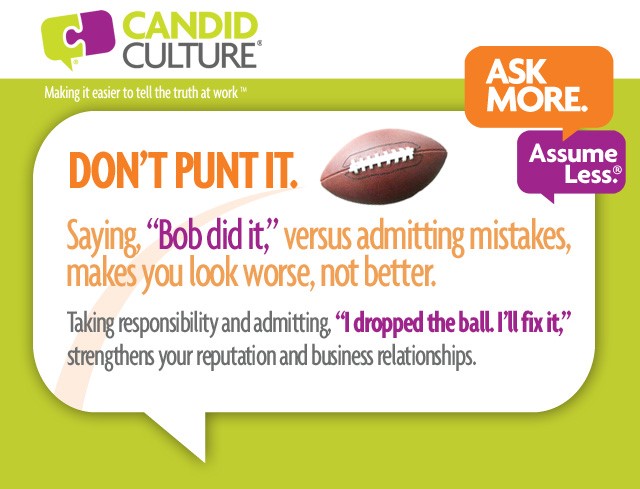
The key to maintaining your relationships and reputation, when you make a mistake, is to take responsibility and make things right as soon as possible. Saying something wasn’t your fault or becoming defensive will only damage your reputation and relationships. As counterintuitive as it sounds, you will gain respect and credibility by admitting fault and correcting problems.
I often get asked if people lose credibility by being humble – asking for feedback and admitting to making mistakes. It takes strength to ask for and be open to feedback and to admit when you drop the ball. So while it may seem counterintuitive, the more you ask for and respond to feedback, and admit when you make mistakes, the stronger you will appear.
I made a mistake at work. Now what?
When you make a mistake say something like:
“I dropped the ball on that. I apologize. I’ll fix it and let you know when it’s been handled.”
Or, “Thank you for the feedback. This clearly didn’t go as planned. I’ll make those changes and let you know when they’re done.”
Also, let people know the steps you’ll take to avoid similar challenges in the future.
You could say something like:
“Thanks for letting me know that our process is causing your department challenges. We certainly want the process to be smooth. My team will fix this month’s report, so your team doesn’t have to invest more time. We’ll update the process for next month and walk you through the changes before the report is due.”
Don’t provide a bunch of reasons for breakdowns. No one cares. Telling people why something occurred can sound like excuse management. People just want to know things will be made right.
Asking for feedback, taking responsibility, and telling people how you will correct errors may not be your natural or first reaction. The more you can train yourself to do these things, the easier you will be to work with and the better your reputation and business relationships will be.
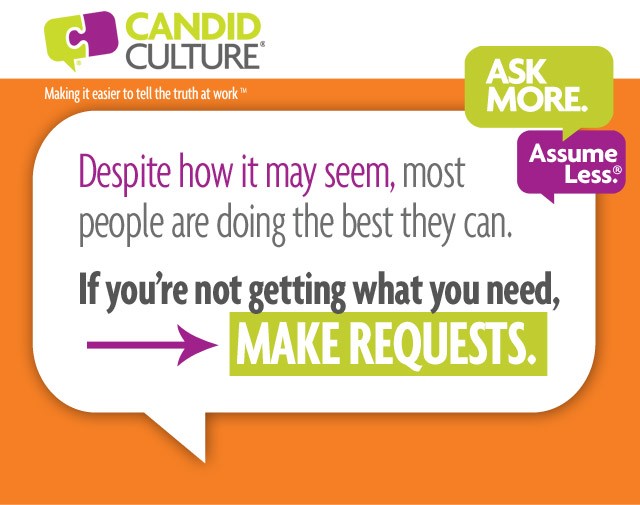
The people you work with want to do a good job. They want you to think well of them. Yes, even the people you think do little work. Give people the benefit of the doubt. Assume people are doing the best they know how to do. And when you don’t get what you want, make requests.
There are two ways to give feedback. One way is very direct.
Version one: “You did this thing and here’s why it’s a problem.”
The other way is less direct. Rather than telling the person what went wrong, simply make a request.
Version two: “Will you…” Or, “It would be helpful to get this report on Mondays instead of Wednesday. Are you able to do that?”
It’s very difficult to give feedback directly without the other person feeling judged. Making a request is much more neutral than giving direct feedback, doesn’t evoke as much defensiveness, and achieves the same result. You still get what you want.
When I teach giving feedback, I often give the example of asking a waitstaff in a restaurant for ketchup. Let’s say your waiter comes to your table to ask how your food is and your table doesn’t have any ketchup.
Option one: Give direct feedback. “Our table doesn’t have any ketchup.”
Option two: Make a request. “Can we get some ketchup?”
Both methods achieve the desired result. Option one overtly tells the waiter, “You’re not doing your job.” Option two still tells the waiter he isn’t doing his job, but the method is more subtle and thus is less likely to put him on the defensive.
You are always dealing with people’s egos. And when egos get bruised, defenses rise. When defenses rise, it’s hard to have a productive conversation. People stop listening and start defending themselves. Defending oneself is a normal and natural reaction to negative feedback. It’s a survival instinct.
You’re more likely to get what you want from others when they don’t feel attacked and don’t feel the need to defend themselves. Consider simply asking for what you want rather than telling people what they’re doing wrong, and see what happens.
I will admit, asking for what you want in a neutral and non-judgmental way when you’re frustrated is very hard to do. The antidote is to anticipate your needs and ask for what you want at the onset of anything new. And when things go awry, wait until you’re not upset to make a request. If you are critical, apologize and promise to do better next time. It’s all trial and error.
Being in the wrong job feels terrible. It’s not unlike being in the wrong romantic relationship, group of friends, or neighborhood. We feel misplaced. Everything is a struggle. Feeling like we don’t fit and can’t be successful is one of the worst feelings in the world.
The ideal situation is for an underperforming employee to decide to move on. But when this doesn’t happen, managers need to help employees make a change.
The first step in helping an underperforming employee move on to something where s/he can be more successful is to accept that giving negative feedback and managing employee performance is not unkind. When managers have an underperforming employee, they often think it isn’t nice to say something. Managers don’t want to hurt employees’ feelings or deal with their defensive reactions. In fact, when we help someone move on to a job that she will enjoy and where she can excel, we do the employee a favor. We set her free from a difficult situation that she was not able to leave out of her own volition.
I get asked the question “How do I know when it’s time to let an employee go?” a lot.
They can’t. Even with coaching and training, they don’t have the ability to do what you’re asking.
Numbers one and two are coachable. With the right training and coaching, employees will likely be able to do what you’re asking them to do.
Numbers three and four are less coachable and are likely not trainable.
When you’re confronted with someone who simply can’t do what you need them to do, it’s time to help the person make a change.
The way you discover whether or not someone can do something is to:
Set clear expectations
Observe performance
Train, coach, and give feedback
Observe performance
Train, coach and give feedback
Observe performance
Train, coach and give feedback
Welcome to management.
After you’ve trained, coached, and given feedback for a period of time, and the person still can’t do what you’re asking her to do, it’s time to make a change.
Making a change does not mean firing someone. You have options:
Take away responsibilities the person can’t do well and give him other things that he can do well.
Rotate the person to a different job.
Firing someone is always a last resort.
Sometimes we get too attached to job descriptions. The job description outlines a specific responsibility that the person can’t do. So we fire the person versus considering, who else in the organization can do that task? Be open-minded. If you have a person who is engaged, committed, and able to do most of her job, be flexible and creative. Give away parts of the job to someone who can do them well. I’ve also seen employees who were failing thrive in a different job. Organizations that are flexible survive; organizations that are rigid do not.
Let’s say you’ve stripped away the parts of the job that an underperforming employee can do well, and she still can’t perform effectively. Now it’s time to make a change.
Here are some words to use when having the difficult “it’s time to move on” conversation:
“I really want you on my team and to be successful in our organization. Over the past six months, we’ve had several conversations about the parts of your job that are a struggle. We’ve taken away responsibilities that aren’t a fit for you and have replaced those responsibilities with things that seemed like a better fit. And yet I can see that you are still struggling. I’m very sorry to say that it’s not appropriate for you to continue working here. Today is your last day.” Depending on your organizational culture, can also say, “How do you want to handle this? You can resign or we can let you go. I’ll do whatever feels more comfortable for you.”
This is a difficult conversation that no manager wants to have. Yet I promise you, this conversation feels better to your employee than suffering in a job in which s/he can’t be successful. After you’ve set expectations, observed performance, and coached and given feedback repeatedly, letting someone go is kinder than letting the employee flounder in a job in which he cannot be successful.
You will be passed over for jobs, projects, and opportunities – personally and professionally. People will choose not to buy from you and they’ll choose not to be your friend and romantic partner. And that’s ok. Not everyone is our right “customer.” The key isn’t to win every opportunity. Rather, it’s what we do when we don’t get what we want.
When you’re done feeling disappointed, mad, and frustrated, get curious. Find out why you were passed over. I’ll never suggest you make changes. I simply want you to know what’s standing in your way, so you have power – the power to choose. Eliminate your business blind spots.
All of us have blind spots – things we do that are off-putting to others, that we’re not aware of. For the most part, people won’t tell us our business blind spots, instead, they simply pass us over. Being rejected is feedback, it’s just not specific enough to help us make different choices. If you want to be able to change your behavior, you need to know what behaviors are standing in your way. Then you can choose what, if anything, to do about those behaviors.
When you get turned down for an opportunity, practice these strategies to eliminate your business blind spots:
Allow yourself to have an emotional reaction, to feel disappointed, and to grieve the loss.
When your emotions dissipate, call people who can tell you why you were turned down, and ask for feedback. The goal of the conversation: Eliminate your business blind spots.
Be humble and open.
Consider saying something like, “Thank you so much for considering me/us to support your needs. We were disappointed not to win your business. Would you be willing to share what had you choose a different provider and what we could have done differently to be a stronger candidate? I’ll be grateful for anything you’re willing to tell me.”
Depending on the circumstances, you could also say something like, “I wasn’t put on the _______ project. I wonder if you have any information as to why? I appreciate anything you’re able to tell me. Your input will help me grow and eliminate my business blind spots.”
Regardless of what you hear, thank the person for the feedback. You can ask for additional information and ask who else you can talk with, but don’t become defensive. The less defensive you get, the more feedback you’ll get. Make it easy to tell you the truth (as the other person sees it).
Remember, information is power, and power is control. Many people don’t give direct feedback because they’re afraid of the other person’s reaction. Surprise people by being open to feedback, and eliminate your business blind spots.
Validate feedback that doesn’t feel right to you. If you’re not sure what someone told you is accurate, vet the feedback with other people you trust. Simply ask other people who are aware of your performance, “I received this feedback. Does that resonate with you?”
Sit with the feedback for a few days before taking any action.
When your emotions have passed, decide what – if anything – you want to do with the input you’ve received. Perhaps you want to make changes. Perhaps you don’t. Either way, you have more power than you did before you received any input.
You won’t win them all. The key isn’t avoiding rejection, it’s what you do when you don’t get what you want. Be brave. Be open. Ask for feedback. And you’ll have the power to make different choices next time, if you want to.










 You’ve heard countless times that you never get a second chance to make a first impression. So when something not-so-positive happens – a customer is upset, you missed a deadline, or made an error – don’t let your boss find out about it from someone else. Manage your professional reputation and get there first to create the first impression of what happened.
 It could sound something like this, “I just had a tough conversation with John in IT. You may get a call. Here’s what happened… I didn’t want you to be surprised.”
 she’s willing to have lunch with me, talk about what’s happened, and see if we can start again in a more positive way. What do you think of me doing that? Would you approach the conversation differently? I don’t know how it’s going to go, so I wanted you to know what I’m planning to do, just in case it backfires and you get a call.”

 Being in the wrong job feels terrible. It’s not unlike being in the wrong romantic relationship, group of friends, or neighborhood. We feel misplaced. Everything is a struggle. Feeling like we don’t fit and can’t be successful is one of the worst feelings in the world.