Need to give negative feedback? Practice out loud. The words you say in your head while driving to work will not be what comes out of your mouth when you give the actual feedback. Ask a friend, family member, or even your pet (aka someone you don’t work with) to listen to you deliver the feedback. If people outside of your industry and organization understand the feedback, the feedback recipient will be clear, too.
Giving feedback is stressful for both the person giving the feedback and the feedback recipient. The best way to manage the stress of giving feedback is to be prepared.
Here are three ways to prepare for difficult feedback conversations:
Write out the feedback, save your notes, and walk away. Read your notes later and ask yourself, “Have I been clear?” Then see if you can cut the notes in half. Shorter feedback is better.
Practice out loud. Use our 8- step Feedback Formula as a guide. The Formula will ensure you give clear, specific, and succinct feedback without emotion.
Bring type-written notes to your feedback conversations. When the feedback recipient becomes defensive (and they will) or you become flustered (and you might), your notes will help you keep the conversation on track.
During every feedback training I teach, I am asked how to reduce feedback recipient’s defensiveness. Defensiveness is a normal, healthy response to feedback. When you give someone negative feedback, you (subtly) tell the person they did something wrong. No one wants to hear that, so the brain goes on the defensive. It’s a normal survival mechanism. Instead of avoiding and dreading defensiveness during feedback conversations, prepare for it. And the best way to prepare is to practice what you want to say out loud. Speaking a message is not the same as practicing the conversation silently in your head. Speaking out loud is more stressful and takes more time. So, if a conversation is particularly difficult or awkward, practice out loud!
I’d like to give a huge shout out to Angela Fusaro of Physician 360 for sharing this video with us. Angela practiced my eight-step Feedback Formula on her dog, Thor. I thought it was so funny and thought you would, too.
Figuring out if a candidate will like and can do a job is fairly straight forward, figuring out if a candidate will like working in your organization is much harder.
A clear and specific job description should tell a candidate whether or not a job’s responsibilities are things she can and wants to do. What’s much harder to determine is whether or not the candidate is a good culture fit with the organization. Will she be comfortable working with the organization’s employees and in the organization’s culture, and will other employees be comfortable working with her? It’s hard to figure that out during a 60 or 90-minute conversation, during which both interviewers and interviewees are on their best behavior.
Some companies use personality assessments to assess culture fit. Others have lots of people meet with candidates. I’m fond of the job shadow interview, which very few companies do.
If you’re really serious about a candidate, why not invite her to spend a day or a half day in your office participating in a job shadow interview. Candidates can attend meetings, have lunch, hang out in the break room and hallways, and meet fellow employees during the job shadow interview. Candidates and employees are more likely to let their guard down and be themselves outside of a formal job interview. You want to know the person you hire as well as possible. You don’t want to hire someone who turns out to be very different once she actually starts.
Hiring and training new employees is the most costly thing most businesses do, so slow down and invest more time. Before you make a candidate an offer, ask the candidate if she would be willing to spend half a day in your office participating in a job shadow interview. That invitation could sound something like, “We really like you and think you’d be a great fit. Before we make you an offer, we wonder if you’d be willing to spend an afternoon (or a day), sitting in on some meetings and job shadowing a potential peer. Would you be interested in doing that?”
Candidates, you’re interviewing and assessing an organization just as the people in the organization are interviewing and assessing you. You won’t be successful or stay in a job very long if you don’t feel at home in the culture. If a hiring manager makes you an offer and you are seriously considering it, ask to job shadow interview for a half or full day. That request could sound something like, “Thank you so much for the job offer. I’m very excited about the possibility of working for you! I want to be sure that I’m a great fit and vice versa. How would you feel if I spent a morning or afternoon attending a few meetings and job shadowing someone on the team? This will give me an even better sense of the organization and make sure this is a great decision for both of us. What do you think?” I can’t imagine any employer outside of those working on government, classified information saying no.
Taking the wrong job and hiring the wrong candidate is costly. Slow down and make better hiring decisions by giving candidates a chance to experience your culture with a job shadow interview, when people aren’t on their best behavior. You’ll make better hiring decisions and save lots of time and money in the process.
The people you live and work with are hesitant to give you negative feedback. They’re afraid you’ll freak out, and they don’t want to deal your freak out. It’s easier to say nothing.
When I started teaching how to give and receive feedback, I provided elaborate explanations as to the predictable response to feedback and the rationale for that response. Now I’ve boiled the natural response to receiving feedback into three words: The Freak Out.
Every person you know – personally and professionally – wants to be liked and approved of. Even the people in your office who you think are lazy want you to think they do good work. And when anyone calls another person’s competence into question, that person is likely to freak out (become defensive).
It’s very difficult not to get at least a little bit defensive when receiving feedback. A defensive response often sounds something like, “Thanks for the telling me that. Can I tell you why I did it that way?” The problem with that slightly defensive response is that what the other person hears is, “You’re not listening. I am wasting my time talking to you.” Then the conversation quickly ends. People want to feel heard. And when the feedback recipient becomes defensive, the person giving feedback doesn’t feel heard.
Don’t feel badly about becoming defensive when you receive negative feedback. Becoming defensive when receiving bad news just means you’re a living, breathing human being with feelings. That beats the alternative. But The Freak Out scares people. They don’t want to deal with your mild, moderate, or very defensive reactions.
Because people want to avoid The Freak Out, they keep negative feedback to themselves, or worse, tell someone else. If you want more truth, you need to make it clear there won’t be negative repercussions for speaking up.
Here are seven steps to get others comfortable giving you negative feedback:
1. Ask for feedback.
2. Be specific about the type of feedback you want.
3. Tell the person from whom you’re asking for feedback when and where she can observe you in action.
A bad example of asking for feedback: “I really want your feedback. Feel free to give it anytime.” This is too vague and doesn’t demonstrate seriousness on your part.
A good example of asking for feedback: “I really want your feedback on the pace of the new-hire-orientation program. Will you sit through the first hour next Wednesday at 9:00 a.m. and tell me what you think of the pace and why?” This request tells the person specifically what you want and demonstrates you’re serious about wanting her feedback.
4. When you receive feedback, say, “Thank you for telling me. I’m going to think about what you’ve said and may come back to you in a few days to talk more.”
5. Don’t respond to negative feedback immediately. Walk away instead of responding.
6. If you’d like more information or want to tell the person you disagree with what she said, wait until you’re calm to have that conversation. That can be minutes or a few days later.
7. You can express a counterpoint of view, you just can’t do it immediately after you receive the feedback.
No matter what a person’s role in your life – your boss, a peer, external customer, or even spouse – it takes courage to give you feedback. When a conversation requires courage, the speaker’s emotions are heightened. If the feedback recipient’s emotions rise in response to the feedback, conversations escalate. This is how arguments start. If you want to put the other person at ease and get more feedback in the future, do the opposite of what she is expecting. Rather than getting even the slightest bit defensive, do the opposite. Say, “Thank you for the feedback. I’m sorry you had that experience. I’m going to think about what you’ve said, and may come back to you to talk more.” Then walk away.
Walking away, when all you want to do is react, is very difficult. Walking away will require a good deal of self-control, but the rewards are great. You will build trust, strengthen your relationships, and get more information than you have in the past – information you need to manage your career, reputation, and business.
It’s hard to watch people do things that damage them – personally or professionally. And yet, if they haven’t asked for feedback, people likely won’t listen to unsolicited advice, so don’t bother giving it.
If you really want to give unsolicited advice, ask for permission and make sure you get a true “yes” before speaking up.
The conversation could go something like this:
“I noticed we’re getting behind on the XYZ project. I have a couple of ideas about what we can do. Would you be interested in talking about them?” Or, “That Monday meeting is rough. I feel for you. I used to run meetings like that. Would you be interested in talking about some meeting management strategies? I’d be happy to share what I’ve learned.”
After you offer to talk (aka, give your opinion), listen and watch the response you get. Do the person’s words and body language portray a true “yes, I’d like your opinion” or what seems like an “I know I’m supposed to say yes, but I’m really not interested” reply? If you get the latter, you’re likely just giving unwanted advice that won’t be heard. If that’s the case, let it go. But if the person appears generally interested and open, proceed.
You could also say something like:
“Last week we were talking about your frustrations about not being promoted. I have a couple of ideas about that. Do you want to talk about them? Either way is fine, but I thought I’d offer.”
Or, “That was a tough conversation during today’s staff meeting. It’s hard to present ideas and not have them be embraced. I have a couple of thoughts about ways you can approach the conversation during the next meeting. Do you want to talk about them?”
If you extend the invitation to talk, the other person has to be able to say no. An invitation is only an invitation if “no” is an acceptable answer. You can’t ask if the person wants your input and then keep talking if he verbally or physically said no.
Be brave. If you care about someone personally or professionally and you see him doing something that gets in the way of his success, ask permission to say something. If you get the go ahead, proceed. If you get a “no thank you,” accept that and move on. You’ve done your part.
Employees leave managers not jobs. We’ve all heard this 100 times.
One of the most prevalent reasons for employee turnover is boredom and lack of growth. We’ve also heard this many times.
We know why employees leave jobs. The question is what must managers do to engage and retain their best people. The answer is actually quite simple, although possibly not easy to execute.
In other words, employees need attention, and attention requires time – time many managers may not feel they have.
Here is a five-step formula for employee retention and employee engagement:
Get to know employees better and differently.
Have meaningful, one-on-one meetings [at least] monthly.
Give feedback every time you meet.
Ask for and be open to feedback.
Create opportunities for employees to do the work that interests them most.
Managers, how do you make time for these meetings when you are busy and have several direct reports?
Meet for 15-30 minutes.
Meet over the phone while commuting or waiting for flights.
Ask direct reports to create an agenda and run the meetings.
Ask direct reports to send follow-up notes of decisions and plans made during meetings. Give some of the accountability away.
If meetings get cancelled, reschedule as soon as possible. Direct reports take cancelled meetings personally. Cancelled meetings that are not rescheduled send the message that managers don’t care about employees and their careers.
Employees, if your manager doesn’t schedule meetings with you:
Ask permission to put a monthly meeting on your manager’s calendar.
Provide rationale for why you want to meet – to get your manager’s feedback and ensure you’re focused on the right work.
Ask permission to reschedule meetings when they get cancelled.
Don’t take cancelled meetings personally.
Offer to meet with your manager via the phone when it’s convenient for him/her. Leverage commute and travel time.
Employees need time with their managers. Meaningful discussions and work result in employee engagement and employee retention. So managers, make the time, even when you don’t feel you have it. Ask questions you don’t ask now. Give feedback, even if it’s uncomfortable. Give your employees an opportunity to do the work that interests them most. And watch your employee engagement and employee retention improve. And if your manager doesn’t do these things, politely and persistently ask. You won’t get what you don’t ask for. We are all 100% accountable for our careers.
Concerned about something happening in your workplace? Don’t just tell someone about the problem, propose a solution. It’s fine to raise challenges. It’s better to raise challenges you’re willing to do something about. If you think two departments don’t talk to each other, bring them together. If you think a process is inefficient, propose a different way to get the work done. If you’re dissatisfied with software you’re using, offer to source three potential vendors and set up a demo. You’re doing the legwork and asking for a small investment of time.
When we ask for something at work, our request often requires time, money, or both. Thus when an employee asks for something, it’s easier for a manager to say no than it is to say yes. “No” requires no work and no financial outlay. A “yes” may require both.
You make it easy to say yes to requests when you’re acting as a change agent:
Propose a solution to a problem.
Offer to do the work to solve the problem.
Ask for small things that are easy to approve.
If you’re overwhelmed and want to hire an additional person, but your boss isn’t convinced you need the headcount, ask for a temp for a finite number of hours. It’s much easier for a manager to say yes to a small and known investment amount than to the long-term commitment of hiring someone new. The point is to ask for something that is easy for your manager to approve.
The word “pilot” is your friend. If you want to make a major change, pilot a scaled down version of your proposed solution in one or two locations, rather than in your organization’s 10 locations. Again, asking for something small makes it more likely that you’ll be told yes.
The bottom line is to be part of the solution – as trite and overused as that phrase is. Don’t be the person who says, “That’s broken” without also saying, “and here’s how we can fix it. Can I give it a try?”
Posted under Career Management on May 12, 2019 by Shari Harley. 2 Comments
Last week some unknown person sent me emails predicting my future. According to the anonymous clairvoyant, in ten years my life will be going well. I’ll have a second child who is amazingly athletic, and I will be offered a job in Oshkosh that I shouldn’t take. After the third predictive email, the sender wanted to know if I had questions about my future. I didn’t.
The whole thing was wildly creepy.
No one should take advice from someone with this much discretionary time. The emailer needs a volunteer job.
Why would I want someone else to tell me my future? That’s something I enjoy creating.
I see myself as 100% responsible for everything that happens to me. As antithetical as it sounds, life is easier when I’m accountable. If I miss a plane because of traffic, I should have left for the airport earlier. If I get overcharged in a restaurant, I should have checked the bill more carefully. If I do a bunch of work for a client and later find out that the work I did isn’t what the client really wanted, I should have asked more questions upfront and asked for feedback earlier.
When I’m responsible for what happens to me, I have some control. When someone else is responsible, I have no control.
Instead of seeking answers about what might happen, pursue the things you want. If you want a different job in your organization, tell someone who can do something about it. If you got passed over for a job, ask the hiring manager for feedback of what would have made you a better candidate. If the hiring manager doesn’t give you any information, ask your current boss to get the information for you. If one of your co-workers excludes you from projects, ask him why. If someone you work with seems to dislike you, ask for feedback about what you did to damage the relationship. Regardless of how challenging the situation and how disappointing the results, there is ALWAYS something you did to either contribute to the situation or something you can do to change the situation.
I don’t mean to tell you what to do. Nor do I mean to minimize how hard some life circumstances are. But I do want you to see yourself as in charge of what happens to you.
Create the life you want by:
Asking, “What do I really want, and what’s one thing I can do right now to get closer to that goal?” Then take one step. Then take one more, and so on.
If negative things are happening, ask, “What could I have done differently to have a different outcome?” Or, ask, “If I could do this over again, what would I do differently?” Then next time, do it differently.
Regardless of how hard or bad something is, there is ALWAYS something you can do to make the situation better. Take your life, your career, and your relationships into your own hands where they belong.
Vague communication is unhelpful. Being vague instills doubt in the people around you and reduces your credibility.
When a customer service agent answers my questions with words like, “That sounds right, I think so, or that should work,” I hang up and call back, hoping to get someone who can give me an affirmative answer. People do this to you, too…they just don’t tell you about it.
Watch your language. If the answer is yes, say “Yes.” If the answer is no, say “No.” “I think so,” says neither yes nor no. Saying, “I think so” tells people you don’t really know.
A few phrases to avoid and what to say instead:
Avoid: “That should be done by Friday.”
Instead, be specific and give a final date. “That will be complete by Friday. If I can’t get it done by Friday, I’ll call you to let you know by 5:00 pm on Thursday.”
Avoid: “Sounds right.”
Instead, be specific and say, “That’s correct.”
Avoid: “We should be able to do that.”
Instead, be specific and say, “We can do that.”
Avoid: “I guess.”
Instead, be specific and say, “Yes” or “No.”
When I teach feedback training, the biggest thing training participants struggle with is specificity. “You’re difficult to work with.” “Your clothing is inappropriate.” “I just find you to be negative.” “You did a good job on that.” “It’s a pleasure to have you on the team.” All of this is vague and thus unhelpful to the feedback recipient. And the same is true when answering questions and making promises.
Tell people exactly what to expect. Be specific. Even if they don’t like your answer, they’ll be happy to have a clear answer.
When the people we work with don’t do their jobs, we might find ourselves saying, “He should be more on top of things.” “She shouldn’t make commitments she can’t keep.” “He doesn’t know what he’s doing, and that’s not my problem.” The challenge is, when your coworkers don’t perform, it is your problem.
When your coworkers don’t get you the information you need in a timely way, you miss deadlines. When you work from incorrect information, your reports are wrong. When others don’t work with you, you look bad. So you can be right all day about how others perform, and your reputation will still be negatively impacted.
I don’t suggest you enable your coworkers by doing the work others don’t. I do suggest you help your coworkers be successful by holding them accountable.
Here are a few things you can do to manage your career and get what you need from your business relationships:
Don’t assume others will meet deadlines. Check in periodically and ask, “What’s been done so far with the XYZ project?” Notice, I didn’t suggest asking, “How are things going with the XYZ project.” “How are things going” is a greeting, not a question.
Set iterative deadlines. If May 20th is your drop-dead deadline, ask to see pieces of work incrementally. “Can I see the results of the survey on May 5th, the write-up on May 10th, and the draft report on May 15th?” One of the biggest mistakes managers and project managers make is not practicing good delegation by setting iterative deadlines and reviewing work as it’s completed.
Don’t just email and ask for updates. The people you work with are overwhelmed with email, and email is too passive. Visit people’s offices or pick up the phone.
You might be thinking, “Holding my coworkers accountable is awkward. I don’t have the formal authority, and I don’t want my coworkers to think I’m bossy or damage my business relationships.”
It’s all in the how you make requests.
If you’ve seen me speak or have read the business book How to Say Anything to Anyone, you know I believe in setting clear expectations at the beginning of anything new. That could sound something like, “I’m looking forward to working with you on the XYZ project. How would you feel if we set iterative deadlines, so we can discuss work as it is completed? You’ll get just-in-time input, making any necessary adjustments as we go, and we’ll stay ahead of schedule. How does that sound? How are the 5th, 10th, and 15th as mini deadlines for you?”
Many people put large projects off until the last minute. People procrastinate less when large projects are broken into smaller chunks with correlating deadlines. You strengthen your business relationships and support people in meeting deadlines and not procrastinating when you agree on completion dates when projects begin. Also, most of us unfortunately know what it’s like to put a lot of work into a project, have someone review our completed work, and then be told we went down the wrong path and need to start over.
Ask more. Assume less. Don’t assume your coworkers will do what they’re supposed to do. Ask upfront to see pieces of work on agreed-upon dates. Pick up the phone versus rely on email to communicate, and know that the people you work closely with are a reflection of you. Get people working with you, and everyone will look good.
People are drowning in data, more specifically in email. If you want people to read your communications, send short emails and fewer of them.
How often do you open an email, see its daunting length, close the email promising you’ll get back to it later, but don’t? Then you bump into the sender a week later and he asks, in an annoyed tone, “Did you get my email?” And you attempt to conjure up the email, distinguishing it from the 1,500 emails you’ve received since.
Some people like receiving lots of information, others don’t. Ask your internal and external customers how much information they want to receive, in what format, how frequently, and with how much detail. And when you can, accommodate their preferences.
I’m a big picture person. For me, more information is not necessarily better. I’ll read five bullets. I won’t read five paragraphs. I’m frequently guilty of opening a long email, becoming overwhelmed, deciding I don’t have time to read the entire message, promising to read it later, and by the time I go back to the message, I’ve typically missed a deadline.
You can say it’s my problem that I don’t read long emails, not the sender’s problem. And you’d be right. I should read every email I get in full. But when I don’t give the sender something she needs because I was overwhelmed by the length of her email, it becomes her problem, too. If you want people to respond and do what you’re asking, communicate how they like to communicate whenever possible.
I’d like to say that people are so used to reading short text messages and Facebook and Twitter updates that they’ve been trained not to read anything longer than a few sentences. And there may be something to that. But the truth is, there are detail people who like a lot of data and there are big picture people who don’t. If you provide a high level summary – just what recipients need to know – followed by more details or information on where more details can be found, you accommodate both the detail and the big picture people.
When you write your next email or any other type of communication, consider: Could this be said with fewer words? Do the recipients want or need this level of detail? Then, shorten your communications and accommodate both the big picture and the detail people. And you’ll be amazed at how quickly you receive the things you’re asking for.
And if that’s not working, go old school and use our greeting cards to write a note, because no one can resist a handwritten note.



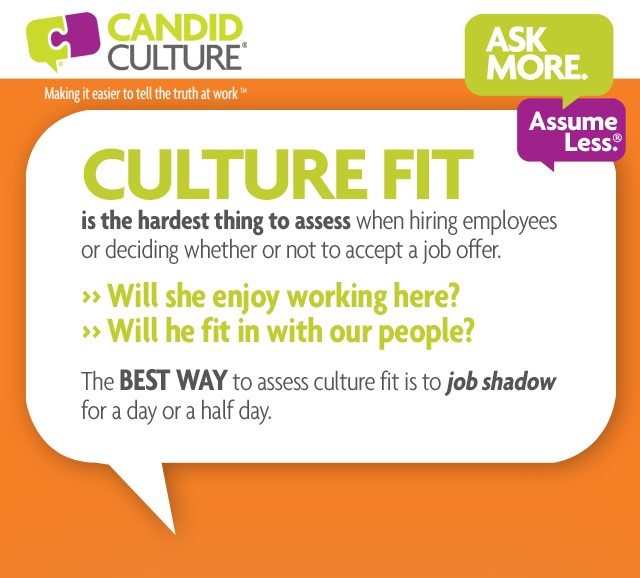 Figuring out if a candidate will like and can do a job is fairly straight forward, figuring out if a candidate will like working in your organization is much harder.
 The people you live and work with are hesitant to give you negative feedback. They’re afraid you’ll freak out, and they don’t want to deal your freak out. It’s easier to say nothing.
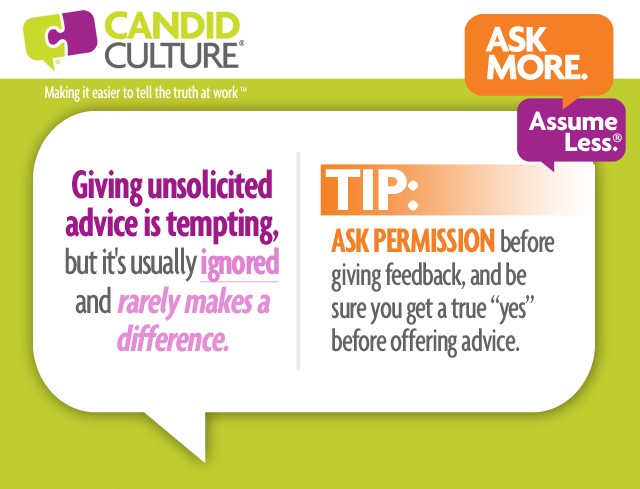 It’s hard to watch people do things that damage them – personally or professionally. And yet, if they haven’t asked for feedback, people likely won’t listen to unsolicited advice, so don’t bother giving it.
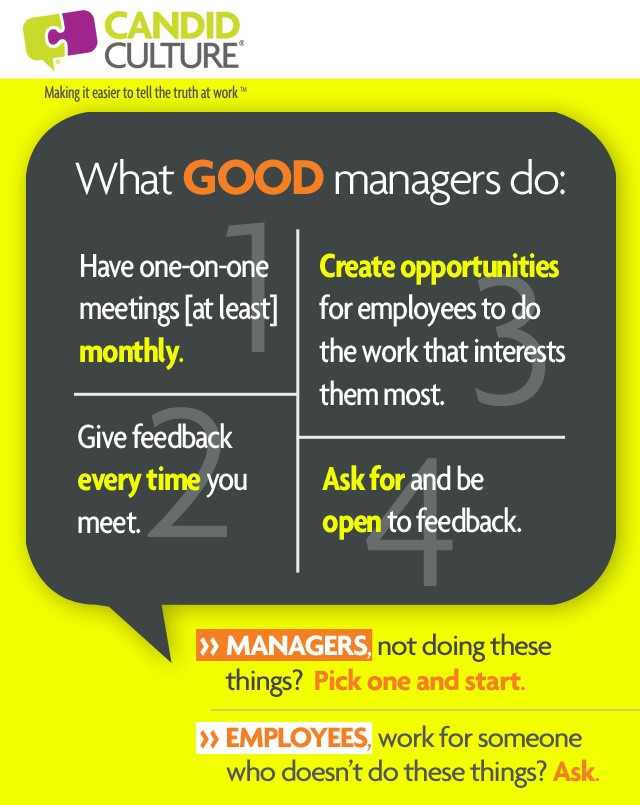 Employees want to know that their manager:
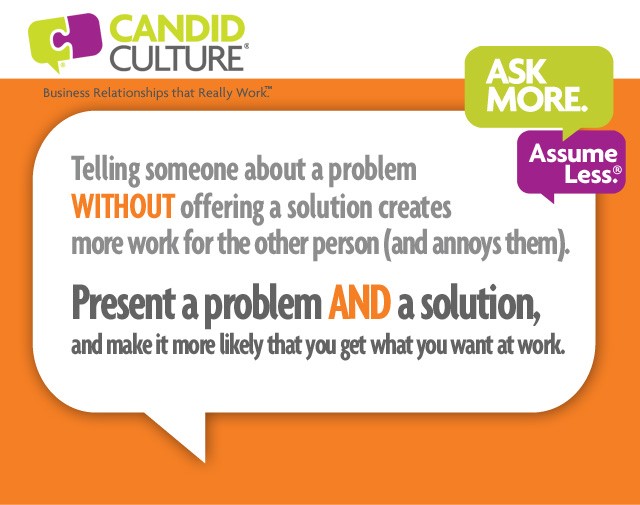 Concerned about something happening in your workplace? Don’t just tell someone about the problem, propose a solution. It’s fine to raise challenges. It’s better to raise challenges you’re willing to do something about. If you think two departments don’t talk to each other, bring them together. If you think a process is inefficient, propose a different way to get the work done. If you’re dissatisfied with software you’re using, offer to source three potential vendors and set up a demo. You’re doing the legwork and asking for a small investment of time.
 Last week some unknown person sent me emails predicting my future. According to the anonymous clairvoyant, in ten years my life will be going well. I’ll have a second child who is amazingly athletic, and I will be offered a job in Oshkosh that I shouldn’t take. After the third predictive email, the sender wanted to know if I had questions about my future. I didn’t.
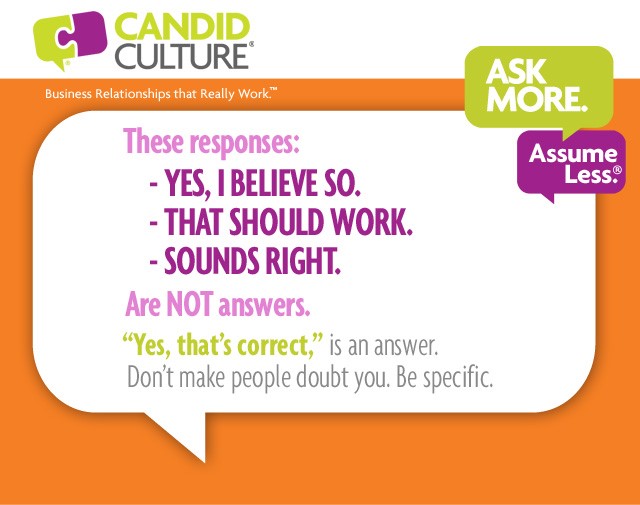 Vague communication is unhelpful. Being vague instills doubt in the people around you and reduces your credibility.
 When the people we work with don’t do their jobs, we might find ourselves saying, “He should be more on top of things.” “She shouldn’t make commitments she can’t keep.” “He doesn’t know what he’s doing, and that’s not my problem.” The challenge is, when your coworkers don’t perform, it is your problem.
 People are drowning in data, more specifically in email. If you want people to read your communications, send short emails and fewer of them.