I’m embarrassed how often I do things I don’t want to do because I’m afraid of looking bad. I agree to things I don’t want to do. I even suggest doing things I don’t want to do, because I think it will look bad if I don’t. Then I have deep regrets.
If I’m aware of this practice, why do I keep doing it, over and over and over? I suspect the need to look good and be liked is so pervasive, it over-powers reason and self-talk. Telling myself, “Don’t do it. You will regret this,” doesn’t help. The need for approval is all-powerful (to me).
My old boss told me many years ago, “Your need to be liked will kill you as a manager,” and he was right. It’s why I can’t interview my own candidates. I want them to like me too.
I suspect I’m not alone here. I lot of us say yes when we want to say no. We extend ourselves and regret it later.
What can be done, at an organizational level, to prevent ourselves and fellow employees from over-extending?
Sanction, at a team and organizational level, that sometimes it’s ok to say no.
Try saying, “Here’s what I can do…” or “Here is what we will do” when you don’t want to say “no”.
Suggest that at times people take 24-hours before agreeing to take on a new task or project. Pause before committing.
Make room for negotiation, so people can say yes on terms that work for them.
Speak your truth and know that it’s ok to set boundaries. Boundaries prevent burnout.
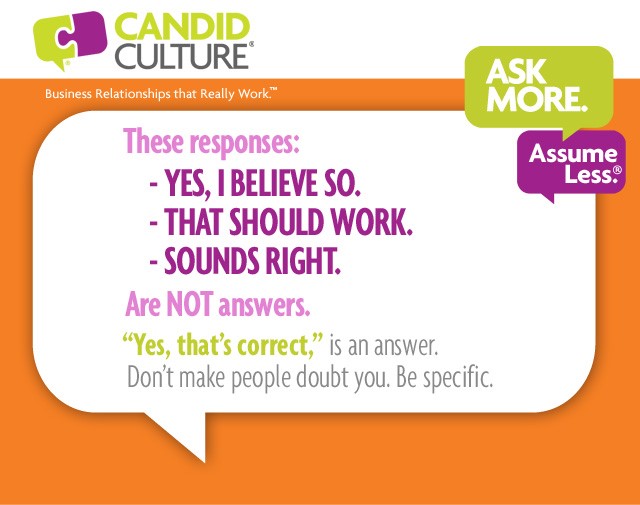
When a customer service agent answers my questions with words like, “That sounds right, I think so, or that should work,” I hang up and call back, hoping to get someone who can give me an affirmative answer. People do this to you too; they just don’t tell you about it.
Vague communication is unhelpful. Being vague instills doubt in the people around you and reduces your credibility.
Pay attention to your language. If the answer is yes, say “Yes.” If the answer is no, say “No.” “I think so,” says neither yes nor no. Saying, “I think so” tells people you don’t really know.
A few phrases to avoid and what to say instead:
Avoid: “That should be done by Friday.”
Instead, be specific and give a final date. “That will be complete by Friday. If I can’t get it done by Friday, I’ll call you to let you know by 5:00 pm on Thursday.”
Avoid: “Sounds right.”
Instead, be specific and say, “That’s correct.”
Avoid: “We should be able to do that.”
Instead, be specific and say, “We can do that.”
Avoid: “I guess.”
Instead, be specific and say, “Yes” or “No.”
When I teach feedback training, the biggest thing training participants struggle with is specificity. “You’re difficult to work with.” “Your clothing is inappropriate.” “I just find you to be negative.” “You did a good job on that.” “It’s a pleasure to have you on the team.” All of this is vague and thus unhelpful to the feedback recipient. And the same is true when answering questions and making promises.
Tell people exactly what to expect. Be specific. Even if they don’t like your answer, they’ll be happy to have a clear answer.
It’s not unusual to wait too long to give feedback. Giving feedback often feels awkward and uncomfortable. What happens if the person cries, or gives us the cold shoulder, or worse, quits?
Working virtually over the past few years has exacerbated the waiting. Many managers who were accustomed to giving feedback in person hesitated to have hard conversations over the phone or via video.
Perhaps you waited so long to give feedback, you feel like you can’t.
It’s never too late. You just need to set the expectation that you’re going to give feedback and why. And know that anything you can say in person, you can say via video or phone.
One of the keys to being (more) comfortable giving feedback is to know that most people genuinely want to know how they’re doing. Working in the dark is frustrating. Not knowing the behaviors that impact us and our opportunities is also frustrating. Working on a project for months only to find out the work we did wasn’t what the other person wanted is ultimately frustrating.
Most people genuinely want feedback. They may struggle to hear feedback, they may get defensive, they may not take responsibility, but it doesn’t mean they don’t want to know.
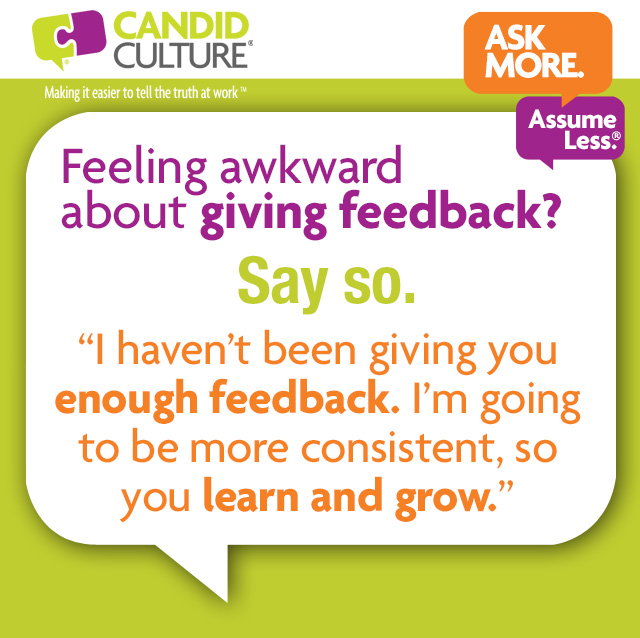
If you want to give feedback but feel like you waited too long, say so. The conversation could sound like this:
Manager to direct report: “I realized that I haven’t been giving you enough feedback. I’d like to start doing a semi-monthly debrief, not because anything is wrong or has changed. I want you to learn and grow as a result of working with me, and you won’t if I’m not providing regular feedback”
Peer to peer: “I need to talk with you about something and I’ve realized that I’ve waited too long. As a result, I’m feeling awkward and hesitant. Is it ok if I speak freely?”
Talking with someone more senior than yourself: “I want to talk with you about something I’ve been seeing for a while. I should have said something sooner. I’m sorry I didn’t. Can I talk with you about it now?”
It’s ok if you waited too long. It’s ok not to say things perfectly. Authenticity goes a long way. Be real. If you’re nervous, say so. If you’re wondering if it’s ok to speak up, say so. If you waited too long, say so. Relationships are built on trust, and authenticity builds trust. The time to start is now.
It’s not unusual to ask who is at fault when mistakes in an organization are made. We want to know who was to blame. Before asking who is accountable for a mistake, I’d ask what lead to the mistake. Was the error a people or a process issue?
If a document with mistakes is shared with people outside of an organization, there is a process issue.
Yes, someone made a mistake. Someone wasn’t careful or knowledgeable enough to catch the error. But if a document’s accuracy is important, more than one person should be looking at that document before it leaves the organization. When only one person looks at an important document, there is a process issue.
Processes include: The practices followed and the tools used when creating, proofreading, saving, and storing work.
William Ury, author of the negotiation books Getting to Yes and Getting Past No, said, “Be easy on the people and hard on the process.” When mistakes happen, evaluate the processes surrounding that work. What allowed the mistake to go out the door unchecked? Would a different process with more checks and balances and more eyes on the work have prevented the error?
After evaluating the processes or lack thereof, coach the person who made the mistake. Fill the gap that allowed the mistake to happen, but first, evaluate your processes.
Who have you fired lately? The person who cuts your hair or lawn? A doctor, accountant, or restaurant where you had a bad experience? Did you call any of those providers and tell them why you were replacing them? My hunch is no. There’s little incentive to do so. Why risk their defensiveness? It’s easier to just replace them. And the same is true for you.
There’s little incentive for the people you work with to tell you when you frustrate them. The perceived cost seems too high. The people you work (and live) with have experienced others’ defensive responses to negative feedback (which is no fun) and they don’t want to experience your reaction. As a result, when you disappoint or frustrate others, it’s easier to say nothing than tell you the truth.
The tendency for others to tell you things are fine when they’re not, will prevent you from managing your career and relationships. People will go missing and you’ll be passed over for professional opportunities and never know why.
To make it more likely that people will tell you when you disappoint or frustrate them, make it easy to tell you the truth.
Here are seven practices for receiving feedback:
Receiving Feedback Practice #1: When you begin new relationships, tell people you want their feedback.
Receiving Feedback Practice #2: Promise that no matter what people say, you’ll respond with “thank you.” This is very hard to do.
Receiving Feedback Practice #3: Tell people you already have relationships with, that if you haven’t said it in the past, you really want their feedback and promise to respond graciously with “thank you.”
Receiving Feedback Practice #4: Ask people who matter to you for feedback regularly.
Receiving Feedback Practice #5: Resist the urge to get defensive.
Receiving Feedback Practice #6: Catch yourself when you start to become defensive and apologize. Say something like, “I’m getting defensive. I’m sorry. Tell me again. I’ll do a better job of listening.”
Receiving Feedback Practice #7: Take a break from conversations during which you find yourself responding defensively. Say something like, “I’m not responding as well as I’d like. How about we take a break? Give me a few minutes (hours or days) and I’ll come back to you to talk more. I really want to hear what you have to say.”
The aforementioned list provides recommendations for asking for and receiving feedback you want, not feedback you don’t. You are not a dumping ground. Don’t ask for feedback you don’t want. And when you do ask for feedback, qualify what type of feedback you’re looking for. Telling people “I want your feedback” doesn’t mean they’re welcome to say whatever they want.
The purpose of asking for feedback and making it safe to tell the truth is to give you more control over your career and relationships. It’s ok to be passed over for opportunities and relationships, but it’s unhelpful not to know why.
I had a colleague at my last job, prior to starting Candid Culture, who was a peer and a friend. We were at a similar level and would periodically sit in one of our offices, with the door closed, talking about the bad decisions our company’s senior leaders made. One day I realized that these conversations were exhausting to me. They were negative and didn’t make me feel better. In fact, they made me feel worse.
Some people distinguish between office gossip and venting, asserting that venting is cathartic and makes people feel better. It doesn’t. Venting and office gossip are one in the same and both will make you tired and feel worse about your job and organization.
I’ll use an analogy from one of Deepak Chopra’s books. When you put a plant in the closet and don’t give it light or water, it withers and dies. When you put a plant in the sunlight and water it, it grows. And the same is true for people. Wherever you put your attention will get bigger and stronger. Whatever you deprive attention will become smaller.
In addition to draining you of energy and ensuring you focus on the things that frustrate you, office gossip destroys organizations’ cultures. If employees can’t trust that their peers won’t talk about them when they’re not there, there is no trust in the organization. And this lack of trust feels terrible. It makes employees nervous and paranoid. A lack of trust sucks the enjoyment out of working because we feel we have to continuously watch our back.
Office gossip isn’t going anywhere. It’s a human phenomenon and is here to stay. But you can reduce office gossip.
Here are five steps to reduce the office gossip in your workplace:
Reducing gossip in the workplace step one: Address the gossip head on.
Tell your employees, “I’ve been hearing a lot of gossip, which is not good for our culture.”
Reducing gossip in the workplace step two: Hold regular town hall meetings, and give employees more information than you think you need to about initiatives, organizational changes, profitability, etc. Employees want to know how the organization is doing. In the absence of knowledge, people make stuff up, not because they’re malicious, but because they have a need to know. Employees don’t have to fill in the gaps with office gossip when you inform them.
Reducing gossip in the workplace step three: Create a no-gossip-in-the-workplace practice and give employees the skills to have direct conversations.
Tell your employees, “We want people talking directly to each other, rather than about each other. As a result, we’re putting a no-gossip practice in place.” Then train employees throughout the organization how to give feedback that strengthens versus damages relationships.
Reducing gossip in the workplace step four: Draw attention to gossip.
Perhaps suggest, “Every time you hear gossip, wave two fingers in the air (or something else that’s equally visual).” This will draw attention to office gossip without calling anyone out.
Also, ask your peers and friends not to gossip with you. End conversations that contain gossip. This will be hard to do, but if everyone does it, it will become much easier.”
Reducing gossip in the workplace step five: Have an agreed-upon consequence for gossip.
Tell employees, “Every time we hear gossip in the workplace, the gossiper owes a dollar. Dollars go towards company happy hours and social events.”
The keys to reducing office gossip are to draw attention to the gossip, have a consequence for gossiping, and over communicate so your employees don’t have to fill in the gaps themselves.
Venting and office gossip are the same. If you’re talking about someone else and you’re not planning a conversation with a coworker or friend to address a challenge or problem, you’re gossiping. And talking about what frustrates you will only make you more frustrated.
My advice: Do something about the things you can impact and let the other stuff go. Talk about the things that matter to you. Resist the temptation to speak negatively about the people around you. And know that anyone who will gossip about someone to you, will also gossip about you.
The purpose of feedback isn’t to teach people a lesson, it’s to elicit certain behavior. Below are six strategies for giving helpful and succinct upgrade feedback:
Write down your message. Save it as a draft. Re-read it later, when you’re not emotional, then cut the words in half. Shorter is better.
Remove emotion. Examples are helpful, emotion is not. Emotion: You embarrassed me. Example: You raised your voice at me in front of others.
Remove judgments. Vague words are judgmental. Judgment: Your behavior was unacceptable. Specific: You rolled your eyes at a coworker.
When you can deliver your message in about a minute, without emotion or judgment, you’re ready to speak.
Deliver all upgrade feedback in a private setting, behind a closed door.
Then, let it go. When the conversation is over, it’s over. Don’t stay angry or remind the person of the situation. If the behavior is repeated, discuss it then.
Say only what you need to. Deliver messages privately. Protect the person’s ego, which is fragile. Let people save face.
This week’s blog is an excerpt from my book How to Say Anything to Anyone: A Guide for Building Business Relationships That Really Work. I hope it helps you have the conversations you need to have!
1. Introduce the conversation. Ask for time to talk, ensure the conversation is private, and it’s a good time for the feedback recipient.
2. Share your motive for speaking so both the feedback provider and the recipient feel as comfortable as possible.
3. Describe the observed behavior so the recipient can picture a specific, recent example of what you’re referring to. The more specific you are, the less defensive the listener will be, and the more likely they’ll be to hear you and take corrective action.
4. Sharing the impact or result describes the consequences of the behavior – what happened as a result of the person’s actions.
5. Having some dialogue gives both people a chance to speak and ensures the conversation is not one-sided. Many feedback conversations are not conversations at all – they’re monologues. One person talks and the other person pretends to listen, while thinking what an idiot you are. Good feedback conversations are dialogues during which the recipient can ask questions, share their point of view, and explore next steps.
6. Make a suggestion or request so the recipient has another way to approach the situation or task in the future. Most feedback conversations tell the person what they did wrong and the impact of the behavior – only rarely do they offer an alternative. Give people the benefit of the doubt. If people knew a better way to do something, they would do it another way.
7. Building an agreement on next steps ensures there is a plan for what the person will do going forward. Too many feedback conversations do not result in behavior change. Agreeing on next steps creates accountability.
8. Say “Thank you” to create closure and to express appreciation for the recipient’s willingness to have a difficult conversation.
If you’re giving more than one piece of feedback during a conversation, address each issue individually. For example, if you need to tell someone that they need to arrive on time and also check their work for errors, first go through the eight steps in the formula to address lateness. When you’ve discussed an agreement of next steps about being on time, go back to step three and address the errors. Talk about one issue at a time so the person clearly understands what they are supposed to do.
Here’s how a conversation could sound, using the eight-step Feedback Formula:
Before I started Candid Culture, I had a coworker who was a lingerer. Lisa would hover outside my office until there was an opportunity to interrupt. Lisa then walked in uninvited and started talking. I was still mid-thought about whatever I’d been working on and wasn’t ready to listen. After a few sentences, I would interrupt Lisa, saying, “I’m sorry. I don’t know what you’re talking about. Will you please start over?”
Embarrassing as it sounds, this went on for more than a year. I wanted to be seen as accessible and open, yet this “lingering” method of interrupting was driving me crazy. And it was a waste of both of our time. After many months of frustration, I decided to use The Feedback Formula.
Step One: Introduce the conversation.
“Lisa, I need to talk with you. When do you have about ten minutes of uninterrupted, private time?”
Step Two: Share your motive for speaking.
“There is something impacting me and our working relationship.”
Step Three: Describe the observed behavior.
“I’ve noticed that when you want to talk to me you stand at my door, waiting for a good time to interrupt. When you come into my office, you’re often in the middle of a thought or problem that you’ve probably been thinking about for a while.”
Steps Four and Six: Share the impact or result of the behavior and make a suggestion or request for what to do next time.
“Because I’m in the middle of something completely different, it takes me a few seconds to catch up. By the time I have, I’ve missed key points about your question, and I have to ask you to start over. This isn’t a good use of either of our time.
“Here is my request: When I’m in my office working and you need something, knock and ask if it’s a good time. If it is, I’ll say yes. Give me a few seconds to finish whatever I’m working on, so I’m focused on you when we start talking. I’ll tell you when I’m ready. Then start at the beginning, giving me a little background, so I have some context. And if it isn’t a good time for me, I’ll tell you that and come find you as soon as I can.”
Step Five: Have some dialogue. Allow the recipient to say whatever they need to say.
“What do you think?”
Step Seven: Agree on next steps.
“Okay, so next time you want to talk with me, you’re going to tap on the door and ask if it’s a good time to talk. If it’s not, I’ll tell you that and come find you as soon as I can. If it is a good time, you’re going to give me a second to finish whatever I’m working on and give me some background about the issue at hand. Does that work for you?”
We have just managed “the lingerer”—a challenge you probably have, unless you work from home 100% of the time or in a closet.
You may have noticed that I changed the order of The Feedback Formula during this conversation. It’s not the order of the conversation that’s important. It’s that you provide specific feedback, offer alternative actions, and have some dialogue before the conversation ends.
Summary: Effective feedback is specific, succinct, and direct.
Provided you have a trusting relationship with someone and have secured permission to give feedback, there is very little you can’t say in two minutes or less. The shorter and more direct the message, the easier it is to hear and act upon. Follow the eight-step Feedback Formula. Be empathetic and direct. Cite specific examples. Give the other person a chance to talk. Come to agreement about next steps. Remember, you do people a favor by being honest with them. People may not like what you have to say, but they will invariably thank you for being candid.
This week’s blog is an excerpt from my book How to Say Anything to Anyone: A Guide for Building Business Relationships That Really Work. I hope it helps you have the conversations you need to have! Be candid. You can do it!
No one likes giving people negative feedback. Giving negative feedback often makes both the feedback deliverer and the recipient feel badly. To make everyone feel better, we dress negative feedback up with pickles and relish, otherwise known as The Empathy Sandwich.
The Empathy Sandwich in action: “You’re doing really great. Now you did almost cost the company $50,000, but in general, things are going great.”
The Empathy Sandwich leaves people unclear, wondering if there is a problem. Instead of softening negative feedback with positive platitudes on both ends, tell people you’ll be providing positive and negative feedback as things happen, and then separate both types of feedback.
Giving feedback to people you manage: “As your manager, my job is to help you be successful. As a result, I’ll tell you what I see, as I see it. I’ll give you both positive and upgrade (negative) feedback in a timely way. Because if I don’t, you won’t grow as a result of working with me.”
Paving the way to give feedback to peers and those at a higher level: “We see each other work and are in a unique position to provide each other with feedback. If you see me do something positive or not so positive, I’d like to know. I promise I’ll be receptive.”
Delivering feedback and avoiding The Empathy Sandwich: When you give feedback, separate the positive from the negative. You could say something like, “I want to talk about a few things today. Here are some things that are going well… Now, I also have something to talk with you about that is not going as well… After you deliver the negative feedback, say something like, “I know there is a tendency to dwell on negative feedback. I want to remind you of the positive things we talked about today.”
People can handle negative feedback. They won’t quit if you’re honest about their performance. They will likely become defensive and get upset for a time. That’s ok! Your job when giving feedback is to be clear, timely, and specific. Prepare and practice your delivery out loud. Ensure you have the relationship to deliver the feedback. Don’t worry so much about the response.
The daily monologue in my house sounds like, “I am not your housekeeper. My job in life is not to clean up after you.” I am, of course, talking to my nine-year-old son who leaves his stuff all over the house and doesn’t see it as his job to clean it up. My expectation is that he will pick up after himself, and when he doesn’t, I get very frustrated.
Violated expectations are at the root of disappointment, frustration, and broken relationships. We think, “I expect you to do or be a certain way and you’re not, so I’m unhappy.” If you want to be more satisfied and less frustrated, change your expectations. I don’t mean lower your expectations. I really do mean change them.
My son’s behavior was tortuous until I got the sage advice, “You’re not going to get everything you want. Pay attention to the big things and be ok with good enough.” That’s hard for me. I want things done a certain way (my way). But I also don’t want to do everything myself. So, I find myself altering my expectations and being ok with good enough. And it is very, very difficult.
You likely want each of your employees, coworkers, boss, clients, and vendors to do things a certain way. Sometimes they’ll meet those expectations and sometimes they won’t. Decide what you must have, communicate those expectations (repeatedly if necessary), and let the rest go.
Here are four steps for setting expectations at work:
Setting expectations step one: Consider everything you need or want from a person. Make a list, even if you’ll be the only person who sees it.
Setting expectations step two: Determine what that person is capable of providing. What’s realistic given who they are and the constraints they’re under (time, skills, experience, etc.)?
Setting expectations step three: Reset your expectations, if necessary.
Setting expectations step four: Ask for what you want and be specific about your requests. Telling someone, “This needs to get better,” will accomplish nothing. Telling someone, “I’d like to be included in each meeting that relates to this project and cc’d on all pertinent emails,” may just get you what you need.
As William Ury said in his book Getting to Yes, be hard on the problem and easy on the person. When you address violated expectations, simply share what you expected to have happen and what actually did happen. That could sound like, “I thought we agreed I would be invited to each meeting pertaining to this client. There was a meeting last week I wasn’t invited to. What happened?” Watch your tone of voice when asking this question. Be neutral and curious.
Changing your expectations will likely be a daily occurrence. People won’t necessarily do things your way or even the way you hoped. Decide what you must have, and let the rest go. Just think of all the time and aggravation you’ll save.