You’ve likely either seen the video or heard about the group think that happened before NASA’s rocket the Challenger exploded in 1986. One engineer felt strongly that there was a defect in the Challenger’s design. He spoke up, others disagreed. He continued to speak up, until it became too uncomfortable to do so.
Most employees don’t get that far. Many employees are afraid to speak up at all, feeling that it’s not ok to have a counter-point-of-view, and that those who disagree with ‘management’ are eventually fired. I honestly am not sure where this comes from. It hasn’t been my experience, and yet the fear of speaking up is pervasive. I hear it in almost every organization with which I work.
If it’s not ok to express different opinions, your organization will deliver the same-old products and services you always have. If staying the same works in your industry, great. But stagnation is detrimental to most organizations.
If you want more innovation in the workplace, you have to make it safe to speak up and offer a different point of view. Saying new, different, and even controversial things must be encourage and rewarded.
Five Ways to Encourage Innovation in the Workplace:
Ask for new ideas and different points of view often and wait until you get both.
Don’t allow a meeting or discussion to move on until you get new, opposing, and different points of view.
Positively acknowledge people who risk by saying something new or different from the norm.
Ensure people with new ideas and different points of view are allowed to finish speaking before they’re interrupted or before someone else tries to negate their ideas.
Create a few awards for speaking up in your organization and announce winners publicly and with great fanfare. You get what you reward.
Create Awards to Encourage Innovation in the Workplace:
Acknowledge the person who fails massively trying something new.
Award the person who brings new ideas to the table, regardless of what happens to those ideas.
Celebrate the person who willingly gives you the worst news.
The fear of speaking up and saying something new or different will destroy your innovation efforts. It will also squelch your employees’ ambition and ability to be creative. Make it safe to tell the truth, even when the truth is hard to understand or unpopular, and see what happens to innovation, creativity, and employee productivity and morale.
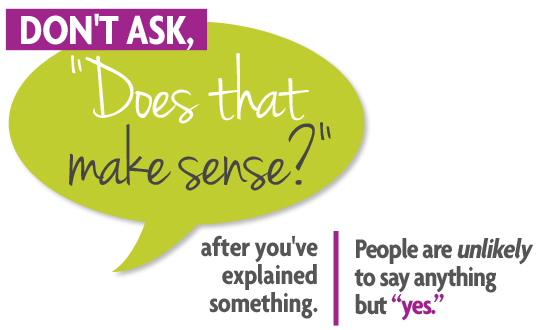
I’m taking golf lessons, which should frighten anyone within 100 feet. Every time the instructor explains something new, he asks me, “Does that make sense?” “Does that make sense” is a common clarifying question that many people ask, but it’s not a good question for two reasons.
Reason number one: If an explanation doesn’t make sense to me, I’m the idiot for not “getting it.” The question implies that the instructor was clear, I just “didn’t get it.”
Reason number two: The question doesn’t force me to speak, thus the person asking the question doesn’t get any information. “Does that make sense” is like asking a shopper in a store, “Can I help you?” We all know the right answer to that question is, “No, I’m just looking.” This is a similar to when someone asks, “Are there any questions?” The right answer is “no.” And when people say “no,” the person who asked the question often says, “good,” affirming people for not asking questions and making it less likely that questions will be asked in the future.
The purpose of asking questions is to get information. The problem with asking, “Does that make sense?” or “Do you have any questions?” is that the typical answers teach us nothing.
The golf instructor should be asking me:
What did you learn today?
What are you planning to do as a result of what we’ve covered?
What techniques did I demonstrate? Let me see how that form looks.
What questions do you have for me?
If he asks me the clarifying questions above, he will know what I am likely to do on the golf course.
Here are some clarifying questions that will force people to talk and won’t make them feel stupid for asking questions. Instead of asking, “Does that make sense,” consider asking:
“I want to make sure I gave clear instructions. Will you tell me what I’m asking you to do?” You could also phrase the questions like this, “Just so I know how I landed, what do you think I’m asking/expecting you to do?” or “What does a good job look like?” or “What should this look like when it’s complete?”
** These questions may sound condescending and like micromanaging in writing, but the questions can be asked in a supportive and non-judgmental manner. If you’re worried that the questions will make you appear as controlling or micromanaging, just say that. “I want to be sure you’re set up for success. If any of my questions feel condescending, please tell me. That isn’t my intention.”
I was talking with one of my clients a few months ago. She was very upset because she told one of her employees what to do and he didn’t do it. Frustrated, she said, “He knew what to do, and he didn’t do it.” I asked her, “How do you know that he knew what to do?” She replied, “I told him what to do and when I asked if he had any questions, he said no.”
Her situation is a common one. The right answer to “Do you have any questions” is “no.” And we’re surprised when we swing by the person’s desk two weeks later to get a status update on the project, and they haven’t started working on it yet.
Here are some additional examples of clarifying and delegation questions. These questions will force people to speak, providing a clearer sense of what people know and are likely to do.
What questions do you have?
What are you planning to do first? If the person answers this question appropriately, ask what they are planning to do next. If they don’t answer the question appropriately, step in and give more direction.
Provided you trust that the person knows what to do, give a tight deadline and ask to review the person’s work in a few days. Give people some freedom, but not enough to waste a lot of time and go down a fruitless path. Delegation is something at which most managers can improve. More effective delegation will lead to fewer missed deadlines and frustrations in the workplace.
Surveys are a great way to gather data. They’re not a great way to build relationships. In addition to sending out employee engagement surveys, ask questions live. Employees want to talk about their experience working with your organization, and employees will give you real, honest, and salient data, if you ask them and make it safe to tell the truth.
Here are a few methods of gathering data, in addition to sending employee engagement surveys:
Managers, ask questions during every one-on-one and team meeting with employees.
Managers, consider asking:
What’s being talked about in the rumor mill?
What do I need to know about that you suspect I don’t?
What makes your job harder than it has to be? What would make your job easier?
What meetings are not a good use of time?
Listen and be careful not to defend. Employees want to be heard. Respond if you’re able, but don’t deflect the feedback you receive.
Leaders, conduct roundtable discussions with small groups of employees throughout the year. I’d suggest discussions with groups of six employees. Have virtual or in-person lunch or coffee. Keep the meetings informal.
Leaders, consider asking:
What’s a good decision we made in the last six months? What’s a decision we made that you question?
Do you refer your friends to work here? If not, why not?
What’s something happening in the organization that you’re concerned about?
How to Get the Truth:
Ensure there are no negative consequences for people who tell you the truth.
Give positive attention to the people who risk and give you negative information.
Tell employees throughout the organization what you learn during these discussions and what you will and won’t be doing with the information. Share as much information as you can.
You don’t need to act on every piece of data you receive. Just acknowledge what you heard and explain why you will or won’t be taking action.
Employees are loyal to managers and organizations they feel connected to, and connections are formed through conversations. So, in addition to sending employee engagement surveys, ask questions during every conversation and make it clear that you’re listening to the answers.
When selling a product, service, or idea, people often think that providing more information is better. The more data points, the more likely the other person is to be persuaded. This is not necessarily the case. Excluding data hounds, most people don’t like to be overloaded with information. But people do appreciate the opportunity to talk about what they want and need. So, if you want to sell something, give people a chance to talk.
I’ll never forget one of my first sales calls, early in my career. I was selling Dale Carnegie Training. After calling a prospect for six months, he agreed to spend ten minutes with me. Feeling rushed, I laid out all of our training brochures and quickly told him about every program we offered. Then I asked if he wanted to buy anything. He didn’t.
If I had asked a few questions and listened to his answers, I could have provided information on just the training programs he needed, instead of giving him a list of likely irrelevant options.
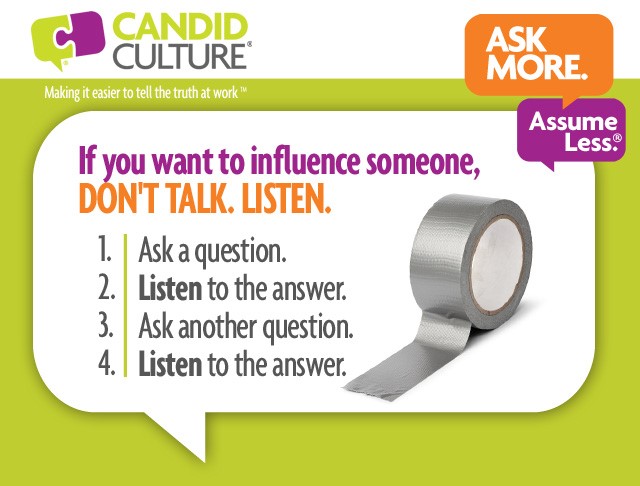
Selling a product or service is no different from selling an idea. You are trying to persuade someone to your way of thinking. Resist the temptation to persuade solely by educating. Instead, ask questions, listen to the answers, and then tell the person what you heard them say. If you’ve taken a listening class, you learned the practice of paraphrasing what someone said. Paraphrasing is a very old, very effective practice.
People need to feel heard and understood. From my experience, asking relevant questions, demonstrating that you listened to the answers by paraphrasing what the person said, and providing pertinent and succinct information is what people need to make a decision.
At some point, you’ll get passed over for a promotion, project, or piece of work, and no one will tell you why. Why should they? There is little incentive to deal with your likely (human and normal) defensive response. It’s easier to say nothing.
The problem is that this lack of information gives you no ability to manage your career.
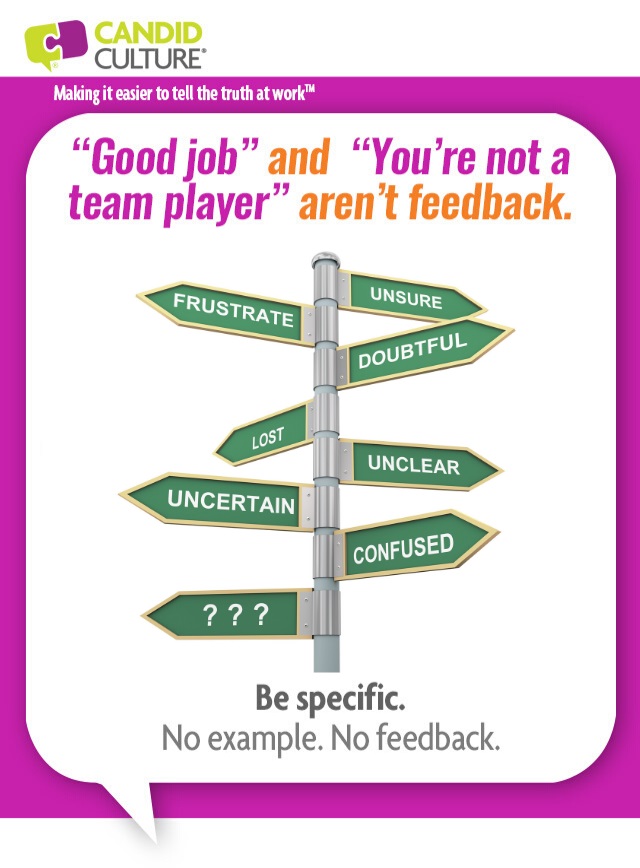
Most people get almost no feedback at work. “Good job” isn’t feedback. Neither is, “You seem distracted.” And being told, “You just weren’t the right fit,” is utterly unhelpful.
If you want to manage your career, you need more information. Getting this information might seem scary. You might be thinking, “What if I don’t want to hear what people have to say? What happens if I hear something really bad?” People are so hesitant to give feedback, they’ll likely go easy on you. You won’t hear anything you can’t handle.
There are people in your life who will tell you the impression you create, what you’re like to work with, and why you might not have gotten a job you really want. They’ll tell you, if you ask and make it safe to tell you the truth. Making it safe means you can’t defend yourself. No matter what the person says and how hard it may be to hear, you must respond with, “Thank you for telling me that,” even if you’re convinced they’re wrong.
The easier it is to give you feedback, the more feedback you’ll get. The harder it is to give you feedback, the less you’ll get. Remember, no one wants to deal with your defensive response. It’s easier to say nothing.
Identify three to five people in your life who care about you, who you trust. They might work with you now, but perhaps not. Don’t overlook your friends, family, spouse and past co-workers. Tell each person, individually, that you want to know more about the impression you make and what you’re like to work/interact with. Do this over the phone or in-person. Emailing the request doesn’t demonstrate seriousness. Ask the person to schedule a conversation with you. Send your questions in advance, so the person is prepared. Have the scheduled meeting; don’t cancel it, even if something important comes up. Consider asking: The first impression you make; what you’re like to work/interact with; the best thing about you; and one change you could make. Say, “thank you,” for the information and not more. Don’t underestimate the power of your emotions. Everyone gets defensive when receiving feedback. Defensiveness can be off-putting and scary to others. Don’t do anything to limit future feedback.
Ask these questions a few times a year. You don’t necessarily need to make any changes, based on what you learned. The point isn’t to act on the information, it’s merely to have it. Information is power, and power is control.
Want to know one of the reasons people get defensive when you give feedback and why they often don’t change their behavior? Because what you’re giving them isn’t actually feedback.
“You’re awesome to work with” isn’t feedback. Neither is “You did a great job.” “Your work isn’t thorough” isn’t either. Neither is, “You were inappropriate.” Most of what we consider feedback isn’t feedback at all. It’s vague, unhelpful language that leaves people wondering what they need to do more, better, or differently.
There are only two reasons to give feedback – to encourage someone to either change or replicate a behavior. Unfortunately, most of the ‘information’ we give is too vague to help people do either.
When you coach or give feedback, you serve as someone’s GPS. Like the GPS on your phone, you need to be so specific the person knows precisely what to change or replicate. If you were driving and your GPS said, “Good job” or “I think you’re off track,” you’d throw the GPS out the window and get a map.
If you give someone what you consider feedback and the person responds with, “I don’t know what you mean. Can I have an example?” you’ll know you weren’t helpful.
Here are six tips for giving helpful feedback:
Giving feedback tip one: Write down what you plan to say, then strip out half the words. Shorter feedback with fewer words is better.
Giving feedback tip two: Practice what you plan to say out loud. Have you noticed that what you ‘practice’ in your head is typically not what comes out of your mouth?
Giving feedback tip three: Before having a conversation, give the feedback to an independent, third-party and ask the person to tell you what they heard. If that person is clear, the feedback recipient likely will be too. Ensure who you practice with will maintain confidentiality. Your organization doesn’t need more gossip.
Giving feedback tip four: Tell someone else about the conversation you need to have and ask that person what they would say. Anyone not emotionally involved in the situation will do a better job than you will. It’s our emotional involvement that makes feedback conversations so challenging. Again, ensure confidentiality.
Giving feedback tip five: Ask the feedback recipient what they heard you say. Asking, “Does that make sense?” is an ineffective question. “Do you have any questions?” isn’t any better. You ask questions to get information. Yes or no questions don’t teach you anything. Require people to tell you what they know and don’t know by asking open-ended questions.
Giving feedback tip six: Give one to three examples of what the person did or didn’t do, during the conversation. If you don’t have an example, you’re not ready to provide feedback, and anything you say will evoke defensiveness rather than behavior change.
Giving feedback doesn’t have to be so hard. Be so specific that your feedback could be used as driving directions. The purpose of feedback is to be helpful.
I’m going to admit that I’m terrible at what I’m recommending today – taking time for yourself. Often my weekly blog is something I too am working on, and this week is no exception.
Many of you know that I have a child and run a business. Perhaps like you, I work, travel, parent, cook and attempt to keep my house clean. I’ll admit, in the past nine years, I haven’t had lunch with a friend without my son in tow, haven’t seen an adult movie, and only talk to friends when I’m traveling for work. BUT, since January 1st, I’ve been to four Pilates classes a week because doing so makes me feel better and because I said I would.
The classes are blocked on my calendar. I take my son to school, go to Pilates, and then start my work day. It’s the one thing I do for myself each week. And this summer, I might just be able to wear a bathing suit without my signature mumu skirt I’ve been wearing my entire adult life.
The value of downtime and taking time for yourself is well documented. There is a lot written on the need to take breaks to recharge and rejuvenate to avoid burn out. The question is how to do so without feeling like something else is getting short shrift.
Here are seven tips for taking time for yourself:
Taking time for yourself tip one: Give yourself permission after a really busy few days or week(s) to have a lightly scheduled day. If you’ve been on the road or worked really long hours for four days, don’t schedule early morning meetings and a full day on the fifth day. Know that you won’t be productive on day five anyway, so you might as well plan to do less, which is what you’re likely to do anyway.
Taking time for yourself tip two: Plan a day doing non-work-related things you really enjoy. When is the last time you did something you really love to do, just because? But, if a day of planned recreational activities feels like another ‘to do,’ you’re better off doing nothing and not feeling badly about it.
Taking time for yourself tip three: Plan time to see a friend weekly. I’ll admit that I have to schedule phone calls to catch up with friends and schedule time to see people I care about. Yes, I admit, this seems wrong. But do whatever it takes. If you have to put lunch or a phone call with a friend in your calendar for it to happen, do it.
Taking time for yourself tip four: Don’t feel badly about taking time off. Many employees don’t take their allotted vacation time – for a variety of reasons. Just do what you need to feel rested and refreshed. Stop judging yourself.
Taking time for yourself tip five: If you take a day off or sleep late, don’t work until two in the morning the next day to compensate. Doing so defeats the purpose and will put you in a hole the next day.
Taking time for yourself tip six: Watch where your time goes when you’re ‘working.’ I know that I squander lots of time while I’m ‘working.’ I allow myself to get distracted reading emails as they come in versus working on the project that’s on my calendar, texting with friends, and chatting in our office. You could work fewer hours if you reduced these distractions.
Taking time for yourself tip seven: Decide what you really want your life to be about and what’s really important to you. Do you want work to be your focus, or do you want an equal balance of friendships, family, and community activities? You likely have what it is that you really want.
If what you really want is a career-centric life, then just admit that and don’t judge yourself for it. But do take enough time off that you are rested, productive, and don’t resent your work.
Think about all the people and situations that frustrate you. Now consider what you’re asking for. My hunch is, you’re getting what you ask for.
While most of us aren’t great at telling people when they violate our expectations, we’re not much better at asking for what we want. You might be afraid of appearing demanding or may not feel you have the right to make requests. When you tell people what you expect, you make their lives easier. Think about when someone invites you to their house for dinner. If you have any manners (and I’m sure you do), you ask what you can bring. When the other person says nothing, it makes your job (to be a good guest) harder. Now you have to guess what the other person wants. It would be so much easier if they would just tell you. This also applies to birthday gifts and where to meet for lunch. When people tell you what they want as a gift and where they want to eat, you don’t have to guess, and they are easier to please.
It’s much easier to live and work with people when we know what they expect from us. And setting expectations is always easier than giving negative feedback. Negative feedback implies someone did something wrong. And no one likes to be told they are wrong. Setting expectations provides a road map to success, making it easier to win with you.
Here are a few phrases to make setting expectations easier:
Setting expectations example one: Consider saying, “I need time to get settled when I start working in the morning. Will you hold all questions and requests until 10:00 am?” You’re not telling someone they barrage you with questions before you’ve opened your laptop in the morning; you’re simply asking for what you need.
Setting expectations example two: You could say, “I like to have things done well before they are due. Will you please send me all input for the weekly status report by Wednesday of each week, so I have a few days to review your input before I have to submit it?” You’re not telling the person that working with them requires a weekly fire drill; you’re simply making a non-judgmental request.
Setting expectations example three: You could ask, “Would it be possible to touch base once a week via phone, so I can get your input on projects?” You’re not telling the person they are impossible to get time with; you’re simply proposing an idea.
One of the keys to getting what you want is make requests in a neutral, non-judgmental way. The more you ask for what you want and the more specific your requests, the easier you are to work with. What you need and want will be clear; there will be no guessing. People may choose to ignore your requests and violate your expectations, and then you’ll provide feedback. But start with making clear and specific requests and see how many fewer feedback conversations you need to have.
One of the hardest things I ever did was to hire someone to care for my infant son. “Here is the person most important to me in the world. Keep him alive.” I had no idea how difficult it would be to trust a relative stranger so implicitly. And as a result, let’s just say I was not the easiest parent to work for.
My son is now nine. While this was a long time ago, I’m still embarrassed to admit that I wrote sixteen-pages of instructions on how to take care of my kid. And I gave that ‘booklet’ to a nanny with much more childcare experience than I had. When I heard my son crying, I would tell myself not to walk into the room and check on him, knowing it undermined the nanny, but I did it anyway. When the nanny sent me an update of when my son last ate, I replied telling her when he should eat again, even though I knew she already knew that. Yes, I really did these things.
Each time I over instructed, monitored, and advised, I regretted it. I knew micromanaging our nanny made me difficult to work with, which is not how I wanted to be.
Many people attend training on how to manage others. I’d suggest we also look at how we manage ourselves. How does working with you make people feel? Do your questions, requests, and interactions make people feel more self-confident and valued, or do people feel questioned and undermined? Do you pick your battles? Do you give just enough direction but not so much as to squelch the other person’s ideas, initiative, and spirit, especially when the stakes are high?
As you know, I’m evaluating how I do these things too. We are always a work in progress.
Here are four ways to build confidence in the people you work with:
Build Confidence 1: Ask people for their ideas and implement those ideas whenever possible. And if you aren’t open to others’ ideas, don’t ask for them. It’s better not to ask for ideas than to ask when you’re really not interested.
Several years ago I hired a vendor that wasn’t a good fit. Try as we might to work together, we didn’t communicate well. Everything was a struggle. After a frustrating few weeks, the owner of the business offered to refund my money and amicably part ways. His company had already done work on our behalf and I didn’t want to lose momentum. I turned him down. That was a mistake. When a small business owner, who needs your business (money), tells you to go elsewhere, listen. We parted ways a few months later in a much more costly and less amicable way.
You don’t want to work with people who don’t want to work with you. The same is true for friends and romantic relationships. Don’t chase people. If they don’t want you, move on. There are lots of other people who will see your value.
There are differing schools of thought on whether or not you should try to retain employees who quit. I’d be interested in seeing statistics on how long employees who quit but are then retained, stay with an organization and how well they perform. I’d let them go. Again, you don’t want people who don’t want you.
The challenge is that most people are afraid to speak up in organizations and relationships (of all kinds) when they’re unhappy. Unhappy employees typically quit versus make requests and give feedback.
The antidote is to create a culture in which employees, vendors, and customers openly make requests and talk about what is and isn’t working. Create a climate of candor in which feedback is exchanged regularly versus just during exit interviews, which is too late.
How to know when to cut bait with unhappy employees and vendors:
You’ve had several open discussions and can’t meet each others’ needs. If you don’t have a job the employee wants, that’s a good reason to part ways.
It’s not a good culture fit. You talk and talk but don’t communicate. Issues don’t get resolved. Frustration is the norm. This is also a good reason to end a working (or personal) relationship.
Five steps to create a more candid culture:
Discuss employees’, customers’, and vendors’ needs and requests at the beginning of working relationships. Agree upon what success and a good job looks like. Ask lots and lots of questions, and listen closely to the answers.
Ask for feedback regularly. Conduct a weekly plus/delta (a discussion of what is and isn’t working) during which all parties are invited and expected to speak freely. The more you have these discussions, the easier they will be and the more candid people will become.
Address challenges as they happen.
Discuss challenges that can’t be fixed.
If a relationship isn’t working, end it sooner rather than later. Be slow to hire and quick to fire.
There are lots of talented vendors and employees. Find employees and suppliers who are easy to work with (for you) and who can meet your needs, and vice versa. If you can’t meet each others’ needs or the relationship is a constant struggle, those are good reasons to move on. Don’t chase.