Managing People Archive
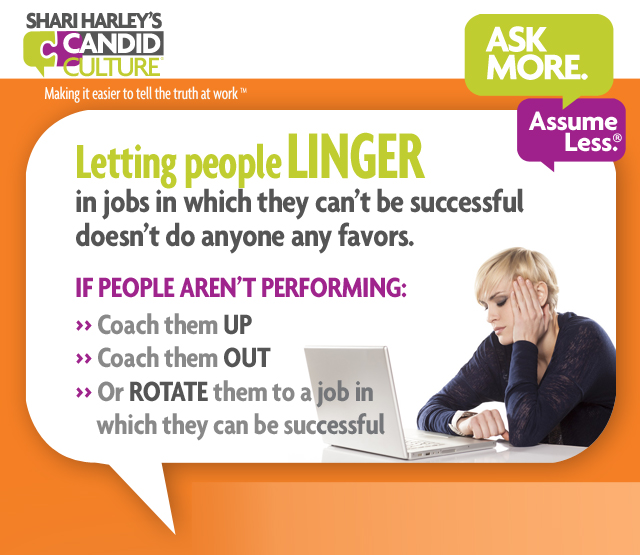 Being in the wrong job feels terrible. It’s not unlike being in the wrong romantic relationship, group of friends, or neighborhood. We feel misplaced. Everything is a struggle. Feeling like we don’t fit and can’t be successful is one of the worst feelings in the world.
The ideal situation is for an underperforming employee to decide to move on. But when this doesn’t happen, managers need to help employees make a change.
The first step in helping an underperforming employee move on to something where s/he can be more successful is to accept that giving negative feedback and managing employee performance is not unkind. When managers have an underperforming employee, they often think it isn’t nice to say something. Managers don’t want to hurt employees’ feelings or deal with their defensive reactions. In fact, when we help someone move on to a job that she will enjoy and where she can excel, we do the employee a favor. We set her free from a difficult situation that she was not able to leave out of her own volition.
I get asked the question “how do I know when it’s time to let an employee go?” a lot.
Here’s what I teach managers in our managing employee performance training programs: There are four reasons employees don’t do what they need to do:
- They don’t know how.
- They don’t think they know how.
- They don’t want to.
- They can’t. Even with coaching and training, they don’t have the ability to do what you’re asking.
Numbers one and two are coachable. With the right training and coaching employees will likely be able to do what you’re asking them to do.
Numbers three and four are less coachable and are likely not trainable.
When you’re confronted with someone who simply can’t do what you need them to do, it’s time to help the person make a change.
The way you discover whether or not someone can do something is to:
- Set clear expectations
- Observe performance
- Train, coach, and give feedback
- Observe performance
- Train, coach and give feedback
- Observe performance
- Train, coach and give feedback
Welcome to management.
After you’ve trained, coached and given feedback for a period of time, and the person still can’t do what you’re asking her to do, it’s time to make a change.
Making a change does not mean firing someone. You have options:
- Take away responsibilities the person can’t do well and give him other things that he can do well.
- Rotate the person to a different job.
Firing someone is always a last resort.
Sometimes we get too attached to job descriptions. The job description outlines a specific responsibility that the person can’t do. So we fire the person versus considering, who else in the organization can do that task? Be open minded. If you have a person who is engaged, committed, and able to do most of her job, be flexible and creative. Give away parts of the job to someone who can do them well. I’ve also seen employees who were failing, thrive in a different job. Organizations that are flexible survive; organizations that are rigid do not.

Let’s say you’ve stripped away the parts of the job that an underperforming employee can do well and she still can’t perform effectively. Now it’s time to make a change.
Here are some words to use when having the difficult ‘it’s time to move on’ conversation:
“I really want you on my team and to be successful in our organization. Over the past six months, we’ve had several conversations about the parts of your job that are a struggle. We’ve taken away responsibilities that aren’t a fit for you and have replaced those responsibilities with things that seemed like a better fit. And yet I can see that you are still struggling. I’m very sorry to say that it’s not appropriate for you to continue to working here. Today is your last day.” Depending on your organizational culture, can also say, “How do you want to handle this? You can resign or we can let you go. I’ll do whatever feels more comfortable for you.”
This is a difficult conversation that no manager wants to have. Yet I promise you, this conversation feels better to your employee than suffering in a job in which s/he can’t be successful. After you’ve set expectations, observed performance, and coached and given feedback repeatedly, letting someone go is kinder than letting the employee flounder in a job in which he cannot be successful.
I’m taking golf lessons, which should frighten anyone within 100 feet. Every time the instructor explains something new, he asks me, “Does that make sense?” “Does that make sense” is a common clarifying question, that many managers, trainers, and instructors ask, but it’s not a good question for two reasons.
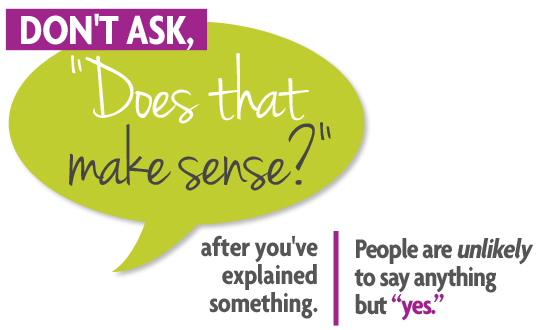
Reason number one: If an explanation doesn’t make sense to me, I’m the idiot for not ‘getting it.’ It’s not that the instructor hasn’t been clear, I just ‘didn’t get it.’
Reason number two: The question doesn’t force me to speak. “Does that make sense” is like asking a shopper in a store, “Can I help you?” We all know the right answer to that question is, “No, I’m just looking.” This is a similar to when someone asks, “Are there any questions?” The right answer is “no.” And when people say “no,” the person who asked the question often says, “good,” affirming people for not asking questions and making it less likely that questions will be asked in the future.
Here are some clarifying questions that will force people to talk and won’t make them feel stupid for asking questions. Instead of asking, “Does that make sense,” consider asking:
- So I know I’ve been clear, tell me what you heard me say.
** This may sound harsh and like micromanaging in writing, but the questions can be asked in a supportive and non-judgmental manner.
- Just so I know how I landed, what do you think I’m asking/expecting you to do?
- What do you think you need to do?
- What are you planning to do?
I was talking with one of my clients a few months ago. She was very upset because she told one of her employees what to do and he didn’t do it. Frustrated, she said, “He knew what to do, and he didn’t do it.” I asked her, “How do you know that he knew what to do?” She replied, “I told him what to do and when I asked if he had any questions, he said no.”
Her situation is a common one. The right answer to “do you have any questions” is “no.” And we’re surprised when we swing by the person’s desk two weeks later to get a status update on the project, and he hasn’t started working on it yet.
Here are some additional examples of clarifying questions and delegation questions. These questions will force people to speak, providing a clearer sense of what people know and are likely to do.
- What questions do you have?
- What are you planning to do first? If the person answers this question appropriately, ask what he is planning to do next. If he doesn’t answer the question appropriately, step in and give more direction.
Provided you trust that the person knows what to do, give a tight deadline and ask to review the person’s work in a few days. Give people some freedom, but not enough to waste a lot of time and go down a fruitless path. Delegation is something few managers do well and the root of many missed deadlines and frustrations in the workplace.
The golf instructor should be asking me:
- What did you learn today?
- What are you planning to do as a result of what we’ve covered?
- What techniques did I ask you to follow?
- Let me see how that form looks?
- What questions do you have for me?
If he asks me these clarifying questions and forces me to do the things he is asking me to do, he will know what I know and am likely to do on the golf course. All he knows right now is that I’m poking fun of him in a blog post.
Figuring out if a candidate will like and can do a job is fairly straight forward, figuring out if a candidate will like working in your organization is much harder.
A clear and specific job description should tell a candidate whether or not a job’s responsibilities are things she can and wants to do. What’s much harder to determine is whether or not the candidate is a good culture fit with the organization. Will she be comfortable working with the organization’s employees and in the organization’s culture, and will other employees be comfortable working with her? It’s hard to figure that out during a 60 or 90-minute conversation, during which both interviewers and interviewees are on their best behavior.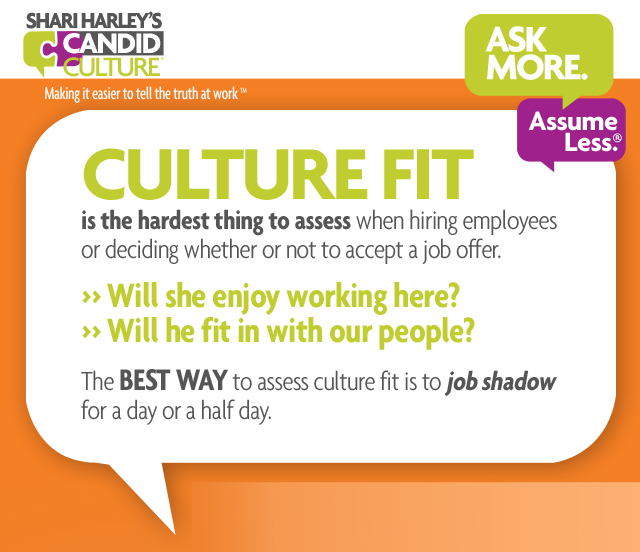
Some companies use personality assessments to assess culture fit. Others have lots of people meet with candidates. I’m fond of the job shadow interview, which very few companies do.
If you’re really serious about a candidate, why not invite her to spend a day or a half day in your office participating in a job shadow interview. Candidates can attend meetings, have lunch, hang out in the break room and hallways, and meet fellow employees during the job shadow interview. Candidates and employees are more likely to let their guard down and be themselves outside of a formal job interview. You want to know the person you hire as well as possible. You don’t want to hire someone who turns out to be very different once she actually starts.
Hiring and training new employees is the most costly thing most businesses do, so slow down and invest more time. Before you make a candidate an offer, ask the candidate if she would be willing to spend half a day in your office participating in a job shadow interview. That invitation could sound something like, “We really like you and think you’d be a great fit. Before we make you an offer, we wonder if you’d be willing to spend an afternoon (or a day), sitting in on some meetings and job shadowing a potential peer. Would you be interested in doing that?”
Candidates, you’re interviewing and assessing an organization just as the people in the organization are interviewing and assessing you. You won’t be successful or stay in a job very long if you don’t feel at home in the culture. If a hiring manager makes you an offer and you are seriously considering it, ask to job shadow interview for a half or full day. That request could sound something like, “Thank you so much for the job offer. I’m very excited about the possibility of working for you! I want to be sure that I’m a great fit and vice versa. How would you feel if I spent a morning or afternoon attending a few meetings and job shadowing someone on the team? This will give me an even better sense of the organization and make sure this is a great decision for both of us. What do you think?” I can’t imagine any employer outside of those working on government, classified information saying no.
Taking the wrong job and hiring the wrong candidate is costly. Slow down and make better hiring decisions by giving candidates a chance to experience your culture with a job shadow interview, when people aren’t on their best behavior. You’ll make better hiring decisions and save lots of time and money in the process.

About fifteen years ago, I worked with a woman with whom I didn’t get along. We were on the same team and had the same job, but didn’t see eye to eye on how to approach work or solve problems. And when we didn’t agree, things got ugly. I have to admit to being afraid of her. She was nasty when things didn’t go her way.
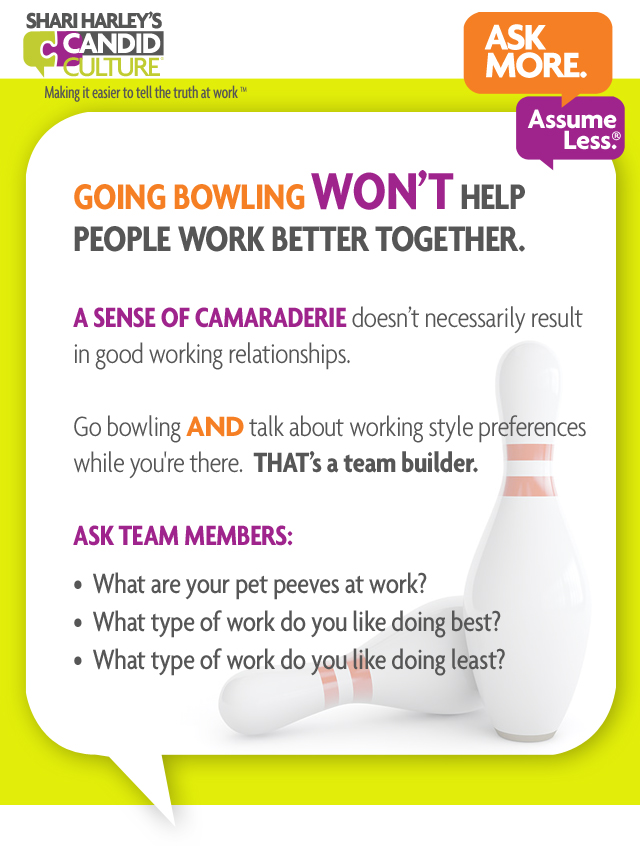 The odd thing is that socially, we did fine. When our team socialized outside of work, we had fun and got along well. That’s when I realized that there was no correlation between getting along outside of work and working well together.
Lots of teams go bowling, to baseball games, and out for happy hour as corporate team building activities. And while team members may enjoy being together at these events and get to know each other better personally, they don’t learn team members’ working style preferences, the work others are really good at, and the things at which team members are not as good.
Go bowling or out for happy hour, just don’t expect people to work better together after doing those activities. If you want to do corporate team building activities, give team members a chance to learn about each other and themselves, and make agreements of how team members will work together in the future. Create occasions for candor.
When I lead corporate team building activities, I put people in small groups, give the group a box of Candor Questions to Say Anything to Anyone, and time to answer the questions. One person in the group asks one question from the box. Everyone in the group answers that person’s question. The person who asked the question then answers his own question. Then another person on the team asks a question and so on. A great conversation always ensues.
People talk about things they should have and wished they’re talked about when they started working together. Team members learn about each others’ work style preferences and what each person needs from both the job and each other. But most importantly, team members have permission to talk about things they normally don’t, and begin to create a climate of candor, which is essential for any group of people working together. For a team to work well together, it must be safe to tell the truth. Teams need to talk about the things that impact them most –each other.
So go bowling and out for happy hour. But also create opportunities for team members to talk about the things that matter most –how they impact each other at work.

 You’ve either seen the video or heard about the group think that happened before NASA’s Challenger exploded in 1986. One engineer felt strongly that there was a defect in the Challenger’s design. He spoke up, others disagreed. He continued to speak up, until it became very uncomfortable to do so.
Most employees don’t even get that far. Many employees are afraid to speak up at all, feeling that it’s not ok to have a counter point of view, and that those who disagree with ‘management’ are eventually fired. I honestly am not sure where this comes from. It hasn’t been my experience, and yet the fear of speaking up is pervasive. I hear it in almost every organization with which I work.
If it’s not ok to express different opinions, your organization will deliver the same-old products and services you always have. If staying the same works in your industry, great. But stagnation is a killer to most organizations.
If you want more innovation in the workplace, you have to make it safe to speak up and offer a different point of view. Saying new, different, and even controversial things must be encourage and rewarded.
Five Ways to Encourage Innovation In the Workplace:
- Ask for new ideas and different points of view.
- Wait until you get both. Don’t allow a meeting or discussion to move on until you get new, opposing, and different points of view.
- Positively acknowledge people who risk and say something new or different from the norm.
- Ensure people with new ideas and different points of view are allowed to finish speaking before they’re interrupted or before someone else tries to negate their ideas.
- Create a few new awards in your organization and announce winners publicly and with great fanfare. You get what you reward.
Create Awards to Encourage Innovation In the Workplace:
- Acknowledge the person who fails massively trying something new.
- Award the person who brings new ideas to the table, regardless of what happens to those ideas.
- Celebrate the person who willingly gives you the worst news.
The fear of speaking up and saying something new or different will kill your innovation efforts. It will also kill your employees’ ambition and ability to be creative. Make it safe to tell the truth, even when the truth is hard to understand or unpopular, and see what happens to innovation, creativity, and employee productivity and morale.
Employees leave managers not jobs. We’ve all heard this 100 times.
One of the most prevalent reasons for employee turnover is boredom and lack of growth. We’ve also heard this many times.
We know why employees leave jobs. The question is what must managers do to engage and retain their best people. The answer is actually quite simple, although possibly not easy to execute.
 Employees want to know that their manager:
- Knows them
- Cares about and is invested in their careers
- Gives feedback so they can improve
- Provides opportunities so they can develop
In other words, employees need attention, and attention requires time, time many managers may not feel they have.
Here is a five-step formula for employee retention and employee engagement:
- Get to know employees better and differently
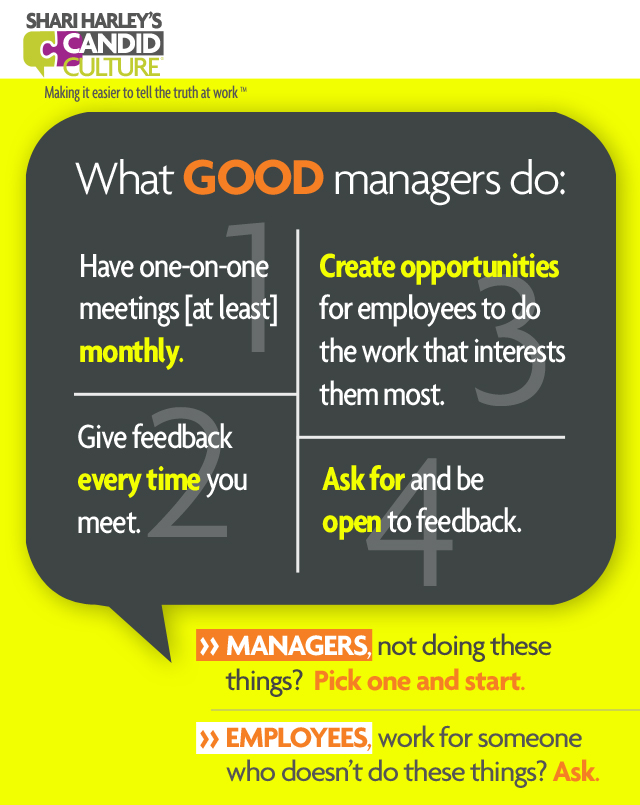
- Have meaningful, one-on-one meetings [at least] monthly
- Give feedback every time you meet
- Ask for and be open to feedback
- Create opportunities for employees to do the work that interests them most
Managers, how do you make time for these meetings when are busy and have several direct reports?
- Meet for 15-30 minutes
- Meet over the phone while commuting or waiting for flights
- Ask direct reports to create an agenda and run the meetings
- Ask direct reports to send follow-up notes of decisions and plans made during meetings. Give some of the accountability away.
- If meetings get cancelled, reschedule as soon as possible. Direct reports take cancelled meeting personally. Cancelled meetings, that are not rescheduled, send the message that managers don’t care about employees and their careers.
Employees, if your manager doesn’t schedule meetings with you:
- Ask permission to put a monthly meeting on your manager’s calendar
- Provide rationale for why you want to meet–to get your manager’s feedback and ensure you’re focused on the right work
- Ask permission to reschedule meetings when they get cancelled
- Don’t take cancelled meetings personally
- Offer to meet with your manager via the phone when it’s convenient for him/her. Leverage commute and travel time.
Employees need time with their managers. Meaningful discussions and work result in employee engagement and employee retention, so managers, make the time, even when you don’t feel you have it. Ask questions you don’t ask now. Give feedback, even if it’s uncomfortable. Give your employees an opportunity to do the work that interests them most. And watch your employee engagement and employee retention improve. And if your manager doesn’t do these things, politely and persistently ask. You won’t get what you don’t ask for. We are all 100% accountable for our careers.
 I’ll never forget a coaching meeting I had about two years ago. I gave the manager I was coaching some tough feedback and he replied by saying, “I know I do that.” So I asked him, “If you know this is an issue, why are we having the discussion? He told me, “I just figured this is the way I am.” And I realized that knowing a behavior is ineffective doesn’t mean we know what to do to make things better.
The people you work with want to do a good job. They want you to think well of them. Yes, even the people you think do little work and/or are out to get you. Give people the benefit of the doubt. Assume people are doing the best they know how to do. And when you don’t get what you want, make requests.
There are two ways to give feedback. One way is very direct.
Version one: “You did this thing and here’s why it’s a problem.”
The other way is less direct. Rather than telling the person what went wrong, simply make a request.
Version two: “Would you be willing to…” Or, “It would be really great to get this report on Monday’s instead of Wednesday. Would you be willing to do that?”
It’s very difficult to give feedback directly without the other person feeling judged. Making a request is much more neutral than giving direct feedback, doesn’t evoke as much defensiveness, and achieves the same result. You still get what you want.
When I teach giving feedback, I often give the example of asking a waitstaff in a restaurant for ketchup. Let’s say your waiter comes to your table to ask how your food is and your table doesn’t have any ketchup.
Option one: Give direct feedback. “Our table doesn’t have any ketchup.”
Option two: Make a request. “Can we get some ketchup?”
Both methods achieve the desired result. Option one overtly tells the waiter, “You’re not doing your job.” Option two still tells the waiter he isn’t doing his job, but the method is more subtle and thus is less likely to put him on the defensive.
You are always dealing with people’s egos. And when egos get bruised, defenses rise. When defenses rise, it’s hard to have a good conversation. People stop listening and start defending themselves. Defending oneself is a normal and natural reaction to negative feedback. It’s a survival instinct.
You’re more likely to get what you want from others when they don’t feel attacked and don’t feel the need to defend themselves. Consider simply asking for what you want rather than telling people what they’re doing wrong, and see what happens.
I will admit, asking for what you want in a neutral and non-judgmental way when you’re frustrated is very hard to do. The antidote is to anticipate your needs and ask for what you want at the onset of anything new. And when things go awry, wait until you’re not upset to make a request. If you are critical, apologize and promise to do better next time. It’s all trial and error. And luckily, because most of us aren’t great at setting expectations and human beings are human and make mistakes, you’ll have lots and lots of chances to practice giving feedback and making requests.

 Surveys are a great way to gather data. They’re not a great way to build relationships. In addition to sending out employee engagement surveys, ask questions live. Employees want to talk about their experience working with your organization. And employees will give you real, honest, and salient data, if you ask them and make it safe to tell the truth.
Here are a few methods of gathering data, in addition to sending employee engagement surveys:
Managers, ask questions during every one-on-one and team meeting with employees.
Managers, consider asking:
- What’s being talked about in the rumor mill?
- What do I need to know about that you suspect I don’t?
- What makes your job harder than it has to be? What would make your job easier?
- What meetings are not a good use of time?
Listen and be careful not to defend. Employees want to be heard. Respond if you’re able, but don’t deflect the feedback you’ve received.
Leaders, conduct roundtable discussions with small groups of employees throughout the year. I’d suggest discussions with groups of six employees. Have lunch or coffee. Keep the meetings informal.
Leaders, consider asking:
- What’s a good decision we made in the last six months. What’s a decision we made that you question?
- What would need to happen for you to be comfortable referring your friends to work here?
- What’s something happening in the organization that you’re concerned about?
How to Get the Truth:
- Share as much information as you can. Trust your employees.
- Ensure there are no negative consequences for people who tell you the truth.
- Give positive attention to the people who risk and give you negative information.
- Tell employees what you learn during these discussions and what you will and won’t be doing with the information.
- You don’t need to act on every piece of data you receive. Just acknowledge what you heard and explain why you will or won’t be taking action.
Employees are loyal to managers and organizations they feel connected to. And connections are formed through conversations. So in addition to sending employee engagement surveys, ask questions during every conversation and make it clear that you’re listening to the answers.
The fear of saying what we think and asking for what we want at work is prevalent across organizations. We want more money, but don’t know how to ask for it. We want to advance our careers but are concerned about the impression we’ll make if we ask for more. Instead of making requests, many employees assume they won’t get their needs met and choose to leave their jobs, either physically or emotionally.
How to Retain Good Employees:
The key to keeping the best employees engaged and doing their best work is to ask more questions and make it safe to tell the truth.
Managers: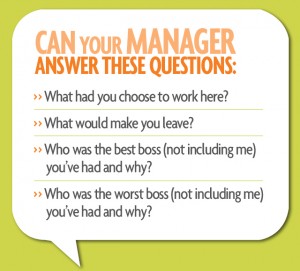
- Do you know why your employees chose your organization and what would make them leave?
- Do you know your employees’ best and worst boss?
The answers to these questions tells managers what employees need from the organization, job, and from the manager/employee working relationship.
Can your manager answer these questions – that I call Candor Questions – about you? For most people, the answer is no. Most managers don’t ask these questions. And most employees are not comfortable giving this information, especially if the manager hasn’t asked for it.
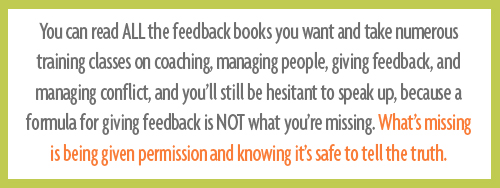
It’s easy to mistake my book, How to Say Anything to Anyone, as a book about giving feedback. It’s not. It takes me nine chapters to get to feedback. The first eight chapters of the book are about how to create relationships in which you can tell the truth without fear. You can read all the feedback books you want and take numerous training classes on coaching, managing people, giving feedback, and managing conflict, and you’ll still be hesitant to speak up, because a formula for giving feedback is not what you’re missing. What’s missing is being given permission and knowing it’s safe to tell the truth.
Managers, here’s how to retain good employees:
“I appreciate you choosing to work here. I want this to be the best career move you’ve made, and I want to be the best boss you’ve had. I don’t want to have to guess what’s important to you. I’d like to ask you some questions to get to know you and your career goals better. Please tell me anything you’re comfortable saying. And if you’re not comfortable answering a question, just know that I’m interested and I care. And if, at any point, you’re comfortable telling me, I’d like to know.”
 Then ask the Candor Questions during job interviews, one-on-one, and team meetings. We’re always learning how to work with people. So continue asking questions throughout your relationships. These conversations are not one-time events.
If you work for someone who isn’t asking you these questions, offer the information. You could say:
“I wanted to tell you why I chose this organization and job, and what keeps me here. I also want to tell you the things I really need to be happy and do my best work. Is it ok if I share?”
Your manager will be caught off guard, but it is likely that she will also be grateful. It’s much easier to manage people when you know what they need and why. Most managers want this information, it just may not occur to them to ask.
If the language above makes you uncomfortable, you can always blame me. You could say:
“I read this blog and the author suggested I tell you what brought me to this organization and what I really need to be happy here and do my best work. She said I’d be easier to manage if you had that information. Is it ok if I share?”
Yes, this might feel a little awkward at first, but the conversation will flow, and both you and your manager will learn a great deal about each other.
The ability to tell the truth starts with asking questions, giving people permission to speak candidly, and listening to the answers.

You know when someone gives you ‘the tone’. Similar to when people roll their eyes at you, when you get ‘the tone’ you’re being told that the other person is exasperated.
 Tone of voice communication is one of the hardest things to coach because we don’t hear ourselves. People who give people ‘the tone’ rarely know they’re doing it. One of the best ways I know to effectively coach tone of voice is to ask tone givers to tape themselves during phone calls. Then listen to the recording together and ask the tone giver, “If your grandmother called and someone spoke to her that way, would you be happy?” You can also read written correspondence out loud, adding the tone you ‘heard’, and ask the sender how she would have interpreted the message.
When given the tone, most people feel judged. And when people feel judged, conversations are constrained.
The way to avoid giving ‘the tone’ is to come from a place of curiosity. When you ask the question, “What were you thinking when you approached the customer that way,” you can sound curious or judgmental. Being judgmental evokes defensiveness, which shuts conversations down. Being curious creates discussion.
Consider asking questions like these to invite discussion:
• Tell me more about…
• Help me understand what happened here…
• What are your thoughts about…
• What’s the history behind….
• Why do we do it this way?
Any of these questions will lead to good discussion, if you manage your tone.
If you want to get information or influence someone, ask questions and engage the person in a dialogue. We often try to persuade people by giving them information. This rarely works. Instead of over loading people with data, ask questions which evoke discussion. Through discussion you might get to a different place. And if not, you’ll at least have learned why the other person thinks as he does and you will have shared your point of view in a way that is inviting versus off putting.
It’s easy to give people ‘the tone’ when we’re tired and frustrated. Try to avoid difficult conversations when you’re tired or stressed. Wait to have important conversations until you know you can manage yourself and your tone.