Managing People Archive
I could give you a list of fifty employee retention strategies you could follow to improve employee performance, engagement and retention. But the truth is, there are really just four things you must do. Employees may appreciate the other 46 things but don’t necessarily need them to stay with your organization and do their best work.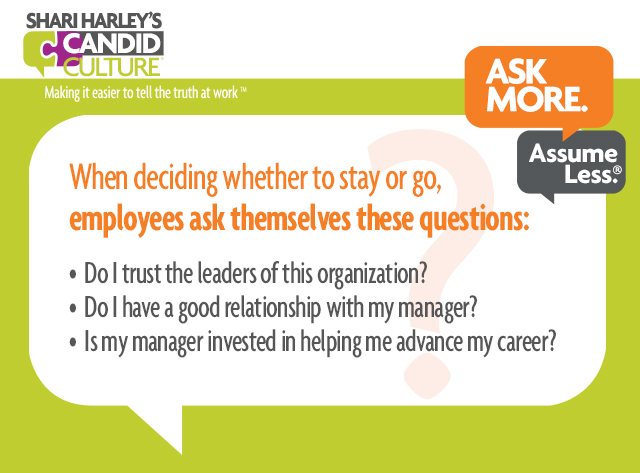
The Colorado Society of Human Resource Management hosts an annual Best Companies competition, and organizations of all sizes compete. Last year I led a workshop before the awards ceremony. The purpose of the workshop was to share the things that make an organization a great place to work. While researching the program, the things that separate the great companies from the less desirable places to work became very clear. I’ll share those employee retention strategies here.
Employees ask themselves these questions at work:
- Do I trust the leaders of this organization?
- Does my opinion/voice matter in this organization?
- Do I have a good relationship with my manager?
- Is my manager invested in helping me advance my career?
Employees enjoy yoga, concierge service, espresso, and social events at work, but these perks don’t necessarily improve retention or performance. The only perk known to improve employee loyalty and commitment is a flexible schedule. Everything else is nice to have, but not essential.
This is what’s really important to your employees:
- I trust the leaders who run this organization.
- My opinion means something. I am listened to.
- I feel respected (by my manager) and have good relationships in the organization.
- My work is challenging and interesting.
So what should you do if you want to be a best place to work?
Four Employee Retention Strategies Leaders Can Use to Create Relationships with Employees at All Levels:
1. Know employees’ names, talents & career goals.
2. Be visible. Talk to employees.
3. Give more information than you think you need to. Employees want to know how your organization is performing.
- Hold town hall meetings. Give financial updates.
- Use ‘Ask the CEO’ boxes to encourage questions and feedback.
- Encourage senior leaders to conduct small, roundtable discussions with employees at all levels.
4. Align leaders’ words and actions.
- Organizational guidelines are applied consistently among all employees.
- Don’t gossip or chuck other leaders under the bus.
- Be consistent. Don’t say, “The CEO says this, but we’re going to do this instead.”
Four Employee Retention Strategies Managers Can Take:
1. Meet one-on-one with employees and have meaningful discussions about employees’ performance and career goals.
2. Ask employees for their opinion and demonstrate that you’ve heard them.
3. Provide opportunities for employees to do work they enjoy.
4. Ensure employees who want to advance in your organization are learning and growing.
Read about our Be a Great Place to Work leadership training program designed for Senior Leaders and HR Professionals.
For the most part, people are afraid to speak up at work. Despite the town hall meetings and roundtable discussions executives host, the feedback training offered, the existence of ask-the-CEO email addresses and blogs, and employee satisfaction and engagement surveys, many employees are still afraid to give feedback at work, citing fear of damaging relationships, being fired, and other forms of retaliation.
Those of you who have worked with me, read How to Say Anything to Anyone, and/or used our tools, know that I am on a quest to make it easier to tell the truth at work.
The Candid Culture Vision:
- Coworkers, leaders, and managers set clear expectations before problems occur. No one has to guess what is expected of them and what a good job looks like.
- Employees ask for and receive regular, balanced and candid feedback and always know where they stand performance wise.
- Managers and leaders are open to and ask for feedback. They always know what’s really happening in the organization and can lead accordingly.
- People talk to each other versus about each other. Gossip and drama is the exception, not the norm.
- Work is a fun place to be. People enjoy working together and produce their best work.
Many of you are taking actions to create the environment I’ve described above. I want to hear from you and want to use this blog to share practices for creating more candid communication at work.

Add a comment and tell us:
- What you are doing to increase the trust and communication in your organization.
- The avenues you are using to give feedback on your team, in your department, or in your entire organization.
We’ll enter you to win 50 of our new door tags. The door tags were designed to tell your coworkers that your office is a place they can speak freely, without concern.
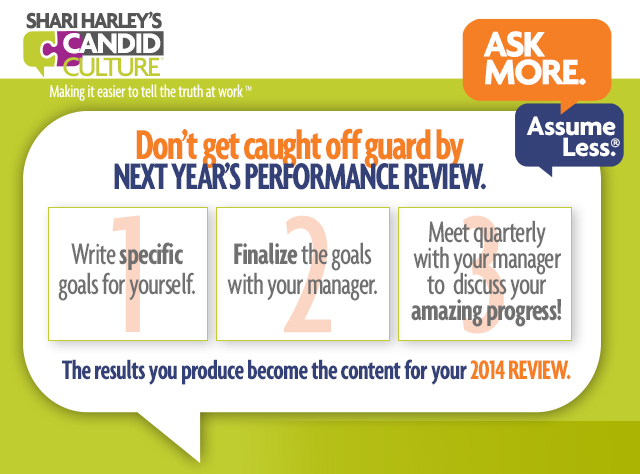 Many year-end performance reviews include whatever the manager and direct report can remember happening during the last six to twelve weeks of the year. For the most part, managers and direct reports sit in front of blank performance appraisals and self-appraisal forms and try to remember everything that happened during the year. The result: A vague, incomplete performance review that leaves employees feeling disappointed, if not discounted.
If you were disappointed by your performance review this year, don’t let it happen again next year. Take charge of your career by writing your own goals.
One of the first companies I worked for did the goal process so well, I learned early in my career how powerful well written goals could be. Each employee set five to seven goals. Experienced employees wrote their own goals and then discussed those goals with their manager. Less experienced employees wrote their goals with their manager. Managers wrote goals for inexperienced employees. The goals were so specific and clear that there could be no debate at the end of the year whether or not the goal had been achieved. It was obvious. Either employees had done what they said they would, or they hadn’t. This made writing performance appraisals very easy. Very little on the appraisal was subjective. And this gave employees a feeling of control over their year and performance.
It’s great if you work for an organization or manager who works with you to write goals. If you don’t, write your own goals and present them to your manager for discussion and approval. Managers will be impressed you took the initiative to write goals and will be thankful for the work it takes off of them.
Goals should be simple and clear. It must be obvious whether you achieved the goal or not. There should be little if any room for debate.
Sample goals are below.
Desired Outcome (goal):
• Improve client feedback – too vague
• Get better written reviews from clients – better
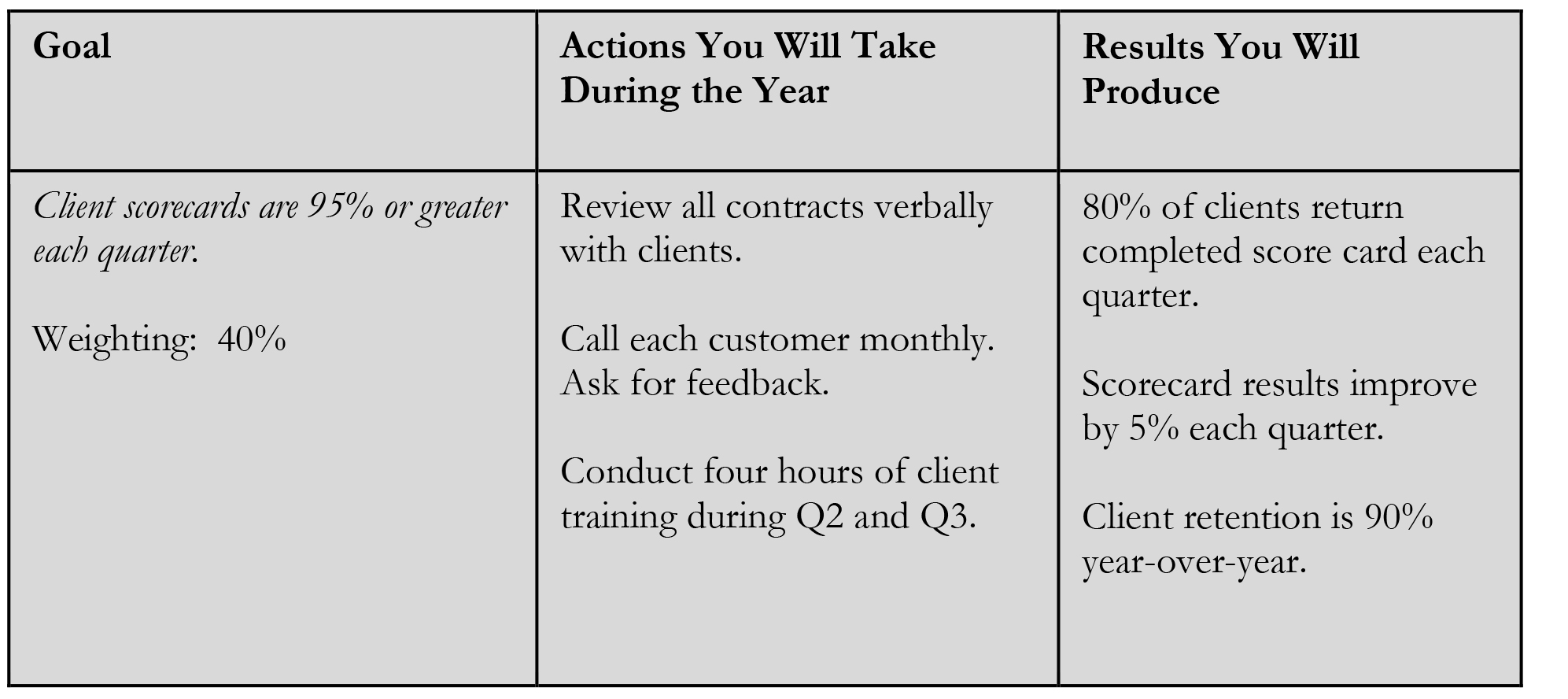
• 80% of clients respond to surveys and respond with an average rating of 4.5 or above – best
Actions you will take to achieve the goal:
• Ask clients for feedback throughout project — too vague
• Ask clients for feedback weekly – better
• Visit client site weekly. Talk with site manager. Ask for feedback — best
Goal template:
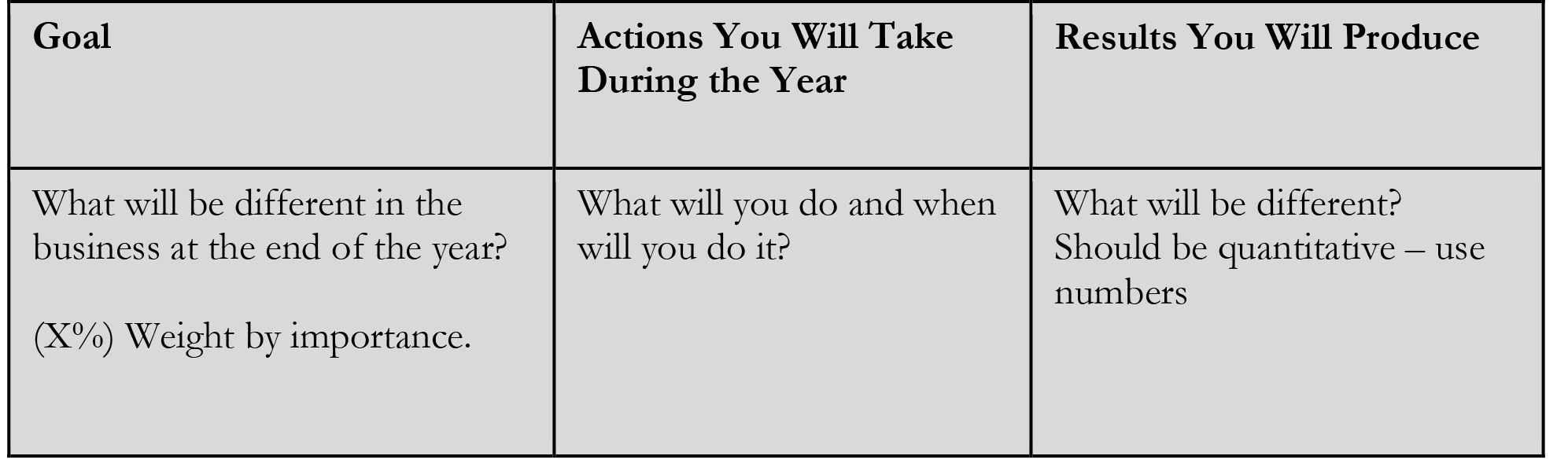
Completed sample goal:
How to approach your manager with written goals:
Try using this language with your manager: “I want to be sure I’m working on the things that are most important to you and the organization. I’ve written some goals for 2014 to ensure I’m focused on the right things. Can we review the goals, and I’ll edit them based on your input? And what do you think of using the agreed-upon goals to measure my performance in 2014?
You have nothing to lose by writing goals and presenting them to your manager. You will gain respect from your manager, clarity of your 2014 priorities, and more control of your year-end performance review. Give it a try, and let me know how it goes.
If you want more feedback from your manager, ask these questions.

Last week I was upset, really upset. I worked hard to practice what I preach when giving feedback – wait to talk until I’m calm, ask questions, and no matter what happens, don’t send a text message. It was hard, really hard.
I was mad and wanted to say, “What the *&^#$@?” But I know that when people receive negative feedback they feel judged. And when people feel judged, they become defensive, making it very difficult to hear what the other person is saying and have a conversation.
When my emotions don’t get the best of me, I plan hard conversations by asking myself these questions:
- What do I want to have happen as a result of the conversation?
- How do I need to approach the conversation to get that result?
Knowing that if I want to have a good conversation, I need to reduce the other person’s defensiveness, I often start feedback conversations by asking the neutral question, “Help me understand; what happened the other day?”
Last week one of my employees tipped me off that the people who work for me are on to me. They’ve read my book. When I ask, “Help me understand; what happened the other day,” they know that feedback will follow.
You don’t want to approach your relationships and conversations in a formulaic and inauthentic way. Inauthenticity stinks and it can damage relationships more than freaking out will do. But it’s not a terrible thing to put someone on notice. If the people who work with me know that negative feedback follows the question “what happened,” they know the conversation is important. Yes, they’ve been tipped off and perhaps as a result they’re on the defensive, but I still think asking “what happened yesterday” is a heck of a lot better than raising your voice, accusing, and asking questions later.
Asking questions to discuss thwarted expectations is hard to practice. It takes great self-management, which I don’t always have. I mostly practice what I teach, and when I don’t, I clean up the mess I’ve made, apologize and recommit to doing so in the future. And you can do the same.
A Few Practices to Consider:

Holiday Promo – $12 a book for 7 or more books.
- Wait to give feedback until you won’t freak out, but don’t let situations fester and become bigger than they need to be. Have the conversation as soon after an event as possible.
- If something is important to you, ask for it. Trying to persuade yourself that it isn’t a big deal and might be your issue, probably won’t help. We want what we want. Be true to yourself.
- Consider starting hard conversations with “help me understand.”
And when you find that you’ve put the other person on the defensive and s/he feels judged, work to do better next time. But in the end, speaking up is always better than stuffing how you feel, even if you handle the conversations differently than you had planned.
A few weeks ago, a college student introduced me before I spoke at a conference. I heard him practicing out loud shortly before he was to read my introduction on stage. As he practiced, I heard him struggle with the word candor. Initially he pronounced it as can-door vs. can-dor. He’d never seen the word and didn’t know what it meant.
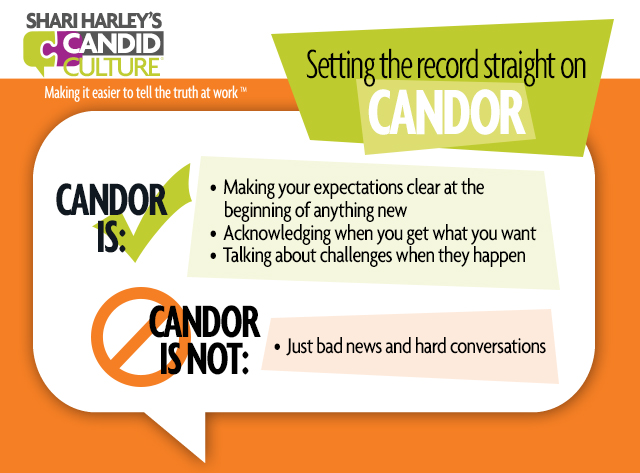
The word candor is not being used on a regular basis. Younger people may not know what it means. And, in my experience, people who are familiar with the word often misinterpret candor to mean bad news. Most people expect bad news to come after the question, “Can I be candid with you?”
The definition of candor is to be honest, truthful and forthright. We at Candid Culture define candor differently. The Candid Culture definition of candor: Telling people what you need before challenges occur. Anticipating everything that can take a project or relationship off track and talking about potential pitfalls before they happen.
Think about the projects and processes in your office – hiring someone new, sourcing a vendor, training people on new software. The potential breakdowns are predictable. You know the pitfalls that can happen when starting anything new because you’ve experienced them.
What if candor sounded like, “We want this project to be smooth. There are a couple of things that will make our work together go well and a few things that may delay the project and have it cost more than we budgeted. Let’s talk about what needs to happen for things to go smoothly, ways to prevent missed deadlines, and how we’re going to handle breakdowns when they happen.”
Some call a conversation like this setting expectations, others call it planning. In my world, these conversations are called candor –talking about what you need when projects begin, rather than letting the anticipatable train wreck happen.
Candor isn’t bad news. It’s telling people how to win with you vs. making them guess.
Examples of candor at work and at home:
“Here a few of my pet peeves… It would be great if you could avoid them.”
“What will frustrate you?”
“I turn off my cell phone alerts at night, so feel free to text or call me anytime. I’ll respond to all messages in the morning.”
“I respond to text messages mostly quickly, then voicemail, then emails. If you don’t get a reply to an email within two or three days, don’t take it personally. Chances are I haven’t read the message. Feel free to follow up with a text or voicemail.”
“I work best by appointment. Drop by’s are hard because they interrupt my flow. Email or text me if you need something, and I’ll tell you when I can swing by. Does that work for you?”
For the most part, we treat people as we want to be treated. Other people aren’t us. They don’t do things as we do and don’t know what we want. Don’t make people guess how to work with you, what you need, and what you expect. Be candid and tell them! Then ask what the people you work and live with expect from you.
You won’t get what you don’t ask for.
Most of the feedback we give and receive puts people on the defensive. We don’t do this intentionally. It just happens. We say how we feel, usually when we’re upset, and the other person responds.
Most of the feedback we give and receive is judgy, like the examples below.
|
Judgy – Not Real Feedback
|
Just the Facts – Actual Feedback
|
| “You ignore me in meetings.” |
“When I raise my hand to participate in meetings, you don’t call on me.” |
| “You’re rude to me.” |
“When you pass me in the hallway, you don’t say hello.” |
| “You won’t work with me. You go around me.” |
“We were supposed to screen potential vendors together. You scheduled and held the appointments without me.” |
| “You’re not responsive.” |
“You usually reply to emails a week after they were sent.” |
| “It’s hard to get time on your calendar.” |
“It takes three weeks to schedule time to meet with you.” |
Becoming defensive when receiving feedback is a hard-wired response, like slamming on your brakes when the car in front of your does the same. The more people feel judged, the more defensive they become. If you want to be sure people become defensive when you give feedback, be vague. If you want people to be able to hear you and take action on your feedback, strip out the opinion (judgment) and give people just the facts.
Referring to the chart above, the sentences on the left are opinions. And opinions can be debated. The sentences on the right are facts. Facts are harder to debate. When giving feedback give just the facts, not your opinion. This will take practice.
The first thing out of our mouths will invariably be judgment/opinion. People who have participated in feedback training with me or who have read How to Say Anything to Anyone know I call the tendency to be vague Cap’n Crunch. Cap’n Crunch: “You’re doing a good job.” That’s sweet but useless.
When someone upsets you and you want to tell the person, prepare for the conversation by asking yourself these questions:
- What did the person do that frustrated me?
- What behaviors did s/he exhibit?
- What actions did s/he take?
- What was the impact on me?
Then practice giving feedback to someone outside of your workplace or group of friends (to reduce gossip and drama) and ask the person with whom you’re practicing what s/he heard. If your feedback is specific and clear, any lay person will interpret the feedback as you intended it.
Giving feedback, that others can hear, isn’t easy to do. It requires you to put your emotions aside, strip out judgments and opinions, and tell the other person the facts of what happened. The more you focus on the facts and less on how you feel about what happened, the better your conversations and relationships will go.
 You get an email that annoys you, hit reply, type up your thoughts, hit send and feel instant regret. We’ve all done this. We’re frustrated and we let the other person know.
Feedback via email is always a bad idea. You don’t know how the recipient will read and interpret your message. You can’t manage the tone of the message or give the person a chance to respond. And more often than not, he’ll reply equally frustrated. And now the non-conversation begins –back and forth, back and forth.
Email is for wimps and voicemail isn’t any better! No texting either. End the madness and pick up the phone or swing by someone’s desk. Things are resolved most quickly and easily by talking about them.
I’m consistently surprised at how much feedback is delivered via email. And I’ll admit to occasionally being guilty of it too. I’m in a hurry or on a plane, and I want something to get done quickly. Or my emotions get the best of me, and I feel compelled to respond to a situation quickly. So I send an email or a text message that I know I shouldn’t send. Then I regret it and spend the rest of the day apologizing and feeling badly for communicating impulsively.
If we want people to want to work with us and perform, we need to consider how our actions impact them. Yes, it’s easier to send a quick email or text. But it invariably annoys the other person and damages your relationships. People can work with you, around you, and against you. If people want to work with you, they’ll work harder and produce better work.
Never underestimate the human ego, which is easily bruised. You are ALWAYS dealing with someone’s ego. The ego needs to be seen as good. When someone (anyone) calls our competence into question, we get defensive. Becoming defensive when receiving negative feedback or when someone questions us is a gut reaction. Not becoming defensive takes a great deal of self-management and is unusual.
Slow down. When you have to give feedback, ask yourself what you want the other person to do. Then ask yourself, how do I need to communicate to get the result I want? Then pause, breathe, and pick up the phone.
 My last few blog posts focused on giving feedback. The posts were designed to help managers get ready to write and deliver performance appraisals.
Giving feedback will always be hard. No one wants to hear that she isn’t doing a good job, thus no one wants to tell her. Part of the performance appraisal process is setting expectations for the next year. And asking for what you want, before problems happen, will always be easier than giving feedback.
If you’ve seen me speak or attended one of our training programs, you received a list of Candor Questions designed to eliminate the guessing at work. They may have been questions for leaders, managers, strengthening business relationships or managing careers. Regardless of which Candor Question Cards you received, the goal is the same. Ask more. Assume less.
The most frequent request I get is for feedback training. Managers tell me, “The communication in our company isn’t good. Can you help our managers and employees be more candid?” And I tell business leaders, “I teach people to be more comfortable giving feedback. But why start with something hard? Why not start by asking more questions and getting to know people better, which is much easier and will reduce the number of feedback conversations you need to have?”
When we know what people expect, we can give people what they need. We make fewer ‘mistakes’, requiring fewer feedback conversations. So start with what’s easy. Ask more questions.
Start with what I call Introductory Candor Questions:
- How do you like to receive information – email, voicemail or text message?
- Are you a detail-oriented or a big-picture person? How much information do you want to receive and in what format?
- What are your pet peeves at work? What would I do that would be frustrating, and I’d never know it?
Then move on to Candor Questions for Managers:
- What had you choose to work here, and what would make you question that decision?
- What kind of work do you love to do most? What kind of work do you like to do least?
- What do you wish I would start, stop, and continue doing?
You can download samples of our seven types of Candor Questions here.
People are not us and don’t do things the way we do. Don’t assume someone will create a report as you would, participate in a meeting as you would, or dress for an event as you would. Setting expectations before the event of what you want, gives them a chance to be successful.
Giving Feedback is Hard – Asking for What You Want is Easier. By Shari Harley.
The Feedback Formula:
1. Introduce the conversation so feedback recipients know what to expect.
2. Empathize so both the feedback provider and the recipient feel as comfortable as possible.
3. Describe the observed behavior so the recipient can picture a specific, recent example of what you’re referring to. The more specific you are, the less defensive he will be, and the more likely he’ll be to hear you and take corrective action.
4. Sharing the impact or result describes the consequences of the behavior. It’s what happened as a result of the person’s actions.
5. Having some dialogue gives both people a chance to speak and ensures that the conversation is not one-sided. Many feedback conversations are not conversations at all; they’re monologues. One person talks and the other person pretends to listen, while thinking what an idiot you are. Good feedback conversations are dialogues during which the recipient can ask questions, share his point of view, and explore next steps.
6. Make a suggestion or request so the recipient has another way to approach the situation or task in the future. Most feedback conversations tell the person what he did wrong and the impact of the behavior; only rarely do they offer an alternative. Give people the benefit of the doubt. If people knew a better way to do something, they would do it another way.
7. Building an agreement on next steps ensures there is a plan for what the person will do going forward. Too many feedback conversations do not result in behavior change. Agreeing on next steps creates accountability.
8. Say “Thank you” to create closure and to express appreciation for the recipient’s willingness to have a difficult conversation.
If you’re giving more than one piece of feedback during a conversation, address each issue individually. For example, if you need to tell someone that she needs to arrive on time and also check her work for errors, first go through the eight steps in the formula to address lateness. When you’ve discussed an agreement of next steps about being on time, go back to step one and address the errors. But talk about one issue at a time so the person clearly understands what she’s supposed to do.
Here’s how a conversation could sound, using the eight-step Feedback Formula:
Step One: Introduce the conversation.
“John, I need to talk with you.”
Step Two: Empathize.
“This is a little awkward, and it may be uncomfortable. I want you to know that while I wish I didn’t have to tell you this, I’m doing it because I care about you and I want you to be successful.”
Just because you’re direct doesn’t mean you’re not empathetic. But remember, these are my words. You’ll need to find your own words that you feel comfortable using to deliver such a difficult message.
Step Three: Describe the observed behavior.
“John, I’ve noticed that you have an odor.”
Step Four: Share the impact or result of the behavior.
“I know this is a very awkward subject (more empathy). We work in a small space. I don’t want others to avoid working with you or say negative things about you. And as awkward as this is, I would rather you hear this from me than from someone else. Sometimes health conditions can cause certain odors, as can eating certain foods.”
Step Five: Have some dialogue. Ask the recipient for his perception of the situation.
“What are your thoughts?”
Give John time to say whatever he wishes to say.
Step Six: Make a suggestion or request for what to do next time.
“Again, I’m really sorry to have to tell you this. Please make sure you shower every day before coming to work and wash your clothes regularly. And please tell me if there’s something else you’d like me to know.”
Because of the awkwardness of this subject, skip step seven, and go to step eight.
“Thank you for being willing to have this conversation with me.”
You Can Say More Than You Think You Can
You might be gasping, thinking there is no way you could ever tell someone he smells. It’s definitely an awkward conversation, one I hope you never have to have. I used one of the most difficult things you will ever have to say to demonstrate that even the most awkward feedback can be delivered empathetically and quickly.
The short and concise body-odor conversation is a lot less uncomfortable for the recipient than the drawn-out, evasive first version. Just think, would you rather listen to someone tell you that you smell for two minutes or for twenty?
You may also think, “I shouldn’t have to tell someone to take a shower and wash their clothes.” That’s true, you shouldn’t. But if you’re working with someone who doesn’t do these things, clearly someone needs to tell him. Remember, other people are not you and don’t do things the way you do, even when those things appear to be no-brainer basics.
Lastly, you may think that telling someone to shower and wash his clothes is insulting and demeaning. It’s true: No matter how you spin it, there’s nothing nice about this message. But which is worse, having your coworkers ask for different desks and be unwilling to work with you, or having someone who has your best interests at heart tell you privately to clean it up—quite literally? When you tell people the truth, you do them a favor.
Here’s another example: A few years ago I had a coworker who was a lingerer. Lisa would hover outside my office until she saw an opportunity to interrupt. She then walked in uninvited and started talking. I was still mid-thought about whatever I’d been working on and wasn’t ready to listen. After a few sentences, I would interrupt Lisa, saying, “I’m sorry. I don’t know what you’re talking about. Will you please start over?”
Embarrassing as it sounds, this went on for more than a year. I wanted to be seen as accessible and open, yet this “lingering” method of interrupting was driving me crazy. And it was a waste of both of our time. After many months of frustration, I decided to use the eight-step Formula.
Step One: Introduce the conversation.
“Lisa, I want to talk about something I’ve noticed.”
Step Two: Empathize.
“I probably should have said something a long time ago. I’m sorry I didn’t.”
Step Three: Describe the observed behavior.
“I’ve noticed that when you want to talk to me you stand at my door, waiting for a good time to interrupt. When you come into my office, you’re often in the middle of a thought or problem that you’ve probably been thinking about for a while.”
Steps Four and Six: Share the impact or result of the behavior and make a suggestion or request for what to do next time.
“Because I’m in the middle of something completely different, it takes me a few seconds to catch up. By the time I have, I’ve missed key points about your question and I have to ask you to start over. This isn’t a good use of either of our time.
“Here is my request: When I’m in my office working and you need something, knock and ask if it’s a good time. If it is, I’ll say yes. Give me a few seconds to finish whatever I’m working on, so I’m focused on you when we start talking. I’ll tell you when I’m ready. Then start at the beginning, giving me a little background, so I have some context. And if it isn’t a good time for me, I’ll tell you that and come find you as soon as I can.”
Step Five: Have some dialogue. Allow the recipient to say whatever she needs to say.
“What do you think?”
Step Seven: Agree on next steps.
“Okay, so next time you want to talk with me, you’re going to tap on the door and ask if it’s a good time to talk. If it’s not, I’ll tell you that and come find you as soon as I can. If it is a good time, you’re going to give me a second to finish whatever I’m working on and give me some background about the issue at hand. Does that work for you?”
We have just managed “the lingerer”—a challenge you probably have, unless you work from home or in a closet.
You may have noticed that I changed the order of the Feedback Formula during this conversation. It’s not the order of the conversation that’s important. It’s that you provide specific feedback, offer alternative actions, and have some dialogue before the conversation ends.
Summary: Good Feedback Is Specific, Succinct, and Direct.
Provided you have a trusting relationship with someone and have secured permission to give feedback, there is very little you can’t say in two minutes or less. The shorter and more direct the message, the easier it is to hear and act upon. Follow the eight-step Feedback Formula. Be empathetic and direct. Cite specific examples. Give the other person a chance to talk. Come to agreement about next steps. Remember, you do people a favor by being honest with them. People may not like what you have to say, but they will invariably thank you for being candid.
This week’s blog is an excerpt from my book How to Say Anything to Anyone: A Guide for Building Business Relationships That Really Work. I hope it helps you have the conversations you need to have! Be candid. You can do it!
If I hear this one more time I might lose it.
Manager: “One of my employees has been making a lot of mistakes. He seems disengaged. I’m not sure what’s happening.”
Me: “Have you talked to him?”
Manager: “No. Performance appraisals are coming up, so I’ll just wait to give the feedback until then.”
Me: “When are performance appraisals?”
Manager: “In six weeks.”
Most people hoard feedback. We wait for the right time, aka when we’re comfortable. That time will never come. The right time to give feedback is when something happens or shortly thereafter. Practice the 24-hour rule and the one-week guideline. Give feedback when you’re not upset, but soon after the event occurs, so people remember what you’re talking about.
Most employees feel as if they’re treated unfairly during some portion of a performance appraisal. Employees receive feedback they’ve not previously heard, or receive feedback that is unbalanced – overly positive or negative, or the feedback is so vague employees aren’t sure what to do more, better or differently.
Good performance appraisals are a quick summary of all the performance conversations you’ve had during the year and planning for next year. To have an appraisal meeting like this one, managers need to meet with their employees regularly and give feedback every time you meet. And that is the management BEST suggestion I can make.
Meet regularly with your employees. If you never meet one-on-one with employees, start meeting monthly. If you meet monthly, meet twice a month. If you meet twice a month, consider meeting weekly for 30 minutes.
The one-on-one meeting agenda, which the employee owns:
- What is the employee working on that’s going well?
- What is the employee working on that is not going great, but she doesn’t want your help?
- What is the employee working on this isn’t going great and she wants your help?
- Give each other feedback: What went well since you last met? What could be improved?
** Give and receive feedback on the work and on your relationship. This will be hard the first few times you do it, but will become easier with each successive conversation.
Ask your employee to create a meeting agenda. Take notes on the agenda and keep your notes. The summary of these meetings becomes your annual performance appraisal.
Regardless of whether or not you’re meeting regularly, throughout the year and have performance notes, you can only give small pieces of feedback during the appraisal meeting. Discuss three SPECIFIC things the employee did well during the year and three things she should do next year. People can’t focus on more.
Think about the New Year’s resolutions you may have made last January. You might have promised yourself you’d save ten percent of your income, lose twenty pounds, take a two-week vacation without your phone, and apply to attend graduate school. How many of those things did you do? Setting too many aggressive goals sets us up to fail. And performance appraisals are not different.
Consider how each of your employees must impact your department and your organization’s annual goals. In that context, determine the most important things each employee did to contribute to those goals this past year and what she should have done more, better or differently? That’s your appraisal. Not more and not less.
During performance appraisals, force yourself to focus on and present ONLY the most important behaviors and outcomes, and your employees will bring the same focus to the ensuing year.