Managing People Archive
Most of the feedback people receive in the workplace isn’t feedback at all. It’s what I fondly refer to as Cap’n Crunch – vague and unhelpful words that make people defensive but don’t change behavior. If you want the people you work with to do some differently, give specific feedback.
Most of the fake feedback people get sounds like this: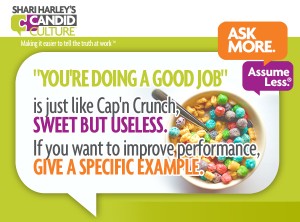
“You did a great job on that.”
“You’re doing really good work.”
“You’re dressing inappropriately.”
“You’re difficult to work with.”
None of this is feedback. It’s all Cap’n Crunch. Vague, vague, and more vague.
The first words out of your mouth will invariably be Cap’n Crunch. Follow those words with, “for example” and you’ll be headed in the right direction.
“You did a great job on that. For example, I never had to ask about the status of the project. You gave me an update every Friday, and that made me feel comfortable that we were on track.”
You dressed inappropriately for that meeting. For example, the client was dressed in business casual and you were jeans and tennis shoes. Next time, please dress as the client dresses or a step above in khaki pants or slacks, a button down shirt, and a jacket.”
Most people are afraid to give feedback because they don’t want to deal with the defensive reaction they anticipate. The more vague you are, the more defensive people will be. Because they don’t know what you’re talking about.
If employees shop your feedback around, asking what others think of the feedback, it’s because you were vague, they disagree with you or they’re being defensive. Feedback will be received better and resisted less if you’re specific.
Specific feedback can be captured on video. Meaning, you can video someone walking into a meeting late, rolling his eyes, and texting on his phone. I dare you to video “you were disrespectful in the meeting, you dressed inappropriately, or you’re difficult to work with.” If you can’t capture the feedback on video, you don’t yet have specific feedback. You have Cap’n Crunch.
When I teach managers to give feedback I ask the managers to, “Describe the situation to me. What did the person do? Managers often reply with, “He was negative.” This is Cap’n Crunch. So I keep asking questions. “What did he do that was negative? What did it look like?” After two or three questions the manager tells me, “I overheard him complaining to other employees in his cube about the decisions the company is making. I’d rather he ask me questions about the direction we’re going versus gossip to his peers.” Now we have specific feedback.
Wait to give feedback until you have a specific example. If you don’t have a specific example, go get one. Without an example, employees will look at you in a confused way, question the validity of what you’re saying and become defensive. And they’ll be right in doing all of these things.
Most of us dread giving and receiving performance reviews. Last week, this week and next week’s blogs are designed to make the performance appraisal process easier. If you want more help, chapters nine through twelve of How to Say Anything to Anyone provide a clear and easy-to-follow formula for giving specific feedback.
I’ll be back next week with more tips on giving feedback that actually changes behavior. Until then, BE SPECIFIC. If you’re not using the words “for example” you’re not giving specific feedback.

Appraisals can raise performance and morale, but most damage both. The appraisal process is broken. Summarizing an entire year’s work into one conversation and giving all that work a numerical rating is demoralizing and ineffective. Yet it’s the system most of us have to work with.
It’s time to get ready to write, deliver, and receive useful, motivating, and effective performance appraisals.
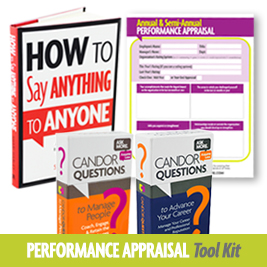 First evaluate your performance appraisal. If it’s more than two pages, it’s too long. If HR professionals are chasing appraisals, trying to get managers to complete them, the tools you’re using aren’t working. If you have to conduct a training to teach people how to complete the appraisal, it’s too complicated.
The next few blogs will be about how to write and deliver effective performance appraisals. I’ll also make Candid Culture’s effective performance appraisals tool kit available. Contact us for bulk pricing.
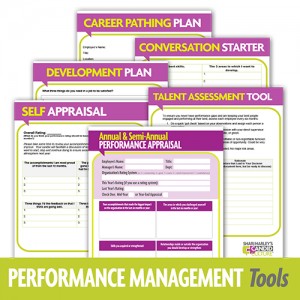 When I managed leadership training and succession planning, in a past job, I inherited a 12-page performance review that no one wanted to use. One of the leaders I supported told me, “If you can give me something that’s one page, I’ll get my people to use it.” From that day on I was on a quest to create tools for effective performance appraisals that were one or two pages. Today Candid Culture offers a suite of performance management tools – self appraisal, annual appraisal, talent assessment, development plans, etc. — that are one and two pages. Let me know if you want to talk with me about using them in your organization.
Employees, make it easy to review your performance. Write a one-page document summarizing your accomplishments. Assemble feedback you’ve received during the year from the people you support. Ask permission to provide both to your manager to make it easier to write your review.
Lastly, managers and employees, get ready to give and receive useful feedback. Most of the feedback employees receive isn’t feedback at all. It’s what I fondly refer to as CAP’N Crunch – vague and thus unhelpful. Effective performance appraisals should focus on three specific things the employee did well during the year and three specific things she can improve. People can’t focus on more than that.
 How to Say Anything to Anyone: A Guide for Building Business Relationships that Really Work is perfect preparation to get ready to deliver and receive performance feedback. I feel so strongly that the book will elevate the appraisal process, that we’re going to offer the book at a deep, bulk discount, to encourage organizations to make it available to managers and employees.
The appraisal process doesn’t have to damage relationships, lower morale and make employees question their commitment to your organization. Get ready now. Don’t wait. Start capturing what employees did well during the year and what could have been improved. Be specific. If you don’t have an example, you’re not ready to give feedback.
Next week I’ll provide specific examples of how to create useful performance feedback that will raise performance while maintaining morale. Until then, start planning! Good luck
 Giving negative feedback is hard. Asking for what you want will always be easier.
Set Expectations That Are Clear
We have all worked hard on a project, only to find out that what we created is not what our manager was expecting. When this happens, everyone is frustrated. Managers question whether or not employees listen. Employees wonder why managers who want something specific didn’t just say so when the work was assigned.
Managers would be well served by setting clear expectations at the beginning of working relationships and projects. Tell your employees what a good job looks like. Don’t make them guess.
If you want a weekly status update, tell employees that rather than being frustrated when you don’t know where projects stand. If you want a bulleted summary, tell people that rather than being annoyed when five paragraphs land in your inbox. If you envision a report with tables and charts, tell employees that versus being disappointed when they create a bulleted list.
Most of us assume people will do things the way we do. They won’t. Save time and reduce frustration by being crystal clear when you set expectations at the beginning of anything new.
When people see the title of my book How to Say Anything to Anyone, they think it’s a book about giving feedback and having difficult conversations. It’s not. How to Say Anything to Anyone is about asking more questions, so you know what your direct supervisor, coworkers, and customers need and don’t have to guess. How to Say Anything to Anyone is not about giving people bad news. It is about asking for what you want before challenges occur, and then talking about how you’ll deal with challenges when they arise.
If you work for someone who does not set expectations that are clear, then you, the employee, needs to set those expectations.
Set expectations by asking your manager:
• When do you want to see this, in what format, with how much detail?
• What does a good job look like?
• What’s your expectation of how this should look when it’s complete?
• Where does this fit, as a priority, in relation to other projects?
• How does this project fit into the department’s or organization’s goals?
Asking questions and telling people what you want is always easier than giving negative feedback. Everyone – employees and managers alike – are accountable for ensuring that the set expectations are clear and that work is done right the first time Ask more. Assume less.
Download the five questions managers must ask their employees to set expectations that are clear:
No one wants to tell you you’re dressed inappropriately for work.
The office dress code conversation seems to be feedback managers avoid and struggle with the most. Perhaps because attire is so personal, I’m not sure. But I do know that I’m getting more and more requests to train managers how to give employees feedback that their butt crack is showing. Yes, really.
Many employees push the envelope on the office dress code during the summer, breaking out tank tops, jeans and capri’s. The problem with dressing this casually is that some of the people you work with will judge you for it, but they are not likely to tell you. They’ll just decide you have poor judgment and that you may not be the right person to stand in for your boss at a meeting or conference.
A couple of office dress code guidelines to follow, unless you work in a very casual office environment where even the folks at the top wear jeans and t-shirts to work:
- Make friends with your iron, or a dry cleaner.
- If you put something on and ask “Can I get away with this,” the answer is most likely no.
- Ladies, your cleavage should never show at work. Never ever. It will only limit your career.
- T-shirts and cargo pants are not business casual.
- Capris and sandals are ok, if your company allows them. Spandex and shorts are not.
- Thongs and butt cracks are a no-no. Ladies, don’t wear low rides to work. Men, if your belt sits below your stomach, buy a bigger pair of pants and raise the belt. This will solve the butt crack problem.
- Ladies check your skirt length. If it’s too tight or too short, it’s not for the office.
- Lots of women are wearing really high heels to work. They look great, at a club.
- General rule of thumb, if can comfortably leave work and go to a club or a baseball game, you’re not dressed conservatively enough for work.
Most of these suggestions are aimed at women because women have more flexibility with clothing and thus a greater margin for error. Men have the man’s business casual uniform: khakis and a button down or golf shirt. That’s hard to screw up, unless of course you sleep in the khakis.
Here’s how you can give a woman feedback that she isn’t dressed appropriately for your office dress code:
“I’ve noticed that some of your clothing shows cleavage. When people look at you, I want them thinking about how smart you are and all that you add to our organization. I don’t want them distracted with something else.” Replace cleavage with whatever misstep the person is making.
Here’s another example: “I’ve noticed that you wear short skirts and pretty high shoes to work. We work in a pretty conservative environment. You always look great, but not for our office environment. I’m going to ask you to wear longer skirts, that aren’t as form fitting, with lower shoes. I know this conversation is awkward, and I appreciate that you’re willing to have it with me. When people look at you I want them thinking about how smart you are and all that you add to our organization. I don’t want them distracted with something else.”
Notice, I didn’t say, “You’re not dressed appropriately for work.” The word “appropriate” is too vague and thus doesn’t qualify as feedback. Being vague doesn’t tell the person what to do differently. If your employees felt that what they are wearing to work was inappropriate, they’d wear something else. You need to spell it out. And this is true for all forms of feedback. Be specific and give an example, or you haven’t given feedback and shouldn’t expect anything to change.
Men, you can’t have this conversation with the women in your office. Ask a woman the employee has a relationship with to have the conversation on your behalf.
Read How to Say Anything to Anyone to get the words to have other difficult feedback conversations.
Some of you are currently gasping, thinking there is no way you can have this conversation. Yes you can. I have these office dress code conversations with clients regularly without damaging my relationships. So few people will tell someone when they’re wearing clothing that damages their reputation, when the feedback recipient gets over being shocked and embarrassed, s/he’ll thank you for caring enough to give such honest feedback.
 I’m frequently asked the question, “Is there such a thing as too much candor?” Clients ask this question when an employee or coworker is telling anyone who will listen exactly what she thinks of just about everything. Incidents like these make managers and leaders hesitant to ask employees for feedback, not knowing how to turn off the well.
Yes, there can be too much candor. The truth is one ingredient in the recipe; it’s not the whole meal.
A few guidelines of when to give feedback:
1. You have a relationship with the feedback recipient, and he will be able to hear you without becoming overly defensive.
2. You’ve been asked for your opinion.
3. You feel very strongly about an impending decision that has not yet been made.
When not to give feedback:
1. The feedback recipient can’t change what you’re concerned about.
- If you’re concerned about a policy that isn’t changing, expressing an opinion is just complaining, which will negatively impact your reputation.
- The person you have feedback for can’t change that aspect of herself. For example, you comment that someone has a high, squeaky voice. That’s just an insult. And an insult isn’t feedback, no matter how hard you try to persuade yourself otherwise.
2. You don’t have a relationship with the feedback recipient and thus your message is likely to go on deaf ears.
3. You have not been asked for your opinion.
4. A decision has been made and at that point you’d just be talking to talk.
When managers ask me, “Is there such a thing as too much candor,” I suspect what they’re really asking me is, “How do I get my employees to be more discerning with the feedback they share, to whom, and how.”
Here are a few ways to guide employees who over communicate:
1. When you ask for feedback, tell people specifically on what you want feedback, in what format, and during what time horizon.
For example, tell employees, “We are looking for feedback on the new time-off policy. We’ll be asking for input at Friday’s town hall meeting. Please come to the meeting and share your thoughts. This will be the only opportunity to provide input.”
2. Tell employees who have a tendency to overwhelm with feedback or violate some of the guidelines listed above, “Your input is valuable. The more feedback you give, the harder it is to discern what’s important. Pick your battles. Give feedback on the things you feel really strongly about, and perhaps save other feedback for future opportunities.”
3. Tell employees who have a tendency to insult people with critical feedback, “How you deliver feedback influences whether or not people can hear your feedback and take action. No one likes to be told that she is wrong. Be careful not to attack people. Focus on the problem, not the person. Ask questions and make requests versus telling someone why what she is doing is wrong. Then, of course, tell the person to read chapters nine through twelve of my book How to Say Anything to Anyone.
Just because you can say something, doesn’t mean you should. None of us wants to damage relationships by insulting people or be labeled as a complainer. Pick your battles. Give feedback when you feel really strongly, a final decision has not been made, and you have a relationship with the recipient. And if you find yourself talking to talk, stop.
 Many organizations spend more money than they have to on employee recognition gifts and appreciation programs that often involve bonuses, paid time off, contests, gifts, and other expensive forms of compensation. What employees want most is to know they’re doing a good job.
Giving feedback in the workplace is the cheapest, most effective, and often overlooked form of employee recognition. Employees want to know how they’re performing, and most employees get little to no positive or constructive feedback at work. They may not want to hear negative feedback, but employees want to know if they aren’t meeting expectations.
In one of Candid Culture’s training programs, I give participants a box of questions to help coworkers set expectations and improve workplace communication. Some of the questions include:
- Do you prefer to receive information via email, voicemail, or text message?
- Are you a big picture or a detail person?
- What are your pet peeves at work?
- What type of work do you like to do most? What type of work do you like to do least?
- What do you wish I would start, stop, and continue doing?
I am consistently amazed at how often training participants ask what their coworkers wish they would start, stop and continue doing. I assume employees will be hesitant to ask for constructive feedback in front of a group of peers. But training participants consistently tell me that they get almost no positive or constructive feedback at work, and they’re desperate for the information.
Here’s How to Celebrate Valentine’s Day at Work Without Spending Money:
- Give clear, specific, and timely positive and negative feedback. Employees want to know how they’re performing.
- Ask what type of work employees really want to do, and let them do that work most of the time.
- Ask what skills employees want to learn, and give them a chance to attain those skills.
- Write hand written notes of appreciation.
Employees at Candid Culture get their birthdays off paid. We often buy employees lunch, give bonuses, and have a generous time off policy. Those perks are important and do help retain employees. But monetary rewards never replace or supersede the value of being aware of employees’ performance and caring enough to tell employees the truth.
There is one job interview question recruiters and hiring managers must ask. And the answer should be a deal breaker.
The most important job interview question for any role and level, in every organization: Tell me about a time you received negative feedback.
This is NOT the same question as tell me about a weakness. Or tell me about a time you made a mistake at work. Those are also important job interview questions to ask. But they’re not the most important question.
Let’s assume everyone you interview is age sixteen and older. Unless your candidates live in a cave, never speaking to anyone, it’s not possible to arrive at age 16 without having received negative feedback. The feedback can come from a friend, teacher, or parent. It doesn’t need to be work related.

The point of the question is to discover whether the candidate is open to feedback. People who are not open to feedback are extraordinarily difficult to work with. They aren’t coachable. Any type of feedback they receive will result in resistance and defensiveness.
Employees who aren’t open to feedback won’t change or improve their behavior, regardless of how effective a manager is. Instead of listening to feedback and taking corrective action, employees who are not open to feedback will tell managers why they are wrong.
Everyone you interview has received negative feedback at some point. The question is whether or not candidates were open enough to listen to the feedback. People who aren’t open to feedback won’t be able to answer your question.
If candidates can’t tell you about a time they received negative feedback, ask a follow-up question. Your job as the interviewer is to give candidates every possible opportunity to be successful. If you don’t get the answer you’re looking for, ask the interview question in two different ways, until you’re certain the candidate can’t or won’t answer the question.
If candidates can’t tell you about a time they received negative feedback, ask what their reputation is at their current job or was at a previous job. Candidates probably won’t be able to answer this question either. Most people don’t know their reputation at work.
Even if a candidate doesn’t know with certainty his reputation at work, the answer he provides will give you a sense of how self aware he is. People who are self aware are more open to feedback and are easier to coach and manage than people who are not self aware.
I really do eliminate candidates who demonstrate that they aren’t open to feedback –whether I’m hiring for Candid Culture or for one of my clients. I don’t care how credentialed or experienced the candidate is.

Last week I had lunch with a client. When I returned from the lunch I saw a friend who told me I had something stuck in my teeth. I was embarrassed and wondered why my client hadn’t told me.
It’s quite possible he hadn’t noticed. In fact, knowing this guy and how much work I’ve done with his firm on being candid, it’s probable he hadn’t noticed. But we all know people who notice and say nothing. We could walk around all day with toilet paper on our shoe, lipstick on our teeth, or our fly down, and the people around us won’t tell us.
If you read my blog weekly, you already know that people have been trained not to tell you the truth.
But I think there is more preventing people from telling us the truth. Complete this sentence: “If you have nothing nice to say, _________________________________. Who told you that? Your mother!!!
I do think there’s something to this. We’re raised to believe that it isn’t nice to say something to another person that isn’t positive. And in the past, when we did speak up, it’s likely the other person got defensive. So it’s no wonder that we don’t readily give people bad news.
Here are five tips for getting feedback from the people around you:
- Establish a core team of people who will always tell you the truth. These can be friends, coworkers, clients, vendors, you boss, etc.
- Give people permission to be honest with you. “Let’s make a deal. I always want you to tell me the truth. If I have something stuck in my teeth, or I’m inappropriately dressed for a meeting, or I’m doing something that damages my reputation, I want you to tell me.”
- Make it easy to tell you the truth. “I promise no matter what you tell me and how hard it is to hear, I will say thank you. I won’t get defensive. And if I do, I’ll apologize and try to do better next time.”
- Offer to do the same for them. “And if you want me to do the same thing for you, I’m happy to do it.”
- Periodically check in with people and ask for feedback. “A few months ago I asked you to tell me anything I said, did, or wore that got in the way of my success. Is there anything you’ve seen that you want to tell me?”
Every time you ask for feedback and take it graciously, you train the person to give you more feedback. On the contrary, every time you get defensive, you make it hard for people to give you feedback, making it likely they won’t do it again.
If you don’t want to walk around looking silly all day, make it safe to tell you the truth.
 Sue: “I shouldn’t have to tell him what I want. He should just know.”
Bob: “She expects me to read her mind. I’m not a mind reader.”
This age-old romantic relationship complaint is as common at work as it is at home.
Several years ago, before I started Candid Culture, I wrote down my annual performance goals, and asked my manager to approve the goals, which he did. But we didn’t weigh the goals. Neither I nor my manager articulated what percent of my bonus should be dedicated to each goal. The company practiced pay-for-performance and paid bonuses based on goal achievement.
At the end of the year, my boss reviewed my performance goals as part of my performance appraisal. There was one very small project that I didn’t finish. And when I say small, I mean, really, really small. So small, that detail-oriented me shouldn’t have included the project on my list of performance goals. My boss dinged me 15% of my annual bonus for not completing that one very small project. Apparently he thought the project was important. And I lost a chunk of change.
I was really upset. But it was my fault. I didn’t work with my boss to weight my projects or performance goals. So when it came time to determine bonuses, the decision was subjective, which is not what you the employee wants.
When evaluating performance, Managers don’t really want subjectivity either. When there are no clear criteria for awarding bonuses, pay increases, or company stock, managers can have a hard time making decisions, and employees often feel treated unfairly. Written guidelines for how compensation is allocated reduce the feeling that compensation decisions are unfair and subjective.
Your manager may or may not verbalize his expectations for the year, but that doesn’t mean he doesn’t have expectations. A professional athlete would never get on the field without knowing the rules of the game, and neither should you. Don’t go to work without knowing what, specifically, is expected of you.
Ask your manager these questions each quarter. Don’t guess!
- What projects are most important this quarter?
- How is my work being evaluated? What are the criteria for a good job?
- How often would you like to review work in progress so you can give feedback, and I can make adjustments as projects progress?
The bottom line is:
- Don’t wait for someone to tell you what to do at work.
- Like speeding limits, not knowing the rules doesn’t mean you’re not subject to them.
- Write down your performance goals and get them approved in writing by your manager, even if your manager is difficult to schedule with. While it’s not ideal, you can write your performance goals down and email them for edits and approval, without discussing live.
- Review performance goals quarterly, at a minimum. Monthly would be better. Bring your goals to your one-on-one meetings with your manager and discuss progress regularly. Don’t make your manager ask you for updates.
- If you’re not having one-on-one meetings with your manager, start. Employees are accountable for asking their manager for feedback.
- Make changes, in writing, to goals that change or become irrelevant.
- If your compensation or annual performance rating is tied to goal achievement, write down specifically how each goal contributes to your compensation or annual rating. Giving each goal a numerical value (a percentage) is ideal.
These guidelines may sound like a lot of work or overly formal. In my experience writing agreed-upon performance goals give employees a sense of control. When I know what I need to do, and I know how I’m being evaluated, I feel like I am in charge of where I put my time. If I elect not to finish a project, I know how I will be affected. And that makes me feel like I’m running the show.

Most managers write performance appraisals from a blank page. They sit at their desks trying to remember all the good things employees did throughout the year. But it’s hard to remember a whole year’s worth of events. So the appraisal ends up being a review of the last quarter, which is all they can remember.
Don’t let this happen to you.
The time to start preparing for your performance appraisal is now. Not in January, now.
Two months ago I wrote a blog encouraging you to ask your boss’s permission to give him/her a list of your 2012 accomplishments. Just in case you didn’t do it, I’m reminding you again.
Most of us are not great at self promotion. We think that if we do great work, the right people will notice, and we’ll get the recognition – status, money, responsibility – we deserve. In fact, many people critique others who are good at self promotion thinking that they’re suck ups, who make themselves look good at others’ expense. And we don’t want to be like that. So we decide, “I’ll quietly do my job well and eventually I’ll get the recognition I deserve.”
You can promote yourself and the work you do without appearing arrogant, self inflated, or trampling on others.
Think about it this way, no one knows the work you do better than you do. Your boss doesn’t follow you around. S/he doesn’t know all the great stuff you do every day. It’s your job to tell her.
Here’s how to promote yourself:
Create a one-page sheet of your projects and accomplishments. Bring this sheet to your one-one-one meetings with your boss, however frequently they occur. At the end of the year these sheets become the cheat sheet from which to write your review. Aggregate all the information you’ve captured during the year and ask your boss’s permission to provide it to help him/her write your appraisal. S/he won’t say no. Writing appraisals is time consuming. If you can make the process easier, it strengthens your relationship with your boss and makes you look good. But you must ask for permission to send the list.
If you haven’t been assembling a list of accomplishments, create one for 2012 now. And start creating a list in January of 2013, and add to the list regularly.
It’s your job to promote yourself and tell the people you work with what you’re doing. Simply say:
“Here’s what I’ve been focused on…”
“Here are a few projects my team finished…”
“Here’s something I’m working on…”
“I’m really proud of…”
Any of these phrases will do the trick. Don’t make your boss guess. Make it easy to promote you.