You’ve heard countless times that you never get a second chance to make a first impression. So when something not-so-positive happens – a customer is upset, you missed a deadline, or made an error – don’t let your boss find out about it from someone else. Manage your professional reputation and get there first to create the first impression of what happened.
Managers don’t like surprises. If your manager is going to get a call about something that isn’t positive, let them know before the call comes in. You will create your manager’s perception of the situation, and perceptions are hard to change. Don’t wait for the s*** to hit the fan. Get ahead of the problem by coming forward and giving your manager and other stakeholders a heads up.
It could sound something like this, “I just had a tough conversation with John in IT. You may get a call. Here’s what happened… I didn’t want you to be surprised.”
Or “I told Jessica at Intellitec we’re raising our prices this quarter. She wasn’t happy. You may get a call.”
Or let’s say you’re going to work on a strained relationship. Tell your manager before you take action. It could sound something like this, “I want to work on my relationship with Julie. Our relationship has been strained since we worked together on the software project last year. I’d like to approach her, tell her that I know our relationship is strained, and that I’d like a good working relationship with her. Then I’d like to ask if she’s willing to have lunch with me, talk about what’s happened, and see if we can start again in a more positive way. What do you think of me doing that? Would you approach the conversation differently? I don’t know how it’s going to go, so I wanted you to know what I’m planning to do, just in case it backfires and you get a call.”
Manage your professional reputation assertively by taking responsibility for mistakes, working on damaged relationships, and telling your manager before someone else does!
Most employees need only a handful of things to be satisfied and productive at work. The key is getting employees to tell you what those things are. And they might just tell you, if you ask.
Effective management involves asking questions during the interview process, after an employee starts, and again 90-days to six months into the job.
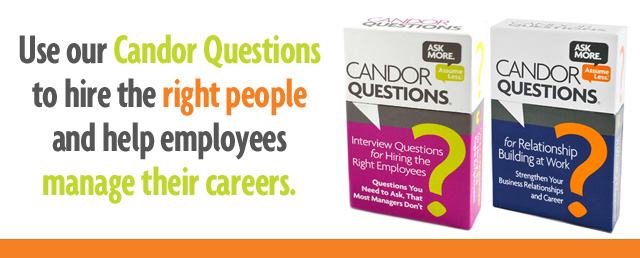
I recommend asking the seven questions below. I call the questions, Candor Questions.
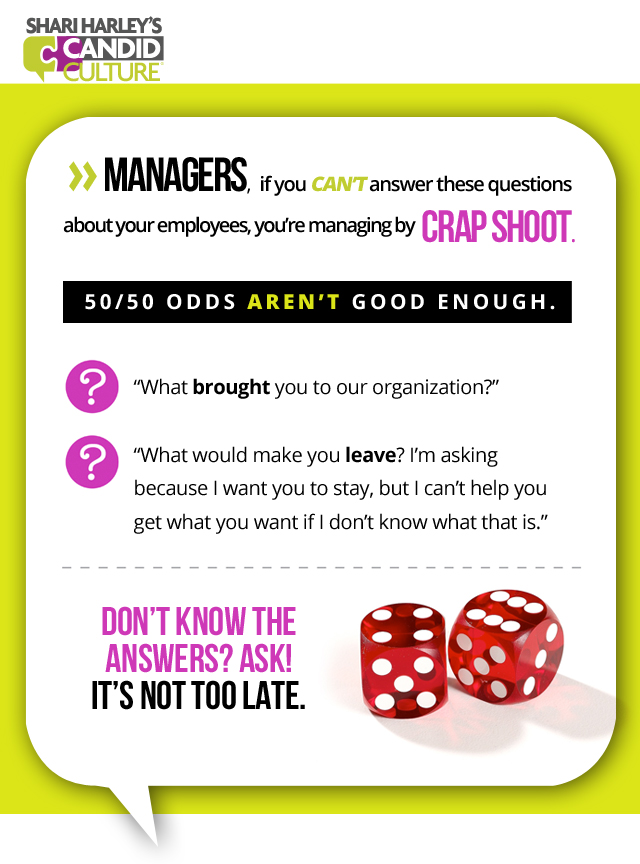
Candor Question number one: “What brought you to our organization? Why did you accept this job? What are you hoping the job will provide?” Ask one of these three questions. Pick the one you like best.
Candor Question number two: “What would make you leave this job? What are your career deal breakers, things you just can’t tolerate at work?” Ask either of these questions.
Candor Question number three: “What type of work, skills, and/or areas of our organization do you want to learn more about?”
Candor Question number four: “Tell me about the best manager you ever had. What made them the best manager?” This will tell you what the employee needs from you as a manager and is a much better question than, “What do you need from me as your manager?” That is a hard question to answer. Telling you the best manager they ever had is easy.
Candor Question number five: “Tell me about the worst manager you ever had? What made them the worst manager?”
Candor Question number six: “What are your pet peeves at work? What will frustrate you?” Why find out the hard way what frustrates employees when it’s so easy to ask. This question demonstrates that you want your employees to be happy and that you will flex your own preferences, when possible, to meet employees’ needs.
Candor Question number seven: “How do you feel about being contacted via cell phone or texts outside of business hours? How do you feel about receiving emails during the evenings and weekends? What time is too early? What time is too late?” When boundaries like work hours are violated, it often erodes employees’ loyalty to managers and organizations, and it’s such an easy question to ask.
If you’ve participated in one of our management trainings or received a box of Candor Questions for Managers, you know I could go on. But these seven questions are a good start.
Regardless of age, work, and educational background, employees have a few things in common.
Employees want to:
• Work for someone who takes an interest in and knows them
• Feel valued and appreciated for their contributions
• Be part of and contribute to something greater than themselves
• Feel respected as a person. Managers respect their time, expertise, and needs
Taking the time to get to know employees throughout your working relationship accomplishes many employee needs.
If you have long-time employees, it’s never too late to ask these questions. Regardless of for how long employees have worked for you, they’ll appreciate you asking. Don’t worry that employees will raise an eyebrow and wonder why you’re asking now. They’ll just be happy you’re asking. You can simply say, “I realized that I’ve never overtly asked these questions. I just assume I know. But I don’t want to do that. During our next one-on-one meeting I’d like to ask you these questions and you can ask me anything you’d like.”
If you have a manager who is unlikely to ask these questions, provide the information. Don’t wait to be asked. You’re 100% accountable for your career. Tell your manager, “There are a few things about me I want to share with you. I think this information will help ensure I do great work for the organization for a long time.”
Managers, the better your relationship with your employees and the more you know about what your employees need from you, the organization, and the job, the easier employees are to engage, retain, and manage. Stop guessing and start asking.
When I interviewed for my last job, before starting Candid Culture 19 years ago, the CEO put a mug in front of me with the company’s values on it and asked if I could live by those values at work. He was smart. Hiring someone with the skills to do a job is one thing. Hiring someone who fits into the organizational culture, is another.
Determining if a prospective employee will fit your organizational culture is much harder than determining if someone has the skills to do a job. Often when an employee leaves a job, only to take the same role at another company, they left for fit. They just didn’t feel comfortable. They weren’t a good fit with the organizational culture.
You’ve probably heard discussions about employees who deliver results at the expense of relationships. Or about employees who fellow employees really like, but they just can’t do the job.
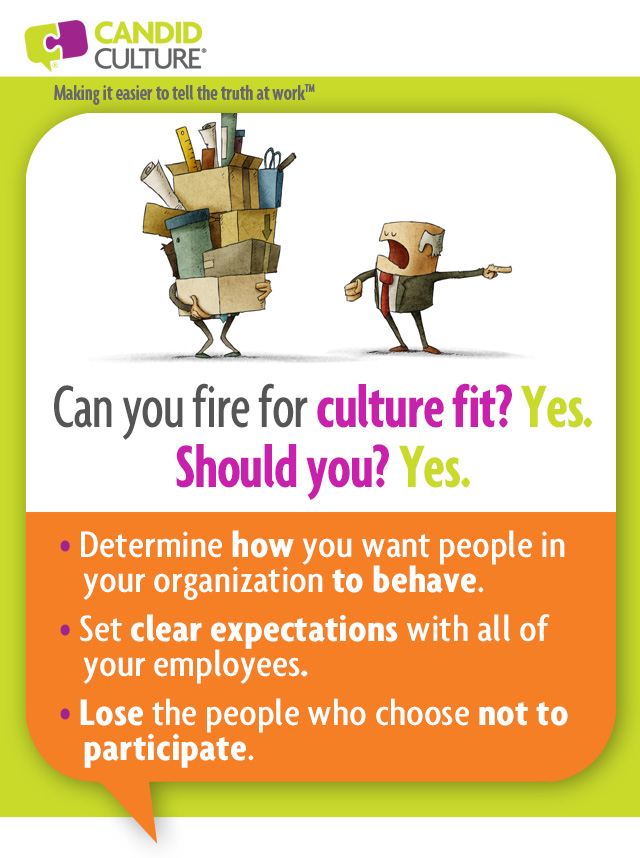
Leaders of organizations need to decide what’s important: What people do? How they do it? Or both. I’m going to assert that both the work employees deliver and how they deliver that work is equally important. I think you should hire and fire for fit.
Work hard to hire people who will fit into your organizational culture. Get rid of people who don’t fit. The impact on your organization’s reputation and on internal and external relationships depends on hiring people who behave consistently with your brand and how you want your organization’s culture to feel.
At Candid Culture, we teach people to have open, candid, trusting relationships at work. Thus, we must hire people who are open to feedback and communicate honestly, and we tell people who don’t model those behaviors to find a better fit
Here are a few ways to ensure you hire people who are a good organizational culture fit:
Share your current or desired culture with job candidates early, often, and clearly.
Work to assess how candidates fit the culture. Use practical interviews, job shadowing, and reference checks to assess organizational culture fit.
Talk about the culture when onboarding employees.
Make behaving according to the culture part of your performance appraisal process.
Reward behavior that matches the culture.
Have consequences for not acting according to the culture. A negative feedback conversation is a consequence.
Ensure your leaders and managers live the culture. Eliminate leaders and managers who aren’t a good culture fit. This takes courage.
When people leave an organization, they don’t often take copies of reports they produced or work they created. And if they do, they rarely look at that work. What they do take, remember for years to come, and find meaning in, are the relationships they built at work. Relationships are dependent on organizational culture.
Determine the organizational culture you want. Talk about it regularly. Require people to act according to the culture. Reward the ones who do. Get rid of the ones who don’t. Make working in your organization feel as you want it to feel.
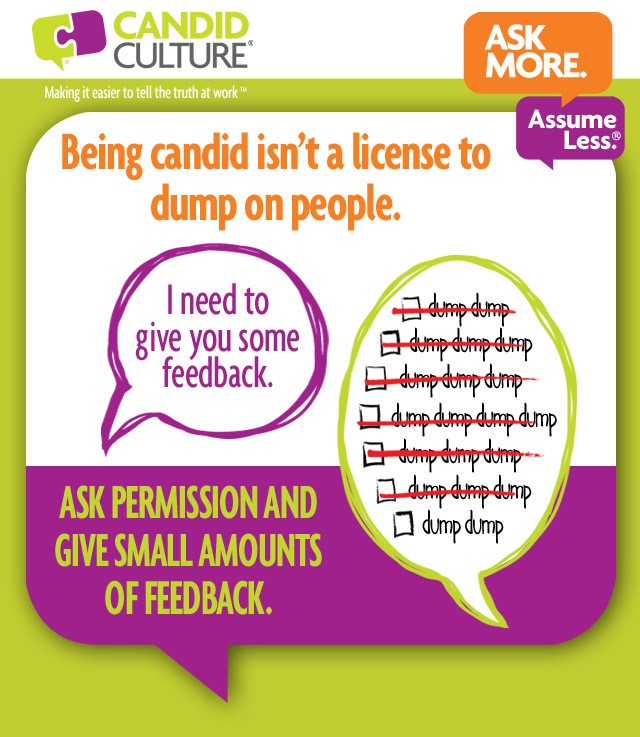
People leave feedback training armed with new skills and unfortunately sometimes use those skills as a weapon. It goes something like this, “I need to have a candid conversation with you.” And then the person proceeds to dump, dump, dump. This couldn’t be more wrong, wrong, wrong.
When you give someone negative feedback you are essentially telling the person they did something wrong. And who likes to be wrong? The ego gets bruised, and people often start to question themselves. This normal reaction doesn’t mean you shouldn’t give feedback, you just need to do it judiciously.
Ask yourself these four questions when deciding whether or not to give someone feedback:
Do I have the relationship to provide feedback? Does the recipient trust me and my motives?
Do I have permission to give feedback? If the recipient doesn’t work for you, you need permission to give feedback.
Is this something the person can do something about? If it’s not a change the recipient can make, keep your thoughts to yourself.
Is the feedback helpful? Ultimately the purpose of all feedback is to be helpful.
Let’s say you’re on the receiving end of too much feedback. What should you do? It’s ok to say “no thank you” to feedback. Here’s what you could say:
“Thank you for taking the time to bring this to my attention. I really appreciate it. You’ve given me a lot of feedback today. I’d like something to focus on that I can impact right now. What’s the most important thing I should do?” You’ve validated the other person and demonstrated openness and interest. You’ve also set some boundaries and expectations of what you will and won’t do.
“Thank you for taking the time to share your requests about… We won’t be making any changes to that and here’s why.” It’s ok not to act on all feedback, simply tell people why you won’t.
“I appreciate your concern. I’m not looking for feedback on that right now.” Can you say that to someone? Yes. Should you? Sometimes. To your boss – no. To someone who offers unsolicited advice that’s outside of their lane, yes. They’ll get the message.
People can only act on and digest small amounts of feedback at a time. Be judicious and assess your motives. The purpose of feedback is to be helpful, when the feedback is requested, and when you have the relationship to give it.
If you receive too much feedback or unsolicited feedback, it’s ok to decline. You’re not the 7-11, aka you’re not always open.
You will be passed over for jobs, projects, and opportunities – personally and professionally. People will choose not to buy from you, and they’ll choose not to be your friend. And that’s ok. Not everyone is our right “customer.” The key isn’t to win every opportunity. Rather, it’s what we do when we don’t get what we want.
When you’re done feeling disappointed, mad, and frustrated, get curious. Find out why you were passed over. I’ll never suggest you make changes. I simply want you to know what’s standing in your way, so you have power – the power to choose.
We all have blind spots – things we do that are off-putting to others, that we’re not aware of. For the most part, people won’t tell us our business blind spots, instead, they simply pass us over. Being rejected is feedback, it’s just not specific enough to help us make different choices. If you want to be able to change your behavior, you need to know what behaviors are standing in your way. Then you can choose what, if anything, to do about those behaviors.
When you get turned down for an opportunity, practice these strategies to eliminate your business blind spots:
Allow yourself to have an emotional reaction, to feel disappointed, and to grieve the loss.
When your emotions dissipate, call people who can tell you why you were turned down and ask for feedback. The goal of the conversation: Eliminate your business blind spots.
Be humble and open.
Consider saying something like, “Thank you so much for considering me/us to support your needs. We were disappointed not to win your business. Would you be willing to share what had you choose a different provider and what we could have done differently to be a stronger candidate? I’ll be grateful for anything you’re willing to tell me.”
Depending on the circumstances, you could also say something like, “I wasn’t put on the _______ project. I wonder if you have any information as to why. I appreciate anything you’re able to tell me. Your input will help me grow and eliminate my blind spots.”
Regardless of what you hear, thank the person for the feedback. You can ask for additional information and ask who else you can talk with, but don’t become defensive. The less defensive you get, the more feedback you’ll get. Make it easy to tell you the truth.
Remember, information is power, and power is control. Many people don’t give direct feedback because they’re afraid of the other person’s reaction. Surprise people by being open to feedback and eliminate your blind spots.
Validate feedback that doesn’t feel right to you. If you’re not sure what someone told you is accurate, vet the feedback with other people you trust. Simply ask other people who are aware of your performance, “I received this feedback. Does that resonate with you?”
Sit with the feedback for a few days before taking any action.
When your emotions have passed, decide what – if anything – you want to do with the input you’ve received. Perhaps you want to make changes. Perhaps you don’t. Either way, you have more power than you did before you received any input.
You won’t win them all. The key isn’t avoiding rejection, it’s what you do when you don’t get what you want. Be brave. Be open. Ask for feedback. And you’ll have the power to make different choices next time, if you want to.
I’m consistently shocked and embarrassed by what comes out of my mouth when I’m mad. It’s like reason and self-control go out the window. Emotion and the need to be right takes over. Every time I react in the moment, I regret it. Every single time.
Talking with another person when we’re upset, often leads to more upset. Emotions and conversations escalate quickly. The more upset we are, the more likely we are to say things we’ll regret. The time to alter how we work, live, and communicate with someone, is when there is nothing wrong.
If you want something in a relationship to change, pick a time when things are calm and when no one is upset to have a conversation. Tell the other person that you want to talk about how you work together, manage disagreements, make decisions, handle disappointments, etc. Share what you have observed in the past and make requests. Brainstorm solutions together. You’ll have a much better conversation when you’ve had time to calm down from whatever happened that created the need for the conversation.
Waiting to have a conversation until you’re not upset creates the risk of waiting too long to address concerns. The right time to talk about a breakdown is as soon after an event as you can. When both people are calm and have time to have the conversation, usually within a few days of a challenge.
There is no talking to my nine-year-old about why I impose certain limits in the moment. He’s too upset. I need to wait to talk to him about the behavior I want to see when he’s calm. Typically, that’s later the same day. Adults may take a little longer. But this isn’t a pass to wait six weeks, which is what we often do. The conversation won’t be as hard or as bad as you think if you talk when you’re calm and speak from what the relationship needs.
Speaking from what the relationship needs is saying just what you need to, not more and not less, to resolve the challenge and create a better way to handle things in the future. And communicating in a kind and direct way, so the other person can take in what you have to say.
Agree upon better ways of handing challenges, when no one is upset. Speaking directly, calmly, caringly and with the desire to make things work, typically has a positive result.
At some point in your career, you will likely get feedback that doesn’t feel accurate. When receiving feedback you question, rather than dismiss it, vet the feedback with the people who know you best. Assemble a core team of people who know you well, love you, and have your back. The relationships may be personal or professional. These are people who will tell you the truth (as they see it) if you ask.
You might think that you’re a different person at home and at work, thus your friends’ and family’s input isn’t valid in the workplace. I don’t think that’s true. You are who you are, and you’re not a completely different person at home and at work. It’s just not possible to be your real self and turn it on and off at work. Sure, you might have a communication style that you only use when working. You may make decisions at work differently than in your personal life. But you’re not a completely different person after 5:00 pm. If you’re often late, don’t keep confidences, talk too much and too long, or wear clothing that is not your friend, your personal relationships can tell you that.
It’s important to know how you come across, your reputation, and your wins and losses at work. Having this information allows you to manage your reputation and in turn, your career.
The question is, with whom should you vet feedback that doesn’t feel quite right? Here are four criteria for core team members:
Your core team should be made up of a small number of people (five or fewer) who know you well, love you, and have your back.
You should respect core team members’ opinions.
You must trust your core team and their motives, in relation to your well-being.
You must be open to core team members’ feedback.
Core team members don’t need to be told they’re on your core team. Simply call these people individually when you need input. Tell them the feedback you’ve received and then ask for their opinion. And be sure to tell them that you’ll take their feedback graciously, by saying “thank you”.
It’s easy to dismiss feedback that’s hard to hear. The feedback you receive might just be that person’s opinion. But people talk. And one person’s experience of you can impact your career greatly. Manage your career assertively and powerfully by knowing your reputation. Find out the impressions you create. Then you can make decisions about changes you will and won’t make.
Last week one of my friends was concerned about something happening at her son’s camp. She wrote out what she planned to say to the camp’s executive director and sent it to me to read. Her letter was long, with lots of unnecessary details. I read five paragraphs before understanding what the situation was even about. I revised her letter. My version was three sentences and easy to write. Why? Because it’s not my child and not my situation.
One of the things that makes giving feedback and making requests particularly difficult, is our emotional involvement. We’re invested in the outcome. The stakes feel high. And that emotion makes everything harder.
If you’re struggling with a message you need to deliver, get some help. The person who helps you craft a succinct, specific, and unemotional message doesn’t have to be a feedback expert or a manager. The person just can’t be involved. As long as the person isn’t emotionally involved, they’ll be helpful.
When you ask for help, don’t ask for advice. Instead of asking a friend or colleague, “What would you do in this situation,” ask, “What would you say?” These are very different questions. You want the specific words to resolve whatever you’re struggling with.
Asking someone for help planning a challenging conversation or message begs the question, isn’t asking for that type of help a form of gossip? It could be. So be careful who you ask.
When asking for help planning a message or conversation, ask someone in your organization who is at your same level or above (title-wise) or ask someone outside of the organization. Change the names of the people involved; protect people’s anonymity. And be clear if you are asking for help to plan a conversation or if you are venting. They are not the same.
The most effective feedback and requests are unemotional, factual, and succinct. Sometimes we need other people who are not involved to help us get there.
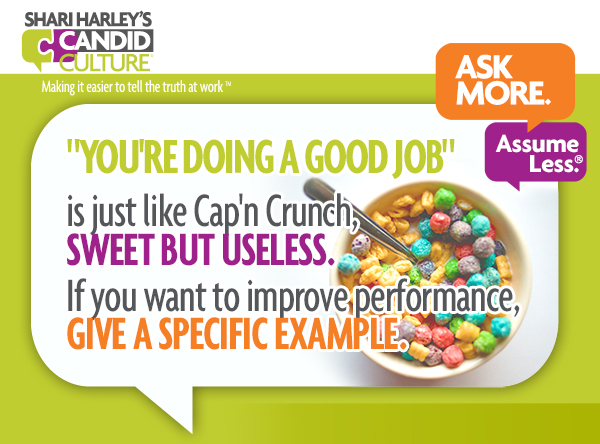
Most of the feedback people receive in the workplace isn’t feedback at all, it’s what I fondly refer to as Cap’n Crunch – vague and unhelpful words that put people on the defensive but don’t change behavior. If you want people to do something differently, give specific feedback.
Most of the fake Cap’n Crunchfeedback people get sounds like this:
“You did a great job on that.”
“You’re doing really good work.”
“You’re dressing inappropriately.”
“You’re difficult to work with.”
None of this is feedback. It’s all Cap’n Crunch. Vague, vague, and more vague.
The first words out of your mouth will invariably be Cap’n Crunch. Follow those words with, “for example” and you’ll be headed in the right direction.
“You did a great job on that. For example, I never had to ask about the status of the project. You gave me an update every Friday, and that made me feel comfortable that we were on track.”
“You dressed inappropriately for that meeting. For example, the client was dressed in business casual; you wore jeans and a t-shirt. Next time, please dress as the client dresses or a step above in khaki pants or slacks and a jacket.”
Most people are afraid to give feedback because they don’t want to deal with the defensive reaction they anticipate. The more vague you are, the more defensive people will be, because they don’t know what you’re talking about and they feel judged. Vague feedback is subjective. Subjective is judgmental. Feeling judged puts people on the defensive.
If employees shop your feedback around, asking what others think of the feedback you provided, it’s because you were vague, they disagree with you, or they’re being defensive. Feedback will be received better and resisted less if you’re specific.
Specific feedback can be captured on video. Meaning, you can video someone calling into a meeting late, rolling their eyes, and texting on their phone. I dare you to video “you were disrespectful in the meeting, you dressed inappropriately, or you’re difficult to work with.” If you can’t capture the feedback on video, you don’t yet have specific feedback. You have Cap’n Crunch.
When I teach managers to give feedback I ask the managers to, “Describe the situation to me. What did the person do?” Managers often reply with, “They were negative.” This is Cap’n Crunch. So, I keep asking questions. “What did they do that was negative? What did it look like?” After two or three questions the manager tells me, “I overheard them complaining to other employees about the decisions the company is making. I’d rather they ask me questions about the direction we’re going versus gossip to peers.” Now we have specific feedback.
Wait to give feedback until you have a specific example. If you don’t have a specific example, go get one. Without an example, employees will look at you in a confused way, question the validity of what you’re saying, and become defensive. And they’ll be justified in doing all of these things.
Most of us dread giving feedback because we don’t want to deal with people’s defensive responses. If you want more help, chapters nine through twelve of How to Say Anything to Anyone provide a clear and easy-to-follow formula for giving specific feedback.
Remember, if you’re not using the words “for example” you’re not giving specific feedback.
Wearing too much perfume, cologne, or other scented products will make people scatter or wish they could. Unfortunately, rather than tell you that you’re wearing too much, people will just avoid sitting near you. Scent is such a personal thing, like clothing choices, that people are hesitant to comment on it.
I suggest not wearing anything scented at work, on airplanes, or when you’ll be in close proximity with other people you don’t know well. But if I can’t persuade you to skip the scent, here are a few guidelines when putting on cologne and perfume:
• Spray the air ten inches in front of you, and walk through the mist, rather than spraying your skin.
• If you can smell the scent on yourself or people who are more than a few inches from you can smell it, you’re wearing too much.
• You should never be able to smell a person’s cologne after they’ve left a room.
No, I’m not an expert on how to wear perfume. I googled it. I’m an expert at how to talk about how scents impact you and your work environment.
The next step is to ask a few people you trust to tell you when you wear too much perfume or cologne. Give people permission to give you this feedback and promise you won’t bite their head off when they do. This could sound something like, “I want to be sure I’m not wearing too much perfume/cologne. Would you be willing to tell me when I do? I promise I won’t freak out or jump down your throat. I really want to know.”
Let’s say you work with someone who wears too much perfume, cologne or other scented products. They haven’t asked if they’re wearing too much, and you want to say something. You could say something like, “This is a bit awkward, but the perfume/cologne you wear is a bit overwhelming. Would you be willing to wear less or none when you’re in the office?” This is an awkward conversation that most people don’t want to have. Consider that you’re doing the person a favor. Would you rather know the amount of scent you wear keeps other people away, or would you rather alienate the people around you?
If the relationship is a personal one, you could say, “You wear the most lovely cologne/perfume. I’m very sensitive to scents. Would you be willing not to wear perfume/cologne when we’re together?” Again, this is an awkward conversation. But you won’t die from having it and the other person won’t either. When they get over being embarrassed and defensive, your relationship will be fine. And if it’s not, you didn’t have much of a relationship to begin with.


 It could sound something like this, “I just had a tough conversation with John in IT. You may get a call. Here’s what happened… I didn’t want you to be surprised.”
 she’s willing to have lunch with me, talk about what’s happened, and see if we can start again in a more positive way. What do you think of me doing that? Would you approach the conversation differently? I don’t know how it’s going to go, so I wanted you to know what I’m planning to do, just in case it backfires and you get a call.”