You open an email (or a few hundred) telling yourself you’ll reply later, but never do. Feeling ambitious, you agree to a deadline you can’t meet. Needing a break, you take a few days off but don’t put an out-of-office message on your email.
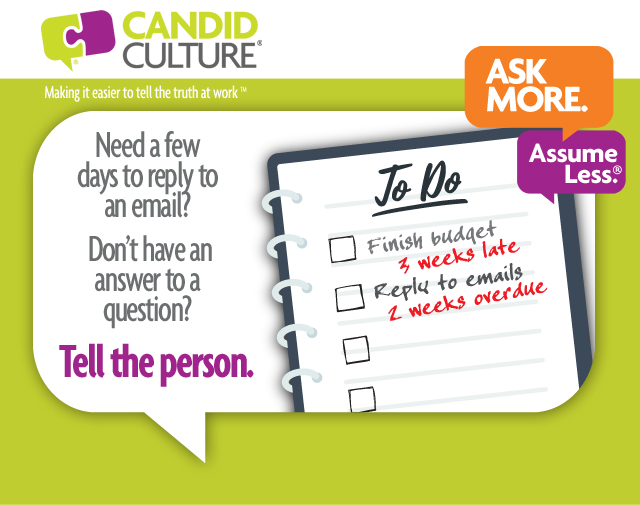
We’ve all taken too long to reply to an email, missed a deadline, or simply taken too long to provide someone with information. It’s ok to take time to respond, not to have all the answers, and take time off. We simply need to provide timely and accurate status updates.
When people don’t hear back from us in what they consider a timely way, they start to wonder (at best), and judge us (worse), or tell others we’re non-responsive and unreliable (worst). Don’t make people wonder if you received their message, send a timely status update and tell the truth.
If you’re behind and need more time than usual to respond to emails, tell people that. Respond to emails within 24-hours and tell senders you received their message and it will be (fill in the blank) before they hear back from you. When you get an email that requires research, respond within 24-hours and tell the person how long it will take to find the information. If you’re out of the office and don’t plan to read or respond to emails, tell people the dates you’re out.
In the absence of knowledge people make stuff up, and it’s never good. Filling in the blanks isn’t malicious. People simply have a need to know what’s happening. And when they don’t know, they invent stuff. It’s how the brain works. When we don’t hear back from people in what we consider a timely way, we start to wonder. “Did they get my message? Why aren’t they responding? What’s wrong?”
It’s ok to need time to respond. It’s ok to be running behind. It’s ok to take time off. Simply let people know the true status. Manage your reputation and business relationships. Don’t make people guess.
Many businesses are struggling to overcome negative and permanent online reviews on Yelp, Google, TripAdvisor, Glassdoor, etc. And they’re wondering why customers and employees go online vs. giving feedback directly. The answer is simple.
Giving feedback online is easy. Giving feedback directly is harder, for many reasons. No one wants to be the person who complains. Feedback is likely to be received with a defensive at worst and explanatory at best response, and who really wants to deal with that? At work we fear we’ll get “in trouble” for giving feedback, etc. etc. I could go on and on.
Customers go to Yelp and Google when they either don’t have an alternative or after they have provided direct feedback and didn’t feel heard. Provide customers an easy method of giving feedback and they won’t need to go to Yelp. This is true for your employees too.
If you want your customers and employees to give you feedback directly instead of blasting you online when they’re unhappy, make it easy to give you feedback, regularly.
Here are four ways to help prevent negative online reviews and improve the data you get from customers and employees:
Ask customers and employees for feedback regularly. Don’t wait until the end of the year or after a service has been provided to ask for feedback. Ask for feedback during the customer’s experience. Ask employees for feedback every 90-days.
If you’re going to send online surveys, keep them short. Never ask a customer more than five questions, and two is better. Ask a version of, “What are you appreciating about your experience? What could we change on your behalf?” What else do you need to know? Too many businesses send exhaustive and exhausting surveys to customers after a service has been provided. It’s unrealistic to expect customers to complete 30+ survey questions. Keep it short. You’ll see better response rates.
Call 10% (or fewer if you have thousands of employees and customers) and ask for feedback. It’s such a rare occurrence to receive a phone call asking for feedback, it’s an immediate loyalty and relationship builder.
Don’t request a positive score on a survey. Sending a survey and asking for a certain response type is a turnoff. Uber drivers who ask me to rate them a five never get that rating. The best way to get an awesome rating is to be awesome.
Ask for feedback early and often, and make it easy to give. P.S. And no anonymous surveys – a topic for another day.
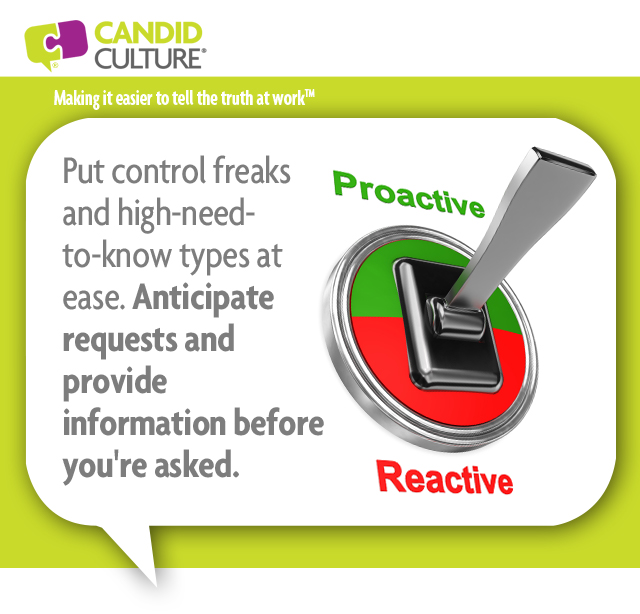
Frustrated by a control freak, micromanager, or a high-need-to-know type? Controlling behavior stems from a need that isn’t being met. Identify the need, meet it, and your life gets easier.
If someone wants more updates, information, or involvement than you’re comfortable with, the person has a need that isn’t being met. When you meet the need, the person will likely back off.
I ask the people who work for me to not make me ask for anything twice. Meaning, if I ask for an update the week before a speaking engagement, anticipate that I’ll want that information for all engagements. Confirm by asking me and then provide the data without being asked for all future engagements. Getting the information regularly without having to ask builds trust and credibility.
Here are six tips for working with control freaks:
1. If you don’t know, ask:
The person’s work-related goals. What are they working on this quarter and year?
What the person is concerned about at work? What are they worried about?
How do they like to communicate – in-person, email, phone, video, voicemail, or text?
How often do they want information, in what format, and with how much detail?
2. When you first begin working with someone, provide more information than you think you need to, and then confirm the person wants that information in the future.
3. If you’re asked for information, ask if they want the same type of information in the future. Then provide the information before you’re asked.
4. If someone is overly involved in your work and you feel you have no freedom, state your observation, and ask for information. That could sound like, “I’ve noticed you’ve been involved with the major decisions with this project. I’m used to working with less oversight. Do you have a concern about my approach?” Then you negotiate. Everything is a negotiation.
5. The approach in number four will likely put the other person on the defensive. A less confrontational approach is to discuss and agree upon levels of involvement and supervision when projects begin. That could sound something like, “What kind of involvement do you want to have in this project? What parts of the project do you want to do? What parts do you want me to do? What kind of updates would you like, how often, and with how much detail?” It’s always easier to prevent a problem than to fix one.
6. Lastly, don’t take anything personally. Oversight and involvement may be a reflection of how someone feels about your performance, but it might not. When in doubt, ask.
Last week I had lunch with people I worked with twenty-seven years ago. Twenty-seven years. I have long forgotten the projects we worked on, deadlines, and deliverables that were important at the time. What I do remember, are Jim and Siobhan. Some of my closest friends and the people most important to me in the world, are the people I’ve worked with.
It makes sense that we make friends at work – it’s where we spend a lot of time. And the people we work with make work fun or miserable. Building relationships and making friends at work are a couple of reasons virtual and hybrid work may feel challenging. I’ve never met Sarah who lives in California and codes our website, or Jessica, our attorney in Boston, and I rarely see Dana, who works for Candid Culture and lives in Arizona. But I feel connected to them, nevertheless. We email, text, and meet via video and phone.
There is a considerable amount of research citing the connection between having good business relationships and employee engagement, retention, and performance. When we feel we belong and have good relationships at work, we are happier and do better work. It makes perfect sense.
As I’m writing this, I’m thinking about my past coworkers who I traveled with for weeks on end, who also endured a CEO who made us practice and re-write presentations until 1:00 am for a meeting the next morning, and the coworkers I worked with at the World Trade Center. As much as I appreciated and cared about the people I worked with, I’m not sure how often I told them that they made my work world better.
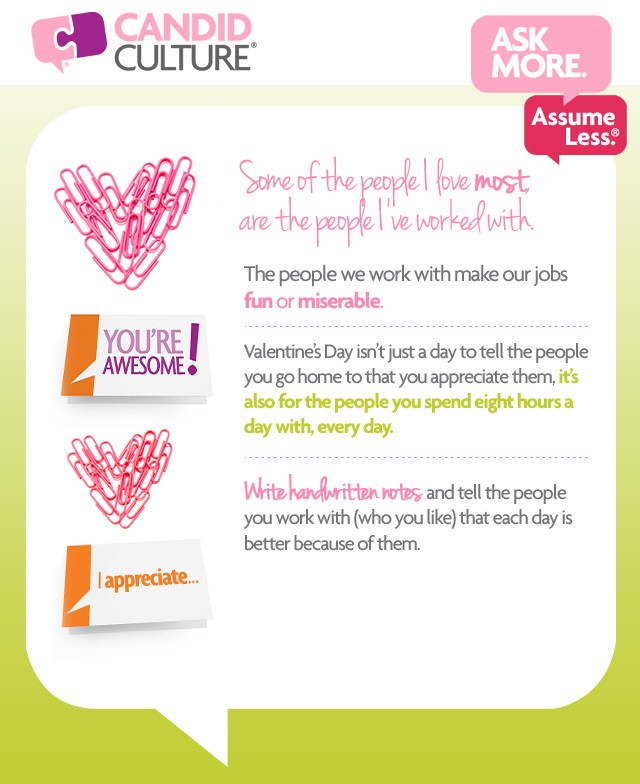
Valentine’s Day is a day we express appreciation for the people closest to us. Don’t limit your appreciation to your loved ones at home – include your coworkers who make work fun and help you get things done. Of course, I hope you’ll express appreciation more than once a year, but Valentine’s Day is an occasion not to miss.
Write the people you work with, who matter most to you, a handwritten note that they’ll keep for a long, long time. You can see our assortment of greeting cards for the workplace HERE. I’ll admit that I collect stationery and love giving and receiving handwritten notes. I suspect the people you work with will appreciate receiving a handwritten note too.
I recently interviewed a candidate who asked for a lot of ‘stuff’ during the interview process. She wanted compensation, perks, accommodations, and benefits that were way outside the norm. I’m assuming she was employing the adage we’ve all heard, that “it can’t hurt to ask.” Unfortunately, it can hurt to ask.
When forging new relationships, we watch (judge) people. We’re trying to figure out who they are and how they are. Are they the person they claimed to be during the interview process? Are they trustworthy? Did I make the right decision in bringing this person into my team, organization, and life?
Requests always make an impression. When we’re building new relationships, requests make an even bigger impression. Candidates who said the commute wouldn’t be an issue, but complain about it two weeks into the job, cause managers to doubt their hiring decision. Coworkers who consistently ask for extensions to deadlines, appear unreliable.
People watch us and silently judge, making assessments about our commitment, reliability and even character. Don’t make people question you. Make reasonable asks.
Five ways to make reasonable requests:
Vet your requests with people who know your company, manager, and/or industry, before making them. A reasonable request in one organization, might not be reasonable in another.
If something is important to you, ask for it during the interview process or at the onset of new projects and relationships. Don’t wait. Waiting to ask for things until after you’ve started a job can damage your relationships and reputation. Managers don’t like bait and switch, even when it’s unintended.
Once you’ve received an emphatic “no”, accept it. I worked with someone who asked for something during the interview process. I said “no” and explained why. He asked again after being hired. This annoyed me and made me feel like he didn’t listen.
If you think a change should be made in your organization, propose a solution. Offer to be the person who drives the process, if appropriate. Pursue the change over a period of months. Ask up to three times for changes to be made. If nothing changes over a period of months, ask the leader you’ve been working with if you should stop asking. The change may not be a priority, and over asking can make you look like a pest who doesn’t understand the organization’s priorities.
If you aren’t sure that what you’re asking for is reasonable, say so. Tell the person what you want and to please tell you if it isn’t a reasonable request.
Ask for feedback on your requests. If you’ve seen me speak, you know I’m a proponent of telling people, “If I do anything that damages our working relationship or makes you question me, I hope you’ll tell me. I promise I’ll take your feedback graciously and say, “thank you.”
Ask for what you want, within reason, be upfront when relationships begin, and build your relationships rather than break them.
Many people struggle to say no. As a result, when someone has a request that we can’t or don’t want to meet, we often say nothing. We simply don’t respond. Or we put the person off, telling them we’ll get back to them. Then people wonder. “Did they get my request? Should I send the request again? Will I look bad if I ask again? How many times should I ask before I just let the request go?”
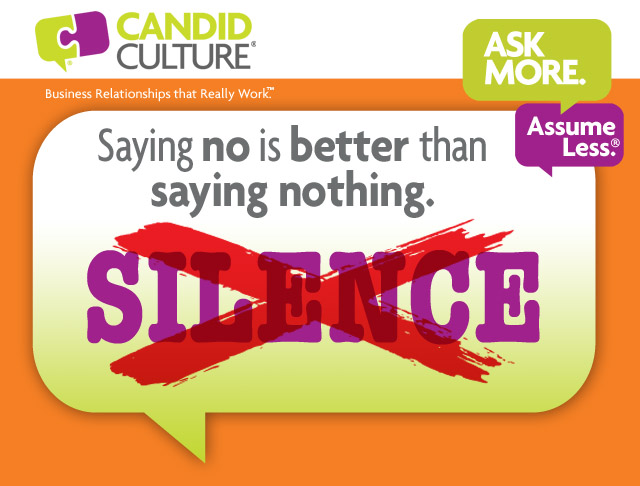
Saying no is better than saying nothing. No gives people closure. Silence leaves people in limbo wondering what they should do next.
Saying no can be hard. We don’t want to disappoint or let people down. And yet, you can’t say yes to everything. You can say no and still sound like a responsive, easy-to-work-with, accommodating professional.
Here are ways to say no:
Thank the person for asking. “Thank you for asking me.”
Saying “thank you” acknowledges the other person and buys you time to think about their request.
Tell the person you need some time to think about their request. Ask, “Can I have a few days to think about it? I’ll get back to you by Friday.”
You don’t need to reply in the moment. I often regret things I agree to without thinking through the request thoroughly.
Consider what you really want and are willing to do. It’s much worse to over commit and under deliver than to simply say no or renegotiate requests.
Get back to the person in a timely way (when you said you would) and tell them what you’re willing to do.
How to Say No Option One: Simply say no.
Example: “I really appreciate you asking me to write the proposal for the __________ RFP. I’m not able to do that. Can I recommend someone else who has the expertise and time to do a great job?”
Don’t give a bunch of reasons for saying no. People aren’t interested in why we can or can’t do something; they just want to know if we will do it.
How to Say No Option Two: Agree and negotiate the time frame.
Example: “I’d be happy to do that. The first chance I’ll have to work on this is the last week of the month. Does that work for you?” If the answer is no, negotiate further. Ask, “What is the hard deadline? I can certainly do pieces by then, but not the whole thing. Given that I can’t meet your timeline, who else can work on this in tandem or instead of me?”
How to Say No Option Three: Say no to the request but say what you can do.
Example: “I can’t do _______. But I can do ________. How does that work?”
A review of how to say no:
Acknowledge the request by getting back to the requestor within 24 hours.
Give yourself time to think about and respond to requests.
Negotiate requests to your and the requestor’s satisfaction.
Agree on what you can and are willing to do.
Keep your commitments.
Saying no is hard. But it’s always better to say no than to ignore requests, or to say yes and do nothing.
If you work long enough, you will have a manager who doesn’t delegate well, doesn’t give feedback, and isn’t a great coach. Not everyone is a good manager.
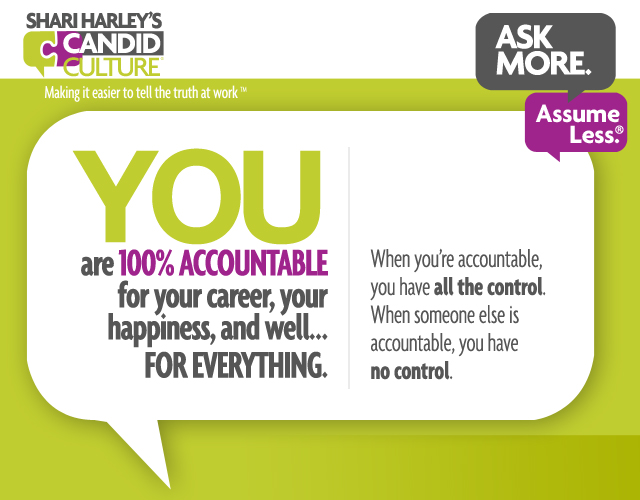
You’re accountable for being successful, regardless of who you work for. Don’t wait for people to tell you what they need and expect, which often happens after breakdowns occur. Set clear expectations at the beginning of anything new and ask for feedback as you make progress. Take your career and success into your own hands. I call this reverse delegation.
Reverse delegation defined: Asking questions until you’re clear what a good job looks like and asking for work to be reviewed in stages, versus solely at the end of a project, ensuring you get all the information you need to be successful. Ultimately, taking your career success into your own hands, where it belongs.
The people you work for and with should tell you what they expect. They should give you feedback along the way. And many won’t. Your career is in your hands, and that’s a very good thing.
When you start a new job, project, or any responsibility, ask the person delegating the work some of these reverse delegation questions:
Reverse Delegation Question one: Why is this project a priority right now? How will it impact the organization?
Reverse Delegation Question two: What does a good job look like? What’s the criteria for success?
Reverse Delegation Question three: What kind of updates would you like? In what format, how frequently, and with what level of detail?
Reverse Delegation Question four: Who in the organization should I work with on this project?
Reverse Delegation Question five: What history, pitfalls, or landmines do I need to be aware of? Has anyone tried to do this before, and if yes, with what outcomes?
Reverse Delegation Question six: Who in the organization supports this project? Who doesn’t?
If you’ve been in your job for a long time or have been working on a project for a while, it’s not too late to ask these questions. Simply approach the person with whom you’re working and say, “I want to be sure I’m doing great work on _____________ project. Can I ask you a couple of questions about the desired end results and how we should be communicating, as I make progress?”
Lots of people aren’t the best delegators. They give us a project, ask if we have any questions, and provide a due date. Don’t fall into the trap of completing an entire project and then asking for feedback. Even if the person delegating the work doesn’t want to review work as it’s completed, ask for that feedback. Schedule weekly or monthly review meetings, present the work you’ve done, and ask for feedback. If you’re worried asking for iterative feedback will make you seem needy or like you don’t know what you’re doing, explain why you’re asking. Say something like, “I want to give you precisely what you’re asking for and don’t want to squander the organization’s resources.”
If you get to the end of a project or responsibility and what you deliver isn’t what the person delegating expected, you didn’t ask enough questions at the beginning and middle of the project, and didn’t get feedback along the way.
People will tell you everything you need to do a good job, if you ask. Take control of your career. Ask more. Assume less.
Breakdowns happen. There will be days people won’t give you what you need to complete projects. Things will break. And you will look bad. When breakdowns happen, I always ask myself, “What could I have done to prevent this situation?” or “What did I do to help create this situation?” I see myself as accountable for whatever breakdowns occur.
It may sound odd that I always look at myself when breakdowns occur, even when it’s someone else who didn’t do their job, but it’s just easier. I can’t control anyone else. But I can control me (admittedly, some days I do a better job at this than others). When I can identify something I could have done to make a situation go differently, I feel more in control – aka better.
It’s like getting off a highway versus sitting in bumper-to-bumper traffic. The alternate route may take longer, but at least I’m moving. I feel like I’m doing something and thus have more control. Taking responsibility for everything that happens to you is similar. When you’re accountable, you can do something to improve your situation. When someone else is accountable, you’re at the mercy of other people and have very little control.
There are, of course, exceptions to the practice that “we’re always accountable.” Terrible acts of violence, crime, and illness happen to people, about which they have no control. But in general, in our day-to-day lives, there is typically something we did to contribute to a bad situation or something we can do to improve it.
Here are five practices for improving difficult situations at work, even when you didn’t create the mess (alone).
1) Ask more questions. If you’re not clear about what someone is expecting from you, ask. You’re responsible for doing good work, regardless of the type of direction you receive.
2) Tell people what you think they’re expecting and how you’re planning to approach a project or task, to ensure everyone’s expectations are aligned. Clarifying expectations beats doing several weeks worth of work, only to discover what you created isn’t what someone else had it mind.
3) Ask for specific feedback as projects progress. Don’t wait until the end of a project to find out how you performed.
4) Say “thank you” for whatever feedback you receive versus defending yourself. The person providing feedback will be pleasantly surprised at your receptivity, and their frustration will dissipate more quickly. This could sound like, “That’s good feedback. I’m sorry that happened. Thank you for telling me.”
5) Admit when you make a mistake or when you wish you had done something differently. Don’t wait for someone to tell you. Saying, “I’m sorry. How can I make this right with you?” goes a long way.
I consistently ask the following questions:
“What could I have done differently?”
“What did I do to contribute to this situation?”
“What can I do now to make this situation better?”
“What can I do to prevent this from happening again?”
I encourage you to ask these questions, even when someone else drops the ball. You can’t control others, but you can control you. And your happiness and success is your responsibility.
Lots of organizations send out employee engagement surveys with the desire of improving employee engagement and retention; unfortunately, they often damage both in the process.
There are a few employee engagement survey pitfalls that luckily are easy to avoid.
Here are three practices to follow when sending out employee engagement surveys:
Shorter is better. I hate to say this, but no one wants to fill out an employee engagement survey. It’s time consuming, employees doubt the survey will yield results, and they worry that their feedback isn’t really confidential.
Make your employee engagement survey easy to fill out by making it short. And by short, I mean 25 questions or fewer. You’ll get a better response rate to a 25-question survey than a 65-question one.
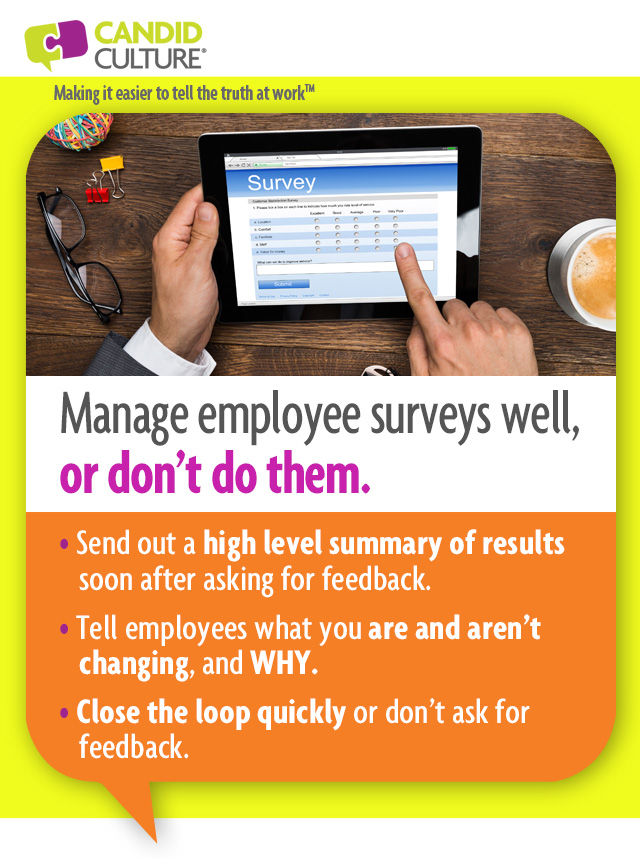
Provide employees with survey results quickly. Most organizations ask for too much information. Leaders are overwhelmed by the volume of survey information, so they spend months and months reviewing it, while employees comment on yet another employee survey with no communication.
Send out a succinct communication sharing the top few learnings – the good and the not-so-good — within a few weeks of sending out the survey. You don’t need to take action at the same time. Simply keep employees in the loop by communicating a quick summary of what you learned. If you wait too long to share the feedback, it often never gets communicated. And the next time you send out a survey, employees will remember the absence of information and be hesitant to fill it out.
Within 90-days, tell employees what you will and won’t be changing, based on the survey feedback, and tell them why. Employees don’t need or expect all of their input to be utilized. Closing the loop with clear communication about what you are and aren’t changing, and why, is often sufficient.
The people you live and work with are hesitant to give you negative feedback. They’re afraid you’ll freak out, and they don’t want to deal your freak out. It’s easier to say nothing.
When I started teaching how to give and receive feedback, I provided elaborate explanations as to the predictable response to feedback and the rationale for that response. Now I’ve boiled the natural response to receiving feedback to three words: The Freak Out.
Every person you know – personally and professionally – wants to be liked and approved of. Even the people in your organization who you think are lazy, want you to think highly of them. And when anyone calls another person’s competence into question, that person is likely to freak out (become defensive).
It’s very difficult not to get at least a little bit defensive when receiving feedback. A defensive response often sounds something like, “Thanks for the telling me that. Can I tell you why I did it that way?” The problem with that slightly defensive response is that what the other person hears is, “You’re not listening. I’m wasting my time talking to you.” People want to feel heard. And when the feedback recipient becomes defensive, the person giving feedback doesn’t feel heard.
Don’t feel badly about becoming defensive when you receive negative feedback. Becoming defensive when receiving bad news just means you’re a living, breathing human being with feelings. But The Freak Out scares people. They don’t want to deal with your mild, moderate, or very defensive reactions.
Because people want to avoid The Freak Out, they keep negative feedback to themselves, or worse, tell someone else. If you want more truth, you need to make it clear there won’t be negative repercussions for speaking up.
Here are seven steps to get others comfortable giving you negative feedback:
1. Ask for feedback.
2. Be specific about the type of feedback you want.
3. Tell the person from whom you’re asking for feedback when and where they can observe you in action.
An ineffective way to ask for feedback: “I really want your feedback. Feel free to give it anytime.” This is too vague and doesn’t demonstrate seriousness on your part.
A more effective way to ask for feedback: “I really want your feedback on the pace of the new-hire-orientation program. Are you available to call into the first hour of orientation next Wednesday at 9:00 a.m. and tell me what you think of the pace and why?” This request tells the person specifically what you want and demonstrates you’re serious about wanting feedback.
4. When you receive feedback, say, “Thank you for telling me. I’m going to think about what you’ve said and may come back to you in a few days to talk more.”
5. Don’t respond to negative feedback immediately. End that part of the conversation instead of responding.
6. If you’d like more information or want to tell the person you disagree with what they said, wait until you’re calm to have that conversation. That can be minutes or a few days later.
7. You can express a counterpoint of view, just don’t do it immediately after receiving feedback. Anything you say in the moment will likely sound defensive.
No matter what a person’s role in your life – your boss, a peer, external customer, or even a friend or spouse – it takes courage to give you feedback. When a conversation requires courage, the speaker’s emotions are heightened. If the feedback recipient’s emotions rise in response to the feedback, conversations escalate. This is how arguments start. If you want to put the other person at ease and get more feedback in the future, do the opposite of what people are expecting. Rather than getting even the slightest bit defensive, do the opposite. Say, “Thank you for the feedback. I’m sorry you had that experience. I’m going to think about what you’ve said and may come back to you to talk more.” Then end that part of the conversation. You’re not being dismissive; you’re ensuring your emotions don’t take over. If you want to have a second conversation, have it within a week. Revisiting the conversation in a timely way shows you respect what the other person is saying and both of you will remember the topic at hand.
Ending a conversation, when all you want to do is react, is very difficult. Putting a conversation on hold will require a good deal of self-control, but the rewards are great. You will build trust, strengthen relationships, and get more information than you have in the past – information you need to manage your career, reputation, and business.