In all of my years of working in and with organizations, I have
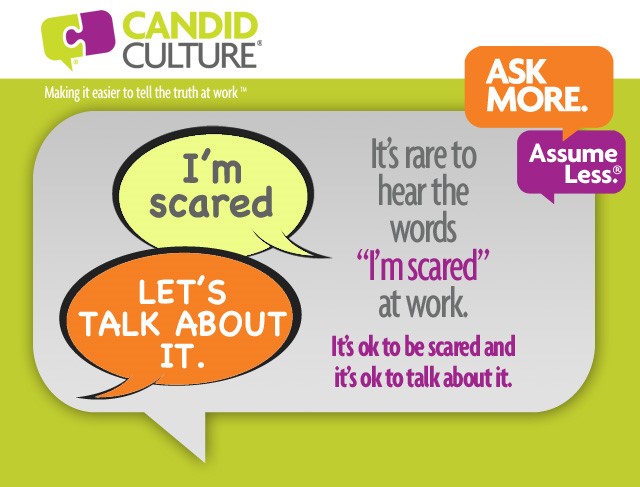
never heard anyone say the words, “I’m scared” at work. I’ve heard: “I’m
concerned” and “I’m uncomfortable,” but never the words, “I’m scared.”
These are scary times. It’s scary to go to the grocery
store, to know who it’s ‘safe’ to stand next to, and to travel.
Make it safe for employees to talk about their fears.
One of the first things I teach when I talk about change management
is letting people express how they feel – their worries, hopes, and concerns.
The people you work with are likely scared. They may be wondering if their job
is secure, what happens if they get sick, and are they doing enough work from
home with their kids present.
It’s hard to talk about fear because we think doing so makes us appear weak. Leaders and managers need to normalize the conversation. Make it ok to talk about how people feel at work.
Here are four steps to make it easier to talk about fear
at work:
Leaders and managers – admit what you’re afraid
of. People will take your lead. Admitting how you feel demonstrates strength
not weakness.
Tell people it’s ok to be afraid and it’s ok to
talk about fear at work. Sanction the conversation.
Give more information about contingency planning,
budgets and work from home and time off policies than you think you need to. Communicate, communicate, communicate. Then do it again.
Create a forum for people to talk about how they
feel about recent events and changes. Managers are not therapists or dumping grounds,
but you are coaches. You can help people work through their work-related fears
when you know what those fears are.
I’ve always believed that demonstrating our humanity at work
is a strength. Being authentic makes people want to work for and with you. Admitting
concerns makes you approachable and real.
Your employees and coworkers don’t need to know the details of
your whole life, but they do need to see your humanity and be able to relate to
you. Talk about how you feel and open the door for others to do the same.
I have a nanny who works in my home. She isn’t afraid of getting sick with the Coronavirus. She was going to the gym, before gyms were closed. I couldn’t tell her not to, however badly I wanted to. I could tell her not to come to work, but that doesn’t help me. How does a nanny work from home?
You are likely in a similar situation. You canceled your spring break trip, your direct report didn’t. You are practicing social distancing, your coworker who sits in the desk next to you isn’t. You’re keeping your kids at home; your next-door neighbors are not. Your kids want to play together.
You can’t
legally tell an employee or coworker what to do when they’re not working, but
you can tell your coworkers, friends, and family members that you’re uncomfortable.
You can make requests and express concern.
My son is on
the cusp of the cutoff to go to kindergarten in September. He just makes the
deadline. I’ve been asking his preschool teacher how I decide if I should send
him to kindergarten in September. His teacher’s criteria for determining if
children are ready for kindergarten is self-advocacy. Can children ask for what
they need and get their needs met. This is an interesting criterion that I see
adults struggle with all the time.
Do we (the adults)
regularly ask for what we need and want? Are we willing to be uncomfortable on
our own behalf, on our employees’ behalf?
The coronavirus
is testing all of us. It’s testing our patience, resilience, and self-discipline.
It’s also testing our personal courage in the area of speaking up.
Here are
a few ways to talk about the coronavirus at work:
Share
your concerns. Tell the
people you work with, “We work closely together. I’ve heard you talking about
attending parties and other events with groups of people outside of work. I am
very nervous about contracting the coronavirus virus. This is making me uncomfortable.
I can’t tell you what to do outside of work. Can we talk about what types of social
distancing we’re both willing to practice so we’re both comfortable?”
This will take
courage. If you can’t advocate for yourself, who will?
Make
requests. Tell your
boss, “I’m really committed to the project I’m working on with _______. I’m
working very hard to stay healthy and practice social distancing. I’ve heard _________
talking about going to parties and gatherings with other people outside of work.
We’re working closely together and it’s making me uncomfortable. I want to be a
good coworker and employee and protect myself. Can you help me?”
Self-advocacy
takes courage.
Caveat – Vet
any conversation you plan to have with your HR person or in-house counsel. Make
sure what you ask for is legal in your home state.
Share your
positive intentions:
“I want to be a good coworker.” “I want
to do good work on this project.” “I want to be easy to work with.”
Share your
concerns: “I’m concerned about getting sick. I’m trying
to limit my exposure to the coronavirus.”
Share your
observation: “I’ve
heard you talk about spending time with groups of people outside of work.” “I’ve
noticed you spending time with groups of people.”
Share how
you feel: “This is
making me uncomfortable.”
Make a
request: “Can we
talk about how we can keep each other safe?”
Creating a safe workspace and working environment requires the courage to speak up. Plan, practice, and prepare your conversations. Don’t speak off the cuff. Vet what you plan to say with your HR person or in-house counsel. Speak from your positive intention. Be courageous. Be safe.
At some point, you’ll get passed over for a promotion, project, or piece of work, and no one will tell you why. Why should they? There is little incentive to deal with your likely (human and normal) defensive response. It’s easier to say nothing.
The problem is that this lack of information gives you no ability to manage your career.
Most people get almost no feedback at work. “Good job” isn’t feedback. Neither is, “You seem distracted.” And being told, “You just weren’t the right fit,” is utterly unhelpful.
If you want to manage your career, you need more information. Getting this information might seem scary. You might be thinking, “What if I don’t want to hear what people have to say? What happens if I hear something really bad?” People are so hesitant to give feedback, they’ll likely be ‘nice’ to you. You won’t hear anything you can’t handle.
There are people in your life who will tell you the impression you create, what you’re like to work with, and why you might not have gotten a job you really want. They’ll tell you, if you ask and make it safe to tell you the truth. Making it safe means you can’t defend yourself. No matter what the person says and how hard it may be to hear, you must respond with, “Thank you for telling me that,” even if you’re convinced they’re wrong.
The easier it is to give you feedback, the more feedback you’ll get. The harder it is to give you feedback, the less you’ll get. Remember, no one wants to deal with your defensive response. It’s easier to say nothing.
Identify five people in your life who care about you, who you trust. They might work with you now, but perhaps not. Don’t overlook your friends, family, spouse and past co-workers. Tell each person, individually, that you want to know more about the impression you make and what you’re like to work/interact with. Do this over the phone or in-person. Emailing the request doesn’t demonstrate seriousness. Ask the person to schedule a conversation with you. Send your questions in advance, so the person is prepared. Have the scheduled meeting; don’t cancel it, even if something important comes up. Consider asking: The first impression you make; what you’re like to work/interact with; the best thing about you; and one change you could make. Say, “thank you,” for the information and not more. Don’t underestimate the power of your emotions. Everyone gets defensive when receiving feedback. Defensiveness can be off-putting and scary to others. Don’t do anything to limit future feedback.
Ask these questions a few times a year. You don’t necessarily need to make any changes, based on what you learned. The point isn’t to act on the information, it’s merely to have it. Information is power, and power is control.
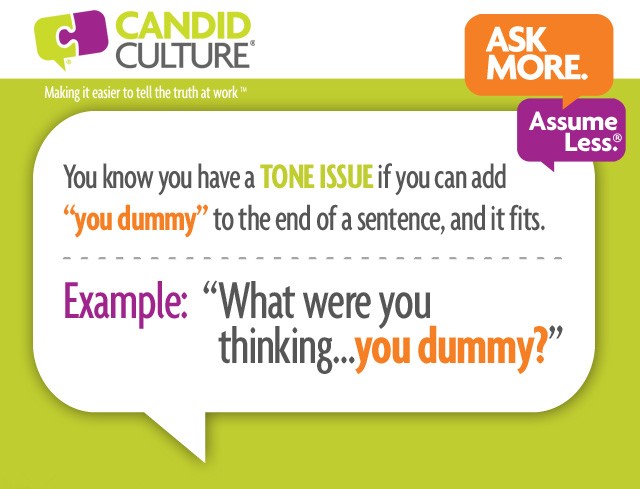
You know when someone gives you ‘the tone’, similar to when people roll their eyes at you? When you get ‘the tone’ you’re being told that the other person is exasperated.
Tone of voice is one of the hardest things to coach because we don’t hear ourselves. People who give people ‘the tone’ rarely know they’re doing it. One of the best ways I know to effectively coach tone of voice is to ask tone givers to tape themselves during phone calls. Then listen to the recording together and ask the tone giver, “If your grandmother called and someone spoke to her that way, would you be happy?” You can also read written correspondence out loud, adding the tone you ‘heard’, and ask the sender how she would have interpreted the message.
When given the tone, most people feel judged. And when people feel judged, conversations are constrained.
The way to avoid giving ‘the tone’ is to come from a place of curiosity. When you ask the question, “What were you thinking when you approached the customer that way,” you can sound curious or judgmental. Being judgmental evokes defensiveness, which shuts conversations down. Being curious creates discussion.
Consider asking questions like these to invite discussion:
• Tell me more about… • Help me understand what happened here… • What are your thoughts about… • What’s the history behind….
Any of these questions will lead to a good discussion, if you manage your tone.
If you want to get information or influence someone, ask questions and engage the person in a dialogue. We often try to persuade people by giving them information. This rarely works. Instead of overloading people with data, ask questions that evoke discussion. Through discussion, you might get to a different place. And if not, you’ll at least have learned why the other person thinks as he does and you will have shared your point of view in a way that is inviting versus off-putting.
It’s easy to give people ‘the tone’ when we’re tired and frustrated. Try to avoid difficult conversations when you’re tired or stressed. Wait to have important conversations until you know you can manage yourself and your tone.
Some people say that you show employees appreciation by giving them a paycheck and that any more thanks is over the top. We call that old school management. And it doesn’t work.
The human brain thrives on recognition. People are more likely to replicate positive behaviors when those behaviors are recognized. If your employees are doing a good job and you appreciate them, don’t make them guess. “Well, my badge still works. So I guess things are going ok,” is not sufficient recognition.
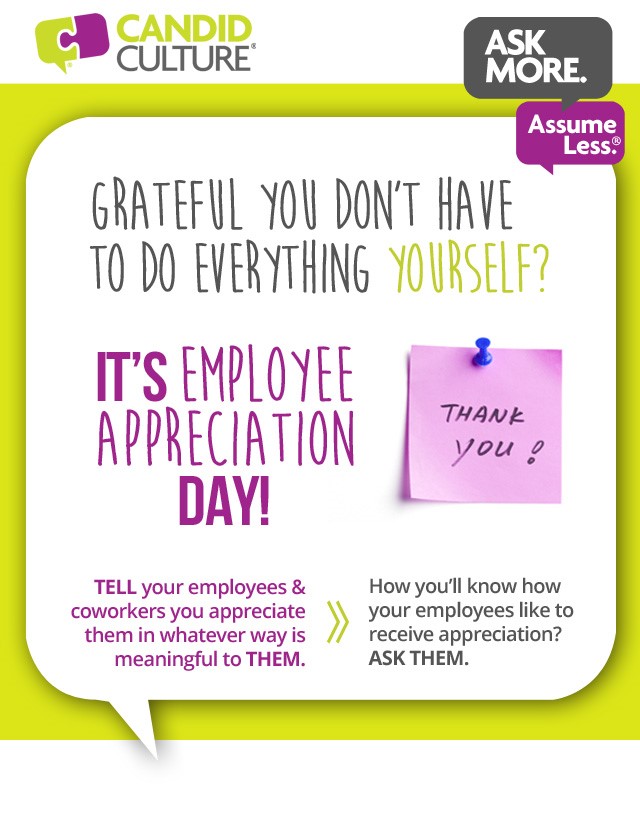
Today is Employee Appreciation Day – a made-up holiday to remind us to say “thank you” to the people we work with, who contribute every day.
Don’t take your employees for granted, or you’ll be finding new ones.
Here are six ways to mark Employee Appreciation Day today and every day:
Employee appreciation ideas 1) Ask employees what’s important to them – why they accepted the job, why they stay, and how they would like to receive recognition.
Most employees will work their entire career without a manager ever asking these questions. Getting to know your employees better and differently costs nothing but a little time.
Employee appreciation ideas 2) Ask employees about the kind of work they want to do in the future and what they want to learn and gain exposure to. Write down what they say (so you don’t have to remember) and give employees exposure to this type of work when it’s appropriate (when there’s a business need and when they’ve earned it by doing good work.)
Employee appreciation ideas 3) Give very specific, positive feedback regularly. Giving specific feedback demonstrates you’re paying attention to employees’ work and noticing the impact they’re making. Employees want to know how they’re doing. As odd as it may sound, feedback is a form of recognition. Taking the time to observe performance and give specific, timely feedback tells employees they matter.
Employee appreciation ideas 4) Tell the senior people in your organization what a great job your employees are doing. Employees have limited exposure to senior leaders. Don’t make the people who can influence your employees’ careers guess who’s doing great work.
Employee appreciation ideas 5) Take the time to write a handwritten note. In my 15 years of working in a corporate environment, I received one handwritten note from one of my managers. I kept it for 10 years.
Employee appreciation ideas 6) Spend time with your employees. Every employee needs face time with his/her boss. Don’t underestimate the value employees place on the time you give them. If you’re not meeting with your employees on a one-on-one basis regularly, start. Meet for 30-minutes once a quarter. Then meet once a month. Employees create the meeting agenda and come prepared to give you an update on their work. You should be prepared to give both positive and upgrade feedback.
Notice not one of the employee appreciation ideas or ways to recognize Employee Appreciation Day above is monetary in nature. Employees want your time and attention. They want to learn and grow. Provided employees feel fairly compensated, money is secondary.
Today, and every day, find a way to say “thank you” that’s meaningful to your employees. And the only way to know what employees will find meaningful is to ask.
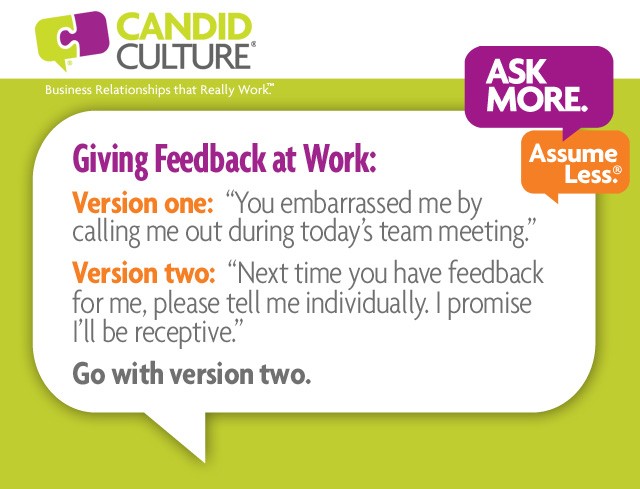
When you feel you’ve been wronged, it’s natural to lay into the offending person, give negative feedback, and tell him exactly what you think. The problem with doing this is that as soon as a person feels accused, he becomes defensive. And when people are put on the defensive and feel threatened, they stop listening. And you’ve potentially damaged your workplace relationship.
When someone does somethingfor the first time that violates your expectations, use the lowest level of intervention necessary. Allow the person to save face, and ask for what you want, without giving an abundance of negative feedback and pointing out all the things he’s done wrong.
Likewise, when you cut your finger while cooking, you put a Band-Aid on your finger. You don’t cut off the finger. This is true with business communication too.
When you’re facilitating a meeting, you can ask the two people who are side talking to stop, or you can go third grade on them and ask, “Is there something you want to share with the rest of us?” Both methods will stop the behavior. But one embarrasses the side talkers a lot, the other only a little.
Likewise, when one of your coworkers takes credit for your work, you can give feedback and say, “I noticed you told Mike that you worked on that project, when we both know that you didn’t. Why did you do that?” Or you can skip the accusation and ask a question instead, saying, “I noticed you told Mike you worked on that project. Can I ask why you did that?” From there you can have a discussion, give feedback if you need to, and negotiate.
When your boss doesn’t make time to meet with you, rather than saying, “You don’t make time for me. That makes it hard for me to do my job and makes me feel unimportant.” Instead consider saying, “I know how busy you are. Your input is really important in helping me move forward with projects. How can we find 30 minutes a week to connect so I can get your input and stay on track?”
In each of the situations above, you’d be justified in calling the person out and giving negative feedback. And it might feel good in the moment. But being right doesn’t get you closer to what you want, and it can damage your workplace relationships.
Practice good business communication –say as little as you have to, to get what you want. If this method doesn’t work, then escalate, communicate more directly, and give feedback. The point is to get what you want, not to make the other person look bad. The better the ‘offender’ feels after the conversation, the more likely you are to get what you want in the future.
Today I’m having lunch with people I worked with twenty years ago. Twenty years. I have long forgotten the projects we worked on, the deadlines, and deliverables that were important at the time. What I do remember, are Jim and Siobhan. Some of my closest friends and the people most important to me in the world, are the people I’ve worked with.
It makes sense that we make friends at work, it’s where we spend a lot of time. And the people we work with make work fun or miserable.
There is a considerable amount of research citing the connection between having good business relationships and employee engagement, retention, and performance. When we feel we belong and have good relationships at work, we are happier and do better work. It makes perfect sense.
As I’m writing this, I’m thinking about my coworkers who I traveled with for weeks on end, who endured a CEO who made us practice and re-write presentations until 1:00 am for a meeting the next morning, and the coworkers I worked with at the World Trade Center. As much as I appreciated and cared about the people I worked with, I’m not sure how often I told them that they made my work world better.
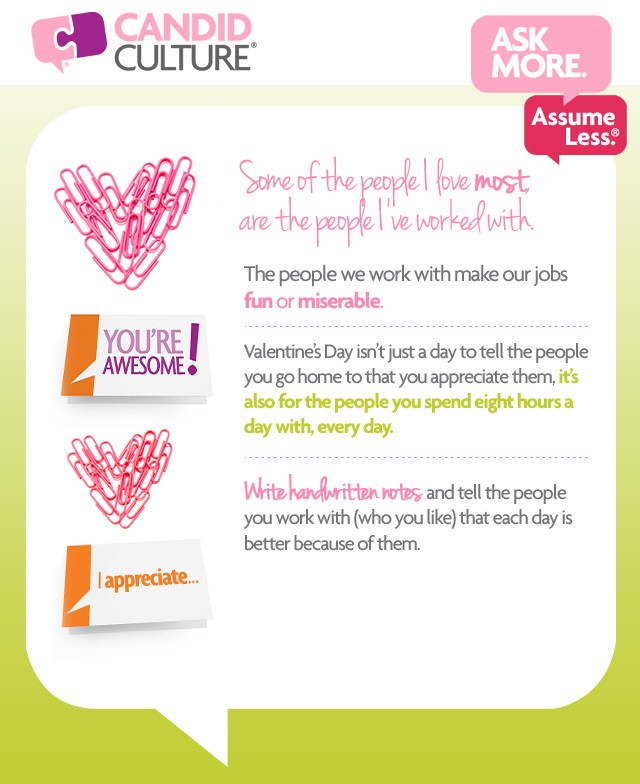
Valentine’s Day is a day we express appreciation for the people closest to us. Don’t limit your appreciation to your loved ones at home; include your coworkers who make your work fun and who help you get things done. Of course, I hope you’ll express appreciation more than once a year, but Valentine’s Day is an occasion not to miss.
Write the people you work with, who matter most to you, a handwritten note that they’ll keep for a long, long time. You can see our assortment of greeting cards for the workplace here. I’ll admit that I collect stationery and love giving and receiving handwritten notes. I suspect the people you work with will appreciate receiving a handwritten note too.
Several years ago, a guy I was dating asked, “We don’t really need to do anything for your birthday do we?” I was taken aback by his question (which was really a statement) and replied, “No, we don’t.” But I didn’t mean it. And when he blew off the ‘big day’ I was furious and let him know it. Instead of having dinner on my birthday, we had an ugly conversation and a lousy rest of the week. Asking for what I wanted upfront would have been much less painful.
Why is it so hard to ask for what we want, especially from the people who love us? Learn how to get what you want on your birthday and every day.
We aren’t likely to get what we don’t ask for. The people in our lives can’t read our minds. They don’t know what we want. This is true at home and at work. If you want a report to look a certain way, sketch it out for your employees. If you want a meeting handled in a certain fashion, give detailed instructions. For the most part, we expect things to go well and thus we delegate insufficiently at work and hope to be pleasantly surprised at home.
I hope the people who love you, know you well enough and are intuitive enough to give your heart what it wants on your birthday, and every day. But if they don’t, make it easy for them to please you by telling them what you want. For example, tell the person you love, “I’d love to spend the day together. I don’t care what we do, as long as we’re together.” Or, “I don’t care what you do for my birthday, but please do something to mark the day.” And if you want something specific, ask for it. “I’d love flowers, despite that they’ll die and are impractical. Anything but roses and carnations would be lovely.”
A few weeks ago, a college student introduced me before I spoke at a conference. I heard him practicing out loud shortly before he was to read my introduction on stage. As he practiced, I heard him struggle with the word candor. Initially, he pronounced it as can-door vs. can-dor. He’d never seen the word and didn’t know what it meant.
The word candor is not being used on a regular basis. Younger people may not know what it means. And, in my experience, people who are familiar with the word often misinterpret candor to mean bad news. Most people expect bad news to come after the question, “Can I be candid with you?”
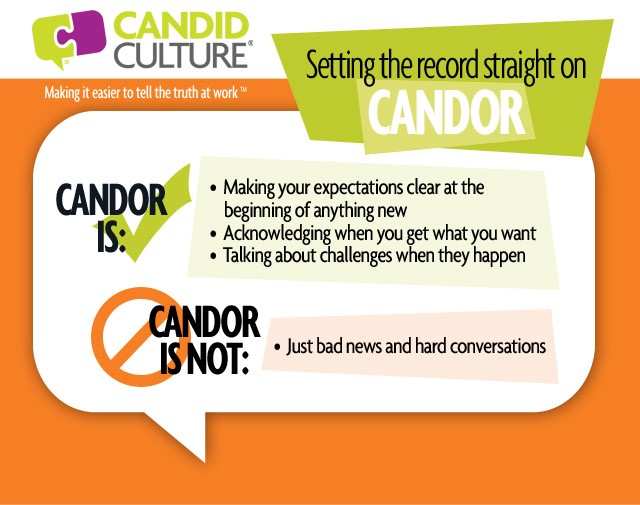
The definition of candor is, to be honest, truthful and forthright. We at Candid Culture define candor differently. The Candid Culture definition of candor: Telling people what you need before challenges occur. Anticipating everything that can take a project or relationship off track and talking about potential pitfalls before they happen.
Think about the projects and processes in your office – hiring someone new, sourcing a vendor, training people on new software. The potential breakdowns are predictable. You know the pitfalls that can happen when starting anything new because you’ve experienced them.
What if candor sounded like, “We want this project to be smooth. There are a couple of things that will make our work together go well and a few things that may delay the project and have it cost more than we budgeted. Let’s talk about what needs to happen for things to go smoothly, ways to prevent missed deadlines, and how we’re going to handle breakdowns when they happen.”
Some call a conversation like this setting expectations, others call it planning. In my world, these conversations are called candor –talking about what you need when projects begin, rather than letting the anticipatable train wreck happen.
Candor isn’t bad news. It’s telling people how to win with you vs. making them guess.
Examples of candor at work and at home:
“Here a few of my pet peeves… It would be great if you could avoid them.”
“What will frustrate you?”
“I turn off my cell phone alerts at night, so feel free to text or call me anytime. I’ll respond to all messages in the morning.”
“I respond to text messages mostly quickly, then voicemail, then emails. If you don’t get a reply to an email within two or three days, don’t take it personally. Chances are I haven’t read the message. Feel free to follow up with a text or voicemail.”
“I work best by appointment. Drop by’s are hard because they interrupt my flow. Email or text me if you need something, and I’ll tell you when I can swing by. Does that work for you?”
For the most part, we treat people as we want to be treated. Other people aren’t us. They don’t do things as we do and don’t know what we want. Don’t make people guess how to work with you, what you need, and what you expect. Be candid and tell them! Then ask what the people you work and live with expect from you.
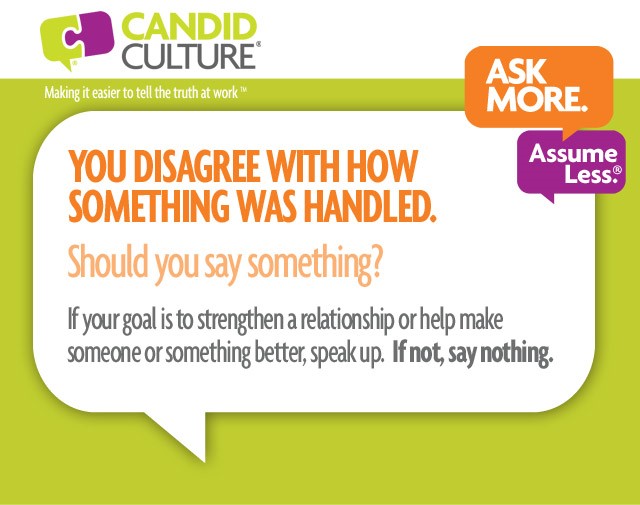
Most of us grapple with whether or not we should give feedback when someone else does or says something frustrating.
Here are a few criteria to help you decide whether or not you should give feedback or say nothing:
Do you have a relationship with the person? Do you know each other well enough to share your opinion? Aka, have you earned the right?
Has the other person requested your opinion? Unsolicited feedback is not typically received well.
If the other person has not requested your opinion, does he appear open to hearing feedback?
Are you trying to make a difference for the other person or just make him look or feel bad?
Do you want to strengthen the relationship?
Before you give feedback, do something I call, ‘check your motives at the door.’ If your motives are pure – you want to strengthen the person or the relationship, and you have a good enough relationship that you’ve earned the right to speak up — then do it.
People are more open to feedback when they trust our motives. If we have a good relationship with the person and he knows we’re speaking up to make a difference for him or for the relationship, you’ll be able to say way more than if your motives are questionable – aka you want to be right.