When I interviewed for my last job, before starting Candid Culture, the CEO put a mug in front of me with the company’s values on it and asked if I could live by those values at work. He was smart. Hiring someone with the skills to do a job is one thing. Hiring someone who fits into the organizational culture, is another.
Determining if a prospective employee will fit your organizational culture is much harder than determining if someone has the skills to do a job. Often when an employee leaves a job, only to take the same role at another company, they left for fit. They just didn’t feel comfortable. They weren’t a good fit with the organizational culture.
You’ve probably heard discussions about employees who deliver results at the expense of relationships. Or about employees who fellow employees really like, but they just can’t do the job.
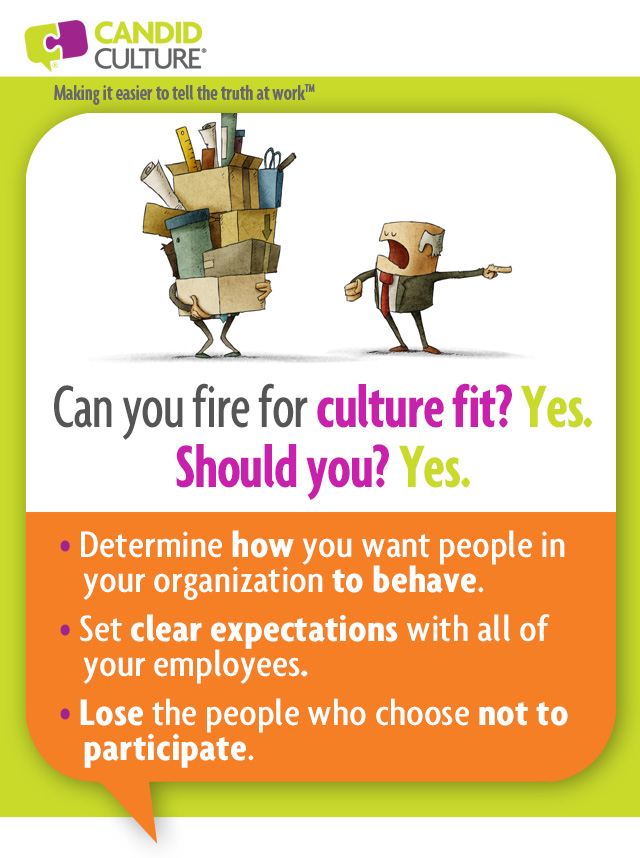
Leaders of organizations need to decide what’s important: What people do? How they do it? Or both. I’m going to assert that both the work employees deliver and how they deliver that work is equally important. I think you should hire and fire for fit.
Work hard to hire people who will fit into your organizational culture. Get rid of people who don’t fit. The impact on your organization’s reputation and on internal and external relationships depends on hiring people who behave consistently with your brand and how you want your organization’s culture to feel.
At Candid Culture, we teach people to have open, candid, trusting relationships at work. Thus we must hire people who are open to feedback and communicate honestly. And we fire people who don’t model those behaviors.
If you want a high service organizational culture, you can’t hire people who don’t care about others or who don’t want customers to feel good about working with you.
Here are a few ways to ensure you hire people who are a good organizational culture fit:
Share your current or desired culture with job candidates early, often, and clearly.
Work to assess how candidates fit the culture. Use practical interviews, job shadowing, and reference checks to assess organizational culture fit.
Talk about the culture when onboarding employees.
Make behaving according to the culture part of your performance appraisal process.
Reward behavior that matches the culture.
Have consequences for not acting according to the culture. A negative feedback conversation is a consequence.
Ensure your leaders and managers live the culture. Get rid of leaders and managers who aren’t a good culture fit. This takes courage.
When people leave an organization, they don’t often take copies of reports they produced or work they created. And if they do, they rarely look at that work. What they do take, remember and find meaning in, are the relationships they built at work. Relationships are dependent on organizational culture.
Determine the organizational culture you want. Talk about regularly. Require people to act according to the culture. Reward the ones who do. Get rid of the ones who don’t. Make working in your organization feel as you want it to feel.
Employees are often afraid of the most senior people in organizations, simply because of their titles. The better the title, the scarier people are. And if employees are scared of organizational leaders, they’re not going to give those leaders negative feedback. The most senior people in an organization get the least information of anyone.
No one likes to be told that he is wrong. Negative feedback tells the person he did something wrong. But there is more than one way to give feedback. Asking questions can be equally as effective as giving direct feedback.
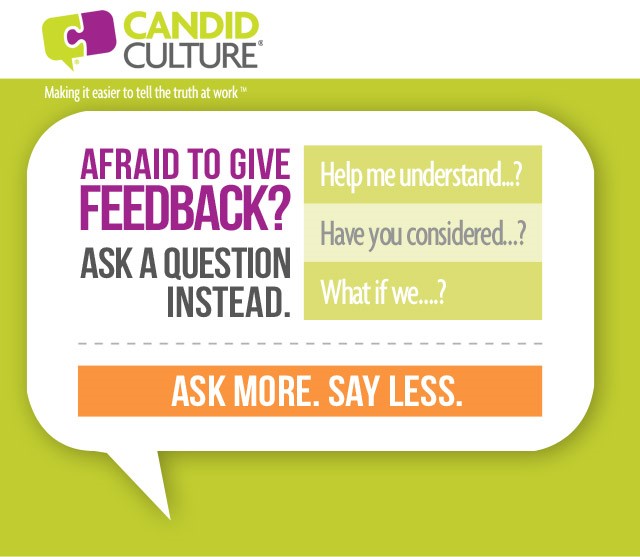
If you want to give a senior person negative feedback, but you’re afraid of the consequences, manage up by asking more and saying less.
Here are some ways to manage up by asking questions:
Rather than saying, “I disagree, I think you’re wrong, or this is a mistake,” consider managing up by asking questions like:
We’ve chosen to invest a lot in this software. I wasn’t here when the software was chosen. What’s the history of this initiative?
What were the criteria for selection?
What are you concerned about?
What are you satisfied with?
What else have we tried?
What are your thoughts about…?
What if we tried…?
Asking questions gets the person involved in a discussion, during which you can eventually express your point of view. When you ask questions, you say very little, and definitely don’t call the person’s decision-making into question.
Human beings are wired for survival. Receiving negative feedback kicks the need to defend oneself into gear, hence why people become defensive when they receive negative feedback. Negative feedback calls survival into question. If you don’t want people to become defensive, don’t require them to defend themselves. A discussion, during which you ask questions, is much less threatening than overtly disagreeing with someone’s point of view.
Asking questions takes more time and more patience than giving direct feedback. But it also takes less courage, and the quality of your relationship doesn’t have to be as good. You need a pretty good relationship to give direct feedback. If you don’t have that relationship, manage up by asking questions instead of being so direct.
If you do choose to ask questions, watch your tone. If you can safely add the words “you dummy” to a question, you aren’t really asking a question, you’re giving feedback, which is likely to evoke the defensive response you’re seeking to avoid.
It’s important to be able to express your point-of-view at work. Staying in a job or organization in which you can’t speak up, doesn’t feel great and doesn’t leverage the best of what you have to offer. But if you’re concerned about giving direct feedback, manage up by asking questions. Say less. Ask more.
Changing a damaged reputation is challenging. My number one piece of advice: Be very overt about the changes you’re making.
Here are eight steps to discover and repair your professional reputation:
Step one to repair your professional reputation: Make a list of people who observe your performance and who can impact your career. If you’re not sure who these people are, ask your boss and peers. They know.
Step two to repair your professional reputation: Ask for specific, candid feedback at least twice a year, and tell people why you’re asking for the information.
Asking, “How am I doing?” is not specific. Instead, say something like, “I want to learn more about my reputation in the office and want to eliminate my blind spots. I’d be grateful for any input you can provide on my reputation and what people say about me when I’m not there.” Then schedule a specific time in the near future to discuss the feedback, so you don’t catch people off guard. You’ll get better feedback when people have had a chance to observe your behavior and think about what they’d like to say.
Step three to repair your professional reputation: Listen to the feedback and no matter how hard the feedback is to hear, say, “Thank you for telling me that.” Don’t defend yourself. Instead, leave the conversation, think about what the person has said, and then go back to him a few days later with questions, if you need to.
Step four to repair your professional reputation: If the feedback you receive doesn’t feel accurate, tell others who you trust about the feedback and ask them to provide input.
Step five to repair your professional reputation: Sit with the feedback before taking action. Let yourself be emotional. You might feel angry, sad, or betrayed. All of those are normal responses to feedback.
Step six to repair your professional reputation: Take action. Make changes that feedback providers suggested.
Step seven to repair your professional reputation: Tell people who provided input and who are impacted by your behavior about the changes you’ve made. You could say, “I recently received feedback that I’m not careful enough and that my work often has errors. I’m really working on this. Will you pay attention to the accuracy of what you receive from me and let me know if you see changes? I’d really appreciate your input.”
Step seven is very important and something people rarely do. Don’t assume people will notice the changes you’ve made. Instead, assume they won’t. Without being told what to look for, the decisions people have already made about you will supersede changes you’ve made. It takes a lot of effort to see people differently. Validating what we already know and think about someone is much easier and more likely than noticing changes.
Step eight to repair your professional reputation: Continue to ask for feedback. Receiving feedback is not a one-time event. It’s an ongoing process. Don’t ask for feedback weekly, rather check in once a quarter, tell people the changes you’ve made, and ask for specific input.
You can change your reputation if you want to. Doing so will require courage, openness, and effort on your part. Work on one or two things at a time, not ten. And then reward yourself for the changes you’ve made with a pint of Ben & Jerry’s because too often we’re hard on ourselves and forget to celebrate wins.
When leaving a job, the late nights and all-consuming projects quickly become history. What we take with us, are the people we worked with and the friendships we formed.
Much of what contributes to job satisfaction or dissatisfaction are our workplace relationships. “I just can’t work with this person. We don’t see eye to eye. We can’t get along,” are the types of challenges that often motivate people to job hunt.
I’m a believer that suffering at work is optional. You deserve and can have a job doing work you love, with people you enjoy. If your workplace relationships are strained, there are several things you can do to improve them.
Four steps to improve workplace relationships:
1. Make a list of the people you need a good working relationship with.
2. If you’re not sure who you need to work well with, ask your boss, peers, and internal customers. They know.
3. Ensure you know what your internal customers are expecting from you. Ask what a good job looks like, how they’re evaluating your results, and how they like to communicate.
4. Tell people you’re struggling with, “I think we both know this relationship is strained. I’d really like a good working relationship with you. Would you be willing to have coffee or lunch with me, and we can talk about what has gone on, and perhaps start in a different way?”
Fixing a broken relationship needs to be a phone or in-person conversation. Sending someone an email, telling him you want a good working relationship, won’t do the job.
Damaged workplace relationships can be fixed. We often don’t know what the other person is really upset about. We may think we know or assume, but may be surprised when we have the conversation.
You spend way too much time at work not to enjoy the people you work with. Don’t assume strained relationships will remain strained. Identify who is most important to your success, tell those people you want a good working relationship, and then ask questions to learn what they are expecting from you. Good relationships don’t just happen.
You have more influence over your relationships than you may think. Don’t accept the status quo. Suffering is optional.
Click here to take advantage of our holiday special. Get everyone in your organization a copy of How to Say Anything to Anyone, and get more peace at work. Buy five books. Get one free. No limit on quantities.
If you haven’t had a bad boss yet, just be more patient. He or she is coming. Why do I say that? Because not all managers are great bosses. Many managers don’t provide employees with challenging opportunities, regular feedback, and exposure to different areas of the business.
Too many professionals are waiting for their boss to make their career happen. You might be lucky enough to have a boss who cares about you and helps you advance your career, but you might not. Either way, you deserve to have the career you want and ultimately, it’s your job to advance your career.
How to Advance Your Career Step One: Learn about different areas of your organization and become clear on what you want to learn and to what areas of the business you want exposure.
You won’t know what to ask for from your manager if you don’t know what your organization does and the opportunities that are available. Get to know the leaders and employees in other departments. Find out what they do on a daily basis, the initiatives they’re working on, and their short and long term goals.
How to Advance Your Career Step Two: Ask your manager, your peers and other organizational leaders who you need a good working relationship with and who can influence your next career opportunity.
You never know who talks to whom and who can influence your future opportunities. Department heads you don’t know well talk to other department heads. Don’t assume that because you don’t know someone well that s/he can’t influence your next opportunity or lack thereof.
How to Advance Your Career Step Three: Build and strengthen necessary working relationships and improve your reputation in areas it has been damaged.
You might need to tell a coworker (in person or over the phone, not via email!), “Our relationship is strained. I don’t think I’m saying anything we both don’t know. I would really like a good working relationship with you. If you’d be willing to have lunch or coffee with me and talk about what has gone on, and perhaps we can start anew, I’d really appreciate that.”
Ask for feedback and make necessary changes. Assume others are not aware of the changes you’ve made, so make those changes overt. Tell people who can impact your career, “I’ve received _________ feedback. As a result, I’ve made ___________ changes. I’d really appreciate your continued feedback on the changes I’ve made and other changes I need to make.”
How to Advance Your Career Step Four: Tell people who can influence your career what you want to do.
Don’t assume people know what you want to do in the future. In fact, assume others have no idea about the work you want to do and the things you want to learn. Tell people, “I’m really interested in learning more about ___________. I’d like exposure to __________ part of our organization.”
How to Advance Your Career Step Five: Make it clear that you’re capable of either doing or learning what you aspire to do.
I’ll never forget my first college internship. I was interning for a company that did ropes courses and backpacking trips with at-risk teenagers. During orientation, my boss pointed to a large storeroom and told me that interns were responsible for sweeping the floor and washing sleeping bags and cooking utensils after camping trips. I thought, “I did not take a semester off from school to sweep floors and wash sleeping bags.” I never said that out loud. I simply did other things (that I wanted to do) well, that offered great value to the organization. At the end of the internship, my boss said, “You’re the only intern who has never cleaned the storeroom because you demonstrated you were capable of doing more.”
Your career is your responsibility. Don’t wait for the right boss to make your career happen. Take matters into your own hands. Follow the steps above and get more of what you want at work.
Most people would rather get a root canal than participate in an annual employee performance appraisal.
The reasons employee performance appraisals are so difficult is simple:
Many managers don’t deliver timely and balanced feedback throughout the year.
Many employees don’t ask for regular feedback.
Too much information is delivered during the annual employee performance appraisal.
And as crazy as it sounds, managers and employees haven’t agreed to give and receive regular and candid feedback.
Employee performance appraisals don’t have to be the worst day of the year.
Here are four steps to ensure employee performance appraisals are useful and positive:
Managers and employees must agree to give and receive balanced, candid feedback. Don’t assume the agreement to speak honestly is implicit, make it explicit.
Managers, be honest and courageous. Don’t rate an employee a five who is really a three. You don’t do anyone any favors. Employees want to know how they’re really doing, no matter how much the feedback may sting.
Managers, focus on three things the employee did well and three things to do more of next year. Any more input is overwhelming.
Managers, schedule a second conversation a week after the employee performance appraisal, so employees can think about and process what you’ve said and discuss further, if necessary.
The key to being able to speak candidly during an employee performance appraisal is as simple as agreeing that you will do so and then being receptive to whatever is said. And don’t make feedback conversations a one-time event. If you do a rigorous workout after not exercising for a long time, you often can’t move the next day. Feedback conversations aren’t any different. They require practice for both the manager and employee to be comfortable.
“If you have nothing nice to say, don’t say anything at
all.” Most of us grew up hearing these words. Last week I used them with my
four-year-old son, and instantly regretted it. He said something hurtful to me
and I told him to keep those thoughts to himself.
I want him to keep his thoughts to himself if he doesn’t
like a kid at school or doesn’t want to play with someone. Walk away, find
another place to play, is often my guidance. But with me? With me I want him to
be honest, always, even if it hurts.
Every time we talk with people, we train them how to
interact with us. If I tell my son not to tell me the truth, I teach him to
protect my emotions and stifle his. I teach him I’m not strong enough to handle
the truth and that I’m someone who needs protecting. I teach him that he can’t
be honest with me.
Do I want him to be a kind, empathetic person? Yes. Do I
want him to measure himself with others, watching what he says and how he says
it? Yes. Do I want him to do those things with me? No. I’m the mom. He’s the
kid. And that will always be the case, even when he’s 45. I can take whatever
he has to say. And if I want to have a real relationship with him, he needs to
know that.
Every time we react to what others say, we train them how to
interact with us. If you want your coworkers, boss, family and friends to be
honest with you, make it easy to tell you the truth. Take in what others say
without visibly reacting. Say “thank you” for whatever feedback and input you
get, even when you want to say everything but. Take the time to ‘get over’ hard
messages and then discuss further, when you’re not angry.
People learn quickly. If we react to suggestions, input, and
feedback negatively, people learn that we can’t take challenging data and they
stop giving it to us. I don’t want to be the person the people I care about are
afraid to talk with because my reaction is just too hard to deal with.
Should you care about everyone’s feedback? No. Should you
ask everyone for feedback? No. Should you be open to everyone’s feedback? No.
Be open to feedback from the people who matter most to you. Open your heart and
your mind. Close your mouth. Even when you want to do everything but.
Strengthen your relationships and train people that you can handle the truth.
Note: I know this blog is not what my weekly tip said it
would be about. I write the weekly tips before the blog and this blog just went
a different direction. Everything I write is inspiration driven. I’ll write
about the courage to speak up in a future week.
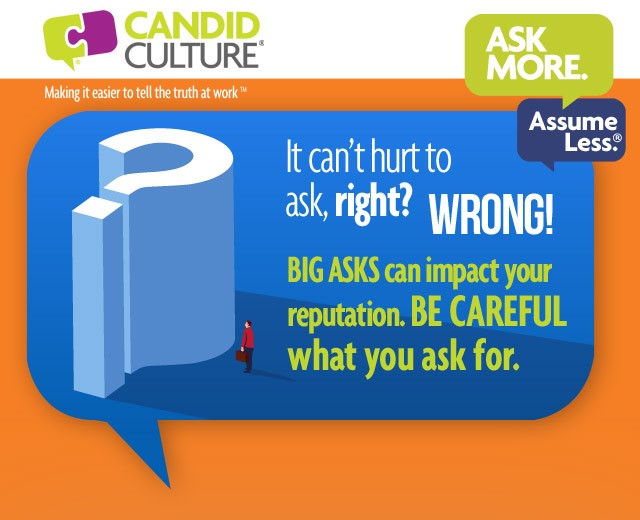
We’ve all heard the expression, “it doesn’t hurt to ask.” But
what if it can and does?
While it’s true that you won’t get what you don’t ask for,
it’s also true that requests help form others’ impressions of us. Some asks may
seem high maintenance and create the impression that we’re difficult to work
with. Other requests may create the impression that we’re out of touch or entitled.
Be brave in what you ask for but also be judicious and aware of how requests
may impact others.
So, what shouldn’t you ask for at work? That’s a hard question
to answer. What’s appropriate in one environment may not be ok in another. I’ll
provide some guidance for most work environments below.
Don’t ask for anything that requires your boss to break the
rules or treat you differently from other employees. This may seem obvious, but
I’ve been asked for things that I couldn’t legally provide. A candidate asked
me to write her a monthly check towards her personal health insurance plan versus
her participating in our company-sponsored health insurance plan. It’s an
innocent request but put me in a very awkward position and I said no.
Here are a few do’s and don’ts to follow when making requests:
Don’t ask for or take time off during the busiest times of
the year. Ask your boss what those busy times are and then plan accordingly.
Don’t ask for exceptions unless you’re desperate – being paid
in advance to cover unforeseen personal expenses, time off you haven’t earned, unless
It’s regularly permitted in your company, using company resources for personal
use. All of these may seem acceptable in the moment, but if they make your boss
bend or break the rules, they’ll likely make you look bad too.
Be brave. Be bold. And be careful what you ask for. Your reputation is more important than a request that feels important right now but will be insignificant by next year.
My four-year-old son Grayson likes to narrate. He gives instructions
to people he doesn’t know, tries to be “helpful” and keeps everyone informed.
Today we rode a miniature train Grayson has ridden many
times. He has the instructions memorized. “Keep your arms and legs inside the
train. Stay seated while the train is in motion, etc. etc.” While we were
waiting to ride the train he informed everyone standing in line of the rules. The
other parents were patient and indulged him, smiling and asking questions. When
we got on the train Grayson continued to give instructions, and I became
embarrassed. Self-conscious that my son
was irritating other passengers, I told him to be quiet. He looked at me and wisely
asked, “Why are you shushing me?” And then I was even more embarrassed.
He was right to ask. Why, indeed, was I shushing him?
Before I had children, I always hoped my child would be one
of those kids who wore superhero costumes everywhere, who didn’t care what anyone
thought, who was unabashedly himself. And I wondered, at what age do kids
become self-conscious? When do they begin to lose this level of self-expression?
And then I had one answer, when adults tell them to.
I imposed an old ‘rule’ on my son, “children are meant to be
seen and not heard.” Sit quietly. Don’t stand out and don’t inconvenience others.
Where are you sitting silent, stifling your views? What do
you know a lot about, but keep your skills or expertise under wraps? When do
you have a solution or a better way to approach a problem, but you don’t share?
Share your ideas. Do it in a way that doesn’t tell others they are wrong. It’s ok to have the answer. You can be right without being righteous. It’s ok to speak up.
Conference calls taken on speakerphone, listening to music without headphones, and a posse of visitors, make people working in an office with an open floor plan want to permanently work from home.
The key to being able to ask your coworkers to move the conversation to a conference room is the same as giving any type of feedback –set expectations and ask for permission to speak candidly.
Working in an open-office environment is challenging. Here is some language to make it easier to ask your coworkers to pipe down:
Get the people who sit in your work area together to talk about your working environment.
That conversation could sound like this, “It’s often pretty loud in our work area. I was wondering if we could set some guidelines of how we’ll manage our workspace, so it works for everyone? What do you think of establishing some practices we all agree to follow? For example, when making or taking phone calls, everyone will either use the handset or a headset. We won’t take or make phone calls on speakerphone. We’ll always use earphones if listening to music or watching videos. If a conversation at someone’s desk lasts longer than five minutes, people will take the conversation to a conference room. And when these guidelines are broken, and they will because we’re human, it’s ok to say something. We could even have a system to let people know it’s getting loud and that a guideline is being broken. With everybody’s agreement, we could throw a nerf ball into the loud cube, put a note in front of the person, or simply walk over and ask the person to take the conversation elsewhere. I want our work environment to work for everyone and make it easy for us to speak up without being concerned that we’re going to hurt someone’s feelings or damage relationships. What do you think?”
You DON’T need to be a manager to do this. Take control of your working environment by asking for what you want. Initiating this conversation may feel odd and uncomfortable, but I assure you most of the people you sit with will be grateful you dared to start the conversation.
You can say anything to anyone at work when you have permission to do so. Suffering is optional. Make requests today and follow up when things get loud. You can do it!
















 Working in an open-office environment is challenging. Here is some language to make it easier to ask your coworkers to pipe down: