Giving feedback upwards is hard. Giving feedback downward is hard. Giving feedback to peers can be the hardest of all. We work closely with our peers. They’re often our friends. And still, we need to be able to speak freely when our coworkers violate our expectations.
The key to being able to give peers feedback (to give anyone feedback) is to agree that doing so is not only acceptable but expected. Before agreeing to give and receive feedback, peers need to set clear expectations of how they’ll work together and treat each other.
Telling people how you want to work with them is always easier than asking someone to change their behavior. But it often just doesn’t occur to us to tell our peers what we want and need from them. We’re busy. They’re busy. And don’t they already know what courteous workplace behavior looks like? Return all emails within a day or two, tell people if you’re running behind on a project and will miss a deadline, and call into meetings on time from a quiet workspace. Aren’t all of these behaviors fairly obvious? Do I really need to tell people these are my expectations? Uh….yes, you do.
If you don’t want employees dumping these challenges on their managers, help employees talk to each other.
Here are seven steps to help people who work together set expectations and hold each other accountable:
Schedule a meeting during which people working together can discuss what they need from each other to be satisfied and productive. Then facilitate a discussion during which the group creates 5 – 7 behavior guidelines each person agrees to follow.
Put the list of agreed-upon behaviors in a shared folder. Leave the guidelines there indefinitely.
Give each person in the group permission to talk to individuals who violate the guidelines. This is very, very important. For the most part, employees won’t tell a peer s/he is missing deadlines, gossiping, or is distracted during meetings. People will suffer in silence and avoid the offender rather than speak up about the behaviors that frustrate them.
Ask the group to grant each other permission to speak up when guidelines are violated. Giving each other permission to speak up will make future conversations possible – difficult but possible. Without permission and these agreed-upon behaviors in place, people will suffer in silence or talk about each other, not to each other.
Ask everyone in the workgroup to take feedback graciously, responding with “thank you for telling me,” rather than with defensiveness.
Two weeks after making the list of guidelines, get the group together on a call to review the list, and make any necessary changes to it. Discuss behaviors that were omitted, aren’t realistic, and are realistic but aren’t being followed.
Then follow up by facilitating a monthly conversation during which group members give honest feedback about which guidelines are being followed and which are not, and problem solve as a group. These conversations aren’t a chance to embarrass or call people out in front of a large group. If one person is violating a guideline, that conversation should happen individually. Group conversations keep the lines of communication open – which is essential to making working with others work.
You will need a strong facilitator for the group discussions. The facilitator must tease out people’s thoughts while making sure no one gets blasted in front of the group. Don’t let concerns, that you know exist, be brushed under the rug. Group members must openly and regularly discuss what is and isn’t working about their work environment, or frustrations will build, and unhappiness and dissension will ensue.
It’s not too late to put these practices in place, even with a group that has been working together for a long time. Just schedule the conversation and explain why you’re having it. People will be relieved and grateful.
Want to know why people get defensive when you give feedback and why they often don’t change their behavior? Because what you’re giving them isn’t actually feedback.
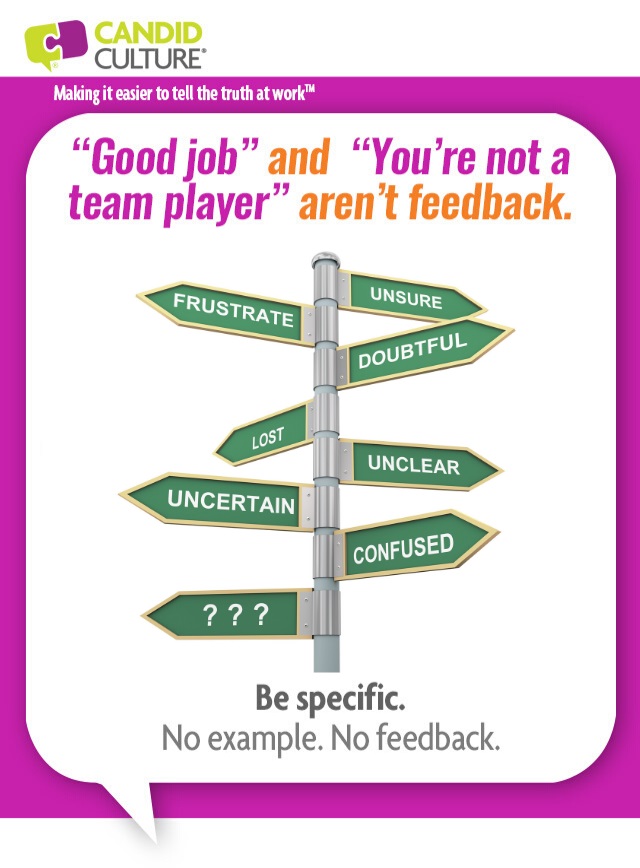
“You’re awesome to work with” isn’t feedback. Neither is “You did a great job.” “Your work isn’t thorough” isn’t either. Neither is, “You were inappropriate.”
Most of what we consider feedback isn’t feedback at all. It’s vague, unhelpful language that leaves people wondering what they need to do more, better, or differently.
There are only two reasons to give feedback – to encourage someone to either change or replicate a behavior. Unfortunately, most of the ‘information’ we give is too vague to help people do either.
When you coach or give feedback, you serve as someone’s GPS. Like the GPS on your phone, you need to be so specific the person knows precisely what to change or replicate. If you were driving and your GPS said, “Good job” or “I think you’re off track,” you’d throw the GPS out the window and get a map.
If you give someone what you consider feedback and he says, “I don’t know what you mean, can I have an example?” you’ll know you weren’t helpful.
Here are six tips for giving helpful feedback:
Giving feedback tip one: Write down what you plan to say, then strip out half the words. Shorter feedback with fewer words is better.
Giving feedback tip two: Practice what you plan to say out loud. Have you noticed that what you ‘practice’ in your head is typically not what comes out of your mouth?
Giving feedback tip three: Before having the ‘real’ conversations, give the feedback to an independent, third-party and ask her to tell you what she heard. Ensure who you talk with will maintain confidentiality. Your organization doesn’t need more gossip.
Giving feedback tip four: Tell someone else about the conversation you need to have, and ask him what he would say. Anyone not emotionally involved in the situation will do a better job than you will. Again, ensure confidentiality.
Giving feedback tip five: Ask the feedback recipient what he heard you say. Asking, “Does that make sense?” is an ineffective question. “Do you have any questions?” isn’t any better.
Giving feedback tip six: Give one to three examples of what the person did or didn’t do, during the conversation. If you don’t have an example, you’re not ready to provide feedback, and anything you say will evoke defensiveness rather than behavior change.
Giving feedback doesn’t have to be so hard. Be so specific that your feedback could be used as driving directions. The purpose of feedback is to be helpful.
I want each of my employees to be happy and to enjoy their jobs and enjoy working for me, every day. That can’t and won’t happen, especially right now. Some days are hard. Some are dull. Sometimes I’m fun and easy to work for. Lots of days I’m not.
I had a manager years ago who told me that my need to be liked by my employees would take me down. He was right. Unfortunately, I’m not the only manager with this challenge.
Lots of managers tell me they’re hesitant to give feedback because they’re afraid employees will quit. Other managers do work they know they shouldn’t be doing because they don’t want to burden their employees.
Not every day will be great. And that’s ok. Work is a roller coaster. Some days are awesome. Others are the pits. Your job isn’t to make people happy at every moment, it’s to create a supportive environment and ensure people have the tools to be successful.
My employees have all the tools they need to be successful. I work hard to set clear expectations and give timely positive and upgrade feedback. The rest is up to them. Some days I’m sure they’re happy. Most days, hopefully. And I’m sure there are days that other jobs sound appealing.
Here are five actions to create a positive culture at work:
Office culture tip #1: Set clear expectations at the beginning of every new project and task. The root of frustration and unhappiness is thwarted expectations.
Office culture tip #2: Ask for and be open to feedback from your employees and coworkers. Ask for feedback regularly and work to respond with, “Thank you for telling me that.”
Office culture tip #3: Respond to feedback by changing what it makes sense to change. Giving feedback that is never acted upon creates cynicism and distrust.
Office culture tip #4: Provide a rationale for your decisions. It’s fine to do things the way you want to do them, even if others disagree. Explain your rationale. You’ll get more buy-in.
Office culture tip #5: Don’t be afraid to make decisions that are unpopular. There is a reason that you want to do what you want to do, the way you want to do it. Vet your plans, when appropriate. Be open to others’ input. And then do what you think is right (within the scope of your role).
Your job isn’t to please everyone and trying to do so will likely produce lesser results and be exhausting.
People leave feedback training armed with new skills and
they unfortunately sometimes use those skills as a weapon. It goes something
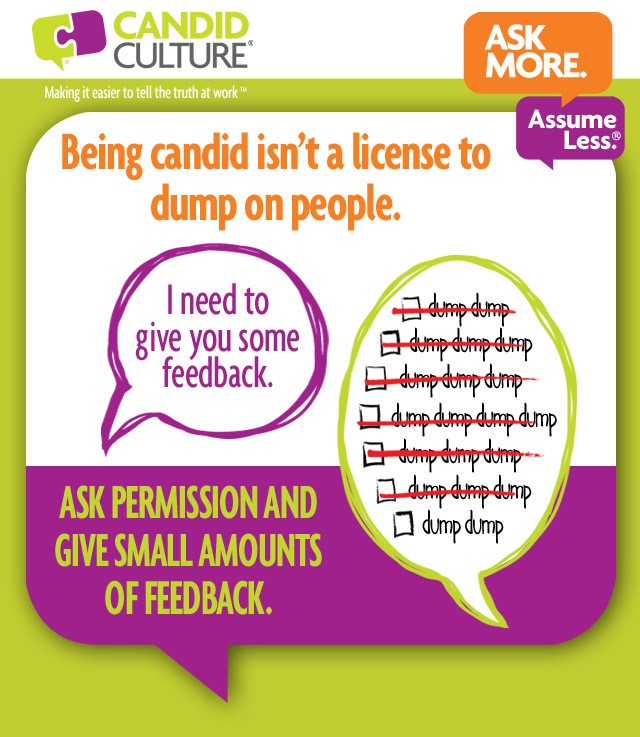
like this, “I need to have a candid conversation with you.” And then the person
proceeds to dump, dump, dump. This couldn’t be more wrong, wrong, wrong.
When you give someone negative feedback you are essentially telling him that he did something wrong. And who likes to be wrong? The ego gets bruised and people often start to question themselves. This normal reaction doesn’t mean you shouldn’t give feedback, you just need to do it judiciously.
Ask yourself these four questions when deciding whether
or not to give someone feedback:
Do I have the relationship to provide feedback?
Does the recipient trust me and my motives?
Do I have permission to give feedback? If the recipient
doesn’t work for you, you need permission to give feedback.
Is this something the person can do something about?
If it’s not a change the recipient can make, keep your thoughts to yourself.
Is the feedback helpful? Ultimately the purpose
of all feedback is to be helpful.
Let’s say you’re on the receiving end of too much feedback.
What should you do? It’s ok to say “no
thank you” to feedback. Here’s what you could say:
“Thank you for taking the time to bring this to my
attention. I really appreciate it. You’ve given me a lot of feedback today. I’d
like something to focus on that I can impact right now. What’s the most
important thing I should do?” You’ve validated the other person and
demonstrated openness and interest. You’ve also set some boundaries and
expectations of what you will and won’t do.
“Thank you for taking the time to share your requests about…
We won’t be making any changes to that and here’s why.” It’s ok not to act on
all feedback, simply tell people why you won’t.
“I appreciate your concern. I’m not looking for feedback on
that right now.” Can you say that to someone? Yes. Should you? Sometimes. To
your boss – no. To someone who offers unsolicited advice that’s outside of
their lane, yes. They’ll get the message.
People can only act on and digest small amounts of feedback
at a time. Be judicious and assess your motives. The purpose of feedback is to
be helpful, when the feedback is requested and when you have the relationship
to give it.
If you receive too much feedback or unsolicited feedback, it’s
ok to decline. You’re not the 7-11, aka you’re not always open.
The days I’ve struggled to be with my young son during this
stay-at-home period are the days his behavior is other than I expect. Jumping, running,
and racing around at bedtime when I expect it to be a calm, quiet time. Eating
ice cream sandwiches before breakfast when I had already said no. Continuing to
play during clean-up time when we had agreed to clean up toys together.
Working with our coworkers, managers, employees, and customers is not different. “I tell people if I’m going to be late or not attend a meeting. Why can’t other people do that?” “I touch base with my employees weekly to see what they need. Why can’t my boss do that?” “I tell vendors if I don’t want to do business with them. Why can’t potential customers just tell me if they don’t want to work with us?”
All of these frustrations stem from violated expectations. I
expected you to do x. You did y. That’s – irritating, infuriating,
flabbergasting.
To be less frustrated and enjoy working with others more, change
your expectations.
I know bedtime is going to be wild, so I need to budget more time to allow for running and jumping before we settle into our bedtime routine. Or better yet, I need to accept that running and jumping are part of our bedtime routine. If someone has a history of not responding to emails or phone calls, I give them more lead time knowing I won’t hear back for a week. I work with the person instead of against them.
It’s easy to think that changing expectations is the same as
lowering expectations. It really isn’t. It’s altering the way we work with
people to reduce struggle. It’s working with versus working against. Altering
expectations is challenging. It takes a lot of patience and preparation.
Below are four ways to change your expectations with people who don’t do things as you think they should:
Remind yourself how this person engages, based on your past experiences with the person. Not to be cynical, but your coworker will likely do something today the same way she did it last week. Remembering how people typically work will help you set your expectations accordingly and you’re likely to be less frustrated when she takes a week to reply to an email.
Set clear expectations when you begin working with people. “I need to get back to my client with this information by Wednesday. I know that’s a quick turn-around. If I don’t hear back from you tomorrow, what’s the best way to get in touch with you?”
I need to tell my son that if he eats sweets when he isn’t supposed to, I won’t buy any more. When it’s clean-up time, any toy my son doesn’t help put away goes into storage for a while.
Follow through on the expectations you’ve set. If you told your coworker you’re going to call and text when you haven’t heard back from them, you need to do that. If the agreement is to escalate when something isn’t done or that you do it yourself and that person isn’t able to provide input, you need to do that.
Following through on expectations is
tricky. No one wants to be the ‘’bad or mean” person who holds others to
account. And sometimes holding people to established expectations results in anger
and backlash.
I’ll never forget the first time I
taught at the graduate level at a local university. I set the expectation that I
would deduct 10% from assignments that were turned in late. When I followed through
on that expectation my students were irate and complained to the Dean, telling
her I was unfair.
It was hard to reduce students’ grades. But if I didn’t follow through when expectations were violated, there was no point in setting expectations. It only undermines me and makes me seem like a person who doesn’t mean what she says.
Lastly, be real with people, not harsh or stringent, but real. If you’re struggling to work with someone or struggling to follow through on expectations, tell people that.
“I really need to get this information by Friday,
and I don’t know what to do. I’m feeling stuck.”
“I want us to have a good working relationship,
but I see that we’re struggling. Can we talk about it?” “I’m realizing I need more
contact with you. How can we find 15-minutes a week to connect live?”
No communication techniques supersede being
authentic and courageous. When you don’t know what to do or say, just be real. “I’m
realizing this isn’t working but I don’t know what to do. I don’t want to go around
you. What do you think we should do?” Working with other people and being a
powerful communicator takes courage.
People aren’t us. They won’t do things our way. To be less frustrated, alter your expectations. Be ready for others to do things their way and plan for that. And when you can, set clear expectations with everyone involved in how projects and work will be managed. And it’s ok to get upset and express frustration. Be real, be yourself, and plan ahead.
My four-year-old son and I have been at home alone together
for seven weeks. No friends, no family, no childcare, no help in our house – just
us. Some days are amazing, others are exasperating. The good days are when I’m
focused on Grayson and am not swimming in a sea of what-if distractions. The bad days are when I’m filled with fear
and worry.
Some days I’m consumed with concern about the future. When will we be able to fly? When will I be able to do what I’m most passionate about – working with groups of people at conferences and training sessions? When should I have my staff ramp up? How can we cut costs? Will summer camps be canceled? What will we do this summer when it’s 100 degrees and pools are closed? When will it be safe to have our childcare provider return to our home? Will my son have school in the fall?
Intellectually I know that the only way to be happy,
regardless of the circumstances, is to be present. There is nothing to compare
to the present. When we live in the present there is no past and no future –
there is only now. Nothing can be wrong with now because there is nothing to
compare the current time and experience to.
I’m way out of my lane here. As you likely know, I don’t
typically stray from my expertise – helping people communicate and work better
together at work. Zen philosophy is not my area of expertise. But I have a
feeling you’re like me – losing sleep, (possibly) gaining weight, and suffering
about what the future might look like.
I want to enjoy this precious time with my little boy. We’ll
never have time like this again – just us. Next year he’ll be older and not so
interested in playing trains and trucks with me. He’ll want to go to his
friends’ house versus playing in our backyard together. Precious, fleeting
time.
I can’t do anything about when it will be safe to travel, be
in a hotel ballroom, or send my son to school. I can look into my child’s
precious eyes and remember that my job is to be here for him, today. To be
great for him, regardless of the circumstances. I can keep in touch with you
and find out how you and your coworkers and customers are doing. I can offer
webinars that, while not in-person, are an effective way to connect with people
and help build necessary skills.
I can focus on the actions I can take now.
Here are seven strategies I’m using to stay in the here
and now:
Do what you need to function at a decent level each day: I need six hours of sleep and a tidy house.
Structure your workday for success: Work in small
chunks. Tell your boss, coworkers, and customers when you’ll be available. Be
realistic and forthright.
Put your cell phone away and silence alerts when you’re with family or doing things for yourself.
When you find yourself thinking about the future, direct
your thoughts to something you can impact.
Call a friend or coworker you haven’t talked to in a
long time.
Smile at whomever you’re with, just because. You’ll
both feel better.
Do one thing every day that makes you happy – a long shower, time outside, activities with your family, read a book. Something that takes you away from the what-if’s playing ping pong in your head.
Silence your concerns about the future, for now. Be present with whomever you’re with. See if things look and feel better.
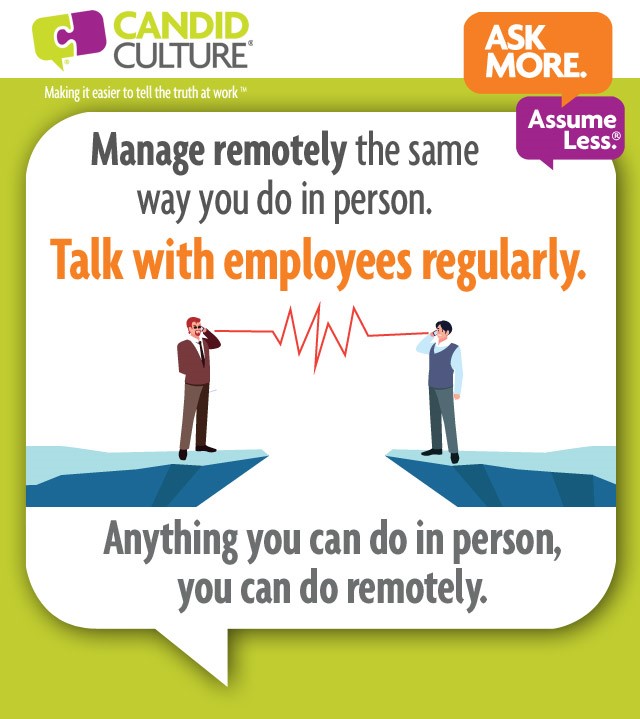
Many managers are asking the question, “How do I manage
employees remotely?” Managing employees remotely isn’t too different than
managing in person. Whether someone is sitting with you or in their home
office, the steps involved in managing people are the same.
There are a few things effective managers do repeatedly. Do
these handful of things and managing people will go well, provided you have the
right person in the job. Managing someone who is a good fit for their current
job is challenging but doable. Managing a person who is not a good fit for
their job is extraordinarily hard. No management practices or skills supersedes
hiring the right person. Hiring the right people is the single most important
thing managers do. Managing and coaching employees are the next most important
things managers do.
Here are the three things effective managers do:
Set clear expectations:
Conversation with new/inexperienced
employees: “This is what I want you to do and by when.”
Conversation with experienced employees: “What do you think needs to be done and when is a manageable deadline?”
2. Delegate:
New/inexperienced employees: “Here is my
vision of how this should look.”
Experienced employees: “What’s your vision of how this should look?”
3. Review work, coach, and give feedback:
Review small pieces of work so
employees can course correct as they go, reducing wasted time and frustration.
Agree on a schedule to review work in process, so employees feel supported and
not micromanaged.
New/inexperienced employees: “Here
is what I would do differently and why.”
Experienced employees: “Here are my
areas of concern. What changes do you think need to be made?”
Repeat
That’s all you need to do. It’s so simple. And so hard.
Managing employees is very challenging.
Here are five ways to make it easier to manage well:
Spend time at the beginning of working relationships and projects getting to know employees work styles and preferences and sharing your own.
Check in with employees regularly, asking questions that elicit what employees need to be successful.
Have frequent, short conversations. A weekly 15-minute touch base is more effective than a monthly 60-minute meeting.
Do a plus/delta every time you meet, giving positive and upgrade feedback as events happen. Waiting to give feedback negatively impacts results and damages trust.
Have courage and know that employees want to work for a manager who sets clear expectations and gives clear feedback. Working in the dark is frustrating and difficult.
If you’re hesitant to do any of the actions above or are worried about how those actions will be perceived by employees, tell employees that. Be authentic and candid. You could say something like, “I want to review your work more frequently than I have in the past, but I’m concerned how you’ll perceive that.” “I want to give you regular, timely feedback to be helpful to you, and know feedback can be hard to hear.”
Lastly – remote meetings can be held via video conferencing but don’t need to be. Sometimes it’s nice to talk via phone and not have to get dressed up or manage your facial expressions. If you’re not sure if you should meet with employees via video or phone, ask them. Setting clear expectations is the first step in managing all business relationships effectively.
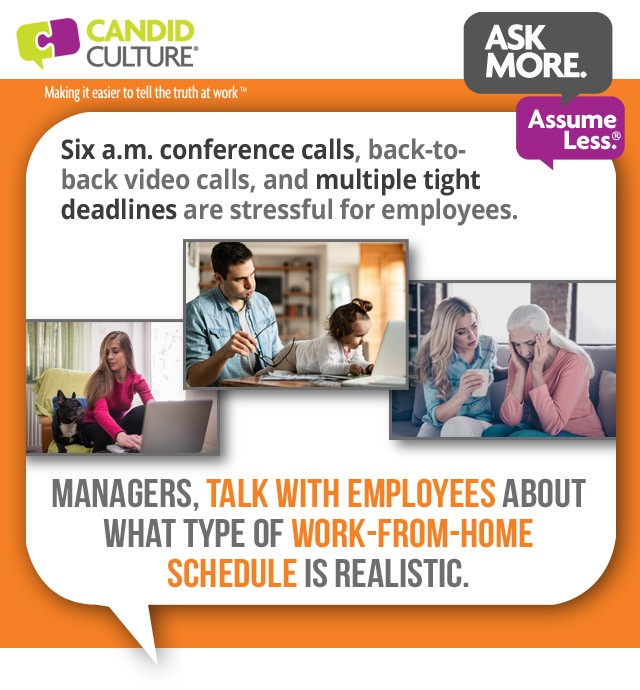
You’ve been on video calls for the past two hours. Your kids are bored, you aren’t accustomed to working alone at home and miss working in an office with other people, you don’t have a quiet, interruption-free environment in which to work, or your parents have called eight times.
Everyone you
work with is dealing with different circumstances. Some are perfectly content
working a full day at home, others are finding the experience isolating and
lonely. Some have no distractions at home and others have many. But we won’t
know what others are dealing with and how those circumstances impact work
schedules and deliverables if we don’t ask.
Managers, employees, and coworkers need to talk to each other about the constraints they’re dealing with and what a realistic work schedule looks like right now, and those conversations may be personal. They’re likely more personal than the conversations you’ve had in the past and that may be uncomfortable.
Managers, before setting goals, assigning projects, or scheduling meetings, talk to employees about what a realistic workday looks like right now.
Here’s how
the conversation could go: “I know working from home all the time is different
from you’re used to. I want to get a sense of what a realistic schedule is for
you and what kind of challenges you’re dealing with. We can create deadlines
and deliverables from there.”
Managers share about your own situation and set expectations with your employees, coworkers and with your own boss. It could sound something like this: “I have two young kids at home and I’m bringing my parents food each day. I check and return emails before 7:00 am, while my kids are still asleep. I log back on and am available for calls from 9:00 am – 10:30 am. I’m out of commission until 3:00 pm. I work from 3:00 pm – 4:30 pm and then I’m available at night from 8:00 pm – 9:30 pm. I know it’s not ideal, but it is my reality. Let’s figure out how to ensure you get what you need from me given the schedule.”
These are the conversations we need to be having and no one wants to have them. Who wants to admit to their boss, employees, and coworkers that they’re not able to work and focus for much of the day? No one. But pretending like we can participate in six hours of video calls each day or that our availability and productivity isn’t impacted is stressful and unrealistic. We are humans working with other humans and we need to be real with one another.
Managers ask your employees what a realistic work schedule looks like and find out what they’re able to do on a given day. Employees, broach the conversation with managers and coworkers. Be honest and ask for flexibility. It’s better to set expectations upfront than to surprise and disappoint.
The most frequent question I’m getting these days is how to manage business relationships (specifically employees) remotely. A future tip and blog are dedicated to this, but I’ll give you the short answer now – talk to people. Pick up the phone. You don’t need to have video calls if you don’t want to. Showering is a personal choice. You just need to talk to people.
People need human contact. We even need to connect with the people we don’t like – when we work for and with them. Text and email don’t replace talking to people.
We stopped talking to each other long before we all began
working from home. Email has been
overused for years. We email the people we sit next to at work. We exchange 20
emails on one topic rather than picking up the phone. We ask permission to call
our friends to catch up. Texting to ask, “Is it ok if I call tomorrow morning?”
is the norm. We’ll exchange 50 texts to determine where and when to meet for
lunch.
Maybe people thinking email and texting is easier, less intrusive,
faster. Less intrusive, yes. Easier, sometimes. Faster, no.
Call the people you work with. Ask for the best time to call, if you like. Check-in on them. Ask how they’re doing. Yes, there may be a crying child or a barking dog in the background. It’s ok. Calls don’t have to be long. People just need contact. They need to know that you care and are ‘in it’ with them. And while you’re on the phone, get questions answered in five minutes rather than with 25 emails.
We all know people who have been furloughed, taken pay cuts, or who were laid off over the past few weeks. It happened fast. Business has slowed or ceased in many industries, businesses are shut, people aren’t working. There are loans and tax refunds in place to motivate employers not to reduce employees’ hours or to reduce headcount.
Business leaders are doing the best they can to make decisions that will keep businesses afloat. It is a difficult time to run a business and manage people.
I too am confronted by these decisions in my own business. I had a new person who was supposed to start on March 16th. I have part-timers who aren’t coming in right now. I have an open job I’m not filling.
I want to
suggest you play the long game letting your personal and professional goals drive
your decision making, and I know this is very, very difficult. It’s difficult for
me too.
Maybe you need
to lay people off or reduce hours or compensation. Communicate with those
employees from a place of TLC – communicate early and often. Give as much information
as you can. Be as generous as you can.
Generosity
comes in all forms. It is not necessarily financial.
Tell employees the benefits that are available to them. Be realistic about when employees may receive checks. But also share how you feel about these employees and how difficult it is to reduce compensation and jobs. People want to work for people who are authentic and care about them. Don’t be afraid to show you care. Call and check-in with employees who aren’t working. Ask how they’re doing. Demonstrate concern.
There is a
long game in how we make business decisions but also in how we treat people.
Treat people like they’re family and you’re working to have a long-term relationship.
Lastly, try not
to make decisions from fear. This is a tricky one and one I can’t say I’m doing
well. I’ve made a few too many recent
decisions out of fear. But fear is not a powerful place to stand. Fear is paralyzing
and limiting.
When making personal and professional decisions, consider your long-term goals. Ask, “What do I want my business to look like in one year, three years, five years? What do I need to do today to achieve those goals, within today’s scary reality.” Act from your goals, not your momentary fear. You may need to remind yourself of this from moment to moment. I know I do.
Think future.
Be realistic. Act with care and humanity. Play your long game personally and
professionally.