Business Relationships Archive
People often hoard feedback until a situation becomes so frustrating that they can’t help but speak up. And because they waited too long to say what they think, many more words come tumbling out than is either necessary or helpful.
When it comes to giving feedback, less is more. Be specific, give an example or two, and stop talking.
If you want people to be receptive to your feedback, make it easier to hear by saying less. By saying less, I don’t mean don’t tell the truth or provide enough information that the person knows precisely what to do differently. I do mean, don’t provide more information than is necessary.
You are likely familiar with the phrase “let someone save face.” Allowing someone to save face requires saying just enough that the person knows what to do differently, but not so much that the person feels attacked.
Here are two examples of giving feedback do’s and don’ts:
Too much feedback: Last week you turned in a report that had five typos and had important pieces of information missing. I’m surprised you’d be so careless. It made our entire department look bad. I’m perplexed that you’d submit work without checking it first. What is leading you not to check your work and submit incomplete reports?
Don’t repeat feedback. Say it once and move on. And remove unnecessary judgments (careless) and share just the facts.
Just the right amount of feedback: The report you gave me last week had a few typos and was missing some important information. The report went to the client with those errors which didn’t reflect well on our department. What happened?
Too much feedback: I noticed you didn’t speak up during last week’s department meeting. People won’t know the value you provide if you don’t share what you’re working on. You need to be more vocal. People’s only exposure to you is often during our team meetings. If you don’t speak up, you won’t establish yourself as a leader in your department. People really need to know what you’re working on and the impact you’re making.
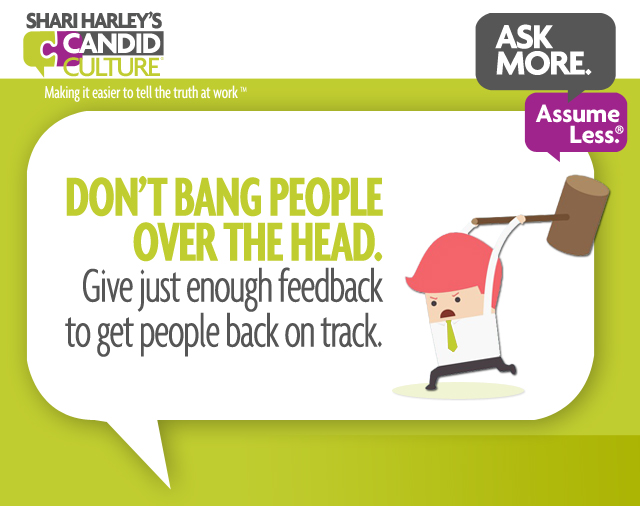
Redundant feedback feels critical and leaves the person feeling like they have been hit over the head with a mallet.
Just the right amount of feedback: I noticed you didn’t speak during last week’s department meeting. Often, team members’ only exposure to you is during our weekly meetings. How can I help you feel comfortable speaking up so you can establish yourself as a leader in the department?
It’s easy to get carried away when giving feedback. We’re likely frustrated. And when our emotions run the show, it’s easy to say too much.
Here are three practices for giving feedback:
- Practice the 24-hour guideline and the one-week-rule. If you’re upset, wait 24-hours to give feedback, but not longer than a week after an event.
- Plan what you’re going to say both in writing and out loud. Practicing a conversation in your head is not the same as speaking it.
- Let someone you trust hear what you’re planning to say and ask that person how you can improve the feedback. Ask what you can remove without losing any of the message.
Planning a conversation is like packing for a trip. When packing for a trip, many people put their clothes on the bed, then put the clothing in a suitcase. Realizing they have way more than they need, they start taking things out of the suitcase. Eventually they arrive at their destination with much less than they initially packed, but still more than they need.
Use the same principles when planning a feedback conversation. Put every thought you have on paper, and then remove what you don’t need, leaving only the necessary points that tell the person just what they need to do differently.
When giving feedback, less is more. Tell the person what happened, why it’s a problem, and what they need to do differently. Then stop talking and let the person save face.
Want to spend less time managing performance issues? Hire the right people. The right people make everything work. The wrong people drain your time, patience, and resources.
Instead of spending 60-90 minutes doing multiple interviews, which tell you little, give candidates a chance to experience the job, and see how they do.
I used to conduct thorough interviews after screening candidates via phone. I’d ask a lot of questions, and I still hired the wrong people. And as a result, we’ve changed our hiring practices at Candid Culture. We no longer do traditional interviews after phone screens. Instead, after conducting a phone screen, we give candidates about an hour to do parts of the job. Then we decide if we want to talk with them further.

Too many companies spend too much time interviewing candidates they won’t hire. You might have multiple employees interview a candidate. It’s not uncommon for candidates to meet seven or eight people and spend multiple days interviewing. The ultimate decision maker often interviews the person last, cuts the candidate, and thus wasted existing employees’ and the candidate’s time. If you want your employees to be involved in the hiring process, have them interview only the candidates the decision maker would be willing to hire. Why waste everyone’s time?
Here Are Seven Interviewing Techniques to Make Better Hiring Decisions:
Interviewing Techniques Number One: Consider hiring a recruiting firm to source and screen candidates. Reading 100 resumes is likely not how you want to spend your time.
Interviewing Techniques Number Two: If you choose not to outsource recruiting, create a few steps for candidates to follow when applying for a job with your company to weed out the people who aren’t serious. It’s better to see 20 resumes from serious candidates than 100 resumes from candidates who potentially aren’t really interested in your company.
Interviewing Techniques Number Three: If you’re sourcing and screening your own candidates, conduct thorough phone screens. Assess culture fit and candidates’ ability to do the job, and eliminate candidates who don’t meet your criteria.
Interviewing Techniques Number Four: After conducting phone screens, schedule interviews with the candidates you’re interested in. Tell candidates they’ll be participating in a practical interview during which they’ll get to do parts of the job, so they can see if they’ll enjoy the work.
Interviewing Techniques Number Five: Have candidates do some work, observe them and/or the work they produce, and provide some positive and improvement feedback. If, after observing candidates do some work, you think they can do the job, and the candidate accepted your feedback without becoming defensive, conduct an in-person interview. If you don’t think they can do the job or were not open to feedback, eliminate the candidate.
During interviews, I screen for a candidate’s willingness to accept coaching and feedback. People who aren’t coachable or open to feedback are exhausting and difficult to work with.
Interviewing Techniques Number Six: If you’re interested in a candidate after both the practical and in-person, video or phone interview, conduct detailed reference checks. Never, ever skip the reference check.
Interviewing Techniques Number Seven: Lastly, if you’re going to extend an offer, ask your finalists to spend a day or half a day job shadowing. Job shadowing virtually is trickier than in person, but with some creativity, it can be done. Candidates and employers are on their best behavior during an interview and become more relaxed outside of the traditional interview. You want candidates to get a feeling for what it’s really like to work in your organization. Culture fit is the hardest thing for candidates and hiring managers to predict. Job shadowing helps.
Slow down your interviewing, be more thorough, and make better hiring decisions.
I’m often asked, “Can I give my boss or the people above me feedback? Is that really realistic?” Giving people ‘above’ you feedback has everything to do with the quality of your relationship and less to do with the person’s title. If your relationship is good and your boss is open to feedback, then yes, you can practice the feedback formula with them. If your relationship isn’t that solid or your boss isn’t open to your feedback, practice managing up by asking for what you want instead of giving direct feedback.
No one likes to be criticized or told that they are wrong. When giving someone direct feedback, no matter how kind the delivery, you are telling someone, “You’re doing ______ wrong. Please do _____ instead.” Being that direct is challenging when you don’t have a trusting relationship or when people are highly defensive. You can achieve the same desired results by simply asking for what you want.

Asking for what you want is less judgmental than giving direct feedback and is a subtle way of telling someone they are not giving you what you need. And people who are paying attention will get that. They don’t need it spelled out.
Here are a few ways to practice managing up with your boss and other leaders in your organization:
Example One:
Giving Direct Feedback: “You don’t make time for me. I’m getting behind on projects because you don’t take the time to review my work.”
Managing Up by Asking: “How can we ensure you get to review my work each week, so I can finish the projects I’m working on?”
Example Two:
Giving Direct Feedback: “Every time we have a meeting scheduled, you cancel it.”
Managing Up by Asking: “If meetings get cancelled, is it ok if I reschedule them?
Example Three:
Giving Direct Feedback: “You’re a micromanager. I feel like I can’t make a move without your permission.”
Managing Up by Asking: “I’d like to manage ________ project. What do you need to feel comfortable with me doing that?”
Telling someone at any level s/he is doing something wrong, which will likely evoke defensiveness. And being direct requires both courage and a good relationship. If you don’t have the relationship to be so direct, simply ask for what you want.
You will be passed over for jobs, projects, and second dates, and never know why. Being passed over isn’t necessarily a bad thing, not knowing why you were passed over is problematic. If you don’t know why you’re being passed over, how can you be prepared next time?
Organizations are political. People talk. You’ve undoubtedly already experienced this.
If you want to manage your professional reputation, one thing you must know is who talks about you and what they say. How decisions get made in organizations isn’t always obvious. There are the obvious channels of decision making, like your boss and your boss’s boss. But there are also the people who talk to your boss and boss’s boss and have an opinion about you, who you may not be aware of.

Everyone in an organization has people they trust, who they listen to and confide in. Who those trusted people are isn’t always obvious. When you’re being considered for a new position or project, the decision makers will invariably ask others for their opinion. Knowing who does and doesn’t support you in a future role is essential to managing your professional reputation and career.
I don’t want you to be nervous, paranoid, or suspicious at work. I do want you to be savvy, smart, and aware.
It’s not difficult to find out who can impact your professional reputation at work, you just need to ask the people who know. Start with your manager. Your manager likely knows and will tell you, if you ask.
To ensure you know who can impact your professional reputation, tell your manager:
“I really enjoy working here. I enjoy the people, the work and our industry. I’m committed to growing my career with this organization.”
Then ask two or three of these questions:
- Who in the organization should I have a good relationship with?
- Who/what departments should I be working closely with?
- Who impacts my professional reputation and the opportunities I have?
- What skills do I have that the organization values most?
- What contributions have I made that the organization values most?
- What mistakes have I made from which I need to recover?
Your manager doesn’t walk around thinking about the answers to these questions. If you want thoughtful answers, set a time to meet with your manager. Tell your manager the purpose of the meeting – to get feedback on your professional reputation so you can adeptly manage your career – and send the questions in advance, giving your manager time to prepare for the meeting. You will get more thoughtful and complete answers if your manager has two weeks to think about the questions and ask others for input.
Don’t be caught off guard by a less-than-stellar professional reputation. Take control of your reputation and career. Ask more. Assume less.

Most employees need only a handful of things to be satisfied and productive at work. The key is getting employees to tell you what those things are. And they might just tell you, if you ask.
Effective management involves asking questions during the interview process, after an employee starts, and again 90-days to six months into the job.
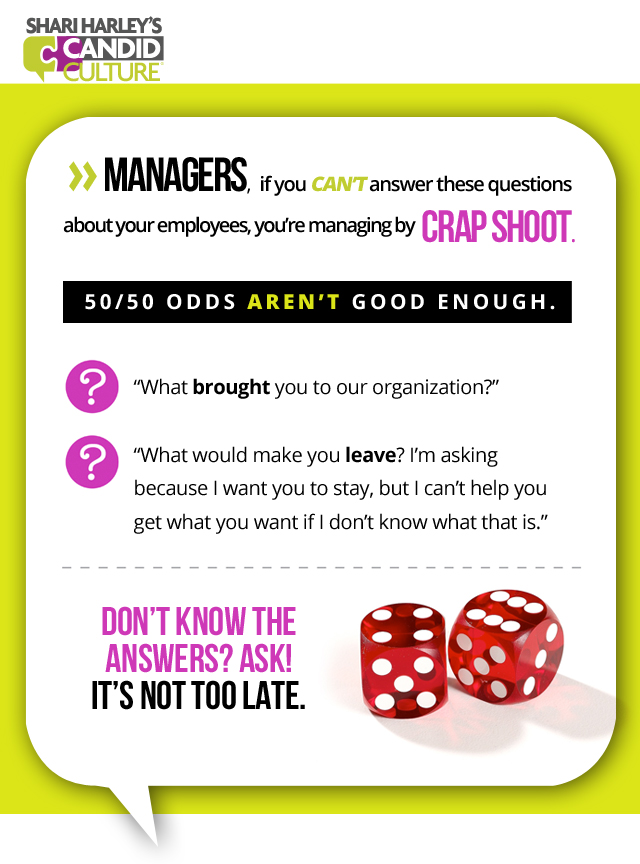
I recommend asking the seven questions below. I call the questions, Candor Questions.
Candor Question number one: “What brought you to this company? Why did you accept this job? What are you hoping the job will provide?” Ask one of these three questions. Pick the one you like best.
Candor Question number two: “What would make you leave this job? What are your career deal breakers, things you just can’t tolerate at work?” Ask either of these questions.
Candor Question number three: “What type of work, skills, and/or areas of our business do you want to learn more about?”
Candor Question number four: “Tell me about the best manager you ever had. What made him/her the best manager?” This will tell you what the employee needs from you as a manager and is a much better question than, “What do you need from me as your manager?” That is a hard question to answer. Telling you the best manager s/he ever had is easy.
Candor Question number five: “Tell me about the worst manager you ever had? What made him/her the worst manager?”
Candor Question number six: “What are your pet peeves at work? What will frustrate you?” Why find out the hard way what frustrates employees when it’s so easy to ask. This question demonstrates that you want your employees to be happy and that you will flex your own preferences, when possible, to meet employees’ needs.
Candor Question number seven: “How do you feel about being contacted via cell phone or text outside of business hours? How do you feel about receiving emails during the evenings and weekends?”
If you’ve participated in one of our management trainings or received a box of Candor Questions for Managers, you know I could go on . But these seven questions are a good start.
Regardless of age, work, and educational background, employees have a few things in common.
Employees want to:
• Work for someone who takes an interest in and knows them
• Feel valued and appreciated for their contributions
• Be part of and contribute to something greater than themselves
• Feel respected as a person. Managers respect their time, expertise, and needs
Taking the time to get to know employees throughout your working relationship accomplishes many employee needs.
If you have long time employees, it’s never too late to ask these questions. Regardless of for how long employees have worked for you, they’ll appreciate you asking. Don’t worry that employees will raise an eyebrow and wonder why you’re asking now. They’ll just be happy you’re asking. You can simply say, “I realized that I’ve never overtly asked these questions. I just assume I know. But I don’t want to do that. During our next one-on-one meeting I’d like to ask you these questions and you can ask me anything you’d like.”
If you have a manager who will never ask you these questions, provide him/her the information. Don’t wait to be asked. You’re 100% accountable for your career. Tell your manager, “There are a few things about myself I want to share with you. I think this information will help ensure I do great work for the organization for a long time.”
Managers, the better your relationship with your employees and the more you know about what your employees need from you, the organization, and the job, the easier employees are to engage, retain, and manage. Stop guessing and start asking.

I’m a big fan of taking responsibility and personal accountability. I think being accountable is easier than passing the buck. When I’m accountable, I have more power and control. When someone else is accountable, I have neither. But there’s a difference between being accountable and apologizing for yourself.

Last week I vowed to stop saying, “I’m sorry.” And yet, the next words out of my mouth were apologetic. Apologizing for oneself is so natural, it’s pervasive, aka, a hard habit to break.
Below are a few strategies for being accountable but not apologetic:
- Establish clear priorities and boundaries. Having clearly established boundaries makes decision making easy.
- Only commit to things you know you will do. For personal situations, only commit to things you genuinely want to do.
- Tell the truth. If you don’t plan to do something, say so, without apology. “Thank you but no” has a lot of power.
- Know your limits and what you need to be healthy and functioning at an optimum level. If you need eight hours of sleep, structure your life to get it. If you need weekends focused on your family, do that. Taking care of yourself enables you to take care of others.
- Renegotiate when you need to. If you realize something you agreed to isn’t feasible or in your best interest, renegotiate versus suffer through it. Or, keep your commitment, but don’t agree again the next time a similar opportunity or request comes around.
- Be careful where you invest your energy. I love my family and friends, and they will never get a printed party invitation or holiday card from me. I want to do both; I really do. But just thinking about collecting addresses puts me over the edge.
- Give yourself a break. You’re doing the best you can. You’re a human like everyone else. We’re all doing the best we can.
Being accountable isn’t being perfect, it’s being human. Be yourself. Take care of yourself. And do your best, unapologetically.

Breakdowns happen. There will be days people won’t give you what you need to complete projects. Things will break. And you will look bad. When breakdowns happen, I always ask myself, “What could I have done to prevent this situation?” or “What did I do to help create this situation?” I see myself as accountable for whatever breakdowns occur.
It may sound odd that I always look at myself when breakdowns occur, even when it’s someone else who didn’t do their job, but it’s just easier. I can’t control anyone else. But I can control me (admittedly, some days I do a better job at this than others). When I can identify something I could have done to make a situation go differently, I feel more in control – aka better.
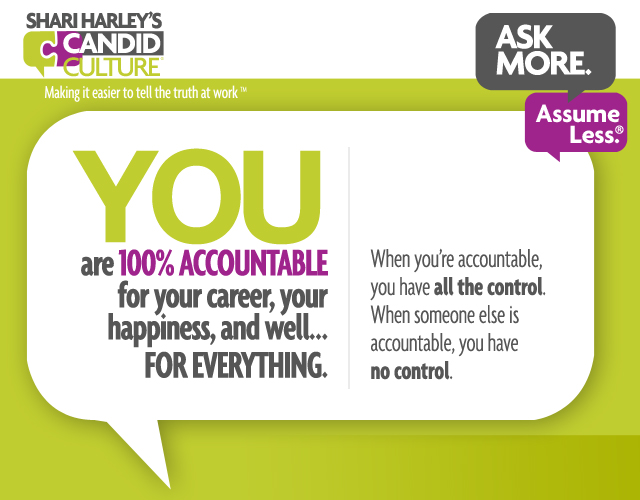
It’s like getting off a highway versus sitting in bumper-to-bumper traffic. The alternate route may take longer, but at least I’m moving. I feel like I’m doing something and thus have more control. Taking responsibility for everything that happens to you is similar. When you’re accountable, you can do something to improve your situation. When someone else is accountable, you’re at the mercy of other people and have very little control.
There are, of course, exceptions to the practice that “we’re always accountable.” Terrible acts of violence, crime, and illness happen to people, about which they have no control. But in general, in our day-to-day lives, there is typically something we did to contribute to a bad situation or something we can do to improve it.
Here are five practices for improving difficult situations, even when you didn’t create the mess (alone).
1) Ask more questions. If you’re not clear about what someone is expecting from you, ask. You’re responsible for doing good work, regardless of the type of direction you receive.
2) Tell people what you think they’re expecting and how you’re planning to approach a project or task, to ensure everyone’s expectations are aligned. Clarifying expectations beats doing several weeks worth of work, only to discover what you created isn’t what someone else had it mind.
3) Ask for specific feedback as projects progress. Don’t wait until the end of a project to find out how you performed.
4) Say “thank you” to whatever feedback you receive versus defending yourself. People will be pleasantly surprised and their upset will dissipate more quickly. That could sound like, “That’s good feedback. I’m sorry that happened. Thank you for telling me.”
5) Admit when you make a mistake or when you wish you had done something differently. Don’t wait for someone to tell you. Saying, “I’m sorry. How can I make this right with you?” goes a long way.
I consistently ask the following questions:
“What could I have done differently?”
“What did I do to contribute to this situation?”
“What can I do now to make this situation better?”
I encourage you to ask these questions, even when someone else drops the ball. You can’t control others, but you can control you. And your happiness and success is your responsibility.

The normal, natural reaction to negative feedback is to become defensive, a response I’ve labeled as The Freak Out.
Everyone, even the people you think do little work, wants to be seen as good – competent, hardworking, and adding value. When anyone calls our competence into question, we get defensive. Becoming defensive is an automatic response that we have to train out of ourselves.
Until the people you work with train themselves not to become visibly defensive when receiving feedback, just expect it. And be happy when you get a defensive response. It means the person is breathing and cares enough about what you’re saying to get upset.
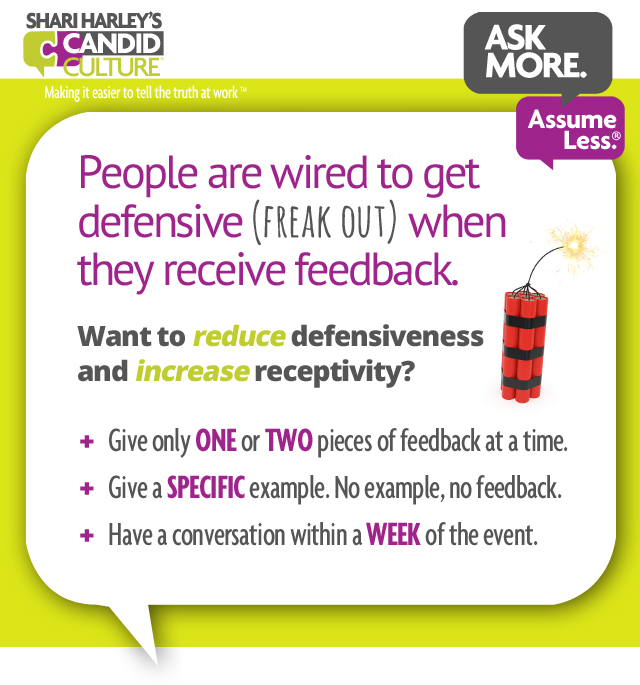
While you can’t get rid of a defensive response to feedback, you can reduce it by following a few feedback practices. Practice these methods of giving feedback and your input will be heard and acted on, more often than not.
Employee feedback practice one: Don’t wait. Give feedback shortly after something happens. But do wait until you’re not upset. Practice the 24-hour guideline and the one week rule. If you’re upset, wait at least 24-hours to give feedback, but not longer than a week. If the feedback recipient can’t remember the situation you’re talking about, you waited too long to give feedback, and you will appear to be someone who holds a grudge.
Employee feedback practice two: Be specific. Provide examples. If you don’t have an example, you’re not ready to give feedback.
Employee feedback practice three: Praise in public. Criticize in private. Have all negative feedback discussions privately.
Employee feedback practice four: Effective feedback discussions are a dialogue; both people talk. When the feedback recipient responds defensively, don’t be thwarted by their reaction. Listen to what they have to say and keep talking. Don’t get distracted.
Employee feedback practice five: Give small amounts of feedback at a time – one or two strengths and areas for improvement during a conversation. People cannot focus on more than one or two things at a time.
Employee feedback practice six: Give feedback on the recipient’s schedule and in their workspace, if you are working in person and the recipient has a door. It will give the other person a sense of control and they will be more receptive.
Employee feedback practice seven: Talk with people – either in person or via phone. Don’t send an email or voicemail. Email is for wimps and will only damage your relationships.
Employee feedback practice eight: Prepare. Make notes of what you plan to say and practice out loud. Articulating a message and thinking about it in your head are not the same thing.
Employee feedback practice nine: Avoid The Empathy Sandwich – positive feedback before and after negative feedback. Separate the delivery of positive and negative feedback, so your message is clear.
Employee feedback practice ten: Offer an alternative. Suggest other ways to approach challenges. If people knew another way to do something, they would do it that way.
You can deal with whatever reaction to negative feedback you get. The other person’s response might make you uncomfortable, but that’s ok. You’ll survive. Try to practice the guidelines above, and if you don’t, and you ‘do it all wrong,’ at least you said something. Just opening your mouth is half the battle. When you come from a good place of truly wanting to make a difference for the other person, and you have both the trust and permission to give feedback, you really can’t go wrong.

You disagree with something someone above you said or did. How do you tell the person without actually telling him?
Lots of people think they can’t give direct feedback when talking to someone at a higher level. I’m here to tell you that that’s not true. The ability to speak freely has little to do with titles and more to do with the quality of your relationship. When you’re comfortable with people and have mutual trust, you can say (almost) anything, regardless of titles and levels. But that’s not the true purpose of today’s blog. So I’m going to stick to the topic at hand –what to say when you feel like you can’t say very much.
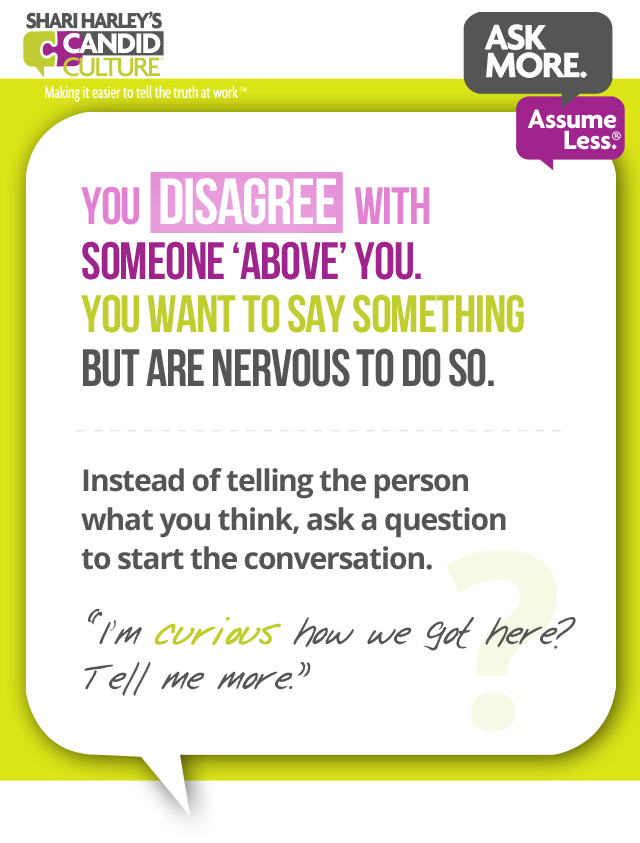
When you don’t have the relationship to say what you really think, manage up by asking a question instead. Engage the person in a conversation. At some point during the conversation, you’ll be able to say what you think.
For example, you question a decision but don’t want to overtly say you question the decision.
Here’s how the conversation could go:
“I wasn’t involved in the conversations to select our new payroll software. Can you give me a little history? What had us choose our current provider?”
“What software features were important when selecting the software?”
“What problem were we trying to solve that drove the need to make a change?”
“What do you like about the software we picked? What don’t you like?”
** Obviously this is meant to be a discussion, not an interrogation. Ask one question at a time and see where the conversation goes. You may ask all of these questions and you may ask only one.
The point is to gather more information. Manage up by seeking to understand before you express an opinion. As the conversation progresses, you might see opportunities to express your point of view.
Here are three suggestions if you’re going to practice the technique of asking questions as a way to manage up and eventually give feedback:
1. When you ask a question, come from a place of genuine curiosity. If you aren’t truly curious and asking questions is just a technique you found in some blog, it will show.
2. Watch your tone of voice. If you can safely add the words “you dummy” to a question, you have a tone issue.
3. Be patient. Asking questions may feel easier than giving direct feedback, but it also takes more patience and time.
As the conversation progresses, you might be asked for your opinion. Before saying what you think, remember, no one likes to be told that s/he is wrong. And the person you’re talking to likely had a hand in making the decision you’re questioning. Be careful not to judge.
Instead of overtly judging, consider saying something like:
“I think the new system has potential and also has some limitations. Do you want feedback as we use the system and get to know it better?”
“What specifically would you like feedback on? What are you not looking for feedback on?”
“What’s the best way to provide input and to whom?”
You can speak more freely when you have the relationship to do so and have permission. Until you have both, earn the right to give feedback by asking questions from a place of genuine curiosity. And only provide your point of view when you’re asked and are certain you have all the information to defend your position.

Employees leave managers not jobs. We’ve all heard this 100 times.
One of the most prevalent reasons for employee turnover is boredom and lack of growth. We’ve also heard this many times.
We know why employees leave jobs. The question is what must managers do to engage and retain their best people. The answer is actually quite simple, although not necessarily easy to execute.
Employees want to know that their manager:
- Knows them
- Cares about and is invested in their careers
- Gives feedback so they can improve
- Provides opportunities so they can develop
In other words, employees need attention, and attention requires time – time many managers may not feel they have.
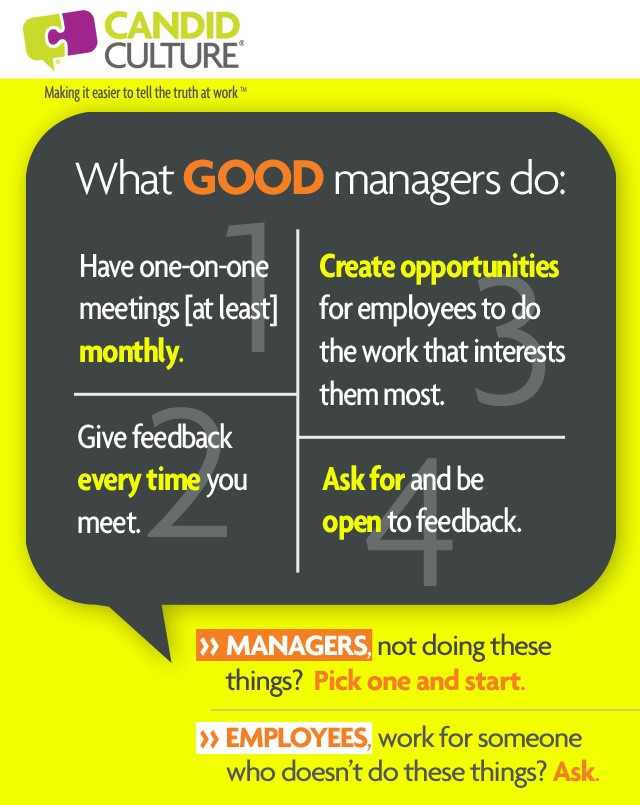
Here is a five-step formula for employee retention and employee engagement:
- Get to know employees better and differently.
- Have meaningful, one-on-one meetings [at least] monthly.
- Give balanced feedback as work is done.
- Ask for and be open to feedback.
- Create opportunities for employees to do the work that interests them most.
Managers, how do you make time for these meetings when you are busy and have several direct reports?
- Meet for 15-30 minutes.
- Ask direct reports to create an agenda and run the meetings.
- Ask direct reports to send follow-up notes of decisions and plans made during meetings. Give some of the accountability away.
- If meetings get cancelled, reschedule as soon as possible. Direct reports take cancelled meetings personally. Cancelled meetings that are not rescheduled send the message that managers don’t care about employees and their careers.
Employees, if your manager doesn’t schedule meetings with you:
- Ask permission to put a monthly meeting on your manager’s calendar.
- Provide rationale for why you want to meet – to get your manager’s feedback and ensure you’re focused on the right work.
- Ask permission to reschedule meetings when they get cancelled.
- Don’t take cancelled meetings personally.
- Offer to meet with your manager via the phone when it’s convenient for him/her. Leverage commute and travel time.
Employees need time with their managers. Meaningful discussions and work result in employee engagement and employee retention. So managers, make the time, even when you don’t feel you have it. Ask questions you don’t ask now. Give feedback, even if it’s uncomfortable. Give your employees an opportunity to do the work that interests them most. And watch your employee engagement and employee retention improve. And if your manager doesn’t do these things, politely and persistently ask. You won’t get what you don’t ask for. We are all 100% accountable for our careers.