I think Instacart is a brilliant idea. I make a grocery list online, someone else goes shopping for me, and drops my groceries on my porch. What a great way to save time, unless I want a certain brand of canned tomatoes with no rosemary, and two green bananas, three that are almost ripe, and one that is ripe right now. Meaning, if I want my groceries a certain way, I need to go shopping myself. No one else will pick precisely what I will. And delegating work and managing people is the same.
No one will do something just like you will. They might do it better or worse, but either way, work won’t be done just as you would do it. If you want something done precisely your way, you’re likely going to need to do it yourself.
There is little more demoralizing than working hard on a document and having your manager red line it with edits that aren’t wrong, they’re just not her way. This kind of feedback makes employees wonder why they bothered doing the work in the first place. Employees find themselves thinking and possibly saying, “If you’re going to change my work to be more your way, you should just do it yourself.”
This isn’t to say that if you have a vision for how work should be done that you shouldn’t delegate. Managers need to delegate work or they will be focused on the wrong things, exhausted, and resentful, and employees won’t grow, develop, and be properly utilized.
Managers need to set clear expectations, follow up to review work, provide regular feedback as the work is in process, and then expect and accept that completed projects won’t look just like what they would have done. Even when employees produce great work, that work likely won’t be a mirror image of what the manager would have done herself.
If getting work that is slightly askew from what you would have done works for you, delegate the work. If work produced must be a certain way, you should likely do it yourself, or risk both you and your employees’ frustration.
Here are six steps on how to delegate, a skill I think most managers can strengthen:
How to delegate step one: Provide clear instructions to the person to whom you’re delegating. If you have an image of what something should look like, provide a sample document.
How to delegate step two: Ask the person to whom you delegated to tell you what you’re expecting. Don’t ask, “Do you have any questions?” The right answer to that question is, “No,” and gives you no insight about the person’s understanding of your expectations. Instead, ask, “So I know I’ve been clear, what am I asking you to do?” Or you could ask, “Based on what I’ve said, what do you think I’m looking for?” There are lots of ways to assess a person’s understanding. You simply need to get the person talking.
How to delegate step three: Don’t assume people know what to do. We have all left someone’s office with a new project thinking, “I have no idea where to start.” And then that project goes on the bottom of the pile.
Ask the person, “What are you going to do first?” If they give you an answer that tells you they know what to do, step back. They’ve earned some freedom. If they give you an answer that will not lead to the results you want, step in and offer help.
How to delegate step four: Ask to see work as the work is completed versus reviewing all of the work when the project is done. Giving a lot of upgrade feedback after work is completed is demoralizing to employees and wastes a lot of time. Tell employees, “I’d like to see your progress every Friday (or whatever interval is appropriate depending on the length and complexity of the project). This isn’t to micromanage you, it’s to ensure you don’t do a bunch of work that I will want changed. I don’t want you to waste your time.”
How to delegate step five: Give candid feedback when you review work. Don’t say something is fine if it’s not. Ask for changes while the work is in its early stages versus when it’s almost complete.
How to delegate step six: Resist the temptation to edit work or give feedback on work that is correct but wasn’t done your way. Remember, if you want something done your way, sometimes it makes sense to do it yourself.
When it makes sense to do something yourself: When you must have something a certain way and you’re the only person who can and will do it that way. If you’re ok with things not having the same words, formatting or flavor you’d put on them, delegate. If you need your bananas to look a certain way, go pick them up yourself. And both options are right answers. It’s ok to want what you want.
If you were on a diet and stepped on a scale that said, “Pretty good. Keep up the good work,” you’d return the scale, claiming it didn’t work. Likewise, if your GPS told you that it “seemed you were going the right way,” you’d probably use a different app. Scales and GPS provide us with feedback, but vague feedback is unhelpful. It doesn’t tell us what to do more, better, or differently, which is the purpose of feedback.
Vague, positive feedback is also inauthentic, and inauthenticity smells. Hearing you did a great job is nice, but utterly unhelpful because the feedback recipient doesn’t know what he did well and what to replicate. If you want people to replicate a behavior, tell them precisely what they did well that you want them to do again.
Most feedback training focuses on giving negative feedback, because it’s so hard to do, but we’re not much better at giving positive feedback. Giving useful, positive feedback takes attention, observation, and timely communication. In short, it’s difficult.
I too find myself telling my team members, “You did a great job on…” I know vague words like these serve as a short pick-me-up. My team probably smiles and appreciates the recognition, but I also know I haven’t given them substantive direction of what actions I want them to replicate. Those of you who have participated in feedback training with me know that I call vague input Cap’n Crunch – all of the sweetness, with none of the nutrients.
To give effective, positive feedback, simply state one or more specific actions you want the person to replicate.
Here are a few examples of positive feedback:
Cap’n Crunch: “You did a great job on……”
Positive feedback example one: “You did a great job onboarding our new analyst. You outlined what he needed to do during his first 90-days to be successful. He now knows precisely what he has to do and won’t have to guess.”
Cap’n Crunch: “Thanks for being so committed to our business.”
Positive feedback example two: “Thanks for calling in to today’s team meeting on a day you had off. Your participation helped us make a decision that would have taken much longer without your participation. I appreciate your commitment to our business.”
Cap’n Crunch: “Thanks for paying attention to the things that may impact us negatively in the marketplace.” This is not terrible, but not as effective as it could be.
Positive feedback example three: “Thanks for paying attention to the things that may impact us negatively in the marketplace. I appreciate you tracking the new products our competitors are launching. It helps me know where we are ahead and behind.”
Don’t assume people know what they did well and that they will replicate positive behavior without receiving positive feedback. Watch people’s actions and tell them, shortly after they do something, what they did well. And watch those positive behaviors be repeated.
Companies want people who make things happen. And to make things happen, you have to speak up. Anticipating the train wreck and commenting after the train goes off the tracks doesn’t count.
What if you said what you thought, in a way other people could hear you, when you had the right to do so? Meaning, you have the relationship with the other person to tell the truth and you’ve asked permission to be candid?
6 Courageous Steps to Advance Your Career:
Look for opportunities to make things better.
Ask for permission to take the ball and run with it.
Find a way to say no, while engaging the other person in a conversation so a new approach is generated.
Be willing to go out on a limb, work hard, and fail.
Here’s how to speak up for change without being labeled as the problem person who finds flaws in everything:
Look for and present solutions, not just problems.
Offer to do the work to move towards a better way of doing things. Don’t drop problems at other people’s doors.
Ask questions versus overtly say that something is wrong. That could sound something like, “I’d love to help. Tell me more about how this works. Maybe we can insert a step to make the process better. What do you think of trying ________?” No one likes to be told he’s wrong. Asking questions elicits participation more than overtly saying, “This is broken. We need to fix it.”
Many people are afraid to speak up at work and believe that people who speak up get fired. I haven’t found this to be the case. People who work hard and produce results are typically the last people to be let go.
Say what you think in a way that is not critical. Offer solutions not just problems. Be a force for good and take an active role in making things better. And my hunch is your career will accelerate faster than you ever thought possible.
Unless you never interact with other people, there’s probably someone in your life who repeatedly engages in a behavior that annoys you. You’ve probably made requests about what you’d like the person to do differently, and hopefully you’ve given feedback. But the behavior hasn’t changed.
At some point, we have to accept that people are who and how they are. People can and will change certain behaviors, if their motivation is high enough. But other behaviors won’t change, and if you want to have the person in your personal or professional life, you have to accept the behavior and the person as they are. Accepting frustrating behaviors can be very difficult, at least it is for me. I admit, I often have this conversation myself, “Why won’t he…? I don’t get it. It’s not that hard. How many times do I have to ask?”
Here are five strategies for working with difficult people:
Working with difficult people strategy one: Decide on the behaviors you absolutely must have from others. We want certain things. We need other things. Get clear on what you need.
Working with difficult people strategy two: Make a request and ask the person to do what you want. It’s always easier to make a request than to offer negative feedback. Be sure you are being explicitly clear in your request. For example, “Please include me in meetings” is too vague. Instead, try, “Please invite me to all client meetings so I can stay connected to the clients and projects.”
Working with difficult people strategy three: Make requests at least three times. With each successive request (nicely) remind the person that you’ve made this request in the past and it still isn’t happening. For example, “We’ve talked about this in the past. Help me understand what’s happening.”
Working with difficult people strategy four: If you’ve made a request at least three times, give feedback as to what isn’t happening and why that causes challenges. For example, “We’ve talked about inviting me to client meetings a few times. It’s still not happening. I’m getting calls from clients with questions I can’t answer because I’m not included in the meetings. Can you help me understand why I’m not being invited to meetings?” Read chapters nine through eleven and chapter thirteen of How to Say Anything to Anyone to get more examples of how to give clear and specific feedback.
Working with difficult people strategy five: Know when to give up and accept the person and behavior as they are. If you’ve made a request and have given feedback three times, you likely aren’t going to get what you want. The person either can’t do what you’re asking or doesn’t want to. Now you have a decision to make.
Decide how important the behavior is. Is it a deal breaker? If it’s not a deal breaker, stop expecting the behavior to happen and accept that it won’t. When you accept that you won’t get what you want from someone you’ll suffer less.
Strategy five is really the crux of this blog. Knowing when to stop expecting something and coming to peace with that decision will give you great freedom. In order to let go of the expectation you have to decide that it’s really ok for you not to get what you want. Ask yourself, “Can I live with this behavior as it is?” If you can’t, you have a hard decision to make. If you can, then stop expecting and asking for the behavior. You’ll feel better.
I recently realized that when I recommend someone for a job, first I mention the person’s competence, second I mention how easy they are to work with.
I want smart, competent, and committed people on my team. I also want people who are easy to work with. People who take everything personally, get defensive when receiving even the slightest amount of feedback, and accuse first and ask questions later, are difficult to work with. These behaviors are exhausting. Working in our current environment is hard enough, working with people who make work harder because they’re difficult to work with is unnecessary and avoidable.
There are a few behaviors that make people difficult to work with. Avoid these blunders and accelerate your career.
Five tips to be easy to work with:
How to be easy to work with tip 1: Don’t take things personally. Human beings are wired for survival. Most people are so worried about themselves – looking good and doing well – they’re not all that worried about you. When you get overlooked for a project or a meeting, rather than feeling slighted, ask what happened that you weren’t included. Or just be grateful you have one fewer meeting to attend.
How to be easy to work with tip 2: Give other people the benefit of the doubt. Most people are genuinely trying to do the right thing. If you question someone’s motives or actions, ask a question before making a decision about that person.
I like the question, “Help me understand…?” It’s neutral and invites the other person to speak. If you choose to ask this question, watch your tone of voice. If you can safely add the words “you dummy” to a question, you have a tone issue.
How to be easy to work with tip 3: Don’t hold a grudge. When an event is over, it’s over. Set expectations for how you want people to interact next time and then let your upset go. Let people recover from mistakes and miscommunication.
How to be easy to work with tip 4: Temper your emotions at work. You’re human and human beings have feelings. But sometimes our feelings can be off putting to others. Most people are uncomfortable when managers and coworkers yell, cry, or give the silent treatment. Wait to have conversations until you’re not upset. And if you can’t manage your emotions during a conversation, excuse yourself until you can.
How to be easy to work with tip 5: Be introspective and self-aware. The better you know yourself and how you impact others, the more you can work with others how they like to work. Periodically ask people you trust for feedback on the impression you make and what you’re like to work with. Listen to their feedback and adjust your communication habits to be easier to work with.
The bottom line – positive work performance isn’t just about producing results, it’s also how we get those results. Are we easy to work with or do we make work harder than it has to be? I want to be someone and want to work with people who make work easier, not harder.
Think about all the people and situations that frustrate you. Now consider what you’re asking for. My hunch is, you’re getting what you ask for.
While most of us aren’t great at telling people when they violate our expectations, we’re not any better at asking for what we want. You might be afraid of appearing demanding or may not feel you have the right to make requests. When you tell people what you expect, you make their lives easier. Think about when someone invites you to their house for a socially-distanced, backyard barbeque. If you have any manners (and I’m sure you do), you ask what you can bring. When the other person says nothing, it makes your job (to be a good guest) harder. Now you have to guess what the other person wants. It would be so much easier if he would just tell you. This also applies to birthday gifts and where to meet for lunch. When people tell you what they want as a gift and where they want to eat, you don’t have to guess and they are easier to please.
It’s much easier to live and work with people when we know what they expect from us. And setting expectations is always easier than giving negative feedback. Negative feedback implies someone did something wrong. And no one likes to be told he is wrong. Setting expectations provides a road map to success, making it easier to win with you.
Here are a few phrases to make setting expectations easier:
Setting expectations example one: Consider saying, “I need time to get settled when I start working in the morning. Will you hold all questions and requests until 10:00 am?” You’re not telling someone she barrages you with questions before you’ve opened your laptop in the morning; you’re simply asking for what you need.
Setting expectations example two: You could say, “I like to have things done well before they are due. Will you send me all input for the weekly status report by Wednesday of each week so I have a few days to review your input before I have to submit it?” You’re not telling the person that working with him requires a weekly fire drill; you’re simply making a non-judgmental request.
Setting expectations example three: You could ask, “Would it be possible to touch base once a week via phone 10 minutes before you officially login so I can get your input on projects?” You’re not telling the person she is impossible to get time with; you’re simply proposing an idea.
One of the keys to getting what you want is make requests in a neutral, non-judgmental way. The more you ask for and the more specific your requests, the easier you are to work with. What you need and want will be clear; there will be no guessing. People may choose to ignore your requests and violate your expectations, and then you’ll provide feedback. But start with making clear and specific requests, and see how many fewer feedback conversations you need to have.
Our company got a shipment of products this week that were partially defective. When I called our vendor to tell him about the defective products, he sighed knowingly. He knew part of our order was imperfect and waited for me to find the problems versus telling me himself.
What?!?!
I love surprise gifts, trips, and discounts. But I don’t like surprise errors and your internal and external customers don’t either.
Everyone makes mistakes at work. Making a mistake is not necessarily a problem. It’s how you deal with the error that matters more. Letting those who are impacted by a mistake be surprised damages your reputation and working relationships much more than coming clean as soon as you realize the error. Rather than waiting to get caught, tell your customers about mistakes and work together to make things right.
Here are a few ways to tell people you made a mistake, while saving face:
Fessing up to making mistakes at work tip #1: When you realize you’ve made a mistake, pick up the phone and tell the person live, as soon as you know. Don’t wait.
Fessing up to making mistakes at work tip #2: Apologize and work with your customer to develop a solution. Be part of the process. Don’t leave your internal or external customer holding the bag.
Fessing up to making mistakes at work tip #3: Don’t give a bunch of reasons or justifications for what happened. It sounds like excuse management and no one cares. Your customers just want to know how you’re going to solve the problem.
Fessing up to making mistakes at work tip #4: Say something like, “I realized we sent you a report with incorrect information. I’m so sorry. I’d like to work with you to make this right. Here are a couple of ideas of what we can do… Would any of these suggestions work for you?”
Or you could say, “I realized parts of your order are imperfect. I’m so sorry. Here’s how we’d like to make things right. Are these solutions satisfactory to you?”
Or consider saying something like, “I’ve realized we can’t fulfill your order by the date we promised. I’m so sorry. Here’s what I suggest we do to get you what you need in a timely way. Does this work for you?”
We all make mistakes. How you handle mistakes determines how your internal and external customers view you and how much they trust you. Come clean quickly. Take responsibility. Don’t provide a bunch of reasons for a mistake. Help make things right. And you’ll likely preserve your reputation and business relationships.
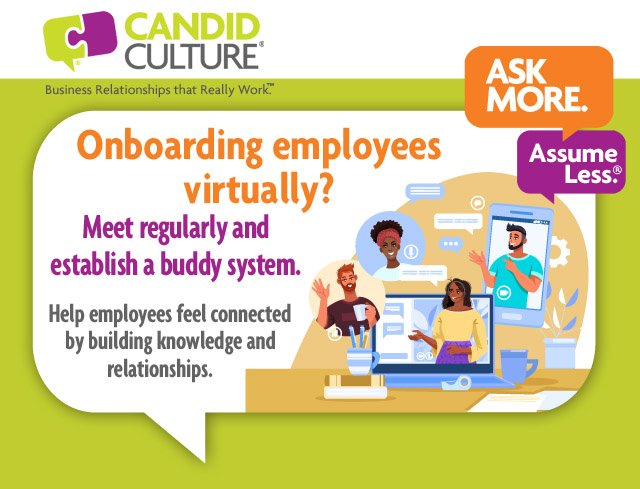
Starting a new job is like the first day of school. It’s scary. Who will I have lunch with? How do I make copies and get reimbursed for expenses? Who do I need a good working relationship with? Starting a new job virtually is even more challenging. Who are these people I work with and how do I reach them?
We need to help new employees acclimate to people and processes, and this introduction increases tenfold when starting a job virtually.
“People leave managers not jobs” is an old phrase. I’ll widen the net a bit – people leave companies, not jobs. People unhappy at one company often take a similar job at a different company. They like being an accountant, auditor, marketing manager, they just didn’t like working for __________ (fill in the blank) at __________ (fill in the blank).
Here are six practices for helping new, virtual employees acclimate and feel at home quickly:
Focus on relationships first and workplace goals second.
I onboard all new employees – virtual or in-person – with a handful of Team Building and Manage People Candor Questions. My first meeting with employees has nothing to do with goals or objectives. Instead, we talk about working-style preferences and pet peeves. We get to know each other and build trust. As Stephen Covey said in his book the Seven Habits of Highly Effective People, “Deposit into the emotional bank account.” And as William Ury said in his book on negotiation, Getting to Yes, “Go slow to go fast.”
2. Make it safe and easy to ask questions.
Few people like to admit they don’t know something. I’d rather have my new employees pick up the phone or email me with a question than spend 60-minutes of frustration searching for an answer.
Ask, “What questions do you have” each time you meet and wait longer than you think you should for the answer. People always have questions. Make room for them to ask.
3. Have multiple people train new employees.
Training a new employee develops the person doing the training and builds immediate relationships.
4. Set up a system for people to ‘interview’ others throughout the organization – a virtual meet and greet of sorts.
5. Have team meetings on video.
I know, I know, people are tired of video meetings. Make them short, sweet, and regular.
6. Meet one-on-one weekly with new employees.
I suggest weekly meetings for at least the first six months, and protect the meeting time. If one-on-one’s with employees get cancelled, reschedule immediately. Cancelling meetings with direct reports without rescheduling sends the message that the direct report isn’t important.
Working with people virtually isn’t that different from working with people in person. Pick up the phone. Use video. Talk with people weekly. Ask questions. Wait for answers. Make sure new employees ‘meet’ and are exposed to a lot of people throughout the organization. People leave companies, not jobs.
Your boss’s job is to help you eliminate obstacles, ensure you have the resources you need to be successful, and to be a coach. A manager’s job is also to evaluate you.
Managers only have so many points of reference to evaluate their employees’ performance. If you tend to vent with your boss how your internal customers are difficult to work with, your boss doesn’t know that you don’t do this with everyone. It’s a point of reference that makes an impression. How do I know this? I learned it the hard way.
My last boss, before I started Candid Culture, was the best boss I ever had. He always had my back. He was knowledgeable about the business and happy to share his knowledge. He trusted me and gave me a lot of latitude. And I confused that positive relationship with that of a confidante.
I felt comfortable with my boss, so I complained about my internal customers to him. I thought he was a safe person to do that with. I was wrong. He eventually told me he had no way to determine that I didn’t vent with everyone. My naïve decision to vent to my boss was a point of reference about my professionalism and not a good one.
It would have been fine to tell my boss I was struggling to work with an internal customer and to ask for suggestions for how to work better with the person. It would have been fine to say that I was frustrated or discouraged and was in need of support. It’s ok to share problems and breakdowns and leverage your boss to find solutions and to get help. Asking your boss to help you solve a problem you haven’t been able to solve yourself is expected. Using your boss as a therapist is not.
I don’t want you to be paranoid, to feel that you have to watch every word that comes out of your mouth, and that you always have to be on your guard. Just know the role people in organizations play. Leaders and managers have to determine who is successful in their current role and who is a good fit for future roles. So be mindful of how you show up and to whom.
We all know impressions are formed quickly and are hard to change. If someone sees you once a week, one a month, once a quarter, what are they seeing? People only know what we show them and what others tell them.
I know this post is political. I’m almost hesitant to write it. But I don’t want you labeled as someone with poor judgment or someone who can’t manage their emotions. Remember, let your boss see the poised professional you are. Let your friends and family see the rest.
Many people worry about giving feedback because they’re concerned they don’t have the ‘right’ words. They’re concerned they’ll say ‘it’ wrong and damage their relationships.
Feedback is hard enough to give without worrying about saying everything perfectly. Worry less about having all the right words and more about whether or not people trust your motives.
When people trust your motives – why you’re giving feedback – you can say almost anything. When they don’t trust your motives you can say almost nothing.
Getting negative feedback is hard. It’s easier to listen to feedback when we trust the person who’s giving us the feedback – we know their intentions are to help versus to judge or hurt us.
Speak from the heart, be authentic, and worry less. Be yourself. If you’re nervous to say what you want to say, tell the other person you’re nervous. If you’re struggling to find the right words, say so. If you’re worried you’ll damage the relationship or that it isn’t your role to give the feedback, say that. Authenticity goes a long way.
How’s how to give feedback you’re apprehensive about:
How to give feedback phrase one: Consider saying, “There’s something I need to talk with you about but I’m concerned that I won’t use the right words and will damage our relationship.”
How to give feedback phrase two: “There’s something I want to talk with you about, but I’m concerned how it will come across. Is it ok if I say what I need to say?”
How to give feedback phrase three: “I want to give you my thoughts on something but I’m concerned that it’s not my place to do so. Is it ok if I share my ideas about _________?”
Other people aren’t expecting you to be perfect. But they do want to know they’re working with a human being. And human beings are fallible. We have fears. We make mistakes. And sometimes we don’t say things perfectly.
You don’t have to be perfect, you just have to be real.






 6 Courageous Steps to Advance Your Career: