The most frequent question I’m getting these days is how to manage business relationships virtually. Here is the short answer – talk to people. Pick up the phone. You don’t need to have video calls, if you don’t want to. Showering is a personal choice. You just need to talk to people.
People need human contact. We even need to connect with the people we don’t like – when we work for and with them. Text and email don’t replace talking to people.
We stopped talking to each other long before so many people began working from home. Email has been overused for years. We emailed the people we sat next to at work. We exchanged 20 emails on one topic rather than picking up the phone.
We ask permission to call our friends to catch up. Texting a friend to ask, “Is it ok if I call you tomorrow morning?” is the norm. We exchange 50 texts to determine where and when to meet for lunch.
Maybe people thinking email and texting is easier, less intrusive, faster. Less intrusive, yes. Easier, sometimes. Faster, no.
Call the people you work with. Ask for the best time to call, if you like. Check in on them. Ask how they’re doing. Yes, there may be a crying child or a barking dog in the background. It’s ok. Calls don’t have to be long. People just need contact. They need to know that you care and are ‘in it’ with them. And while you’re on the phone, get questions answered in five minutes rather than with 25 emails.
It’s been eleven months that many people are working from home who would ordinarily go into an office. Some people are content with the fancy-on-the-top, jammies on the bottom video-work life, others are feeling lonely and isolated. Some employees have a private, uninterrupted work setting, others are trying to find a quiet place to participate in meetings while a partner and kids are also at home. Working from home amid distractions and loneliness is tricky and we need to be able to talk about it.
Managers, your employees don’t want to tell you they’re struggling, lonely, distracted, or can’t make certain meetings or deadlines. They want you to think everything is fine, that they’re fine. Who likes to admit to their boss that they can’t keep up or are unhappy at work?
If a manager loves working from home and has a quiet, uninterrupted work environment, it may be easy to miss employees’ challenges. Managers need to cross the line and ask questions they otherwise wouldn’t.
Don’t assume employees are fine. Don’t assume employees will tell you if they’re not. They likely won’t. You need to ask and make it easy and safe to tell you the truth.
Managers, ask employees these questions:
What’s your work environment like?
What constraints are you under?
What’s a realistic work schedule right now?
What do you want me to know?
What do you need?
It may seem like it’s too late to ask. It’s not. It’s never too late. Simply be honest. It could sound something like, “I wanted to check in and see how you’re doing working from home. I want to ask some questions so I can support you. I wish I’d asked before. I’m sorry I didn’t.”
Managers who are willing to tell employees they wish they’d done something differently earn loyalty and trust for showing vulnerability and humanity. Strong managers admit mistakes.
If you’re nervous that employees will delve into arenas that are too personal, set parameters for the conversation. It’s ok to set boundaries when asking questions. You could say, “I want to talk about some of the constraints you may be under working from home. I’m sorry I didn’t ask before. Let’s focus on things I can support you with and stay away from items I can’t help with like finances and personal relationships.”
Then be prepared to help employees problem solve. Maybe employees need a different work schedule or different deadlines or deliverables. Maybe employees need help setting expectations with peers and clients around when they can and can’t attend meetings.
Make it safe to talk about how employees are really doing and what they need to be successful in today’s circumstances. Tell employees that you really want to know, you’re sorry you didn’t ask before, and that it’s safe to tell the truth. Then problem solve with employees. And ask the same questions periodically. Make talking about work environment, schedule, and expectations a regular conversation.
Most people hoard feedback. We wait for the right time, aka when we’re comfortable. That time will never come. The right time to give feedback is when something happens or shortly thereafter. Practice the 24-hour rule and the one-week guideline. Give feedback when you’re not upset, but soon after the event occurs, so people remember what you’re talking about.
Most employees feel as if they’re treated unfairly during some portion of a performance appraisal. Employees receive feedback they’ve not previously heard or receive feedback that is unbalanced – overly positive or negative, or the feedback is so vague, employees aren’t sure what to do more, better, or differently.
Effective performance appraisals are a quick summary of all the performance conversations you’ve had during the year and planning for next year. To have an appraisal meeting that’s a summary of past conversations managers need to meet with their employees regularly and give feedback every time they meet. Giving feedback regularly throughout the year is the most effective management suggestion I can make.
Meet regularly with your employees. If you never meet one-on-one with employees, start meeting monthly. If you meet monthly, meet twice a month. If you meet twice a month, consider meeting weekly for 10 to 30 minutes.
Below is a one-on-one meeting agenda, which the direct report leads:
What is the employee working on that’s going well?
What is the employee working on that is not going great, but she doesn’t want your help?
What is the employee working on this isn’t going great and she wants your help?
** Give and receive feedback on the work and on your relationship. This will be hard the first few times you do it but will become easier with each successive conversation.
Ask your employee to create a meeting agenda. Take notes during the meeting and keep your notes. The summary of these meetings becomes your annual performance appraisal.
Regardless of whether or not you’re meeting regularly throughout the year, you can only give small pieces of feedback during the appraisal meeting. Discuss three SPECIFIC things the employee did well during the year and three things she should do next year. People can’t focus on more.
Consider how each of your employees should impact your department and your organization’s annual goals. In that context, determine the most important things each employee did to contribute to those goals this past year and what she should have done more, better, or differently? That’s your appraisal. Not more and not less.
During performance appraisals, force yourself to focus on and present ONLY the most important behaviors and outcomes, and your employees will bring the same focus to the ensuing year.
One of the hardest things I ever did was to hire someone to care for my infant son. “Here is the person most important to me in the world. Keep him alive.” I had no idea how difficult it would be to trust a relative stranger so implicitly. And as a result, let’s just say I was not the easiest parent to work for.
I’m embarrassed to admit that I wrote sixteen-pages of instructions on how to take care of my kid. And I gave that ‘booklet’ to a nanny with much more childcare experience than I had. When I heard my son crying, I would tell myself not to walk into the room and check on him, knowing it undermined the nanny, but I did it anyway. When the nanny sent me an update of when my son last ate, I replied telling her when he should eat again, even though I knew she already knew that. Yes, I really did these things.
Each time I over instructed, monitored, and advised, I regretted it. I knew micromanaging our nanny made me difficult to work with, which is not how I wanted to be. It reminds me of a comment an old boss said to me after we interviewed a candidate for a job together. He said, “Shari, your job as the interviewer is to make the candidate feel comfortable and ensure she leaves feeling good, regardless of how well or poorly she interviewed.” During the interview, my face must have said anything but, “I want you to feel comfortable and you’re doing a great job.” His words stuck with me and I was reminded of them each time I over managed our nanny.
Many people attend training on how to manage others. I’d suggest we also look at how we manage ourselves. How does working with you make people feel? Do your questions, requests, and interactions make people feel more self-confident and valued, or do people feel questioned and undermined? Do you pick your battles? Do you give just enough direction but not so much as to squelch the other person’s ideas, initiative, and spirit, especially when the stakes are high?
As you know, I’m evaluating how I do these things too. We are always a work in progress.
Here are four ways to build confidence in the people you work with:
Build Confidence 1: Ask people for their ideas and implement those ideas whenever possible. And if you aren’t open to others’ ideas, don’t ask for them. It’s better not to ask for ideas than to ask when you’re really not interested.
It’s not easy to admit when we’re overwhelmed and need help. In fact, it’s such a hard thing to say that instead of asking for help, most of us either work harder or longer or job hunt. Admitting work overload isn’t a weakness and it isn’t bad. It’s all in how you handle it.
If you find yourself with work overload and you aren’t sure what to do, consider taking these four steps.
Eliminate work overload step one: Every time you find yourself doing something that someone else could and should do, write it down, including how much time the task took. Doing this will create awareness of how much time you spend doing things that may not be the best use of your skills and experience. Then work with whomever you need to in your organization to align that work where it belongs. This practice isn’t to make you sound like an entitled prima donna. It’s an entrepreneurial way to approach your work.
The business owner’s mantra is, “If I can pay someone less than I get paid to do something, I should do that.” Consider how you can apply that practice to your workplace, without appearing to be someone who won’t ‘wash windows.’ Meaning, you don’t want to be or appear to be someone who isn’t willing to do grunt work. Every job has it. But those tasks shouldn’t be where you spend most of your time unless your job description and annual goals say so.
Eliminate work overload step two: Watch out for and eliminate time suckers. This includes people, problems, and processes. If you find yourself in meetings all day long, consider which meetings you don’t really need to attend or send someone else on your team. If someone in your organization calls you daily to have personal conversations, tell the person, “I’d love to talk with you and I’m working under a deadline. Can we catch up later?”
Eliminate work overload step three: Sometimes doing 110% percent isn’t important. Notice when you’re doing more than you need to and when that additional work doesn’t add significant value. I.e., you put together an elaborate PowerPoint presentation and then spent five more hours printing and stuffing folders to mail to coworkers’ homes. Next time, focus on the content and worry less about the aesthetics.
Eliminate work overload step four: Lastly, know when and how to ask for help. The last organization where I worked, before starting Candid Culture, was very fast-paced and lean. I worked all the time and consistently felt overwhelmed. I eventually went to my boss to ask for help. I made a list of everything I was working on and asked him to rate each item based on how important he saw the project/task. He put an “A” next to the things that needed to get done first, a “B” next to the things that came next, and a “C” next to the things that were the least important. He told me to do the A’s first, then the B’s, and if I got to the C’s, great, if not, no problem.
The meeting was eye-opening for me. I assumed he thought everything on my list was an “A” and that left me stressed with an inability to prioritize. Hearing how he perceived my workload reduced my anxiety and gave me permission to ease up on projects I’d previously considered timely.
Don’t suffer in silence. But do approach reducing work overload in a positive way. Rather than whining to your boss and coworkers, end conversations that you know are a time drain, limit work that doesn’t add significant value, and ask for help prioritizing when you can’t do it for yourself.
I’ve heard lots of people say they just want 2020 to be over and that 2020 has been a bad year. It’s definitely been a very different and difficult year. I’m right there with you – virtual school, no childcare, not seeing family or friends, and doing three jobs because everyone in our office is working virtually. And part of being powerful is creating fun and choosing happiness regardless of the circumstances.
Here are some ideas for creating fun and happiness, regardless of the circumstances. If you read last week’s blog, some of this will sound familiar.
Connect with people you haven’t talked to in a while. Call, texting isn’t the same.
Past coworkers
Friends from high school, college, and graduate school
Cousins and siblings
Neighbors
Out-of-town friends
Local friends
Here are a few ways to take care of yourself during the workday:
Listen to music.
Eat breakfast or lunch instead of skipping a meal.
Text a friend when you have down time.
Walk outside to take a break.
Catch the last of your city’s holiday activities. Do things five-year-old’s think are fun. They’re fun for adults too.
Is your city’s Zoo lit up for the holidays? Bring hot chocolate and go.
Are your city’s botanic gardens or downtown lit up? Are there drive-through light shows?
Find a place to toast marsh mellows and make s’mores. Hotels are often lit up and have outdoor fire pits.
Drive or walk and see your neighbor’s lights.
Decorate cookies, cupcakes and gingerbread houses. Seriously, it’s fun! If you email me, I’ll send you photos of our masterpieces. If you have kids, give up what the gingerbread house is ‘supposed to look like’ and let the kids do their thing (this is challenging for me).
Do something you enjoy every day. Keep it simple and cheap. Here are a few from my life:
Listen to music. Maybe go crazy and have a spontaneous dance party.
Order food from a favorite restaurant. I’ll admit that sometimes we have breakfast delivered.
Go for a walk or hike.
Do something you’ve never done. We’re trying snowmobiling this week.
Drive someplace beautiful.
Watch a movie you haven’t seen.
Lastly, what’s a bad habit you can stop doing, for one day. Don’t over commit. Mine are below:
Opening emails, promising I’ll reply, only to have the email get buried and forgotten.
Surfing Facebook and the internet at night.
Eating whatever my kid doesn’t finish.
Checking my phone (way more than necessary).
There are lots of ways to have fun regardless of the circumstances – from seeing lights, to reconnecting with old friends, to taking care of ourselves, and stopping a bad habit, just for one day.
Have a wonderful rest of the year! We are grateful for the many organizations that invested in virtual training and keynote speaking this year. We’ve loved working with all of you and hope to see you virtually or in person next year.
We wish you a Happy New Year and powerful start to 2021!
Maybe you’re not flying to see your family, celebrating the holidays with the people you otherwise would, or taking that big vacation. This year’s holidays will look different from other years, but they can still be fun. Below are some simple and free ways to have fun this holiday season, whether you’re working or off.
Do things five-year-old’s think are fun. They’re fun for adults too.
Is your city’s Zoo lit up for the holidays? Bring hot chocolate and go. Ride the train and the carousel if they have one, yes, even without kids.
Are your city’s botanic gardens or other gardens lit up?
Is your downtown lit up?
Are there drive-through light shows?
Drive or walk and see your neighbor’s lights.
Decorate cookies and gingerbread houses. Seriously, it’s fun! If you email me, I’ll send you photos of our masterpieces. If you have kids, give up what the gingerbread house is ‘supposed to look like’ and let the kids do their thing (this is challenging for me).
Moving on to day-to-day happiness, when is the last time you did things you enjoy? Keep it simple and cheap. Here are a few from my life:
Listen to music
Go out for ice cream
Ride my bike
Go to the mountains or some other beautiful spot
Read a book
Call people you haven’t talked to in a while. Yes, call. Texting isn’t the same.
Past coworkers
Friends from high school, college, and graduate school
Cousins and siblings
Neighbors
Out-of-town friends
Local friends
If you’re working over the holidays, below are a few ways to take care of yourself during the workday:
Walk around your neighborhood or house for a short break
Listen to music
Eat breakfast or lunch instead of skipping a meal
Text a friend when you have down time
Walk outside to take a break
Five minutes of yoga
Lastly, what’s a bad habit you can stop doing, for one day. Don’t over commit. Mine are below:
Surfing Facebook and the internet at night
Eating whatever my kid doesn’t finish
Eating the remaining Halloween candy when my kid isn’t looking
Texting when I should be working or sleeping
Checking my phone (way more than necessary)
There are lots of ways to have fun this holiday season – from seeing lights, to reconnecting with old friends, to taking care of ourselves and stopping a bad habit, just for one day.
We wish you and your family a warm wrap-up to 2020 and a very different 2021. Happy Holidays from all of us at Candid Culture.
The coaches of my son’s pre-Covid soccer class would frequently tell the kids, “You get what you get and you don’t throw a fit.” As adults entering performance appraisal season, I think we can do better.
Performance appraisals are, for many, the most dreaded day of the year. Most employees anticipate the meeting, wondering what their manager will say. In addition to hearing about the situations your manager, and others in your organization, observed throughout the year, why not tell your manager what you’d like to know?
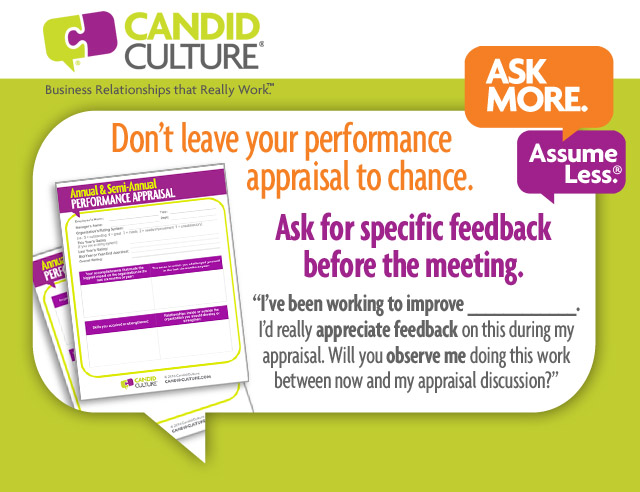
It’s perfectly appropriate to tell your manager if you’d like feedback about a specific aspect of your performance or about a certain project or piece of work. And the time to ask for this feedback is at least one month BEFORE your appraisal meeting.
If you ask for feedback during the meeting, you’re likely to catch your boss off guard. Managers don’t typically follow employees around or call into every meeting in which employees participate. As a result, your boss may not have an answer to your question. She is likely not thinking about the specific input you want.
Most people don’t like to be caught off guard or feel that they can’t answer a question. Asking for feedback in the moment, that your boss can’t address, may embarrass your manager. Don’t put managers on the spot. Set your boss and yourself up for success by asking for specific feedback BEFORE meetings, and give your manager a chance to observe you doing that kind of work.
Ask a vague question, get a vague answer. Ask a specific question, get a specific answer. If you want specific feedback, let your manager know and give her time to observe you doing the actions you’re asking about BEFORE the feedback conversation.
If you want to know how you manage telling internal or external clients “no”, give your boss a chance to see or hear you do this. If you want feedback on how you built relationships with peers virtually this year, give your boss a chance to observe that behavior or time to ask your peers for input.
Here’s how asking for specific feedback might sound: “My annual performance appraisal is in January. I am, of course, interested in everything you have to say. I’d also like feedback on how I lead large meetings. I’m leading two meetings between now and my appraisal. If you have the availability to call into either one and listen to how I elicit participation while maintaining control of the meeting, I’d really appreciate it. I’ll send you the call-in information.”
When you tell your manager the specific feedback you want to hear and give her an opportunity to observe you doing that work, you demonstrate seriousness about getting feedback and that you respect your manager’s time. You’re also likely to get more useful, specific feedback.
The practice of asking for specific feedback before one-on-one meetings and giving your manager time to observe you doing that work, is something I recommend doing all year, not just during performance appraisals. Feedback should be delivered as work is produced. The annual review should be just that, a review of conversations that happened during the year.
Remember, you get what you ask for. Ask a vague question, get a vague answer.
People get defensive when they receive negative feedback. It’s hard not to. Everyone wants to be seen as competent, and when we receive negative feedback, our competence is called into question. So we react.
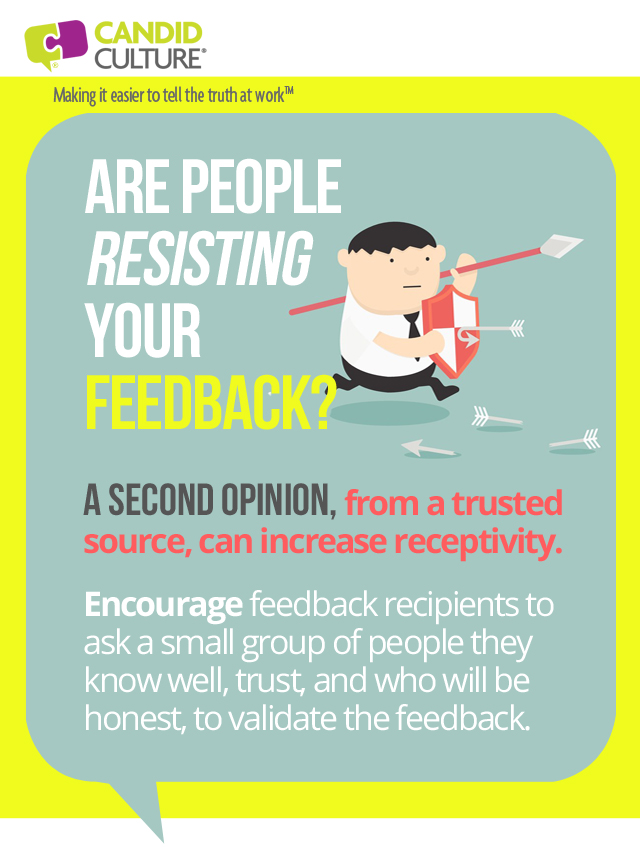
There are several things you can do to reduce others’ defensiveness – ensure you have a trusting relationship and thus have earned the right to give feedback, watch your words, deliver feedback in a private setting, etc. But for today, I’m going to focus on getting a second opinion.
If you want people to be more receptive to your feedback, consider encouraging them to get a second, third, or fourth opinion. I’m a fan of casual 360-degree feedback – when we ask for feedback from people we work with both inside and possibly outside the organization. Think of 360-degree feedback like an orange, it’s all the way around, like a sphere. When you get 360-degree feedback, you gather input from all the different types of people you interact with, thus getting a more comprehensive and accurate picture of performance. There are different types of 360-degree feedback. 360-degree feedback ranges from the formal – an online, anonymous survey (I’m not a fan) – to casual conversations (which I recommend). In this instance, I’m suggesting something I call The Core Team.
I suggest everyone has a Core Team of about five people who love you, know you well, and have your back. Most important is that you trust these people. Your Core Team may be personal or professional relationships or a mixture of both. You may have worked with Core Team members or not. What all Core Team members have in common is that they know you well, want what’s best for you, and will tell you the truth when asked.
My core team consists of a friend from high school, two people I used to work with, and my parents. When I get feedback that I’m having a hard time reconciling, I ask people on my Core Team to validate the feedback. It doesn’t matter if they’ve worked with me or not. I am who I am. I do the same annoying stuff in my personal and professional relationships. So a personal Core Team member can provide valid, professional feedback and vice versa. Sometimes they agree with the feedback I’ve been given and sometimes they don’t. But I always get compelling information to think about. And because I trust the people on my Core Team, I listen to what they have to say.
Don’t be disheartened if people don’t trust your feedback and aren’t receptive. Instead, see their resistance as human and encourage them to get a second opinion. And then talk again. Listening to and incorporating feedback is a process. It takes time, courage, and patience.
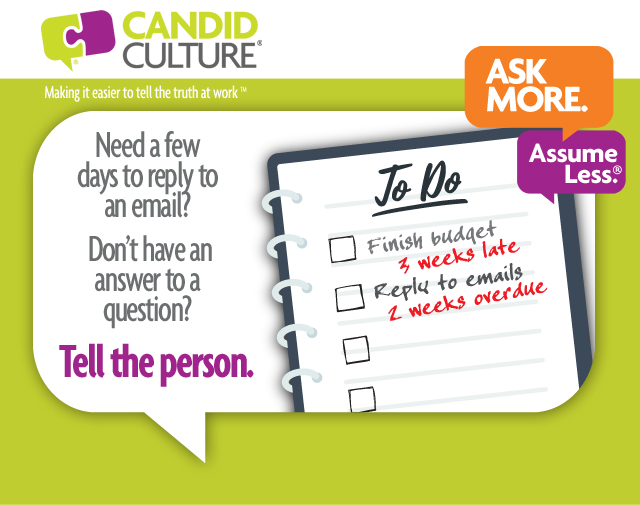
You open an email (or a few hundred) telling yourself you’ll reply later, but never do. Feeling ambitious, you agree to a deadline you can’t meet. Needing a break, you take time off over the holidays but don’t put an out-of-office message on your email.
We’ve all taken too long to reply to an email, missed a deadline, or simply taken too long to provide someone with information. It’s ok to take time to respond, to not have all the answers, and to take time off. We simply need to provide a timely and accurate status update.
When people don’t hear back from us in what they consider a timely way, they start to wonder (at best), and judge us (worse), or tell others we’re non-responsive and unreliable (worst). Don’t make people wonder if you received their message, send a timely status update and tell the truth.
If you’re behind and need more time than usual to respond to emails, tell people that. Respond to each email within 24-hours and tell the person you received their message and it will be (fill in the blank) a week or two before they hear back from you. When you get an email that requires research, respond within 24-hours and tell the person it will take however long it will really take to find the information. If you’re out of the office and don’t plan to read or respond to emails, tell people the dates you’re out.
In the absence of knowledge people make stuff up. And it’s never good. Filling in the blanks isn’t malicious. People simply have a need to know what’s happening. And when we don’t know, we invent stuff. It’s how the brain works. When we don’t hear back from people in what we consider a timely way, we start to wonder. “Did she get my message? I haven’t heard back. She must not like me. Maybe she’s out of the office? Maybe she doesn’t work here anymore?”
It’s ok to need time to respond. It’s ok to be running behind. It’s ok to take time off. Simply let people know the true status. Manage your reputation and business relationships. Don’t make people guess.