Covid-19 has shown many of us our edge – working from home for many months, not traveling, missing people we’re used to seeing, and for me, being silent when I would normally speak up.
Earlier in the fall, a friend came to bring my son a birthday present. We hadn’t seen my friend for many months. We visited outside. He didn’t wear a mask, gave Grayson a high five, and then a hug. It seemed like terrible judgment and it happened so fast before I could say anything. Then he went into my house to get a glass of water without wearing a mask while we stayed outside.
I was shocked by all of this. It didn’t seem smart or respectful. And I didn’t say anything. I still haven’t said anything. I could give you ten similar examples of instances in these past months when I was uncomfortable but didn’t say anything – sometimes with people I know, sometimes with people I don’t know.
It feels risky to write this because wearing masks and physical distancing has been so politicized. This blog post isn’t about the coronavirus and anyone’s personal choices. It’s about when we don’t speak up and why.
I think the way to handle potentially tough situations is to anticipate the unexpected and have a setting-expectation conversation before a challenge occurs. What I could have said to my friend, before he visited, was, “We are excited to see you. Let’s stay outside and let’s all wear masks.” I should have set expectations before being confronted with a difficult and awkward situation. Setting expectations is always easier than addressing behavior after it has happened.
Sometimes you can’t anticipate another person’s behavior or how a situation might go. You can’t plan for everything. And telling someone you don’t know in a store, office, or elevator that you’re uncomfortable may feel risky.
Here are four practices for making harder conversations easier and for taking care of yourself when you don’t know what to say:
Anticipate everything that can happen.
Decide how you want to manage situations before they happen.
Set clear expectations before seeing people or going someplace. My son knows that if we go to a park and it’s crowded, we will leave. I tell him this before we go so, he isn’t surprised.
Set boundaries. It’s ok to ask people in line at the grocery store to back up a few feet. “I’m trying to keep a six feet distance. Would you mind stepping back a few feet?” Yes, this likely feels very hard in the moment.
I worry about what people will think of me. I want people to like me. I’m consumed by both of these thoughts way more than you would ever guess. But what’s more important – protecting ourselves and our family or not offending a person in line at the grocery store you’ll never see again?
It needs to be ok to respectfully and kindly speak up on our own behalf. And speaking up starts by opening our mouths and saying what makes us uncomfortable again and again and again.
I read a quote a few months ago that struck me – “It’s so hard to change yourself, what makes you think you can change someone else?” This seems so true. And yet, how much energy do we invest trying or at least hoping other people will change? We want our not-so-forthcoming manager to give regular and helpful feedback, our Halloween candy stuffed selves to prefer celery over chocolate, our not-so-affectionate partner to become a cuddler.
People are who and (largely) how they are. Even with lots of effort, coaching, and even counseling, it’s hard to change.
As someone who leads a training and development company, it feels risky to write this. I’m concerned that my words will be misunderstood. So I want to be sure I’m clear. People can learn new skills. Managers can learn to coach and give feedback. People at all levels and in all roles can learn to communicate differently. Everyone can learn to use new technology. But we don’t fundamentally change who and how we are. People who hate to public speak aren’t likely to wake up tomorrow clambering to give presentations to thousands of people. People who don’t like crowds aren’t likely to want to spend every weekend at large sporting events when they resume.
What I’m really trying to say is, stop trying to get something from someone who can’t give that to you. If you work for someone who never provides feedback, no matter how often you ask, get input from someone else. Lots of people can provide you with helpful information if you ask for it and make it safe to tell you the truth. If you’re chastising yourself for not being more athletic, accept that you like to read, and buy yourself a new book.
Instead of trying to get something from someone who can’t give it to you, get what you can from that relationship and get the rest of your needs met elsewhere. And tell others to do the same. I had someone working for me a few years ago who was extremely sensitive and didn’t do well receiving feedback. I tried to accommodate her needs and preferences, softening my messages, picking my battles, and in the end, giving less and less feedback. And it was exhausting. Eventually, I said to her, “I’m not the right manager for you and this is the not right company for you. It’s not a good fit. You won’t be happy here, and I want you to be happy. Let’s help you find another home.”
I’m not telling you to get a new job. I’m telling you to be realistic in your expectations of yourself and others. The most powerful thing you can do is to be yourself and let others be themselves. And if you don’t like how or who someone is, hang out with someone else.
You get an email that annoys you, hit reply, type up your thoughts, hit send, and feel instant regret. We’ve all done this. We’re frustrated and we let the other person know.
Feedback via email is always a bad idea. You don’t know how the recipient will read and interpret your message. You can’t manage the tone of the message or give the person a chance to respond. And more often than not, he’ll reply equally frustrated. And now the non-conversation begins –back and forth, back and forth.
Email is for wimps and voicemail isn’t any better! No texting either. End the madness and pick up the phone or take a shower and meet via video. Things are resolved most quickly and easily by talking about them.
I’m consistently surprised at how much feedback is delivered via email. And it’s only gotten worse with people working virtually. I’ll admit to occasionally being guilty of it too. I’m in a hurry and I want to get something done quickly. Or my emotions get the best of me and I feel compelled to respond to a situation quickly. So I send an email or a text message that I know I shouldn’t send. Then I regret it and spend the rest of the day apologizing and feeling badly for communicating impulsively.
If we want people to want to work with us and perform, we need to consider how our actions impact them. Yes, it’s easier to send a quick email or text. But it invariably annoys the other person and damages your relationship. People can work with you, around you, and against you. If people want to work with you, they’ll work harder and produce better work.
Never underestimate the human ego, which is easily bruised. You are ALWAYS dealing with someone’s ego. When someone (anyone) calls our competence into question, we get defensive. Becoming defensive when receiving negative feedback or when someone questions us is a gut reaction. Not becoming defensive takes a great deal of self-management and is unusual.
Slow down. When you need to give feedback, ask yourself what you want the other person to do. Then ask yourself, how do I need to communicate to get the result I want? Then pause, breathe, and pick up the phone.
Sometimes people take credit for our work. It happens, sometimes purposefully, sometimes not. The key is what we do when things like this take place.
I’m going to suggest that you use the lowest level of intervention possible to resolve challenges.
When a coworker takes credit for your work, you could say:
1) “I noticed that when talking about project X during last week’s department-wide meeting, my name wasn’t mentioned in conjunction with the project. Why is that?”
Or you could say:
2) “Thanks for highlighting the X project during last week’s department-wide meeting. I’m glad the project got some exposure. I noticed that my name wasn’t mentioned in conjunction with the project. I want people to know they can come to me with questions about this project. In the future, will you tell people that I wrote the plan?”
Feedback can be given directly, “You did X and it frustrated me.” Or feedback can be given by asking a question and making requests, “Will you be sure to mention my name when you talk about X project?”
Some might call option one passive and even disingenuous. Both methods produce the desired result – the other person knows that you know what happened, and you’ve requested different behavior. One method may incite conflict, one most likely won’t.
Be as direct as your relationship will allow. There are people with whom you can be very direct, without consequence. And there are some relationships that can’t withstand direct feedback.
Most of the people I talk with in organizations believe they can’t give feedback without negative consequences. The only way to know how direct you can be is by trial and error. Give a little feedback, see how it goes. Give some more, see how it goes. You might be surprised at how honest you can be. And when there is backlash for giving direct feedback, next time, give less. Ask a question or make a request instead. Asking questions is another form of feedback. It’s just less direct and thus less confrontational.
We train people to treat us as they treat us. You will get both what you ask for and what you allow. What are you allowing?
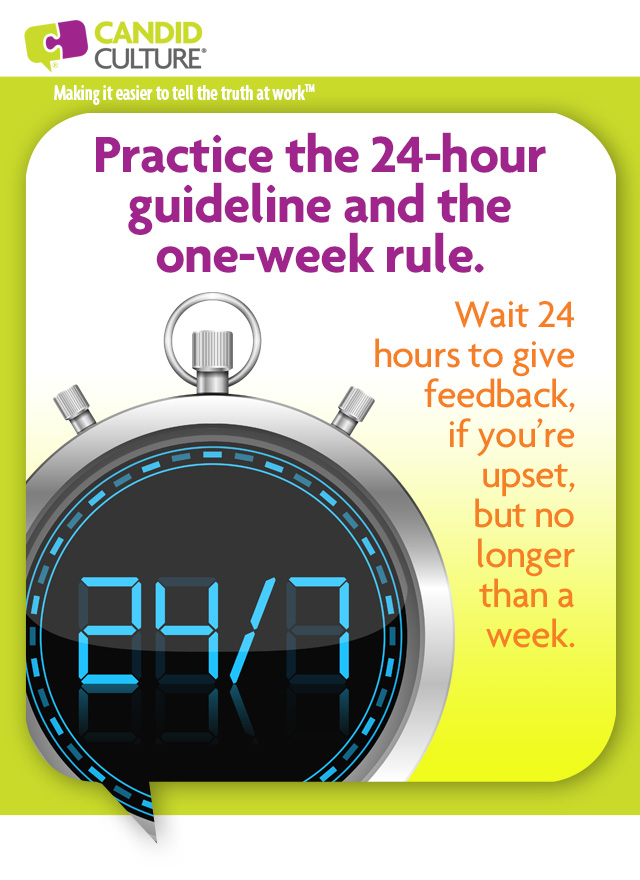
Most of us wait to give negative feedback until it’s the right time, aka the recipient won’t get upset. Or we wait, hoping the situation will resolve itself. If something is really an issue, the likelihood of either happening is pretty slim. The right time to give feedback is shortly after something happens. I’ll offer up the 24-guideline and the one-week rule. Wait 24-hours to give feedback, if you’re upset. But don’t wait longer than a week.
The purpose of giving positive or negative feedback (I like the words upgrade feedback) is to motivate someone to replicate or change a behavior. That’s it. Feedback is supposed to be helpful. If you wait longer than a week to give either positive or upgrade feedback, the person isn’t likely to remember the situation you’re referencing and the purpose of giving feedback – to change or replicate a behavior – will be lost.
Here are four practices to make negative (upgrade) feedback conversations shorter, less painful, and more useful:
Giving feedback practice one: Agree to give and receive feedback at the onset of relationships. Do this with everyone you work with – direct supervisors, direct reports, peers, internal and external customers, and vendors. If we’ve doneHow to Say Anything to Anyone training for your organization or you’ve read the book, you got the specific language to have this conversation.
Giving feedback practice two: Prepare for feedback conversations by writing down what you plan to say and then delivering the feedback to a neutral person. Ask that person to tell you what she heard and what her expectations would be, based on what you said. Confide in someone either at your level or above at work or someone outside of work, to keep the gossip to a minimum. Ask for confidentiality.
Giving feedback practice three: Tell a neutral person about your situation, and ask what she would say to address the situation. Everyone but you will do a better job at giving feedback. Feedback conversations become hard when we’re emotionally involved. The guy working at the 7-11 will do a better job than you. Seriously. It’s our emotions and concern about the other person’s reaction that makes feedback conversations challenging.
Giving feedback practice four: Agree to do a weekly debrief with the people you work closely with, and follow-through. Answer the questions – what went well this week from a work perspective and what would we do differently if we could. Answer the same questions about your working relationship. Giving feedback about your relationship will be hard at first. It will be easier the more you do it. Be sure to say “thank you” for the feedback, regardless of what you really want to say. One of the reasons giving negative feedback is so hard is we wait too long. Shorter, more frequent conversations are better than long, infrequent discussions.
Giving negative feedback doesn’t have to be so hard. Follow the suggestions above and remind yourself that the purpose of giving feedback is to be helpful. If you were doing the wrong work, you’d want to know. And others do too.
At some point in your career, you will likely get feedback that doesn’t feel accurate. When receiving feedback you question, rather than dismiss it, vet the feedback with the people who know you best. Assemble a core team of people who know you well, love you, and have your back. The relationships may be personal or professional. These are people who will tell you the truth (as they see it) if you ask.
You might think that you’re a different person at home and at work, thus your friends’ and family’s input isn’t valid in the workplace. That’s untrue. You are who you are, and you’re not a completely different person at home and at work. It’s just not possible to be your real self and turn it on and off at work. Sure, you might have a communication style that you only use at work. You may make decisions at work differently than you do personally. And you are likely to dress differently at work than at home. But you’re not a completely different person after 5:00 pm. If you’re often late, don’t keep confidences, talk too much and too long, or wear clothing that is not your friend, your personal relationships can tell you that.
It’s important to know how you come across, your reputation, and your wins and losses at work. Having this information allows you to manage your reputation and in turn, your career.
So the question is, with whom should you vet feedback that doesn’t feel quite right?
Receiving feedback criteria one: Your core team should be made up of a small number of people (five or fewer) who know you well, love you, and have your back.
Receiving feedback criteria two: You should respect core team members’ opinions.
Receiving feedback criteria three: You must trust them and their motives, in relation to your well-being.
Receiving feedback criteria four: You must be open to rather than dismissive of core team members’ feedback.
The right answer to feedback is always, “Thank you for telling me that,” regardless of how much the feedback stings. The easier it is to give you feedback, the more you’ll get when you ask in the future.
Core team members don’t need to be told they’re on your core team. Simply call these people individually when you need input. Tell them the feedback you’ve received and then ask for their opinion.
It’s easy to dismiss feedback that’s hard to hear. And the feedback might just be that person’s opinion. But people talk. And one person’s experience of you can impact your career greatly. Manage your career assertively and powerfully by knowing your reputation. Find out the impressions you create. Then you can make decisions about changes you will and won’t make.
I’m consistently shocked and embarrassed by what comes out of my mouth when I’m mad. It’s like reason and self-control go out the window. Emotion and the need to be right takes over. Every time I react in the moment, I regret it. Every single time.
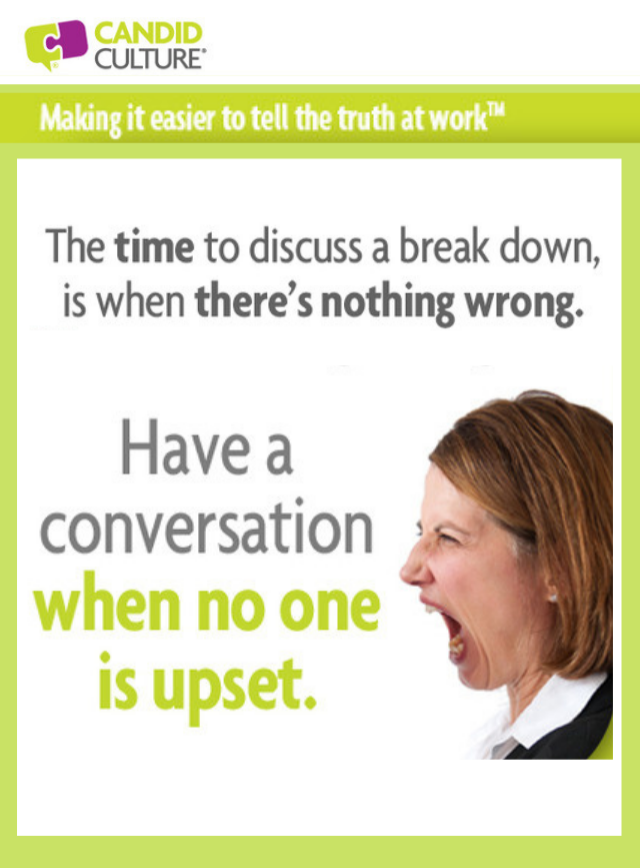
Talking with another person when we’re upset, often leads to more upset. Emotions and conversations escalate quickly. The more upset we are, the more likely we are to say things we’ll regret. The time to alter how we work, live, and communicate with someone, is when there is nothing wrong.
If you want something in a relationship to change, pick a time when things are calm and when no one is upset to have a conversation. Tell the other person that you want to talk about how you work together, manage disagreements, make decisions, handle disappointments, etc. Share what you have observed in the past and make requests. Brainstorm solutions together. You’ll have a much better conversation when you’ve had time to calm down from whatever happened to create the need for the conversation.
Waiting to have a conversation until you’re not upset creates the risk of waiting too long to address concerns. The right time to talk about a breakdown is as soon after an event as you can. When both people are calm and have time to have the conversation, usually within a few days of a challenge.
There is no talking to my five-year-old about why I impose certain limits in the moment. He’s too upset. I need to wait to talk to him about why I did what I did and what I want him to do next time when he’s calm. Typically, that’s later the same day. Adults may take a little longer. But this isn’t a pass to wait six weeks, which is what we often do. The conversation won’t be as hard or as bad as you think if you talk when you’re calm and speak from what the relationship needs.
Speaking from what the relationship needs is saying just what you need to, not more and not less, to resolve the challenge and create a better way to handle things in the future. And communicating in a kind and direct way, so the other person can take in what you have to say.
Agree upon better ways of handing challenges when no one is upset. Speaking directly, calmly, caringly and with the desire to make things work, typically has a positive result.
When I started training managers 20 years ago, I recommended managers meet with their employees weekly for 45-60 minutes. Over time I stopped recommending that because long, weekly meetings didn’t seem feasible and most managers weren’t doing them.
Many managers replaced the weekly one-on-one with the desk-drop-by and team meetings. Managers would tell me, “I talk with my employees daily and have a regular team meeting. I don’t need to do individual one-on-ones. Well, you do now. Employees need to talk to you on a regular basis. It’s time to go old school.
Many employees are still working from home and will be for the next several months, if not indefinitely. Some people love working from home and do it successfully, others hate it and struggle. Whatever you and your employees’ preference for working remotely, people need regular, one-on-one contact.
The questions I’m getting more frequently than any others these days are, “How do I work with others virtually” and “how do I manage remotely?”
Managing Up:
If you work for a manager who doesn’t reach out much, it’s fine to ask for a phone call. Tell your manager, “I’d like to talk with you individually each week. Can we schedule that? Is it ok to reschedule if we have to cancel?”
Don’t wait for your manager to ask for an update on your work progress. Send your manager a monthly, bulleted list (or more frequently if she would like) of what you’re working on, what you’re accomplishing, items you’d like help with, and anything else you want her to know. Keep the bullets short and focused. Your manager can use these updates to write your annual review.
Managing Peer Relationships:
Pick up the phone or have video calls. Either one works. People need contact.
If you’ve exchanged three emails on one topic, it’s time to pick up the phone. Talking live is quicker, prevents assumptions being made, and preserves relationships.
Ask how your peers are doing personally and professionally. Most people are struggling in some area. It helps when others care enough to ask how we are doing. But don’t ask just because you think you’re supposed to. If you don’t really want to hear a personal update, don’t ask for it. Just tell people you hope they’re doing well and move on to the business at hand.
Talk about how you agree to work together from a distance. If could sound like, “How do you want to manage this project? What parts do you want to manage? How should we handle it if we haven’t heard from a team member or if someone is falling behind and missing deadlines?” Talking about how you’ll handle potential breakdowns before they happen is ALWAYS easier than addressing breakdowns after they happen.
Set agreed-upon deadlines and talk about how you’ll track progress and milestones. You don’t need a manager to do these things.
My main message regarding working virtually is to talk to people more than you think you need to. Pick up the phone. Check-in. Ask how people are doing. Do everything you would do in person, just do it via the phone or video.
Don’t assume people are fine. Don’t assume everything will get done according to your expectation. Pick up the phone and talk about it.
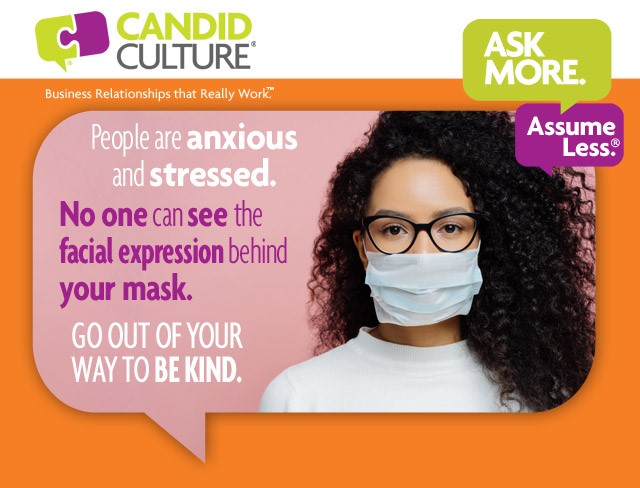
We are living in a weird, crazy time. It may feel scary to go into a restaurant or a store, let alone to work. People are wondering if it’s safe to fly, return to their offices, or visit family and friends. There is so much uncertainty and so many unknowns. People are anxious and stressed.
I can see and feel the stress when I go to the grocery store. My neighborhood store didn’t feel particularly friendly before Covid. Fellow shoppers would run you over with their cart if it appeared you were going to beat them to the last bag of organic, gluten-free, paleo-friendly, vegan, sustainably-sourced chips. But now it’s much worse. People shopping in the store understandably want to get in and out as soon as possible. Other people are obstacles, like moving, orange cones pushing carts. Long lines are stressful. You can’t tell if a masked person smiles or silently growls at you.
During these uncertain, scary, and unpredictable times I think we need to go out of our way to demonstrate kindness.
I’ll admit that I am the person always in a rush, often on the phone at the checkout counter (I hate when people do that, even though I do it too), sometimes not making meaningful eye contact. But lately I’m making more of an effort – saying hello to strangers I pass, when I normally wouldn’t, making it obvious I’m smiling at a person under my mask, even telling people, “I know you can’t tell, but I’m smiling at you.” I’m asking hospitality workers how they’re doing, what it’s like to be working in a coffee shop or a grocery store, and what makes a customer respectful during this scary and uncertain time. And I’m listening more closely to their answers.
It’s harder to see kindness right now because a mask conceals so much. It also allows me not to wear makeup, which I’m grateful for. But people can’t interpret my intentions behind my mask. They can’t see if I’m friendly, happy, or irritated. I have to go out of my way to demonstrate how I feel and what I mean in ways I never have before.
Here are five ways you can demonstrate kindness:
Tell people you appreciate that they’re working (in an environment that may feel risky from a health perspective).
Ensure your tone is friendly and patient.
Tell people overtly how you feel. “I’m not irritated, this mask just makes me look cranky.” “I’m smiling at you. Thank you for the good service.”
Wait patiently, versus sighing and rolling your eyes, if there is a long wait for customer service or an answer to a question.
Follow the posted rules for distancing and masks. Following the posted guidelines makes everyone feel more at ease.
Be overt. Make your positive feelings known. Put someone else at ease. And this ‘thing’ will feel better.
Coming next week: You asked. We answered. Next week’s tip and blog: How to work well with others virtually.
“He does great work but is really difficult to work with.” “She produces great results at the expense of people.” I hear these complaints all the time. I feel like people need permission to hire and fire because of fit. So here it is, it’s ok to hire and fire people who don’t fit your culture. You can find people who do great work and who interact according to your company’s values, and you deserve to have both.
Results are often considered more important than the seemingly ‘softer stuff,’ how people got those results. And it often doesn’t feel legitimate to want to get rid of an employee who treats coworkers poorly. We question ourselves thinking, “Maybe it’s not that bad? Perhaps I’m being too sensitive?” Or, “He does great work and is really reliable. Maybe I need to get over that he throws me under the bus in meetings I don’t attend?” “It’s really hard to find and keep good, reliable, employees. I should just suck it up.”
What if employees who treat coworkers and direct reports poorly or don’t practice your organizational values aren’t good employees? People don’t want to work for a manager who is knowledgeable but mistreats people. And likewise, people don’t want to work with people who are super friendly but do no work.
Some organizations evaluate employees both on the results they achieve and how they get to those results. That makes perfect sense.
Here are six tips for hiring and firing employees for fit:
Share your organizational values and behavior practices overtly when you interview candidates. Make it clear that people who don’t follow those practices won’t be happy or successful in the organization.
Create an opportunity for candidates to do an extended practical interview, during which they can get a feel for what the culture is really like, outside of a formal sit-down interview. Then give candidates an opportunity to opt-out of a job because they didn’t feel they fit in during the practical interview.
Trust yourself. If you find it off putting that a coworker raises her voice at you, gossips about you, or takes credit for your work, trust yourself.
Set clear expectations around how employees, coworkers, vendors, and customers are expected to behave when doing business with your organization. And be willing to let internal and external customers and suppliers go because they aren’t willing or able to follow your behavioral practices.
Coach and give feedback on how people achieve results.
Let employees go who don’t respond to feedback on interpersonal behaviors. Or let them know it’s time for them to look elsewhere.
Suffering at work is optional. You deserve to work with people who reflect your organization’s values.