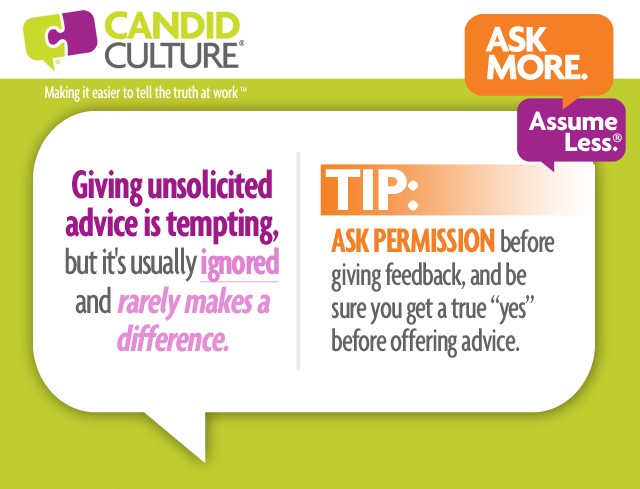
 It’s hard to watch people do things that damage them – personally or professionally. And yet, if they haven’t asked for feedback, people likely won’t listen to unsolicited advice, so don’t bother giving it.
If you really want to give unsolicited advice, ask for permission and make sure you get a true “yes” before speaking up.
The conversation could go something like this:
“I noticed we’re getting behind on the XYZ project. I have a couple of ideas about what we can do. Would you be interested in talking about them?” Or, “That Monday meeting is rough. I feel for you. I used to run meetings like that. Would you be interested in talking about some meeting management strategies? I’d be happy to share what I’ve learned.”
After you offer to talk (aka, give your opinion), listen and watch the response you get. Do the person’s words and body language portray a true “yes, I’d like your opinion” or what seems like an “I know I’m supposed to say yes, but I’m really not interested” reply? If you get the latter, you’re likely just giving unwanted advice that won’t be heard. If that’s the case, let it go. But if the person appears generally interested and open, proceed.
You could also say something like:
“Last week we were talking about your frustrations about not being promoted. I have a couple of ideas about that. Do you want to talk about them? Either way is fine, but I thought I’d offer.”
Or, “That was a tough conversation during today’s staff meeting. It’s hard to present ideas and not have them be embraced. I have a couple of thoughts about ways you can approach the conversation during the next meeting. Do you want to talk about them?”
If you extend the invitation to talk, the other person has to be able to say no. An invitation is only an invitation if “no” is an acceptable answer. You can’t ask if the person wants your input and then keep talking if he verbally or physically said no.
Be brave. If you care about someone personally or professionally and you see him doing something that gets in the way of his success, ask permission to say something. If you get the go ahead, proceed. If you get a “no thank you,” accept that and move on. You’ve done your part.

Employees leave managers not jobs. We’ve all heard this 100 times.
One of the most prevalent reasons for employee turnover is boredom and lack of growth. We’ve also heard this many times.
We know why employees leave jobs. The question is what must managers do to engage and retain their best people. The answer is actually quite simple, although possibly not easy to execute.
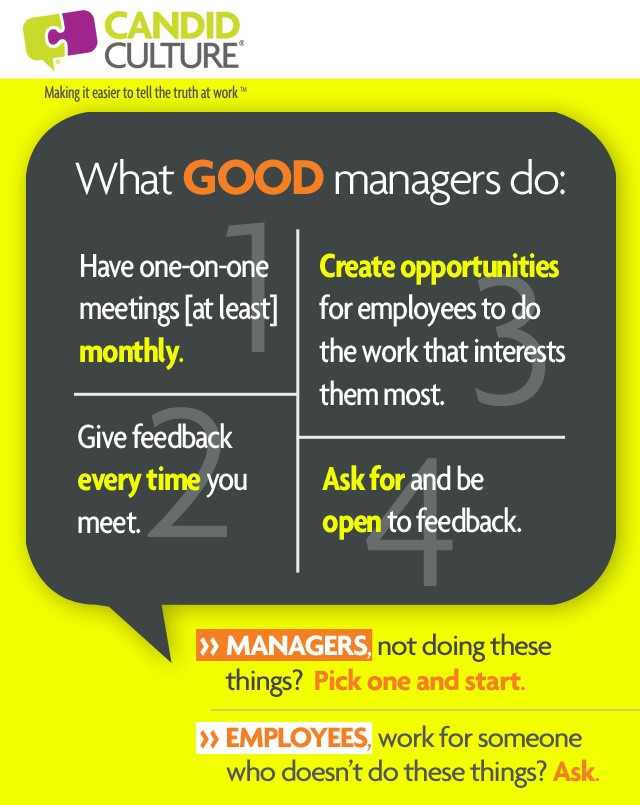 Employees want to know that their manager:
- Knows them
- Cares about and is invested in their careers
- Gives feedback so they can improve
- Provides opportunities so they can develop
In other words, employees need attention, and attention requires time – time many managers may not feel they have.
Here is a five-step formula for employee retention and employee engagement:
- Get to know employees better and differently.
- Have meaningful, one-on-one meetings [at least] monthly.
- Give feedback every time you meet.
- Ask for and be open to feedback.
- Create opportunities for employees to do the work that interests them most.
Managers, how do you make time for these meetings when you are busy and have several direct reports?
- Meet for 15-30 minutes.
- Meet over the phone while commuting or waiting for flights.
- Ask direct reports to create an agenda and run the meetings.
- Ask direct reports to send follow-up notes of decisions and plans made during meetings. Give some of the accountability away.
- If meetings get cancelled, reschedule as soon as possible. Direct reports take cancelled meetings personally. Cancelled meetings that are not rescheduled send the message that managers don’t care about employees and their careers.
Employees, if your manager doesn’t schedule meetings with you:
- Ask permission to put a monthly meeting on your manager’s calendar.
- Provide rationale for why you want to meet – to get your manager’s feedback and ensure you’re focused on the right work.
- Ask permission to reschedule meetings when they get cancelled.
- Don’t take cancelled meetings personally.
- Offer to meet with your manager via the phone when it’s convenient for him/her. Leverage commute and travel time.
Employees need time with their managers. Meaningful discussions and work result in employee engagement and employee retention. So managers, make the time, even when you don’t feel you have it. Ask questions you don’t ask now. Give feedback, even if it’s uncomfortable. Give your employees an opportunity to do the work that interests them most. And watch your employee engagement and employee retention improve. And if your manager doesn’t do these things, politely and persistently ask. You won’t get what you don’t ask for. We are all 100% accountable for our careers.

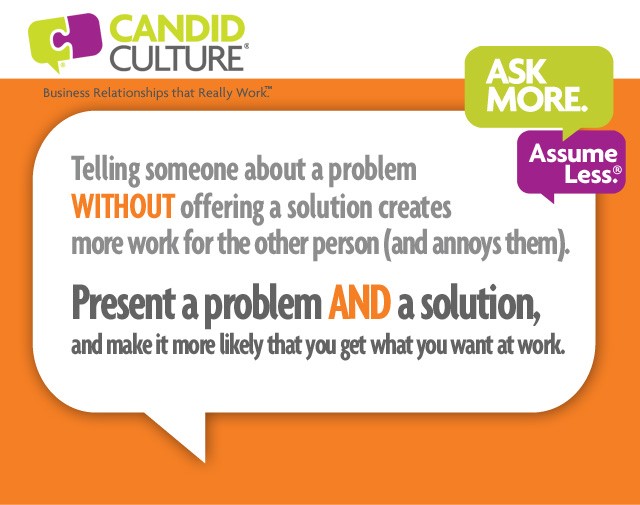 Concerned about something happening in your workplace? Don’t just tell someone about the problem, propose a solution. It’s fine to raise challenges. It’s better to raise challenges you’re willing to do something about. If you think two departments don’t talk to each other, bring them together. If you think a process is inefficient, propose a different way to get the work done. If you’re dissatisfied with software you’re using, offer to source three potential vendors and set up a demo. You’re doing the legwork and asking for a small investment of time.
When we ask for something at work, our request often requires time, money, or both. Thus when an employee asks for something, it’s easier for a manager to say no than it is to say yes. “No” requires no work and no financial outlay. A “yes” may require both.
You make it easy to say yes to requests when you’re acting as a change agent:
- Propose a solution to a problem.
- Offer to do the work to solve the problem.
- Ask for small things that are easy to approve.
If you’re overwhelmed and want to hire an additional person, but your boss isn’t convinced you need the headcount, ask for a temp for a finite number of hours. It’s much easier for a manager to say yes to a small and known investment amount than to the long-term commitment of hiring someone new. The point is to ask for something that is easy for your manager to approve.
The word “pilot” is your friend. If you want to make a major change, pilot a scaled down version of your proposed solution in one or two locations, rather than in your organization’s 10 locations. Again, asking for something small makes it more likely that you’ll be told yes.
The bottom line is to be part of the solution – as trite and overused as that phrase is. Don’t be the person who says, “That’s broken” without also saying, “and here’s how we can fix it. Can I give it a try?”

 Last week some unknown person sent me emails predicting my future. According to the anonymous clairvoyant, in ten years my life will be going well. I’ll have a second child who is amazingly athletic, and I will be offered a job in Oshkosh that I shouldn’t take. After the third predictive email, the sender wanted to know if I had questions about my future. I didn’t.
- The whole thing was wildly creepy.
- No one should take advice from someone with this much discretionary time. The emailer needs a volunteer job.
- Why would I want someone else to tell me my future? That’s something I enjoy creating.
I see myself as 100% responsible for everything that happens to me. As antithetical as it sounds, life is easier when I’m accountable. If I miss a plane because of traffic, I should have left for the airport earlier. If I get overcharged in a restaurant, I should have checked the bill more carefully. If I do a bunch of work for a client and later find out that the work I did isn’t what the client really wanted, I should have asked more questions upfront and asked for feedback earlier.
When I’m responsible for what happens to me, I have some control. When someone else is responsible, I have no control.
Instead of seeking answers about what might happen, pursue the things you want. If you want a different job in your organization, tell someone who can do something about it. If you got passed over for a job, ask the hiring manager for feedback of what would have made you a better candidate. If the hiring manager doesn’t give you any information, ask your current boss to get the information for you. If one of your co-workers excludes you from projects, ask him why. If someone you work with seems to dislike you, ask for feedback about what you did to damage the relationship. Regardless of how challenging the situation and how disappointing the results, there is ALWAYS something you did to either contribute to the situation or something you can do to change the situation.
I don’t mean to tell you what to do. Nor do I mean to minimize how hard some life circumstances are. But I do want you to see yourself as in charge of what happens to you.
Create the life you want by:
- Asking, “What do I really want, and what’s one thing I can do right now to get closer to that goal?” Then take one step. Then take one more, and so on.
- If negative things are happening, ask, “What could I have done differently to have a different outcome?” Or, ask, “If I could do this over again, what would I do differently?” Then next time, do it differently.
Regardless of how hard or bad something is, there is ALWAYS something you can do to make the situation better. Take your life, your career, and your relationships into your own hands where they belong.
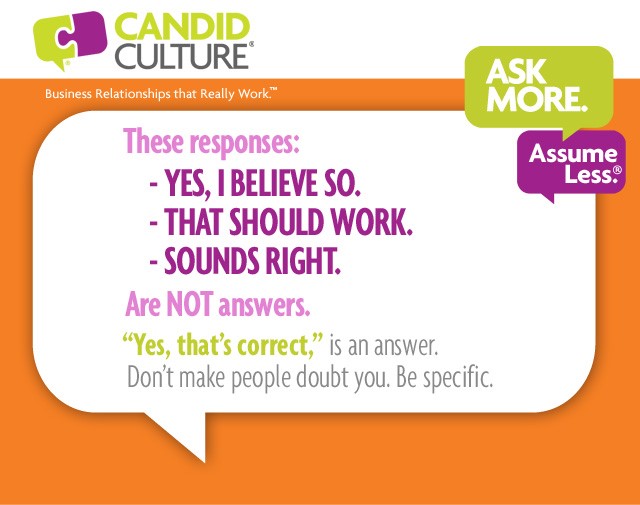 Vague communication is unhelpful. Being vague instills doubt in the people around you and reduces your credibility.
When a customer service agent answers my questions with words like, “That sounds right, I think so, or that should work,” I hang up and call back, hoping to get someone who can give me an affirmative answer. People do this to you, too…they just don’t tell you about it.
Watch your language. If the answer is yes, say “Yes.” If the answer is no, say “No.” “I think so,” says neither yes nor no. Saying, “I think so” tells people you don’t really know.
A few phrases to avoid and what to say instead:
Avoid: “That should be done by Friday.”
Instead, be specific and give a final date. “That will be complete by Friday. If I can’t get it done by Friday, I’ll call you to let you know by 5:00 pm on Thursday.”
Avoid: “Sounds right.”
Instead, be specific and say, “That’s correct.”
Avoid: “We should be able to do that.”
Instead, be specific and say, “We can do that.”
Avoid: “I guess.”
Instead, be specific and say, “Yes” or “No.”
When I teach feedback training, the biggest thing training participants struggle with is specificity. “You’re difficult to work with.” “Your clothing is inappropriate.” “I just find you to be negative.” “You did a good job on that.” “It’s a pleasure to have you on the team.” All of this is vague and thus unhelpful to the feedback recipient. And the same is true when answering questions and making promises.
Tell people exactly what to expect. Be specific. Even if they don’t like your answer, they’ll be happy to have a clear answer.

 When the people we work with don’t do their jobs, we might find ourselves saying, “He should be more on top of things.” “She shouldn’t make commitments she can’t keep.” “He doesn’t know what he’s doing, and that’s not my problem.” The challenge is, when your coworkers don’t perform, it is your problem.
When your coworkers don’t get you the information you need in a timely way, you miss deadlines. When you work from incorrect information, your reports are wrong. When others don’t work with you, you look bad. So you can be right all day about how others perform, and your reputation will still be negatively impacted.
I don’t suggest you enable your coworkers by doing the work others don’t. I do suggest you help your coworkers be successful by holding them accountable.
Here are a few things you can do to manage your career and get what you need from your business relationships:
- Don’t assume others will meet deadlines. Check in periodically and ask, “What’s been done so far with the XYZ project?” Notice, I didn’t suggest asking, “How are things going with the XYZ project.” “How are things going” is a greeting, not a question.
- Set iterative deadlines. If May 20th is your drop-dead deadline, ask to see pieces of work incrementally. “Can I see the results of the survey on May 5th, the write-up on May 10th, and the draft report on May 15th?” One of the biggest mistakes managers and project managers make is not practicing good delegation by setting iterative deadlines and reviewing work as it’s completed.
- Don’t just email and ask for updates. The people you work with are overwhelmed with email, and email is too passive. Visit people’s offices or pick up the phone.
You might be thinking, “Holding my coworkers accountable is awkward. I don’t have the formal authority, and I don’t want my coworkers to think I’m bossy or damage my business relationships.”
It’s all in the how you make requests.
If you’ve seen me speak or have read the business book How to Say Anything to Anyone, you know I believe in setting clear expectations at the beginning of anything new. That could sound something like, “I’m looking forward to working with you on the XYZ project. How would you feel if we set iterative deadlines, so we can discuss work as it is completed? You’ll get just-in-time input, making any necessary adjustments as we go, and we’ll stay ahead of schedule. How does that sound? How are the 5th, 10th, and 15th as mini deadlines for you?”
Many people put large projects off until the last minute. People procrastinate less when large projects are broken into smaller chunks with correlating deadlines. You strengthen your business relationships and support people in meeting deadlines and not procrastinating when you agree on completion dates when projects begin. Also, most of us unfortunately know what it’s like to put a lot of work into a project, have someone review our completed work, and then be told we went down the wrong path and need to start over.
Ask more. Assume less. Don’t assume your coworkers will do what they’re supposed to do. Ask upfront to see pieces of work on agreed-upon dates. Pick up the phone versus rely on email to communicate, and know that the people you work closely with are a reflection of you. Get people working with you, and everyone will look good.

 People are drowning in data, more specifically in email. If you want people to read your communications, send short emails and fewer of them.
How often do you open an email, see its daunting length, close the email promising you’ll get back to it later, but don’t? Then you bump into the sender a week later and he asks, in an annoyed tone, “Did you get my email?” And you attempt to conjure up the email, distinguishing it from the 1,500 emails you’ve received since.
Some people like receiving lots of information, others don’t. Ask your internal and external customers how much information they want to receive, in what format, how frequently, and with how much detail. And when you can, accommodate their preferences.
I’m a big picture person. For me, more information is not necessarily better. I’ll read five bullets. I won’t read five paragraphs. I’m frequently guilty of opening a long email, becoming overwhelmed, deciding I don’t have time to read the entire message, promising to read it later, and by the time I go back to the message, I’ve typically missed a deadline.
You can say it’s my problem that I don’t read long emails, not the sender’s problem. And you’d be right. I should read every email I get in full. But when I don’t give the sender something she needs because I was overwhelmed by the length of her email, it becomes her problem, too. If you want people to respond and do what you’re asking, communicate how they like to communicate whenever possible.
I’d like to say that people are so used to reading short text messages and Facebook and Twitter updates that they’ve been trained not to read anything longer than a few sentences. And there may be something to that. But the truth is, there are detail people who like a lot of data and there are big picture people who don’t. If you provide a high level summary – just what recipients need to know – followed by more details or information on where more details can be found, you accommodate both the detail and the big picture people.
When you write your next email or any other type of communication, consider: Could this be said with fewer words? Do the recipients want or need this level of detail? Then, shorten your communications and accommodate both the big picture and the detail people. And you’ll be amazed at how quickly you receive the things you’re asking for.
And if that’s not working, go old school and use our greeting cards to write a note, because no one can resist a handwritten note.

The fear of saying what we think and asking for what we want at work is prevalent across organizations. We want more money, but don’t know how to ask for it. We want to advance our careers but are concerned about the impression we’ll make if we ask for more. Instead of making requests, many employees assume they won’t get their needs met and choose to leave their jobs, either physically or emotionally.
How to Retain Good Employees:
The key to keeping the best employees engaged and doing their best work is to ask more questions and make it safe to tell the truth.
Managers: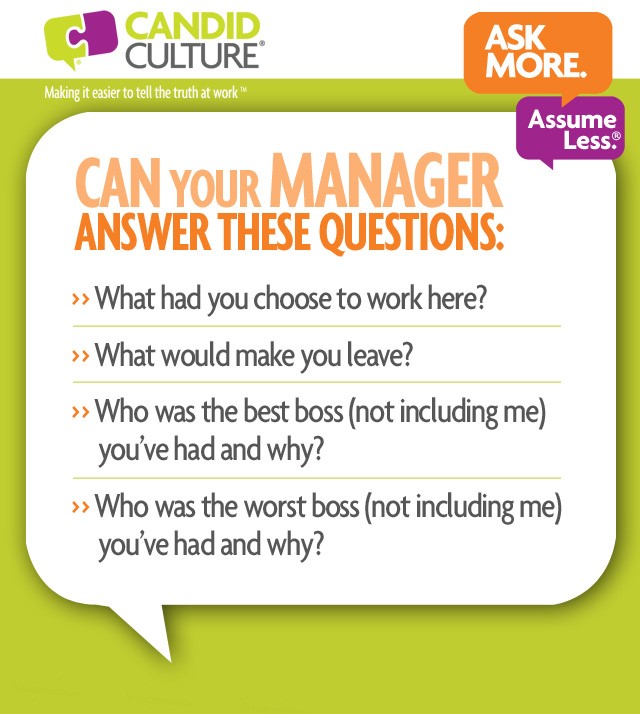
- Do you know why your employees chose your organization and what would make them leave?
- Do you know your employees’ best and worst boss?
The answers to these questions tells managers what employees need from the organization, job, and from the manager/employee working relationship.
Can your manager answer these questions – that I call Candor Questions – about you? For most people, the answer is no. Most managers don’t ask these questions. And most employees are not comfortable giving this information, especially if the manager hasn’t asked for it.
It’s easy to mistake my book, How to Say Anything to Anyone, as a book about giving feedback. It’s not. It takes me nine chapters to get to feedback. The first eight chapters of the book are about how to create relationships in which you can tell the truth without fear. You can read all the feedback books you want and take numerous training classes on coaching, managing people, giving feedback, and managing conflict, and you’ll still be hesitant to speak up, because a formula for giving feedback is not what you’re missing. What’s missing is being given permission and knowing it’s safe to tell the truth.
Managers, here’s how to retain good employees:
“I appreciate you choosing to work here. I want this to be the best career move you’ve made, and I want to be the best boss you’ve had. I don’t want to have to guess what’s important to you. I’d like to ask you some questions to get to know you and your career goals better. Please tell me anything you’re comfortable saying. And if you’re not comfortable answering a question, just know that I’m interested and I care. And if, at any point, you’re comfortable telling me, I’d like to know.”
 Then ask the Candor Questions during job interviews, one-on-one, and team meetings. We’re always learning how to work with people. So continue asking questions throughout your relationships. These conversations are not one-time events.
If you work for someone who isn’t asking you these questions, offer the information. You could say:
“I wanted to tell you why I chose this organization and job, and what keeps me here. I also want to tell you the things I really need to be happy and do my best work. Is it ok if I share?”
Your manager will be caught off guard, but it is likely that she will also be grateful. It’s much easier to manage people when you know what they need and why. Most managers want this information, it just may not occur to them to ask.
If the language above makes you uncomfortable, you can always blame me. You could say:
“I read this blog and the author suggested I tell you what brought me to this organization and what I really need to be happy here and do my best work. She said I’d be easier to manage if you had that information. Is it ok if I share?”
Yes, this might feel a little awkward at first, but the conversation will flow, and both you and your manager will learn a great deal about each other.
The ability to tell the truth starts with asking questions, giving people permission to speak candidly, and listening to the answers.
 Surveys are a great way to gather data. They’re not a great way to build relationships. In addition to sending out employee engagement surveys, ask questions live. Employees want to talk about their experience working with your organization. And employees will give you real, honest, and salient data, if you ask them and make it safe to tell the truth.
Here are a few methods of gathering data, in addition to sending employee engagement surveys:
Managers, ask questions during every one-on-one and team meeting with employees.
Managers, consider asking:
- What’s being talked about in the rumor mill?
- What do I need to know about that you suspect I don’t?
- What makes your job harder than it has to be? What would make your job easier?
- What meetings are not a good use of time?
Listen and be careful not to defend. Employees want to be heard. Respond if you’re able, but don’t deflect the feedback you’ve received.
Leaders, conduct roundtable discussions with small groups of employees throughout the year. I’d suggest discussions with groups of six employees. Have lunch or coffee. Keep the meetings informal.
Leaders, consider asking:
- What’s a good decision we made in the last six months? What’s a decision we made that you question?
- What would need to happen for you to be comfortable referring your friends to work here?
- What’s something happening in the organization that you’re concerned about?
How to Get the Truth:
- Share as much information as you can. Trust your employees.
- Ensure there are no negative consequences for people who tell you the truth.
- Give positive attention to the people who risk and give you negative information.
- Tell employees what you learn during these discussions and what you will and won’t be doing with the information.
- You don’t need to act on every piece of data you receive. Just acknowledge what you heard and explain why you will or won’t be taking action.
Employees are loyal to managers and organizations they feel connected to, and connections are formed through conversations. So in addition to sending employee engagement surveys, ask questions during every conversation and make it clear that you’re listening to the answers.
When I led leadership development training for a large mutual fund company we offered a lot of training focused on helping people have hard conversations. Over time I realized that despite that I’d bought and offered the best training programs I could find, the training wasn’t helping. Managers didn’t give enough feedback, and when they did give feedback, employees were often left confused, wondering what they needed to do differently.
I decided that what was missing was the conversation before the crucial conversation. It wasn’t that managers didn’t know what they wanted to say, but many managers felt they couldn’t say what they wanted to say. There wasn’t sufficient safety or permission for giving feedback, so managers said little or delivered messages that were so vague, employees were left wondering if there was a problem. This is when the idea for Candid Culture was born.
 If you’re struggling with giving feedback, I doubt it’s the message that’s the challenge. The distinction between being able to tell the truth (as you see it) and saying nothing, is the quality of your relationship.
Think about the people – personal and professional – who can say anything to you. These are the people who can tell you that the person you’re dating is wrong for you, that a piece of clothing is not flattering, that you disappointed them, or that you dropped the ball. You may not enjoy getting the feedback, but you’re able to hear what they have to say and take it in because you know they care about you and have your best interests at heart. You trust their motives. When you trust people’s motives, they can say anything to you. When you don’t trust people’s motives, there is little they can say.
If you’re struggling to give feedback, evaluate your relationship by asking these three questions:
- Does this person know that I have her back under any circumstances?
- Does this person trust me?
- Does this person know that I accept her just as she is?
If the answer to any of the questions above is no, it’s not giving feedback you’re struggling with, it’s the quality of your relationship. Work on building trust with this person and you’ll be able to say whatever you feel you need to say.
Here are five steps to building trusting relationships:
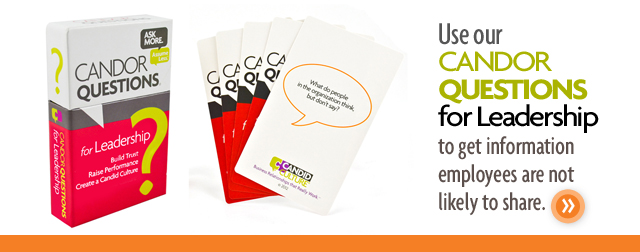
- Get to know people better than you know them now. Get five free conversation-starting Candor Questions to have these conversations.
- Tell people you want them to succeed and demonstrate that by being supportive of their efforts.
- Don’t be judgy. No one likes to be told that she is wrong.
- Set the expectation that you will give both positive and negative feedback when appropriate, because you want the person to win. And if you remain silent, you are of no help to the other person.
- When you deliver feedback, be extremely specific. Feedback that is specific will be received much better than vague feedback, which is typically judgmental.
When people know that you respect and want good things for them, you have a great deal of freedom to speak up. When people don’t trust your motives, giving feedback is almost impossible. The recipient will become defensive and dismiss whatever you say, rationalizing that you don’t like her and never have.
Worry less about giving feedback – for now. Instead, build trust. Get to know people better, then work on giving feedback.