Archive for May, 2025
When my son started school, I went to new parent orientation. At the orientation I sat next to parents who told me their questions about the program, but they never asked the people running the meeting their questions. They wondered in silence, whispering to seat mates who didn’t know any more than they knew. I’m always flabbergasted by these situations until I remind myself that people don’t like to admit they don’t know something. No one wants to look stupid.
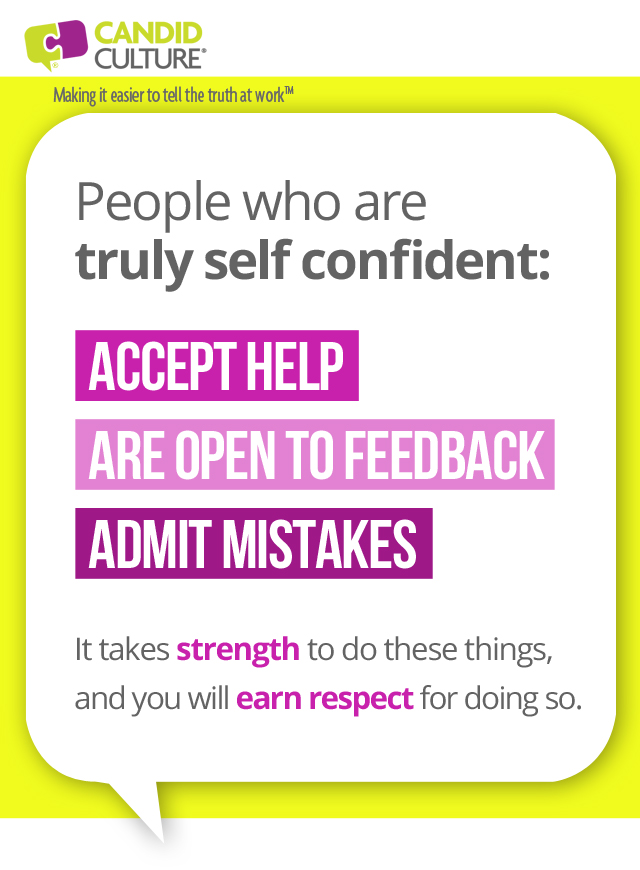
Most of us aren’t eager to admit when we don’t know something, need help, or make a mistake. We fear these things will damage our reputation and make us appear less than to others. But neither are true. It takes strength and self-confidence to admit mistakes, accept feedback, and ask for help. Strong, self-confident people do all of these things.
When someone who works for me is willing to admit mistakes, I think more of them. When employees ask for help rather than spin their wheels unnecessarily, I’m appreciative. When they’re open to feedback, I’m grateful they’re easy to work with. And the same is likely true for you.
Before launching Candid Culture, I worked for a CEO who frequently led with, “I may not be the smartest guy in the room, but…” The CEO was trying to appear humble and relatable, but he was the smartest guy in the room, and we all knew it, thus his attempts were false and came off as such. Arrogance masquerades as self-confidence. People who are arrogant come off as strong and self-confident, but it’s a façade.
It may seem like your personal power and reputation will be diminished by admitting mistakes and accepting help. But this couldn’t be further from the truth. It takes strength to say you don’t know how to do something, to embrace feedback that stings, and to admit bad choices. And strong, self-confident people do all of these things, regularly.
You won’t lose credibility or damage your reputation by being humble, instead you’ll be seen as real, relatable, and willing to admit a lack of perfection. And all of those things take strength that ingratiate you to others. So be yourself. Don’t pretend you’re better or more knowledgeable than you are. Authenticity goes a long way.
I’m embarrassed how often I do things I don’t want to do because I’m afraid of looking bad. I agree to things I don’t want to do. I even suggest doing things I don’t want to do, because I think it will look bad if I don’t. Then I have deep regrets.
If I’m aware of this practice, why do I keep doing it, over and over and over? I suspect the need to look good and be liked is so pervasive, it over-powers reason and self-talk. Telling myself, “Don’t do it. You will regret this,” doesn’t help. The need for approval is all-powerful (to me).
My old boss told me many years ago, “Your need to be liked will kill you as a manager,” and he was right. It’s why I can’t interview my own candidates. I want them to like me too.
I suspect I’m not alone here. I lot of us say yes when we want to say no. We extend ourselves and regret it later.
What can be done, at an organizational level, to prevent ourselves and fellow employees from over-extending?
- Sanction, at a team and organizational level, that sometimes it’s ok to say no.
- Try saying, “Here’s what I can do…” or “Here is what we will do” when you don’t want to say “no”.
- Suggest that at times people take 24-hours before agreeing to take on a new task or project. Pause before committing.
- Make room for negotiation, so people can say yes on terms that work for them.
Speak your truth and know that it’s ok to set boundaries. Boundaries prevent burnout.
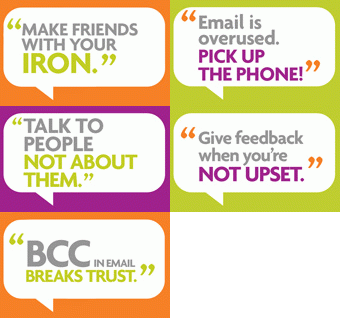
When a customer service agent answers my questions with words like, “That sounds right, I think so, or that should work,” I hang up and call back, hoping to get someone who can give me an affirmative answer. People do this to you too; they just don’t tell you about it.
Vague communication is unhelpful. Being vague instills doubt in the people around you and reduces your credibility.
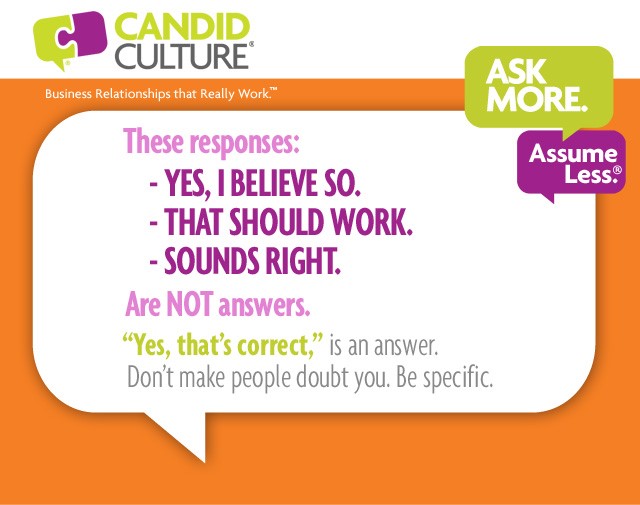
Pay attention to your language. If the answer is yes, say “Yes.” If the answer is no, say “No.” “I think so,” says neither yes nor no. Saying, “I think so” tells people you don’t really know.
A few phrases to avoid and what to say instead:
Avoid: “That should be done by Friday.”
Instead, be specific and give a final date. “That will be complete by Friday. If I can’t get it done by Friday, I’ll call you to let you know by 5:00 pm on Thursday.”
Avoid: “Sounds right.”
Instead, be specific and say, “That’s correct.”
Avoid: “We should be able to do that.”
Instead, be specific and say, “We can do that.”
Avoid: “I guess.”
Instead, be specific and say, “Yes” or “No.”
When I teach feedback training, the biggest thing training participants struggle with is specificity. “You’re difficult to work with.” “Your clothing is inappropriate.” “I just find you to be negative.” “You did a good job on that.” “It’s a pleasure to have you on the team.” All of this is vague and thus unhelpful to the feedback recipient. And the same is true when answering questions and making promises.
Tell people exactly what to expect. Be specific. Even if they don’t like your answer, they’ll be happy to have a clear answer.

It’s not unusual to wait too long to give feedback. Giving feedback often feels awkward and uncomfortable. What happens if the person cries, or gives us the cold shoulder, or worse, quits?
Working virtually over the past few years has exacerbated the waiting. Many managers who were accustomed to giving feedback in person hesitated to have hard conversations over the phone or via video.
Perhaps you waited so long to give feedback, you feel like you can’t.
It’s never too late. You just need to set the expectation that you’re going to give feedback and why. And know that anything you can say in person, you can say via video or phone.
One of the keys to being (more) comfortable giving feedback is to know that most people genuinely want to know how they’re doing. Working in the dark is frustrating. Not knowing the behaviors that impact us and our opportunities is also frustrating. Working on a project for months only to find out the work we did wasn’t what the other person wanted is ultimately frustrating.
Most people genuinely want feedback. They may struggle to hear feedback, they may get defensive, they may not take responsibility, but it doesn’t mean they don’t want to know.
If you want to give feedback but feel like you waited too long, say so. The conversation could sound like this:
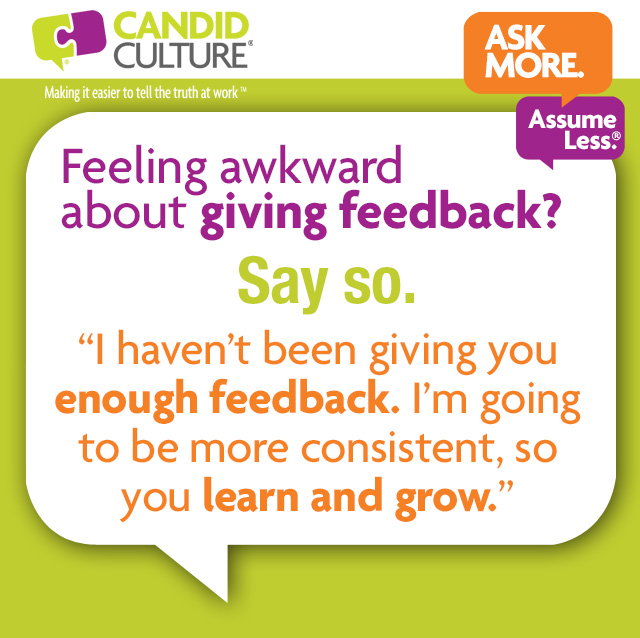
Manager to direct report: “I realized that I haven’t been giving you enough feedback. I’d like to start doing a semi-monthly debrief, not because anything is wrong or has changed. I want you to learn and grow as a result of working with me, and you won’t if I’m not providing regular feedback”
Peer to peer: “I need to talk with you about something and I’ve realized that I’ve waited too long. As a result, I’m feeling awkward and hesitant. Is it ok if I speak freely?”
Talking with someone more senior than yourself: “I want to talk with you about something I’ve been seeing for a while. I should have said something sooner. I’m sorry I didn’t. Can I talk with you about it now?”
It’s ok if you waited too long. It’s ok not to say things perfectly. Authenticity goes a long way. Be real. If you’re nervous, say so. If you’re wondering if it’s ok to speak up, say so. If you waited too long, say so. Relationships are built on trust, and authenticity builds trust. The time to start is now.