Posts Tagged ‘giving feedback’
If you were on a diet and stepped on a scale that said, “Pretty good. Keep up the good work,” you’d return the scale, claiming it didn’t work. Likewise, if your GPS told you that it “seemed you were going the right way,” you’d probably use a different app, or heaven forbid, buy a map. Scales and GPS provide us with feedback, but vague feedback is unhelpful. It doesn’t tell us what to do more, better, or differently, which is the purpose of feedback.
Vague, positive feedback is also inauthentic, and inauthenticity smells. Hearing you did a great job is nice, but utterly unhelpful because the feedback recipient doesn’t know what he did well and what to replicate. If you want people to replicate a behavior, tell them precisely what they did well that you want them to do again.
Most feedback training focuses on giving negative feedback, because it’s so hard to do, but we’re not much better at giving positive feedback. Giving useful, positive feedback takes attention, observation, and timely communication. In short, it’s difficult.

I too find myself telling my team members, “You did a great job on…” I know vague words like these serve as a short pick-me-up. My team probably smiles and appreciates the recognition, but I also know I haven’t given them substantive direction of what actions I want them to replicate. Those of you who have participated in feedback training with me know that I call vague input Cap’n Crunch – all of the sweetness, with none of the nutrients.
To give effective, positive feedback, simply state one or more specific actions you want the person to replicate.
Here are a few examples of positive feedback:
Cap’n Crunch: “You did a great job on……”
Example of positive feedback: “You did a great job onboarding our new analyst. You outlined what he needed to do during his first 90-days to be successful. He now knows precisely what he has to do and won’t have to guess.”
Cap’n Crunch: “Thanks for being so committed to our business.”
Example of positive feedback: “Thanks for calling in to today’s team meeting on a day you had off. Your participation helped us make a decision that would have taken much longer without your participation. I appreciate your commitment to our business.”
Cap’n Crunch: “Thanks for paying attention to the things that may impact us negatively in the marketplace.” This is not terrible, but not as effective as it could be.
Example of positive feedback: “Thanks for paying attention to the things that may impact us negatively in the marketplace. I appreciate you tracking the new products our competitors are launching. It helps me know where we are ahead and behind.”
Don’t assume people know what they did well and that they will replicate positive behavior without receiving positive feedback. Watch people’s actions and tell them, shortly after they do something, what they did well. And watch those positive behaviors be repeated.

How many times have you been sitting at your desk wondering, “Why won’t he ___________ ?’ Perplexed, you talk with your buddy at work. The conversation goes something like, “I’ve got this person, and I can’t figure out why he won’t ______________.” Or perhaps you talked directly to the person, but after several conversations, he still hasn’t done what you asked him to do.
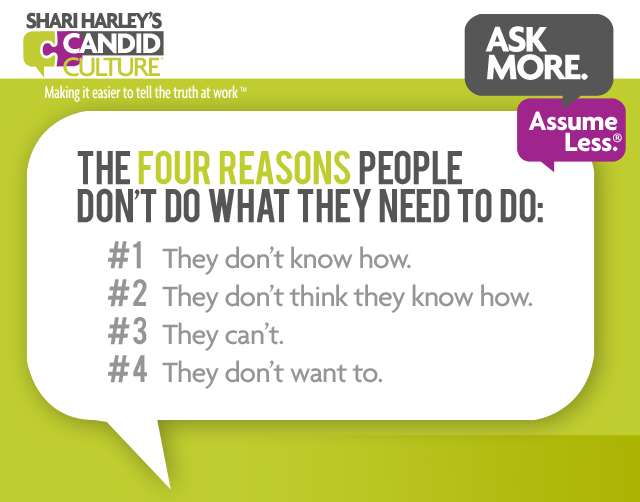
There are four reasons for a lack of employee performance and why people don’t do what you want them to do:
- They don’t know how.
- They don’t think they know how.
- They can’t.
- They don’t want to.
Reason number one for a lack of employee performance, they don’t know how, is the easiest to solve. People who don’t know how to do something need training, coaching, a mentor, a job aid or some other form of instruction. The hope is that with the right training and exposure, he will be able to do what you’re asking.
Reason number two for a lack of employee performance, they don’t think they know how, can be improved over time with patience and consistent coaching. You aren’t working with clean slates. Most people are recovering from or reacting to a past relationship or situation. If a person worked for a controlling manager who never let him make a decision or worked for someone who invoked punitive consequences for making mistakes, the person will be hesitant to make decisions. Hence why he does drive-bys on you, repeatedly checking in, but never pulling the trigger on anything.
If you work with someone who doesn’t think he knows what to do, but you know that he has the answer, encourage him to trust himself. When he comes to you for validation or approval, ask questions, don’t give answers. Tell the person you trust his judgment and encourage risk taking. Tell him that you’ll support his decision, even if it proves to be the wrong one. And encourage him to make the decision next time without consulting you. And then keep your word. If he makes the wrong call, you have to have his back and can’t invoke negative consequences.
Reason number three for a lack of employee performance, they can’t, is challenging but clear-cut. People who can’t do a task their brains aren’t wired for, will never do that responsibility well, regardless how much coaching, training, and assistance you provide. If you have repeatedly AND EFFECTIVELY, coached, trained, and provided support, remove that responsibility and give the person something he can do well. If that responsibility is a large part of the job, you have someone in the wrong job. It’s time to make a change.
Reason number four for a lack of employee performance, they don’t want to, is annoying but manageable. There are lots of reasons people don’t do things they don’t want to do. Those reasons include, but aren’t limited to, boredom, lack of buy-in as to why something is important, insufficient time, feeling like a task is beneath them, etc. If you’ve got someone who can but doesn’t want to do something, you can either take the responsibility away, incent him to do it, or give feedback EVERY TIME the task doesn’t get done.
Giving negative feedback isn’t fun for the giver or the receiver. No one wants to hear that he isn’t meeting expectations and most people don’t want to tell him. But the discomfort of receiving negative feedback EVERY TIME the person doesn’t do what he needs to do will create behavior change. He will either begin doing what you ask, quit, or ask for a transfer. Either way, your problem is solved.
The first step in getting people to do what you want them to do is to discover why they’re not doing what you ask. It’s impossible to appropriately manage employee performance if you don’t know why someone isn’t doing what he needs to do. And the person to ask why a responsibility isn’t getting done isn’t you or your buddy, it’s the person not doing the work. So get out of your head, leave your office, and go talk to the person not doing the work.
Here’s how to start an employee performance conversation:
“I’ve noticed you’re not doing ___________. Help me understand what’s happening.” Watch your tone, inquire from a place of genuine curiosity, and identify the reason he isn’t doing what he needs to do. Then you can intervene appropriately and hopefully get what you want.
When I led leadership development training for a large mutual fund company we offered a lot of training focused on helping people have hard conversations. Over time I realized that despite that I’d bought and offered the best training programs I could find, the training wasn’t helping. Managers didn’t give enough feedback and when they did give feedback, employees were often left confused, wondering what they needed to do differently.
I decided that what was missing was the conversation before the crucial conversation. It wasn’t that managers didn’t know what they wanted to say, many managers felt they couldn’t say what they wanted to say. There wasn’t sufficient safety or permission for giving feedback, so managers said little or delivered messages that were so vague, employees were left wondering if there was a problem. This is when the idea for Candid Culture was born.
 If you’re struggling with giving feedback, I doubt it’s the message that’s the challenge. The distinction between being able to tell the truth (as you see it) and saying nothing, is the quality of your relationship.
Think about the people – personal and professional – who can say anything to you. These are the people who can tell you that the person you’re dating is wrong for you, that a piece of clothing is not flattering, that you disappointed them, or dropped the ball. You may not enjoy getting the feedback, but you’re able to hear what they have to say and take it in, because you know they care about you and have your best interests at heart. You trust their motives. When you trust people’s motives, they can say anything to you. When you don’t trust people’s motives, there is little they can say.
If you’re struggling to give feedback, evaluate your relationship by asking these three questions:
- Does this person know that I have her back under any circumstances?
- Does this person trust me?
- Does this person know that I accept her just as she is?
If the answer to any of the questions above is no, it’s not giving feedback you’re struggling with, it’s the quality of your relationship. Work on building trust with this person and you’ll be able to say whatever you feel you need to say.
Here are five steps to building trusting relationships:
- Get to know people better than you know them now. Download free conversation-starting Candor Questions to have these conversations.
- Tell people you want them to succeed and demonstrate that by being supportive of their efforts.
- Don’t be judgy. No one likes to be told that she is wrong.
- Set the expectation that you will give both positive and negative feedback when appropriate, because you want the person to win. And if you remain silent, you are of no help to the other person.
- When you deliver feedback, be extremely specific. Feedback that is specific will be received much better than vague feedback, which is typically judgmental.
When people know that you respect and want good things for them, you have a great deal of freedom to speak up. When people don’t trust your motives, giving feedback is almost impossible. The recipient will become defensive and dismiss whatever you say, rationalizing that you don’t like her and never have.
Worry less about giving feedback –for now. Instead, build trust. Get to know people better, then work on giving feedback.
 If a friend asked you to do something, you did it, and she didn’t say thank you, you’d probably think twice the next time she asked you for something. The people you work with are not different.
If you don’t say thank you to employees, they too will stop doing things you think are important. Human beings thrive on recognition and relationships. We need both to survive. And when we don’t feel connected or appreciated, we find appreciation elsewhere.
If you think saying “thank you” to the people you work with is unnecessary, consider this example. An overwhelmed employee feels strapped for time. She produces a 30-page report every month that takes hours of her time. No one has ever talked with her about how the report is used and why it’s important. So when she is overwhelmed and decides that something needs to go, she stops doing work that appears not to add value—the 30-page report. It turns out the report reflects her department’s results and is reviewed by the CEO, CIO, CFO, and COO. Oops.
There are managers who think that a paycheck is enough of a thank you to employees (old school) and that any other thank you to employees is unnecessary (this doesn’t work). Human beings want to make a difference.We don’t like doing tasks we perceive as not being impactful. So tell the people you work with that their work matters by saying thank you, and how you say thank you matters. Saying, “Thanks for doing such a great job on that project” doesn’t go nearly as far as saying, “Thank you for taking over the Briggs proposal. You shepherded the proposal from beginning to end and made sure no detail was overlooked. You made all of us look good and we would not have won the business without you.” Like all feedback, specific feedback is meaningful and drives future behavior. Vague feedback feels inauthentic and doesn’t tell the recipient what to replicate in the future.
Onto why it’s important to say “I’m sorry.” Some people think that saying you’re sorry puts you in a weak position and that you will lose employees’ respect. This couldn’t be further from the truth. Strong people admit when they’re wrong. Weak people can’t admit mistakes.Admitting fault ingratiates you to other people. Refusing to take responsibility alienates you.
It’s very frustrating to work hard and never be told “thank you.” Likewise, it’s upsetting when people don’t apologize for dropping the ball and making mistakes. It’s so easy to say “thank you” and “I’m sorry,” and it costs nothing. The more you demonstrate appreciation for the people you work with and take responsibility for your mistakes, the harder people will work on your behalf.

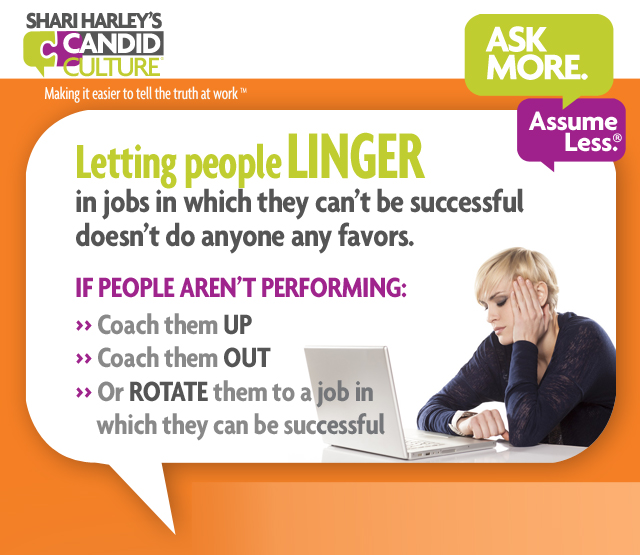 Being in the wrong job feels terrible. It’s not unlike being in the wrong romantic relationship, group of friends, or neighborhood. We feel misplaced. Everything is a struggle. Feeling like we don’t fit and can’t be successful is one of the worst feelings in the world.
The ideal situation is for an underperforming employee to decide to move on. But when this doesn’t happen, managers need to help employees make a change.
The first step in helping an underperforming employee move on to something where s/he can be more successful is to accept that giving negative feedback and managing employee performance is not unkind. When managers have an underperforming employee, they often think it isn’t nice to say something. Managers don’t want to hurt employees’ feelings or deal with their defensive reactions. In fact, when we help someone move on to a job that she will enjoy and where she can excel, we do the employee a favor. We set her free from a difficult situation that she was not able to leave out of her own volition.
I get asked the question “how do I know when it’s time to let an employee go?” a lot.
Here’s what I teach managers in our managing employee performance training programs: There are four reasons employees don’t do what they need to do:
- They don’t know how.
- They don’t think they know how.
- They don’t want to.
- They can’t. Even with coaching and training, they don’t have the ability to do what you’re asking.
Numbers one and two are coachable. With the right training and coaching employees will likely be able to do what you’re asking them to do.
Numbers three and four are less coachable and are likely not trainable.
When you’re confronted with someone who simply can’t do what you need them to do, it’s time to help the person make a change.
The way you discover whether or not someone can do something is to:
- Set clear expectations
- Observe performance
- Train, coach, and give feedback
- Observe performance
- Train, coach and give feedback
- Observe performance
- Train, coach and give feedback
Welcome to management.
After you’ve trained, coached and given feedback for a period of time, and the person still can’t do what you’re asking her to do, it’s time to make a change.
Making a change does not mean firing someone. You have options:
- Take away responsibilities the person can’t do well and give him other things that he can do well.
- Rotate the person to a different job.
Firing someone is always a last resort.
Sometimes we get too attached to job descriptions. The job description outlines a specific responsibility that the person can’t do. So we fire the person versus considering, who else in the organization can do that task? Be open minded. If you have a person who is engaged, committed, and able to do most of her job, be flexible and creative. Give away parts of the job to someone who can do them well. I’ve also seen employees who were failing, thrive in a different job. Organizations that are flexible survive; organizations that are rigid do not.
Let’s say you’ve stripped away the parts of the job that an underperforming employee can do well and she still can’t perform effectively. Now it’s time to make a change.
Here are some words to use when having the difficult ‘it’s time to move on’ conversation:
“I really want you on my team and to be successful in our organization. Over the past six months, we’ve had several conversations about the parts of your job that are a struggle. We’ve taken away responsibilities that aren’t a fit for you and have replaced those responsibilities with things that seemed like a better fit. And yet I can see that you are still struggling. I’m very sorry to say that it’s not appropriate for you to continue to working here. Today is your last day.” Depending on your organizational culture, can also say, “How do you want to handle this? You can resign or we can let you go. I’ll do whatever feels more comfortable for you.”
This is a difficult conversation that no manager wants to have. Yet I promise you, this conversation feels better to your employee than suffering in a job in which s/he can’t be successful. After you’ve set expectations, observed performance, and coached and given feedback repeatedly, letting someone go is kinder than letting the employee flounder in a job in which he cannot be successful.
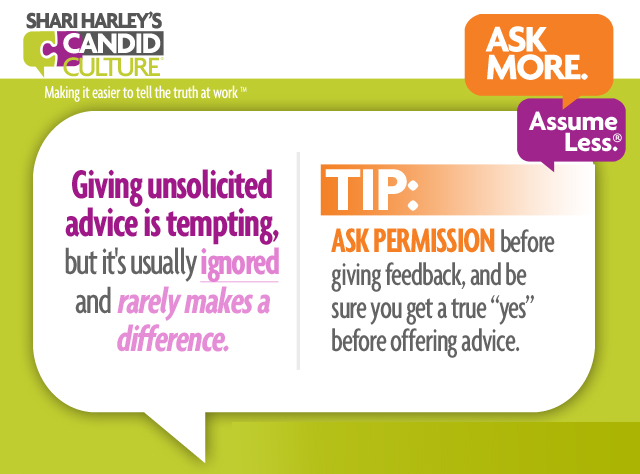 It’s hard to watch people do things that damage them – personally or professionally. And yet, if they haven’t asked for feedback, people likely won’t listen to unsolicited advice, so don’t bother giving it.
If you really want to give unsolicited advice, ask for permission and make sure you get a true “yes” before speaking up.
The conversation could go something like this:
“I noticed we’re getting behind on the XYZ project. I have a couple of ideas about what we can do. Would you be interested in talking about them?” Or, “That Monday meeting is rough. I feel for you. I used to run meetings like that. Would you be interested in talking about some meeting management strategies? I’d be happy to share what I’ve learned.”
After you offer to talk (aka, give your opinion), listen and watch the response you get. Does the person’s words and body language portray a true “yes, I’d like your opinion” or what seems like an “I’m supposed to say yes” reply? If you get the latter, you’re likely just giving unwanted advice that won’t be heard. If that’s the case, let it go. But if the person appears generally interested and open, proceed.
You could also say something like:
“Last week we were talking about your frustrations about not being promoted. I have a couple of ideas about that. Do you want to talk about them? Either way is fine, but I thought I’d offer.”
Or, “That was a tough conversation during today’s staff meeting. It’s hard to present ideas and not have them be embraced. I have a couple of thoughts about ways you can approach the conversation during the next meeting. Want to talk about them?”
If you make the invitation to talk, the other person has to be able to say no. An invitation is only an invitation if no is an acceptable answer. You can’t ask if the person wants your input and then keep talking even if he verbally or physically said no.
Be brave. If you care about someone personally or professionally and you see him doing something that gets in the way of his success, ask permission to say something. If you get the go ahead, proceed. If you get a “no thank you,” accept that and move on. You’ve done your part.
Read How to Say Anything to Anyone, and get the words to have even the toughest conversations.
Employees leave managers not jobs. We’ve all heard this 100 times.
One of the most prevalent reasons for employee turnover is boredom and lack of growth. We’ve also heard this many times.
We know why employees leave jobs. The question is what must managers do to engage and retain their best people. The answer is actually quite simple, although possibly not easy to execute.
 Employees want to know that their manager:
- Knows them
- Cares about and is invested in their careers
- Gives feedback so they can improve
- Provides opportunities so they can develop
In other words, employees need attention, and attention requires time, time many managers may not feel they have.
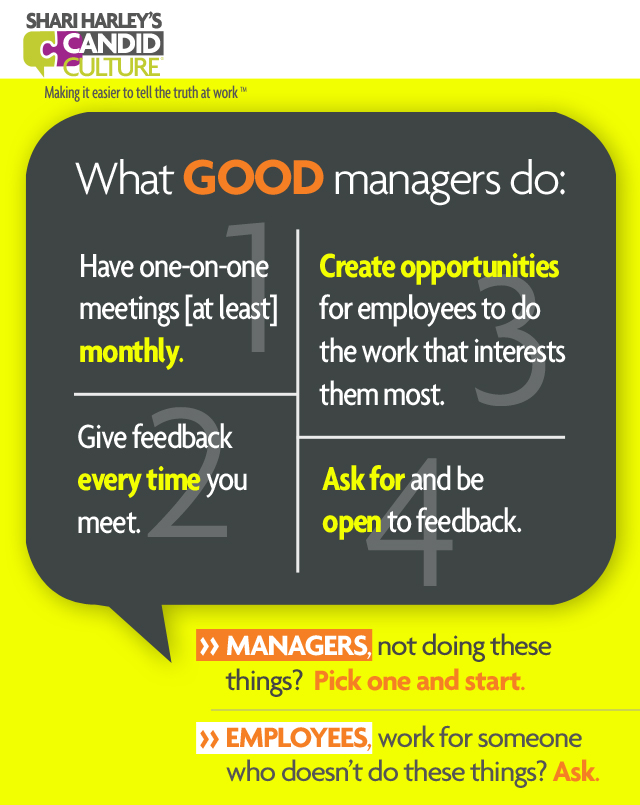
Here is a five-step formula for employee retention and employee engagement:
- Get to know employees better and differently
- Have meaningful, one-on-one meetings [at least] monthly
- Give feedback every time you meet
- Ask for and be open to feedback
- Create opportunities for employees to do the work that interests them most
Managers, how do you make time for these meetings when are busy and have several direct reports?
- Meet for 15-30 minutes
- Meet over the phone while commuting or waiting for flights
- Ask direct reports to create an agenda and run the meetings
- Ask direct reports to send follow-up notes of decisions and plans made during meetings. Give some of the accountability away.
- If meetings get cancelled, reschedule as soon as possible. Direct reports take cancelled meeting personally. Cancelled meetings, that are not rescheduled, send the message that managers don’t care about employees and their careers.
Employees, if your manager doesn’t schedule meetings with you:
- Ask permission to put a monthly meeting on your manager’s calendar
- Provide rationale for why you want to meet–to get your manager’s feedback and ensure you’re focused on the right work
- Ask permission to reschedule meetings when they get cancelled
- Don’t take cancelled meetings personally
- Offer to meet with your manager via the phone when it’s convenient for him/her. Leverage commute and travel time.
Employees need time with their managers. Meaningful discussions and work result in employee engagement and employee retention, so managers, make the time, even when you don’t feel you have it. Ask questions you don’t ask now. Give feedback, even if it’s uncomfortable. Give your employees an opportunity to do the work that interests them most. And watch your employee engagement and employee retention improve. And if your manager doesn’t do these things, politely and persistently ask. You won’t get what you don’t ask for. We are all 100% accountable for our careers.
 I’ll never forget a coaching meeting I had about two years ago. I gave the manager I was coaching some tough feedback and he replied by saying, “I know I do that.” So I asked him, “If you know this is an issue, why are we having the discussion? He told me, “I just figured this is the way I am.” And I realized that knowing a behavior is ineffective doesn’t mean we know what to do to make things better.
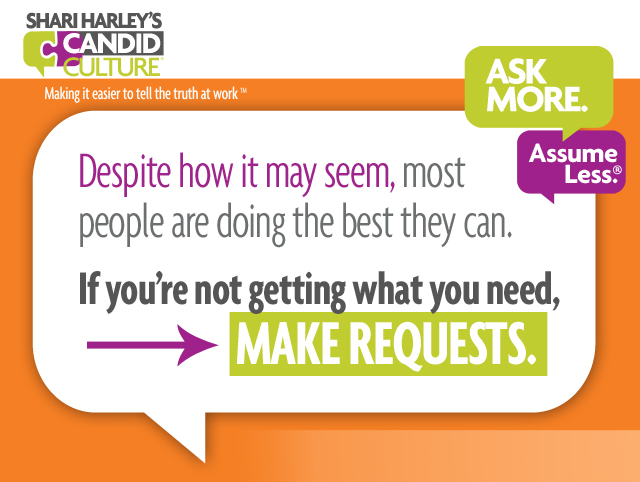
The people you work with want to do a good job. They want you to think well of them. Yes, even the people you think do little work and/or are out to get you. Give people the benefit of the doubt. Assume people are doing the best they know how to do. And when you don’t get what you want, make requests.
There are two ways to give feedback. One way is very direct.
Version one: “You did this thing and here’s why it’s a problem.”
The other way is less direct. Rather than telling the person what went wrong, simply make a request.
Version two: “Would you be willing to…” Or, “It would be really great to get this report on Monday’s instead of Wednesday. Would you be willing to do that?”
It’s very difficult to give feedback directly without the other person feeling judged. Making a request is much more neutral than giving direct feedback, doesn’t evoke as much defensiveness, and achieves the same result. You still get what you want.
When I teach giving feedback, I often give the example of asking a waitstaff in a restaurant for ketchup. Let’s say your waiter comes to your table to ask how your food is and your table doesn’t have any ketchup.
Option one: Give direct feedback. “Our table doesn’t have any ketchup.”
Option two: Make a request. “Can we get some ketchup?”
Both methods achieve the desired result. Option one overtly tells the waiter, “You’re not doing your job.” Option two still tells the waiter he isn’t doing his job, but the method is more subtle and thus is less likely to put him on the defensive.
You are always dealing with people’s egos. And when egos get bruised, defenses rise. When defenses rise, it’s hard to have a good conversation. People stop listening and start defending themselves. Defending oneself is a normal and natural reaction to negative feedback. It’s a survival instinct.
You’re more likely to get what you want from others when they don’t feel attacked and don’t feel the need to defend themselves. Consider simply asking for what you want rather than telling people what they’re doing wrong, and see what happens.
I will admit, asking for what you want in a neutral and non-judgmental way when you’re frustrated is very hard to do. The antidote is to anticipate your needs and ask for what you want at the onset of anything new. And when things go awry, wait until you’re not upset to make a request. If you are critical, apologize and promise to do better next time. It’s all trial and error. And luckily, because most of us aren’t great at setting expectations and human beings are human and make mistakes, you’ll have lots and lots of chances to practice giving feedback and making requests.
The fear of saying what we think and asking for what we want at work is prevalent across organizations. We want more money, but don’t know how to ask for it. We want to advance our careers but are concerned about the impression we’ll make if we ask for more. Instead of making requests, many employees assume they won’t get their needs met and choose to leave their jobs, either physically or emotionally.
How to Retain Good Employees:
The key to keeping the best employees engaged and doing their best work is to ask more questions and make it safe to tell the truth.
Managers: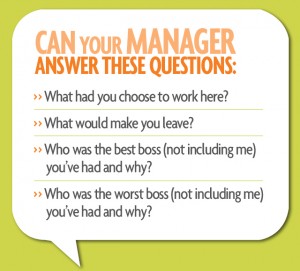
- Do you know why your employees chose your organization and what would make them leave?
- Do you know your employees’ best and worst boss?
The answers to these questions tells managers what employees need from the organization, job, and from the manager/employee working relationship.
Can your manager answer these questions – that I call Candor Questions – about you? For most people, the answer is no. Most managers don’t ask these questions. And most employees are not comfortable giving this information, especially if the manager hasn’t asked for it.
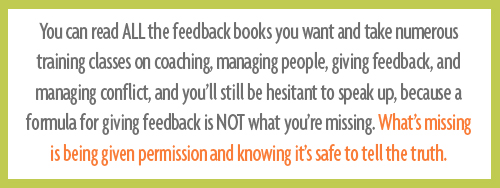
It’s easy to mistake my book, How to Say Anything to Anyone, as a book about giving feedback. It’s not. It takes me nine chapters to get to feedback. The first eight chapters of the book are about how to create relationships in which you can tell the truth without fear. You can read all the feedback books you want and take numerous training classes on coaching, managing people, giving feedback, and managing conflict, and you’ll still be hesitant to speak up, because a formula for giving feedback is not what you’re missing. What’s missing is being given permission and knowing it’s safe to tell the truth.
Managers, here’s how to retain good employees:
“I appreciate you choosing to work here. I want this to be the best career move you’ve made, and I want to be the best boss you’ve had. I don’t want to have to guess what’s important to you. I’d like to ask you some questions to get to know you and your career goals better. Please tell me anything you’re comfortable saying. And if you’re not comfortable answering a question, just know that I’m interested and I care. And if, at any point, you’re comfortable telling me, I’d like to know.”
 Then ask the Candor Questions during job interviews, one-on-one, and team meetings. We’re always learning how to work with people. So continue asking questions throughout your relationships. These conversations are not one-time events.
If you work for someone who isn’t asking you these questions, offer the information. You could say:
“I wanted to tell you why I chose this organization and job, and what keeps me here. I also want to tell you the things I really need to be happy and do my best work. Is it ok if I share?”
Your manager will be caught off guard, but it is likely that she will also be grateful. It’s much easier to manage people when you know what they need and why. Most managers want this information, it just may not occur to them to ask.
If the language above makes you uncomfortable, you can always blame me. You could say:
“I read this blog and the author suggested I tell you what brought me to this organization and what I really need to be happy here and do my best work. She said I’d be easier to manage if you had that information. Is it ok if I share?”
Yes, this might feel a little awkward at first, but the conversation will flow, and both you and your manager will learn a great deal about each other.
The ability to tell the truth starts with asking questions, giving people permission to speak candidly, and listening to the answers.

You know when someone gives you ‘the tone’. Similar to when people roll their eyes at you, when you get ‘the tone’ you’re being told that the other person is exasperated.
 Tone of voice communication is one of the hardest things to coach because we don’t hear ourselves. People who give people ‘the tone’ rarely know they’re doing it. One of the best ways I know to effectively coach tone of voice is to ask tone givers to tape themselves during phone calls. Then listen to the recording together and ask the tone giver, “If your grandmother called and someone spoke to her that way, would you be happy?” You can also read written correspondence out loud, adding the tone you ‘heard’, and ask the sender how she would have interpreted the message.
When given the tone, most people feel judged. And when people feel judged, conversations are constrained.
The way to avoid giving ‘the tone’ is to come from a place of curiosity. When you ask the question, “What were you thinking when you approached the customer that way,” you can sound curious or judgmental. Being judgmental evokes defensiveness, which shuts conversations down. Being curious creates discussion.
Consider asking questions like these to invite discussion:
• Tell me more about…
• Help me understand what happened here…
• What are your thoughts about…
• What’s the history behind….
• Why do we do it this way?
Any of these questions will lead to good discussion, if you manage your tone.
If you want to get information or influence someone, ask questions and engage the person in a dialogue. We often try to persuade people by giving them information. This rarely works. Instead of over loading people with data, ask questions which evoke discussion. Through discussion you might get to a different place. And if not, you’ll at least have learned why the other person thinks as he does and you will have shared your point of view in a way that is inviting versus off putting.
It’s easy to give people ‘the tone’ when we’re tired and frustrated. Try to avoid difficult conversations when you’re tired or stressed. Wait to have important conversations until you know you can manage yourself and your tone.