Most employees need only a handful of things to be satisfied and productive at work. The key is getting employees to tell you what those things are. And they might just tell you, if you ask.
Effective management involves asking questions during the interview process, after an employee starts, and again 90-days to six months into the job.
I recommend asking the seven questions below. I call the questions, Candor Questions.
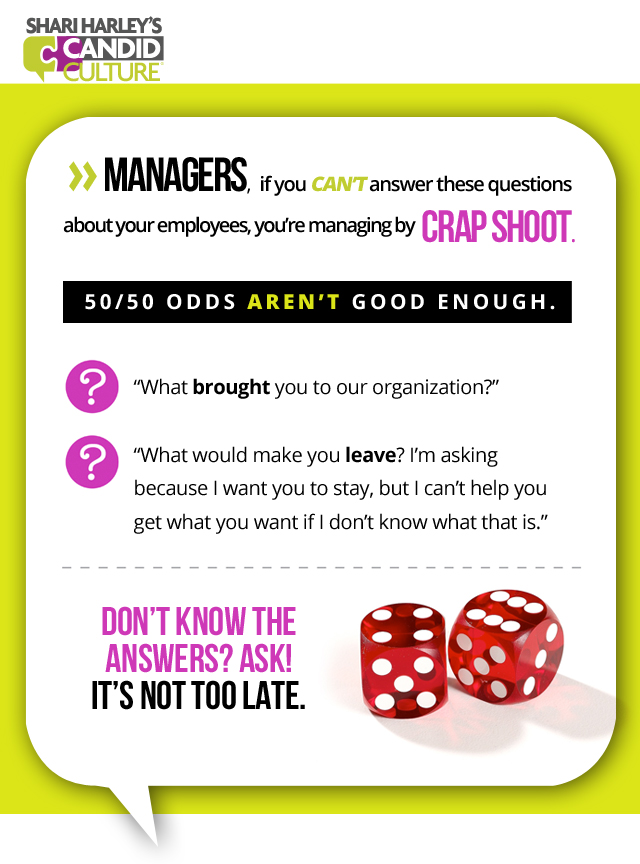
Candor Question number one: “What brought you to our organization? Why did you accept this job? What are you hoping the job will provide?” Ask one of these three questions. Pick the one you like best.
Candor Question number two: “What would make you leave this job? What are your career deal breakers, things you just can’t tolerate at work?” Ask either of these questions.
Candor Question number three: “What type of work, skills, and/or areas of our organization do you want to learn more about?”
Candor Question number four: “Tell me about the best manager you ever had. What made them the best manager?” This will tell you what the employee needs from you as a manager and is a much better question than, “What do you need from me as your manager?” That is a hard question to answer. Telling you the best manager they ever had is easy.
Candor Question number five: “Tell me about the worst manager you ever had? What made them the worst manager?”
Candor Question number six: “What are your pet peeves at work? What will frustrate you?” Why find out the hard way what frustrates employees when it’s so easy to ask. This question demonstrates that you want your employees to be happy and that you will flex your own preferences, when possible, to meet employees’ needs.
Candor Question number seven: “How do you feel about being contacted via cell phone or texts outside of business hours? How do you feel about receiving emails during the evenings and weekends? What time is too early? What time is too late?” When boundaries like work hours are violated, it often erodes employees’ loyalty to managers and organizations, and it’s such an easy question to ask.
If you’ve participated in one of our management trainings or received a box of Candor Questions for Managers, you know I could go on. But these seven questions are a good start.
Regardless of age, work, and educational background, employees have a few things in common.
Employees want to:
• Work for someone who takes an interest in and knows them
• Feel valued and appreciated for their contributions
• Be part of and contribute to something greater than themselves
• Feel respected as a person. Managers respect their time, expertise, and needs
Taking the time to get to know employees throughout your working relationship accomplishes many employee needs.
If you have long-time employees, it’s never too late to ask these questions. Regardless of for how long employees have worked for you, they’ll appreciate you asking. Don’t worry that employees will raise an eyebrow and wonder why you’re asking now. They’ll just be happy you’re asking. You can simply say, “I realized that I’ve never overtly asked these questions. I just assume I know. But I don’t want to do that. During our next one-on-one meeting I’d like to ask you these questions and you can ask me anything you’d like.”
If you have a manager who is unlikely to ask these questions, provide the information. Don’t wait to be asked. You’re 100% accountable for your career. Tell your manager, “There are a few things about me I want to share with you. I think this information will help ensure I do great work for the organization for a long time.”
Managers, the better your relationship with your employees and the more you know about what your employees need from you, the organization, and the job, the easier employees are to engage, retain, and manage. Stop guessing and start asking.
You know when someone gives you ‘the tone’, similar to when people roll their eyes at you? When you get ‘the tone’ you’re being told that the other person is exasperated.
Tone of voice is one of the hardest things to coach because we don’t hear ourselves. People who give people ‘the tone’ rarely know they’re doing it.
One of the best ways I know to effectively coach tone of voice is to ask tone givers to record themselves during meetings and calls, then listen to the recording together and ask what they heard and how they would have interpretated the communication had it been directed at them. Finally, ask if their tone would pass The Grandma Test. Ask, “If your grandmother called and someone spoke to her that way, how would you feel?” No one wants to speak unkindly to their grandma. You can also read emails out loud, adding the tone you ‘heard’, and ask the sender how they would have interpreted the message.
When given the tone, most people feel judged. And when people feel judged, conversations are constrained.
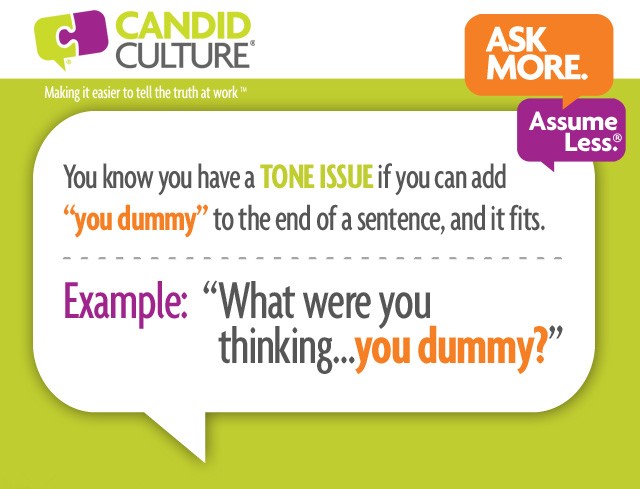
The way to avoid giving ‘the tone’ is to come from a place of curiosity. When you ask the question, “What were you thinking when you approached the customer that way,” you can sound curious or judgmental. Being judgmental evokes defensiveness, which shuts conversations down. Being curious creates discussion.
Consider asking questions like these to invite discussion:
“Tell me more about… Help me understand… What are your thoughts about…. What’s the history behind….”
Any of these questions will lead to a good discussion, if you manage your tone.
If you want to get information or influence someone, ask questions and engage the person in a dialogue. We often try to persuade people by giving them information. This rarely works. Instead of overloading people with data, ask questions that evoke discussion. Through discussion, you might get to a different place. And if not, you’ll at least have learned why the other person thinks as they do, and you will have shared your point of view in a way that is inviting versus off-putting.
It’s easy to give people ‘the tone’ when we’re tired and frustrated. Try to avoid difficult conversations when you’re tired or stressed. Wait to have important conversations until you know you can manage yourself and your tone.
You will be passed over for jobs, projects, and opportunities – personally and professionally. People will choose not to buy from you, and they’ll choose not to be your friend. And that’s ok. Not everyone is our right “customer.” The key isn’t to win every opportunity. Rather, it’s what we do when we don’t get what we want.
When you’re done feeling disappointed, mad, and frustrated, get curious. Find out why you were passed over. I’ll never suggest you make changes. I simply want you to know what’s standing in your way, so you have power – the power to choose.
We all have blind spots – things we do that are off-putting to others, that we’re not aware of. For the most part, people won’t tell us our business blind spots, instead, they simply pass us over. Being rejected is feedback, it’s just not specific enough to help us make different choices. If you want to be able to change your behavior, you need to know what behaviors are standing in your way. Then you can choose what, if anything, to do about those behaviors.
When you get turned down for an opportunity, practice these strategies to eliminate your business blind spots:
Allow yourself to have an emotional reaction, to feel disappointed, and to grieve the loss.
When your emotions dissipate, call people who can tell you why you were turned down and ask for feedback. The goal of the conversation: Eliminate your business blind spots.
Be humble and open.
Consider saying something like, “Thank you so much for considering me/us to support your needs. We were disappointed not to win your business. Would you be willing to share what had you choose a different provider and what we could have done differently to be a stronger candidate? I’ll be grateful for anything you’re willing to tell me.”
Depending on the circumstances, you could also say something like, “I wasn’t put on the _______ project. I wonder if you have any information as to why. I appreciate anything you’re able to tell me. Your input will help me grow and eliminate my blind spots.”
Regardless of what you hear, thank the person for the feedback. You can ask for additional information and ask who else you can talk with, but don’t become defensive. The less defensive you get, the more feedback you’ll get. Make it easy to tell you the truth.
Remember, information is power, and power is control. Many people don’t give direct feedback because they’re afraid of the other person’s reaction. Surprise people by being open to feedback and eliminate your blind spots.
Validate feedback that doesn’t feel right to you. If you’re not sure what someone told you is accurate, vet the feedback with other people you trust. Simply ask other people who are aware of your performance, “I received this feedback. Does that resonate with you?”
Sit with the feedback for a few days before taking any action.
When your emotions have passed, decide what – if anything – you want to do with the input you’ve received. Perhaps you want to make changes. Perhaps you don’t. Either way, you have more power than you did before you received any input.
You won’t win them all. The key isn’t avoiding rejection, it’s what you do when you don’t get what you want. Be brave. Be open. Ask for feedback. And you’ll have the power to make different choices next time, if you want to.
I’m consistently shocked and embarrassed by what comes out of my mouth when I’m mad. It’s like reason and self-control go out the window. Emotion and the need to be right takes over. Every time I react in the moment, I regret it. Every single time.
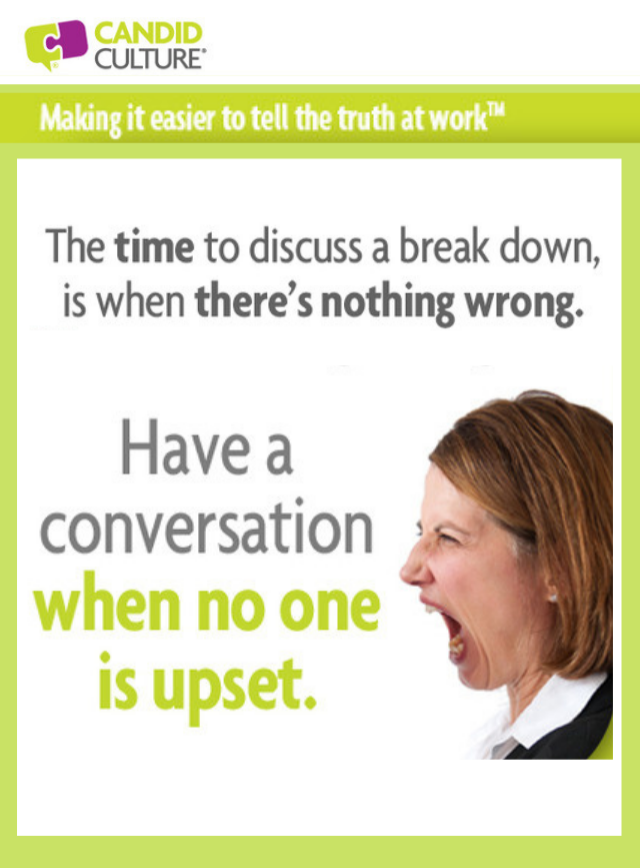
Talking with another person when we’re upset, often leads to more upset. Emotions and conversations escalate quickly. The more upset we are, the more likely we are to say things we’ll regret. The time to alter how we work, live, and communicate with someone, is when there is nothing wrong.
If you want something in a relationship to change, pick a time when things are calm and when no one is upset to have a conversation. Tell the other person that you want to talk about how you work together, manage disagreements, make decisions, handle disappointments, etc. Share what you have observed in the past and make requests. Brainstorm solutions together. You’ll have a much better conversation when you’ve had time to calm down from whatever happened that created the need for the conversation.
Waiting to have a conversation until you’re not upset creates the risk of waiting too long to address concerns. The right time to talk about a breakdown is as soon after an event as you can. When both people are calm and have time to have the conversation, usually within a few days of a challenge.
There is no talking to my nine-year-old about why I impose certain limits in the moment. He’s too upset. I need to wait to talk to him about the behavior I want to see when he’s calm. Typically, that’s later the same day. Adults may take a little longer. But this isn’t a pass to wait six weeks, which is what we often do. The conversation won’t be as hard or as bad as you think if you talk when you’re calm and speak from what the relationship needs.
Speaking from what the relationship needs is saying just what you need to, not more and not less, to resolve the challenge and create a better way to handle things in the future. And communicating in a kind and direct way, so the other person can take in what you have to say.
Agree upon better ways of handing challenges, when no one is upset. Speaking directly, calmly, caringly and with the desire to make things work, typically has a positive result.
At some point in your career, you will likely get feedback that doesn’t feel accurate. When receiving feedback you question, rather than dismiss it, vet the feedback with the people who know you best. Assemble a core team of people who know you well, love you, and have your back. The relationships may be personal or professional. These are people who will tell you the truth (as they see it) if you ask.
You might think that you’re a different person at home and at work, thus your friends’ and family’s input isn’t valid in the workplace. I don’t think that’s true. You are who you are, and you’re not a completely different person at home and at work. It’s just not possible to be your real self and turn it on and off at work. Sure, you might have a communication style that you only use when working. You may make decisions at work differently than in your personal life. But you’re not a completely different person after 5:00 pm. If you’re often late, don’t keep confidences, talk too much and too long, or wear clothing that is not your friend, your personal relationships can tell you that.
It’s important to know how you come across, your reputation, and your wins and losses at work. Having this information allows you to manage your reputation and in turn, your career.
The question is, with whom should you vet feedback that doesn’t feel quite right? Here are four criteria for core team members:
Your core team should be made up of a small number of people (five or fewer) who know you well, love you, and have your back.
You should respect core team members’ opinions.
You must trust your core team and their motives, in relation to your well-being.
You must be open to core team members’ feedback.
Core team members don’t need to be told they’re on your core team. Simply call these people individually when you need input. Tell them the feedback you’ve received and then ask for their opinion. And be sure to tell them that you’ll take their feedback graciously, by saying “thank you”.
It’s easy to dismiss feedback that’s hard to hear. The feedback you receive might just be that person’s opinion. But people talk. And one person’s experience of you can impact your career greatly. Manage your career assertively and powerfully by knowing your reputation. Find out the impressions you create. Then you can make decisions about changes you will and won’t make.
Last week one of my friends was concerned about something happening at her son’s camp. She wrote out what she planned to say to the camp’s executive director and sent it to me to read. Her letter was long, with lots of unnecessary details. I read five paragraphs before understanding what the situation was even about. I revised her letter. My version was three sentences and easy to write. Why? Because it’s not my child and not my situation.
One of the things that makes giving feedback and making requests particularly difficult, is our emotional involvement. We’re invested in the outcome. The stakes feel high. And that emotion makes everything harder.
If you’re struggling with a message you need to deliver, get some help. The person who helps you craft a succinct, specific, and unemotional message doesn’t have to be a feedback expert or a manager. The person just can’t be involved. As long as the person isn’t emotionally involved, they’ll be helpful.
When you ask for help, don’t ask for advice. Instead of asking a friend or colleague, “What would you do in this situation,” ask, “What would you say?” These are very different questions. You want the specific words to resolve whatever you’re struggling with.
Asking someone for help planning a challenging conversation or message begs the question, isn’t asking for that type of help a form of gossip? It could be. So be careful who you ask.
When asking for help planning a message or conversation, ask someone in your organization who is at your same level or above (title-wise) or ask someone outside of the organization. Change the names of the people involved; protect people’s anonymity. And be clear if you are asking for help to plan a conversation or if you are venting. They are not the same.
The most effective feedback and requests are unemotional, factual, and succinct. Sometimes we need other people who are not involved to help us get there.
Most of the feedback people receive in the workplace isn’t feedback at all, it’s what I fondly refer to as Cap’n Crunch – vague and unhelpful words that put people on the defensive but don’t change behavior. If you want people to do something differently, give specific feedback.
Most of the fake Cap’n Crunchfeedback people get sounds like this:
“You did a great job on that.”
“You’re doing really good work.”
“You’re dressing inappropriately.”
“You’re difficult to work with.”
None of this is feedback. It’s all Cap’n Crunch. Vague, vague, and more vague.
The first words out of your mouth will invariably be Cap’n Crunch. Follow those words with, “for example” and you’ll be headed in the right direction.
“You did a great job on that. For example, I never had to ask about the status of the project. You gave me an update every Friday, and that made me feel comfortable that we were on track.”
“You dressed inappropriately for that meeting. For example, the client was dressed in business casual; you wore jeans and a t-shirt. Next time, please dress as the client dresses or a step above in khaki pants or slacks and a jacket.”
Most people are afraid to give feedback because they don’t want to deal with the defensive reaction they anticipate. The more vague you are, the more defensive people will be, because they don’t know what you’re talking about and they feel judged. Vague feedback is subjective. Subjective is judgmental. Feeling judged puts people on the defensive.
If employees shop your feedback around, asking what others think of the feedback you provided, it’s because you were vague, they disagree with you, or they’re being defensive. Feedback will be received better and resisted less if you’re specific.
Specific feedback can be captured on video. Meaning, you can video someone calling into a meeting late, rolling their eyes, and texting on their phone. I dare you to video “you were disrespectful in the meeting, you dressed inappropriately, or you’re difficult to work with.” If you can’t capture the feedback on video, you don’t yet have specific feedback. You have Cap’n Crunch.
When I teach managers to give feedback I ask the managers to, “Describe the situation to me. What did the person do?” Managers often reply with, “They were negative.” This is Cap’n Crunch. So, I keep asking questions. “What did they do that was negative? What did it look like?” After two or three questions the manager tells me, “I overheard them complaining to other employees about the decisions the company is making. I’d rather they ask me questions about the direction we’re going versus gossip to peers.” Now we have specific feedback.
Wait to give feedback until you have a specific example. If you don’t have a specific example, go get one. Without an example, employees will look at you in a confused way, question the validity of what you’re saying, and become defensive. And they’ll be justified in doing all of these things.
Most of us dread giving feedback because we don’t want to deal with people’s defensive responses. If you want more help, chapters nine through twelve of How to Say Anything to Anyone provide a clear and easy-to-follow formula for giving specific feedback.
Remember, if you’re not using the words “for example” you’re not giving specific feedback.
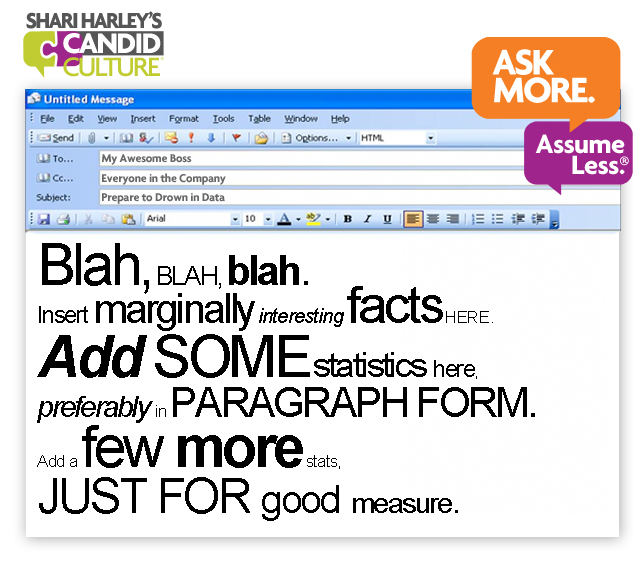
When I get an email that has multiple paragraphs I look at it, decide I don’t have time to read it, and close it out, promising to go back to it later when I have more time, which never happens. If you want your emails read, shorter is better.
Here are a few tips for writing effective emails that are more likely to be read:
Put a specific subject in the subject line that says what the email is about.
This does not include your name. We already know your name.
Example: “Meeting” (that’s not specific). Instead try: “Meeting to agree upon Q3 goals.”
Highlight and bold important parts of the email.
Limit this practice so what’s bolded and highlighted stands out.
If everything is bold, nothing stands out.
Use bullets.
Use the fewest number of words possible.
Use links that send readers to relevant information.
Offer to provide additional information, if desired.
The shorter your emails are, the more likely they are to get read. You can always offer additional information, but readers won’t get to the detail if they never read the email. When it comes to writing effective emails, shorter is better.
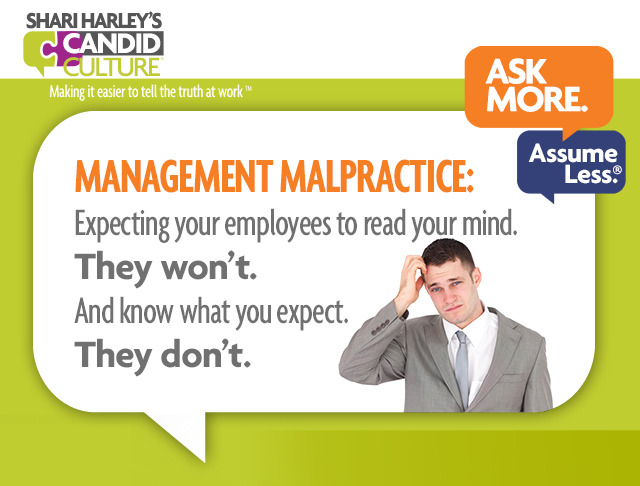
We have all worked hard on a project, only to find out that what we created was not what our manager was expecting. When this happens, everyone is frustrated. Managers question whether or not employees listen. Employees wonder why managers weren’t clearer about what they wanted at the beginning.
Giving negative feedback is hard. Asking for what you want will always be easier. Managers would be well served by setting clear expectations at the beginning of working relationships and projects. Tell your employees what a good job looks like. Don’t make them guess.
If you want a weekly status update, tell employees that rather than being frustrated when you don’t know where projects stand. If you want a bulleted summary, tell people that rather than being annoyed when five paragraphs land in your inbox. If you envision a report with tables and charts, tell employees that versus being disappointed when they create a bulleted list. Setting clear expectations applies to all internal and external working relationships – up, down, and lateral.
Most of us assume people will do things the way we do. They won’t. Save time and reduce frustration by being crystal clear when you set expectations at the beginning of anything new.
When people see the title of my book How to Say Anything to Anyone, they think it’s a book about giving feedback and having difficult conversations. It’s not. How to Say Anything to Anyone is about asking more questions, so you know what your direct supervisor, coworkers, and customers need and don’t have to guess. How to Say Anything to Anyone is not about giving people bad news. It is about asking for what you want before challenges occur and then talking about how you’ll deal with challenges when they arise.
If you work for or with someone who does not set expectations that are clear, then you, the employee, needs to set those expectations.
Set expectations by asking your manager and coworkers:
• When do you want to see this, in what format, with how much detail?
• What does a good job look like?
• What’s your expectation of how this should look when it’s complete?
• Where does this fit, as a priority, in relation to other projects?
• How does this project fit into the department’s or organization’s goals?
Asking questions and telling people what you want is always easier than giving negative feedback. Everyone – employees and managers alike – are accountable for ensuring that expectations are clear and that work is done right the first time Ask more. Assume less.
Download the five questions managers must ask their employees to set expectations that are clear:
Meetings go long; attendees stealthily text under the table like no one can see them; one person talks the whole time, while everyone else rolls their eyes. All the while, the facilitator does nothing.
Sound familiar?
The amount of time wasted in unproductive meetings and the degree of frustration meeting participants feel is astronomical.
The solution is simple but may not feel easy.
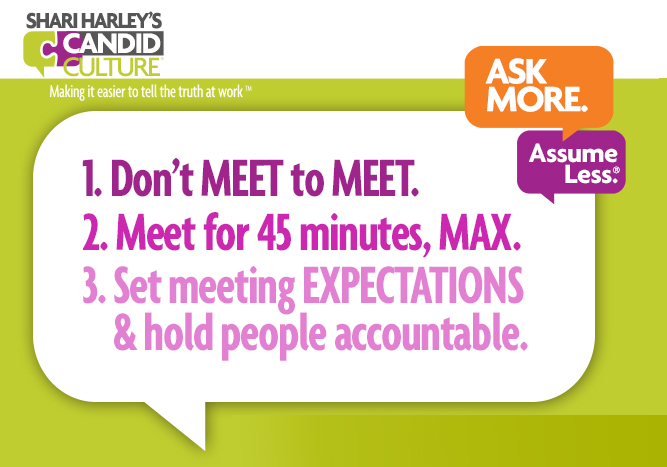
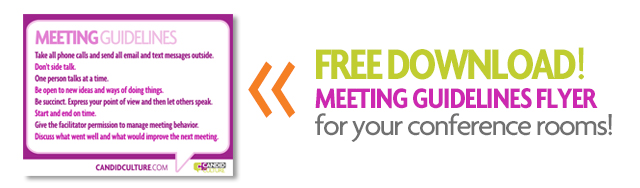
Set clear meeting expectations at the beginning of EVERY in-person, virtual, and hybrid meeting and hold people accountable when they violate the guidelines.
Most meeting facilitators don’t set expectations at the beginning of meetings. Instead, facilitators expect attendees to follow the unstated, assumed guidelines. And when the meeting facilitator’s boss, peers, or customers are distracted, it’s too hard to say something, so facilitators ignore the behavior, hoping it will stop without intervention.
The key to getting what you want in meetings (and in life) is to ask, which for the most part, we don’t. We assume people will do things as we do.
Tips for Running an Effective Meeting:
1. Set meeting expectations at your next in-person, virtual, or hybrid meeting.
2. Write the expectations on a flip chart or in the online chat and hang them up/post them in the chat at the beginning of every meeting.
3. Review the meeting expectations every time you meet, even with groups who meet weekly.
4. Ask meeting participants’ permission to manage meeting behavior. Your role as the meeting facilitator gives you the right to address bad meeting behavior. Asking for permission and letting people know you will say something if participants are distracted, etc., makes it easier to speak up.
5. Tell participants they are expected to hold themselves and each other accountable.
6. Hold people accountable for following the meeting expectations. If you ask people not to side talk, address side talking when you hear it. If you ask people not to be on their laptops or phones, ask people to put them away. If one person talks too long, interrupt them. You will have no credibility if you set expectations but don’t hold people accountable. Hold virtual participants accountable just as you hold in-person participants accountable.
The reason facilitators don’t hold people accountable is that they feel uncomfortable. It’s hard to tell your peers, boss, and coworkers to be more succinct. It’s almost impossible if you don’t set expectations about meeting behavior and set the expectation that you will say something when the meeting expectations are violated. The simple act of setting meeting expectations and asking people’s permission to manage to those expectations makes managing ‘bad’ meeting behavior easier. Not easy, but easier.
You may be thinking, “I don’t run these meetings. I’m an innocent victim.”
As a meeting participant, it is frustrating to go to poorly run meetings. But it’s also your role to speak up when you see things going poorly. Talk with the meeting facilitator.
The conversation could go something like this:
Express empathy: “That Wednesday team meeting is tough. I wouldn’t want to run it.”
Ask permission to give feedback: “I’d like to help. I’ve got a few observations and suggestions. Is it ok if I share them?”
Give feedback: “I’ve noticed that several people have been missing the meeting and others are on their phones and laptops during meetings. This definitely limits what we can get done and must be frustrating to you. What are your thoughts?”
Make a suggestion: “What do you think of setting meeting expectations at the next meeting and then telling people you’re going to hold them accountable?”
Offer help: “You’re not alone in this meeting. I’d be happy to tee up this discussion and explain why we need to set meeting expectations. What do you think?”
The facilitator knows the meetings aren’t going well. They just don’t know what to do. Offer to help. Don’t judge. The facilitator might be more receptive than you think, and you can stop suffering through poorly run meetings.