We are living in a weird, crazy time. It may feel scary to go into a restaurant or a store, let alone to work. People are wondering if it’s safe to fly, return to their offices, or visit family and friends. There is so much uncertainty and so many unknowns. People are anxious and stressed.
I can see and feel the stress when I go to the grocery store. My neighborhood store didn’t feel particularly friendly before Covid. Fellow shoppers would run you over with their cart if it appeared you were going to beat them to the last bag of organic, gluten-free, paleo-friendly, vegan, sustainably-sourced chips. But now it’s much worse. People shopping in the store understandably want to get in and out as soon as possible. Other people are obstacles, like moving, orange cones pushing carts. Long lines are stressful. You can’t tell if a masked person smiles or silently growls at you.
During these uncertain, scary, and unpredictable times I think we need to go out of our way to demonstrate kindness.
I’ll admit that I am the person always in a rush, often on the phone at the checkout counter (I hate when people do that, even though I do it too), sometimes not making meaningful eye contact. But lately I’m making more of an effort – saying hello to strangers I pass, when I normally wouldn’t, making it obvious I’m smiling at a person under my mask, even telling people, “I know you can’t tell, but I’m smiling at you.” I’m asking hospitality workers how they’re doing, what it’s like to be working in a coffee shop or a grocery store, and what makes a customer respectful during this scary and uncertain time. And I’m listening more closely to their answers.
It’s harder to see kindness right now because a mask conceals so much. It also allows me not to wear makeup, which I’m grateful for. But people can’t interpret my intentions behind my mask. They can’t see if I’m friendly, happy, or irritated. I have to go out of my way to demonstrate how I feel and what I mean in ways I never have before.
Here are five ways you can demonstrate kindness:
Tell people you appreciate that they’re working (in an environment that may feel risky from a health perspective).
Ensure your tone is friendly and patient.
Tell people overtly how you feel. “I’m not irritated, this mask just makes me look cranky.” “I’m smiling at you. Thank you for the good service.”
Wait patiently, versus sighing and rolling your eyes, if there is a long wait for customer service or an answer to a question.
Follow the posted rules for distancing and masks. Following the posted guidelines makes everyone feel more at ease.
Be overt. Make your positive feelings known. Put someone else at ease. And this ‘thing’ will feel better.
Coming next week: You asked. We answered. Next week’s tip and blog: How to work well with others virtually.
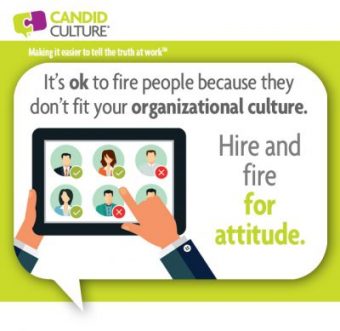
“He does great work but is really difficult to work with.” “She produces great results at the expense of people.” I hear these complaints all the time. I feel like people need permission to hire and fire because of fit. So here it is, it’s ok to hire and fire people who don’t fit your culture. You can find people who do great work and who interact according to your company’s values, and you deserve to have both.
Results are often considered more important than the seemingly ‘softer stuff,’ how people got those results. And it often doesn’t feel legitimate to want to get rid of an employee who treats coworkers poorly. We question ourselves thinking, “Maybe it’s not that bad? Perhaps I’m being too sensitive?” Or, “He does great work and is really reliable. Maybe I need to get over that he throws me under the bus in meetings I don’t attend?” “It’s really hard to find and keep good, reliable, employees. I should just suck it up.”
What if employees who treat coworkers and direct reports poorly or don’t practice your organizational values aren’t good employees? People don’t want to work for a manager who is knowledgeable but mistreats people. And likewise, people don’t want to work with people who are super friendly but do no work.
Some organizations evaluate employees both on the results they achieve and how they get to those results. That makes perfect sense.
Here are six tips for hiring and firing employees for fit:
Share your organizational values and behavior practices overtly when you interview candidates. Make it clear that people who don’t follow those practices won’t be happy or successful in the organization.
Create an opportunity for candidates to do an extended practical interview, during which they can get a feel for what the culture is really like, outside of a formal sit-down interview. Then give candidates an opportunity to opt-out of a job because they didn’t feel they fit in during the practical interview.
Trust yourself. If you find it off putting that a coworker raises her voice at you, gossips about you, or takes credit for your work, trust yourself.
Set clear expectations around how employees, coworkers, vendors, and customers are expected to behave when doing business with your organization. And be willing to let internal and external customers and suppliers go because they aren’t willing or able to follow your behavioral practices.
Coach and give feedback on how people achieve results.
Let employees go who don’t respond to feedback on interpersonal behaviors. Or let them know it’s time for them to look elsewhere.
Suffering at work is optional. You deserve to work with people who reflect your organization’s values.
If you work with other people, there is likely at least one business relationship you wish was stronger. If only that person included you on necessary communications, didn’t gossip about you, or gave you honest feedback versus telling you everything is fine and then working around you.
What often makes work hard isn’t the work at hand, it’s the people we work with – the power struggles, cc-reply-to-all when everyone doesn’t need to know, and the gossip that pervades most organizations.
You need to communicate and work well with the people you work with regularly. And like any relationship, business relationships require work. But what happens when someone doesn’t return your efforts for a positive working relationship? S/he doesn’t return emails or voicemails, ignores requests, and/or goes above you instead of coming to you when issues arise?
Make three attempts at strengthening a business relationship.
I’ll attempt to strengthen a business relationship three times before giving up. Phone calls, video, and in-person meetings count as an attempt to improve a relationship, emails and text messages don’t. Emails and texts are passive, one-sided communications. If you’re serious about strengthening a relationship, talk with the person, either in person or via video or the phone.
The conversation could go something like, “We’re going to be working together a lot this quarter, I thought it would be helpful to talk through how we both like to communicate and who will do what. When is a good time for us to connect via phone?”
Or, you could say, “A lot has happened this year – good and bad. I thought it would be helpful to talk about what did and didn’t work, so the rest of the year is smooth. Can we schedule a call to talk about it?”
Or, perhaps, “I want to talk with you about how we work together. I think we both know that this year has been hard. I’d love for us to have a good working relationship. Can we talk about how we want to work together going forward?”
I’ll make attempts like those above three times (with the same person). If the person doesn’t reach back, says no, or cancels three scheduled meetings, I give up. Don’t chase people. The people who are interested in fostering a good working relationship will make the time and be willing to be uncomfortable.
What does it mean to give up? You are not the Golden Retriever of the workplace. Nor are you the 7-11 – always open. If someone isn’t interested in talking with me about how we can improve our relationship, I don’t keep asking. After the third no, I’m polite. I include the person in all necessary meetings and communications. I’m professional. But I don’t keep inviting. You can’t work with someone who won’t work with you.
Extend an olive branch. Be forthcoming, brave, and yourself. And if you get three nos’, work on other business relationships and leave this one be.
Lots of organizations do exit interviews after employees give notice. Exit interviews can be a source of helpful information. Employees have little to lose after they’ve quit, so they’re likely to speak candidly about their work experience. But asking for feedback after an employee has quit is a little (a lot) too late. The time to ask about an employee’s working experience is every 90 days, if not more frequently.
Employees quit. It’s a natural part of doing business. And some turnover is healthy and helpful. Surprises, however, are not helpful and are unnecessary. Turnover should rarely, if ever, be a surprise. The writing is always on the wall, if you ask the right questions and make it easy to speak freely.
Most employees are concerned about giving feedback when their input is negative. Employees at almost every company cite “a list,” and those who speak up, end up on it, and then mysteriously leave the organization. Mind you, no one has ever seen the list, but employees at all types of organizations are certain it exists.
If you want to reduce the turnover in your organization and increase employee engagement and satisfaction, ask for feedback regularly, and make it easy to speak candidly.
Five ways to get your employees talking before they quit:
Ask for feedback at the end of every meeting. Simply ask, “What are you enjoying about your job? What are you not enjoying?” Or ask, “What makes your job easier? What makes your job harder?”
Manage your responses to feedback. The easier it is to tell you the truth, the more truth you’ll get. Employees are afraid of their manager’s reactions. Resist the urge to become defensive (which is very difficult to do). Saying, “I’m sorry that was your experience. Thank you for telling me,” goes a long way. Employees will breathe a sigh of relief and are more likely to speak candidly in the future.
Replace one satisfaction survey with roundtable discussions during which a leader or manager asks a small group of employees for feedback. Live conversations build trust and loyalty. Written surveys do not.
Help employees who aren’t a good fit, exit the organization. Don’t wait for poor performers or employees who aren’t a good culture fit to leave. Help misplaced employees find a better match. The right employees raise performance and morale, the wrong employees destroy both.
Don’t be afraid to ask for feedback. Just because you asked for feedback, doesn’t mean you have to act on that information. Employees don’t typically expect all of their requests to be met. It’s often enough just to be able to speak and be heard.
Keep doing exit interviews, and add quarterly or monthly requests for feedback. Talk with people over the phone or in person. Ask one or two simple questions to get the other person talking. Manage your face. Smile. Say “thank you” for the feedback. And watch your employee engagement and satisfaction rise.
I recently interviewed a candidate who asked for a lot of ‘stuff’ during the interview process. He wanted compensation, perks, accommodations, and benefits that were way outside the norm. I’m assuming he was employing the adage we’ve all heard, that “it can’t hurt to ask.” Unfortunately, it can hurt to ask.
When forging new relationships, we watch (judge) people. We’re trying to figure out who they are and how they are. Are they the person they claimed to be during the interview process? Are they trustworthy? Did I make the right decision in bringing this person into my team, organization, and life?
Requests always make an impression. When we’re building new relationships, requests make an even bigger impression. Candidates who said the commute wouldn’t be an issue, but complain about it two weeks into the job, cause managers to doubt their hiring decision. Coworkers who consistently ask for extensions to deadlines, appear unreliable.
People watch us and silently judge, making assessments about our commitment, reliability and even character. Don’t make people question you. Make reasonable asks.
Five ways to make reasonable requests:
Vet your requests with people who know your company, manager, and/or industry, before making them. What is a reasonable request in one organization, might not be in another.
If something is important to you, ask for it during the interview process or at the onset of new projects and relationships. Don’t wait. Waiting to ask for things, until after you’ve started a job and are comfortable with your manager, can damage your relationships and reputation. Managers don’t like bait and switch, even when it’s unintended.
Don’t ask again, once you’ve received an emphatic “no.” I worked with someone who asked for something during the interview process. I said “no” and explained why. He asked again after being hired. This annoyed me and made me feel like he didn’t listen and would push me on this and on other things.
If you aren’t sure that what you’re asking for is reasonable, say so. Tell the person you’re asking what you want and to please tell you if it isn’t a reasonable request.
Ask for feedback on your requests. If you’ve seen me speak, you know I’m a proponent of telling people, “If I do anything that damages our working relationship or makes you question me, I hope you’ll tell me. I promise I’ll take your feedback graciously, and say “thank you.”
Ask for what you want, within reason, be upfront when relationships begin, and build your relationships rather than break them.
It can’t hurt to ask, right? Wrong. Requests make an impression. Make reasonable asks. Repair a relationship, when you’ve asked for too much.
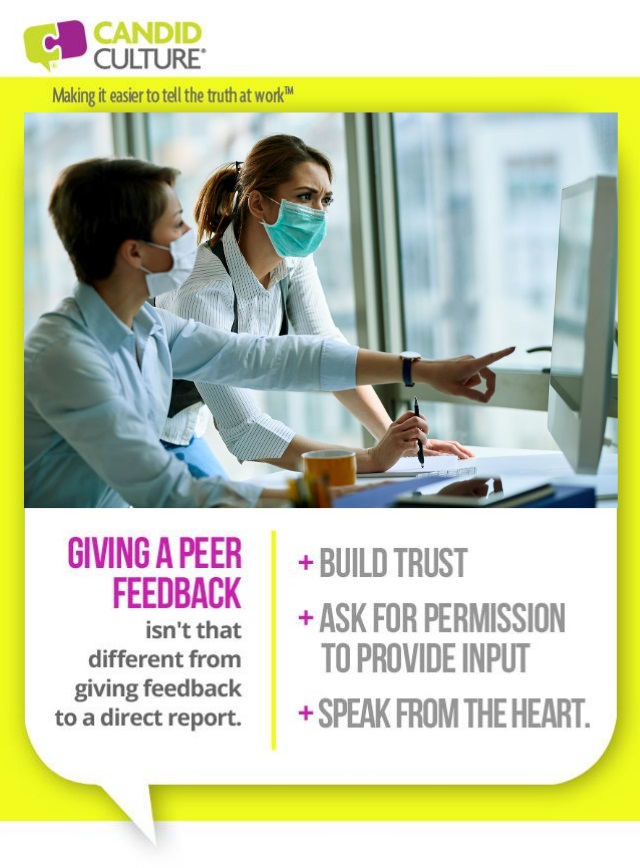
Many of us are hesitant to give peer feedback. We worry that giving peer feedback will damage our relationships. We wonder if we have the right and if it’s our place to give peer feedback. And we are concerned about what the consequences of giving peer feedback will be.
Giving peer feedback isn’t so different from giving feedback to a friend or even a direct report. While you have an implicit ‘right’ to give a direct report feedback, doing so without building trust will ensure your feedback falls flat.
People respond to feedback in predictable ways. Most people get upset and defend themselves. This is normal and natural. Negative feedback conflicts with our desire to be thought well of, which all people (despite what they might say) want. People are more open and less defensive when they trust the source of the feedback and trust the sources’ motives. Follow these practices when giving peer feedback and your feedback will hopefully be well received.
Think about why you want to give feedback. Really think about this. Is your desire to help the person change a behavior, or are you just being judgmental? If your intention isn’t to help someone replicate or change a behavior, say nothing. It’s not feedback you’re planning to give, it’s only your opinion you want to disseminate. One of my friends recently told me she felt my son’s name was waspy. Her comment wasn’t feedback as there was nothing I could do with the information. She simply gave me her judgmental opinion, which annoyed me.
Also, consider why you want to give feedback. Do you simply want something done your way, or do you feel strongly that what the person is doing is having a negative impact on him/her or the organization? I worked with a business leader who red-lined every document his staff created. He didn’t only change language that was wrong, he edited documents so they were written more akin to his writing style. This made his staff feel that they couldn’t do anything right and it wouldn’t matter what they produced, he’d revise even the most ‘perfect’ work. So they stopped trying. Evaluate your true motive. Just because something wasn’t done your way, doesn’t mean it wasn’t done well.
Provided your motives are pure – you’re trying to make a difference for someone and his/her behavior is causing real challenges, it’s ok to speak up. Be sure you have the relationship to give peer feedback. Does the person know you have his/her back? If you speak up, will s/he trust it’s because you care about her or the organization, versus you just want to express your opinion and be right.
Provided you are giving feedback to alter a behavior and you have the relationship to give feedback, it’s important that you ask for permission. A peer relationship is a lateral one. You each have the same ‘power’ (at least by title) in the organization, thus you don’t intrinsically have the ‘right’ to give feedback. You earn the right to give feedback by asking for permission and being willing to hear, “No, thank you.”
Asking for permission to give feedback might sound something like, “I’ve noticed a few things that I think are making ________ project harder than it has to be. Would you be willing to talk with me about it?”
Or, “Our weekly team meetings are tough. It’s a challenging group. I have a couple of ideas that might make the meetings easier to run. Would you be interested in talking about them?”
Or, “I have something I want to share with you. I feel awkward bringing this up because we’re peers and I’m not sure it’s my place to do so. But I care about you and want you to be successful. Would it be ok if I shared? Feel free, of course, to say no.”
Lastly, don’t worry about giving peer feedback perfectly. You might follow our feedback formula to a tee. You might not. There is no one right way to give feedback. Speak from the heart. If you’re nervous to have a conversation, say so. If you’re not sure it’s your place to give a piece of feedback, say so. If you’re worried you won’t deliver the feedback well, say that. Saying how you really feel, being human and vulnerable builds trust, relationships, and credibility. People want to work with other real people, and real people have concerns. It’s ok to share them.
Giving peer feedback doesn’t have to be hard. Evaluate your motives. Ensure that what you plan to share is really feedback versus merely your opinion. Build trust, ask for permission, and speak from the heart. If you make a mess, you can always clean it up. Simply repeat the steps by saying something like, “I’m sorry if I hurt your feelings. I hope it’s ok I said something. I really want this project to go well for both you and the team. How could I have done that better for next time?”
When I led leadership development training for a large mutual fund company we offered a lot of training focused on helping people have hard conversations. Over time I realized that despite that I’d bought and offered the best training programs I could find, the training wasn’t helping. Managers didn’t give enough feedback, and when they did give feedback, employees were often left confused, wondering what they needed to do differently.
I decided that what was missing was the conversation before the crucial conversation. It wasn’t that managers didn’t know what they wanted to say, but many managers felt they couldn’t say what they wanted to say. There wasn’t sufficient safety or permission for giving feedback, so managers said little or delivered messages that were so vague, employees were left wondering if there was a problem. This is when the idea for Candid Culture was born.
If you’re struggling with giving feedback, I doubt it’s the message that’s the challenge. The distinction between being able to tell the truth (as you see it) and saying nothing, is the quality of your relationship.
Think about the people – personal and professional – who can say anything to you. These are the people who can tell you that the person you’re dating is wrong for you, that a piece of clothing is not flattering, that you disappointed them, or that you dropped the ball. You may not enjoy getting the feedback, but you’re able to hear what they have to say and take it in because you know they care about you and have your best interests at heart. You trust their motives. When you trust people’s motives, they can say anything to you. When you don’t trust people’s motives, there is little they can say.
If you’re struggling to give feedback, evaluate your relationship by asking these three questions:
Does this person know that I have her back under any circumstances?
Does this person trust me?
Does this person know that I accept her just as she is?
If the answer to any of the questions above is no, it’s not giving feedback you’re struggling with, it’s the quality of your relationship. Work on building trust with this person and you’ll be able to say whatever you feel you need to say.
Here are five steps to building trusting relationships:
Get to know people better than you know them now. Get five free conversation-starting Candor Questions to have these conversations.
Tell people you want them to succeed and demonstrate that by being supportive of their efforts.
Don’t be judgy. No one likes to be told that she is wrong.
Set the expectation that you will give both positive and negative feedback when appropriate because you want the person to win. And if you remain silent, you are of no help to the other person.
When you deliver feedback, be extremely specific. Feedback that is specific will be received much better than vague feedback, which is typically judgmental.
When people know that you respect and want good things for them, you have a great deal of freedom to speak up. When people don’t trust your motives, giving feedback is almost impossible. The recipient will become defensive and dismiss whatever you say, rationalizing that you don’t like her and never have.
Worry less about giving feedback – for now. Instead, build trust. Get to know people better, then work on giving feedback.
If you’ve gotten courageous and given someone negative feedback or questioned a decision or action, you probably didn’t get a shiny, happy reply in return. The normal and natural reaction to negative feedback or data is to defend ourselves. It’s human. Defending yourself when receiving negative feedback is an act of self-preservation, not unlike hitting your brakes when the person driving in front of you unexpectedly slams on their brakes.
The problem with reacting defensively (normally) to negative feedback is that it’s scary and off-putting to others. As normal as a defensive reaction is to negative feedback, it makes others so uncomfortable that they’ll be hesitant to give you negative feedback again. And this lack of knowledge of what others really think is dangerous. Silence inhibits career growth and leads to bad business decisions. You want people to tell you the truth, as they see it. So you need to make it easy to speak freely.
If you want more of what others see as the truth, do the opposite of what people expect. Rather than defending or going silent, say “thank you.” “Thank you for telling me that. I’ll think about what you said and will likely come back to you to discuss further,” buys you time and puts the other person at ease.
Here are five ways to make it easier to say thank you for the feedback:
Only accept feedback when you’re ready to listen. You’re allowed to put people on ice and come back to them when you have time to talk. Bad days, when you have five minutes between meetings, or are about to leave for a vacation are not the times to accept negative information. Set up a time to talk, as soon as you have the bandwidth to listen.
Take breaks during hard conversations. You’re allowed to say, “I need a few minutes.” Go get coffee. Take a walk. Go outside. Regain your composure. Then continue the conversation.
Have feedback conversations when you’re rested and have eaten. Everything seems bigger and more difficult when we’re tired or hungry.
Accept that “thank you” isn’t the same as telling the other person she is right or that you agree. “Thank you” is a mere acknowledgment that you heard. It buys you time and gives you a chance to gather your thoughts and respond when you’re not emotional.
Don’t have conversations when you’re upset, and we often don’t know when we’re upset. Your emotions will run the show. Give yourself time to get through your emotional response, and then talk.
People are more hesitant than you think to tell you when they disagree. Make it easy to speak up. Do the opposite of what others expect. Say “thank you” rather than reacting, and you’ll get more data than you do now.
Several years ago, I was doing frequent training and consulting with a client and was in their offices weekly. One of their employees confided in me that she could see the train wreck coming on her team but wasn’t planning to say anything. She was going to watch the predicted mayhem happen without saying a word.
Why wasn’t she planning to speak up about the breakdowns she could see were coming? Did she care not care about her job or company? Was she not invested? The problem wasn’t any of those things. She simply didn’t believe that anyone wanted to hear what she had to say, the negative consequences for speaking up felt high, and quite simply, it was easier to say nothing.
When we were little our parents told us, “If you have nothing nice to say, don’t say anything at all.” As young professionals, when we did speak up and someone didn’t like what we had to say, we got ‘in trouble’. And no one wants to hurt people’s feelings, damage relationships, or get labeled as the person who complains. The odds are stacked against speaking candidly.
The problem is, when employees don’t speak up about concerns avoidable breakdowns happen, innovation is stifled, and dissatisfaction festers. We must find a way to speak up, even when we’re afraid or uncomfortable.
Many years ago, a fellow trainer said to me, “The truth is one ingredient in the recipe, it’s not the whole meal.” I can’t take credit for this bit of wisdom, but it stuck with me. You don’t have to say everything you’re thinking, you can just say a little.
If you want to speak up at work but are hesitant, test the waters. Provide a little bit of information and see what happens. Was the person receptive? Did you face negative consequences? Were you treated unfairly? If the person handled your message well, give a little more information. See how that goes. Be judicious in how much input you provide. Remember, every time you give someone negative feedback, you may bruise their ego and every person and organization has its own pace for change.
Silence leads to stale ideas, employee turnover, and cultures where people don’t want to work. Speak up, just a little.
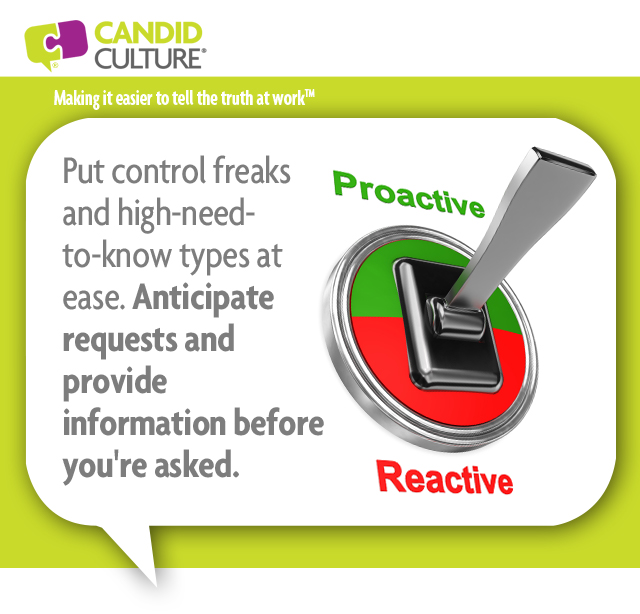
Frustrated by a control freak, micromanager, or a high-need-to-know type? Controlling behavior stems from a need that isn’t being met. Identify the need, meet it, and your life gets easier.
This is similar to what salespeople learn during good sales training. The customer wants to buy the car but doesn’t make a purchase. She visits the dealership three times, but just can’t pull the trigger. She has some sort of concern. If the salesperson can identify the concern, he can possibly resolve it, and sell the car. Working with control freaks is the same.
If someone wants more updates, information, or involvement than you’re comfortable with, he has a need that isn’t being met. When you meet the need, the person will likely back off.
I ask the people who work for me to never make me ask for something twice. Meaning, if I ask for an update the week before a speaking engagement, anticipate that I’ll want that information for all engagements. Confirm by asking me and then provide the data without being asked for all future engagements. Getting the information regularly without having to ask builds trust and credibility.
Here are six tips for working with control freaks:
If you don’t know, ask:
The person’s work-related goals. What are they working on this quarter and year?
What the person is concerned about at work? What are they worried about?
How does s/he like to communicate – in-person, email, phone, video, voicemail, or text.
How often does s/he want information, in what format, and with how much detail.
2. Provide more information than you think you need to, and then ensure the person wants that information in the future.
3. If you’re asked for information, ask why the person wants it, and if s/he wants it in the future. Then provide the information before you’re asked.
4. If someone is overly involved in your work and you feel you have no freedom, state your observation and ask for information. That could sound like, “You’ve been involved with each major decision with this project. I’m used to working with less oversight. Do you have a concern about my approach?” Then you negotiate. Everything is a negotiation.
5. This will put the other person on the defensive. A less confrontational approach is to discuss and agree upon levels of involvement and supervision when projects begin. That could sound something like, “What kind of involvement do you want to have in this project? What do you want to do? What do you want me to do? What kind of updates would you like, how often, and with how much detail?” It’s always easier to prevent a problem than to fix one.
6. Lastly, don’t take anything personally. Oversight and involvement may be a reflection of how someone feels about your performance, but it might not. When in doubt, ask.