I’ve heard lots of people say they just want 2020 to be over and that 2020 has been a bad year. It’s definitely been a very different and difficult year. I’m right there with you – virtual school, no childcare, not seeing family or friends, and doing three jobs because everyone in our office is working virtually. And part of being powerful is creating fun and choosing happiness regardless of the circumstances.
Here are some ideas for creating fun and happiness, regardless of the circumstances. If you read last week’s blog, some of this will sound familiar.
Connect with people you haven’t talked to in a while. Call, texting isn’t the same.
Past coworkers
Friends from high school, college, and graduate school
Cousins and siblings
Neighbors
Out-of-town friends
Local friends
Here are a few ways to take care of yourself during the workday:
Listen to music.
Eat breakfast or lunch instead of skipping a meal.
Text a friend when you have down time.
Walk outside to take a break.
Catch the last of your city’s holiday activities. Do things five-year-old’s think are fun. They’re fun for adults too.
Is your city’s Zoo lit up for the holidays? Bring hot chocolate and go.
Are your city’s botanic gardens or downtown lit up? Are there drive-through light shows?
Find a place to toast marsh mellows and make s’mores. Hotels are often lit up and have outdoor fire pits.
Drive or walk and see your neighbor’s lights.
Decorate cookies, cupcakes and gingerbread houses. Seriously, it’s fun! If you email me, I’ll send you photos of our masterpieces. If you have kids, give up what the gingerbread house is ‘supposed to look like’ and let the kids do their thing (this is challenging for me).
Do something you enjoy every day. Keep it simple and cheap. Here are a few from my life:
Listen to music. Maybe go crazy and have a spontaneous dance party.
Order food from a favorite restaurant. I’ll admit that sometimes we have breakfast delivered.
Go for a walk or hike.
Do something you’ve never done. We’re trying snowmobiling this week.
Drive someplace beautiful.
Watch a movie you haven’t seen.
Lastly, what’s a bad habit you can stop doing, for one day. Don’t over commit. Mine are below:
Opening emails, promising I’ll reply, only to have the email get buried and forgotten.
Surfing Facebook and the internet at night.
Eating whatever my kid doesn’t finish.
Checking my phone (way more than necessary).
There are lots of ways to have fun regardless of the circumstances – from seeing lights, to reconnecting with old friends, to taking care of ourselves, and stopping a bad habit, just for one day.
Have a wonderful rest of the year! We are grateful for the many organizations that invested in virtual training and keynote speaking this year. We’ve loved working with all of you and hope to see you virtually or in person next year.
We wish you a Happy New Year and powerful start to 2021!
Maybe you’re not flying to see your family, celebrating the holidays with the people you otherwise would, or taking that big vacation. This year’s holidays will look different from other years, but they can still be fun. Below are some simple and free ways to have fun this holiday season, whether you’re working or off.
Do things five-year-old’s think are fun. They’re fun for adults too.
Is your city’s Zoo lit up for the holidays? Bring hot chocolate and go. Ride the train and the carousel if they have one, yes, even without kids.
Are your city’s botanic gardens or other gardens lit up?
Is your downtown lit up?
Are there drive-through light shows?
Drive or walk and see your neighbor’s lights.
Decorate cookies and gingerbread houses. Seriously, it’s fun! If you email me, I’ll send you photos of our masterpieces. If you have kids, give up what the gingerbread house is ‘supposed to look like’ and let the kids do their thing (this is challenging for me).
Moving on to day-to-day happiness, when is the last time you did things you enjoy? Keep it simple and cheap. Here are a few from my life:
Listen to music
Go out for ice cream
Ride my bike
Go to the mountains or some other beautiful spot
Read a book
Call people you haven’t talked to in a while. Yes, call. Texting isn’t the same.
Past coworkers
Friends from high school, college, and graduate school
Cousins and siblings
Neighbors
Out-of-town friends
Local friends
If you’re working over the holidays, below are a few ways to take care of yourself during the workday:
Walk around your neighborhood or house for a short break
Listen to music
Eat breakfast or lunch instead of skipping a meal
Text a friend when you have down time
Walk outside to take a break
Five minutes of yoga
Lastly, what’s a bad habit you can stop doing, for one day. Don’t over commit. Mine are below:
Surfing Facebook and the internet at night
Eating whatever my kid doesn’t finish
Eating the remaining Halloween candy when my kid isn’t looking
Texting when I should be working or sleeping
Checking my phone (way more than necessary)
There are lots of ways to have fun this holiday season – from seeing lights, to reconnecting with old friends, to taking care of ourselves and stopping a bad habit, just for one day.
We wish you and your family a warm wrap-up to 2020 and a very different 2021. Happy Holidays from all of us at Candid Culture.
People get defensive when they receive negative feedback. It’s hard not to. Everyone wants to be seen as competent, and when we receive negative feedback, our competence is called into question. So we react.
There are several things you can do to reduce others’ defensiveness – ensure you have a trusting relationship and thus have earned the right to give feedback, watch your words, deliver feedback in a private setting, etc. But for today, I’m going to focus on getting a second opinion.
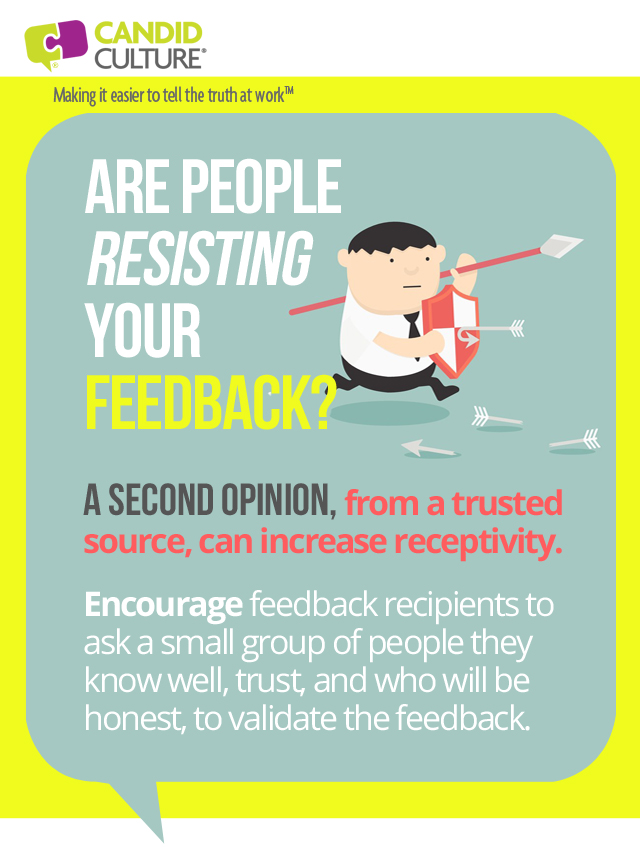
If you want people to be more receptive to your feedback, consider encouraging them to get a second, third, or fourth opinion. I’m a fan of casual 360-degree feedback – when we ask for feedback from people we work with both inside and possibly outside the organization. Think of 360-degree feedback like an orange, it’s all the way around, like a sphere. When you get 360-degree feedback, you gather input from all the different types of people you interact with, thus getting a more comprehensive and accurate picture of performance. There are different types of 360-degree feedback. 360-degree feedback ranges from the formal – an online, anonymous survey (I’m not a fan) – to casual conversations (which I recommend). In this instance, I’m suggesting something I call The Core Team.
I suggest everyone has a Core Team of about five people who love you, know you well, and have your back. Most important is that you trust these people. Your Core Team may be personal or professional relationships or a mixture of both. You may have worked with Core Team members or not. What all Core Team members have in common is that they know you well, want what’s best for you, and will tell you the truth when asked.
My core team consists of a friend from high school, two people I used to work with, and my parents. When I get feedback that I’m having a hard time reconciling, I ask people on my Core Team to validate the feedback. It doesn’t matter if they’ve worked with me or not. I am who I am. I do the same annoying stuff in my personal and professional relationships. So a personal Core Team member can provide valid, professional feedback and vice versa. Sometimes they agree with the feedback I’ve been given and sometimes they don’t. But I always get compelling information to think about. And because I trust the people on my Core Team, I listen to what they have to say.
Don’t be disheartened if people don’t trust your feedback and aren’t receptive. Instead, see their resistance as human and encourage them to get a second opinion. And then talk again. Listening to and incorporating feedback is a process. It takes time, courage, and patience.
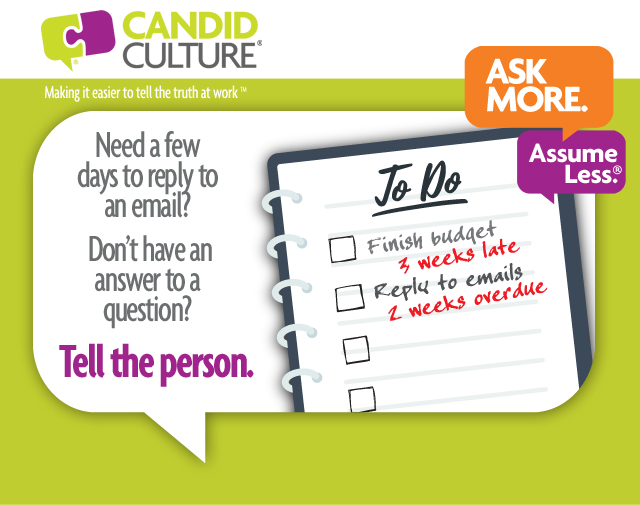
You open an email (or a few hundred) telling yourself you’ll reply later, but never do. Feeling ambitious, you agree to a deadline you can’t meet. Needing a break, you take time off over the holidays but don’t put an out-of-office message on your email.
We’ve all taken too long to reply to an email, missed a deadline, or simply taken too long to provide someone with information. It’s ok to take time to respond, to not have all the answers, and to take time off. We simply need to provide a timely and accurate status update.
When people don’t hear back from us in what they consider a timely way, they start to wonder (at best), and judge us (worse), or tell others we’re non-responsive and unreliable (worst). Don’t make people wonder if you received their message, send a timely status update and tell the truth.
If you’re behind and need more time than usual to respond to emails, tell people that. Respond to each email within 24-hours and tell the person you received their message and it will be (fill in the blank) a week or two before they hear back from you. When you get an email that requires research, respond within 24-hours and tell the person it will take however long it will really take to find the information. If you’re out of the office and don’t plan to read or respond to emails, tell people the dates you’re out.
In the absence of knowledge people make stuff up. And it’s never good. Filling in the blanks isn’t malicious. People simply have a need to know what’s happening. And when we don’t know, we invent stuff. It’s how the brain works. When we don’t hear back from people in what we consider a timely way, we start to wonder. “Did she get my message? I haven’t heard back. She must not like me. Maybe she’s out of the office? Maybe she doesn’t work here anymore?”
It’s ok to need time to respond. It’s ok to be running behind. It’s ok to take time off. Simply let people know the true status. Manage your reputation and business relationships. Don’t make people guess.
Covid-19 has shown many of us our edge – working from home for many months, not traveling, missing people we’re used to seeing, and for me, being silent when I would normally speak up.
Earlier in the fall, a friend came to bring my son a birthday present. We hadn’t seen my friend for many months. We visited outside. He didn’t wear a mask, gave Grayson a high five, and then a hug. It seemed like terrible judgment and it happened so fast before I could say anything. Then he went into my house to get a glass of water without wearing a mask while we stayed outside.
I was shocked by all of this. It didn’t seem smart or respectful. And I didn’t say anything. I still haven’t said anything. I could give you ten similar examples of instances in these past months when I was uncomfortable but didn’t say anything – sometimes with people I know, sometimes with people I don’t know.
It feels risky to write this because wearing masks and physical distancing has been so politicized. This blog post isn’t about the coronavirus and anyone’s personal choices. It’s about when we don’t speak up and why.
I think the way to handle potentially tough situations is to anticipate the unexpected and have a setting-expectation conversation before a challenge occurs. What I could have said to my friend, before he visited, was, “We are excited to see you. Let’s stay outside and let’s all wear masks.” I should have set expectations before being confronted with a difficult and awkward situation. Setting expectations is always easier than addressing behavior after it has happened.
Sometimes you can’t anticipate another person’s behavior or how a situation might go. You can’t plan for everything. And telling someone you don’t know in a store, office, or elevator that you’re uncomfortable may feel risky.
Here are four practices for making harder conversations easier and for taking care of yourself when you don’t know what to say:
Anticipate everything that can happen.
Decide how you want to manage situations before they happen.
Set clear expectations before seeing people or going someplace. My son knows that if we go to a park and it’s crowded, we will leave. I tell him this before we go so, he isn’t surprised.
Set boundaries. It’s ok to ask people in line at the grocery store to back up a few feet. “I’m trying to keep a six feet distance. Would you mind stepping back a few feet?” Yes, this likely feels very hard in the moment.
I worry about what people will think of me. I want people to like me. I’m consumed by both of these thoughts way more than you would ever guess. But what’s more important – protecting ourselves and our family or not offending a person in line at the grocery store you’ll never see again?
It needs to be ok to respectfully and kindly speak up on our own behalf. And speaking up starts by opening our mouths and saying what makes us uncomfortable again and again and again.
I read a quote a few months ago that struck me – “It’s so hard to change yourself, what makes you think you can change someone else?” This seems so true. And yet, how much energy do we invest trying or at least hoping other people will change? We want our not-so-forthcoming manager to give regular and helpful feedback, our Halloween candy stuffed selves to prefer celery over chocolate, our not-so-affectionate partner to become a cuddler.
People are who and (largely) how they are. Even with lots of effort, coaching, and even counseling, it’s hard to change.
As someone who leads a training and development company, it feels risky to write this. I’m concerned that my words will be misunderstood. So I want to be sure I’m clear. People can learn new skills. Managers can learn to coach and give feedback. People at all levels and in all roles can learn to communicate differently. Everyone can learn to use new technology. But we don’t fundamentally change who and how we are. People who hate to public speak aren’t likely to wake up tomorrow clambering to give presentations to thousands of people. People who don’t like crowds aren’t likely to want to spend every weekend at large sporting events when they resume.
What I’m really trying to say is, stop trying to get something from someone who can’t give that to you. If you work for someone who never provides feedback, no matter how often you ask, get input from someone else. Lots of people can provide you with helpful information if you ask for it and make it safe to tell you the truth. If you’re chastising yourself for not being more athletic, accept that you like to read, and buy yourself a new book.
Instead of trying to get something from someone who can’t give it to you, get what you can from that relationship and get the rest of your needs met elsewhere. And tell others to do the same. I had someone working for me a few years ago who was extremely sensitive and didn’t do well receiving feedback. I tried to accommodate her needs and preferences, softening my messages, picking my battles, and in the end, giving less and less feedback. And it was exhausting. Eventually, I said to her, “I’m not the right manager for you and this is the not right company for you. It’s not a good fit. You won’t be happy here, and I want you to be happy. Let’s help you find another home.”
I’m not telling you to get a new job. I’m telling you to be realistic in your expectations of yourself and others. The most powerful thing you can do is to be yourself and let others be themselves. And if you don’t like how or who someone is, hang out with someone else.
Most people would rather get a root canal than participate in an annual employee performance appraisal.
The reasons employee performance appraisals are so difficult is simple:
Most managers don’t deliver timely and balanced (positive and negative) feedback throughout the year.
Many employees don’t ask for regular feedback.
Too much information is delivered during the annual employee performance appraisal.
And as crazy as it sounds, managers and employees haven’t agreed to give and receive regular and candid feedback.
Employee performance appraisals don’t have to be the worst day of the year.
Here are four steps to ensure employee performance appraisals are useful and positive:
Managers and employees must agree to give and receive balanced, candid feedback. Don’t assume the agreement to speak honestly is implicit, make it explicit.
Managers, be honest and courageous. Don’t rate an employee a five who is really a three. You don’t do anyone any favors. Employees want to know how they’re really doing, no matter how much the feedback may sting.
Managers, focus on three things the employee did well and three things to do more of next year. Any more input is overwhelming.
Managers, schedule a second conversation a week after the employee performance appraisal, so employees can think about and process what you’ve said and discuss further, if necessary.
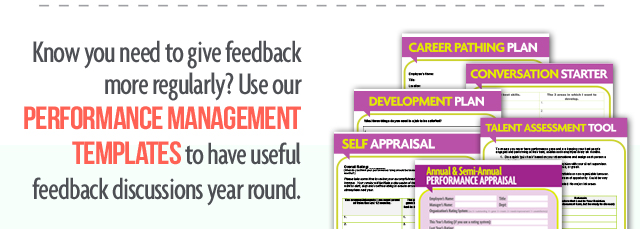
The key to being able to speak candidly during an employee performance appraisal is as simple as agreeing that you will do so and then being receptive to whatever is said. And don’t make feedback conversations a one-time event. If you do a rigorous workout after not exercising for a long time, you often can’t move the next day. Feedback conversations aren’t any different. They require practice for both the manager and employee to be comfortable.
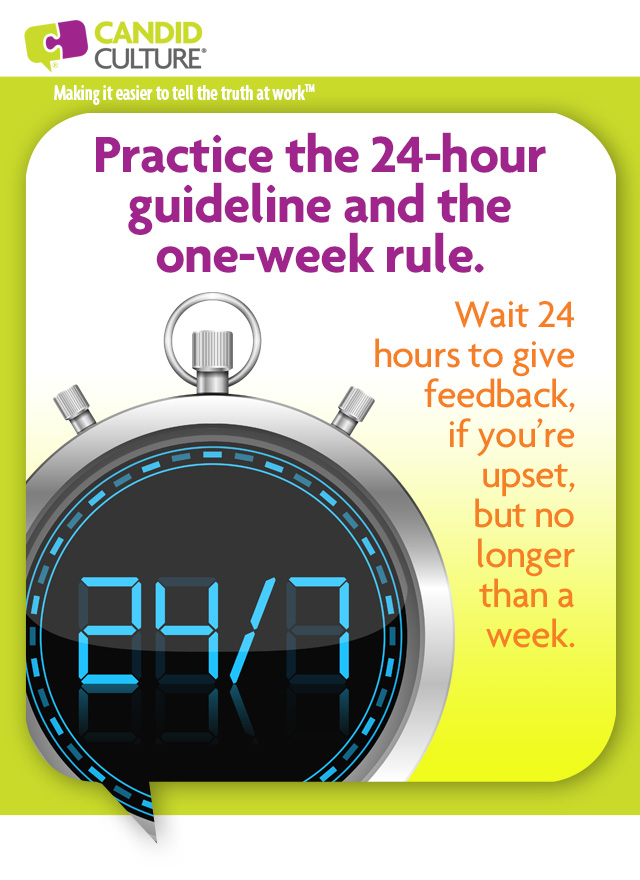
Most of us wait to give negative feedback until it’s the right time, aka the recipient won’t get upset. Or we wait, hoping the situation will resolve itself. If something is really an issue, the likelihood of either happening is pretty slim. The right time to give feedback is shortly after something happens. I’ll offer up the 24-guideline and the one-week rule. Wait 24-hours to give feedback, if you’re upset. But don’t wait longer than a week.
The purpose of giving positive or negative feedback (I like the words upgrade feedback) is to motivate someone to replicate or change a behavior. That’s it. Feedback is supposed to be helpful. If you wait longer than a week to give either positive or upgrade feedback, the person isn’t likely to remember the situation you’re referencing and the purpose of giving feedback – to change or replicate a behavior – will be lost.
Here are four practices to make negative (upgrade) feedback conversations shorter, less painful, and more useful:
Giving feedback practice one: Agree to give and receive feedback at the onset of relationships. Do this with everyone you work with – direct supervisors, direct reports, peers, internal and external customers, and vendors. If we’ve doneHow to Say Anything to Anyone training for your organization or you’ve read the book, you got the specific language to have this conversation.
Giving feedback practice two: Prepare for feedback conversations by writing down what you plan to say and then delivering the feedback to a neutral person. Ask that person to tell you what she heard and what her expectations would be, based on what you said. Confide in someone either at your level or above at work or someone outside of work, to keep the gossip to a minimum. Ask for confidentiality.
Giving feedback practice three: Tell a neutral person about your situation, and ask what she would say to address the situation. Everyone but you will do a better job at giving feedback. Feedback conversations become hard when we’re emotionally involved. The guy working at the 7-11 will do a better job than you. Seriously. It’s our emotions and concern about the other person’s reaction that makes feedback conversations challenging.
Giving feedback practice four: Agree to do a weekly debrief with the people you work closely with, and follow-through. Answer the questions – what went well this week from a work perspective and what would we do differently if we could. Answer the same questions about your working relationship. Giving feedback about your relationship will be hard at first. It will be easier the more you do it. Be sure to say “thank you” for the feedback, regardless of what you really want to say. One of the reasons giving negative feedback is so hard is we wait too long. Shorter, more frequent conversations are better than long, infrequent discussions.
Giving negative feedback doesn’t have to be so hard. Follow the suggestions above and remind yourself that the purpose of giving feedback is to be helpful. If you were doing the wrong work, you’d want to know. And others do too.
I’m consistently shocked and embarrassed by what comes out of my mouth when I’m mad. It’s like reason and self-control go out the window. Emotion and the need to be right takes over. Every time I react in the moment, I regret it. Every single time.
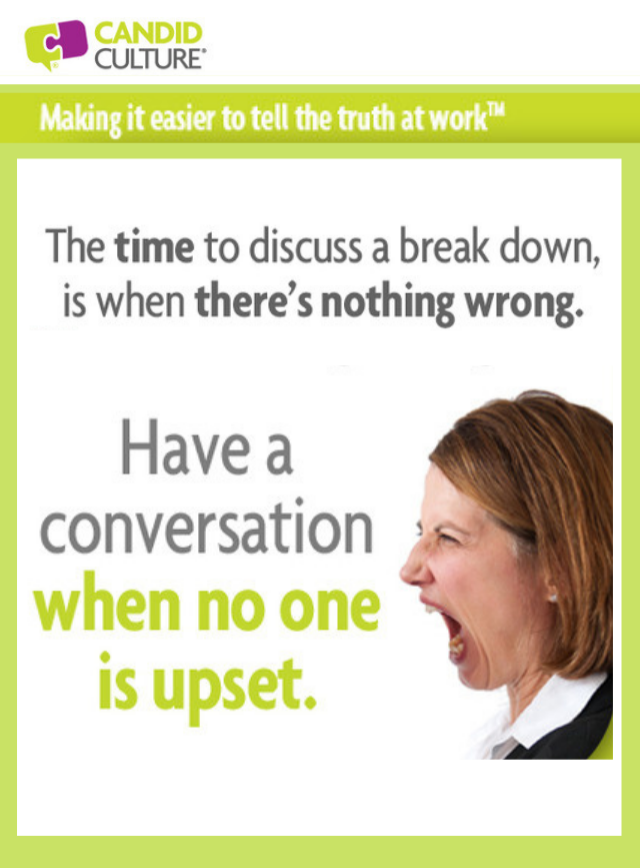
Talking with another person when we’re upset, often leads to more upset. Emotions and conversations escalate quickly. The more upset we are, the more likely we are to say things we’ll regret. The time to alter how we work, live, and communicate with someone, is when there is nothing wrong.
If you want something in a relationship to change, pick a time when things are calm and when no one is upset to have a conversation. Tell the other person that you want to talk about how you work together, manage disagreements, make decisions, handle disappointments, etc. Share what you have observed in the past and make requests. Brainstorm solutions together. You’ll have a much better conversation when you’ve had time to calm down from whatever happened to create the need for the conversation.
Waiting to have a conversation until you’re not upset creates the risk of waiting too long to address concerns. The right time to talk about a breakdown is as soon after an event as you can. When both people are calm and have time to have the conversation, usually within a few days of a challenge.
There is no talking to my five-year-old about why I impose certain limits in the moment. He’s too upset. I need to wait to talk to him about why I did what I did and what I want him to do next time when he’s calm. Typically, that’s later the same day. Adults may take a little longer. But this isn’t a pass to wait six weeks, which is what we often do. The conversation won’t be as hard or as bad as you think if you talk when you’re calm and speak from what the relationship needs.
Speaking from what the relationship needs is saying just what you need to, not more and not less, to resolve the challenge and create a better way to handle things in the future. And communicating in a kind and direct way, so the other person can take in what you have to say.
Agree upon better ways of handing challenges when no one is upset. Speaking directly, calmly, caringly and with the desire to make things work, typically has a positive result.
When I started training managers 20 years ago, I recommended managers meet with their employees weekly for 45-60 minutes. Over time I stopped recommending that because long, weekly meetings didn’t seem feasible and most managers weren’t doing them.
Many managers replaced the weekly one-on-one with the desk-drop-by and team meetings. Managers would tell me, “I talk with my employees daily and have a regular team meeting. I don’t need to do individual one-on-ones. Well, you do now. Employees need to talk to you on a regular basis. It’s time to go old school.
Many employees are still working from home and will be for the next several months, if not indefinitely. Some people love working from home and do it successfully, others hate it and struggle. Whatever you and your employees’ preference for working remotely, people need regular, one-on-one contact.
The questions I’m getting more frequently than any others these days are, “How do I work with others virtually” and “how do I manage remotely?”
Managing Up:
If you work for a manager who doesn’t reach out much, it’s fine to ask for a phone call. Tell your manager, “I’d like to talk with you individually each week. Can we schedule that? Is it ok to reschedule if we have to cancel?”
Don’t wait for your manager to ask for an update on your work progress. Send your manager a monthly, bulleted list (or more frequently if she would like) of what you’re working on, what you’re accomplishing, items you’d like help with, and anything else you want her to know. Keep the bullets short and focused. Your manager can use these updates to write your annual review.
Managing Peer Relationships:
Pick up the phone or have video calls. Either one works. People need contact.
If you’ve exchanged three emails on one topic, it’s time to pick up the phone. Talking live is quicker, prevents assumptions being made, and preserves relationships.
Ask how your peers are doing personally and professionally. Most people are struggling in some area. It helps when others care enough to ask how we are doing. But don’t ask just because you think you’re supposed to. If you don’t really want to hear a personal update, don’t ask for it. Just tell people you hope they’re doing well and move on to the business at hand.
Talk about how you agree to work together from a distance. If could sound like, “How do you want to manage this project? What parts do you want to manage? How should we handle it if we haven’t heard from a team member or if someone is falling behind and missing deadlines?” Talking about how you’ll handle potential breakdowns before they happen is ALWAYS easier than addressing breakdowns after they happen.
Set agreed-upon deadlines and talk about how you’ll track progress and milestones. You don’t need a manager to do these things.
My main message regarding working virtually is to talk to people more than you think you need to. Pick up the phone. Check-in. Ask how people are doing. Do everything you would do in person, just do it via the phone or video.
Don’t assume people are fine. Don’t assume everything will get done according to your expectation. Pick up the phone and talk about it.