You get an email that annoys you, hit reply, type up your thoughts, hit send, and feel instant regret. We’ve all done this. We’re frustrated and we let the other person know.
Feedback via email is always a bad idea. You don’t know how the recipient will read and interpret your message. You can’t manage the tone of the message or give the person a chance to respond. And more often than not, he’ll reply equally frustrated. And now the non-conversation begins –back and forth, back and forth.
Email is for wimps and voicemail isn’t any better! No texting either. End the madness and pick up the phone or take a shower and meet via video. Things are resolved most quickly and easily by talking about them.
I’m consistently surprised at how much feedback is delivered via email. And it’s only gotten worse with people working virtually. I’ll admit to occasionally being guilty of it too. I’m in a hurry and I want to get something done quickly. Or my emotions get the best of me and I feel compelled to respond to a situation quickly. So I send an email or a text message that I know I shouldn’t send. Then I regret it and spend the rest of the day apologizing and feeling badly for communicating impulsively.
If we want people to want to work with us and perform, we need to consider how our actions impact them. Yes, it’s easier to send a quick email or text. But it invariably annoys the other person and damages your relationship. People can work with you, around you, and against you. If people want to work with you, they’ll work harder and produce better work.
Never underestimate the human ego, which is easily bruised. You are ALWAYS dealing with someone’s ego. When someone (anyone) calls our competence into question, we get defensive. Becoming defensive when receiving negative feedback or when someone questions us is a gut reaction. Not becoming defensive takes a great deal of self-management and is unusual.
Slow down. When you need to give feedback, ask yourself what you want the other person to do. Then ask yourself, how do I need to communicate to get the result I want? Then pause, breathe, and pick up the phone.
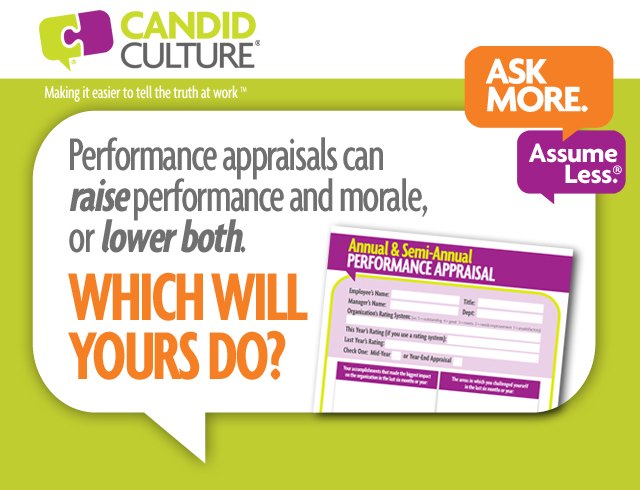
Most people would rather get a root canal than participate in an annual employee performance appraisal.
The reasons employee performance appraisals are so difficult is simple:
Most managers don’t deliver timely and balanced (positive and negative) feedback throughout the year.
Many employees don’t ask for regular feedback.
Too much information is delivered during the annual employee performance appraisal.
And as crazy as it sounds, managers and employees haven’t agreed to give and receive regular and candid feedback.
Employee performance appraisals don’t have to be the worst day of the year.
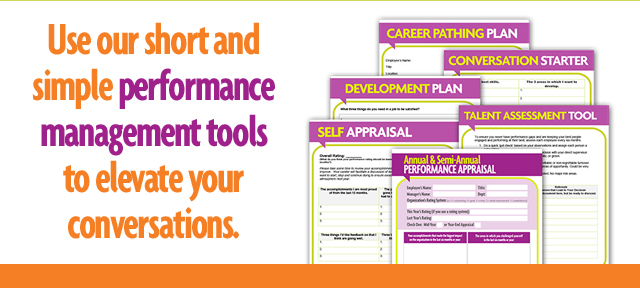
Here are four steps to ensure employee performance appraisals are useful and positive:
Managers and employees must agree to give and receive balanced, candid feedback. Don’t assume the agreement to speak honestly is implicit, make it explicit.
Managers, be honest and courageous. Don’t rate an employee a five who is really a three. You don’t do anyone any favors. Employees want to know how they’re really doing, no matter how much the feedback may sting.
Managers, focus on three things the employee did well and three things to do more of next year. Any more input is overwhelming.
Managers, schedule a second conversation a week after the employee performance appraisal, so employees can think about and process what you’ve said and discuss further, if necessary.
The key to being able to speak candidly during an employee performance appraisal is as simple as agreeing that you will do so and then being receptive to whatever is said. And don’t make feedback conversations a one-time event. If you do a rigorous workout after not exercising for a long time, you often can’t move the next day. Feedback conversations aren’t any different. They require practice for both the manager and employee to be comfortable.
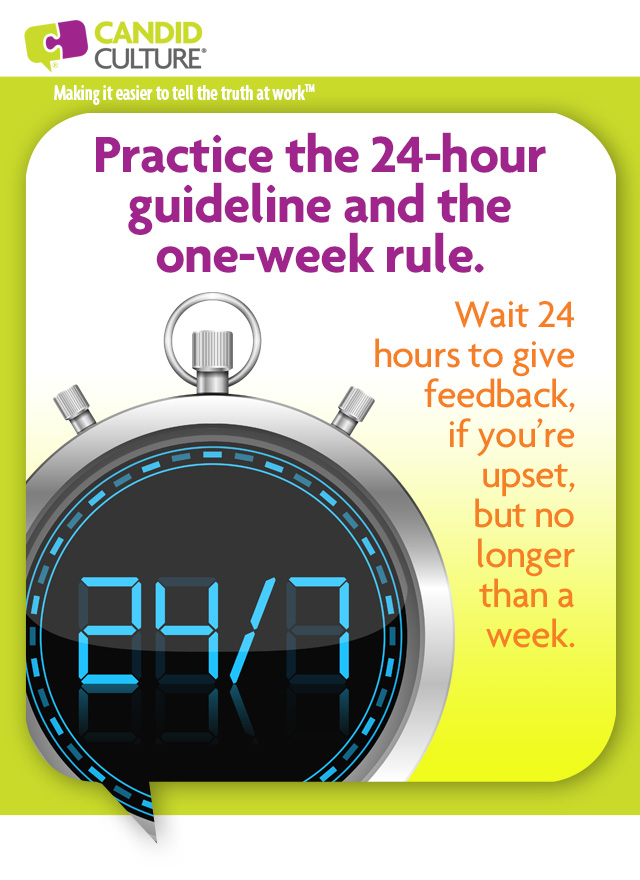
Most of us wait to give negative feedback until it’s the right time, aka the recipient won’t get upset. Or we wait, hoping the situation will resolve itself. If something is really an issue, the likelihood of either happening is pretty slim. The right time to give feedback is shortly after something happens. I’ll offer up the 24-guideline and the one-week rule. Wait 24-hours to give feedback, if you’re upset. But don’t wait longer than a week.
The purpose of giving positive or negative feedback (I like the words upgrade feedback) is to motivate someone to replicate or change a behavior. That’s it. Feedback is supposed to be helpful. If you wait longer than a week to give either positive or upgrade feedback, the person isn’t likely to remember the situation you’re referencing and the purpose of giving feedback – to change or replicate a behavior – will be lost.
Here are four practices to make negative (upgrade) feedback conversations shorter, less painful, and more useful:
Giving feedback practice one: Agree to give and receive feedback at the onset of relationships. Do this with everyone you work with – direct supervisors, direct reports, peers, internal and external customers, and vendors. If we’ve doneHow to Say Anything to Anyone training for your organization or you’ve read the book, you got the specific language to have this conversation.
Giving feedback practice two: Prepare for feedback conversations by writing down what you plan to say and then delivering the feedback to a neutral person. Ask that person to tell you what she heard and what her expectations would be, based on what you said. Confide in someone either at your level or above at work or someone outside of work, to keep the gossip to a minimum. Ask for confidentiality.
Giving feedback practice three: Tell a neutral person about your situation, and ask what she would say to address the situation. Everyone but you will do a better job at giving feedback. Feedback conversations become hard when we’re emotionally involved. The guy working at the 7-11 will do a better job than you. Seriously. It’s our emotions and concern about the other person’s reaction that makes feedback conversations challenging.
Giving feedback practice four: Agree to do a weekly debrief with the people you work closely with, and follow-through. Answer the questions – what went well this week from a work perspective and what would we do differently if we could. Answer the same questions about your working relationship. Giving feedback about your relationship will be hard at first. It will be easier the more you do it. Be sure to say “thank you” for the feedback, regardless of what you really want to say. One of the reasons giving negative feedback is so hard is we wait too long. Shorter, more frequent conversations are better than long, infrequent discussions.
Giving negative feedback doesn’t have to be so hard. Follow the suggestions above and remind yourself that the purpose of giving feedback is to be helpful. If you were doing the wrong work, you’d want to know. And others do too.
“He does great work but is really difficult to work with.” “She produces great results at the expense of people.” I hear these complaints all the time. I feel like people need permission to hire and fire because of fit. So here it is, it’s ok to hire and fire people who don’t fit your culture. You can find people who do great work and who interact according to your company’s values, and you deserve to have both.
Results are often considered more important than the seemingly ‘softer stuff,’ how people got those results. And it often doesn’t feel legitimate to want to get rid of an employee who treats coworkers poorly. We question ourselves thinking, “Maybe it’s not that bad? Perhaps I’m being too sensitive?” Or, “He does great work and is really reliable. Maybe I need to get over that he throws me under the bus in meetings I don’t attend?” “It’s really hard to find and keep good, reliable, employees. I should just suck it up.”
What if employees who treat coworkers and direct reports poorly or don’t practice your organizational values aren’t good employees? People don’t want to work for a manager who is knowledgeable but mistreats people. And likewise, people don’t want to work with people who are super friendly but do no work.
Some organizations evaluate employees both on the results they achieve and how they get to those results. That makes perfect sense.
Here are six tips for hiring and firing employees for fit:
Share your organizational values and behavior practices overtly when you interview candidates. Make it clear that people who don’t follow those practices won’t be happy or successful in the organization.
Create an opportunity for candidates to do an extended practical interview, during which they can get a feel for what the culture is really like, outside of a formal sit-down interview. Then give candidates an opportunity to opt-out of a job because they didn’t feel they fit in during the practical interview.
Trust yourself. If you find it off putting that a coworker raises her voice at you, gossips about you, or takes credit for your work, trust yourself.
Set clear expectations around how employees, coworkers, vendors, and customers are expected to behave when doing business with your organization. And be willing to let internal and external customers and suppliers go because they aren’t willing or able to follow your behavioral practices.
Coach and give feedback on how people achieve results.
Let employees go who don’t respond to feedback on interpersonal behaviors. Or let them know it’s time for them to look elsewhere.
Suffering at work is optional. You deserve to work with people who reflect your organization’s values.
Lots of organizations do exit interviews after employees give notice. Exit interviews can be a source of helpful information. Employees have little to lose after they’ve quit, so they’re likely to speak candidly about their work experience. But asking for feedback after an employee has quit is a little (a lot) too late. The time to ask about an employee’s working experience is every 90 days, if not more frequently.
Employees quit. It’s a natural part of doing business. And some turnover is healthy and helpful. Surprises, however, are not helpful and are unnecessary. Turnover should rarely, if ever, be a surprise. The writing is always on the wall, if you ask the right questions and make it easy to speak freely.
Most employees are concerned about giving feedback when their input is negative. Employees at almost every company cite “a list,” and those who speak up, end up on it, and then mysteriously leave the organization. Mind you, no one has ever seen the list, but employees at all types of organizations are certain it exists.
If you want to reduce the turnover in your organization and increase employee engagement and satisfaction, ask for feedback regularly, and make it easy to speak candidly.
Five ways to get your employees talking before they quit:
Ask for feedback at the end of every meeting. Simply ask, “What are you enjoying about your job? What are you not enjoying?” Or ask, “What makes your job easier? What makes your job harder?”
Manage your responses to feedback. The easier it is to tell you the truth, the more truth you’ll get. Employees are afraid of their manager’s reactions. Resist the urge to become defensive (which is very difficult to do). Saying, “I’m sorry that was your experience. Thank you for telling me,” goes a long way. Employees will breathe a sigh of relief and are more likely to speak candidly in the future.
Replace one satisfaction survey with roundtable discussions during which a leader or manager asks a small group of employees for feedback. Live conversations build trust and loyalty. Written surveys do not.
Help employees who aren’t a good fit, exit the organization. Don’t wait for poor performers or employees who aren’t a good culture fit to leave. Help misplaced employees find a better match. The right employees raise performance and morale, the wrong employees destroy both.
Don’t be afraid to ask for feedback. Just because you asked for feedback, doesn’t mean you have to act on that information. Employees don’t typically expect all of their requests to be met. It’s often enough just to be able to speak and be heard.
Keep doing exit interviews, and add quarterly or monthly requests for feedback. Talk with people over the phone or in person. Ask one or two simple questions to get the other person talking. Manage your face. Smile. Say “thank you” for the feedback. And watch your employee engagement and satisfaction rise.
A few years ago, I facilitated a company-wide training program for an 80-person organization. Early in the program, we were talking about career deal breakers and I asked someone in the group to share a deal breaker so I knew that everyone was clear on what is and is not a true deal-breaker. An employee spoke up. She said, “I’ve been here six weeks. I’m overwhelmed and exhausted. If I don’t get some help soon, I’m leaving.” People in the room gasped audibly. And everyone surely thought the same thing – “She’s done. She’ll be gone by Monday.”
I ran into the organization’s CEO at the Denver airport two weeks later and we had dinner together. Over dinner, I asked if I could give him some advice. I said, “That woman who spoke up during the training did you a huge favor. You spent time and money to become a more candid organization; she gave you the opportunity to demonstrate whether or not you really mean it. Make sure nothing (bad) happens to her.”
It can be really hard when people disagree with us. Leaders institute a new practice, employees resist. Employees say they agree with a policy in a meeting but managers hear otherwise informally.
It may feel easier to introduce a practice and ask employees to follow it without asking what they think. And sometimes it makes sense to do that. You shouldn’t involve employees in every decision. But in an organization, it has to be safe to offer a counter-point-of-view. It must be safe to disagree – publicly and privately.
Disagreement is hard. But silence and the fear of speaking up is dangerous. Organizations full of yes people don’t innovate. They don’t solve problems or find new ways to save costs. They don’t grow, develop, or change. Hearing the truth takes courage and persistence. Put your ego aside and ask – again and again and again.
Every time I work with a new organization, at least one employee pulls me aside and tells me about the organization’s “list”. Employees who speak up and say things the leadership team disagree with get put on the “list”. And employees who make the “list” disappear from the organization. Mind you, no one has ever seen this “list”, but employees everywhere are convinced it exists. And this is a challenge for leaders.
Even leaders who do all the right things regarding asking for and being open to all kinds of input are up against the belief that it isn’t safe to tell the truth at work. It may not even be true. There may be no consequences whatsoever for speaking up, but the perception of the negative consequence is what matters. And this perception is powerful and pervasive across organizations.
So what is to be done? How do leaders get the truth when employees are afraid, disbelieving and perhaps cynical?
Below are seven practices for leaders and managers to get more truth in their organization:
Put your ego aside. It hurts when people disagree with our beliefs or approach, and we’ll be fine. Let curiosity rather than your ego run the show.
Ask for input. Ask again and again and again. Employees may eventually believe that you really want their input.
Ask for input in different ways – in-person roundtable discussions, email, surveys (if you wish).
Ensure there are no negative consequences for speaking up. You can coach employees on how they spoke up and make suggestions for diplomacy, but reward the courage it took to speak up.
Share what you learn after gathering data. Give more information than you think you need to.
Tell employees the ideas you’re accepting and those you’re rejecting and why. It’s ok not to accept and act on all feedback. But close the loop and explain the rationale for decisions.
Be human. Admit failure, fear, worry, and wins. People trust leaders who are human and humans have feelings and make mistakes. I’ll follow a humble leader further than a polished and seemingly perfect one.
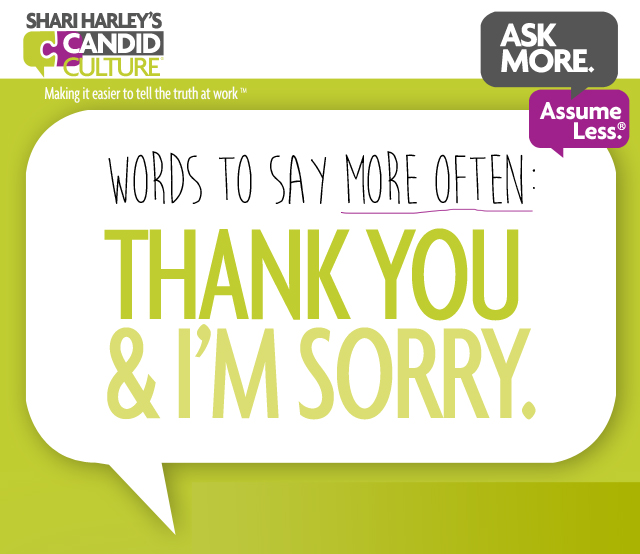
If a friend asked you to do something, you did it, and she didn’t say thank you, you’d probably think twice the next time she asked you for something. The people you work with are not different.
If you don’t say thank you to employees, they too will stop doing things you think are important. Human beings thrive on recognition and relationships. We need both to survive. And when we don’t feel connected or appreciated, we find appreciation elsewhere.
If you think saying “thank you” to the people you work with is unnecessary, consider this example. An overwhelmed employee feels strapped for time. She produces a 30-page report every month that takes hours of her time. No one has ever talked with her about how the report is used and why it’s important. So when she is overwhelmed and decides that something needs to go, she stops doing work that appears not to add value—the 30-page report. It turns out the report reflects her department’s results and is reviewed by the CEO, CIO, CFO, and COO. Oops.
There are managers who think that a paycheck is enough of a thank you to employees (old school) and that any other thank you to employees is unnecessary (this doesn’t work). Human beings want to make a difference. We don’t like doing tasks we perceive as not being impactful. So tell the people you work with that their work matters by saying thank you, and how you say thank you matters. Saying, “Thanks for doing such a great job on that project” doesn’t go nearly as far as saying, “Thank you for taking over the Briggs proposal. You shepherded the proposal from beginning to end and made sure no detail was overlooked. You made all of us look good and we would not have won the business without you.” Like all feedback, specific feedback is meaningful and drives future behavior. Vague feedback feels inauthentic and doesn’t tell the recipient what to replicate in the future.
Onto why it’s important to say “I’m sorry.” Some people think that saying you’re sorry puts you in a weak position and that you will lose employees’ respect. This couldn’t be further from the truth. Strong people admit when they’re wrong. Weak people can’t admit mistakes. Admitting fault ingratiates you to other people. Refusing to take responsibility alienates you.
It’s very frustrating to work hard and never be told “thank you.” Likewise, it’s upsetting when people don’t apologize for dropping the ball and making mistakes. It’s so easy to say “thank you” and “I’m sorry,” and it costs nothing. The more you demonstrate appreciation for the people you work with and take responsibility for your mistakes, the harder people will work on your behalf.
Want to know why people get defensive when you give feedback and why they often don’t change their behavior? Because what you’re giving them isn’t actually feedback.
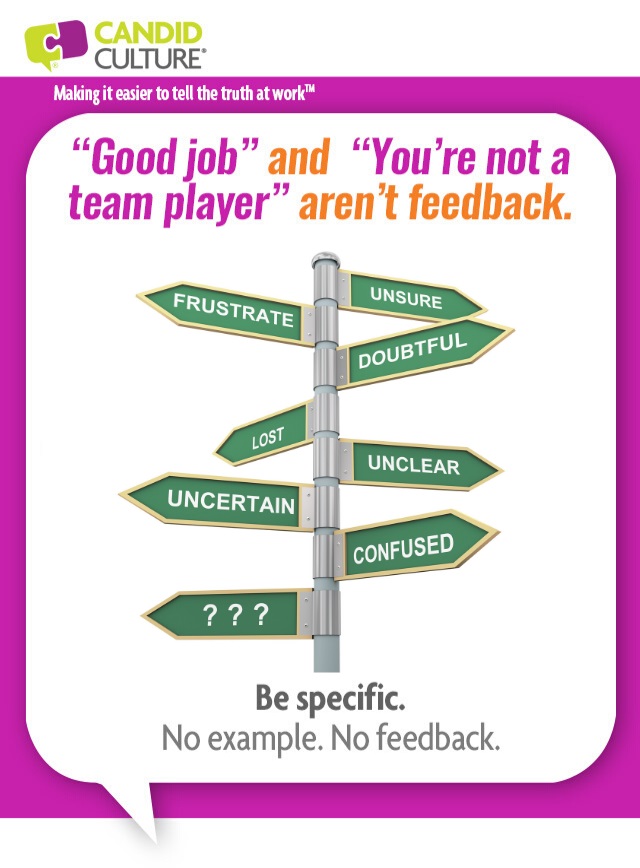
“You’re awesome to work with” isn’t feedback. Neither is “You did a great job.” “Your work isn’t thorough” isn’t either. Neither is, “You were inappropriate.”
Most of what we consider feedback isn’t feedback at all. It’s vague, unhelpful language that leaves people wondering what they need to do more, better, or differently.
There are only two reasons to give feedback – to encourage someone to either change or replicate a behavior. Unfortunately, most of the ‘information’ we give is too vague to help people do either.
When you coach or give feedback, you serve as someone’s GPS. Like the GPS on your phone, you need to be so specific the person knows precisely what to change or replicate. If you were driving and your GPS said, “Good job” or “I think you’re off track,” you’d throw the GPS out the window and get a map.
If you give someone what you consider feedback and he says, “I don’t know what you mean, can I have an example?” you’ll know you weren’t helpful.
Here are six tips for giving helpful feedback:
Giving feedback tip one: Write down what you plan to say, then strip out half the words. Shorter feedback with fewer words is better.
Giving feedback tip two: Practice what you plan to say out loud. Have you noticed that what you ‘practice’ in your head is typically not what comes out of your mouth?
Giving feedback tip three: Before having the ‘real’ conversations, give the feedback to an independent, third-party and ask her to tell you what she heard. Ensure who you talk with will maintain confidentiality. Your organization doesn’t need more gossip.
Giving feedback tip four: Tell someone else about the conversation you need to have, and ask him what he would say. Anyone not emotionally involved in the situation will do a better job than you will. Again, ensure confidentiality.
Giving feedback tip five: Ask the feedback recipient what he heard you say. Asking, “Does that make sense?” is an ineffective question. “Do you have any questions?” isn’t any better.
Giving feedback tip six: Give one to three examples of what the person did or didn’t do, during the conversation. If you don’t have an example, you’re not ready to provide feedback, and anything you say will evoke defensiveness rather than behavior change.
Giving feedback doesn’t have to be so hard. Be so specific that your feedback could be used as driving directions. The purpose of feedback is to be helpful.
I want each of my employees to be happy and to enjoy their jobs and enjoy working for me, every day. That can’t and won’t happen, especially right now. Some days are hard. Some are dull. Sometimes I’m fun and easy to work for. Lots of days I’m not.
I had a manager years ago who told me that my need to be liked by my employees would take me down. He was right. Unfortunately, I’m not the only manager with this challenge.
Lots of managers tell me they’re hesitant to give feedback because they’re afraid employees will quit. Other managers do work they know they shouldn’t be doing because they don’t want to burden their employees.
Not every day will be great. And that’s ok. Work is a roller coaster. Some days are awesome. Others are the pits. Your job isn’t to make people happy at every moment, it’s to create a supportive environment and ensure people have the tools to be successful.
My employees have all the tools they need to be successful. I work hard to set clear expectations and give timely positive and upgrade feedback. The rest is up to them. Some days I’m sure they’re happy. Most days, hopefully. And I’m sure there are days that other jobs sound appealing.
Here are five actions to create a positive culture at work:
Office culture tip #1: Set clear expectations at the beginning of every new project and task. The root of frustration and unhappiness is thwarted expectations.
Office culture tip #2: Ask for and be open to feedback from your employees and coworkers. Ask for feedback regularly and work to respond with, “Thank you for telling me that.”
Office culture tip #3: Respond to feedback by changing what it makes sense to change. Giving feedback that is never acted upon creates cynicism and distrust.
Office culture tip #4: Provide a rationale for your decisions. It’s fine to do things the way you want to do them, even if others disagree. Explain your rationale. You’ll get more buy-in.
Office culture tip #5: Don’t be afraid to make decisions that are unpopular. There is a reason that you want to do what you want to do, the way you want to do it. Vet your plans, when appropriate. Be open to others’ input. And then do what you think is right (within the scope of your role).
Your job isn’t to please everyone and trying to do so will likely produce lesser results and be exhausting.
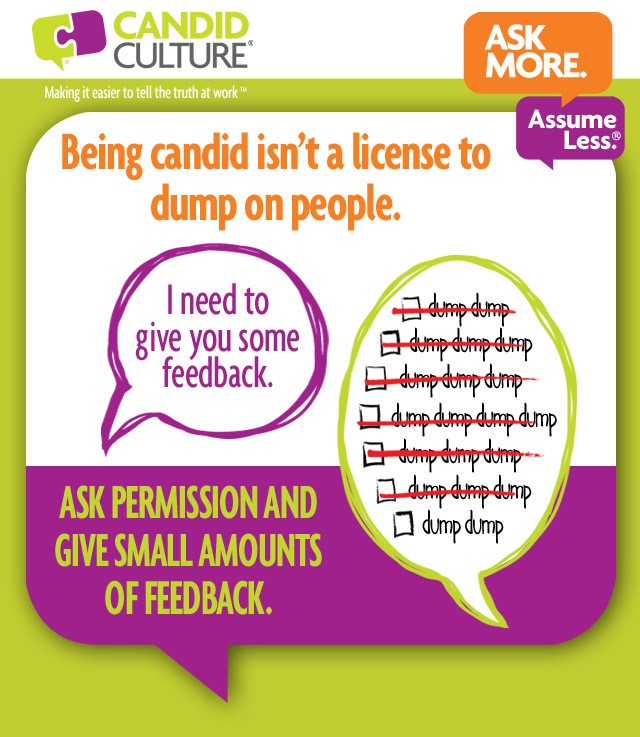
People leave feedback training armed with new skills and
they unfortunately sometimes use those skills as a weapon. It goes something
like this, “I need to have a candid conversation with you.” And then the person
proceeds to dump, dump, dump. This couldn’t be more wrong, wrong, wrong.
When you give someone negative feedback you are essentially telling him that he did something wrong. And who likes to be wrong? The ego gets bruised and people often start to question themselves. This normal reaction doesn’t mean you shouldn’t give feedback, you just need to do it judiciously.
Ask yourself these four questions when deciding whether
or not to give someone feedback:
Do I have the relationship to provide feedback?
Does the recipient trust me and my motives?
Do I have permission to give feedback? If the recipient
doesn’t work for you, you need permission to give feedback.
Is this something the person can do something about?
If it’s not a change the recipient can make, keep your thoughts to yourself.
Is the feedback helpful? Ultimately the purpose
of all feedback is to be helpful.
Let’s say you’re on the receiving end of too much feedback.
What should you do? It’s ok to say “no
thank you” to feedback. Here’s what you could say:
“Thank you for taking the time to bring this to my
attention. I really appreciate it. You’ve given me a lot of feedback today. I’d
like something to focus on that I can impact right now. What’s the most
important thing I should do?” You’ve validated the other person and
demonstrated openness and interest. You’ve also set some boundaries and
expectations of what you will and won’t do.
“Thank you for taking the time to share your requests about…
We won’t be making any changes to that and here’s why.” It’s ok not to act on
all feedback, simply tell people why you won’t.
“I appreciate your concern. I’m not looking for feedback on
that right now.” Can you say that to someone? Yes. Should you? Sometimes. To
your boss – no. To someone who offers unsolicited advice that’s outside of
their lane, yes. They’ll get the message.
People can only act on and digest small amounts of feedback
at a time. Be judicious and assess your motives. The purpose of feedback is to
be helpful, when the feedback is requested and when you have the relationship
to give it.
If you receive too much feedback or unsolicited feedback, it’s
ok to decline. You’re not the 7-11, aka you’re not always open.