Every time I ignore the red flags I see when interviewing a candidate, or when I feel an employee is struggling, or a project is off track, I pay the price. Every single time.
You interview a candidate who has had six jobs in the last year. You think, “Maybe this one will work out.” No it won’t. Move on. You haven’t gotten an update from a project team in over a month. You think, “This group is typically reliable. Things are probably fine.” Check in. Even the most diligent employees need accountability and attention.
They call them red flags for a reason. If you suspect a problem, there likely is one. Don’t just wait and ‘see how things go.’ Make a hard decision, get more information, or get involved. Wait and see is often a recipe for disaster.
Sometimes we don’t get involved because we don’t have the time or want to focus on other things. Other times we just don’t trust or listen to our gut.
Trust yourself.
Here are a six steps you can take to help listen to yourself and ensure you don’t overlook or ignore red flags:
1. Become very clear about your desired outcome. Decide what you want.
2. Eliminate distractions. Get quiet, aka, still your mind.
3. Think about the situation at hand. Weigh the facts and your options.
4. Decide without belaboring.
5. Act on your decision.
6. Don’t look back. Your initial decision is usually the right one.
Trusting and listening to ourselves can be hard. Perhaps it’s the fear of making a mistake or being wrong. Chances are you’re right. So pay attention to the red flags, trust yourself, and listen to your gut.
Think about all the people and situations that frustrate you. Now consider what you’re asking for. My hunch is, you’re getting what you ask for.
While most of us aren’t great at telling people when they violate our expectations, we’re not any better at asking for what we want. You might be afraid of appearing demanding or may not feel you have the right to make requests. When you tell people what you expect, you make their lives easier. Think about when someone invites you to their house for a socially-distanced, backyard barbeque. If you have any manners (and I’m sure you do), you ask what you can bring. When the other person says nothing, it makes your job (to be a good guest) harder. Now you have to guess what the other person wants. It would be so much easier if he would just tell you. This also applies to birthday gifts and where to meet for lunch. When people tell you what they want as a gift and where they want to eat, you don’t have to guess and they are easier to please.
It’s much easier to live and work with people when we know what they expect from us. And setting expectations is always easier than giving negative feedback. Negative feedback implies someone did something wrong. And no one likes to be told he is wrong. Setting expectations provides a road map to success, making it easier to win with you.
Here are a few phrases to make setting expectations easier:
Setting expectations example one: Consider saying, “I need time to get settled when I start working in the morning. Will you hold all questions and requests until 10:00 am?” You’re not telling someone she barrages you with questions before you’ve opened your laptop in the morning; you’re simply asking for what you need.
Setting expectations example two: You could say, “I like to have things done well before they are due. Will you send me all input for the weekly status report by Wednesday of each week so I have a few days to review your input before I have to submit it?” You’re not telling the person that working with him requires a weekly fire drill; you’re simply making a non-judgmental request.
Setting expectations example three: You could ask, “Would it be possible to touch base once a week via phone 10 minutes before you officially login so I can get your input on projects?” You’re not telling the person she is impossible to get time with; you’re simply proposing an idea.
One of the keys to getting what you want is make requests in a neutral, non-judgmental way. The more you ask for and the more specific your requests, the easier you are to work with. What you need and want will be clear; there will be no guessing. People may choose to ignore your requests and violate your expectations, and then you’ll provide feedback. But start with making clear and specific requests, and see how many fewer feedback conversations you need to have.
When my son started pre-school, I attended new parent orientation. I had never sent my son to school and I had lots of questions. I asked my questions at the orientation; I was the only parent who asked questions. The mom sitting next to me wasn’t even sure she qualified for the program. Her child was enrolled in a parent-tot program; parents had to attend with their child and couldn’t send a caregiver. The mom worked full-time and couldn’t attend herself. Even though she wasn’t sure her child could participate in the program, she didn’t ask any questions. It was just me asking all the questions. By the end if the evening, I could feel the other parents’ eyes on me, wishing I’d shut up so they could go home and relieve their babysitter.
One of managers’ and employers’ biggest complaints is the inability to hire critical thinkers – employees who question. I hear this complaint all the time. Yet we often find the people who ask questions irritating and bothersome. “Why do they have to look for what’s wrong? Why do they have to question?”
Questioners are often seen as boat rockers, challenging the status quo. They are ‘difficult’.
We can’t have it both ways. We can’t hire people who think critically, who don’t question.
I’m not talking about people who can’t make a decision and are constantly asking managers to validate their solutions or employees who use managers as google rather than doing their own research. I’m talking about squelching the counter-point-of-view.
If you want employees who identify and solve problems and create new products and ways of working, then you need to reward those who question.
One of the reasons employees may not ask questions is the fear of appearing as if they don’t know. Who likes to admit they don’t know something at work? Not knowing makes us appear less valuable, less reliable. It takes strength to admit, “I don’t know.” Managers and leaders need to model the behaviors they want to see. We need to ask our own questions visibly and regularly. We need to admit when we don’t know. We need to be willing to be wrong and to let others see it.
There is an old workplace adage, you get what you reward. Does your organization have an award for the employee who asks the most questions? If not, create one. Do you recognize employees publicly who are willing to point out inefficient processes and costly systems? Do you have a reward system in place for employees who fail trying to fix a problem or create something new? If we get what we reward, what are we rewarding?
Starting a new job is like the first day of school. It’s scary. Who will I have lunch with? How do I make copies and get reimbursed for expenses? Who do I need a good working relationship with? Starting a new job virtually is even more challenging. Who are these people I work with and how do I reach them?
We need to help new employees acclimate to people and processes, and this introduction increases tenfold when starting a job virtually.
“People leave managers not jobs” is an old phrase. I’ll widen the net a bit – people leave companies, not jobs. People unhappy at one company often take a similar job at a different company. They like being an accountant, auditor, marketing manager, they just didn’t like working for __________ (fill in the blank) at __________ (fill in the blank).
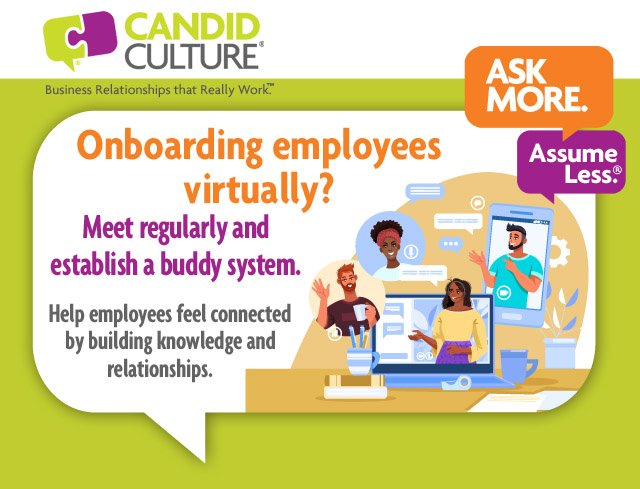
Here are six practices for helping new, virtual employees acclimate and feel at home quickly:
Focus on relationships first and workplace goals second.
I onboard all new employees – virtual or in-person – with a handful of Team Building and Manage People Candor Questions. My first meeting with employees has nothing to do with goals or objectives. Instead, we talk about working-style preferences and pet peeves. We get to know each other and build trust. As Stephen Covey said in his book the Seven Habits of Highly Effective People, “Deposit into the emotional bank account.” And as William Ury said in his book on negotiation, Getting to Yes, “Go slow to go fast.”
2. Make it safe and easy to ask questions.
Few people like to admit they don’t know something. I’d rather have my new employees pick up the phone or email me with a question than spend 60-minutes of frustration searching for an answer.
Ask, “What questions do you have” each time you meet and wait longer than you think you should for the answer. People always have questions. Make room for them to ask.
3. Have multiple people train new employees.
Training a new employee develops the person doing the training and builds immediate relationships.
4. Set up a system for people to ‘interview’ others throughout the organization – a virtual meet and greet of sorts.
5. Have team meetings on video.
I know, I know, people are tired of video meetings. Make them short, sweet, and regular.
6. Meet one-on-one weekly with new employees.
I suggest weekly meetings for at least the first six months, and protect the meeting time. If one-on-one’s with employees get cancelled, reschedule immediately. Cancelling meetings with direct reports without rescheduling sends the message that the direct report isn’t important.
Working with people virtually isn’t that different from working with people in person. Pick up the phone. Use video. Talk with people weekly. Ask questions. Wait for answers. Make sure new employees ‘meet’ and are exposed to a lot of people throughout the organization. People leave companies, not jobs.
The most frequent question I’m getting these days is how to manage business relationships virtually. Here is the short answer – talk to people. Pick up the phone. You don’t need to have video calls, if you don’t want to. Showering is a personal choice. You just need to talk to people.
People need human contact. We even need to connect with the people we don’t like – when we work for and with them. Text and email don’t replace talking to people.
We stopped talking to each other long before so many people began working from home. Email has been overused for years. We emailed the people we sat next to at work. We exchanged 20 emails on one topic rather than picking up the phone.
We ask permission to call our friends to catch up. Texting a friend to ask, “Is it ok if I call you tomorrow morning?” is the norm. We exchange 50 texts to determine where and when to meet for lunch.
Maybe people thinking email and texting is easier, less intrusive, faster. Less intrusive, yes. Easier, sometimes. Faster, no.
Call the people you work with. Ask for the best time to call, if you like. Check in on them. Ask how they’re doing. Yes, there may be a crying child or a barking dog in the background. It’s ok. Calls don’t have to be long. People just need contact. They need to know that you care and are ‘in it’ with them. And while you’re on the phone, get questions answered in five minutes rather than with 25 emails.
It’s been eleven months that many people are working from home who would ordinarily go into an office. Some people are content with the fancy-on-the-top, jammies on the bottom video-work life, others are feeling lonely and isolated. Some employees have a private, uninterrupted work setting, others are trying to find a quiet place to participate in meetings while a partner and kids are also at home. Working from home amid distractions and loneliness is tricky and we need to be able to talk about it.
Managers, your employees don’t want to tell you they’re struggling, lonely, distracted, or can’t make certain meetings or deadlines. They want you to think everything is fine, that they’re fine. Who likes to admit to their boss that they can’t keep up or are unhappy at work?
If a manager loves working from home and has a quiet, uninterrupted work environment, it may be easy to miss employees’ challenges. Managers need to cross the line and ask questions they otherwise wouldn’t.
Don’t assume employees are fine. Don’t assume employees will tell you if they’re not. They likely won’t. You need to ask and make it easy and safe to tell you the truth.
Managers, ask employees these questions:
What’s your work environment like?
What constraints are you under?
What’s a realistic work schedule right now?
What do you want me to know?
What do you need?
It may seem like it’s too late to ask. It’s not. It’s never too late. Simply be honest. It could sound something like, “I wanted to check in and see how you’re doing working from home. I want to ask some questions so I can support you. I wish I’d asked before. I’m sorry I didn’t.”
Managers who are willing to tell employees they wish they’d done something differently earn loyalty and trust for showing vulnerability and humanity. Strong managers admit mistakes.
If you’re nervous that employees will delve into arenas that are too personal, set parameters for the conversation. It’s ok to set boundaries when asking questions. You could say, “I want to talk about some of the constraints you may be under working from home. I’m sorry I didn’t ask before. Let’s focus on things I can support you with and stay away from items I can’t help with like finances and personal relationships.”
Then be prepared to help employees problem solve. Maybe employees need a different work schedule or different deadlines or deliverables. Maybe employees need help setting expectations with peers and clients around when they can and can’t attend meetings.
Make it safe to talk about how employees are really doing and what they need to be successful in today’s circumstances. Tell employees that you really want to know, you’re sorry you didn’t ask before, and that it’s safe to tell the truth. Then problem solve with employees. And ask the same questions periodically. Make talking about work environment, schedule, and expectations a regular conversation.
Organizations are working hard to retain employees. Employees are watching how their organization’s leaders and managers work, and often make career decisions based on the hours the most senior people keep. Not a recipe for retaining employees.
Many employees pay particular attention to how often managers and senior leaders take time off and whether or not leaders attend meetings and respond to emails while they’re ‘off.’ Employees observe the late nights that leaders and managers put in and the emails sent at 11:00 pm and on the weekends. I’ve heard lots of employees say, “If I need to work like my boss works to get ahead in this organization, I’m not interested.”
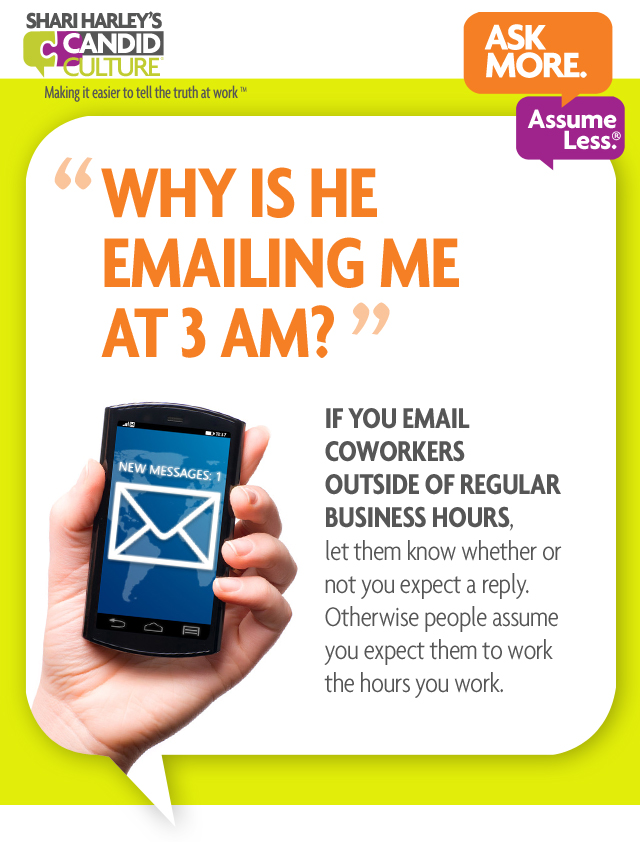
Managers, one of the keys to retaining employees is to communicate expectations. If you’re available while you’re on vacation, but don’t expect employees to do the same, set that expectation. If you send an email outside of regular business hours but don’t expect employees to respond until the next business day, tell them so. They don’t know. Many employees assume that if you email them at night, you expect a reply.
Instead of allowing employees to make assumptions about what managers do and don’t expect, set clear expectations. Be overt and clear. Tell employees, “I work most evenings and weekends, but don’t expect you to do so. And I work these hours because I enjoy it, not because I have to. If I email you outside of regular business hours, I am not expecting you to reply.” Retaining good employees begins during the interview process when initial expectations are set.
Managers, if you expect employees to check and respond to emails outside of regular business hours and to be available while on vacation, tell candidates during the interview process. If working long hours is a criteria for promotion, set that expectation. It’s completely fine to expect long hours and for employees to be accessible outside of regular business hours. There is nothing wrong with either expectation. There is only a problem if employees don’t know that’s the expectation.
Employees, if your manager emails you outside of regular business hours and she doesn’t tell you whether or not she expects you to reply, ask. Simply say, “I often receive emails outside of regular business hours. How will I know when you need me to reply?” Likewise, if you notice your manager emails you on vacation, you can say, “I typically hear from you when you’re on vacation. Are you expecting me to check in while I’m off?”
The need to ask questions and set expectations goes both ways. Don’t wait to be told. Ask.
Managers and employees, ask these Candor Questions about working style preferences to aid in retaining employees:
How do you feel about being contacted outside of regular business hours?
If I need to reach you over a weekend or in the evening, what method is best?
Would you prefer I text you so you don’t have to check your email outside of business hours?
What time is too early and too late to call, text, and/or email?
Ask more. Assume less and make retaining employees easier.
Most people hoard feedback. We wait for the right time, aka when we’re comfortable. That time will never come. The right time to give feedback is when something happens or shortly thereafter. Practice the 24-hour rule and the one-week guideline. Give feedback when you’re not upset, but soon after the event occurs, so people remember what you’re talking about.
Most employees feel as if they’re treated unfairly during some portion of a performance appraisal. Employees receive feedback they’ve not previously heard or receive feedback that is unbalanced – overly positive or negative, or the feedback is so vague, employees aren’t sure what to do more, better, or differently.
Effective performance appraisals are a quick summary of all the performance conversations you’ve had during the year and planning for next year. To have an appraisal meeting that’s a summary of past conversations managers need to meet with their employees regularly and give feedback every time they meet. Giving feedback regularly throughout the year is the most effective management suggestion I can make.
Meet regularly with your employees. If you never meet one-on-one with employees, start meeting monthly. If you meet monthly, meet twice a month. If you meet twice a month, consider meeting weekly for 10 to 30 minutes.
Below is a one-on-one meeting agenda, which the direct report leads:
What is the employee working on that’s going well?
What is the employee working on that is not going great, but she doesn’t want your help?
What is the employee working on this isn’t going great and she wants your help?
** Give and receive feedback on the work and on your relationship. This will be hard the first few times you do it but will become easier with each successive conversation.
Ask your employee to create a meeting agenda. Take notes during the meeting and keep your notes. The summary of these meetings becomes your annual performance appraisal.
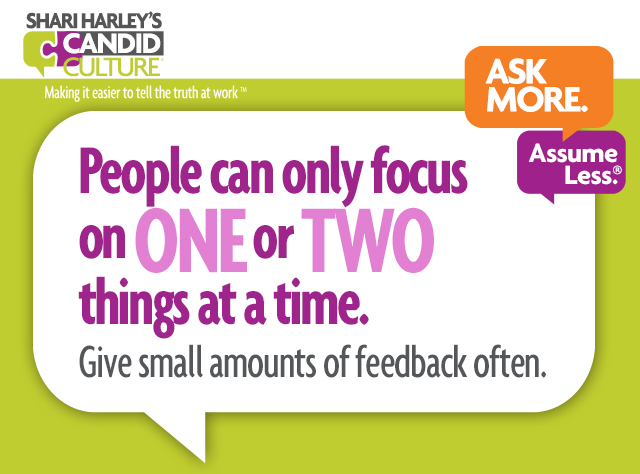
Regardless of whether or not you’re meeting regularly throughout the year, you can only give small pieces of feedback during the appraisal meeting. Discuss three SPECIFIC things the employee did well during the year and three things she should do next year. People can’t focus on more.
Consider how each of your employees should impact your department and your organization’s annual goals. In that context, determine the most important things each employee did to contribute to those goals this past year and what she should have done more, better, or differently? That’s your appraisal. Not more and not less.
During performance appraisals, force yourself to focus on and present ONLY the most important behaviors and outcomes, and your employees will bring the same focus to the ensuing year.
One of the hardest things I ever did was to hire someone to care for my infant son. “Here is the person most important to me in the world. Keep him alive.” I had no idea how difficult it would be to trust a relative stranger so implicitly. And as a result, let’s just say I was not the easiest parent to work for.
I’m embarrassed to admit that I wrote sixteen-pages of instructions on how to take care of my kid. And I gave that ‘booklet’ to a nanny with much more childcare experience than I had. When I heard my son crying, I would tell myself not to walk into the room and check on him, knowing it undermined the nanny, but I did it anyway. When the nanny sent me an update of when my son last ate, I replied telling her when he should eat again, even though I knew she already knew that. Yes, I really did these things.
Each time I over instructed, monitored, and advised, I regretted it. I knew micromanaging our nanny made me difficult to work with, which is not how I wanted to be. It reminds me of a comment an old boss said to me after we interviewed a candidate for a job together. He said, “Shari, your job as the interviewer is to make the candidate feel comfortable and ensure she leaves feeling good, regardless of how well or poorly she interviewed.” During the interview, my face must have said anything but, “I want you to feel comfortable and you’re doing a great job.” His words stuck with me and I was reminded of them each time I over managed our nanny.
Many people attend training on how to manage others. I’d suggest we also look at how we manage ourselves. How does working with you make people feel? Do your questions, requests, and interactions make people feel more self-confident and valued, or do people feel questioned and undermined? Do you pick your battles? Do you give just enough direction but not so much as to squelch the other person’s ideas, initiative, and spirit, especially when the stakes are high?
As you know, I’m evaluating how I do these things too. We are always a work in progress.
Here are four ways to build confidence in the people you work with:
Build Confidence 1: Ask people for their ideas and implement those ideas whenever possible. And if you aren’t open to others’ ideas, don’t ask for them. It’s better not to ask for ideas than to ask when you’re really not interested.
I read a quote a few months ago that struck me – “It’s so hard to change yourself, what makes you think you can change someone else?” This seems so true. And yet, how much energy do we invest trying or at least hoping other people will change? We want our not-so-forthcoming manager to give regular and helpful feedback, our Halloween candy stuffed selves to prefer celery over chocolate, our not-so-affectionate partner to become a cuddler.
People are who and (largely) how they are. Even with lots of effort, coaching, and even counseling, it’s hard to change.
As someone who leads a training and development company, it feels risky to write this. I’m concerned that my words will be misunderstood. So I want to be sure I’m clear. People can learn new skills. Managers can learn to coach and give feedback. People at all levels and in all roles can learn to communicate differently. Everyone can learn to use new technology. But we don’t fundamentally change who and how we are. People who hate to public speak aren’t likely to wake up tomorrow clambering to give presentations to thousands of people. People who don’t like crowds aren’t likely to want to spend every weekend at large sporting events when they resume.
What I’m really trying to say is, stop trying to get something from someone who can’t give that to you. If you work for someone who never provides feedback, no matter how often you ask, get input from someone else. Lots of people can provide you with helpful information if you ask for it and make it safe to tell you the truth. If you’re chastising yourself for not being more athletic, accept that you like to read, and buy yourself a new book.
Instead of trying to get something from someone who can’t give it to you, get what you can from that relationship and get the rest of your needs met elsewhere. And tell others to do the same. I had someone working for me a few years ago who was extremely sensitive and didn’t do well receiving feedback. I tried to accommodate her needs and preferences, softening my messages, picking my battles, and in the end, giving less and less feedback. And it was exhausting. Eventually, I said to her, “I’m not the right manager for you and this is the not right company for you. It’s not a good fit. You won’t be happy here, and I want you to be happy. Let’s help you find another home.”
I’m not telling you to get a new job. I’m telling you to be realistic in your expectations of yourself and others. The most powerful thing you can do is to be yourself and let others be themselves. And if you don’t like how or who someone is, hang out with someone else.