There was way too much guessing at work before most people began working from home. Without visual cues, figuring out how to work with people is even harder. You may find yourself thinking, “I’m going to miss this deadline. I wonder what the consequences will be?” Or perhaps, “She said she wanted input on this project. I wonder if she really meant that, and how much feedback is ok to provide?” Or maybe, “He asked for a proposal. Is he expecting something elaborate, or will a one-pager do?”
We often don’t know what others are expecting from us, so we guess. The problem with guessing is that we may do more work than we actually need to, and not in the way the other person wants it. Even worse, when we don’t work according to others’ expectations, they aren’t likely to tell us. Instead, they tell others and make decisions about us that aren’t positive.
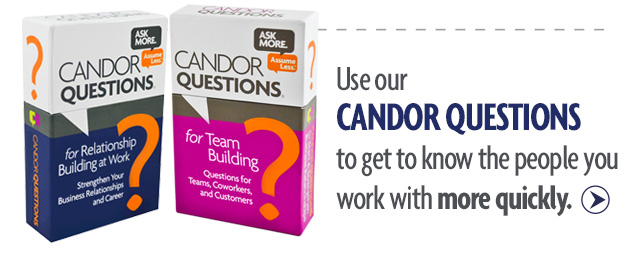
I’m a fan of asking lots and lots of questions, preferably at the beginning of anything new. Anticipate all that can happen, get in front of breakdowns, and set clear expectations by asking questions. The people who participate in virtual and in-person training with me get an entire box of questions to ask. And the homework is to go ask more questions of the people they work most closely with. Asking questions will always be easier than recovering from violated and often unstated expectations.
If you want fewer breakdowns and frustrations at work, ask the following questions of the people you work with:
What do you want to do, on this project, and what do you want me to do?
What does a good job look like?
What will be different in the organization when this project is finished?
How would I frustrate you and not even know it?
How often do you want to receive updates from me?
Do you want to receive all the details or just big picture information?
Do you want to receive the information in bullet form or paragraphs?
It’s never too late to ask questions like these. It’s ideal to ask the question at the beginning of a piece of work. But asking in the middle or even towards the end is fine too. People will appreciate that you asked, whenever you ask.
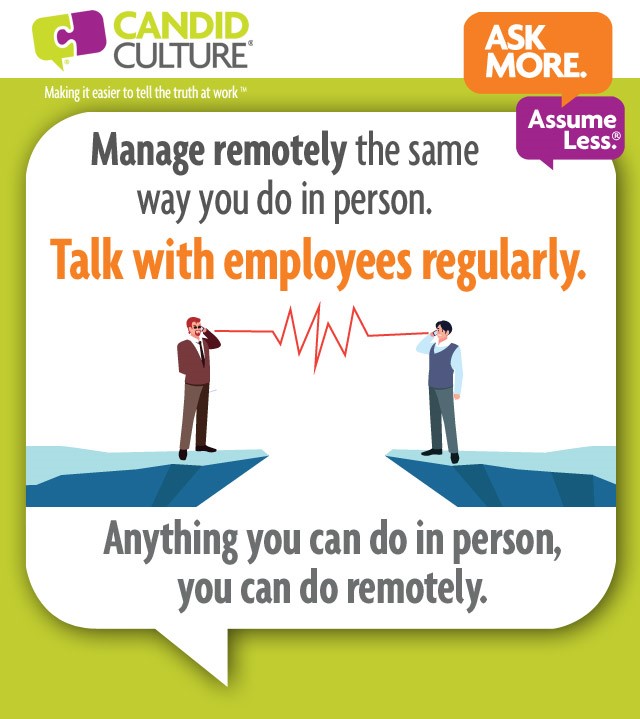
Many managers are asking the question, “How do I manage
employees remotely?” Managing employees remotely isn’t too different than
managing in person. Whether someone is sitting with you or in their home
office, the steps involved in managing people are the same.
There are a few things effective managers do repeatedly. Do
these handful of things and managing people will go well, provided you have the
right person in the job. Managing someone who is a good fit for their current
job is challenging but doable. Managing a person who is not a good fit for
their job is extraordinarily hard. No management practices or skills supersedes
hiring the right person. Hiring the right people is the single most important
thing managers do. Managing and coaching employees are the next most important
things managers do.
Here are the three things effective managers do:
Set clear expectations:
Conversation with new/inexperienced
employees: “This is what I want you to do and by when.”
Conversation with experienced employees: “What do you think needs to be done and when is a manageable deadline?”
2. Delegate:
New/inexperienced employees: “Here is my
vision of how this should look.”
Experienced employees: “What’s your vision of how this should look?”
3. Review work, coach, and give feedback:
Review small pieces of work so
employees can course correct as they go, reducing wasted time and frustration.
Agree on a schedule to review work in process, so employees feel supported and
not micromanaged.
New/inexperienced employees: “Here
is what I would do differently and why.”
Experienced employees: “Here are my
areas of concern. What changes do you think need to be made?”
Repeat
That’s all you need to do. It’s so simple. And so hard.
Managing employees is very challenging.
Here are five ways to make it easier to manage well:
Spend time at the beginning of working relationships and projects getting to know employees work styles and preferences and sharing your own.
Check in with employees regularly, asking questions that elicit what employees need to be successful.
Have frequent, short conversations. A weekly 15-minute touch base is more effective than a monthly 60-minute meeting.
Do a plus/delta every time you meet, giving positive and upgrade feedback as events happen. Waiting to give feedback negatively impacts results and damages trust.
Have courage and know that employees want to work for a manager who sets clear expectations and gives clear feedback. Working in the dark is frustrating and difficult.
If you’re hesitant to do any of the actions above or are worried about how those actions will be perceived by employees, tell employees that. Be authentic and candid. You could say something like, “I want to review your work more frequently than I have in the past, but I’m concerned how you’ll perceive that.” “I want to give you regular, timely feedback to be helpful to you, and know feedback can be hard to hear.”
Lastly – remote meetings can be held via video conferencing but don’t need to be. Sometimes it’s nice to talk via phone and not have to get dressed up or manage your facial expressions. If you’re not sure if you should meet with employees via video or phone, ask them. Setting clear expectations is the first step in managing all business relationships effectively.
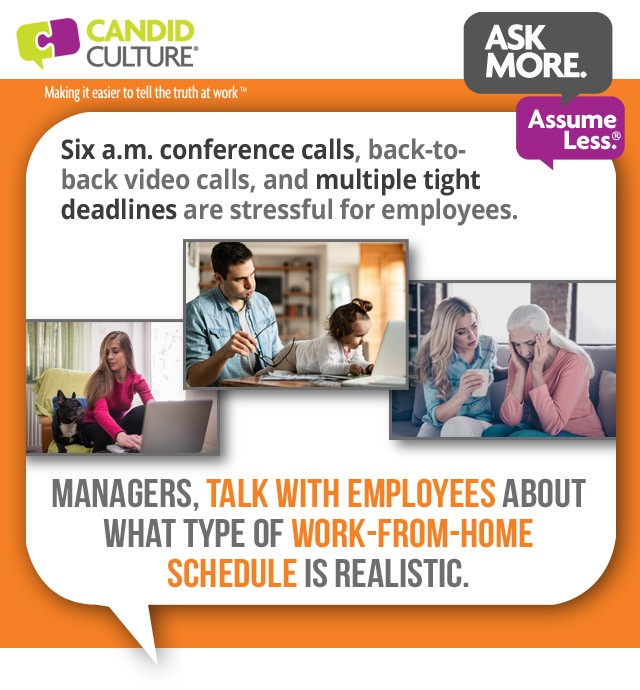
You’ve been on video calls for the past two hours. Your kids are bored, you aren’t accustomed to working alone at home and miss working in an office with other people, you don’t have a quiet, interruption-free environment in which to work, or your parents have called eight times.
Everyone you
work with is dealing with different circumstances. Some are perfectly content
working a full day at home, others are finding the experience isolating and
lonely. Some have no distractions at home and others have many. But we won’t
know what others are dealing with and how those circumstances impact work
schedules and deliverables if we don’t ask.
Managers, employees, and coworkers need to talk to each other about the constraints they’re dealing with and what a realistic work schedule looks like right now, and those conversations may be personal. They’re likely more personal than the conversations you’ve had in the past and that may be uncomfortable.
Managers, before setting goals, assigning projects, or scheduling meetings, talk to employees about what a realistic workday looks like right now.
Here’s how
the conversation could go: “I know working from home all the time is different
from you’re used to. I want to get a sense of what a realistic schedule is for
you and what kind of challenges you’re dealing with. We can create deadlines
and deliverables from there.”
Managers share about your own situation and set expectations with your employees, coworkers and with your own boss. It could sound something like this: “I have two young kids at home and I’m bringing my parents food each day. I check and return emails before 7:00 am, while my kids are still asleep. I log back on and am available for calls from 9:00 am – 10:30 am. I’m out of commission until 3:00 pm. I work from 3:00 pm – 4:30 pm and then I’m available at night from 8:00 pm – 9:30 pm. I know it’s not ideal, but it is my reality. Let’s figure out how to ensure you get what you need from me given the schedule.”
These are the conversations we need to be having and no one wants to have them. Who wants to admit to their boss, employees, and coworkers that they’re not able to work and focus for much of the day? No one. But pretending like we can participate in six hours of video calls each day or that our availability and productivity isn’t impacted is stressful and unrealistic. We are humans working with other humans and we need to be real with one another.
Managers ask your employees what a realistic work schedule looks like and find out what they’re able to do on a given day. Employees, broach the conversation with managers and coworkers. Be honest and ask for flexibility. It’s better to set expectations upfront than to surprise and disappoint.
We all know people who have been furloughed, taken pay cuts, or who were laid off over the past few weeks. It happened fast. Business has slowed or ceased in many industries, businesses are shut, people aren’t working. There are loans and tax refunds in place to motivate employers not to reduce employees’ hours or to reduce headcount.
Business leaders are doing the best they can to make decisions that will keep businesses afloat. It is a difficult time to run a business and manage people.
I too am confronted by these decisions in my own business. I had a new person who was supposed to start on March 16th. I have part-timers who aren’t coming in right now. I have an open job I’m not filling.
I want to
suggest you play the long game letting your personal and professional goals drive
your decision making, and I know this is very, very difficult. It’s difficult for
me too.
Maybe you need
to lay people off or reduce hours or compensation. Communicate with those
employees from a place of TLC – communicate early and often. Give as much information
as you can. Be as generous as you can.
Generosity
comes in all forms. It is not necessarily financial.
Tell employees the benefits that are available to them. Be realistic about when employees may receive checks. But also share how you feel about these employees and how difficult it is to reduce compensation and jobs. People want to work for people who are authentic and care about them. Don’t be afraid to show you care. Call and check-in with employees who aren’t working. Ask how they’re doing. Demonstrate concern.
There is a
long game in how we make business decisions but also in how we treat people.
Treat people like they’re family and you’re working to have a long-term relationship.
Lastly, try not
to make decisions from fear. This is a tricky one and one I can’t say I’m doing
well. I’ve made a few too many recent
decisions out of fear. But fear is not a powerful place to stand. Fear is paralyzing
and limiting.
When making personal and professional decisions, consider your long-term goals. Ask, “What do I want my business to look like in one year, three years, five years? What do I need to do today to achieve those goals, within today’s scary reality.” Act from your goals, not your momentary fear. You may need to remind yourself of this from moment to moment. I know I do.
Think future.
Be realistic. Act with care and humanity. Play your long game personally and
professionally.
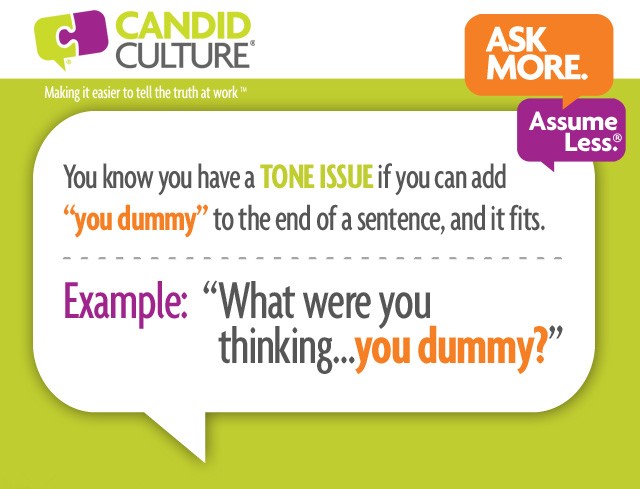
You know when someone gives you ‘the tone’, similar to when people roll their eyes at you? When you get ‘the tone’ you’re being told that the other person is exasperated.
Tone of voice is one of the hardest things to coach because we don’t hear ourselves. People who give people ‘the tone’ rarely know they’re doing it. One of the best ways I know to effectively coach tone of voice is to ask tone givers to tape themselves during phone calls. Then listen to the recording together and ask the tone giver, “If your grandmother called and someone spoke to her that way, would you be happy?” You can also read written correspondence out loud, adding the tone you ‘heard’, and ask the sender how she would have interpreted the message.
When given the tone, most people feel judged. And when people feel judged, conversations are constrained.
The way to avoid giving ‘the tone’ is to come from a place of curiosity. When you ask the question, “What were you thinking when you approached the customer that way,” you can sound curious or judgmental. Being judgmental evokes defensiveness, which shuts conversations down. Being curious creates discussion.
Consider asking questions like these to invite discussion:
• Tell me more about… • Help me understand what happened here… • What are your thoughts about… • What’s the history behind….
Any of these questions will lead to a good discussion, if you manage your tone.
If you want to get information or influence someone, ask questions and engage the person in a dialogue. We often try to persuade people by giving them information. This rarely works. Instead of overloading people with data, ask questions that evoke discussion. Through discussion, you might get to a different place. And if not, you’ll at least have learned why the other person thinks as he does and you will have shared your point of view in a way that is inviting versus off-putting.
It’s easy to give people ‘the tone’ when we’re tired and frustrated. Try to avoid difficult conversations when you’re tired or stressed. Wait to have important conversations until you know you can manage yourself and your tone.
Some people say that you show employees appreciation by giving them a paycheck and that any more thanks is over the top. We call that old school management. And it doesn’t work.
The human brain thrives on recognition. People are more likely to replicate positive behaviors when those behaviors are recognized. If your employees are doing a good job and you appreciate them, don’t make them guess. “Well, my badge still works. So I guess things are going ok,” is not sufficient recognition.
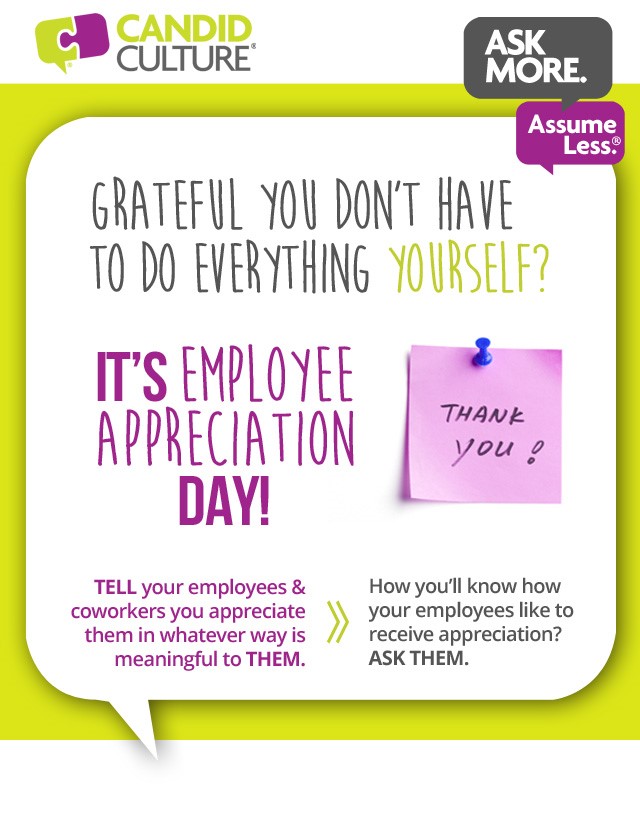
Today is Employee Appreciation Day – a made-up holiday to remind us to say “thank you” to the people we work with, who contribute every day.
Don’t take your employees for granted, or you’ll be finding new ones.
Here are six ways to mark Employee Appreciation Day today and every day:
Employee appreciation ideas 1) Ask employees what’s important to them – why they accepted the job, why they stay, and how they would like to receive recognition.
Most employees will work their entire career without a manager ever asking these questions. Getting to know your employees better and differently costs nothing but a little time.
Employee appreciation ideas 2) Ask employees about the kind of work they want to do in the future and what they want to learn and gain exposure to. Write down what they say (so you don’t have to remember) and give employees exposure to this type of work when it’s appropriate (when there’s a business need and when they’ve earned it by doing good work.)
Employee appreciation ideas 3) Give very specific, positive feedback regularly. Giving specific feedback demonstrates you’re paying attention to employees’ work and noticing the impact they’re making. Employees want to know how they’re doing. As odd as it may sound, feedback is a form of recognition. Taking the time to observe performance and give specific, timely feedback tells employees they matter.
Employee appreciation ideas 4) Tell the senior people in your organization what a great job your employees are doing. Employees have limited exposure to senior leaders. Don’t make the people who can influence your employees’ careers guess who’s doing great work.
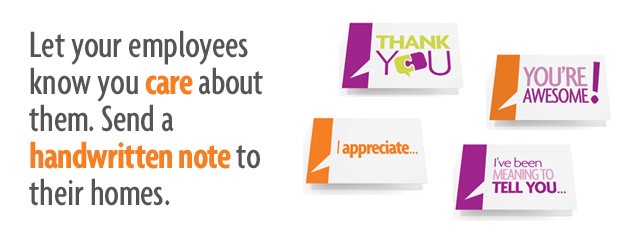
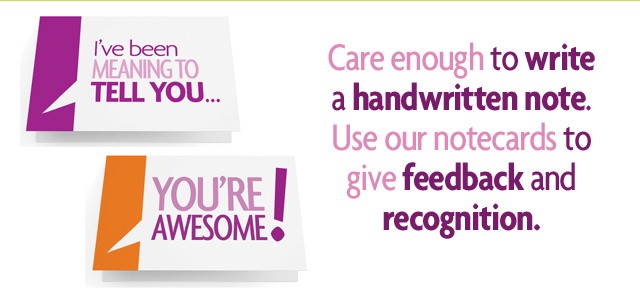
Employee appreciation ideas 5) Take the time to write a handwritten note. In my 15 years of working in a corporate environment, I received one handwritten note from one of my managers. I kept it for 10 years.
Employee appreciation ideas 6) Spend time with your employees. Every employee needs face time with his/her boss. Don’t underestimate the value employees place on the time you give them. If you’re not meeting with your employees on a one-on-one basis regularly, start. Meet for 30-minutes once a quarter. Then meet once a month. Employees create the meeting agenda and come prepared to give you an update on their work. You should be prepared to give both positive and upgrade feedback.
Notice not one of the employee appreciation ideas or ways to recognize Employee Appreciation Day above is monetary in nature. Employees want your time and attention. They want to learn and grow. Provided employees feel fairly compensated, money is secondary.
Today, and every day, find a way to say “thank you” that’s meaningful to your employees. And the only way to know what employees will find meaningful is to ask.
Many organizations spend more money than they have to on employee recognition gifts and appreciation programs that often involve bonuses, paid time off, contests, gifts, and other expensive forms of compensation. What employees want most is to know they’re doing a good job.
Giving feedback in the workplace is the cheapest, most effective, and often overlooked form of employee recognition. Employees want to know how they’re performing, and most employees get little to no positive or negative feedback at work. They may not want to hear negative feedback, but employees want to know if they aren’t meeting expectations.
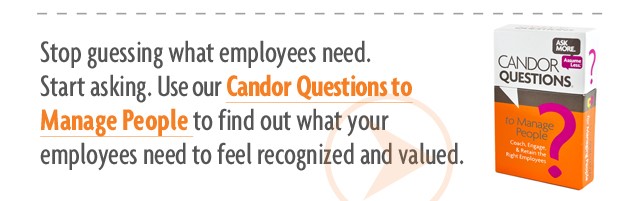
In several of Candid Culture’s training programs, I give participants a box of questions to help coworkers set expectations and improve workplace communication. Some of the questions include:
Do you prefer to receive information via email, voicemail, or text message?
Are you a big picture or a detail-oriented person?
What are your pet peeves at work?
What type of work do you like to do the most? What type of work do you like to do the least?
What do you wish I would start, stop, and continue doing?
Participants use the questions during the training, and I am consistently amazed at how often training participants ask what their coworkers wish they would start, stop and continue doing. I assume employees will be hesitant to ask for feedback in front of a group of peers. But training participants consistently tell me that they get almost no feedback at work, and they’re desperate for the information.
Here’s How to Celebrate Valentine’s Day at Work Without Spending Money:
Give clear, specific, and timely positive and negative feedback. Employees want to know how they’re performing.
Ask what type of work employees really want to do, and let them do that work most of the time.
Ask what skills employees want to learn, and give them a chance to attain those skills.
Write handwritten notes of appreciation.
Employees at Candid Culture get their birthdays off paid. We often buy employees lunch, give bonuses, and have a generous time-off policy. Those perks are important and do help retain employees. But monetary rewards never replace or supersede the value of being aware of employees’ performance and caring enough to tell employees the truth.
Last week I had lunch with a client. When I returned from lunch I saw a friend who told me I had something stuck in my teeth. I was embarrassed and wondered why my client hadn’t told me.
It’s quite possible he hadn’t noticed. In fact, knowing this guy and how much work I’ve done with his firm on being candid, it’s probable he hadn’t noticed. But we all know people who notice and say nothing. We could walk around all day with toilet paper on our shoe, lipstick on our teeth, or our fly down, and the people around us won’t tell us.
If you read my blog weekly, you already know that people have been trained not to tell you the truth.
But I think there is more preventing people from telling us the truth. Complete this sentence: “If you have nothing nice to say, _________________________________. Who told you that? Your mother!!!
I do think there’s something to this. We’re raised to believe that it’s not nice to say something to another person that isn’t positive. And in the past, when we did speak up, it’s likely the other person got defensive. So it’s no wonder that we don’t readily give people bad news.
Here are five tips for getting feedback from the people around you:
Establish a core team of people who will always tell you the truth. These can be friends, coworkers, clients, vendors, your boss, etc.
Give people permission, to be honest with you. “Let’s make a deal. I always want you to tell me the truth. If I have something stuck in my teeth, or I’m inappropriately dressed for a meeting, or I’m doing something that damages my reputation, I want you to tell me.”
Make it easy to tell you the truth. “I promise no matter what you tell me and how hard it is to hear, I will say thank you. I won’t get defensive. And if I do, I’ll apologize and try to do better next time.”
Offer to do the same for them. “And if you want me to do the same thing for you, I’m happy to do it.”
Periodically check in with people and ask for feedback. “A few months ago I asked you to tell me anything I said, did, or wore that got in the way of my success. Is there anything you’ve seen that you want to tell me?”
Every time you ask for feedback and take it graciously, you train the person to give you more feedback. On the contrary, every time you get defensive, you make it hard for people to give you feedback, making it likely they won’t do it again.
If you don’t want to walk around looking silly all day, create a safe environment where co-workers can tell the truth.
There is one job interview question recruiters and hiring managers must ask. And the answer should be a deal-breaker.
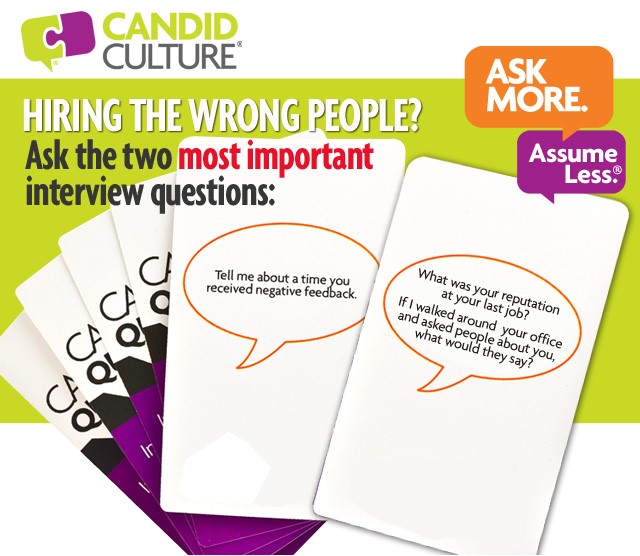
The most important job interview question for any role and level, in every organization: Tell me about a time you received negative feedback.
This is NOT the same question as tell me about a weakness. Or tell me about a time you made a mistake at work. Those are also important job interview questions to ask. But they’re not the most important question.
Let’s assume everyone you interview is age sixteen and older. Unless your candidates live in a cave, never speaking to anyone, it’s not possible to arrive at age 16 without having received negative feedback. The feedback can come from a friend, teacher, or parent. It doesn’t need to be work-related.
The point of the question is to discover whether the candidate is open to feedback. People who are not open to feedback are extraordinarily difficult to work with. They aren’t coachable. Any type of feedback they receive will result in resistance and defensiveness.
Employees who aren’t open to feedback won’t change or improve their behavior, regardless of how effective a manager is. Instead of listening to feedback and taking corrective action, employees who are not open to feedback will tell managers why s/he is wrong.
Everyone you interview has received negative feedback at some point. The question is whether or not candidates were open enough to listen to the feedback. People who aren’t open to feedback won’t be able to answer your question.
If candidates can’t tell you about a time they received negative feedback, ask a follow-up question. Your job as the interviewer is to give candidates every possible opportunity to be successful. If you don’t get the answer you’re looking for, ask the interview question in two different ways, until you’re certain the candidate can’t or won’t answer the question.
If candidates can’t tell you about a time they received negative feedback, ask what their reputation is at their current job or was at a previous job. Candidates probably won’t be able to answer this question either. Most people don’t know their reputation at work.
Even if a candidate doesn’t know with certainty his reputation at work, the answer he provides will give you a sense of how self-aware he is. People who are self-aware are more open to feedback and are easier to coach and manage than people who are not self-aware.
I really do eliminate candidates who demonstrate that they aren’t open to feedback –whether I’m hiring for Candid Culture or for one of my clients. I don’t care how credentialed or experienced the candidate is.
Many year-end performance reviews include whatever the manager and direct report can remember happening during the last six to twelve weeks of the year. For the most part, managers and direct reports sit in front of blank performance appraisals and self-appraisal forms and try to remember everything that happened during the year. The result: A vague, incomplete performance review that leaves employees feeling disappointed, if not discounted.
If you were disappointed by your performance review this year, don’t let it happen again next year. Take charge of your career by writing your own goals.
One of the first companies I worked for did the goal process so well, I learned early in my career how powerful well-written goals could be. Each employee set five to seven goals. Experienced employees wrote their own goals and then discussed those goals with their manager. Less experienced employees wrote their goals with their manager. Managers wrote goals for inexperienced employees. The goals were so specific and clear that there could be no debate at the end of the year whether or not the goal had been achieved. It was obvious. Either employees had done what they said they would, or they hadn’t. This made writing performance appraisals very easy. Very little on the appraisal was subjective. And this gave employees a feeling of control over their year and performance.
It’s great if you work for an organization or manager who works with you to write goals. If you don’t, write your own goals and present them to your manager for discussion and approval. Managers will be impressed you took the initiative to write goals and will be thankful for the work it takes off of them.
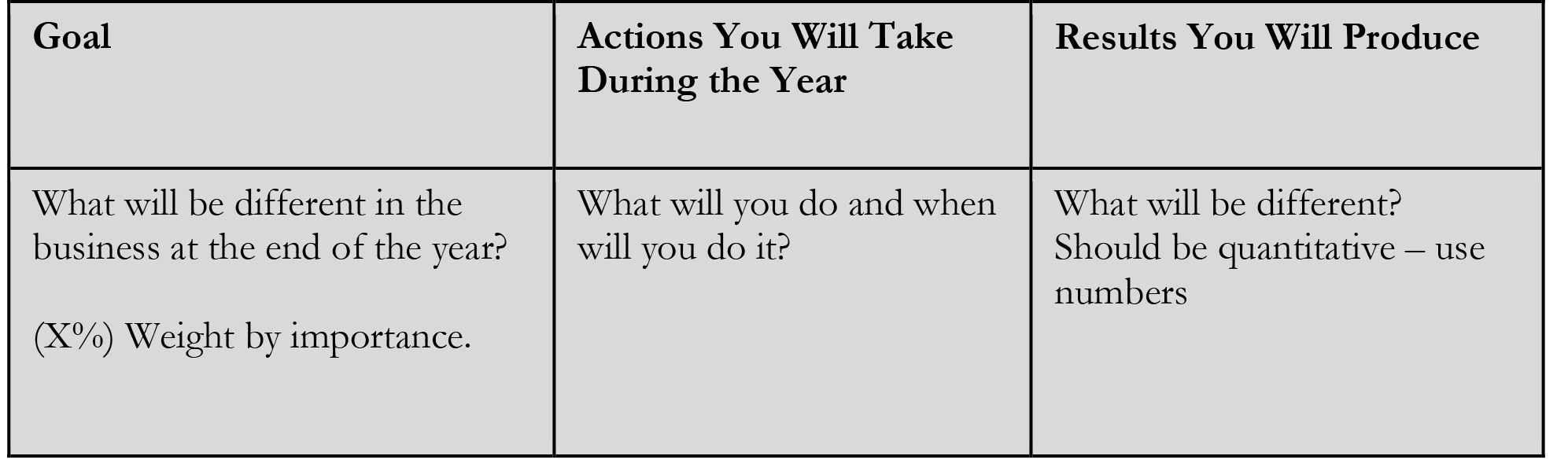
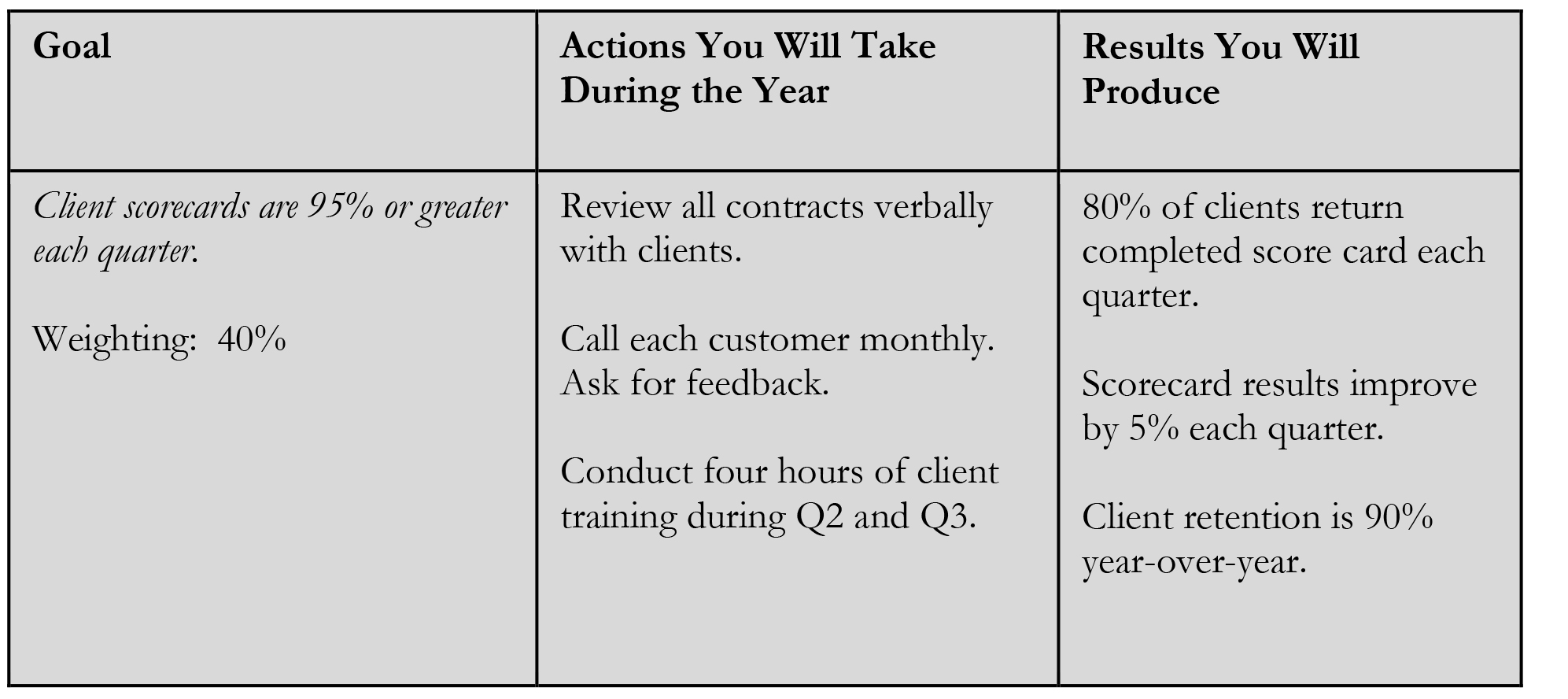
Goals should be simple and clear. It must be obvious whether you achieved the goal or not. There should be little if any room for debate. Sample goals are below.
Desired Outcome (goal):
• Improve client feedback – too vague • Get better-written reviews from clients – better • 80% of clients respond to surveys and respond with an average rating of 4.5 or above – best
Actions you will take to achieve the goal:
• Ask clients for feedback throughout project — too vague • Ask clients for feedback weekly – better • Visit client site weekly. Talk with site manager. Ask for feedback — best
Goal template:
Completed sample goal:
How to approach your manager with written goals:
Try using this language with your manager: “I want to be sure I’m working on the things that are most important to you and the organization. I’ve written some goals for 2020 to ensure I’m focused on the right things. Can we review the goals and I’ll edit them based on your input? And what do you think of using the agreed-upon goals to measure my performance in 2020?”
You have nothing to lose by writing goals and presenting them to your manager. You will gain respect from your manager, clarity of your 2020 priorities, and more control of your year-end-performance review. Give it a try, and let me know how it goes.