Leading Organizations Archive
 There are three reasons people say “that’s above or below my paygrade” or “that’s not my job” –they don’t feel empowered to make decisions, they think they’re being unfairly compensated for the challenges at hand, or they aren’t particularly motivated (read lazy).
“That’s not my job” (aka, I don’t do things that are outside of my job description) is a mindset, and if someone has it, I’d suggest not hiring that person. People who think they should only have to do what’s on their job description aren’t utility players, and your organization is likely too lean to afford employees who only want to perform in a narrow box.
“That’s not my job” can also be an outcome of leaders and managers who can’t let go and let employees take risks and make decisions. If that’s your management style, hire people who will follow directions and don’t want to create new things and solve problems. Problem solvers will be frustrated if they only get to follow instructions.
Here are six steps to steer clear of “that’s not my job” syndrome and advance your career, regardless of your current role in your organization:
- Never say the words “that’s above or below my paygrade” or “that’s not my job.” Even if it’s true.
- If you don’t have the latitude to solve certain problems, ask the people you work for how they want you to handle those types of issues when you see or hear about them. That’s a subtle way to provide feedback that you don’t have the latitude you need to solve certain problems.
- When you see an impending train wreck, say something. I see lots of very capable employees see the train wreck coming, comment to themselves or others who can’t do anything about the problem (aka gossip), and then nod knowingly when the *&#@ hits the fan. Don’t be that person. Look out for your organization and the people you work with.
- If you see a broken or lacking process, raise the issue with someone who can do something about it, and offer to take a stab at fixing the problem. One of managers’ biggest complaints is employees who dump and run – “I’ve identified a problem. I’m leaving it for you to fix.”
- Go out of your way to do the right thing, even if you are uncomfortable or don’t want to. If it’s easier to email someone, but you know the right thing to do is to pick up the phone, pick up the phone. If an internal or external customer expresses concern and you can’t solve the problem, find someone who can. There are lots of ways to make an impact.
- Ask more questions. Find a non-judgmental way to ask, “Why do we do this this way?” “Have we considered…?” “Would you be open to trying…?” Status quo can be the right thing and what’s necessary. It can also be the death of organizations.
Make stuff happen. Don’t pass the buck. And if you are going to pass the buck, don’t announce it. It only makes you look disempowered and uncommitted.

 As crazy as it sounds, it can be difficult to get work done at work. There are the drive bys –people who want your opinion on EVERYTHING before they make decisions, the interrupters who have just one question, several times a day, the visitors who want to update you on EVERYTHING happening in their personal lives, and coworkers who host meetings at their workstation, take phone calls on speaker phone, and who listen to music without headphones, while loudly eating potato chips. All of these distractions are enough to make many employees want to find a quieter place to work.
The concept that it can be hard to get work done at work is crazy. We’re at work to work. And yet many employees, with and without a door, get in at 7:00 am, before others arrive, so they can “get some work done” and stay late because they “got nothing done all day.”
Open work environments can be productive and interruptions can be minimized, but managing interruptions at work will require some clear guidelines and direct communication, which many workplaces are missing.
Managing interruptions at work – practices for creating a work environment that works for everyone:
Write workspace practices down, share them with all employees, post the practices in every work area, and discuss them frequently.
Examples of practices for managing interruptions at work:
- Use a headset for all phone calls.
- Pay attention to your volume. Speak as quietly as possible.
- If you have visitors at your desk for business or non-business related conversations that last longer than five minutes, take the conversation to a conference room, empty office, or local coffee shop.
- Use headphones to watch videos and listen to music.
- Avoid prairie dogging—calling down a row, hallway, or over a cubicle wall. Instead, walk to the person’s desk, call, or send an email or text message.
- Turn off all auditory alerts on computers and cell phones, so your coworkers don’t have to hear pinging and ringing all day. The people you sit with don’t need to know every time you receive an email, text, or Facebook message.
- Finally, but MOST IMPORTANTLY, give all employees permission to make requests and give feedback when workspace guidelines are broken. It must not only be acceptable but expected that employees will say something when a guideline is broken and the workspace gets too loud.
Most employees will not speak up when others are being loud. It’s easier to find another location to work than risk a coworker’s defensive response. And no one wants to be ‘that person’ who complains about how loud someone is. If employees aren’t comfortable speaking up and making requests, offer training on how to have these conversations, and provide written examples of what employees can say that is respectful and clear.
Guidelines for dealing with interruptions at work:
You’d think that having a door would make people immune to work place distractions, but that’s not the case. Employees with offices also deal with drive bys and interruptions. The key to dealing with both is communication.
- Don’t wait for problems to occur. Anticipate challenges and talk about them before guidelines are broken. It’s much easier to make a request than to give feedback.
- Each time a new person joins a team, department, or workspace, ask everyone on the team to share their work-related pet peeves, how they like to communicate, and how they prefer to be interrupted. Everyone deals with interruptions, so you might as well express a preference. If you’d prefer people email you and ask when you have time for a quick question, make that request. If you’re ok with people interrupting you without notice, let people know. If you’re not distracted by noise, tell people. If you are, make that preference known.
People are too hesitant to speak up at work for fear of damaging relationships and hurting people’s feelings. The best thing leaders can do to improve the working environment (or any workplace challenge) is to set clear expectations, create opportunities to talk about how things are going, and make it ok to speak up.
Suffering at work is optional. Everyone is accountable for the work environment, and you won’t get what you don’t ask for.

Employees appreciate perks – good coffee, an onsite gym, concierge service, and workout classes. But none of those things motivate employees to stay with an organization. And no one will quit because a company doesn’t offer those perks.
I won’t tell you not to offer yoga classes or to get rid of your video games. Just know neither perk is resulting in employee retention.
There are really just a few things employees need to stay with your company and do good work. And if you do those things consistently, you’ll see your best employees stay and excel.
Here are a few employee retention ideas: 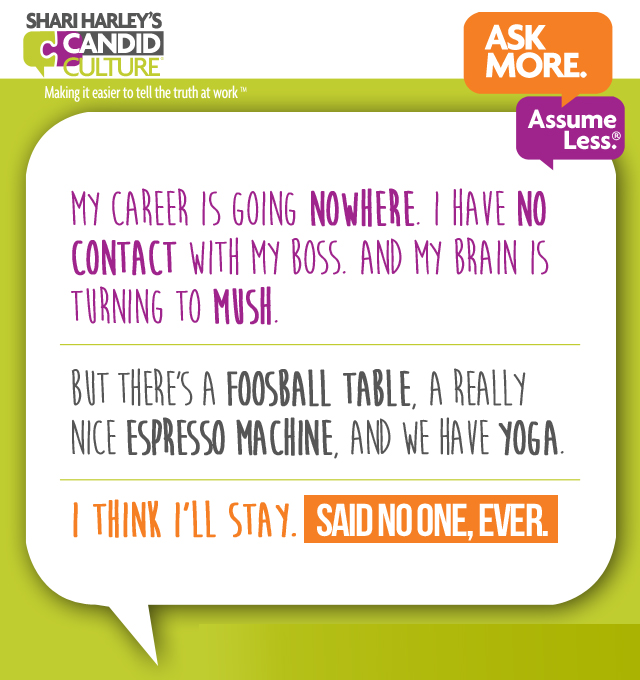
Employee retention idea #1: Managers, get to know employees better. Ask what brought employees to your company, what would make them leave, what employees want to learn, and what type of work they really don’t want to do. And when it’s possible, remove responsibilities employees don’t want to do, and replace those tasks with things employees enjoy more. You can’t eliminate all aspects of a job that employees don’t like. But people won’t stay in a job for long that doesn’t let them do work they enjoy about 75% of the time.
Employee retention idea #2: Managers, meet individually with employees, twice a month, for at least 30 minutes, to discuss current and future projects. Give specific and balanced (positive and negative) feedback during each meeting. Even the most independent employees need regular feedback and one-one-one time with their manager.
Employee retention idea #3: Teach and coach employees, so they expand their skill set and approach challenges in new and different ways. Most employees want to learn and grow. Managers don’t have to do the training themselves, just ensure it happens.
Employee retention idea #4: Give employees exposure to the senior leaders in your organization. This includes: attending meetings where senior leaders are present; pitching ideas to senior leaders; and learning from people above the employees’ manager.
Employee retention idea #5: Give employees stretch assignments and the chance to learn new things. One of the greatest reasons for employee turnover is boredom and a lack of growth and development. You don’t need to rotate or promote someone to help them grow. Giving employees exposure to different departments and types of work will allow employees to expand their skill set.
Most employees want to work for a manager who cares about them, takes time to get to know them, and helps advance their career. These activities will take some time. They won’t take a lot of money. Perhaps have your next one-on-one at the foosball table or over espresso. But know that the time managers take with employees, trumps every perk, every time.

How many times have you been sitting at your desk wondering, “Why won’t he ___________ ?’ Perplexed, you talk with your buddy at work. The conversation goes something like, “I’ve got this person, and I can’t figure out why he won’t ______________.” Or perhaps you talked directly to the person, but after several conversations, he still hasn’t done what you asked him to do.
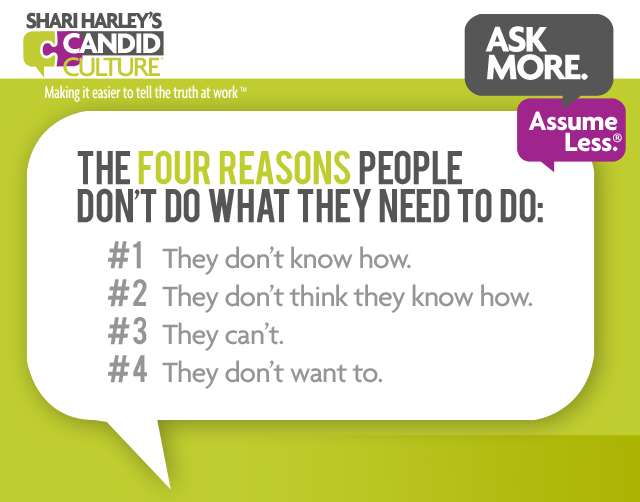
There are four reasons for a lack of employee performance and why people don’t do what you want them to do:
- They don’t know how.
- They don’t think they know how.
- They can’t.
- They don’t want to.
Reason number one for a lack of employee performance, they don’t know how, is the easiest to solve. People who don’t know how to do something need training, coaching, a mentor, a job aid or some other form of instruction. The hope is that with the right training and exposure, he will be able to do what you’re asking.
Reason number two for a lack of employee performance, they don’t think they know how, can be improved over time with patience and consistent coaching. You aren’t working with clean slates. Most people are recovering from or reacting to a past relationship or situation. If a person worked for a controlling manager who never let him make a decision or worked for someone who invoked punitive consequences for making mistakes, the person will be hesitant to make decisions. Hence why he does drive-bys on you, repeatedly checking in, but never pulling the trigger on anything.
If you work with someone who doesn’t think he knows what to do, but you know that he has the answer, encourage him to trust himself. When he comes to you for validation or approval, ask questions, don’t give answers. Tell the person you trust his judgment and encourage risk taking. Tell him that you’ll support his decision, even if it proves to be the wrong one. And encourage him to make the decision next time without consulting you. And then keep your word. If he makes the wrong call, you have to have his back and can’t invoke negative consequences.
Reason number three for a lack of employee performance, they can’t, is challenging but clear-cut. People who can’t do a task their brains aren’t wired for, will never do that responsibility well, regardless how much coaching, training, and assistance you provide. If you have repeatedly AND EFFECTIVELY, coached, trained, and provided support, remove that responsibility and give the person something he can do well. If that responsibility is a large part of the job, you have someone in the wrong job. It’s time to make a change.
Reason number four for a lack of employee performance, they don’t want to, is annoying but manageable. There are lots of reasons people don’t do things they don’t want to do. Those reasons include, but aren’t limited to, boredom, lack of buy-in as to why something is important, insufficient time, feeling like a task is beneath them, etc. If you’ve got someone who can but doesn’t want to do something, you can either take the responsibility away, incent him to do it, or give feedback EVERY TIME the task doesn’t get done.
Giving negative feedback isn’t fun for the giver or the receiver. No one wants to hear that he isn’t meeting expectations and most people don’t want to tell him. But the discomfort of receiving negative feedback EVERY TIME the person doesn’t do what he needs to do will create behavior change. He will either begin doing what you ask, quit, or ask for a transfer. Either way, your problem is solved.
The first step in getting people to do what you want them to do is to discover why they’re not doing what you ask. It’s impossible to appropriately manage employee performance if you don’t know why someone isn’t doing what he needs to do. And the person to ask why a responsibility isn’t getting done isn’t you or your buddy, it’s the person not doing the work. So get out of your head, leave your office, and go talk to the person not doing the work.
Here’s how to start an employee performance conversation:
“I’ve noticed you’re not doing ___________. Help me understand what’s happening.” Watch your tone, inquire from a place of genuine curiosity, and identify the reason he isn’t doing what he needs to do. Then you can intervene appropriately and hopefully get what you want.

What to say about September 11th, this year, didn’t come to me until I was standing in front of a client’s leaders, talking with them about retaining employees and what they could do to become an even better place to work.
Their office isn’t too far from Shankesville, PA, where flight 93 crashed on September 11th, so they seemed like the right group with whom to share my story. Then I decided that perhaps I should share it with you too.
I bought my first house in Denver in 1999 and went on vacation shortly after closing on the house. Right before I left, my manager told me he had too many direct reports and was putting a layer between us. I’d have a new boss when I came back from my vacation.
Two weeks later, I returned to my new manager and found her to be defensive, paranoid, and irrational – in short, impossible to work with. I did everything I knew to work well with her, calling on our HR department and the EAP counseling available to me, for help. Despite that I led communication skills training for the company and taught conflict resolution, I couldn’t work with her, and let my old boss know I’d be leaving.
I suspect he already knew my new boss wasn’t going to work out (I wasn’t the only person struggling to work with her), and offered me a position in our New York office. He told me that if after 90-days I wanted to return to Denver, I could. Ninety-days in New York with all my expenses paid or unemployment with no plan? The choice was clear. I went to New York and moved into my office in Tower Two of the World Trade Center, where I worked on September 11th.
I’m not proud of uprooting my whole life for a manager I couldn’t work with, and it’s not something I recommend others do. But it does demonstrate the difference one person can make. I never actually lived in that first house I bought. I accepted a permanent job in New York, but wasn’t ready to let go of my life in Denver. So I struggled with the decision of whether to stay in New York or return to Denver, for three years.
It’s normal to question our purpose and wonder if we make a difference. If you ask these questions, consider all the people you work with on a daily basis and how you impact their daily lives. We spend a huge portion of our existence at work, and how we interact with coworkers, customers, direct reports, and vendors impacts their happiness, or lack thereof, in a big way.
Don’t underestimate the difference you make when you smile at someone in the hallway at work, or don’t. When you thank someone for making your job easier, or don’t. When you take the time to teach someone a quicker way to do something, saving him countless of hours, or don’t. Regardless of your title and position in your organization, you impact the people around you in a huge way, every day.
During last week’s training in Pennsylvania, I talked about the four things essential to retaining employees.
Retaining employees –the four things employees need to be satisfied and engaged at work:
- I trust the leaders who run this organization.
- My opinion means something. I am listened to.
- I feel respected (by my manager). We have a good working relationship.
- My work is challenging and interesting. My career is going somewhere here.
If you’re a manager working on retaining employees, spend time with your employees. Ask questions about their career goals. Take the time to coach and give feedback. If you’re a senior leader committed to retaining employees, be visible. Walk around your office(s), addressing employees by name, and asking about their daily work. And if you’re not in a position of leadership, be easy to work with by keeping your commitments, being a short cut and providing information when you can, and offering to help employees who are overwhelmed. Retaining employees is not just a manager’s job. Every person we work with impacts our daily lives more than we know.

We added to our team at Candid Culture a few weeks ago, so we did what I teach other organizations to do –use Candor Questions to onboard our new team member, and help the entire team get to know each other better.
I sent my team the Candor Questions below and asked them to pick a few additional team building questions for everyone on the team to answer.
- What will keep you working here and what would make you leave?
- What’s the best way to get information to you – voicemail, text, or email?
- What time is too early?
- What time is too late?
- Do you leave your email and/or text alerts on at night/when you go to sleep?
- Would you prefer I send all emails and text messages during regular business hours?
- What frustrates you at work?
- What are your pet peeves?
- What’s something you want to learn, skill or business wise, that you haven’t had a chance to do?
- What’s something you wish I would start, stop, or continuing doing?
We run so fast at work and are so focused on completing goals, we often don’t take the time to really get to know the people we work with. I feel very strongly that asking the team building questions above will help people work better together. We’ll make fewer ‘mistakes’ with each other, and get more done with less stress and more ease. As William Ury said in his book, Getting to Yes, “Go slow to go fast.”

How many times have you sent someone five emails and become frustrated when none were returned? Or you thought an employee was happy, only to be surprised when she quit? Or you needed to talk with someone but couldn’t get her attention, so you walked by her office throughout the day, wondering if it was ok to knock? Working with other people doesn’t have to be so hard.
Taking the time to ask team building questions is much faster than recovering from missteps with other people. Ask the questions at the beginning of anything new – when you hire a new employee, get a new customer, or start a new project. And keep asking the questions as you work with people.
Asking questions about working style preferences and goals is an ongoing process, and it’s never too late. You can ask the team building questions during meetings or just slip them into your conversations. The process doesn’t have to be formal or time consuming. The point is simply, don’t guess what people need and are expecting from you, ask.

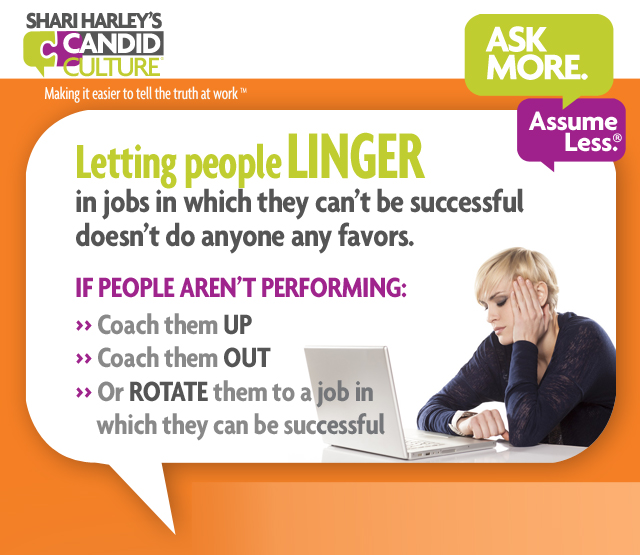 Being in the wrong job feels terrible. It’s not unlike being in the wrong romantic relationship, group of friends, or neighborhood. We feel misplaced. Everything is a struggle. Feeling like we don’t fit and can’t be successful is one of the worst feelings in the world.
The ideal situation is for an underperforming employee to decide to move on. But when this doesn’t happen, managers need to help employees make a change.
The first step in helping an underperforming employee move on to something where s/he can be more successful is to accept that giving negative feedback and managing employee performance is not unkind. When managers have an underperforming employee, they often think it isn’t nice to say something. Managers don’t want to hurt employees’ feelings or deal with their defensive reactions. In fact, when we help someone move on to a job that she will enjoy and where she can excel, we do the employee a favor. We set her free from a difficult situation that she was not able to leave out of her own volition.
I get asked the question “how do I know when it’s time to let an employee go?” a lot.
Here’s what I teach managers in our managing employee performance training programs: There are four reasons employees don’t do what they need to do:
- They don’t know how.
- They don’t think they know how.
- They don’t want to.
- They can’t. Even with coaching and training, they don’t have the ability to do what you’re asking.
Numbers one and two are coachable. With the right training and coaching employees will likely be able to do what you’re asking them to do.
Numbers three and four are less coachable and are likely not trainable.
When you’re confronted with someone who simply can’t do what you need them to do, it’s time to help the person make a change.
The way you discover whether or not someone can do something is to:
- Set clear expectations
- Observe performance
- Train, coach, and give feedback
- Observe performance
- Train, coach and give feedback
- Observe performance
- Train, coach and give feedback
Welcome to management.
After you’ve trained, coached and given feedback for a period of time, and the person still can’t do what you’re asking her to do, it’s time to make a change.
Making a change does not mean firing someone. You have options:
- Take away responsibilities the person can’t do well and give him other things that he can do well.
- Rotate the person to a different job.
Firing someone is always a last resort.
Sometimes we get too attached to job descriptions. The job description outlines a specific responsibility that the person can’t do. So we fire the person versus considering, who else in the organization can do that task? Be open minded. If you have a person who is engaged, committed, and able to do most of her job, be flexible and creative. Give away parts of the job to someone who can do them well. I’ve also seen employees who were failing, thrive in a different job. Organizations that are flexible survive; organizations that are rigid do not.
Let’s say you’ve stripped away the parts of the job that an underperforming employee can do well and she still can’t perform effectively. Now it’s time to make a change.
Here are some words to use when having the difficult ‘it’s time to move on’ conversation:
“I really want you on my team and to be successful in our organization. Over the past six months, we’ve had several conversations about the parts of your job that are a struggle. We’ve taken away responsibilities that aren’t a fit for you and have replaced those responsibilities with things that seemed like a better fit. And yet I can see that you are still struggling. I’m very sorry to say that it’s not appropriate for you to continue to working here. Today is your last day.” Depending on your organizational culture, can also say, “How do you want to handle this? You can resign or we can let you go. I’ll do whatever feels more comfortable for you.”
This is a difficult conversation that no manager wants to have. Yet I promise you, this conversation feels better to your employee than suffering in a job in which s/he can’t be successful. After you’ve set expectations, observed performance, and coached and given feedback repeatedly, letting someone go is kinder than letting the employee flounder in a job in which he cannot be successful.
About fifteen years ago, I worked with a woman with whom I didn’t get along. We were on the same team and had the same job, but didn’t see eye to eye on how to approach work or solve problems. And when we didn’t agree, things got ugly. I have to admit to being afraid of her. She was nasty when things didn’t go her way.
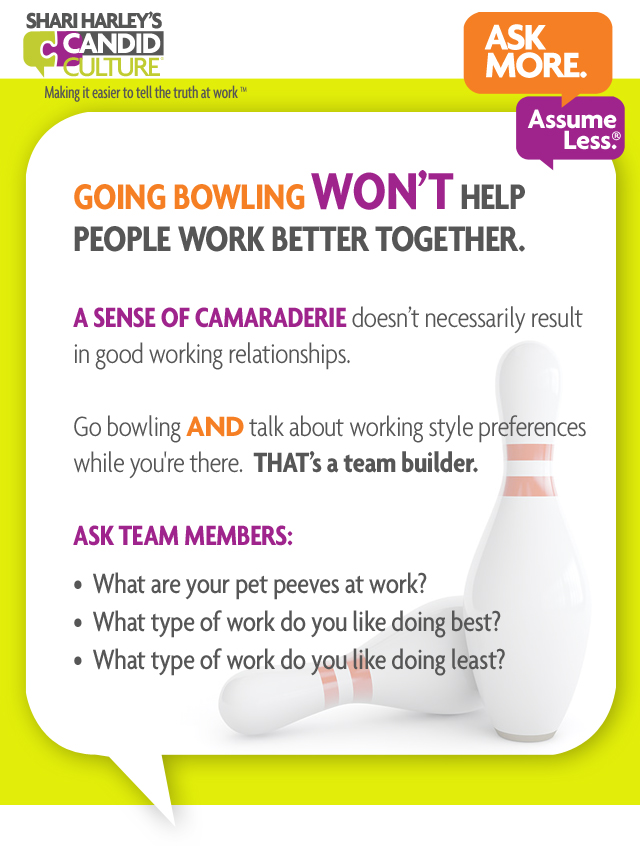 The odd thing is that socially, we did fine. When our team socialized outside of work, we had fun and got along well. That’s when I realized that there was no correlation between getting along outside of work and working well together.
Lots of teams go bowling, to baseball games, and out for happy hour as corporate team building activities. And while team members may enjoy being together at these events and get to know each other better personally, they don’t learn team members’ working style preferences, the work others are really good at, and the things at which team members are not as good.
Go bowling or out for happy hour, just don’t expect people to work better together after doing those activities. If you want to do corporate team building activities, give team members a chance to learn about each other and themselves, and make agreements of how team members will work together in the future. Create occasions for candor.
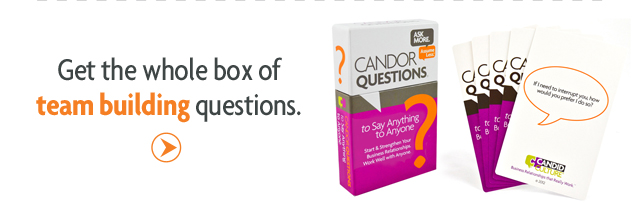
When I lead corporate team building activities, I put people in small groups, give the group a box of Candor Questions to Say Anything to Anyone, and time to answer the questions. One person in the group asks one question from the box. Everyone in the group answers that person’s question. The person who asked the question then answers his own question. Then another person on the team asks a question and so on. A great conversation always ensues.
People talk about things they should have and wished they’re talked about when they started working together. Team members learn about each others’ work style preferences and what each person needs from both the job and each other. But most importantly, team members have permission to talk about things they normally don’t, and begin to create a climate of candor, which is essential for any group of people working together. For a team to work well together, it must be safe to tell the truth. Teams need to talk about the things that impact them most –each other.
So go bowling and out for happy hour. But also create opportunities for team members to talk about the things that matter most –how they impact each other at work.
 You’ve either seen the video or heard about the group think that happened before NASA’s Challenger exploded in 1986. One engineer felt strongly that there was a defect in the Challenger’s design. He spoke up, others disagreed. He continued to speak up, until it became very uncomfortable to do so.
Most employees don’t even get that far. Many employees are afraid to speak up at all, feeling that it’s not ok to have a counter point of view, and that those who disagree with ‘management’ are eventually fired. I honestly am not sure where this comes from. It hasn’t been my experience, and yet the fear of speaking up is pervasive. I hear it in almost every organization with which I work.
If it’s not ok to express different opinions, your organization will deliver the same-old products and services you always have. If staying the same works in your industry, great. But stagnation is a killer to most organizations.
If you want more innovation in the workplace, you have to make it safe to speak up and offer a different point of view. Saying new, different, and even controversial things must be encourage and rewarded.
Five Ways to Encourage Innovation In the Workplace:
- Ask for new ideas and different points of view.
- Wait until you get both. Don’t allow a meeting or discussion to move on until you get new, opposing, and different points of view.
- Positively acknowledge people who risk and say something new or different from the norm.
- Ensure people with new ideas and different points of view are allowed to finish speaking before they’re interrupted or before someone else tries to negate their ideas.
- Create a few new awards in your organization and announce winners publicly and with great fanfare. You get what you reward.
Create Awards to Encourage Innovation In the Workplace:
- Acknowledge the person who fails massively trying something new.
- Award the person who brings new ideas to the table, regardless of what happens to those ideas.
- Celebrate the person who willingly gives you the worst news.
The fear of speaking up and saying something new or different will kill your innovation efforts. It will also kill your employees’ ambition and ability to be creative. Make it safe to tell the truth, even when the truth is hard to understand or unpopular, and see what happens to innovation, creativity, and employee productivity and morale.
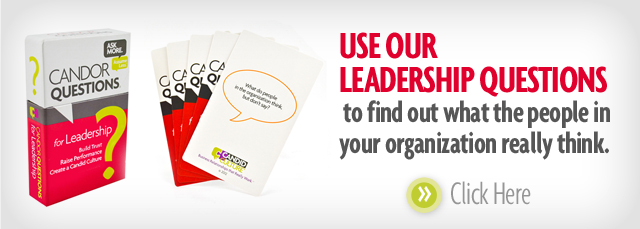
 Surveys are a great way to gather data. They’re not a great way to build relationships. In addition to sending out employee engagement surveys, ask questions live. Employees want to talk about their experience working with your organization. And employees will give you real, honest, and salient data, if you ask them and make it safe to tell the truth.
Here are a few methods of gathering data, in addition to sending employee engagement surveys:
Managers, ask questions during every one-on-one and team meeting with employees.
Managers, consider asking:
- What’s being talked about in the rumor mill?
- What do I need to know about that you suspect I don’t?
- What makes your job harder than it has to be? What would make your job easier?
- What meetings are not a good use of time?
Listen and be careful not to defend. Employees want to be heard. Respond if you’re able, but don’t deflect the feedback you’ve received.
Leaders, conduct roundtable discussions with small groups of employees throughout the year. I’d suggest discussions with groups of six employees. Have lunch or coffee. Keep the meetings informal.
Leaders, consider asking:
- What’s a good decision we made in the last six months. What’s a decision we made that you question?
- What would need to happen for you to be comfortable referring your friends to work here?
- What’s something happening in the organization that you’re concerned about?
How to Get the Truth:
- Share as much information as you can. Trust your employees.
- Ensure there are no negative consequences for people who tell you the truth.
- Give positive attention to the people who risk and give you negative information.
- Tell employees what you learn during these discussions and what you will and won’t be doing with the information.
- You don’t need to act on every piece of data you receive. Just acknowledge what you heard and explain why you will or won’t be taking action.
Employees are loyal to managers and organizations they feel connected to. And connections are formed through conversations. So in addition to sending employee engagement surveys, ask questions during every conversation and make it clear that you’re listening to the answers.