Leading Organizations Archive
 Lots of organizations send out employee engagement surveys with the desire of improving employee engagement and retention; unfortunately they often damage both in the process.
There are a few employee engagement survey pitfalls that are luckily easy to avoid.
Here are three practices to follow when sending out employee engagement surveys:
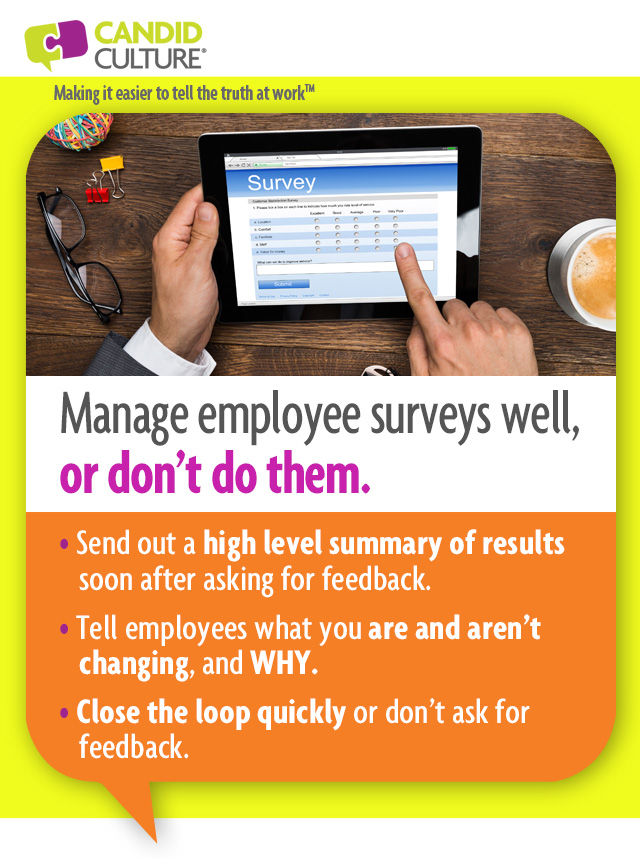
- Shorter is better. I hate to say this, but no one wants to fill out your employee engagement survey. It’s time consuming, employees doubt the survey will yield results, and employees worry that their feedback isn’t really confidential.
Make your employee engagement survey easy to fill out by making it short. And by short, I mean 10 questions or fewer. You’ll get a better response rate to a 10-question survey than a 65-question one. And do you really need more information than the answers to ten well-written questions?
- Provide employees with survey results quickly. Most organizations ask for too much information. Leaders are overwhelmed by the survey information, so they spend months and months reviewing it, while employees comment on yet another employee survey with no communication.
Send out a communication sharing the top few learnings – the good and the not-so-good — within a few weeks of sending out the survey. You don’t need to take action at the same time. Simply keep employees in the loop by communicating a quick summary of what you learned. If you wait too long to share the feedback, it often never gets communicated. And the next time you send out a survey, employees will remember the absence of information and be hesitant to fill it out.
- Within 90-days, tell employees what you will and won’t be changing, based on the survey feedback, and tell them why. Employees don’t need or expect all of their input to be utilized. Closing the loop with clear communication about what you are and aren’t changing, and why, is often sufficient.
All of that being said, I’m going to recommend you send out fewer surveys. Employee engagement surveys are a good way to quickly collect lots of information. Engagement surveys are not a good way of building trust and relationships with employees, which is what leads to employee engagement and retention. Employees don’t feel closer to an organization’s leadership team after filling out an employee engagement survey. Trust isn’t built. Instead of sending out so many surveys, I’d suggest cutting the number in half and have leaders and managers hold roundtable discussions with groups of 6-8 employees a few times a year instead. Roundtable discussions achieve several goals at once—they give leaders visibility, which builds trust, they help leaders build rapport and relationships, and gather the same data that a written survey provides.
When leaders participate in our Be a Best Place to Work program, we teach the five things leaders need to do to engage and retain employees. Holding roundtable discussions and asking these questions is a key recommendation of the training. Sending out written surveys is not. Engage and retain employees by talking with employees. Ask employees for their input. Listen. And watch your employee engagement survey scores sky rocket.
When I had knee surgery a bunch of years ago, the surgeon told me, “I didn’t fix your knee. I altered it.” He was trying to set the expectation that my knee wouldn’t be perfect, it would be different.

Violated expectations are at the root of disappointment, frustration, and broken relationships. We think, “I expect you to do or be a certain way and you’re not, so I’m unhappy.” If you want to be more satisfied and less frustrated, change your expectations. I don’t mean lower your expectations. I really do mean change them.
I had a baby last year and had no idea how difficult it would be have someone I barely knew (our new nanny) take care of him. It was tortuous until I got the sage advice, “You’re not going to get everything you want. Pay attention to the big things and be ok with good enough.” That’s hard for me. I have high standards and I want things done a certain way (my way). But I also don’t want to do everything myself. So I find myself altering my expectations and being ok with good enough. And it’s very, very difficult.
You likely want each of your employees, coworkers, boss, clients, and vendors to do things a certain way. Sometimes they’ll meet those expectations and sometimes they won’t. Decide what you must have, communicate those expectations (repeatedly if necessary), and let the rest go.
Here are four steps for setting expectations at work:
Setting expectations step one: Consider everything you need or want from a person. Make a list, even if it’s just for you.
Setting expectations step two: Determine what that person is capable of providing. What’s realistic given who they are and the constraints they’re under (financial, time, skills, experience, etc.)?
Setting expectations step three: Reset your expectations, if necessary.
Setting expectations step four: Ask for what you want and be specific about your request. Telling someone, “This needs to get better,” will get you nothing. Telling someone, “I’d like to be included in each meeting that relates to this project and cc’d on all pertinent emails,” may just get you what you need.
As William Ury said in his book Getting to Yes, be hard on the problem and easy on the person. When you address violated expectations, simply share what you expected to have happen and what actually did happen. That could sound like, “I thought we agreed I would be invited to each meeting pertaining to this client. There was a meeting last week I wasn’t invited to. What happened?” Watch your tone of voice when asking this question. Be neutral and curious.
Changing your expectations will likely be a daily occurrence. People won’t necessarily do things your way or even in the way you hoped. Decide what you must have, and let the rest go. Just think of all the time and aggravation you’ll save.


I had a colleague at my last job, prior to starting Candid Culture, who was a peer and a friend. We were at a similar level and would periodically sit in one of our offices, with the door closed, engaging in office gossip, talking about the bad decisions our company’s senior leaders made. One day I realized that these conversations were exhausting to me. They were negative and didn’t make me feel better. In fact, they made me feel worse.
Some people distinguish between office gossip and venting, asserting that venting is cathartic and makes people feel better. It doesn’t. Venting and office gossip are one in the same and both will make you tired and feel worse about your job and organization.
I’ll use an analogy I read in one of Deepak Chopra’s books. When you put a plant in the closet and don’t give it light or water, it withers and dies. When you put a plant in the sunlight and water it, it grows. And the same is true for people. Wherever you put your attention will get bigger and stronger. Whatever you deprive attention will become smaller.
In addition to draining you of energy and ensuring you focus on the things that frustrate you, office gossip kills organizations’ cultures. If employees can’t trust that their peers won’t talk about them when they’re not there, there is no trust in the organization. And this lack of trust feels terrible. It makes employees nervous and paranoid. A lack of trust sucks the enjoyment out of working because we feel we have to continuously watch our back.
Office gossip isn’t going anywhere. It’s a human phenomenon and is here to stay. But you can reduce office gossip.
Here are five steps to reduce the office gossip in your workplace:
Reducing gossip in the workplace step one: Address the gossip head on.
Tell your employees, “I’ve been hearing a lot of gossip, which is not good for our culture.”
Reducing gossip in the workplace step two: Hold regular town hall meetings, and give employees more information than you think you need to about initiatives, organizational changes, profitability, etc. Employees want to know how the organization is doing and what they can do to contribute. In the absence of knowledge, people make stuff up, not because they’re malicious, but because they have a need to know. Employees don’t have to fill in the gaps with office gossip when you inform them.
Reducing gossip in the workplace step three: Create a no-gossip-in-the-workplace policy.
Tell your employees, “We want people talking directly to each other, rather than about each other. As a result, we’re putting a no-gossip policy in place.”
Reducing gossip in the workplace step four: Draw attention to gossip.
Perhaps suggest, “Every time you hear gossip, wave two fingers in the air (or something else that’s equally visual).” This will draw attention to office gossip without calling anyone out.
Also, ask your peers and friends not to gossip with you. End conversations that contain gossip. This will be hard to do, but if everyone does it, it will become much easier.”
Reducing gossip in the workplace step five: Have an agreed-upon consequence for gossip.
Tell employees, “Every time we hear gossip in the workplace, the gossiper owes a dollar. Every quarter the gossipers will buy the office lunch from the office gossip jar.”
The keys to reducing office gossip are to draw attention to the gossip, have a consequence for gossiping, and over communicate so your employees don’t have to fill in the gaps themselves.
Venting and office gossip are the same. If you’re talking about someone else, unless you’re planning a conversation with a coworker or friend to address a challenge or problem, you’re gossiping. And talking about what frustrates you will only make you more frustrated.
My advice: Do something about the things you can impact and let the other stuff go. Talk about the things that matter to you. Resist the temptation to speak negatively about the people around you. And know that anyone who will gossip about someone to you, will also gossip about you.

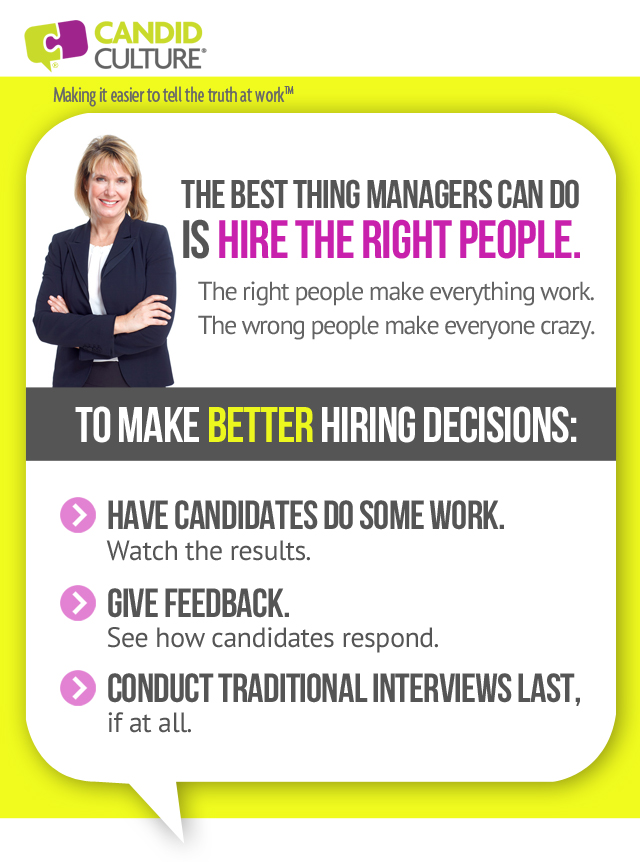
Want to spend less time managing performance issues? Hire the right people. The right people make everything work. The wrong people drain your time, patience, and resources.
Instead of spending 60-90 minutes doing in-person interviews, which tell you little, give candidates a chance to experience the job, and see how they do. I used to conduct thorough, in-person interviews. I’d ask a lot of questions, and I still hired the wrong people. And as a result, we’ve changed our hiring practices at Candid Culture. We no longer do traditional, in-person interviews after phone screens. Instead, we watch candidates do parts of the job. Then we decide if we want to talk with them further.
Too many companies spend too much time interviewing candidates they won’t hire. You might have multiple employees interview a candidate. It’s not uncommon for candidates to meet six or seven people and spend an entire day interviewing. The ultimate decision maker(s) often interviews the person last, cuts the candidate, and thus wasted her employees’ and the candidate’s time. If you want your employees to be involved in the hiring process, have them interview only the candidates the decision maker(s) would be willing to hire. Why waste everyone’s time?
Here Are Seven Interviewing Techniques to Make Better Hiring Decisions:
Interviewing Techniques Number One: Consider hiring a recruiting firm to source and screen candidates. Reading 100 resumes is likely not how you want to spend your time.
Interviewing Techniques Number Two: If you choose not to outsource recruiting, create a few steps for candidates to follow when applying for a job with your company to weed out the people who aren’t serious. It’s better to see 20 resumes from serious candidates than 100 resumes from candidates who potentially aren’t really interested in your company.
Interviewing Techniques Number Three: If you’re sourcing and screening your own candidates, conduct thorough phone screens. Assess culture fit and candidates’ ability to do the job, and eliminate candidates who don’t meet your criteria.
Interviewing Techniques Number Four: Schedule in-person interviews with the candidates you’re interested in. Tell candidates they’ll be participating in a practical interview during which they’ll get to do parts of the job, so they can see if they’ll enjoy the work.
Interviewing Techniques Number Five: Have candidates do some of the work, observe them and/or the work they produce, and provide some positive and improvement feedback. If, after observing candidates do some work, you think they can do the job, and the candidate accepted your feedback without becoming defensive, conduct an in-person interview. If you don’t think they can do the job, end the interview.
During interviews, I screen for a candidate’s willingness to accept coaching and feedback. People who aren’t coachable or open to feedback are exhausting and difficult to work with.
Interviewing Techniques Number Six: If you’re interested in a candidate after both the practical and in-person interview, conduct detailed reference checks. Never, ever skip the reference check.
Interviewing Techniques Number Seven: Lastly, if you’re going to extend an offer, ask your finalists to spend a day or half a day job shadowing. Candidates and employers are on their best behavior during an interview and become more relaxed outside of the traditional interview. You want candidates to get a feeling for what it’s really like to work in your organization. Culture fit is the hardest thing for candidates and hiring managers to predict. Job shadowing helps.
Slow down your interviewing, be more thorough, and make better hiring decisions.
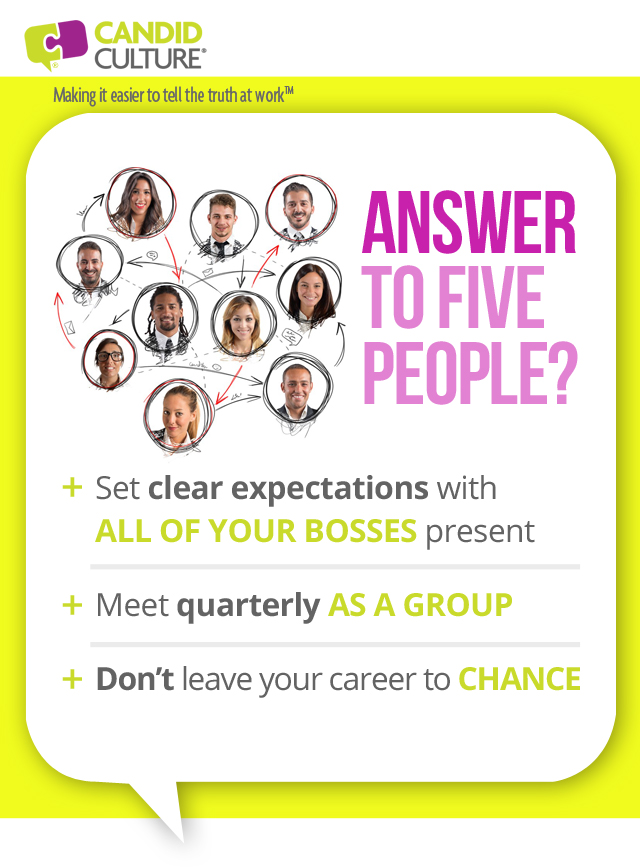 Working in a matrix management structure often means being accountable to several people/having multiple bosses, and having lots of accountability without much authority – both challenging. The key to making a matrix management structure work is lots and lots of good communication.
It’s not uncommon for people working in a matrix management structure to be frustrated. People with dotted line employees or managers often say they’re unsure of who they really work for, who to go to with challenges and needs, and that they don’t have the authority to lead people or processes. All of these frustrations are avoidable and manageable.
If you work in a matrix management environment and are thus accountable to multiple people, take charge of the management structure by asking the questions:
- Who is my ultimate boss?
- Who has input on my performance feedback and review?
- Who writes my performance review?
- Who decides on raises and promotion opportunities?
- Who do I go to when I need help?
Request:
- Quarterly (at a minimum) joint meetings with all the managers you answer to
- That all the managers you’re accountable to provide input on your performance appraisal
- That all the managers your report to participate in your performance discussion(s)
Follow the same practices for people who dotted line report to you. If you’re accountable for someone’s results, but you’re not his/her direct supervisor, ask for quarterly meetings with the employees’ boss. Ask to participate in the appraisal process, and keep the lines of communication between you, the employee, and the direct supervisor transparent and open. Talk regularly. Agree on who sets expectations and gives feedback. Be sure you know your role and the direct supervisor’s role.
The key to making a matrix management structure work is:
- Everyone knows who does what and who has what authority
- Joint meetings happen regularly
- Expectations are clear
Ask more. Assume less.

Several years ago I hired a vendor that wasn’t a good fit. Try as we might to work together, we didn’t communicate well. Everything was a struggle. After a frustrating few weeks, the owner of the business offered to refund my money and amicably part ways. His company had already done work on our behalf and I didn’t want to lose momentum. I turned him down. That was a mistake. When a small business owner, who needs your business (money), tells you to go elsewhere, listen. We parted ways a few months later in a much more costly and less amicable way.
You don’t want to work with people who don’t want to work with you. The same is true for friends and romantic relationships. Don’t chase people. If they don’t want you, move on. There are lots of other people who will see your value.
There are differing schools of thought on whether or not you should try to retain unhappy employees who quit. I’d be interested in seeing statistics on how long employees who quit but are then retained, stay with an organization and how well they perform. I’d let them go. Again, you don’t want people who don’t want you.
The challenge is that most people are afraid to speak up in organizations and relationships (of all kinds) when they’re unhappy. Unhappy employees typically quit versus make requests and give feedback.
The antidote is to create a culture in which employees, vendors, and customers openly make requests and talk about what is and isn’t working. Create a climate of candor in which feedback is exchanged regularly versus just during exit interviews, which is too late.
How to know when to cut bait with unhappy employees and vendors:
- You’ve had several open discussions and can’t meet each others’ needs. If you don’t have a job the employee wants, that’s a good reason to part ways.
- It’s not a good culture fit. You talk and talk but don’t communicate. Issues don’t get resolved. Frustration is the norm. This is also a good reason to end a working (or personal) relationship.
Five steps to create a more candid culture:
- Discuss employees’, customers’, and vendors’ needs and requests at the beginning of working relationships. Agree upon what success and a good job looks like. Ask lots and lots of questions, and listen closely to the answers.
- Ask for feedback regularly. Conduct a weekly plus/delta (a discussion of what is and isn’t working) during which all parties are invited and expected to speak freely. The more you have these discussions, the easier they will be and the more candid people will become.
- Address challenges as they come up.
- Discuss challenges that can’t be fixed.
- If a relationship isn’t working, end it sooner rather than later. Be slow to hire and quick to fire.
There are lots of talented vendors and employees. Find employees and suppliers who are easy to work with (for you) and who can meet your needs, and vice versa. If you can’t meet each others’ needs or the relationship is a constant struggle, those are good reasons to move on. Don’t chase.

 Every time I ignore the red flags I see when interviewing a candidate, or when I feel an employee is struggling, or a project is off track, I pay the price. Every single time.
You interview a candidate whose commute will be 75-minutes each each way, but she says she likes to drive. Sure, until it snows. Move on. You haven’t gotten an update from a project team in over a month, but this group is typically reliable, so things are probably fine. Check in. Even the most diligent employees need accountability and attention.
They call them red flags for a reason. If you suspect a problem, there likely is one. Don’t just wait and ‘see how things go.’ Make a hard decision, get more information, or get involved. Wait and see is often a recipe for disaster.
Sometimes we don’t get involved because we don’t have the time or want to focus on other things. Other times we just don’t trust or listen to our gut.
Trust yourself.
I usually know what I want and need to do, both personally and professionally. Yet I tend to ask LOTS of people for their opinions of what I should do. I solicit advice from friends and colleagues, and in the end, I usually do whatever I want. Why not just trust that I know the right thing to do and just do it? Dad, are you reading this? See, I listen. My dad tells me all the time to stop soliciting opinions, I often ignore anyway, and just act.
Here are a six steps you can take to help listen to yourself and ensure you don’t overlook or ignore red flags:
1. Become very clear about your desired outcome. Decide what you want.
2. Eliminate distractions. Get quiet, aka, still your mind.
3. Think about the situation at hand. Weigh the facts and your options.
4. Decide without belaboring.
5. Act on your decision.
6. Don’t look back. Your initial decision is usually the right one.
Trusting and listening to ourselves can be hard. Perhaps it’s the fear of making a mistake or being wrong. Chances are you’re right. So pay attention to the red flags, trust yourself, and listen to your gut.
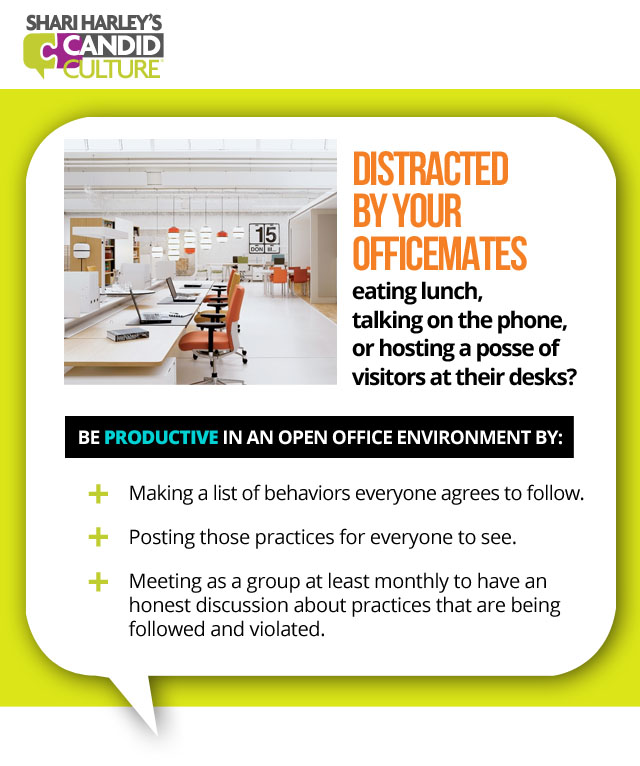 Many organizations have moved from cubeland to open plan offices in which employees sit in rows of desks with no barriers between them.
There’s considerable research on the workability of open plan offices. Some of what’s written says that introverts do worse than extroverts in an open plan office. I disagree. I’d say that how a person learns/takes in information determines how well she’ll do in an open plan office.
If you’re a visual or kinesthetic learner who learns by seeing or doing, you’ll be less distracted by noise than an auditory learner who learns by hearing. Auditory learners hear everything and are easily distracted by talking, music, and other noise. Visual and kinesthetic learners often don’t hear distractions, so they do better in an open plan office.
Here are seven steps to make an open plan office a more productive environment:
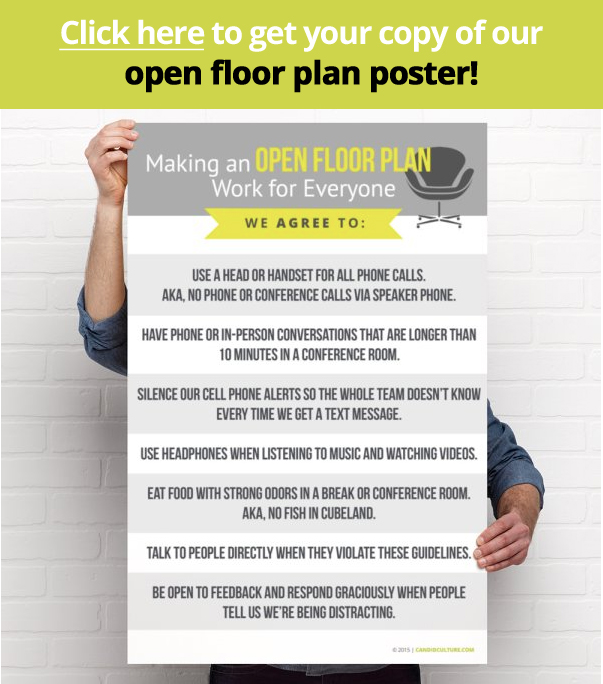
- Schedule a meeting during which people sitting together can discuss the working environment they need to be satisfied and productive. Then facilitate a discussion during which the group creates 5 – 7 behavior guidelines each person agrees to follow when at their desks.
- Post the list of agreed-upon behaviors on a poster that is large enough to be read from any place in the work environment. Leave the poster up indefinitely.
- Give each person in the group permission to talk to individuals who violate the guidelines. This is very, very important. For the most part, employees won’t tell another person she is talking too loudly, eating food that smells, has too many visitors at her desk, listens to music or videos without headphones, or takes phone calls via speaker phone. People will suffer in silence and choose to work from home or in an empty office or conference room rather than speak up about the behaviors that frustrate them. Ask the group to grant each other permission to speak up when guidelines are violated. Giving each other permission to speak up will make future conversations possible – difficult but possible. Without permission and these agreed-upon behaviors in place, people will suffer in silence or talk about each other, not to each other.
- Ask everyone in the work group to take feedback graciously, responding with “thank you for telling me,” rather than with defensiveness.
- Two weeks after making the list of guidelines, get the group together to review the list and make any necessary changes to it. Discuss behaviors that were omitted, aren’t realistic, and are realistic but aren’t being followed.
- Then follow up by facilitating a monthly conversation during which group members give honest feedback about which guidelines are being followed and which are not, and problem solve as a group. These conversations aren’t a chance to embarrass or call people out in a group setting. If one person is violating a guideline, that conversation should happen individually.
- You will need a strong facilitator for the group discussions. The facilitator must tease out people’s thoughts, while making sure no one gets blasted in front of the group. Don’t let concerns that you know exist be brushed under the rug. Group members must openly and regularly discuss what is and isn’t working about their work environment, or frustrations will build and unhappiness and dissension will ensue.
It’s not too late to put these practices in place, even with a group who has been sitting together for a long time. Just schedule the conversation and explain why you’re having it. People will be relieved and grateful.
Working in an open plan office is challenging. It requires good communication and compromise. Don’t wait for problems to occur and frustrations to build. Have a conversation today.
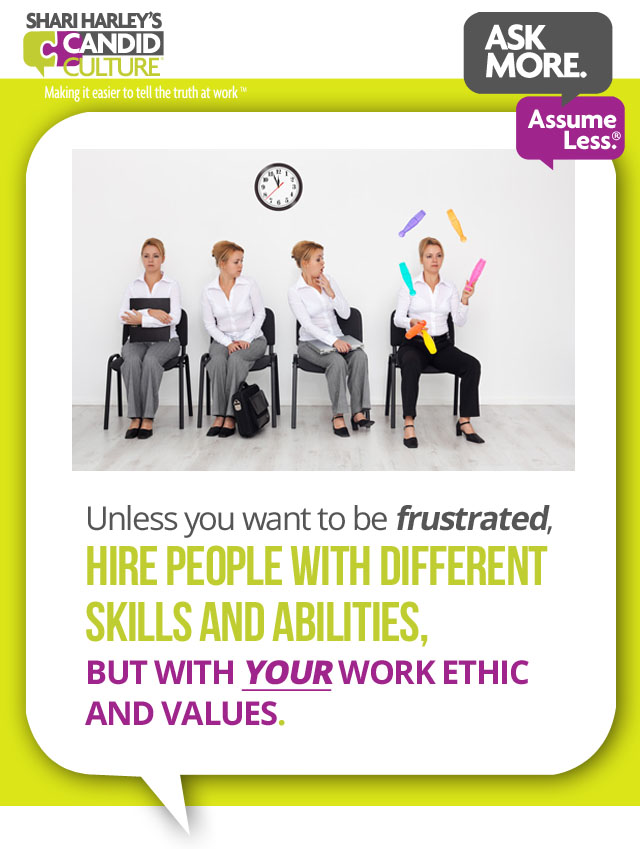 Most hiring best practices tell you not to hire people like you, and instead create diversity in your workforce by hiring people different from you. And that’s sort of true. You should hire people with different skill sets, experiences, and ways of thinking. And you should hire people with a similar work ethic and values, or you will consistently be frustrated.
Here’s what I mean: If you live to work and hire people who work to live, that’s a values difference. If your view of what is reasonable regarding expected hours worked is different from your employees, that difference will cause conflict. If, like in our company, you value open, candid communication, but your employees can’t or won’t speak honestly, that’s going cause frustration. And these values and practices won’t change. Trust me.
The question is how to identify candidates’ values and work ethic before you hire them.
Here are a five hiring tips to ensure you hire people who reflect your values and work ethic:
Hiring tips number one: Describe what it’s really like to work for you and your organization. Don’t sugar coat the bad stuff. Tell the truth. Candidates will find out eventually. If the negatives of the job are deal breakers, your new employees will leave anyway.
Hiring tips number two: Check references. I’m shocked at the number of hiring managers who don’t check references. You might think that references have been so well trained to say nothing incriminating, that making the call is a waste of time. This couldn’t be further from the truth. Be personable, make friends with the reference, ask innocent sounding questions, and references will tell you everything you need to know.
Hiring tips number three: Require candidates to jump through some hoops during the interview process. Ask candidates to invest time doing a little of the work they’ll do on the job (this is called a Practical Interview, something way too few hiring managers do) and observing people work in your office. If candidates aren’t willing to invest this time, cut them.
Hiring tips number four: Ask how many hours candidates want to work and candidate’s preferred work hours, and believe what they tell you. If someone wants to work 35 hours per week and your culture is 50 hours a week, no matter how much your new hire wants and enjoys her new job, she doesn’t want to work 50 hours a week, and won’t do so for very long.
Hiring tips number five: Don’t ignore red flags or your instincts. If you think, “I have some concerns, but let’s see. Maybe it will work out.” Run the other way. It won’t work out. You’ll end up cutting that employee after months of training and coaching, or s/he’ll end up cutting you. It’s faster, cheaper, and easier to wait to hire until you find the right person.
Hiring rule of thumb: Be slow to hire and quick to fire.


People like certainty. We feel more comfortable knowing than not knowing. Not having an answer is uncomfortable. And looking for answers requires work. But sometimes knowledge is the enemy and the death to innovation in the workplace. If we know how something or someone is, there isn’t much of a reason to look for different and possibly better answers. But sometimes we don’t know what we don’t know.
Companies want to be innovative, creative and agile. And that’s good. A lack of innovation is surely the route to long-term failure. For example, a company is at the top of its game. It sells a product that is better than everyone else’s and becomes complacent. Relying on its past success, the successful company creates nothing new for five years, while up-and-comers are creating better solutions. Before they know it, the successful company is obsolete.
On a smaller scale, but equally damaging to innovation in the workplace, is hiring and retaining employees who don’t regularly ask the questions:
- Why do we do this this way?
- Is there a better way to do this?
- What don’t we know that we don’t know?
If you want innovation in the workplace, you need to hire people who are curious and think critically.
People who are curious and think critically have a few key qualities. Curious and critical thinkers are:
- Secure
- Self-confident
- Coachable
- Not afraid to ask questions
- Not afraid to be wrong
Identifying these qualities in candidates is challenging. I’ve interviewed and hired many people who seemed quite self-confident and coachable during the interview process, but once they began working, it quickly became apparent that they were neither. If you want people who will execute an existing process that works, non-critical thinkers are effective employees. If you want people who will consistently challenge the status quo, you should let insecure and people lacking curiosity go, as soon as you see the signs.
If you want innovation in the workplace and want your organization to stay current and competitive you need to have employees who aren’t afraid to consistently ask the question “why. Incorporate status-quo busting questions into your meetings. Create rewards and recognize people who risk trying to fix a problem or create something new.
Train employees to ask these questions:
- Why do we do things this way?
- Why did this happen?
- What questions have we not asked?
- What would happen if we did _______?
As always, you get what you ask for. What are you asking for?