Leading Organizations Archive
I could give you a list of fifty employee retention strategies you could follow to improve employee performance, engagement and retention. But the truth is, there are really just four things you must do. Employees may appreciate the other 46 things but don’t necessarily need them to stay with your organization and do their best work.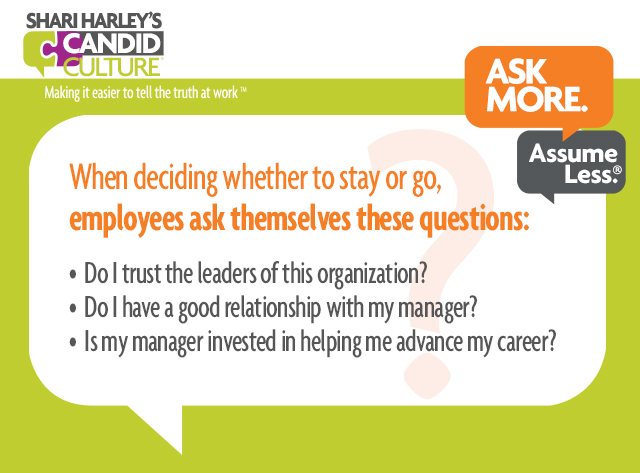
The Colorado Society of Human Resource Management hosts an annual Best Companies competition, and organizations of all sizes compete. Last year I led a workshop before the awards ceremony. The purpose of the workshop was to share the things that make an organization a great place to work. While researching the program, the things that separate the great companies from the less desirable places to work became very clear. I’ll share those employee retention strategies here.
Employees ask themselves these questions at work:
- Do I trust the leaders of this organization?
- Does my opinion/voice matter in this organization?
- Do I have a good relationship with my manager?
- Is my manager invested in helping me advance my career?
Employees enjoy yoga, concierge service, espresso, and social events at work, but these perks don’t necessarily improve retention or performance. The only perk known to improve employee loyalty and commitment is a flexible schedule. Everything else is nice to have, but not essential.
This is what’s really important to your employees:
- I trust the leaders who run this organization.
- My opinion means something. I am listened to.
- I feel respected (by my manager) and have good relationships in the organization.
- My work is challenging and interesting.
So what should you do if you want to be a best place to work?
Four Employee Retention Strategies Leaders Can Use to Create Relationships with Employees at All Levels:
1. Know employees’ names, talents & career goals.
2. Be visible. Talk to employees.
3. Give more information than you think you need to. Employees want to know how your organization is performing.
- Hold town hall meetings. Give financial updates.
- Use ‘Ask the CEO’ boxes to encourage questions and feedback.
- Encourage senior leaders to conduct small, roundtable discussions with employees at all levels.
4. Align leaders’ words and actions.
- Organizational guidelines are applied consistently among all employees.
- Don’t gossip or chuck other leaders under the bus.
- Be consistent. Don’t say, “The CEO says this, but we’re going to do this instead.”
Four Employee Retention Strategies Managers Can Take:
1. Meet one-on-one with employees and have meaningful discussions about employees’ performance and career goals.
2. Ask employees for their opinion and demonstrate that you’ve heard them.
3. Provide opportunities for employees to do work they enjoy.
4. Ensure employees who want to advance in your organization are learning and growing.
Read about our Be a Great Place to Work leadership training program designed for Senior Leaders and HR Professionals.
For the most part, people are afraid to speak up at work. Despite the town hall meetings and roundtable discussions executives host, the feedback training offered, the existence of ask-the-CEO email addresses and blogs, and employee satisfaction and engagement surveys, many employees are still afraid to give feedback at work, citing fear of damaging relationships, being fired, and other forms of retaliation.
Those of you who have worked with me, read How to Say Anything to Anyone, and/or used our tools, know that I am on a quest to make it easier to tell the truth at work.
The Candid Culture Vision:
- Coworkers, leaders, and managers set clear expectations before problems occur. No one has to guess what is expected of them and what a good job looks like.
- Employees ask for and receive regular, balanced and candid feedback and always know where they stand performance wise.
- Managers and leaders are open to and ask for feedback. They always know what’s really happening in the organization and can lead accordingly.
- People talk to each other versus about each other. Gossip and drama is the exception, not the norm.
- Work is a fun place to be. People enjoy working together and produce their best work.
Many of you are taking actions to create the environment I’ve described above. I want to hear from you and want to use this blog to share practices for creating more candid communication at work.

Add a comment and tell us:
- What you are doing to increase the trust and communication in your organization.
- The avenues you are using to give feedback on your team, in your department, or in your entire organization.
We’ll enter you to win 50 of our new door tags. The door tags were designed to tell your coworkers that your office is a place they can speak freely, without concern.
 Many year-end performance reviews include whatever the manager and direct report can remember happening during the last six to twelve weeks of the year. For the most part, managers and direct reports sit in front of blank performance appraisals and self-appraisal forms and try to remember everything that happened during the year. The result: A vague, incomplete performance review that leaves employees feeling disappointed, if not discounted.
If you were disappointed by your performance review this year, don’t let it happen again next year. Take charge of your career by writing your own goals.
One of the first companies I worked for did the goal process so well, I learned early in my career how powerful well written goals could be. Each employee set five to seven goals. Experienced employees wrote their own goals and then discussed those goals with their manager. Less experienced employees wrote their goals with their manager. Managers wrote goals for inexperienced employees. The goals were so specific and clear that there could be no debate at the end of the year whether or not the goal had been achieved. It was obvious. Either employees had done what they said they would, or they hadn’t. This made writing performance appraisals very easy. Very little on the appraisal was subjective. And this gave employees a feeling of control over their year and performance.
It’s great if you work for an organization or manager who works with you to write goals. If you don’t, write your own goals and present them to your manager for discussion and approval. Managers will be impressed you took the initiative to write goals and will be thankful for the work it takes off of them.
Goals should be simple and clear. It must be obvious whether you achieved the goal or not. There should be little if any room for debate.
Sample goals are below.
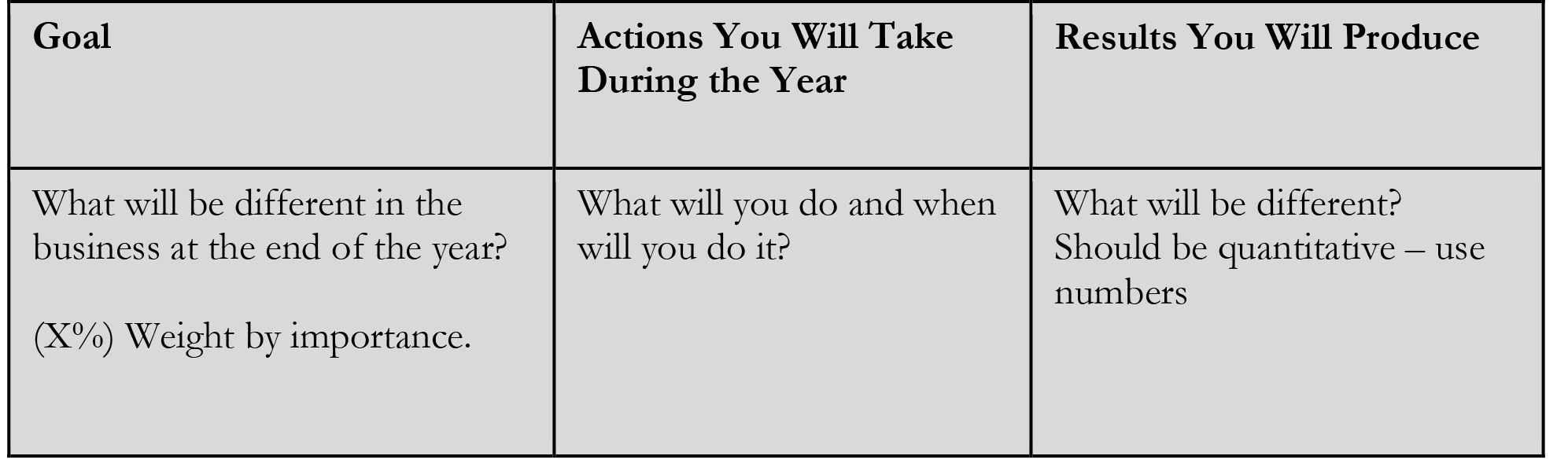
Desired Outcome (goal):
• Improve client feedback – too vague
• Get better written reviews from clients – better
• 80% of clients respond to surveys and respond with an average rating of 4.5 or above – best
Actions you will take to achieve the goal:
• Ask clients for feedback throughout project — too vague
• Ask clients for feedback weekly – better
• Visit client site weekly. Talk with site manager. Ask for feedback — best
Goal template:
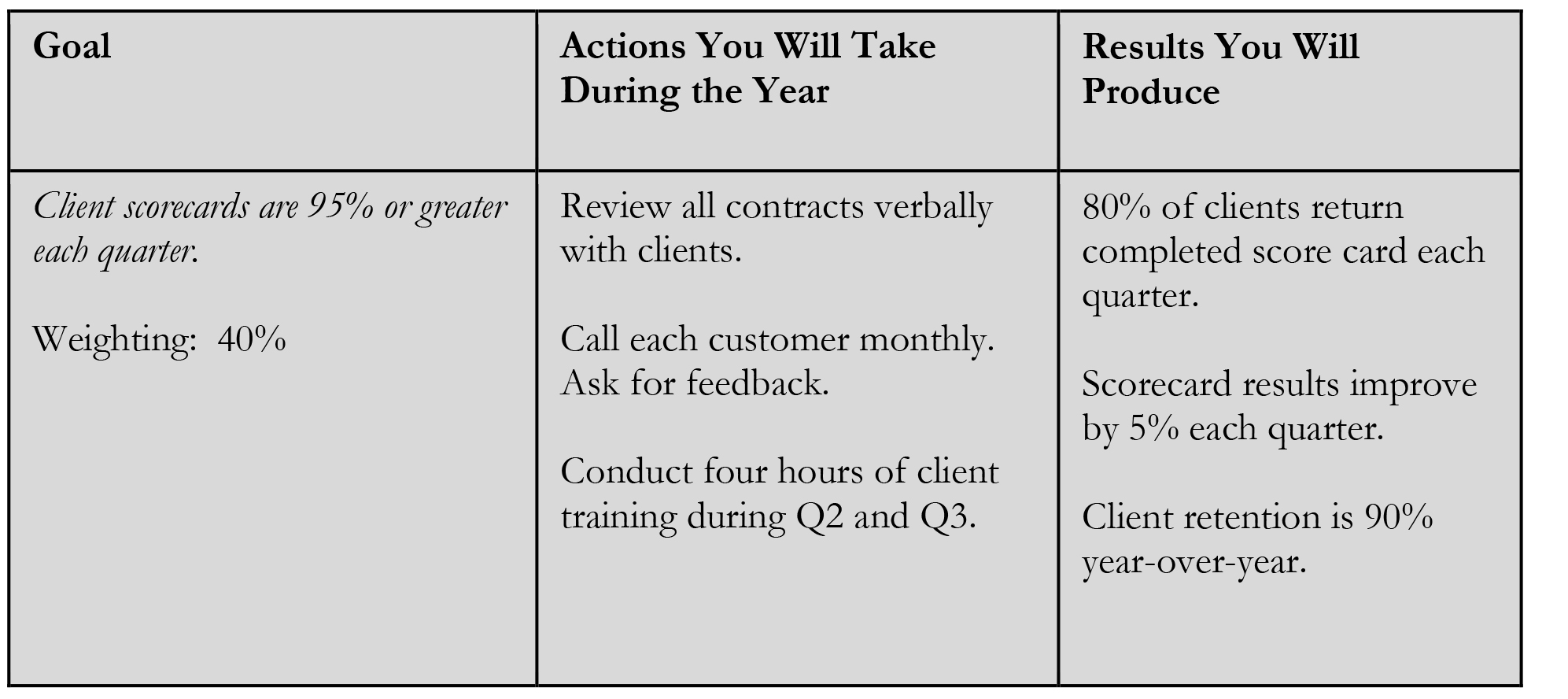
Completed sample goal:
How to approach your manager with written goals:
Try using this language with your manager: “I want to be sure I’m working on the things that are most important to you and the organization. I’ve written some goals for 2014 to ensure I’m focused on the right things. Can we review the goals, and I’ll edit them based on your input? And what do you think of using the agreed-upon goals to measure my performance in 2014?
You have nothing to lose by writing goals and presenting them to your manager. You will gain respect from your manager, clarity of your 2014 priorities, and more control of your year-end performance review. Give it a try, and let me know how it goes.
If you want more feedback from your manager, ask these questions.

 My last few blog posts focused on giving feedback. The posts were designed to help managers get ready to write and deliver performance appraisals.
Giving feedback will always be hard. No one wants to hear that she isn’t doing a good job, thus no one wants to tell her. Part of the performance appraisal process is setting expectations for the next year. And asking for what you want, before problems happen, will always be easier than giving feedback.
If you’ve seen me speak or attended one of our training programs, you received a list of Candor Questions designed to eliminate the guessing at work. They may have been questions for leaders, managers, strengthening business relationships or managing careers. Regardless of which Candor Question Cards you received, the goal is the same. Ask more. Assume less.
The most frequent request I get is for feedback training. Managers tell me, “The communication in our company isn’t good. Can you help our managers and employees be more candid?” And I tell business leaders, “I teach people to be more comfortable giving feedback. But why start with something hard? Why not start by asking more questions and getting to know people better, which is much easier and will reduce the number of feedback conversations you need to have?”
When we know what people expect, we can give people what they need. We make fewer ‘mistakes’, requiring fewer feedback conversations. So start with what’s easy. Ask more questions.
Start with what I call Introductory Candor Questions:
- How do you like to receive information – email, voicemail or text message?
- Are you a detail-oriented or a big-picture person? How much information do you want to receive and in what format?
- What are your pet peeves at work? What would I do that would be frustrating, and I’d never know it?
Then move on to Candor Questions for Managers:
- What had you choose to work here, and what would make you question that decision?
- What kind of work do you love to do most? What kind of work do you like to do least?
- What do you wish I would start, stop, and continue doing?
You can download samples of our seven types of Candor Questions here.
People are not us and don’t do things the way we do. Don’t assume someone will create a report as you would, participate in a meeting as you would, or dress for an event as you would. Setting expectations before the event of what you want, gives them a chance to be successful.
Giving Feedback is Hard – Asking for What You Want is Easier. By Shari Harley.
 I had a colleague at my last job who was a peer and a friend. We were at a similar level and would periodically sit in one of our offices, with the door closed, talking about the bad decisions our company’s senior leaders made. One day I realized that these conversations were exhausting to me. They were negative and didn’t make me feel better. In fact, they made me feel worse.
Some people distinguish between gossip and venting, asserting that venting is cathartic and makes people feel better. It doesn’t.
I’ll use an analogy I read in one of Deepak Chopra’s books. When you put a plant in the closet and don’t give it light or water, it withers and dies. When you put a plant in the sunlight and water it, it grows. And the same is true for people. Whatever you give attention will proliferate. Whatever you deprive attention will go away.
Your life is made up of the people you spend time with and what you talk about. What are you talking about?
In addition to draining you of energy and ensuring you focus on the things that frustrate you, gossip in the workplace kills the organization’s culture. If employees can’t trust that their peers won’t talk about them when they’re not there, there is no trust in the organization. And you can’t have real relationships without trust.
Gossip isn’t going anywhere. It’s a human phenomenon and is here to stay. But you can reduce gossip.
A few ways to reduce the gossip in the workplace:
- Address the gossip head on.
“I’ve been hearing a lot of gossip, which is not good for our culture.”
- Hold regular town hall meetings, and give employees information about initiatives, organizational changes, profitability, etc. Employees want to know how the company is really doing and what they can do to contribute.
- Create a no gossip in the workplace policy.
“We want people talking directly to each other, rather than about each other. As a result, we’re putting a no gossip policy in place.”
- Draw attention to gossip.
“Every time you hear gossip, wave two fingers in the air.” This will draw attention to the gossip in the workplace without calling anyone out.
Also, ask your peers and friends not to gossip with you. End conversations that contain gossip. This will be hard to do, but if everyone does it, it will become much easier.
- Have an agreed-upon consequence for gossip.
“Every time we hear gossip in the workplace, the gossiper owes a dollar. Every quarter the gossipers will buy the office lunch from the gossip jar.”
The keys to reducing gossip in your office are to draw attention to the gossip, have a consequence for gossiping, and over communicate so your employees don’t have to make stuff up. Employees want to know what’s happening in the organization. In the absence of knowledge, people make stuff up, and it’s never good.
Venting and gossip are the same. Unless you’re planning a conversation with a coworker or friend to address a challenge or problem, you’re gossiping. And talking about what frustrates you will only make you more frustrated.
My advice: Do something about the things you can impact and let the other stuff go. Talk about the things that matter to you. Resist the temptation to speak negatively about the people around you. And know that anyone who will gossip about someone to you, will also gossip about you.
 Many organizations spend more money than they have to on employee recognition gifts and appreciation programs that often involve bonuses, paid time off, contests, gifts, and other expensive forms of compensation. What employees want most is to know they’re doing a good job.
Giving feedback in the workplace is the cheapest, most effective, and often overlooked form of employee recognition. Employees want to know how they’re performing, and most employees get little to no positive or constructive feedback at work. They may not want to hear negative feedback, but employees want to know if they aren’t meeting expectations.
In one of Candid Culture’s training programs, I give participants a box of questions to help coworkers set expectations and improve workplace communication. Some of the questions include:
- Do you prefer to receive information via email, voicemail, or text message?
- Are you a big picture or a detail person?
- What are your pet peeves at work?
- What type of work do you like to do most? What type of work do you like to do least?
- What do you wish I would start, stop, and continue doing?
I am consistently amazed at how often training participants ask what their coworkers wish they would start, stop and continue doing. I assume employees will be hesitant to ask for constructive feedback in front of a group of peers. But training participants consistently tell me that they get almost no positive or constructive feedback at work, and they’re desperate for the information.
Here’s How to Celebrate Valentine’s Day at Work Without Spending Money:
- Give clear, specific, and timely positive and negative feedback. Employees want to know how they’re performing.
- Ask what type of work employees really want to do, and let them do that work most of the time.
- Ask what skills employees want to learn, and give them a chance to attain those skills.
- Write hand written notes of appreciation.
Employees at Candid Culture get their birthdays off paid. We often buy employees lunch, give bonuses, and have a generous time off policy. Those perks are important and do help retain employees. But monetary rewards never replace or supersede the value of being aware of employees’ performance and caring enough to tell employees the truth.
No matter how much you like and get along with your boss, your boss is not your friend. Nor is your boss your confidant or venting buddy.
Unless your boss follows you around all day, every day, she is not aware of all the things you do at work. And if she does follow you around, she probably needs more to do, which I doubt.
Given that your boss often doesn’t see you work, the only exposure you may have to each other is during one-on-one and group meetings. So be careful how you behave during these meetings.
I’ve made lots of career mistakes . . . once. Here’s a mistake I made before launching Candid Culture. I’m hoping you won’t replicate it.
In my last job, I was lucky enough to have a great boss. He was a good coach and mentor. He supported me, gave me exposure throughout the company, and always had my back. We didn’t cross paths much at work, except during our regularly scheduled one-on-one meetings.
I’m what some might call passionate. I have a strong sense of what is right and what is wrong. And I can be critical of those who I think don’t do the right things.
I would often share my frustrations with my boss. The head of that department didn’t do this. This person made a bad call. So and so was making my employees’ lives hard. I wasn’t complaining, well I kind of was, but not without a purpose.
One day my boss called me out on my passionate (and at times critical) style. He said that if I was so impassioned during meetings with him, he assumed I was equally vocal in meetings with other people and departments.
This wasn’t the case. I was very careful in how I managed myself with other people in our company. I understood the importance of good business relationships and knew that people work with the people they want to work with and around the people they don’t.
But my boss didn’t get to see any of those interactions. For the most part all he saw was how I interacted with him during our meetings. With no other point of reference he was left to assume that if I vented with him, I did this with other people. If I got a little too soapboxish about an issue with him, I must do the same in other meetings. I didn’t do those things with other people, but he had no way to know that.
My boss and I had a good relationship and I felt comfortable with him, probably too comfortable. I was politically savvy with everyone but him.
Your boss is an appropriate person with whom to express frustration, but manage how you do it. Don’t vent to vent. Every topic you raise should be with the aim of problem solving. Keep things honest but positive. Vent and complain at home, or with someone who doesn’t know the people you work with. Or better yet, spare your friends and family, and take your frustration to the gym, or the shoe department, whatever your preferred form of therapy.
Assuming you have limited exposure to your boss, make the time you have with her count. Put in front of your boss only what you want her to see. I’m not saying to be disingenuous or brush problems under the rug. Speak candidly, but manage yourself with your boss as you would with any internal or external customer.
If you stayed out until two in the morning and you’re dragging the next day, your boss doesn’t need to know that. She will assume you’re not on your game that day and that will be a check mark in the negative category for lacking good judgment and commitment to your job and the company. If you had a bad date, your boss doesn’t need or even want to know. If you think someone you work with is a dolt, ask for help in how to work well with him, and keep your opinion of his acumen to yourself.
Your boss has limited time and exposure to you. Manage yourself by showing him your polished and professional self.
Indecision plagues many of us at work.
- Hire the person or source additional candidates?
- Let the employee go or keep him?
- Launch the software implementation or wait?
- Gather more technical requirements or move forward with the information you have?
- Ask for different responsibilities or look for a job?
- Announce upcoming organizational changes to all employees or just to the leadership team?
We meet and discuss, meet some more, discuss some more, and still don’t decide. Endless meetings, discussions, and indecision exhausts and discourages employees and costs money.

Do your due diligence:
- involve the people closest to the work in making the decision;
- gather enough information to make an informed decision;
- get key stakeholders’ buy in;
- then decide and act.
And if it’s the wrong decision you’ll know soon enough and can course correct.
The indecision is often worse than making the wrong decision. My friend and colleague Steve Shapiro author of Goal Free Living would say that the only wrong decision is not making one.
But we know there are decisions that have negative consequences, which is why we’re often hesitant to make decisions. If we make the wrong decision families, careers, and companies are impacted.
So we wait and discuss, dialogue, and debate, over and over and over. Follow the steps above regarding due diligence and decide. Don’t wait too long or stay too long. It’s not good for anyone, especially you.
There are things in our lives that bug us, but we put up with them. They’re often little things like a burned out light bulb or a messy drawer in which we dump stuff that doesn’t have a real home. Maybe the bulb has been out or the drawer has been a mess for so long that we no longer even notice it.
Our workplace isn’t any different. There are things in your organization you’re tolerating. Perhaps a process or software is inefficient, but you don’t say anything to the people in your organization who can do something about it. Or maybe you said something a few times, but you didn’t feel anyone listened and you gave up.
Organizations are comprised of doers and leaders. And organizations need both. If everyone wants to lead, you’ll have trouble. If no one leads, you’ll have even more trouble. Doers keep things going from day-to-day. Leaders create opportunities, fix problems, and upgrade existing conditions.
I’m often asked to coach managers in organizations. The coachees’ boss tells me, “He’s a great employee. But if he wants to move up in this organization, he needs to be a leader.” And more often than not, the employee is confused by what the manager wants. Coachees say things like, “I give my opinion in meetings. I volunteer for stuff. What else does my boss want?”
I tell my coachees the most straightforward thing I know to transition from a doer to a leader –improve processes and look for opportunities to fix things that are broken.
Want to know how to become a leader in an organization? Ask these questions regularly:
- What in the organization frustrates people? What could we do differently to ease people’s frustration?
- Where do we have mediocre results? What’s the breakdown?
- Where are we wasting money? Where are our costs too high? Where are we losing revenue?
- What processes take longer than they need to? Or where is there a lack of process?
- Where do we have inefficiencies and redundancies?
- What practices work in one department that could work in another?
Leaders in organizations are always looking for ways to make things better. They look for opportunities and (picking their battles) pursue solutions. Pursuing a potential change does not mean asking your boss or department leader once or twice. It means telling someone in a position of formal authority about a missed opportunity, asking permission to make a change, and then doing the work required to make it happen. Leaders do not tell their boss about a problem and walk away. Leaders suggest and implement a solution.
A few weeks ago I flew an airline whose employees were universally nasty. Every person I interacted with –from the person who checked me in for the flight, to the gate agent who scanned tickets, to the flight attendant on the plane–was nasty without being provoked.
There are two reasons why employees in various roles and locations are universally nasty to customers. Either employees feel they are treated poorly by the organization’s leaders, and they knowingly or unknowingly take their frustration out on customers, or there are insufficient expectations for good customer service. Given the competitive nature of the airline industry, I’m going to assume customer service standards are in place, and employees are reacting to how they feel they’re treated by the organization.
Your employees will not treat customers better than you treat your employees. You get what you give. Expecting employees to treat customers better than the employees feel treated is akin to buying subpar building materials and expecting superior construction. It isn’t going to happen.
Your organization’s handbook and customer service training programs can outline explicit instructions for how customers should be treated, but if the practices for treating employees are markedly different, don’t expect great customer service.
This begs the question, what does it mean to treat employees well? Don’t all employees need different things to be happy? What about the differences between Baby Boomers, Generation X, and Generation Y employees?
In my experience people of all ages need many of the same things to be satisfied in a job. Employees want to learn, grow, and feel challenged. They want to work in an environment in which they feel comfortable–they like the people and feel accepted and respected. They want to make a difference and contribute to something bigger than themselves. And they want the flexibility to control their schedule and personal lives. Depending on an employee’s stage in life and career, some of these things become more important than others.
The difference between Baby Boomers, Generation X, and Generation Y: I don’t think each group needs drastically different things to be satisfied at work. In my experience, the key difference between the groups is that Baby Boomers and Gen X’ers will put up with not having everything they want. Gen Y’ers will not. Baby Boomers and Generation X will put up with a boss or job they don’t like for two years, waiting to see if things improve. Millennials are more impatient. If they don’t think they can get what they want from a job or organization, they move on quickly.
The quickest and easiest thing managers can do to engage and retain employees of all ages and stages in their careers is to ask what employees need to be satisfied. And no, employees may not tell you. There is an almost universal and pervasive fear in organizations to speak candidly with one’s manager. But employees definitely won’t tell you what they need to stay with your organization if you don’t ask. And even if employees aren’t candid about their desires, you still get points for asking the questions most managers don’t.
In every leadership, management and coaching class I teach, I ask managers to answer these questions:
• What are your employees’ career deal breakers? What would make your employees leave your organization?
• What kind of work do your employees like to do most? What kind of work do they like to do least?
• So you can provide personalized recognition they’ll appreciate, what are your employees’ favorite
hobbies, foods, and places to eat or shop?
• What are employees’ pet peeves at work?
I’ve asked these questions of thousands of managers, and few can answer the questions. If you can’t, without absolute certainty, answer these questions about your employees, don’t be surprised that you aren’t getting the performance you desire. How can you manage and motivate employees if you don’t know what’s important to them?
The easiest thing to do today to raise employee performance, and in turn improve customer service, is to ask your employees what they need, and when appropriate, give employees those things. If you can’t provide what employees what, tell employees why you can’t honor their requests. Rationale, the answer to the question why not, goes a long way.
You may be wondering, isn’t it worse to ask employees what they want and have to say no, than not to ask at all?” Quite simply, no. Not asking about employees’ needs because we may not be able to tell them yes is akin to the fallacy that if we don’t talk about something it doesn’t really exist.
Employees want what they want, regardless of whether you talk about those desires or not. I’d much rather have an open discussion about not being able to meet an employee’s needs, and know they will job hunt, then be surprised when they quit. If employees’ desires are truly deal breakers, you’ll lose them anyway. If you know what employees want, you can negotiate and attempt to meet some or all of their needs, giving you more control over employee engagement and retention.
Ask what employees need to stay with your organization and be satisfied, and watch performance, morale, and customer service rise.