Career Management Archive
You know when someone gives you ‘the tone’. Similar to when people roll their eyes at you, when you get ‘the tone’ you’re being told that the other person is exasperated.
 Tone of voice communication is one of the hardest things to coach because we don’t hear ourselves. People who give people ‘the tone’ rarely know they’re doing it. One of the best ways I know to effectively coach tone of voice is to ask tone givers to tape themselves during phone calls. Then listen to the recording together and ask the tone giver, “If your grandmother called and someone spoke to her that way, would you be happy?” You can also read written correspondence out loud, adding the tone you ‘heard’, and ask the sender how she would have interpreted the message.
When given the tone, most people feel judged. And when people feel judged, conversations are constrained.
The way to avoid giving ‘the tone’ is to come from a place of curiosity. When you ask the question, “What were you thinking when you approached the customer that way,” you can sound curious or judgmental. Being judgmental evokes defensiveness, which shuts conversations down. Being curious creates discussion.
Consider asking questions like these to invite discussion:
• Tell me more about…
• Help me understand what happened here…
• What are your thoughts about…
• What’s the history behind….
• Why do we do it this way?
Any of these questions will lead to good discussion, if you manage your tone.
If you want to get information or influence someone, ask questions and engage the person in a dialogue. We often try to persuade people by giving them information. This rarely works. Instead of over loading people with data, ask questions which evoke discussion. Through discussion you might get to a different place. And if not, you’ll at least have learned why the other person thinks as he does and you will have shared your point of view in a way that is inviting versus off putting.
It’s easy to give people ‘the tone’ when we’re tired and frustrated. Try to avoid difficult conversations when you’re tired or stressed. Wait to have important conversations until you know you can manage yourself and your tone.
 You’ve heard countless times that you never get a second chance to make a first impression. So when something not-so-positive happens – a customer is upset, you missed a deadline or made an error – don’t let your boss find out about it from someone else. Manage your professional reputation and get there first to create the first impression of what happened.
Managers don’t like surprises. If your manager is going to get a call about something that isn’t positive, let her know before the call comes in. You will create her perception of the situation, and perceptions are hard to change. Don’t wait for the s*** to hit the fan. Get ahead of the problem by coming forward and giving your manager and other stakeholders a heads up.
 It could sound something like this, “I just had a tough conversation with John in IT. You may get a call. Here’s what happened… I didn’t want you to be surprised.”
Or, “I told Brian at Intellitec that we’re raising our prices in the second quarter. He wasn’t happy. You may get a call.”
Or let’s say you’re going to work on a strained relationship. Tell your manager before you take action. It could sound something like this, “I want to work on my relationship with Julie. Our relationship has been strained since we worked together on the software project last year. I’d like to approach her, tell her that I know our relationship is strained, and that I’d like a good working relationship with her. Then I’d like to ask if  she’s willing to have lunch with me, talk about what’s happened, and see if we can start again in a more positive way. What do you think of me doing that? Would you approach the conversation differently? I don’t know how it’s going to go, so I wanted you to know what I’m planning to do, just in case it backfires and you get a call.”
Manage your professional reputation assertively by taking responsibility for mistakes, working on damaged relationships, and telling your manager before someone else does!

Too many people sit at their desks doing their minimal best, while begrudging their boss, organization and current job, hoping that something better will come along. Or people do good work and think that someday someone will notice and they’ll get the role and recognition they deserve.
If you want to advance your career, you must know how to ask for more responsibility at work.
You may be rolling your eyes thinking, “More? I can’t do more. I already work evenings and weekends. I sleep with my phone and haven’t taken a vacation in two years, and you want me to do more?!?!?” Actually I want you to stop sleeping with your phone and take a vacation. But that’s a post for a different day.
When I say do more, I don’t mean do anything anyone asks nor anything your organization needs. Offer to take on more work that is aligned with what you want to do AND is important to the leaders of your organization.
Before starting Candid Culture, I ran an operations unit for a career college. Four years into my tenure with the company, one of my peers left, and his role wasn’t refilled. I felt his department was important to our organization’s success, so I offered to run it, in addition to my already big job.
My new department was a change agent’s dream. I outlined a strategic plan and long and short term goals. I re-wrote job descriptions and org charts. But six months into taking on the department, I couldn’t get one change approved. I was confused and frustrated.
I had initially been hired to turn another department around, and I’d been very successful at getting changes approved. Yet this time, I could get nothing approved. After six months of banging my head against a wall, I finally ‘got it.’ The owners of the company didn’t see the department as valuable, thus they weren’t willing to invest in it.
I’m embarrassed at how long it took me to see this. When my colleague’s senior level job wasn’t refilled and there was no freeze in hiring, I should have known the department wasn’t seen as important.
If you want to know what’s important in your organization, look at where money is being spent. Who is getting resources?
When I say ask for more, I mean be strategic about what you ask for.
Ask yourself these questions:
- What do I want to do?
- Where in the organization are there opportunities to do that kind of work – that is important to the organization’s leaders?
- Who will support me in doing this work? Who won’t?
How to ask for more responsibility at work. Tell your boss and/or department leader:
- I really enjoy working here. I enjoy the people, the work and our industry.
- I’m committed to growing my career with this organization.
- I’m interested in learning more about ________________________.
- I’d love to run ___________________________.
- I think we have some opportunities to make improvements in _____________________.
- How could I get some exposure to ____________________.
- A project is starting in ______________. I’d love to be on the team. What are your thoughts about that? Would you be comfortable supporting my participation? If yes, how can we make it happen? If not, what would you need from me in order to support it?
The work you take on does not need to be high level. Everyone in an organization does grunt work. Just be sure that whatever you offer to do is seen as integral to the future of the organization. You’re not likely to get what you don’t ask for.
Read chapter five of How to Say Anything to Anyone and manage your boss better.

There are several mistakes most professionals make while attending conferences, training sessions, and other networking events. Avoid these common practices, and you’ll get great value from networking events that will more than justify your time away from the office and far exceed the price of attendance.
Business Networking Tips
Mistake Number One: Skipping meals and other social events.
Many busy professionals have a hard time leaving work to attend networking events, conferences and training sessions. We don’t think we have time and may be worried about how our absence will appear, so we spend ‘down time’ at events catching up on email.
Don’t think of time in the exhibit hall, meals, cocktail hours, and other social events as down time. Think of those events as just as important as keynote and breakout sessions. You never know who at the conference has a vendor you’ve been looking for or a solution to one of your challenges.
Mistake Number Two: Talking with the people you already know during meals and social events.
It’s natural and comfortable to sit and talk with the people you know. The problem is, you already have access to those people. You can already call them to ask questions and problem solve. You’re attending the event to expand your network. The more people you talk to, the bigger your pool of potential future job leads and problem solving peers.
Most people are uncomfortable talking to people they don’t know. When you introduce yourself to new people, they let out a sigh of relief. They are grateful that you took the risk of introducing yourself. When you feel nervous in groups of mostly strangers, remember that everyone is nervous.
Mistake Number Three: Introducing yourself by telling people what you do.
“Hi, I’m Lauren Adler. I’m an Accountant” is a show stopper, not a conversation starter. The other person replies, “I’m Mary Guest. I’m an Analyst.” Then the two of you look at each other and wonder how to get out of the conversation. Rather than introducing yourself with your title, ask a question.
Here are a few questions you can ask when meeting fellow attendees:
- What’s one challenge you’re facing in your organization?
- What’s a resource you need, that I might be able to refer?
These questions are much better conversation starters than “Hi, I’m an attorney. What do you do?”
Ask one question, listen to the answer and then ask the next natural question. Provocative questions are a great way to build new, meaningful relationships.
Mistake Number Four: Not ending conversations soon enough.
We’ve all gotten trapped in a conversation and wondered, “How do I graciously get out of here?” When a conversation is over, end it by saying, “It’s been great talking with you. I’m going to meet some other people.” Just be honest. You’re doing both of you a favor by freeing each other up to meet someone new.
Mistake Number Five: Letting groups of people intimidate you.
Break into groups by walking up to a group of people talking and simply ask, “May I join you?” They will say yes. And when you’re ready to leave the group, who probably knew each other before the event, simply say, “It was great meeting all of you. Enjoy the meeting.”
Mistake Number Six: Hanging out by the buffet, in the bathroom, or in your phone.
The buffet cannot hire you.
It’s very tempting to catch up on email or Facebook updates while waiting for speakers to begin and meals to be served. Hiding out in our phones will not get you your next client nor expand your network. It may feel safer and easier to be distracted by your phone during a networking event or to visit the bathroom more than you really need to. Risk a little. Remember that everyone is just as nervous as you are. Approach someone you don’t know, and ask a question.
Much of the reason we attend events is to tap into the collective years of experience of other attendees. Get the maximum value from events by attending all social events and meals, talking with exhibitors and fellow attendees who you don’t already know, and putting away your phone. You never know who has the solution to your greatest challenge or from where your next customer or job offer will come.
No one likes to make mistakes. We want to do good work and have people think well of us.
The key to maintaining your relationships and reputation, when you make a mistake, is to take responsibility and make things right as soon as possible. Saying something wasn’t your fault or becoming defensive will only damage your reputation and relationships. As counterintuitive as it sounds, you will gain respect and credibility by admitting fault and correcting problems.
I often get asked if people lose credibility by being humble – asking for feedback and admitting to making mistakes. It takes strength to ask for and be open to feedback and to admit when you drop the ball. So while it may seem counterintuitive, the more you ask for and respond to feedback, and admit when you make mistakes, the stronger you will appear.
I made a mistake at work. Now what?
When you make a mistake say something like:
“I dropped the ball on that. I apologize. I’ll fix it and let you know when it’s been handled.”
Or, “Thank you for the feedback. This clearly didn’t go as planned. I’ll make those changes and let you know when they’re done.”
Also, let people know the steps you’ll take to avoid similar challenges in the future.
You could say something like:
“Thanks for letting me know that our process is causing your department challenges. We certainly want the process to be smooth. My team will fix this month’s report, so your team doesn’t have to invest more time. We’ll update the process for next month and walk you through the changes before the report is due.”
Don’t provide a bunch of reasons for breakdowns. No one cares. Telling people why something occurred can sound like excuse management. People just want to know things will be made right.
Asking for feedback, taking responsibility, and telling people how you will correct errors may not be your natural or first reaction. The more you can train yourself to do these things, the easier you will be to work with and the better your reputation and business relationships will be.

Click here to download free questions to find out what your coworkers and internal and external customers are satisfied with about your performance and what they wish you would do differently.
 Many year-end performance reviews include whatever the manager and direct report can remember happening during the last six to twelve weeks of the year. For the most part, managers and direct reports sit in front of blank performance appraisals and self-appraisal forms and try to remember everything that happened during the year. The result: A vague, incomplete performance review that leaves employees feeling disappointed, if not discounted.
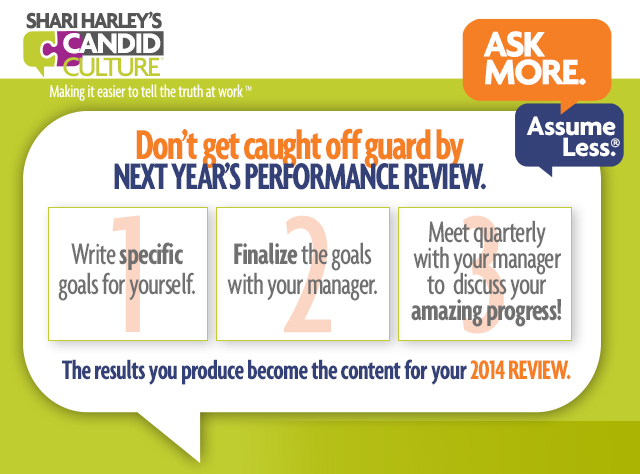
If you were disappointed by your performance review this year, don’t let it happen again next year. Take charge of your career by writing your own goals.
One of the first companies I worked for did the goal process so well, I learned early in my career how powerful well written goals could be. Each employee set five to seven goals. Experienced employees wrote their own goals and then discussed those goals with their manager. Less experienced employees wrote their goals with their manager. Managers wrote goals for inexperienced employees. The goals were so specific and clear that there could be no debate at the end of the year whether or not the goal had been achieved. It was obvious. Either employees had done what they said they would, or they hadn’t. This made writing performance appraisals very easy. Very little on the appraisal was subjective. And this gave employees a feeling of control over their year and performance.
It’s great if you work for an organization or manager who works with you to write goals. If you don’t, write your own goals and present them to your manager for discussion and approval. Managers will be impressed you took the initiative to write goals and will be thankful for the work it takes off of them.
Goals should be simple and clear. It must be obvious whether you achieved the goal or not. There should be little if any room for debate.
Sample goals are below.
Desired Outcome (goal):
• Improve client feedback – too vague
• Get better written reviews from clients – better
• 80% of clients respond to surveys and respond with an average rating of 4.5 or above – best
Actions you will take to achieve the goal:
• Ask clients for feedback throughout project — too vague
• Ask clients for feedback weekly – better
• Visit client site weekly. Talk with site manager. Ask for feedback — best
Goal template:
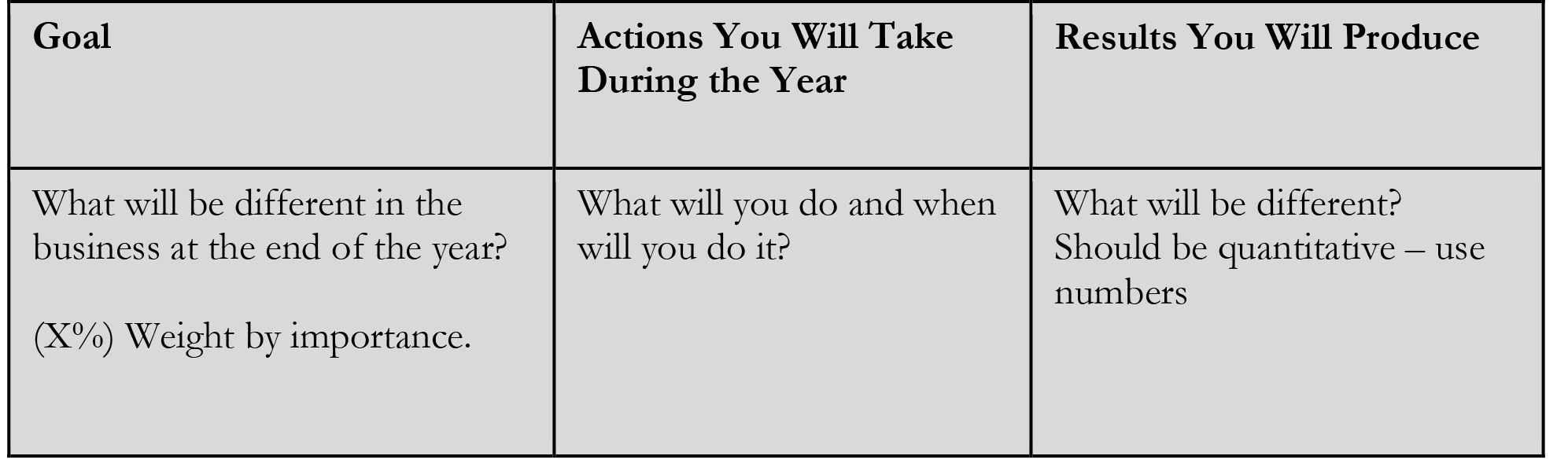
Completed sample goal:
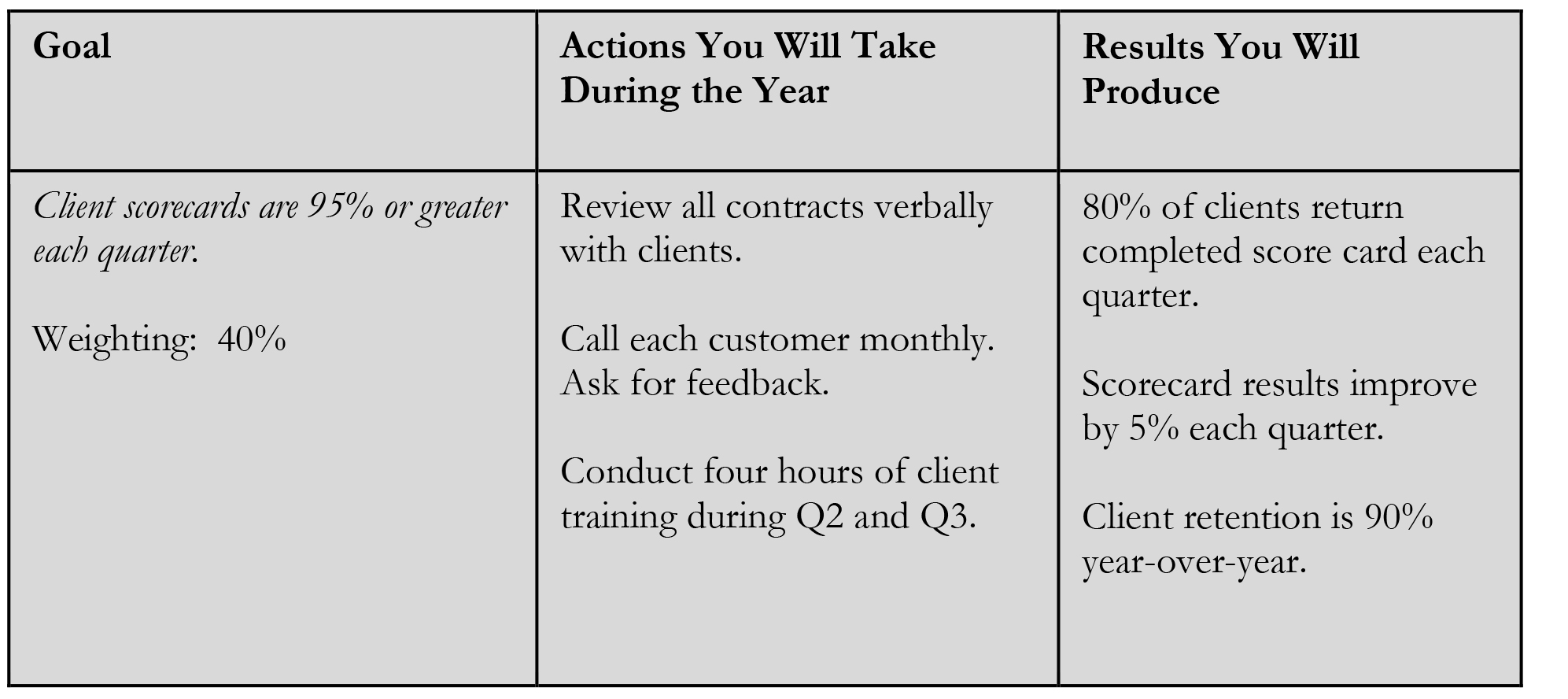
How to approach your manager with written goals:
Try using this language with your manager: “I want to be sure I’m working on the things that are most important to you and the organization. I’ve written some goals for 2014 to ensure I’m focused on the right things. Can we review the goals, and I’ll edit them based on your input? And what do you think of using the agreed-upon goals to measure my performance in 2014?
You have nothing to lose by writing goals and presenting them to your manager. You will gain respect from your manager, clarity of your 2014 priorities, and more control of your year-end performance review. Give it a try, and let me know how it goes.
If you want more feedback from your manager, ask these questions.

Most of the feedback we give and receive puts people on the defensive. We don’t do this intentionally. It just happens. We say how we feel, usually when we’re upset, and the other person responds.
Most of the feedback we give and receive is judgy, like the examples below.
|
Judgy – Not Real Feedback
|
Just the Facts – Actual Feedback
|
| “You ignore me in meetings.” |
“When I raise my hand to participate in meetings, you don’t call on me.” |
| “You’re rude to me.” |
“When you pass me in the hallway, you don’t say hello.” |
| “You won’t work with me. You go around me.” |
“We were supposed to screen potential vendors together. You scheduled and held the appointments without me.” |
| “You’re not responsive.” |
“You usually reply to emails a week after they were sent.” |
| “It’s hard to get time on your calendar.” |
“It takes three weeks to schedule time to meet with you.” |
Becoming defensive when receiving feedback is a hard-wired response, like slamming on your brakes when the car in front of your does the same. The more people feel judged, the more defensive they become. If you want to be sure people become defensive when you give feedback, be vague. If you want people to be able to hear you and take action on your feedback, strip out the opinion (judgment) and give people just the facts.
Referring to the chart above, the sentences on the left are opinions. And opinions can be debated. The sentences on the right are facts. Facts are harder to debate. When giving feedback give just the facts, not your opinion. This will take practice.
The first thing out of our mouths will invariably be judgment/opinion. People who have participated in feedback training with me or who have read How to Say Anything to Anyone know I call the tendency to be vague Cap’n Crunch. Cap’n Crunch: “You’re doing a good job.” That’s sweet but useless.
When someone upsets you and you want to tell the person, prepare for the conversation by asking yourself these questions:
- What did the person do that frustrated me?
- What behaviors did s/he exhibit?
- What actions did s/he take?
- What was the impact on me?
Then practice giving feedback to someone outside of your workplace or group of friends (to reduce gossip and drama) and ask the person with whom you’re practicing what s/he heard. If your feedback is specific and clear, any lay person will interpret the feedback as you intended it.
Giving feedback, that others can hear, isn’t easy to do. It requires you to put your emotions aside, strip out judgments and opinions, and tell the other person the facts of what happened. The more you focus on the facts and less on how you feel about what happened, the better your conversations and relationships will go.
 Coming to work in costume on Halloween? Whatever you wear to work is likely to be captured by someone’s phone and shared . . . widely.
None of these are work appropriate Halloween costumes:
- Your boss
- Your boss’s spouse
- An employee who is “regrettably” no longer with the organization
- Whatever fit ten years ago
Sometimes people forget that work parties are still work and work appropriate Halloween costumes should be worn.
This reminds me of a participant I had in a public speaking class several years ago. While doing a presentation, in class, he told a story about being ten years old and playing outside in his neighborhood when he realized he needed to go to the bathroom. He raced home, but didn’t make it. He ended up going to the bathroom outside, next to his house. After that class, every time I saw the guy in the hallway at work, I had the image of him pooping next to his house and years later the image remains with me.
Telling that story was a bad call. It created a long-lasting impression I doubt he wanted his co-workers to have.
Impressions are made more quickly than they are forgotten. Have fun on Halloween, just not too much fun. If you wouldn’t want to see a photo of you in costume hanging in your organization’s lobby or on your website, don’t wear it to work.
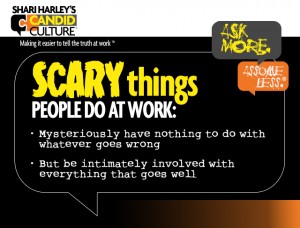 Taking credit for others’ work is not unusual or mysteriously having nothing to do with things that go wrong. It happens, sometimes purposefully, sometimes not. The key is what we do when things like this happen.
I’m going to suggest that you use the lowest level of intervention possible to resolve challenges. Give feedback while allowing people to save face. Don’t back people into a corner from which neither they nor your relationship can recover.
When your coworker is taking credit for others’ work, you could say:
1) “I noticed that when talking about project X during last week’s department-wide meeting, my name wasn’t mentioned in conjunction with the project. Why is that?”
Or you could say:
2) “Thanks for highlighting the X project during last week’s department-wide meeting. I’m glad the project got some exposure. I noticed that my name wasn’t mentioned in conjunction with the project. I want people to know they can come to me with questions about this project. In the future, will you tell people that I wrote the plan?”
Feedback can be given directly, “You did X and it frustrated me.” Or feedback can be given by asking a question and making requests, “Will you be sure to mention my name when you talk about X project?”
Some might call option one passive and even a disingenuous. Both methods produce the desired result –the other person knows that you know what happened, and you’ve requested different behavior. One method may incite conflict, one most likely won’t.
Be as direct as your relationship will allow. There are people with whom you can be very direct, without consequence. And there are some relationships that can’t withstand direct feedback.
Most of the people I talk with in organizations believe they can’t give feedback without negative consequences. The only way to know how direct you can be is by trial and error. Give a little feedback, see how it goes. Give some more, see how it goes. You might be surprised at how honest you can be. And when there is backlash for giving direct feedback, next time, give less. Ask a question or make a request instead. Asking questions is another form of feedback. It’s just less direct and thus less confrontational.
We train people to treat us as they treat us. You will get both what you ask for and what you allow. What are you allowing?
Written by Shari Harley owner and President of Candid Culture a training and development company making it easier to tell the truth at work.
 You get an email that annoys you, hit reply, type up your thoughts, hit send and feel instant regret. We’ve all done this. We’re frustrated and we let the other person know.
Feedback via email is always a bad idea. You don’t know how the recipient will read and interpret your message. You can’t manage the tone of the message or give the person a chance to respond. And more often than not, he’ll reply equally frustrated. And now the non-conversation begins –back and forth, back and forth.
Email is for wimps and voicemail isn’t any better! No texting either. End the madness and pick up the phone or swing by someone’s desk. Things are resolved most quickly and easily by talking about them.
I’m consistently surprised at how much feedback is delivered via email. And I’ll admit to occasionally being guilty of it too. I’m in a hurry or on a plane, and I want something to get done quickly. Or my emotions get the best of me, and I feel compelled to respond to a situation quickly. So I send an email or a text message that I know I shouldn’t send. Then I regret it and spend the rest of the day apologizing and feeling badly for communicating impulsively.
If we want people to want to work with us and perform, we need to consider how our actions impact them. Yes, it’s easier to send a quick email or text. But it invariably annoys the other person and damages your relationships. People can work with you, around you, and against you. If people want to work with you, they’ll work harder and produce better work.
Never underestimate the human ego, which is easily bruised. You are ALWAYS dealing with someone’s ego. The ego needs to be seen as good. When someone (anyone) calls our competence into question, we get defensive. Becoming defensive when receiving negative feedback or when someone questions us is a gut reaction. Not becoming defensive takes a great deal of self-management and is unusual.
Slow down. When you have to give feedback, ask yourself what you want the other person to do. Then ask yourself, how do I need to communicate to get the result I want? Then pause, breathe, and pick up the phone.