Career Management Archive
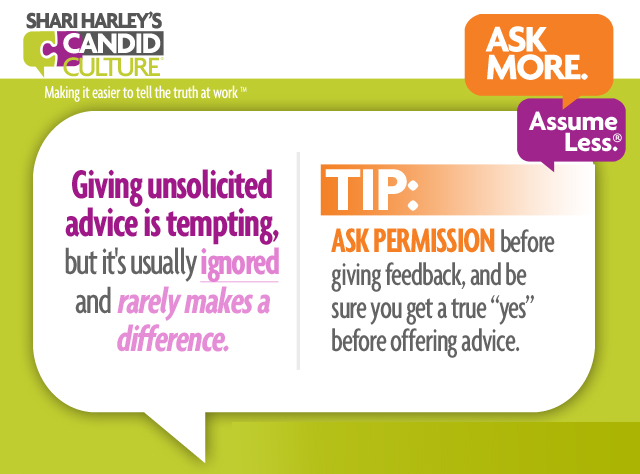 It’s hard to watch people do things that damage them – personally or professionally. And yet, if they haven’t asked for feedback, people likely won’t listen to unsolicited advice, so don’t bother giving it.
If you really want to give unsolicited advice, ask for permission and make sure you get a true “yes” before speaking up.
The conversation could go something like this:
“I noticed we’re getting behind on the XYZ project. I have a couple of ideas about what we can do. Would you be interested in talking about them?” Or, “That Monday meeting is rough. I feel for you. I used to run meetings like that. Would you be interested in talking about some meeting management strategies? I’d be happy to share what I’ve learned.”
After you offer to talk (aka, give your opinion), listen and watch the response you get. Does the person’s words and body language portray a true “yes, I’d like your opinion” or what seems like an “I’m supposed to say yes” reply? If you get the latter, you’re likely just giving unwanted advice that won’t be heard. If that’s the case, let it go. But if the person appears generally interested and open, proceed.
You could also say something like:
“Last week we were talking about your frustrations about not being promoted. I have a couple of ideas about that. Do you want to talk about them? Either way is fine, but I thought I’d offer.”
Or, “That was a tough conversation during today’s staff meeting. It’s hard to present ideas and not have them be embraced. I have a couple of thoughts about ways you can approach the conversation during the next meeting. Want to talk about them?”
If you make the invitation to talk, the other person has to be able to say no. An invitation is only an invitation if no is an acceptable answer. You can’t ask if the person wants your input and then keep talking even if he verbally or physically said no.
Be brave. If you care about someone personally or professionally and you see him doing something that gets in the way of his success, ask permission to say something. If you get the go ahead, proceed. If you get a “no thank you,” accept that and move on. You’ve done your part.
Read How to Say Anything to Anyone, and get the words to have even the toughest conversations.

Employees leave managers not jobs. We’ve all heard this 100 times.
One of the most prevalent reasons for employee turnover is boredom and lack of growth. We’ve also heard this many times.
We know why employees leave jobs. The question is what must managers do to engage and retain their best people. The answer is actually quite simple, although possibly not easy to execute.
 Employees want to know that their manager:
- Knows them
- Cares about and is invested in their careers
- Gives feedback so they can improve
- Provides opportunities so they can develop
In other words, employees need attention, and attention requires time, time many managers may not feel they have.
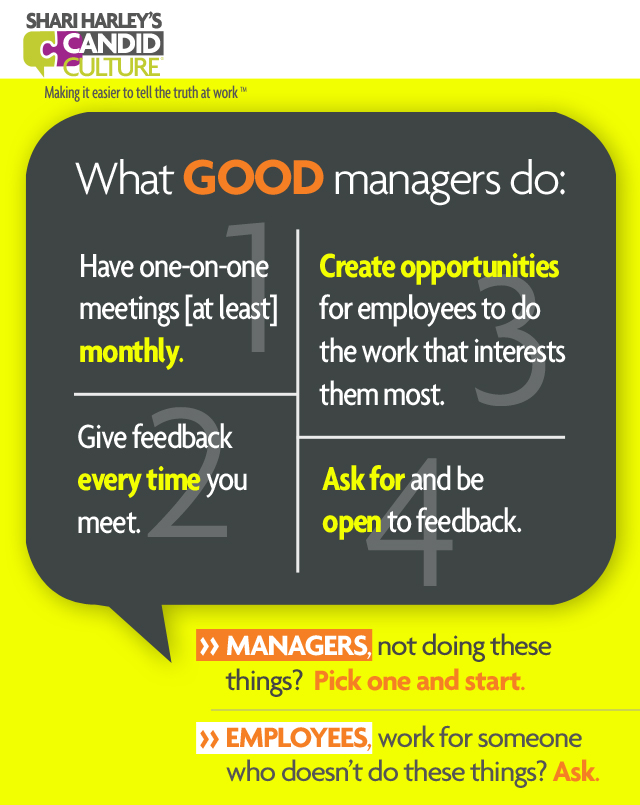
Here is a five-step formula for employee retention and employee engagement:
- Get to know employees better and differently
- Have meaningful, one-on-one meetings [at least] monthly
- Give feedback every time you meet
- Ask for and be open to feedback
- Create opportunities for employees to do the work that interests them most
Managers, how do you make time for these meetings when are busy and have several direct reports?
- Meet for 15-30 minutes
- Meet over the phone while commuting or waiting for flights
- Ask direct reports to create an agenda and run the meetings
- Ask direct reports to send follow-up notes of decisions and plans made during meetings. Give some of the accountability away.
- If meetings get cancelled, reschedule as soon as possible. Direct reports take cancelled meeting personally. Cancelled meetings, that are not rescheduled, send the message that managers don’t care about employees and their careers.
Employees, if your manager doesn’t schedule meetings with you:
- Ask permission to put a monthly meeting on your manager’s calendar
- Provide rationale for why you want to meet–to get your manager’s feedback and ensure you’re focused on the right work
- Ask permission to reschedule meetings when they get cancelled
- Don’t take cancelled meetings personally
- Offer to meet with your manager via the phone when it’s convenient for him/her. Leverage commute and travel time.
Employees need time with their managers. Meaningful discussions and work result in employee engagement and employee retention, so managers, make the time, even when you don’t feel you have it. Ask questions you don’t ask now. Give feedback, even if it’s uncomfortable. Give your employees an opportunity to do the work that interests them most. And watch your employee engagement and employee retention improve. And if your manager doesn’t do these things, politely and persistently ask. You won’t get what you don’t ask for. We are all 100% accountable for our careers.
 When I landed my first ‘real’ job after graduating from college I was so scared, I almost turned the job down. It took me five years to finish my first book, How to Say Anything to Anyone, in part because I was afraid no one would like it.
It seems anything worth doing is worth fearing.
I’m not talking about taking risks for the sake of risk –driving as fast as your car can take you, not paying your bills to see what will happen, or offering a counter point of view at work for the sake of doing so. I’m talking about pursuing the things you really want, that speak to your true purpose.
Being afraid doesn’t mean you can’t do something, nor does it mean that you shouldn’t. Feeling some fear just means what you want is outside of what you know you can do. But it’s the edge and the unknown that is juicy and rich.
During the past two years I’ve been pursuing things I’m terrified of, that I don’t know I can do. Yet I want these things, so I pursue them in the face of fear. And I have to admit, that as I get closer to getting what I want, the fear doesn’t dissipate, it actually gets worse . As I can almost taste having what I want, I get more scared. And sometimes I pull back, thinking, maybe I don’t really won’t those things. Maybe I was wrong. Then I remember why I want what I want and step back into the pursuit, despite the fear.
Don’t misinterpret fear as a reason not to do something.
A few suggestions for how to face your fears at work:
1. Write your desires down and/or tell people what you want.
- You’re more likely to get what you talk about having.
2. Take one step towards having what you want.
- Talk to someone who either has what you want or can help you get what you want.
3. Put yourself in the place of most potential, where you can get what you want.
- If you want to work in a certain department, express interest in working on a project that serves that department.
- Tell your boss and people in leadership in your desired work area of your interest.
- Apply for a job in that area.
4. Be positive and persistent.
- No one wants to give a complainer an opportunity, and takes time to make a shift.
The key is to take one step, then another, then another. And when you feel fear, don’t let it stop you. Fearing the next job or opportunity doesn’t mean you can’t do it well, it just means you haven’t done it yet.
When you need encouragement to face your fears, hang our inspiring magnets at your desk. You have to believe in yourself just as much as the people around you believe in you.

 People are drowning in data, more specifically in email. If you want people to read your communications, send short emails and fewer of them.
How often do you open an email, see its daunting length, close the email promising you’ll get back to it later, but don’t. Then you bump into the sender a week later and he asks, in an annoyed tone, “Did you get my email?” And you attempt to conjure up the email, distinguishing it from the 1500 you’ve received since.
Some people like receiving lots of information, others don’t. Ask your internal and external customers how much information they want to receive, in what format, how frequently, and with how much detail. And when you can, accommodate their preferences.
I’m a big picture person. For me, more information is not necessarily better. I’ll read five bullets. I won’t read five paragraphs. I’m frequently guilty of opening a long email, becoming overwhelmed, deciding I don’t have time to read the entire message, promising to read it later, and by the time I go back to the message, I’ve typically missed a deadline.
You can say it’s my problem that I don’t read long emails, not the sender’s problem. And you’d be right. I should read every email I get in full. But when I don’t give the sender something she needs, because I was overwhelmed by the length of her email, it becomes her problem too. If you want people to respond and do what you’re asking, communicate how they like to communicate, whenever possible.
I’d like to say that people are so used to reading short text messages and Facebook and Twitter updates that they’ve been trained not to read anything longer than a few sentences. And there may be something to that. But the truth, is there are detail people who like a lot of data and there are big picture people who don’t. If you provide a high level summary – just what recipients need to know – followed by more details or information on where more details can be found, you accommodate both the detail and the big picture people.
When you write your next email or any other type of communication, consider, could this be said with fewer words? Do the recipients want or need this level of detail? Then, shorten your communications and accommodate both the big picture and the detail people. And you’ll be amazed at how quickly you receive the things you’re asking for.
And if that’s not working, go old school and use our greeting cards to write a note, because no one can resist and handwritten note.

How many times do you walk by something in your house or office and think, “I have to clean that up?” Or get in your car and think, “I really need to wash this thing.” Every day we put up with things that drain our energy and attention, but we often do nothing.
What you’re tolerating may be small –a disorganized drawer or desk. But it may also be bigger –an unsatisfying relationship, a job you’ve outgrown, or a policy with which you disagree.
I took a time management class years ago and the trainer helped us organize our Word files so things were easier to find. She asked the question, “What are you tolerating?” I thought it was a funny question in relation to my laptop’s hard drive. But after my files were organized and I could access things without searching for 20 minutes, I realized how much time I’d been wasting and what I was indeed tolerating.
What frustrates you, but you’re so used to it, you no longer even notice? Perhaps you’re tired of responding to emails late at night or on the weekends? Or frustrated by people who don’t keep their word? We train people to treat us as they treat us.
Here a few suggestions for how to say no at work:
Start cleaning up the small things that make you cringe each time you look at them. Perhaps start with your desk or a drawer you’re afraid to open. Then consider when you’ve said yes, when you meant no. These situations are harder than cleaning out a drawer because they involve other people.
If you’ve agreed to something you don’t want to do, you can often renegotiate. Saying no at work could sound something like this, “I said I really wanted to lead X project and realized that I don’t have the time to do the project justice. I think I need to replace myself. I’m sorry to suggest a change so late in the game. I shouldn’t have offered to take it on in the first place. It was too ambitious. Who do you think would be a good fit?” Retracting yourself is better than doing a poor job.
Or, “I realized I said I’d plan our next family reunion. I’d love to do it and don’t feel I have the time to do the event justice. Who do you think would take it on?”
If you’ve committed to something you really don’t want to do, it will likely show. You’ll resent it and might not do the best job. Both of which are bad for your relationships and reputation. So start speaking up and saying no at work. And if that feels too big, go wash your car. You’ve got to start somewhere.
Seven years ago today I left my corporate job and started what’s now Candid Culture. Thank you for your support and for working towards having a more candid workplace. Please enjoy 20% off all of our resources through Friday May 16th. Use code: 7YEARSOFCANDOR.
 The time to ask for a raise isn’t at the end of the year. In fact, the end of the year, when compensation decisions have likely already been made and you’re competing with everyone else in your organization for a finite pool of money, is the worst time to ask for a raise. The time to ask for a raise is at the beginning of the year, and it could sound like this:
How to ask for a raise:
“Next year I’d like to take on more responsibility and be earning _____. What would it take to get me there? I’ve written a few goals. Can we review the goals together and talk about if this is the right course of action to help me get to the next level?”
Set yourself and your boss up for success in giving you a raise. Significant pay increases need to be justified and approved by others in the organization. And results justify raises.
A few steps to take to get the pay increase you want:
- At the beginning of the year, you and your boss should agree upon goals that are important to the organization.
- Agree that at the end of the year, goal achievement will position you for more responsibility and more money.
No manager will promise a raise a year out, but ensure your career path is a conversation that will be had.
Given that you may want to ask for a raise now, here are some techniques for asking for more money in the middle of the year:
- Schedule time to talk with your boss, so you’re sure to have her undivided attention.
- Bring a list of accomplishments from the past months or years. Be sure to document those accomplishments in whatever format and level of detail your organization’s decision makers’ like to get information. You’ll know that by watching how the leaders communicate.
- Give your boss a copy of the list.
- Be bold. Use words like, “I’d like to talk with you about my career. It’s been _____ months/years since I’ve had a raise. I’ve generated __________ results. Can we discuss what it would take to get me to the next level?”
- Don’t say, “This is awkward and I’m uncomfortable asking, but I’d like to talk about my compensation.” That’s not a powerful way to ask for anything.
The worst you will get is a no. You won’t get fired or ‘in trouble’ for asking. And if you get a no, ask, “What do I need to do to position myself for a significant pay increase in the next year?”
When asking for money, time, or resources, it’s easier to say no than it is to say yes. So give your manager something that’s easy to say yes to.
When asking for a raise, say:
- “I’d like to position myself for more responsibility and more money.
- What do I need to do to do that?
- What’s a reasonable time frame to make that happen?
- Whose support do I need in addition to yours?
- What can I do to ensure the leaders who will also impact the decision are knowledgeable about my contributions?”
You will not get what you don’t ask for. So be bold, but also be deliberate, planful, and smart about how you ask.

 Companies want people who make things happen. And to make things happen, you have to speak up. No, anticipating the train wreck and commenting after the train goes off the tracks doesn’t count.
What if you said what you thought, in a way other people could hear you, when you had the right to do so? Meaning, you have the relationship with the other person to tell the truth and you’ve asked permission to be candid?
6 Courageous Steps to Advance Your Career:
- Look for opportunities to make things better.
- Ask for permission to take the ball and run with it.
- Build relationships with other people who are making things happen.
- Don’t say yes, when they mean no.
- Find a way to say no, while engaging the other person in a conversation so a new approach is generated.
- Are willing to go out on a limb, work hard, and fail.
Here’s how to speak up for change without being labeled as the problem person who finds flaws in everything:
- Look for and present solutions, not merely problems.
- Offer to do the work to move towards a better way of doing things. Don’t drop problems at your other people’s doors.
- Ask questions versus overtly say why something is wrong. That could sound something like, “I’d love to help. Tell me more about the process. Perhaps we can insert a step to make this better. What do you think of trying…?” No one likes to be told he’s wrong. Asking questions elicits participation more than overtly saying, “This is broken. We need to fix it.”
Many people are afraid to speak up at work and believe that people who speak up get fired. I haven’t found this to be the case. People who work hard and produce results are typically the last people to be let go.
Say what you think in a way that is not critical; offer solutions not just problems; be a force for good and take an active role in making things better, and my hunch is your career will accelerate faster than you ever thought possible.

 I’ll never forget a coaching meeting I had about two years ago. I gave the manager I was coaching some tough feedback and he replied by saying, “I know I do that.” So I asked him, “If you know this is an issue, why are we having the discussion? He told me, “I just figured this is the way I am.” And I realized that knowing a behavior is ineffective doesn’t mean we know what to do to make things better.
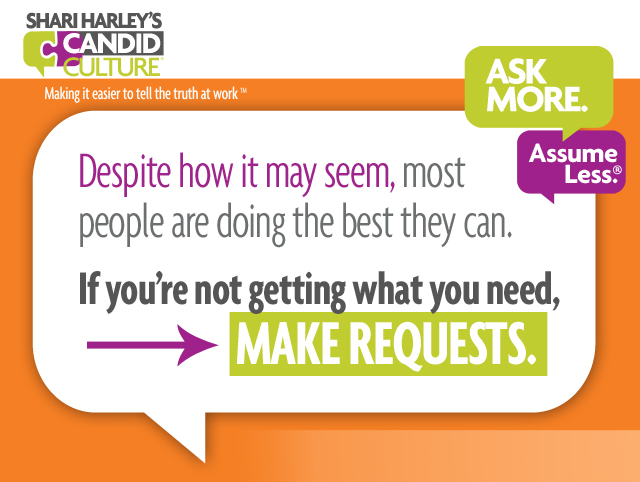
The people you work with want to do a good job. They want you to think well of them. Yes, even the people you think do little work and/or are out to get you. Give people the benefit of the doubt. Assume people are doing the best they know how to do. And when you don’t get what you want, make requests.
There are two ways to give feedback. One way is very direct.
Version one: “You did this thing and here’s why it’s a problem.”
The other way is less direct. Rather than telling the person what went wrong, simply make a request.
Version two: “Would you be willing to…” Or, “It would be really great to get this report on Monday’s instead of Wednesday. Would you be willing to do that?”
It’s very difficult to give feedback directly without the other person feeling judged. Making a request is much more neutral than giving direct feedback, doesn’t evoke as much defensiveness, and achieves the same result. You still get what you want.
When I teach giving feedback, I often give the example of asking a waitstaff in a restaurant for ketchup. Let’s say your waiter comes to your table to ask how your food is and your table doesn’t have any ketchup.
Option one: Give direct feedback. “Our table doesn’t have any ketchup.”
Option two: Make a request. “Can we get some ketchup?”
Both methods achieve the desired result. Option one overtly tells the waiter, “You’re not doing your job.” Option two still tells the waiter he isn’t doing his job, but the method is more subtle and thus is less likely to put him on the defensive.
You are always dealing with people’s egos. And when egos get bruised, defenses rise. When defenses rise, it’s hard to have a good conversation. People stop listening and start defending themselves. Defending oneself is a normal and natural reaction to negative feedback. It’s a survival instinct.
You’re more likely to get what you want from others when they don’t feel attacked and don’t feel the need to defend themselves. Consider simply asking for what you want rather than telling people what they’re doing wrong, and see what happens.
I will admit, asking for what you want in a neutral and non-judgmental way when you’re frustrated is very hard to do. The antidote is to anticipate your needs and ask for what you want at the onset of anything new. And when things go awry, wait until you’re not upset to make a request. If you are critical, apologize and promise to do better next time. It’s all trial and error. And luckily, because most of us aren’t great at setting expectations and human beings are human and make mistakes, you’ll have lots and lots of chances to practice giving feedback and making requests.

The fear of saying what we think and asking for what we want at work is prevalent across organizations. We want more money, but don’t know how to ask for it. We want to advance our careers but are concerned about the impression we’ll make if we ask for more. Instead of making requests, many employees assume they won’t get their needs met and choose to leave their jobs, either physically or emotionally.
How to Retain Good Employees:
The key to keeping the best employees engaged and doing their best work is to ask more questions and make it safe to tell the truth.
Managers: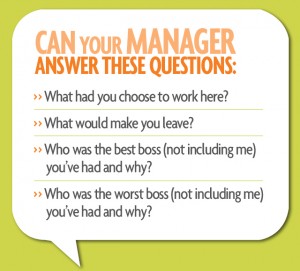
- Do you know why your employees chose your organization and what would make them leave?
- Do you know your employees’ best and worst boss?
The answers to these questions tells managers what employees need from the organization, job, and from the manager/employee working relationship.
Can your manager answer these questions – that I call Candor Questions – about you? For most people, the answer is no. Most managers don’t ask these questions. And most employees are not comfortable giving this information, especially if the manager hasn’t asked for it.
It’s easy to mistake my book, How to Say Anything to Anyone, as a book about giving feedback. It’s not. It takes me nine chapters to get to feedback. The first eight chapters of the book are about how to create relationships in which you can tell the truth without fear. You can read all the feedback books you want and take numerous training classes on coaching, managing people, giving feedback, and managing conflict, and you’ll still be hesitant to speak up, because a formula for giving feedback is not what you’re missing. What’s missing is being given permission and knowing it’s safe to tell the truth.
Managers, here’s how to retain good employees:
“I appreciate you choosing to work here. I want this to be the best career move you’ve made, and I want to be the best boss you’ve had. I don’t want to have to guess what’s important to you. I’d like to ask you some questions to get to know you and your career goals better. Please tell me anything you’re comfortable saying. And if you’re not comfortable answering a question, just know that I’m interested and I care. And if, at any point, you’re comfortable telling me, I’d like to know.”
 Then ask the Candor Questions during job interviews, one-on-one, and team meetings. We’re always learning how to work with people. So continue asking questions throughout your relationships. These conversations are not one-time events.
If you work for someone who isn’t asking you these questions, offer the information. You could say:
“I wanted to tell you why I chose this organization and job, and what keeps me here. I also want to tell you the things I really need to be happy and do my best work. Is it ok if I share?”
Your manager will be caught off guard, but it is likely that she will also be grateful. It’s much easier to manage people when you know what they need and why. Most managers want this information, it just may not occur to them to ask.
If the language above makes you uncomfortable, you can always blame me. You could say:
“I read this blog and the author suggested I tell you what brought me to this organization and what I really need to be happy here and do my best work. She said I’d be easier to manage if you had that information. Is it ok if I share?”
Yes, this might feel a little awkward at first, but the conversation will flow, and both you and your manager will learn a great deal about each other.
The ability to tell the truth starts with asking questions, giving people permission to speak candidly, and listening to the answers.

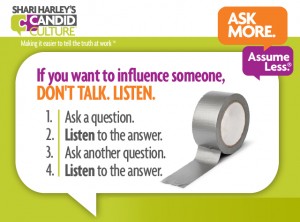 When selling a product, service, or idea, people often think that providing more information is better. The more data points, the more likely the other person is to be persuaded. This is not necessarily the case. Excluding data hounds, most people don’t like to be overloaded with information. But people do appreciate the opportunity to talk about what they want and need. So if you want to sell something, give people a chance to talk.
I’ll never forget one of my first sales calls, many years ago. I was selling Dale Carnegie Training. After calling a prospect for six months, he agreed to spend ten minutes with me. Feeling rushed, I laid out all of our training brochures and quickly told him about every program we offered. Then I asked if he wanted to buy anything. He didn’t.
If I had asked a few questions and listened to his answers, I could have provided information on just the training programs he needed, instead of giving him a list of likely irrelevant options.
Selling a product or service is no different from selling an idea. You are trying to persuade someone to your way of thinking. Resist the temptation to persuade solely by educating. Instead, ask questions, listen to the answers, and then tell the person what you heard her say. If you’ve taken a listening class, you learned the practice of paraphrasing what someone said. Paraphrasing is a very old technique, but still very effective.
People need to feel heard and understood. From my experience, asking relevant questions, demonstrating that you listened to the answers by paraphrasing what the person said, and providing pertinent and succinct information is what people need to make a decision.
Click here to download five free questions from our box of Candor Questions for Sales and Customer Service.