Career Management Archive
I recently interviewed a candidate who asked for a lot of ‘stuff’ during the interview process. He wanted compensation, perks, accommodations, and benefits that were way outside the norm. I’m assuming he was employing the adage we’ve all heard, that “it can’t hurt to ask.” Unfortunately, it can hurt to ask.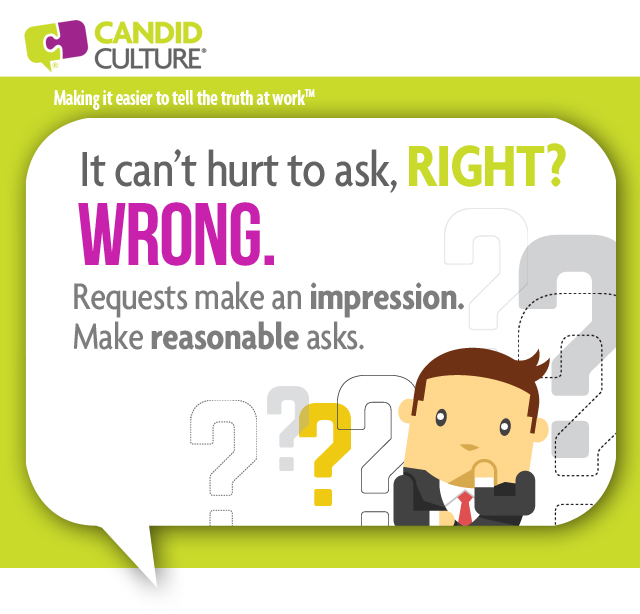
When forging new relationships, we watch (judge) people. We’re trying to figure out who they are and how they are. Are they the person they claimed to be during the interview process? Are they trustworthy? Did I make the right decision in bringing this person into my team, organization, and life?
Requests always make an impression. When we’re building new relationships, requests make an even bigger impression. Candidates who said the commute wouldn’t be an issue, but complain about it two weeks into the job, cause managers to doubt their hiring decision. Coworkers who consistently ask for extensions to deadlines, appear unreliable.
People watch us and silently judge, making assessments about our commitment, reliability and even character. Don’t make people question you. Make reasonable asks.
Five ways to make reasonable requests:
- Vet your requests with people who know your company, manager, and/or industry, before making them. What is a reasonable request in one organization, might not be in another.
- If something is important to you, ask for it during the interview process or at the onset of new projects and relationships. Don’t wait. Waiting to ask for things, until after you’ve started a job and are comfortable with your manager, can damage your relationships and reputation. Managers don’t like bait and switch, even when it’s unintended.
- Don’t ask again, once you’ve received an emphatic “no.” I worked with someone who asked for something during the interview process. I said “no” and explained why. He asked again after being hired. This annoyed me and made me feel like he didn’t listen and would push me on this and on other things.
- If you aren’t sure that what you’re asking for is reasonable, say so. Tell the person you’re asking what you want and to please tell you if it isn’t a reasonable request.
- Ask for feedback on your requests. If you’ve seen me speak, you know I’m a proponent of telling people, “If I do anything that damages our working relationship or makes you question me, I hope you’ll tell me. I promise I’ll take your feedback graciously, and say “thank you.””
Ask for what you want, within reason, be up front when relationships begin, and build your relationships rather than break them.
It can’t hurt to ask, right? Wrong. Requests make an impression. Make reasonable asks. Repair a relationship, when you’ve asked for too much.
When I was pregnant, I worried that I would gain sixty pounds and never take the weight off. Well, that’s not what happened. I gained 18 pounds (amazing) and most of it was gone when Grayson was a week old. Six months later, I was fourteen pounds below my pre-pregnancy weight. I couldn’t explain it. It certainly isn’t a result of eating well or exercising, because I did neither. But it lef t me with a problem that impacted my professional image. None of my clothing fit. This was a good problem to have, but nonetheless, it was a problem.
Until I made some changes to my wardrobe, I went to events in my ‘old clothes’ and hoped no one would notice. And they might not have. For all I know, I was the only person who knew I was wearing ill-fitting clothing. But more important than what others saw, is how I felt. I felt unprofessional, unpolished and silly. Aka, I was uncomfortable. I didn’t trust my appearance and it had me doubt myself.
We feel more confident and do better work when we feel good in what we’re wearing and know we look good.
Here are four things you can do to elevate your professional image:
Elevate your professional image tip #1: Take photos of yourself wearing your ‘go to’ outfits. Look at the photos and assess how you look in your favorite clothing. I’m often dismayed at how I ‘really look’ in my favorite pieces of clothing. Then start taking photos of how you look in pieces of clothing before you buy them.
Elevate your professional image tip #2: Ask a friend whose judgment you trust to weigh in on your clothing. Specifically ask, “What’s the first impression I make in this outfit? Where should I wear this? Where shouldn’t I wear it?”
Elevate your professional image tip #3: Get a good haircut. You get what you pay for. Utilize the same practice as above. Ask a friend who always looks great to share the first impression your hair makes. Then make friends with your blow dryer. This might be the part of the blog when men check out. Stay with me. This applies to you too.
Elevate your professional image tip #4: Try on old items in your closet and get rid of everything that doesn’t pass the photo and friend evaluations. If you can’t bear to get rid of things you love, box them up so you won’t wear them. I admit, this is a painful process.
You’ll present yourself more confidently when you have confidence in your appearance.
Note, these suggestions only apply when you’re in front of other people. If you work from home and don’t see anyone during the day but your dog and the occasional neighbor, bring on the spandex or the jammies. There is a school of thought that says you’ll do better work, even at home, if you’re professionally dressed. This isn’t true for me. I do better work when I’m comfortable. So now you know what I’m wearing when you call me. Aren’t you glad we don’t Skype!
One of the hardest things I’ve ever done is hire someone to care for my almost two year old son. “Here is the person most important to me in the world. Keep him alive.” I had no idea how difficult it would be to trust a relative stranger so implicitly. And as a result, let’s just say I’ve not been the easiest for a nanny to work with.
I’m embarrassed to admit that I wrote sixteen-pages of instructions of how to take care of my kid. And I gave that ‘booklet’ to a nanny with much more childcare experience than I have. When I work from home and hear my son crying, I tell myself not to walk into the room and check on him, knowing it undermines the nanny, but I do it anyway. When the nanny sends me an update of when my son last ate, I reply telling her when he should eat again, even though I know she knows. Yes, I’ve really been doing these things.
Each time I over instruct, monitor, and advise, I regret it. I know micromanaging the nanny makes me difficult to work with, which is not how I want to be. It reminds me of a comment an old boss said to me after we interviewed a candidate for a job together. He said, “Shari, your job as the interviewer is to make the candidate feel comfortable and ensure she leaves feeling good, regardless of how well or poorly she interviewed.” My face must have said anything but, “I want you to feel comfortable and you’re doing a great job.” His words stuck with me and I’m reminded of them each time I over manage our nanny.
Many people attend training on how to manage others; I’d suggest we also look at how we manage ourselves. How does working with you make people feel? Do your questions, requests, and interactions make people feel more self-confident and valued or do people feel questioned and undermined? Do you pick your battles? Do you give just enough direction but not so much as to squelch the other person’s ideas, initiative and spirit, especially when the stakes are high?
As you know, I’m evaluating how I do these things too. We are always a work in progress.
Here are four ways to build confidence in the people you work with:
Build Confidence 1: Ask people for their ideas and implement those ideas whenever possible. And if you aren’t open to others’ ideas, don’t ask for them. It’s better not to ask for ideas than to ask when you’re really not interested.
Build Confidence 2: Ask for and be open to others’ feedback. People will be more receptive to your feedback when you’re receptive to theirs.
Build Confidence 3: Say “thank you” regularly and mean it. Give specific examples about what you’re thankful for.
Build Confidence 4: Admit when you’re wrong. Strong people admit mistakes, weak people don’t.
People can work with you, around you, and against you. Earn loyalty and respect by respecting others’ talents and knowing when to take a step back.

Unless you never interact with other people, there’s probably someone in your life who repeatedly engages in a behavior that annoys you. You’ve probably made requests about what you’d like to the person to do differently, and hopefully you’ve given feedback. But the behavior hasn’t changed.
At some point, we have to accept that people are who and how they are. People can and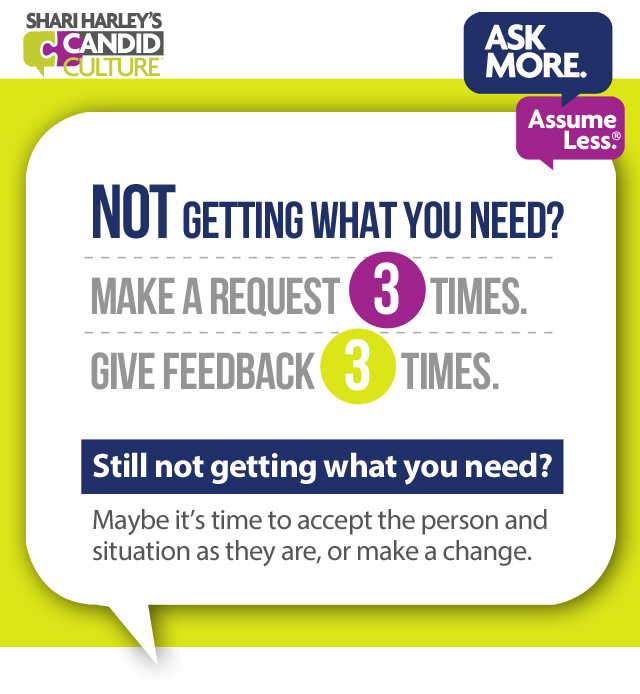 will change certain behaviors, if their motivation is high enough. But other behaviors won’t change. They are what they are. And if you want to have the person in your personal or professional life, you have to accept the behavior and the person as they are. And doing this can be very difficult, at least it is for me. I admit, I often have this conversation myself, “Why won’t he…? I don’t get it. It’s not that hard. How many times do I have to ask?”
Here are five strategies for working with difficult people:
Working with difficult people strategy one: Become very clear on the behavior(s) you expect.
Working with difficult people strategy two: Make a request and ask the person to do what you want. Be sure you are being explicitly clear in your request. For example, “Please include me in meetings” is too vague. Instead, try, “Please invite me to all client meetings so I can stay connected to the clients and projects.”
Working with difficult people strategy three: Make requests at least three times. With each successive request (nicely) remind the person that you’ve made this request in the past and it still isn’t happening. For example, “We’ve talked about this in the past and it isn’t happening. Help me understand what’s happening?”
Working with difficult people strategy four: If you’ve made a request at least three times, give feedback as to what isn’t happening and why that causes challenges. For example, “We’ve talked about inviting me to client meetings a few times. It’s still not happening. I’m getting calls from clients with questions I can’t answer because I’m not included in the meetings. Can you help me understand why I’m not being invited to meetings?” Read chapters nine through eleven and chapter thirteen of How to Say Anything to Anyone to get more examples of how to give clear and specific feedback.
Working with difficult people strategy five: Know when to give up and accept the person and behavior as they are. If you’ve made a request and have given feedback three times, you likely aren’t going to get what you want. The person either can’t do what you’re asking or doesn’t want to. Now you have a decision to make.
Decide how important this behavior is. Is it a deal breaker? If it’s a deal breaker, you can’t work or live with the person. If it’s not a deal breaker stop expecting the behavior to happen and accept that it won’t. When you accept that you won’t get what you want from someone you’ll suffer less.
Strategy five is really the crux of this blog. Knowing when to stop expecting something and coming to peace with that decision will give you great freedom. In order to let go of the expectation you have to decide that it’s really ok for you not to get what you want. Ask yourself, “Can I live with this behavior as it is?” If you can’t, you have a hard decision to make. If you can, then stop expecting and asking for the behavior. Truly let it go. You’ll feel better.
I always try to do the right thing. I try to remember and send cards for special occasions. Apologize for mistakes, or better yet, don’t make any. Listen more than I talk. Be a great boss. Keep in touch with friends near and far. Always take the high road. Never lose my temper or patience. Eat healthy. Get fewer parking tickets. I could go on and on and on. In short, I want to be perfect. And I’m annoyed that I’m not.
Lately I’ve begun to realize that my desire to be perfect is causing me stress, diminishing my happiness, and preventing me from pursuing things I really want. So here’s to overcoming per fectionism. I hope the steps here help all of us who are frustrated that we’re not perfect.
Overcoming perfectionism tip number one: When you make a choice, go with it. Don’t second guess yourself.
If you decide to skip a party, networking event, or class at the gym, you have a good reason. Don’t question yourself or say, “I should have.”
Overcoming perfectionism tip number two: Stop thinking that life has to look a certain way.
Maybe you’re in a job that doesn’t challenge you 100%, or you wish you were saving more money. Be careful not to buy into others’ views of how life should be lived. You’re living your life in the way it works for you.
Overcoming perfectionism tip number three: Don’t compare yourself to others.
Comparing ourselves to other people is normal and natural, and it’s the booby prize. There will also be people who are more successful, more fit, and more attractive than us. Those seemingly perfect folks have challenges and disappointments we will never know about.
Overcoming perfectionism tip number four: If you make a mistake, apologize once and move on.
I often feel badly for ‘mistakes’ long after they’re over. The other person is likely to have forgotten about the incident long after I’m still feeling guilty.
Overcoming perfectionism tip number five: Worry less what people think.
Human beings are wired for survival. Most people are so worried about themselves; they’re not preoccupied with you. So do your thing and assume the rest of the world is not watching.
Overcoming perfectionism tip number six: Try new things and be willing to make mistakes.
We won’t have anything different if we don’t do anything different. Learn a new skill, try a new way to solve a problem, and be willing to look silly and fail.
I’m hoping the tips above provide both me and my striving-to-be-perfect comrades some freedom. By suggesting you live your desired life, I’m not saying ignore responsibilities, be rude, or put yourself first all the time. I am saying that living life the way you think it should be lived, versus how you really want to live it, will diminish your personal happiness and satisfaction. And as far as we know, we only go around once.
If you’ve gotten courageous and given someone negative feedback or questioned a decision or action, you probably didn’t get a shiny, happy reply in return. The normal and natural reaction to negative feedback or data is to defend ourselves. It’s human. Defending yourself when receiving negative feedback is an act of self-preservation, not unlike hitting your brakes when the person driving in front of you unexpectedly slams on their brakes.

The problem with reacting defensively (normally) to negative feedback is that it’s scary and off putting to others. As normal as a defensive reaction is to negative feedback, it makes others so uncomfortable that they’ll be hesitant to give you negative feedback again. And this lack of knowledge of what others really think is dangerous. Silence inhibits career growth and leads to bad business decisions. You want people to tell you the truth, as they see it. So you need to make it easy to speak freely.
If you want more of what others see as the truth, do the opposite of what people expect. Rather than defending or going silent, say “thank you.” “Thank you for telling me that. I’ll think about what you said and will likely come back to you to discuss further,” buys you time and puts the other person at ease.
Here are five ways to make it easier to say thank you for the feedback:
- Only accept feedback when you’re ready to listen. You’re allowed to put people on ice and come back to them when you have time to talk. Bad days, when you have five minutes between meetings, or are about to leave for a vacation are not the times to accept negative information. Set up a time to talk, as soon as you have the bandwidth to listen.
- Take breaks during hard conversations. You’re allowed to say, “I need a few minutes.” Go get coffee. Take a walk. Go outside. Regain your composure. Then continue the conversation.
- Have feedback conversations when you’re rested and have eaten. Everything seems bigger and more difficult when we’re tired or hungry.
- Accept that “thank you” isn’t the same as telling the other person she is right or that you agree. “Thank you” is a mere acknowledgment that you heard. It buys you time and gives you a chance to gather your thoughts and respond when you’re not emotional.
- Don’t have conversations when you’re upset, and we often don’t know when we’re upset. Your emotions will run the show. Give yourself time to get through your emotional response, and then talk.
People are more hesitant than you think to tell you when they disagree. Make it easy to speak up. Do the opposite of what others expect. Say “thank you” rather than reacting, and you’ll get more data than you do now.
You disagree with something someone above you said or did. How do you tell the person without actually telling him?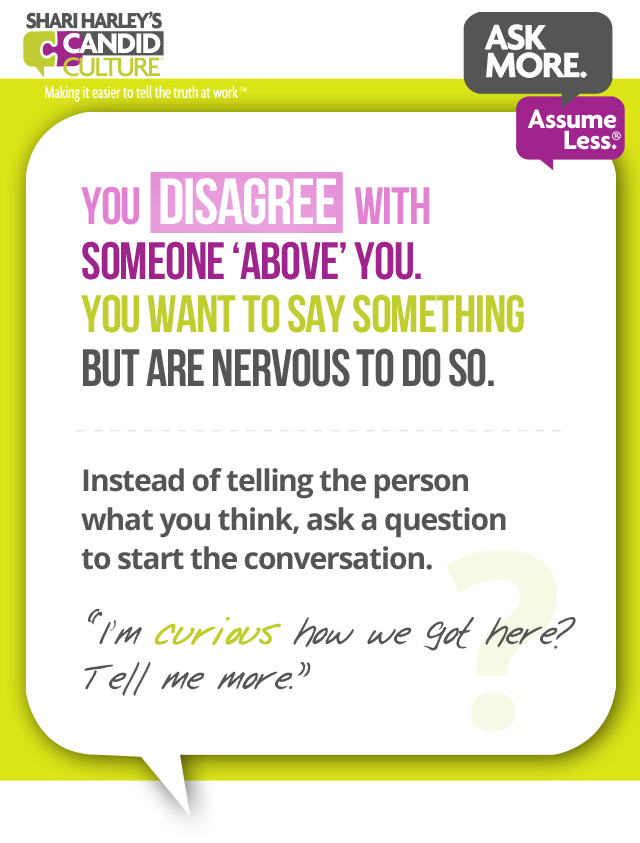
Lots of people think they can’t give direct feedback when talking to someone at a higher level. I’m here to tell you that that’s not true. The ability to speak freely has little to do with titles and more to do with the quality of your relationship. When you’re comfortable with people and have mutual trust, you can say (almost) anything, regardless of titles and levels. But that’s not the true purpose of today’s blog. So I’m going to stick to the topic at hand –what to say when you feel like you can’t say very much.
When you don’t have the relationship to say what you really think, manage up by asking a question instead. Engage the person in a conversation. At some point during the conversation, you’ll be able to say what you think.
For example, you question a decision but don’t want to overtly say you question the decision.
Here’s how the conversation could go:
“I wasn’t involved in the conversations to select our new payroll software. Can you give me a little history? What had us choose our current provider?”
“What software features were important when selecting the software?”
“What problem were we trying to solve that drove the need to make a change?”
“What do you like about the software we picked? What don’t you like?”
** Obviously this is meant to be a discussion, not an interrogation. Ask one question at a time and see where the conversation goes. You may ask all of these questions and you may ask only one.
The point is to gather more information. Manage up by seeking to understand before you express an opinion. As the conversation progresses, you might see opportunities to express your point of view.
Here are three suggestions if you’re going to practice the technique of asking questions as a way to manage up and eventually give feedback:
1. When you ask a question, come from a place of genuine curiosity. If you aren’t truly curious and asking questions is just a technique you found in some blog, it will show.
2. Watch your tone of voice. If you can safely add the words “you dummy” to a question, you have a tone issue.
3. Be patient. Asking questions may feel easier than giving direct feedback, but it also takes more patience and time.
As the conversation progresses, you might be asked for your opinion. Before saying what you think, remember, no one likes to be told that s/he is wrong. And the person you’re talking to likely had a hand in making the decision you’re questioning. Be careful not to judge.
Instead of overtly judging, consider saying something like:
“I think the new system has potential and also has some limitations. Do you want feedback as we use the system and get to know it better?”
“What specifically would you like feedback on? What are you not looking for feedback on?”
“What’s the best way to provide input and to whom?”
You can speak more freely when you have the relationship to do so and have permission. Until you have both, earn the right to give feedback by asking questions from a place of genuine curiosity. And only provide your point of view when you’re asked and are certain you have all the information to defend your position.
At some point in your career, you will likely get feedback that doesn’t feel accurate. When receiving feedback you question, rather than dismiss it, vet the feedback with the people who know you best. Assemble a core team of people who know you well, love you, and have your back. The relationships may be personal or professional. These are people who will tell you the truth (as they see it), if you ask.
You might think that you’re a different person at home and at work, thus your friends’ and family’s input isn’t valid in the workplace. That’s untrue. You are who you are, and you’re not a completely different person at home and at work. It’s just not possible to be your real self and turn it on and off at work. Sure, you might have a communication style that you only use at work. You may make decisions at work differently than you do personally. And you are likely to dress differently at work than at home. But you’re not a completely different person after 5:00 pm. If you’re often late, don’t keep confidences, talk too much and too long, or wear clothing that is not your friend, your personal relationships can tell you that.
It’s important to know how you come across, your reputation, and your wins and losses at work. Having this information allows you to manage your reputation and in turn, your career.
So the question is, with whom should you vet feedback that doesn’t feel quite right?
Receiving feedback criteria one: Your core team should be made up of a small number of people (five or fewer) who know you well, love you, and have your back.
Receiving feedback criteria two: You should respect core team members’ opinions.
Receiving feedback criteria three: You must trust them and their motives, in relation to your well-being.
Receiving feedback criteria four: You must be open to rather than dismissive of core team members’ feedback.
The right answer to feedback is always, “Thank you for telling me that,” regardless of how much the feedback stings. The easier it is to give you feedback, the more you’ll get when you ask in the future.
Core team members don’t need to be told they’re on your core team. Simply call these people individually when you need input. Tell them the feedback you’ve received and ask for their opinion.
It’s easy to dismiss feedback that’s hard to hear. And the feedback might just be that person’s opinion. But people talk. And one person’s experience of you can impact your career greatly. Manage your career assertively and powerfully by knowing your reputation. Find out the impressions you create. Then you can make decisions about changes you will and won’t make.

People are busy and stressed. Reading the news is stressful. Sitting in traffic is stressful. Feeling we need to check our phones at all hours of the day and night is stressful. It’s easy to make someone’s day at work better. Why not do it? 
I’m going to suggest being nice to people at work. And I’ll give you my definition of nice. In my world, nice isn’t about asking about someone’s weekend, how their kids are doing, or what they’re doing with their summer. I won’t tell you not to talk about these things at work, but they aren’t required to be nice. In fact, those conversations can be distracting and keep people at work longer than they want and have to be there, which is anything but nice.
Here are six ways to create a nice company culture:
Nice company culture tip number one: Look people in the eye as you pass them in the hallway, both people you know and don’t know, and say hello. I’ve always found it odd that someone can pass me on a sidewalk or in a hallway and pretend I’m not there. It’s weird. Say hi to the people you walk by.
Nice company culture tip number two: Don’t send emails cc’ing people who don’t need to know. This damages relationships, annoys people, and fills people’s inboxes with unnecessary emails.
Nice company culture tip number three: Take the high road. It’s easy to fall on principle or insist on doing something a certain way when the other person is frustrating or otherwise difficult to work with. Resist the temptation to be right and instead, do what works.
Nice company culture tip number four: When you disagree, pick up the phone rather than having a text or email debate. You can often resolve issues more quickly and manage communication better verbally than in writing.
Nice company culture tip number five: Do the things you said you would. Be on time, meet deadlines, and keep your agreements. If you can’t keep an agreement, make it known as soon as you know.
Nice company culture tip number six: Don’t gossip. Definition of gossip: Talking about anyone who isn’t physically present. Gossip creates environments of negativity and distrust. Think it and then let it go.
You have more control over your workplace atmosphere and your day than you may think you do. Be nice. Just because.
People are tired, busy, and stressed. Be nice to people. Just because. It will make your day, their day, and your work environment better.
Join the Candid Culture Community:




When I’m not sure what to do, I do nothing. And my hunch is I’m not alone. When something feels big, it’s easier to do nothing than something.
Time management experts will tell you to divide a big project into small pieces, to make it manageable. That’s good advice. The universe – as woo-woo as it sounds – rewards action. Momentum, like inertia, is very powerful. As we know, a body that’s in motion is likely to stay in motion. A body at rest is likely to stay at rest.
The key to getting through anything large, scary, or intimidating is to start. Any action will do. The key is simply taking action.
Here are five keys to make taking action more likely:
Taking action key #1: What often stands in the way of taking action is that we aren’t sure what to do. Perhaps we aren’t sure we can do the task at hand. Or we can’t see what the end result should look like. Or the project feels so big that even thinking about starting is tiring. Ask questions and ask for help.
Most managers aren’t great delegators. When assigning a project, managers often ask, “Do you have any questions?” This is an ineffective question because few people want to admit to having questions about a project that feels so big, all they want to do is avoid it and take a nap. Or managers ask, “What do you need from me?” when most people have no idea what they need.
Don’t be afraid to ask questions until you’re clear about what a good job looks like, and ask for help.
Taking action key #2: Do one small thing, anything, towards achieving the goal. And do it now. Don’t wait until the right time. There is no right time.
Taking action key #3: Then do one more thing. Don’t wait six weeks or months to take another action. Momentum is very powerful. Keep things moving.
Taking action key #4: Give yourself small windows of time to work on a project. If you give yourself 30 uninterrupted minutes to work, you’re likely to invest that time. If you dedicate a day, you’re likely to get distracted and fill the time with other things.
Taking action key #5: Trust that you can do what’s in front of you. Someone wouldn’t have asked you to do something if they’d didn’t have confidence that you could do it. And if this is a goal you set for yourself, and it’s something you really want, deep down, you know you’re capable of doing it.
If you’re overwhelmed or don’t believe you can do something, call someone who has more faith in you than you have in yourself, at this present moment. Let that person fill you with confidence until you can generate it for yourself. When I started Candid Culture, I was filled with fear and quite honestly, was convinced I was going to fail. But everyone around me believed I could do it. And their confidence carried me until I could generate my own.
The way out is always through. Ask for help. Take one small action, then another. Dedicate small pieces of uninterrupted time to work on a large project. Trust that you can do it. Things don’t get done without your action. Take one action, then the next, then the next.