Career Management Archive
Avoiding having difficult conversations because you’re uncomfortable? Afraid you’ll hurt someone’s feelings? Worried you’ll damage your relationship? Why not just say so?
The people you work with want to work with other human beings. And part of being human is expressing how you feel.
It may seem that admitting that you’re nervous or uncomfortable we akens your position and diminishes your power. This couldn’t be further from the truth. Saying how you feel and being willing to be vulnerable are signs of strength. People with strong egos can admit when they are uncomfortable, people with weak egos feel too threatened to do so. Vulnerability and authenticity help other people see you as human, and make people feel closer to you. And people want to work with other human beings, not emotionless androids who never show their cards.
If you’re nervous, say you’re nervous. If you’re afraid you’ll negatively impact your relationship by speaking up, say so. If you’re not sure it’s your place to raise an issue, say that. You won’t lose anything by stating your concerns. You only stand to gain.
Starting difficult conversations could sound like this:
Having difficult conversations option one: “I’m not sure it’s my place to talk about our department’s Customer Service Survey results, but I care about our reputation and have a few thoughts. Is it ok if I talk about them with you?”
Having difficult conversations option two: “I’ve got some input for you that I’ve been hesitant to share, but I think the information could be helpful to you. I care about you and your career, and I want you to be successful. Is it ok if I share my thoughts?”
Having difficult conversations option three: “I’ve got a few things to talk with you about, but haven’t brought them up because I’m a bit concerned about how you’ll react. Is it ok if I share them with you? I’m saying these things because I care about our department, and I’m noticing a few things I think we can do differently, for better results.”
You probably noticed that in the examples above, I stated that I was concerned about speaking up, asked for permission to do so, and stated the reason I wanted to provide input. Your motive for having difficult conversations is very important. When people trust your motives you can say anything. When they don’t trust your motives, you can say little.
Don’t be afraid to say how you feel. If you’re afraid to speak up, saying so won’t reduce your credibility, it will likely increase it. State your concerns, explain why you’re speaking, and ask for permission to give feedback. Doing those three things will help any message be well received and is likely to make it easier for you to say what you want to say.

No one likes to hear people complain, especially people who go on, and on, and on. But there is a reason people complain for longer than may seem necessary. For the most part, the people who sound like a broken record don’t feel heard. And when people don’t feel heard, they repeat themselves, again, and again, and again.
One of the first practices for how to handle customer complaints taught during any decent customer service training class is to acknowledge the other person’s concern. Demonstrate that you listened and heard. We often think that complainers want us to solve their problems. That’s not always the case. Sometimes feeling heard is enough, even if there is no resolution to the complaint.
Last week I had a horrible experience in a hotel. I called the front desk staff to voice my concerns with how an incident was handled. Her response: “Ok….ok….ok.” I wasn’t satisfied. So the next morning I spoke to the front desk manager. She responded by explaining why her staff had done what they did. Still, no apology or demonstration of understanding my frustration. So I went to the hotel general manager, who did all the right things. She listened and apologized. She didn’t defend or explain. And then I stopped escalating my complaint.
Here are a eight tips for how to handle customer complaints:
How to handle customer complaints tip #1: Resist the temptation to defend yourself, your team, or your organization.
How to handle customer complaints tip #2: Watch your tone of voice. If you sound annoyed, the other person will just become more upset and will, you guessed it, continue complaining.
How to handle customer complaints tip #3: Tell the person you’re sorry for his experience. Apologizing doesn’t mean he is right or that you agree. You are simply sorry he had the experience he did.That could sound like, “I’m sorry that was your experience. That sounds frustrating. That’s certainly not the experience we want customers to have.”
How to handle customer complaints tip #4: Ask clarifying questions, if you need to. That could sound like, “Can I ask you a few questions, so I fully understand the situation?”
How to handle customer complaints tip #5: Paraphrase what the person said to ensure you understand his complaint and to demonstrate that you heard. Nothing sounds better to someone who is upset than another person who understands his concerns. That could sound like, “I just want to be sure I understand your concern. You’re concerned that _______ “ (repeat or paraphrase what the person said.)
How to handle customer complaints tip #6: Apologize again for the person’s experience. Often, all the person wants is an authentic apology. An apology doesn’t admit fault or wrong doing. You are simply apologizing for the person’s perception of their experience.
How to handle customer complaints tip #7: Tell the person what action(s) you’ll take, if any. People like to know that they’re complaints aren’t wasted.
How to handle customer complaints tip #8: Don’t be a black hole. Circle back to the person and let him know what action was or wasn’t taken.
The key to getting someone to stop complaining is to make the other person feel heard. Acknowledge the complaint. Watch your tone of voice. Apologize for the person’s experience. And watch people’s complaints dissipate more quickly than you thought possible.

As crazy as it sounds, it can be difficult to get work done at work. There are the drive bys – people who want your opinion on EVERYTHING before they make decisions, the interrupters who have just one question, several times a day, the visitors who want to update you on EVERYTHING happening in their personal lives, and coworkers who host meetings at their workstation, take phone calls on speaker phone, and who listen to music without headphones, while loudly eating potato chips. All of these distractions are enough to make many employees want to find a quieter place to work.
The concept that it can be hard to get work done at work is crazy. We’re at work to work. And yet many employees, with and without a door, get in at 7:00 am, before others arrive, so they can “get some work done” and stay late because they “got nothing done all day.”
Open work environments can be productive and interruptions can be minimized, but managing interruptions at work will require some clear guidelines and direct communication, which many workplaces are missing.
Managing interruptions at work – practices for creating a work environment that works for everyone:
Write workspace practices down, share them with all employees, post the practices in every work area, and discuss them frequently.
Examples of practices for managing interruptions at work:
- Use a headset for all phone calls.
- Pay attention to your volume. Speak as quietly as possible.
- If you have visitors at your desk for business or non-business related conversations that last longer than five minutes, take the conversation to a conference room, empty office, or local coffee shop.
- Use headphones to watch videos and listen to music.
- Avoid prairie dogging—calling down a row, hallway, or over a cubicle wall. Instead, walk to the person’s desk, call, or send an email or text message.
- Turn off all auditory alerts on computers and cell phones, so your coworkers don’t have to hear pinging and ringing all day. The people you sit with don’t need to know every time you receive an email, text, or Facebook message.
- Finally, but MOST IMPORTANTLY, give all employees permission to make requests and give feedback when workspace guidelines are broken. It must not only be acceptable but expected that employees will say something when a guideline is broken and the workspace gets too loud.
Most employees will not speak up when others are being loud. It’s easier to find another location to work than risk a coworker’s defensive response. And no one wants to be ‘that person’ who complains about how loud someone is. If employees aren’t comfortable speaking up and making requests, offer training on how to have these conversations, and provide written examples of what employees can say that is respectful and clear.
Guidelines for dealing with interruptions at work:
You’d think that having a door would make people immune to work place distractions, but that’s not the case. Employees with offices also deal with drive bys and interruptions. The key to dealing with both is communication.
- Don’t wait for problems to occur. Anticipate challenges and talk about them before guidelines are broken. It’s much easier to make a request than to give feedback.
- Each time a new person joins a team, department, or workspace, ask everyone on the team to share their work-related pet peeves, how they like to communicate, and how they prefer to be interrupted. Everyone deals with interruptions, so you might as well express a preference. If you’d prefer people email you and ask when you have time for a quick question, make that request. If you’re ok with people interrupting you without notice, let people know. If you’re not distracted by noise, tell people. If you are, make that preference known.
People are too hesitant to speak up at work for fear of damaging relationships and hurting people’s feelings. The best thing leaders can do to improve the working environment (or any workplace challenge) is to set clear expectations, create opportunities to talk about how things are going, and make it ok to speak up.
Suffering at work is optional. Everyone is accountable for the work environment, and you won’t get what you don’t ask for.

As someone who writes and teaches about effective communication in the workplace, the people I work and socialize with are expecting me to model good communication skills all the time. The good news: I try really hard to always do the right thing and impact people positively. The bad news, I’m human and sometimes I don’t get it right.
One of the things I’m proud of about Candid Culture, is that we are real people, working with real people. We work very hard to prac tice effective communication in the workplace and to always model what we’re teaching. And yet, like all people, we get busy, rushed, and tired. We read emails we intend to reply to, but then forget to do so. We occasionally send emails, when we should pick up the phone.
In my world, a good communicator is not someone who always communicates perfectly.
A good communicator who practices effective communication in the workplace is someone who:
- Cares about people and consistently works to communicate in the way others need.
- Asks for and is open to feedback about how s/he impacts people.
- Listens and watches other people’s verbal and non-verbal communication.
- Alters his/her communication style to meet other people’s needs.
- Takes responsibility when things don’t go well.
This week I’m advocating for picking up the phone, even when you want to do everything but, being patient, even when you’re frustrated, and asking questions, versus accusing. And I’m going to admit, I’m working to do these things too. Sometimes I get it right, and sometimes I don’t. I’m in the trenches with you, working to say and do the right things every day.
I promised you five tips to practice effective communication in the workplace and to be generous with people:
- Only call people when you have adequate time, attention, and patience to have whatever conversation needs to be had.
- If you need a few days to return a call, say so. Let the person know when you’ll call.
- Prepare for conversations. Plan what you’re going to say and how you’re going to say it.
- Don’t have hard conversations when you’re frustrated, tired, or busy. They won’t go well.
- If the conversation goes poorly, call back later and clean it up.
Being a good communicator doesn’t mean being perfect. It means caring enough to notice when you miss the mark, cleaning up your messes, and working to do it better next time. I’ll be working on the above recommendations too this week. And when I screw it up, you can be assured that my mistakes will become examples in our training programs of what not to do, followed by a new technique that will hopefully work for all of us.

It’s the time of year when people start to evaluate the last year and plan for the next. As I do my own planning, I watch myself repeatedly doing things that will never allow me to reach my personal and professional goals.
I want to get more sleep, but I lie in bed playing with my iphone long after I should be asleep. I want to be in better shape, but I find every reason not to work out. I want to do more local work, but I don’t pursue work in Denver. Who in Colorado wants to hire me to speak or do some training? Ok, back on track.
To have something different, we need to do something different, and that often means giving something up. Letting go of a habit or pattern is challenging. There’s a reason we do what we do. Our habits provide something – comfort, distraction, fun, etc. If you’ve ever done a ropes course or graduated to a more challenging ski run, you know you need to let go of what feels secure to get to the next level. And letting go can be scary and difficult. But if we don’t let go, we get stuck where we are.
Make a list of things you want that you don’t have now. Perhaps you want to:
- Learn a new skill or take on a new responsibility at work
- Buy a house
- Save more money
- Be in better shape
- Pursue a hobby
Then I’d ask, what do you need to give up (aka stop doing) to have what you want?
You need to do something differently, or you would already have what you want. Doing something differently could be as simple as telling someone who can help you get what you want. We often tell our coworkers and friends what we need to be happy in our job, but we don’t always tell the people who can help us get what we want.
If you want a different job, tell someone in your organization who can help you get what you want. Then create a plan with actions you’ll take, milestones, dates, and measurable outcomes, and follow up until you attain your goal.
Lastly, accept when you can’t get what you want from a person or organization, grieve, and then make a big change. If you have consistently pursued a role in your organization and in two or three years haven’t moved toward that goal, chances are you won’t get that job at that company. It’s likely you need to leave.
Choosing to leave is often the most difficult decision to make. We work and work on a relationship or situation, and eventually realize, we will never get what we want. That’s a very hard pill to swallow. But if you’re certain you won’t get what you want, despite your efforts, move on.
Five Steps to Reaching Your Goals – Ask Yourself:
Reaching your goals #1: What do I want that I don’t have now?
Reaching your goals #2: What do I need to give up in order to have what I want?
Reaching your goals #3: Have I made a request of the person/people who can help me get what I want?
Reaching your goals #4: Can the person/people I’ve asked for help assist me, and do they want to do so?
Reaching your goals #5: With persistence and consistency, can I get what I want from this situation, or is it time to move on?
Keys to reaching your goals: Determine what you want; tell someone who can help you get what you want; be consistent and persistent, and be ready to make changes. To have something different, we have to do something different.
Add a comment to the blog about what you’re giving up or doing differently to create the life you want, and we’ll enter you to win a free copy of my book, How to Say Anything to Anyone. And if you already have the book, you can pick a box of Candor Questions of your choosing.

Consider the things other people do that frustrate you. Now consider what you’re asking for.
You aren’t likely to get what you don’t ask for, but most people don’t ask for very much. We assume that the people in our lives will do the right thing without prompting. We’ll get the recognition and compensation we deserve at work because it’s the right thing to do. Our friends will remember our birthday because how couldn’t they know that’s important to us? And no one will come to our home empty handed for dinner because we would never do that.
If you read this blog regularly, you already know that I’m a proponent of setting clear expectations and asking more questions before problems occur. Consider what you want and need, anticipate what can go wrong, and plan accordingly before problems happen. Doing that sounds great in theory, but how does it work in practice?
 Here are five ways to increase your job satisfaction:
Increasing your job satisfaction tip one: Be honest with yourself about what you need to be happy at work. Rather than tell yourself you won’t get what you need or try to convince yourself that you shouldn’t need something, just admit your needs to yourself.
Increasing your job satisfaction tip two: Share your needs with people who can help you get those needs met. Don’t make people guess. Chances are they won’t guess at all or will guess wrong.
Increasing your job satisfaction tip three: Don’t assume things will go well and just wait and see what happens. Instead, set clear expectations at the beginning of new projects and working relationships.
Here’s how that could sound: “We’re going to be working together for the next six months. Let’s talk about how everyone likes to communicate, what people’s pet peeves are, and the kind of information each person wants to receive.”
Here’s another example of how that could sound: “I’m excited to work on this project with you. There are a few things to know about me that will help us work well together and deliver timely results. I ask a lot of questions. Let me know if this frustrates you. I’m not questioning you; I just have a need to understand why we do what we do. And I work best with a deadline. I am happy to be available off hours, but you probably won’t hear from me before 9 am. You will get messages and work from me at night and on the weekends. Just let me know if you’d prefer I schedule messages to go out during regular business hours.”
People might give you what you need if you ask, but they likely won’t if you don’t. Train others how to work with you.
Increasing your job satisfaction tip four: Agree to talk about things as they happen. Don’t wait until you’re about to explode to speak up.
That could sound like, “I want us to work well together, and things will go wrong. Can we agree that we’ll provide feedback as things happen so we can make timely adjustments?”
Increasing your job satisfaction tip five: Renegotiate when you need to. If you realize you need or want something that you didn’t ask for, go back and ask. It’s never too late.
Here’s how that could sound, “We touch base about once a month and I’m realizing that if we could talk for about 20 minutes once a week, I’d be able to get more done. Can we make that happen?”
Job satisfaction and happiness at work (and at home) don’t just happen. The people you live and work with are not you and they don’t know what you need. Make a regular practice of identifying what you need, making those needs known, and then speaking up when things go array. You won’t get what you don’t ask for. But you will get whatever you allow.

When I was leading Leadership Development for OppenheimerFunds I told my boss, the head of HR, that one of my career goals was to be an HR generalist. He said, in his lovely British accent, “Shari, you’re very good at what you do, and you would be a terrible generalist. You will never be a generalist here.” At the next company, I also told the he ad of HR that one of my career goals was to be an HR generalist, and he too said, “You would be a terrible generalist. You won’t have that role here.” I could have left that company and chased my desire to be a generalist, or I could have listened to people who saw something I didn’t. I listened.
Sometimes others can see things we can’t and it makes sense to listen. That’s actually my definition of a coach – someone who can see things that we can’t, and they’re willing to tell us.
If you’re serious about achieving your career goals, consider these six practices:
- Identify what you want to do.
- Share your career goals with people who can help you achieve them.
- Ask people you trust and those in a position to help you achieve your career goals what may prevent you from having what you want. Obstacles might be organizational (i.e. the job you want doesn’t exist at your company) or they might be personal (i.e. you don’t have the skills, acumen, or temperament for the job you want).
- Work to develop skills you’re missing.
- Accept things that might prevent you from getting what you want, i.e. I don’t have the temperament to be an effective HR generalist, and I never will.
- Decide when to stop pursuing a goal. Make peace with that decision. And move on to something equally, if not, more compelling.
Most of us were raised to believe that quitting is taking the easy way out and that to quit is bad. I don’t know about that. Sometimes you have to listen to the feedback the world gives you and act accordingly.

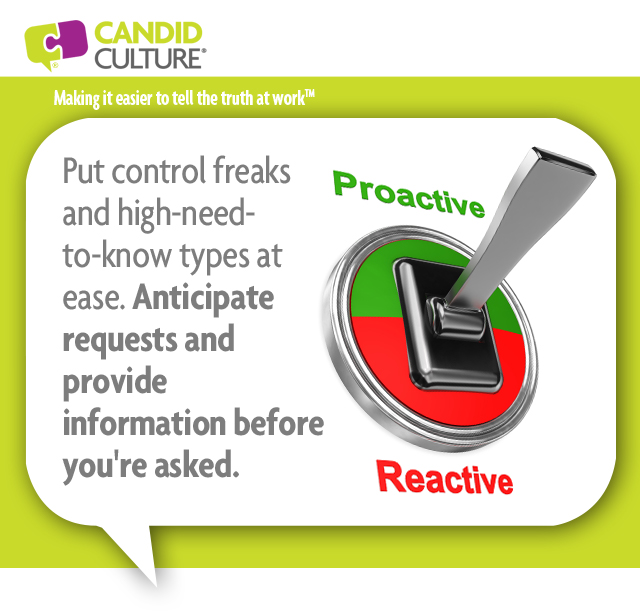
Frustrated by a control freak, micromanager, or a high-need-to-know type? Controlling behavior stems from a need that isn’t being met. Identify the need, meet it, and your life gets easier.
This is similar to what sales people learn during good sales training. The customer wants to buy the car but doesn’t. She visits the dealership three times, but just can’t pull the trigger. She has some sort of a concern. If the sales person can identify the concern, he can possibly resolve it, and sell the car. Working with control freaks is the same.
If someone wants more updates, information, or involvement than you’re comfortable with, he has a need that isn’t being met. When you meet the need, the person will likely back off.
I ask the people who work for me to never make me ask for something twice. Meaning, if I ask for an update the week before a speaking engagement, anticipate that I’ll want that information for all engagements. Confirm by asking me and then provide the data without being asked for all future engagements. Getting the information regularly without having to ask builds trust and credibility.
Here are six tips for working with control freaks:
- If you don’t know, ask:
- Their work-related goals.
- What the person is concerned about at work.
- How s/he likes to communicate – in-person, email, phone, voicemail, or text.
- How often s/he wants information, in what format, and with how much detail.
2. Provide more information than you think you need to, and then ensure the person wants that information in the future.
3. If you’re asked for information, ask why the person wants it, and if s/he wants it in the future. Then provide the information before you’re asked.
4. If someone is overly involved in your work and you feel you have no freedom, state your observation and ask for information. That could sound like, “You’ve been involved with each major decision with this project. I’m used to working with less oversight. Do you have a concern about my approach?” Then you negotiate. Everything is a negotiation.
5. This will put the other person on the defensive. A less confrontational approach is to discuss and agree upon levels of involvement and supervision when projects begin. That could sound something like, “What kind of involvement do you want to have in this project? What do you want to do? What do you want me to do? What kind of updates would you like, how often, and with how much detail?” It’s always easier to prevent a problem than to fix one.
6. Lastly, don’t take anything personally. Oversight and involvement may be a reflection of how someone feels about your performance, but it might not. When in doubt, ask.

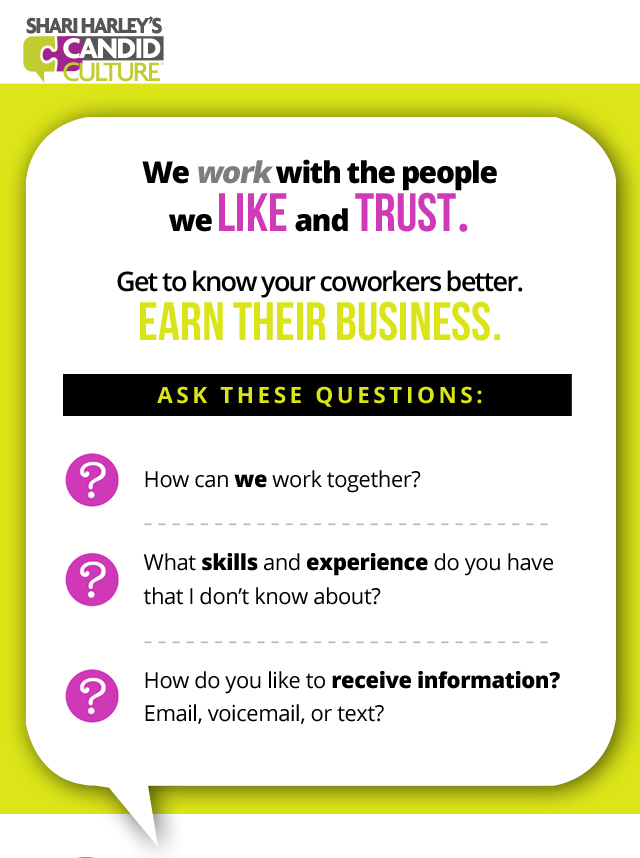
Regardless of who your company’s org chart says you should work with, people work with the people they want to work with and around those they don’t. One way to get people working with you (by choice) is to get to know your coworkers better, and I don’t mean personally.
Most people don’t know the people they work with very well. Coworkers often don’t know what fellow team members are tasked with doing for the company, their past work experience, education, or working style preferences. They often don’t know how fellow team members like to receive information, but get annoyed when they don’t return unopened emails.
If you’ve had any team building training with me, you know I advocate getting to know people better by asking more questions.
Organizations spend a lot of money on team building. Teams go bowling, out to happy hour, and have pot luck lunches, etc. All of those activities are fun and build comradery, and that’s important. But comradery and enjoying spending time together outside of work won’t help a team learn to communicate or overcome challenges.
If you’re really committed to team building and working well with people, ask more questions at the onset and throughout working relationships.
Here are five team building questions coworkers should be asking each other:
- What are your pet peeves? How would I frustrate you and not even know it?
- Are you a big picture or detail oriented person? Should I send you information in bullets or paragraphs?
- What are you best at doing? What type of work could you be doing that you’re not doing now?
- What are you working on now? What are your priorities for the next six months?
- What’s something I could do differently that would make your job easier? (You will survive the answer. I promise)
Your manager may coordinate an activity that gives your team the ability to ask questions like this, and s/he might not. Either way, ask the questions and be forthcoming if others ask you for this information. It’s not just your manager’s job to get your team working well together.
Your daily experience at work – how much you get done, how easily you get that work done, and how much fun you have along the way – is largely dependent on the people you work with. Don’t leave your working relationships to chance. Be assertive. Get to know people better. Ask more questions and offer information about yourself.

Most of us aren’t eager to admit when we don’t know something, need help, or make a mistake. We fear these things will damage our reputation and make us appear less than to others. But neither are true. It takes strength and self confidence to admit mistakes, accept feedback, and ask for help. Strong, self confident people do all of these things.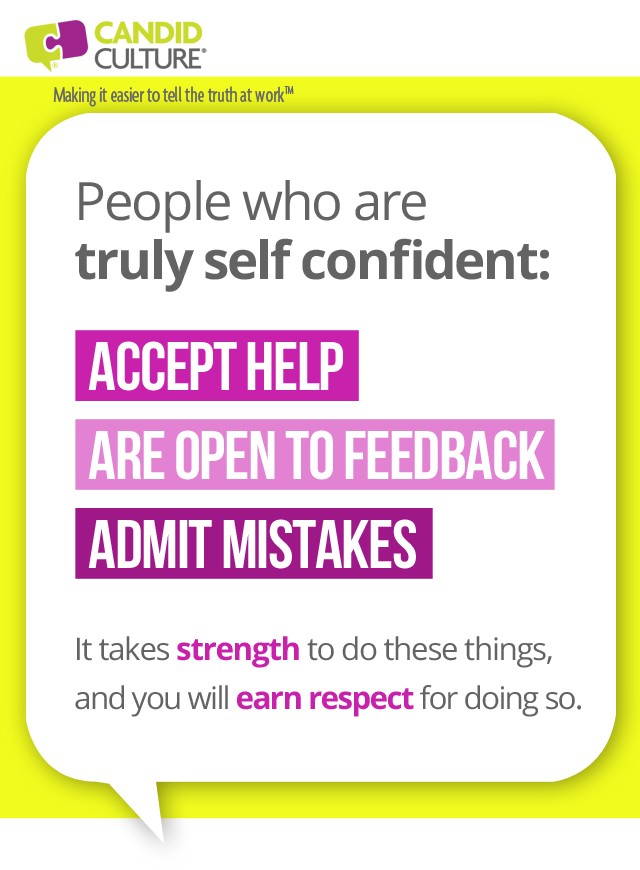
When someone who works for me is willing to admit mistakes, I think more of them. When employees ask for help rather than spin their wheels unnecessarily, I’m appreciative. When they’re open to feedback, I’m grateful they’re easy to work with. And the same is likely true for you.
Arrogance masquerades as self confidence. People who are arrogant come off as strong and self confident, but it’s a façade.
It may seem like your personal power and reputation will be diminished by admitting mistakes and accepting help. But this couldn’t be further from the truth. It takes strength to say we don’t know how to do something, to embrace feedback that stings, and to admit bad choices. And strong, self confident people do all of these things, regularly.
You won’t lose credibility or damage your reputation by being humble, instead you’ll be seen as real, relatable and willing to admit a lack of perfection. And all of those things take strength that ingratiate you to others. So be yourself. Don’t pretend you’re better or more knowledgeable than you are. Authenticity goes a long way.