Career Management Archive
In a previous blog, I advocated for picking up the phone, even when you don’t want to, being patient, and asking questions versus accusing. Admittedly, it’s easier to be generous with some people than with others. Some people are just hard to work with. And no matter how much you want to do the right thing, when difficult people’s na mes show up on your caller-id, it’s tempting to let them go to voicemail, indefinitely.
There are a few behaviors that make people difficult people to work with. Avoid these communication blunders, and help ensure your calls don’t go to voicemail.
Five tips to be easy to work with:
How to be easy to work with tip 1: Don’t take things personally. Human beings are wired for survival. Most people are so worried about themselves – looking good and doing well – they’re not all that worried about you. When you get overlooked for a project or a meeting, rather than feeling slighted, ask what happened that you weren’t included. Or just be grateful you have one fewer meeting to attend.
How to be easy to work with tip 2: Remember it’s not all about you. People who think everything is about them are exhausting to be with. Be humble. Take an interest in others. And remember that no matter how talented and fabulous you are, you’re not the only one in your organization who is producing results.
How to be easy to work with tip 3: Give other people the benefit of the doubt. Most people are genuinely trying to do the right thing. If you question someone’s motives or actions, ask a question before making a decision about that person.
I like the question, “Help me understand…?” It’s neutral and invites the other person to speak. If you choose to ask this question, watch your tone of voice. If you can safely add the words “you dummy” to a question, you have a tone issue.
How to be easy to work with tip 4: Temper your emotions at work. You’re human and human beings have feelings. But sometimes our feelings can be off putting to others. Most people are uncomfortable when managers and coworkers yell, cry, or give the silent treatment. Manage your emotions at work. Wait to have conversations until you’re not upset. And if you can’t manage your emotions during a conversation, excuse yourself until you can.
How to be easy to work with tip 5: Be introspective and self-aware. The better you know yourself and how you impact others, the more you can work with others how they like to work. Periodically ask people you trust for feedback on the impression you make and what you’re like to work with. Listen to their feedback and adjust your communication habits to be easier to work with.
The bottom line – to be easy to work with you need to be sensitive to how you impact others. People who pay attention to how they impact others and make changes to work better with others, are enjoyable to work with. People who don’t pay attention to how they impact others and aren’t open to altering their working styles get sent to voicemail.

When my son was born, I was given lots of advice. One suggestion I remember distinctly was, “stay present.” I blew the comment off, at the time, thinking, “Well, of course.” But it’s so easy to be physically present and mentally elsewhere.
When you read, read. When you exercise, exercise. When you work, work. A practice that’s so simple, yet so hard to do. I’m never doing or thinking about just one thing. When I’m with my young son, I’m thinking about the next time he needs to eat or sleep, or something I need to do. Instead of sleeping, I think about things I’m worried about. I’m often preoccupied, wondering how I could have handled something better. In summary, I’m terrible at being present. And it’s the root of a lot of suffering.
I was told long ago that there is only suffering when we’re not present. If we’re worried about the past or the future, we’re elsewhere. Be in the here and now, and there is nothing to worry about. I just wish it wasn’t so hard to do.
I’m working at this ‘being present’ thing, and there are a few things that I find help. I hope they help you too.
- Don’t carry your phone with you all the time. I don’t carry my phone with me when I’m with my son. That time is ours. The phone is a distraction for both of us.
- Set an alarm (on your hidden phone) 10 minutes before something needs to end. I set an alarm on my phone, which is away or face down, 10 minutes before I need to leave lunch, etc. with a friend. That ensures I’m on time for my next commitment and focused on the conversation versus being concerned about being late.
- Deal with what is weighing on you. If you’re worried about your finances, health, or a deadline, act. Ask for help. Do something to move closer to your goal.
- Have a conversation you know you need to have. If there is something left unsaid and it’s weighing on you, pick up the phone and speak up.
- Don’t over commit. Over committing is sure way to be stressed, unhappy, and not present.
Lots of people set New Year’s goals or resolutions. Mine is simple. I want to worry less and enjoy more. I want to live in the present.
If you were on a diet and stepped on a scale that said, “Pretty good. Keep up the good work,” you’d return the scale, claiming it didn’t work. Likewise, if your GPS told you that it “seemed you were going the right way,” you’d probably use a different app, or heaven forbid, buy a map. Scales and GPS provide us with feedback, but vague feedback is unhelpful. It doesn’t tell us what to do more, better, or differently, which is the purpose of feedback.
Vague, positive feedback is also inauthentic, and inauthenticity smells. Hearing you did a great job is nice, but utterly unhelpful because the feedback recipient doesn’t know what he did well and what to replicate. If you want people to replicate a behavior, tell them precisely what they did well that you want them to do again.
Most feedback training focuses on giving negative feedback, because it’s so hard to do, but we’re not much better at giving positive feedback. Giving useful, positive feedback takes attention, observation, and timely communication. In short, it’s difficult.

I too find myself telling my team members, “You did a great job on…” I know vague words like these serve as a short pick-me-up. My team probably smiles and appreciates the recognition, but I also know I haven’t given them substantive direction of what actions I want them to replicate. Those of you who have participated in feedback training with me know that I call vague input Cap’n Crunch – all of the sweetness, with none of the nutrients.
To give effective, positive feedback, simply state one or more specific actions you want the person to replicate.
Here are a few examples of positive feedback:
Cap’n Crunch: “You did a great job on……”
Positive feedback example one: “You did a great job onboarding our new analyst. You outlined what he needed to do during his first 90-days to be successful. He now knows precisely what he has to do and won’t have to guess.”
Cap’n Crunch: “Thanks for being so committed to our business.”
Positive feedback example two: “Thanks for calling in to today’s team meeting on a day you had off. Your participation helped us make a decision that would have taken much longer without your participation. I appreciate your commitment to our business.”
Cap’n Crunch: “Thanks for paying attention to the things that may impact us negatively in the marketplace.” This is not terrible, but not as effective as it could be.
Positive feedback example three: “Thanks for paying attention to the things that may impact us negatively in the marketplace. I appreciate you tracking the new products our competitors are launching. It helps me know where we are ahead and behind.”
Don’t assume people know what they did well and that they will replicate positive behavior without receiving positive feedback. Watch people’s actions and tell them, shortly after they do something, what they did well. And watch those positive behaviors be repeated.

Last week I was on plane and the woman in back of me kicked the back of my seat throughout the flight. It made me nutty. The guy next to her talked so loudly, I’m pretty sure the people six rows in front and behind him could hear the conversation. And no one said anything.
Many of us don’t return food in restaurant s that isn’t good. We often say nothing when people drop the ball and make mistakes. We replace ineffective vendors and service providers rather than tell them where they’re falling short.
People usually claim they aren’t giving feedback because they don’t want to hurt the other person’s feelings, think the person is not likely to change, or because they’re not sure if their complaint is valid. I don’t buy most of these reasons.
I think the real reason we aren’t giving feedback is because we don’t want to deal with the other person’s reaction. We are concerned – often rightly so – that the person will kill us off. We will be given the cold shoulder, excluded from projects, or thrown under the bus.
You may be wondering why I, who wrote a book called How to Say Anything to Anyone and who teaches other people to give feedback, didn’t speak up on the plane last week. I too have been trained to pick my battles and that if I have nothing nice to say, say nothing at all. Each day I also grapple with when to speak up and when to let things go.
The concern over giving feedback will get better if the people in our lives – personal and professional relationships – agree it’s ok to tell the truth and agree that there will not be negative consequences for doing so. Open and direct conversations will be had. Disagreements will be discussed and resolved as best they can. And when the conversation is over, it’s over. People can’t hold the conversation over your head or hold a grudge.
It would be difficult to agree to open and honest communication with the people who sit behind you on planes, but you certainly can make that agreement in your office and with your family and friends. Agreeing to tell the truth without consequence can be one of your organization’s values and a practice you establish in your personal relationships.

You can hire people who understand they are expected to speak candidly and then let disagreements go. And you can manage people who don’t speak up, who hold grudges, and who punish people for giving feedback. You can tell friends and family that you want candid relationships in which challenges are dealt with quickly and then the disagreement is over.
Making the request for open and honest communication and assuring people there will be no negative consequence for doing so is the differentiator between being able to speak up when you’re frustrated or say nothing.
People get defensive when they receive negative feedback. It’s hard not to. Everyone wants to be seen as competent, and when we receive negative feedback, our competence is called into question. So we react.
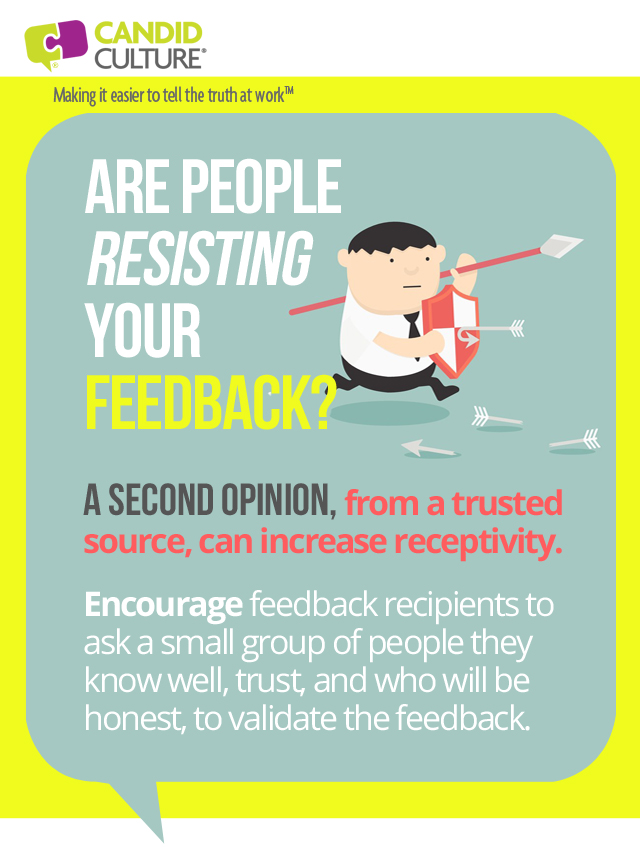
There are several things you can do to reduce others’ defensiveness – ensure you have trusting relationship and thus have earned the right to give feedback, watch your words, deliver feedback in a private setting, etc. But for today, I’m going to focus on getting a second opinion.
If you want people to be more receptive to your feedback, consider encouraging them to get a second, third, or fourth opinion. I’m a fan of casual 360 degree feedback – when we ask for feedback from people we work with both inside and possibly outside the organization. Think of 360 degree feedback like an orange, it’s all the way around, like a sphere. When you get 360 degree feedback, you gather input from all the different types of people you interact with, thus getting a more comprehensive and accurate picture of performance. There are different types of 360 degree feedback. 360 degree feedback ranges from the formal – an online, anonymous survey (I’m not a fan) – to casual conversations (which I recommend). In this instance I’m suggesting something I call The Core Team.
I suggest everyone has a Core Team of about five people who love you, know you well, and have your back. Most important is that you trust these people. You Core Team may be personal or professional relationships, or a mixture of both. You may have worked with Core Team members or not. What all Core Team members have in common is that they know you well, want what’s best for you, and will tell you the truth when asked.
My core team consists of a friend from high school, two people I used to work with, and my parents. When I get feedback that I’m having a hard time reconciling, I ask people on my Core Team to validate the feedback. It doesn’t matter if they’ve worked with me or not. I am who I am. I do the same annoying stuff in my personal and professional relationships. So a personal Core Team member can provide valid, professional feedback and vice versa. Sometimes they agree with the feedback I’ve been given and sometimes they don’t. But I always get compelling information to think about. And because I trust the people on my Core Team, I listen to what they have to say.
Don’t be disheartened if people don’t trust your feedback and aren’t receptive. Instead, see their resistance as human and encourage them to get a second opinion. And then talk again. Listening to and incorporating feedback is a process. It takes time, courage, and patience.
Employees appreciate perks – good coffee, an onsite gym, concierge service, and workout classes. But none of those things motivate employees to stay with an organization. And no one will quit because a company doesn’t offer those perks.
I won’t tell you not to offer yoga classes or to get rid of your video games. Just know neither perk is resulting in employee retention.
There are really just a few things employees need to stay with your company and do good work. And if you do those things consistently, you’ll see your best employees stay and excel.
Here are a few employee retention ideas: 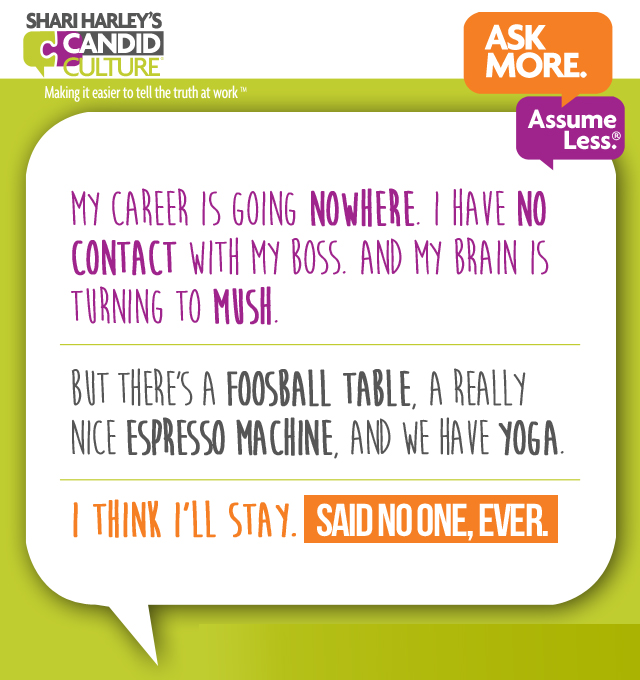
Employee retention idea #1: Managers, get to know employees better. Ask what brought employees to your company, what would make them leave, what employees want to learn, and what type of work they really don’t want to do. And when it’s possible, remove responsibilities employees don’t want to do, and replace those tasks with things employees enjoy more. You can’t eliminate all aspects of a job that employees don’t like. But people won’t stay in a job for long that doesn’t let them do work they enjoy about 75% of the time.
Employee retention idea #2: Managers, meet individually with employees, twice a month, for at least 30 minutes, to discuss current and future projects. Give specific and balanced (positive and negative) feedback during each meeting. Even the most independent employees need regular feedback and one-on-one time with their manager.
Employee retention idea #3: Teach and coach employees, so they expand their skill set and approach challenges in new and different ways. Most employees want to learn and grow. Managers don’t have to do the training themselves, just ensure it happens.
Employee retention idea #4: Give employees exposure to the senior leaders in your organization. This includes: attending meetings where senior leaders are present; pitching ideas to senior leaders; and learning from people above the employees’ manager.
Employee retention idea #5: Give employees stretch assignments and the chance to learn new things. One of the greatest reasons for employee turnover is boredom and a lack of growth and development. You don’t need to rotate or promote someone to help them grow. Giving employees exposure to different departments and types of work will allow employees to expand their skill set.
Most employees want to work for a manager who cares about them, takes time to get to know them, and helps advance their career. These activities will take some time. They won’t take a lot of money. Perhaps have your next one-on-one at the foosball table or over espresso. But know that the time managers take with employees, trumps every perk, every time.

Keeping with the theme of happiness and well-being during this holiday season, I’m hoping you’ll steer clear of the people and things that don’t make you feel good.
If you have a friend who talks only about herself, even after you’ve repeatedly given her this feedback, perhaps stop hanging out with her.
If you have a habit that you know isn’t in your best interest, perhaps break it.
The suggestions above are hard to do, but even harder is navigating relationships with people you can’t avoid. These are the people who when they show up on your caller ID, you often think, “not today,” and let the call go to voicemail.
Here are eight techniques for managing challenging relationships and conflict resolution in the workplace:
Conflict Resolution in the Workplace Technique #1: Know that there are difficult people in every organization. You can leave your job to get away from the person who makes you crazy. But I promise you, he will be waiting for you at the next organization in a different body.
Conflict Resolution in the Workplace Technique #2: Don’t ignore challenging relationships and expect things to get better without your intervention. They won’t. Deal with strained relationships head on.
Conflict Resolution in the Workplace Technique #3: Work on relationships in person or over the phone, not via email.
Conflict Resolution in the Workplace Technique #4: The time to fix a relationship is when there’s nothing wrong. Have hard conversations when things in your relationship are calm and you’re not upset, otherwise the conversations are likely to quickly escalate.
Conflict Resolution in the Workplace Technique #5: Give people the benefit of the doubt. People are doing the best they can. If people knew another way to do something, they would do it that way.
Conflict Resolution in the Workplace Technique #6: Let the other person save face. The more critical we are, the more the other person will feel compelled to defend himself. It’s almost impossible to have a useful conversation with someone who is in defense mode.
Conflict Resolution in the Workplace Technique #7: Ask for what you want. Rather than telling people everything they do wrong, make requests. That could sound something like, “Would you be willing to talk with me directly when my team is frustrating your team? I’ll do everything I can to make things right.” Or, “If you need something from me that you’re not getting, will you give me a call? I’d rather hear about challenges directly from you than from someone else.”
Conflict Resolution in the Workplace Technique #8: Be vulnerable. If you want a better relationship with someone, tell her. If a relationship is strained or broken, chances are, the other person knows. You could say something like, “I think we both know this relationship is strained. I want you to know that I’d really like a good working relationship with you. If you’d like to get together for lunch or coffee and talk about what has gone on, I’d really like that. Perhaps we can start in a new way.”
If you don’t want to be that direct, perhaps considering saying something like, “I just want you to know that I really want a good working relationship with you. What can I do to ensure you and your department get what you need from me? What’s one change I can make that would make the biggest difference for you?”
Damaged and strained relationships won’t get better without your intervention. Ask for what you want. Be positive, be yourself, and be honest. And if the person doesn’t play ball with you, you’ll know that you’ve done what you can.

Just because you can say something, doesn’t mean you should.
There can be too much candor and feedback.
A few guidelines to consider before giving feedback:
- Ask yourself, was the feedback solicited? Unsolicited feedback rarely goes over well.
- Assess if you have the relationship to give feedback. I’m offered all sorts of feedback from people I don’t even know. People I don’t know haven’t earned the right to give me feedback.
- Determine if you’re trying to strengthen the person or the relationship. If you aren’t trying to help someone improve, AND the feedback isn’t requested, AND you don’t have the rapport to give feedback, say nothing.
Feedback recipients don’t have to accept unsolicited input or advice. It’s perfectly acceptable to put limits and boundaries on the input you’re open to from peers, friends and family.
Here are two tips for how to handle negative feedback:
How to handle negative feedback tip one:
When you ask for feedback, be very specific about what type of feedback you want.
For example, you could say something like, “We’re picking a new software application to track leads. I’ve already narrowed the choice down to three vendors and vetted what each software application can and can’t do. I want to know about things I may not be aware of, like software that’s being phased out and won’t be supported and potential bankruptcies.”
There’s nothing wrong with asking for targeted feedback. Simply tell people what kind of feedback you want and why. And avoid asking open ended questions like, “What do you think?” If you ask a broad question, you’ll likely get a broad answer.
How to handle negative feedback tip two:
Tell people if you aren’t looking for feedback.
For example, you could say something like, “Thank you so much for your concern. I really appreciate it. I’m actually not looking for feedback at this time. But I really appreciate your concern.”
There’s NOTHING wrong with setting limits and boundaries about what kind of input you’re seeking. And when you do set those limits, intrusive people will think twice before offering unsolicited advice in the future.

Last week I was chased down in the hallway by a conference participant. She told me that she and her husband bickered about (his) driving all the way to the conference. After three hours of bickering, she knew she needed to discuss how to handle driving disagreements in the future, and asked me how. I told her, “The time to fix a relationship, is when there is nothing wrong.”
Talking with another person when you’re upset, often leads to more upset. Emotions and conversations escalate quickly. The more upset you are, the more likely you are to say things you’ll regret. The time to alter how you work, live, and communicate with someone, is when there is nothing wrong.
Pick a time when things are calm and when no one is upset. Tell the other person that you want to talk about how you work together, manage disagreements, make decisions, handle disappointments, etc. Share what you have observed in the past and make requests. Brainstorm solutions together. You’ll have a much better conversation when you’ve had time to calm down from whatever happened to create the need for the conversation.
Waiting to have a conversation until you’re not upset creates the risk of waiting too long to address concerns. The right time to talk about a breakdown is as soon after an event as you can. When both people are calm and have time to have the conversation, usually within a few days of a challenge.
There is no talking to my two-year old about why I took away a toy when I do it. He’s too upset. I need to wait to talk to him about why I did what I did and what I want him to do next time, when he’s calm. Typically, that’s later the same day. Adults may take a little longer. But this isn’t a pass to wait six weeks, which is what we often do. The conversation won’t be as hard or as bad as you think, if you talk when you’re calm and speak from what the relationship needs.
Speaking from what the relationship needs is saying just what you need to, not more and not less, to resolve the challenge and create a better way to handle things in the future. And communicating in a kind and direct way, so the other person can take in what you have to say.
Men get a bad rap for going to the man-cave and coming out to talk when they’re ready. This has a lot of wisdom. Don’t talk if you’re not ready.
Agree upon better ways for handing challenges when no one is upset. Speaking directly, calmly, caringly and with the desire to make things work, typically has a positive result.

If you work with other people, there is likely at least one business relationship you wish was stronger. If only that person included you on necessary communications, didn’t gossip about you, or gave you honest feedback versus telling you everything is fine and then working around you.
What often makes work hard isn’t the work at hand, but the people we work with – the power struggles, cc-reply-to-all when everyone doesn’t need to know, and the gossip that pervades most organizations.
You need to communicate and work well with the people you work with regularly. And like any relationship, business relationships require work. But what happens when someone doesn’t return your efforts for a positive working relationship? S/he doesn’t return emails or voicemails, ignores requests, and/or goes above you instead of coming to you when issues arise?
Make three attempts at strengthening a business relationship.
I’ll attempt to strengthen a business relationship three times before giving up. Phone calls and in-person meetings count as an attempt to improve a relationship, emails and text messages don’t. Emails and texts are passive, one sided communications. If you’re serious about strengthening a relationship, talk with the person, either in person or over the phone.
The conversation could go something like, “We’re going to be working together a lot this quarter, I thought it would be helpful to talk through how we both like to communicate and who will do what. When is a good time to spend a few minutes to discuss?”
Or, you could say, “Lots has happened in the past year – good and bad. I thought it would be helpful to talk about what did and didn’t work this year, so next year can be smooth. Would you be interested in having that conversation?”
Or, perhaps, “I want to talk with you about how we work together. I think we both know that this past year was hard. I’d love for us to have a good working relationship. Would you be willing to have lunch with me to discuss how we want to work together next year?”
It doesn’t so much matter what you say, as long as you start the conversation. Relationships don’t just improve by chance.
I’ll make attempts like those above three times (with the same person). If the person doesn’t reach back, says no, or cancels three scheduled meetings, I give up. Don’t chase people. The people who are interested in fostering a good working relationship with you will make the time and be willing to be uncomfortable.
What does it mean to give up? You are not the Golden Retriever of the workplace. Nor are you the 7-11 – always open. If someone isn’t interested in talking with me about how we can improve our relationship, I don’t keep asking. After the third no, I’m polite. I include the person in all necessary meetings and communications. I’m professional. But I don’t keep inviting. You can’t work with someone who won’t work with you.
Extend an olive branch. Be forthcoming, brave, and yourself. And if you get three nos’, go to lunch with someone else.