Business Relationships Archive
I’m honored to have been quoted in Fast Company’s article on how to give negative feedback. Check it out.
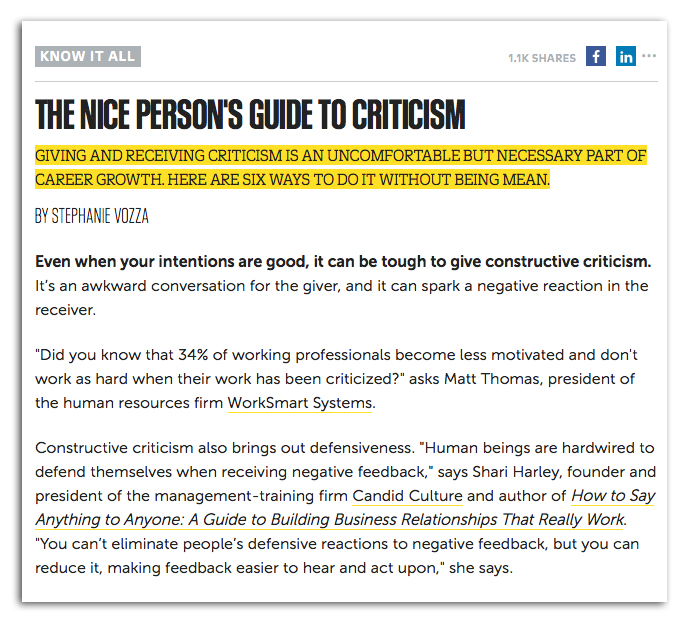 EVEN WHEN YOUR INTENTIONS ARE GOOD, IT CAN BE TOUGH TO GIVE CONSTRUCTIVE CRITICISM.
Constructive criticism also brings out defensiveness. “Human beings are hardwired to defend themselves when receiving negative feedback,” says Shari Harley, founder and president of the management-training firm Candid Culture and author of How to Say Anything to Anyone: A Guide to Building Business Relationships That Really Work. “You can’t eliminate people’s defensive reactions to negative feedback, but you can reduce it, making feedback easier to hear and act upon,” she says.
4. Don’t “save up” your negative feedback
People often hoard feedback until a situation becomes so frustrating that they can’t help but speak up, says Harley. “Because they waited too long to say what they think, many more words come tumbling out than is either necessary or helpful.”
Instead, make it a practice to give small amounts of feedback at a time—one or two strengths and areas for improvement during a conversation. People cannot focus on more than one or two things at a time, says Harley.
5. Be timely but not immediate
Give feedback close to the time of an event, but not when you’re upset, says Harley.
“The time to fix a problem is when no one is upset,” she says. “I call this practice the 24-hour guideline and the one-week rule: Wait 24 hours to give feedback if you’re upset, but not longer than a week after an event occurs.”
6. Finally, be discreet
“Praise in public, criticize in private,” says Harley. Make sure all negative feedback discussions happen behind a closed door.
Click here to read the entire article at FastCompany.com.
 If you took my advice last week and asked your boss who impacts the decisions made about you at work and what those people think of you, you probably got some feedback. The question is, what should you do with the feedback?
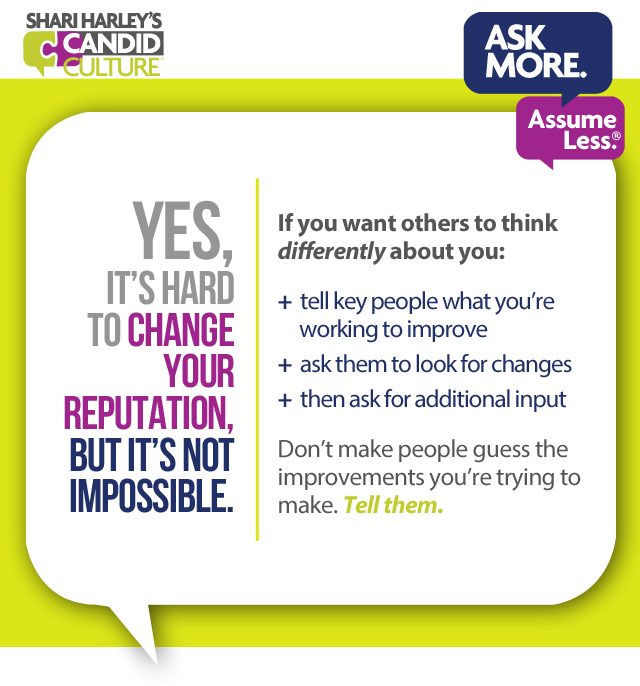
We know impressions are made quickly and are hard to change. But it’s not impossible to repair your reputation. If you want to change how people see you, I’d suggest being very overt about the changes you’ve made. Don’t simply alter your behavior and wait for people to notice. They likely won’t.
Once people have formed an opinion about you, that’s often their opinion for as long as they know you. For example, if you have a tendency to be late, even if you periodically show up on time, your friends and coworkers will think of you as the person who is always late. If you work with someone who tends to miss deadlines, even if she periodically turns work in on time, you’ll think of her as someone who misses deadlines.
Once people make a decision about us, that’s often how they’ll see us for the duration our relationship. So if you want to repair your reputation, you’re going to have to do it overtly. Making changes and hoping people notice, won’t produce the desired result.
Here Are Eight Steps to Repair Your Reputation:
- Ask people who can impact your reputation and whose judgment you trust for feedback.
- Work hard to manage yourself and not get defensive. Respond to all feedback, no matter how hard it is to hear or how invalid it may feel with, “Thank you for telling me that. I’m going to think about what you said. I may come back to talk more later.”
- Once you’ve absorbed the feedback, decide what, if any, changes you will make.
- Change your behavior for a period of weeks.
- Return to the people who gave you feedback, tell them about the behavior changes you’ve made, and ask them to observe your behavior.
- Tell the people who gave you feedback that you’ll ask them for feedback again in a few weeks, and you want to know what they see.
- Return to the people who gave you feedback and ask what changes they have or haven’t noticed.
- Repeat steps 3 through 7 at least quarterly. Everyone periodically does things that can damage their reputation.
Overtly pointing out the behavior changes you’ve made, asking people who are important to you to pay attention, and give you additional feedback, is key to altering your reputation. Most people working to change their reputation don’t do this. They make behavior changes and hope others notice. If you want to alter your reputation and how others see you, you need to do so overtly. Tell people the changes you’ve made; don’t make them guess. Ask people to observe your behavior, and then ask for more feedback. And no matter how hard the feedback is to hear, don’t get defensive. Becoming defensive will ensure you don’t get feedback the next time you ask.

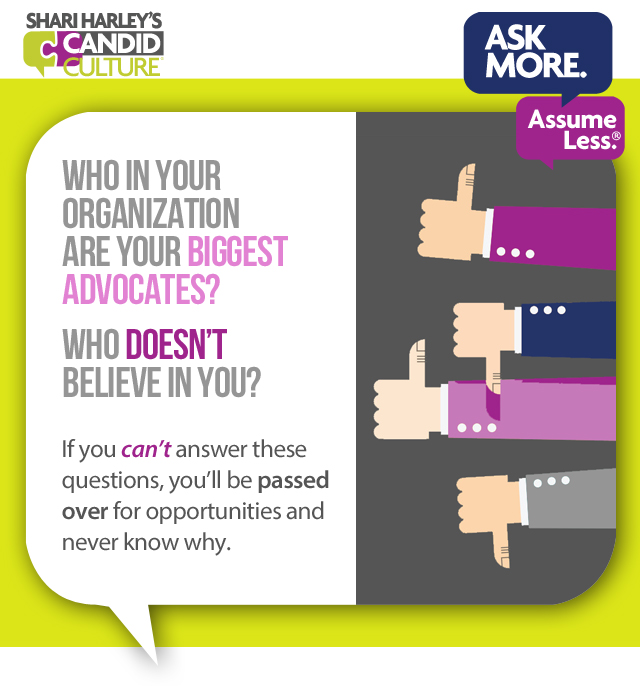 You will be passed over for jobs, projects, and second dates and never know why. Being passed over isn’t necessarily a bad thing, not knowing why is problematic. If you don’t know why you’re being passed over, how can you be prepared for next time?
Organizations are political. People talk. You’ve undoubtedly already experienced this.
If you want to manage your professional reputation, one thing you must know is who talks about you and what they say. How decisions get made in organizations isn’t always obvious. There are the obvious channels of decision making, like your boss and your boss’s boss. But there are also the people who talk to your boss and boss’s boss and have an opinion about you, who you may not be aware of.
Everyone in an organization has people they trust, who they listen to and confide in. Who those trusted people are isn’t always obvious. When you’re being considered for a new position or project, the decision makers will invariably ask others for their opinion. Knowing who does and doesn’t support you in a future role is essential to managing your professional reputation and career.
I don’t want you to be nervous, paranoid, or suspicious at work. I do want you to be savvy, smart, and aware.
It’s not difficult to find out who can impact your professional reputation at work, you just need to ask the people who know. Start with your boss. S/he likely knows and will tell you, if you ask.
To ensure you know who can impact your professional reputation, tell your boss:
“I really enjoy working here. I enjoy the people, the work and our industry. I’m committed to growing my career with this organization.”
Then ask:
- Who in the organization should I have a good relationship with?
- Who/what departments should I be working closely with?
- Who impacts my professional reputation and the opportunities I have?
- What skills do I have that the organization values most?
- What contributions have I made that the organization values most?
- What mistakes have I made from which I need to recover?
Your manager doesn’t walk around thinking about the answers to these questions. If you want thoughtful answers, set a time to meet with your boss, tell him/her the purpose of the meeting – to get feedback on your professional reputation so you can adeptly manage your career – and send the questions in advance, giving your boss time to prepare for the meeting. You will get more thoughtful and complete answers if your boss has two weeks to think about the questions and ask others for input.
Don’t be caught off guard by a less-than-stellar professional reputation. Take control of your reputation and career. Ask more. Assume less.
Write a comment about this week’s blog and we’ll enter your organization to win 50 professional reputation bookmarks!

Most training programs about giving feedback focus on negative feedback, because giving negative feedback is hard and makes us uncomfortable. But most people aren’t any better at giving positive feedback.
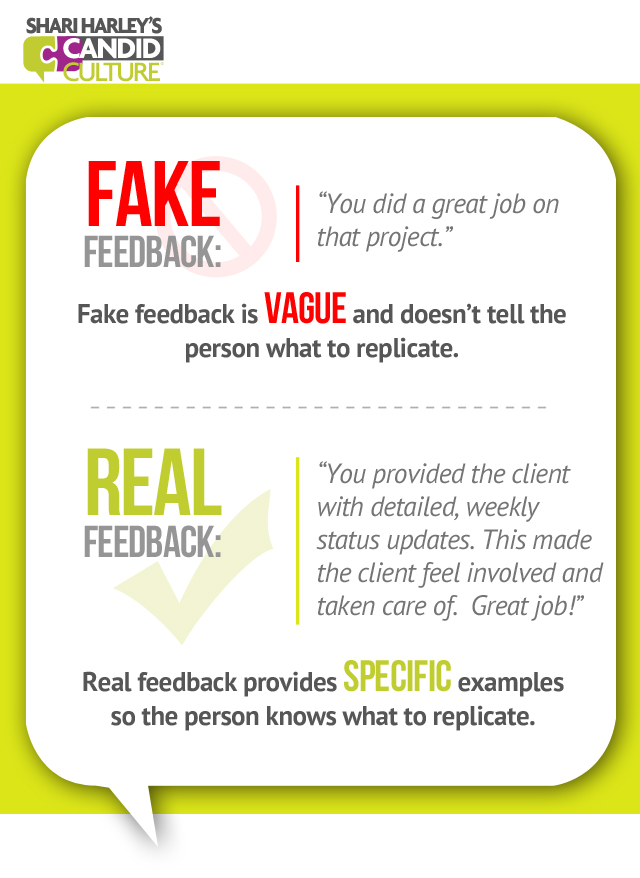
Most of the positive feedback people get at work really isn’t feedback at all. It’s vague, fluffy, and unhelpful. Aka, Cap’n Crunch – sweet but useless.
“Great job.” “You’re awesome.” “You’re great to work with.” None of this qualifies as real feedback.
The purpose of positive feedback is to make people feel valued and appreciated and to get them to replicate a behavior. Telling someone, “great job” or “you’re doing great work” will make the person feel good (momentarily), but won’t tell her what to replicate. These phrases are vague, and vague positive comments come across as inauthentic at best and unhelpful at worst.
Here are a few examples of what I refer to as real vs. fake feedback:
Examples of positive feedback:
Fake feedback: “Great job.”
Real feedback: “You researched three vendors when making a proposal of who we should choose to manage our payroll operations. You included all the necessary information for us to make a decision and presented the information in a one-page table that was easy to read. Your work made it really easy to make a decision. Great job!”
Examples of positive feedback:
Fake feedback: “You’re really reliable.”
Real feedback: “I know that whatever I give you to do will get done the first time I ask and will be accurate. I don’t have to ask again or check your work. You check your work for typos and mistakes before submitting it.”
Examples of positive feedback:
Fake feedback: “You make my job easy.”
Real feedback: “Last week you noticed an invoice that didn’t seem accurate. You researched the invoice and got the mistake corrected before I even knew there was a problem. You make my job easy.”
Examples of positive feedback:
Fake feedback: “You’re awesome.”
Real feedback: “You always do what’s right for the company. Last week you called a vendor whose service has been spotty. You provided them with feedback and asked for their plan to improve their service levels. This added a lot of value to our organization.”
The guidelines for giving positive feedback are the same as giving negative feedback:
- Be specific.
- Give an example.
- Give feedback close to the time an event happens.
To give specific and meaningful positive comments, you will have to observe performance, and that takes time. But if you want someone to replicate a behavior, tell the person specifically what she did well.

People are not us; they do things their way, not ours. This is so obvious. Yet violated expectations are consistently a source of lots of frustration and upset, both personally and professionally. “How could you not check your work before submitting information to a client?” “What do you mean you didn’t call that person back?” “You said what?!”
The most frequent request we get at Candid Culture is for feedback training. The call usually goes something like this, “The  communication isn’t great at our company. Managers don’t give a lot of feedback. People don’t talk directly to each other when there are problems, they talk about each other. Can you help?”
Sure, we can help. But once we’re having this conversation people are already frustrated. Trust has been violated and relationships and reputations have been damaged. Instead of waiting for problems to occur, expect the unexpected. Set clear expectations before people don’t proofread reports, miss deadlines, and do other things you wouldn’t dream of doing.
How to avoid violated (often unstated) expectations? Ask more questions.
Here are five questions you should ask every person you work with. And if you do, your workplace will have fewer frustrations and violated expectations:
- What’s most important that you’re working on right now? What are your goals this quarter?
- What are we both working on that we can work on together? Or what should one of us stop working on?
- How do you like to communicate? Phone, in-person, by appointment or drop by’s.
- How do you like to receive information – email, voicemail, text message or instant messenger?
- If I need information from you and I haven’t heard back from you, what should I do, and is it ok to do that?
- What are your pet peeves at work? How will I annoy you and not even know it?
- How do you like to be interrupted? (You’re going to be interrupted. You might as well have a preference.)
I know. That was seven questions, not five. I could keep going. But this is a good start.
Here’s the philosophy and practice: People aren’t you. Anticipate challenges, breakdowns, and violated expectations, and talk about them before they happen. Make requests. Ask questions.
It’s always easier to ask for what you want than to give feedback.
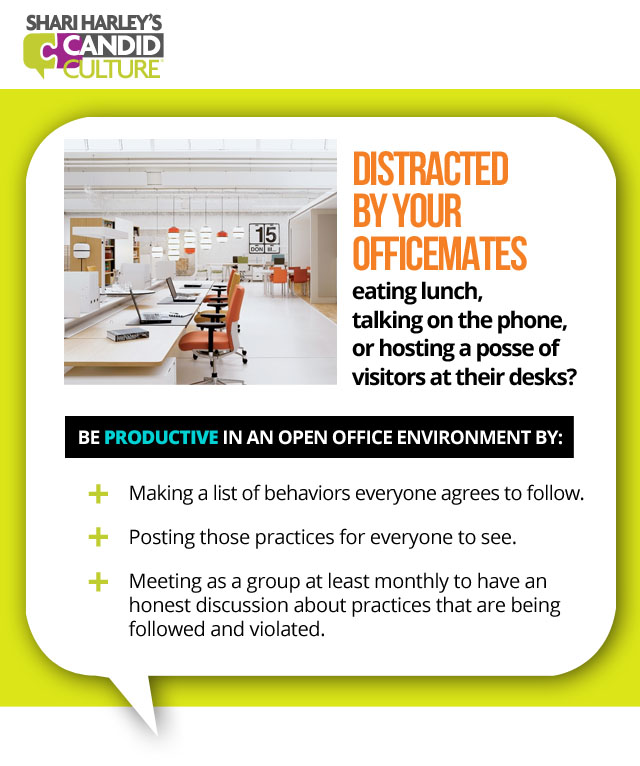 Many organizations have moved from cubeland to open plan offices in which employees sit in rows of desks with no barriers between them.
There’s considerable research on the workability of open plan offices. Some of what’s written says that introverts do worse than extroverts in an open plan office. I disagree. I’d say that how a person learns/takes in information determines how well she’ll do in an open plan office.
If you’re a visual or kinesthetic learner who learns by seeing or doing, you’ll be less distracted by noise than an auditory learner who learns by hearing. Auditory learners hear everything and are easily distracted by talking, music, and other noise. Visual and kinesthetic learners often don’t hear distractions, so they do better in an open plan office.
Here are seven steps to make an open plan office a more productive environment:
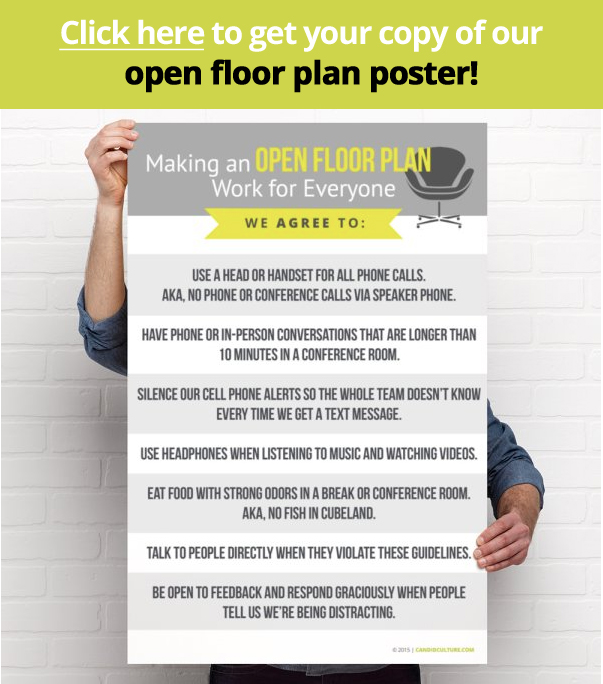
- Schedule a meeting during which people sitting together can discuss the working environment they need to be satisfied and productive. Then facilitate a discussion during which the group creates 5 – 7 behavior guidelines each person agrees to follow when at their desks.
- Post the list of agreed-upon behaviors on a poster that is large enough to be read from any place in the work environment. Leave the poster up indefinitely.
- Give each person in the group permission to talk to individuals who violate the guidelines. This is very, very important. For the most part, employees won’t tell another person she is talking too loudly, eating food that smells, has too many visitors at her desk, listens to music or videos without headphones, or takes phone calls via speaker phone. People will suffer in silence and choose to work from home or in an empty office or conference room rather than speak up about the behaviors that frustrate them. Ask the group to grant each other permission to speak up when guidelines are violated. Giving each other permission to speak up will make future conversations possible – difficult but possible. Without permission and these agreed-upon behaviors in place, people will suffer in silence or talk about each other, not to each other.
- Ask everyone in the work group to take feedback graciously, responding with “thank you for telling me,” rather than with defensiveness.
- Two weeks after making the list of guidelines, get the group together to review the list and make any necessary changes to it. Discuss behaviors that were omitted, aren’t realistic, and are realistic but aren’t being followed.
- Then follow up by facilitating a monthly conversation during which group members give honest feedback about which guidelines are being followed and which are not, and problem solve as a group. These conversations aren’t a chance to embarrass or call people out in a group setting. If one person is violating a guideline, that conversation should happen individually.
- You will need a strong facilitator for the group discussions. The facilitator must tease out people’s thoughts, while making sure no one gets blasted in front of the group. Don’t let concerns that you know exist be brushed under the rug. Group members must openly and regularly discuss what is and isn’t working about their work environment, or frustrations will build and unhappiness and dissension will ensue.
It’s not too late to put these practices in place, even with a group who has been sitting together for a long time. Just schedule the conversation and explain why you’re having it. People will be relieved and grateful.
Working in an open plan office is challenging. It requires good communication and compromise. Don’t wait for problems to occur and frustrations to build. Have a conversation today.
 People are too afraid to tell the truth at work. We’re afraid that if we give honest performance feedback, people will get upset. They will. We’re afraid that if we say what we think, we’ll get marginalized, put in a corner, never to be given cool work again. That’s unlikely.
We tiptoe around the people we work with, afraid to hurt people’s feelings and rock the boat. This doesn’t work. Without honesty in the workplace, performance won’t improve and problems won’t get solved.
Here are five ways to increase honesty in the workplace:
Increase honesty in the workplace tip #1: Overtly tell employees that it’s acceptable, safe, and expected that they will make mistakes. If people are afraid to make mistakes, they’ll never risk trying anything new.
Create an award for the person who failed while trying to do something new. And present the award very publically, sending the message that it’s ok to fail.
Increase honesty in the workplace tip #2: Set the expectation when you hire and onboard new employees that they will receive regular and balanced (positive and negative) performance feedback. Tell candidates and new employees that giving and receiving honest feedback is part of your organization’s values and culture, and if employees don’t want to give and receive this type of feedback, they shouldn’t work for your company.
When you interview employees, ask about a time they received negative feedback and what they did with that information. People who can’t answer this question aren’t self-aware or open to feedback. Don’t hire them.
Increase honesty in the workplace tip #3: Create safe places and occasions to give regular feedback. Ensure managers and employees meet one-on-one at least monthly to discuss performance. Give teams a chance to openly talk about how projects are going. Debrief significant projects and pieces of work by asking what did and didn’t work. And ensure managers are asking for employees’ feedback on what the manager can do differently to make work an easier place to be. Feedback goes both ways – up and down. Managers earn the right to give feedback when they’re open to receiving it.
While you’re going to ask for feedback, it doesn’t mean that you’re a dumping ground. It’s perfectly ok to tell employees what you want feedback about and what you don’t. If you made a decision and aren’t looking for input, don’t ask for input on that subject. If you receive unsolicited and unwelcomed feedback, say “no thank you.” A feedback-rich culture doesn’t mean you accept feedback on every topic all the time. It’s ok to set boundaries.
Increase honesty in the workplace tip #4: Don’t be daunted by people’s negative reaction to feedback. No one likes to be told s/he is wrong and no one wants his/her competence called into question, as a result, becoming defensive when receiving negative feedback is normal and natural. Not becoming defensive is not the norm. People might tell you you’re wrong, turn red, cry, yell, or go silent and pretend you don’t exist for a period of weeks. But everyone will survive. Try not to hire people who won’t talk to you for weeks after receiving feedback. Those folks need to grow up.
Increase honesty in the workplace tip #5: Remind people over and over and over that honest feedback is what allows employees and organizations to grow, evolve, and thrive. Not telling the truth creates stagnation and will ultimately lead to individual and organizational failure. The more you give and receive feedback, the more comfortable employees will be with the process.
Periodically give yourself a pep talk about being honest with your employees. Letting someone linger in a job in which s/he cannot be successful is not kind, it’s cruel. To talk about people when they’re not present, versus giving candid feedback directly, is also unkind.
We all need to man or woman up. Tell employees that everyone in the organization is expected to tell the truth and to do so directly, kindly, and tactfully. Likewise, everyone is expected to be open to receiving feedback graciously. Over time people will become more comfortable speaking up and receiving all types of input. And if you want a feedback-rich culture, the people who can’t or won’t speak candidly, aren’t the right fit for your organization.

 Our company got a shipment of products this week that were partially defective. When I called our vendor to tell him about the defective products, he sighed knowingly. He knew part of our order was imperfect and waited for me to find the problems versus telling me himself.
What?!?!
I love surprise gifts, trips, and discounts. But I don’t like surprise errors and your internal and external customers don’t either.
Everyone makes mistakes at work. Making a mistake is not necessarily a problem. It’s how you deal with the error that matters more. Letting those who are impacted by a mistake be surprised damages your reputation and working relationships much more than coming clean as soon as you realize the error. Rather than waiting to get caught, tell your customers about mistakes and work together to make things right.
Here are a few ways to tell people you made a mistake, while saving face:
Fessing up to making mistakes at work tip #1: When you realize you’ve made a mistake, pick up the phone and tell the person live, as soon as you know. Don’t wait.
Fessing up to making mistakes at work tip #2: Apologize and work with your customer to develop a solution. Be part of the process. Don’t leave your internal or external customer holding the bag.
Fessing up to making mistakes at work tip #3: Don’t give a bunch of reasons or justifications for what happened. It sounds like excuse management and no one cares. Your customers just want to know how you’re going to solve the problem.
Fessing up to making mistakes at work tip #4: Say something like, “I realized we sent you a report with incorrect information. I’m so sorry. I’d like to work with you to make this right. Here are a couple of ideas of what we can do… Would any of these suggestions work for you?”
Or you could say, “I realized parts of your order are imperfect. I’m so sorry. Here’s how we’d like to make things right. Are these solutions satisfactory to you?”
Or consider saying something like, “I’ve realized we can’t fulfill your order by the date we promised. I’m so sorry. Here’s what I suggest we do to get you what you need in a timely way. Does this work for you?”
We all make mistakes. How you handle mistakes determines how your internal and external customers view you and how much they trust you. Come clean quickly. Take responsibility. Don’t provide a bunch of reasons for a mistake. Help make things right. And you’ll likely preserve your reputation and business relationships.

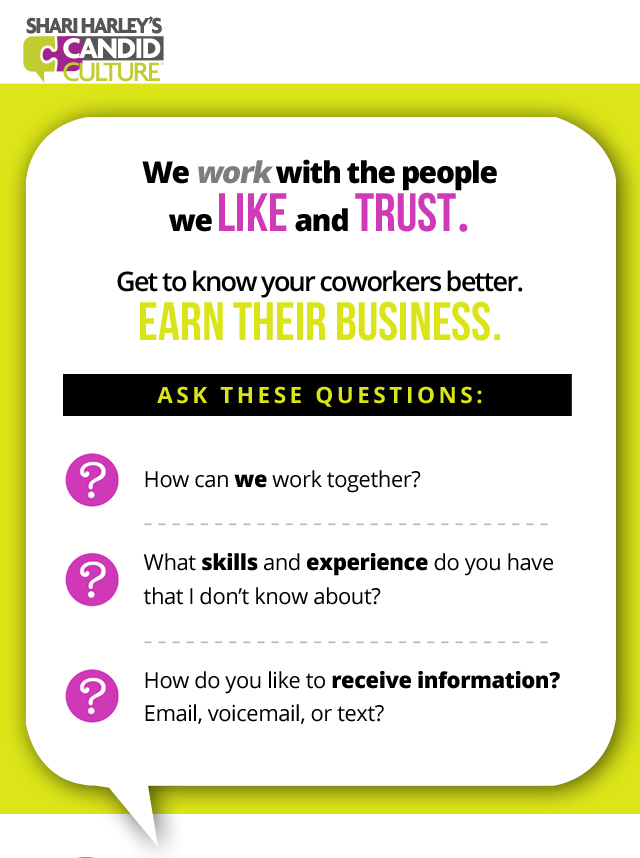
Regardless of who your company’s org chart says you should work with, people work with the people they want to work with and around those they don’t. One way to get people working with you (by choice) is to get to know your coworkers better, and I don’t mean personally.
Most people don’t know the people they work with very well. Coworkers often don’t know what fellow team members are tasked with doing for the company, their past work experience, education, or working style preferences. They often don’t know how fellow team members like to receive information, but get annoyed when they don’t return unopened emails.
If you’ve had any team building training with me, you know I advocate getting to know people better by asking more questions.
Organizations spend a lot of money on team building. Teams go bowling, out to happy hour, and have pot luck lunches, etc. All of those activities are fun and build comradery, and that’s important. But comradery and enjoying spending time together outside of work won’t help a team learn to communicate or overcome challenges.
If you’re really committed to team building and working well with people, ask more questions at the onset and throughout working relationships.
Here are five team building questions coworkers should be asking each other:
- What are your pet peeves? How would I frustrate you and not even know it?
- Are you a big picture or detail oriented person? Should I send you information in bullets or paragraphs?
- What are you best at doing? What type of work could you be doing that you’re not doing now?
- What are you working on now? What are your priorities for the next six months?
- What’s something I could do differently that would make your job easier? (You will survive the answer. I promise)
Your manager may coordinate an activity that gives your team the ability to ask questions like this, and s/he might not. Either way, ask the questions and be forthcoming if others ask you for this information. It’s not just your manager’s job to get your team working well together.
Your daily experience at work – how much you get done, how easily you get that work done, and how much fun you have along the way – is largely dependent on the people you work with. Don’t leave your working relationships to chance. Be assertive. Get to know people better. Ask more questions and offer information about yourself.

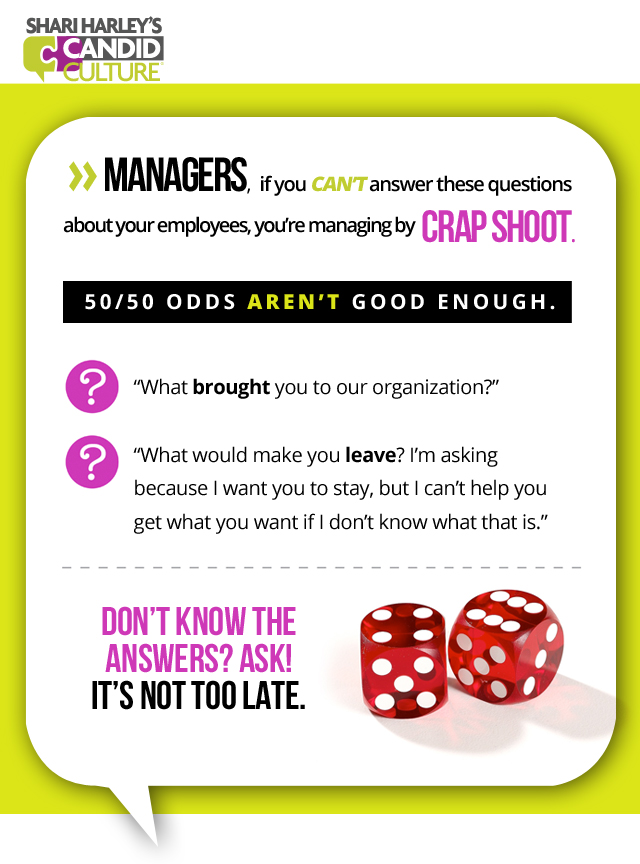 If an employee quits and the manager is surprised, shame on the manager. Employee turnover – literal turnover (he quits and leaves the building) or figurative turnover (he quits but continues to come in everyday and do his minimal best) – are extremely predictable.
Most employees need only a handful of things to be satisfied and productive at work. The key is getting employees to tell you what those things are. And they might just tell you, if you ask.
An employee’s first few weeks at a new job often involve a lot of training. Managers tell employees what they need to do and hopefully why they need to do those things. I recommend balancing telling with asking.
Effective management involves asking the seven questions below during the interview process, after an employee starts, and again 90-days to six months into the job.
Effective management question number one: “What brought you to this company? Why did you accept this job? What are you hoping the job will provide?” Ask one of these three questions. Pick the one you like best.
Effective management question number two: “What would make you leave this job? What are your career deal breakers, things you just can’t tolerate at work?” Ask either of these questions.
Effective management question number three: “What type of work, skills, and/or areas of our business do you want to learn more about?”
Effective management question number four: “Tell me about the best manager you ever had. What made him/her the best manager?” This will tell you what the employee needs from you as a manager and is a much better question than, “What do you need from me as your manager?” That is a hard question to answer. Telling you the best manager s/he ever had is easy.
Effective management question number five: “Tell me about the worst manager you ever had? What made him/her the worst manager?”
Effective management question number six: “What are your pet peeves at work? What will frustrate you?” Why find out the hard way what frustrates employees when it’s so easy to ask. This question demonstrates that you want your employees to be happy and that you will flex your own preferences, when possible, to meet employees’ needs.
Effective management question number seven: “How do you feel about being contacted via cell phone or text outside of business hours? How do you feel about receiving emails during the evenings and weekends?”
If you’ve participated in one of our effective management trainings and received a box of Candor Questions for Managers, you know I could go on. But these seven questions are a good start.
Regardless of age, gender, or work and educational background, all employees have a few things in common. Employees want to:
• Work for someone who takes an interest in and knows them
• Feel valued and appreciated for their contributions
• Be part of and contribute to something greater than themselves
• Feel respected as a person. Managers respect their time, expertise, and needs
Taking the time to get to know employees throughout your working relationship accomplishes many employee needs.
If you have long time employees, it’s never too late to ask these questions. Regardless of for how long employees have worked for you, they’ll appreciate you asking. There is no need to feel that employees will raise an eyebrow and wonder why you’re asking now. They’ll just be happy you’re asking. You can simply say, “I realized that I’ve never overtly asked these questions. I just assume I know. But I don’t want to do that. You’re too valuable to me and to the organization. During our next one-on-one meeting I’d like to ask you these questions and you can ask me anything you’d like.”
If you have a manager who will never ask you these questions, provide him/her the information. Don’t wait to be asked. You’re 100% accountable for your career. Tell your manager, “There are a few things about myself I want to share with you. I think this information will make me easier to manage and will help ensure I do great work for the organization for a long time.”
Managers, the better your relationship with your employees and the more you know about what your employees need from you, the organization, and the job, the easier employees are to engage, retain, and manage. Stop guessing and start asking.