You’ve heard countless times that you never get a second chance to make a first impression. So when something not-so-positive happens – a customer is upset, you missed a deadline, or made an error – don’t let your boss find out about it from someone else. Manage your professional reputation and get there first to create the first impression of what happened.
Managers don’t like surprises. If your manager is going to get a call about something that isn’t positive, let them know before the call comes in. You will create your manager’s perception of the situation, and perceptions are hard to change. Don’t wait for the s*** to hit the fan. Get ahead of the problem by coming forward and giving your manager and other stakeholders a heads up.
It could sound something like this, “I just had a tough conversation with John in IT. You may get a call. Here’s what happened… I didn’t want you to be surprised.”
Or “I told Brian at Intellitec that we’re raising our prices in the second quarter. He wasn’t happy. You may get a call.”
Or let’s say you’re going to work on a strained relationship. Tell your manager before you take action. It could sound something like this, “I want to work on my relationship with Julie. Our relationship has been strained since we worked together on the software project last year. I’d like to approach her, tell her that I know our relationship is strained, and that I’d like a good working relationship with her. Then I’d like to ask if she’s willing to have lunch with me, talk about what’s happened, and see if we can start again in a more positive way. What do you think of me doing that? Would you approach the conversation differently? I don’t know how it’s going to go, so I wanted you to know what I’m planning to do, just in case it backfires, and you get a call.”
Manage your professional reputation assertively by taking responsibility for mistakes, working on damaged relationships, and telling your manager before someone else does!
Vague communication is unhelpful. Being vague instills doubt in the people around you and reduces your credibility.
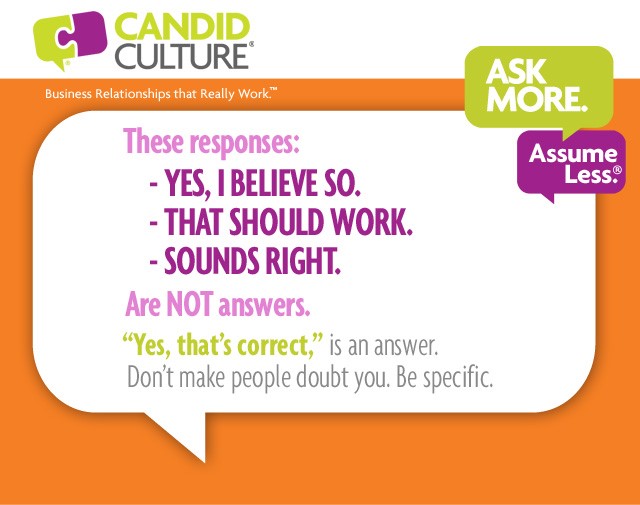
When a customer service agent answers my questions with words like, “That sounds right, I think so, or that should work,” I hang up and call back, hoping to get someone who can give me an affirmative answer. People do this to you too; they just don’t tell you about it.
Pay attention to your language. If the answer is yes, say “Yes.” If the answer is no, say “No.” “I think so,” says neither yes nor no. Saying, “I think so” tells people you don’t really know.
A few phrases to avoid and what to say instead:
Avoid: “That should be done by Friday.”
Instead, be specific and give a final date. “That will be complete by Friday. If I can’t get it done by Friday, I’ll call you to let you know by 5:00 pm on Thursday.”
Avoid: “Sounds right.”
Instead, be specific and say, “That’s correct.”
Avoid: “We should be able to do that.”
Instead, be specific and say, “We can do that.”
Avoid: “I guess.”
Instead, be specific and say, “Yes” or “No.”
When I teach feedback training, the biggest thing training participants struggle with is specificity. “You’re difficult to work with.” “Your clothing is inappropriate.” “I just find you to be negative.” “You did a good job on that.” “It’s a pleasure to have you on the team.” All of this is vague and thus unhelpful to the feedback recipient. And the same is true when answering questions and making promises.
Tell people exactly what to expect. Be specific. Even if they don’t like your answer, they’ll be happy to have a clear answer.
Many businesses are struggling to overcome negative and permanent online reviews on yelp, trip advisor, Glassdoor, etc. And they’re wondering why customers and employees go online vs. giving feedback directly. The answer is simple.
Giving feedback online is easy. Giving feedback directly is harder, for many reasons. No one wants to be the person who complains. Feedback is likely to be received with a defensive at worst and explanatory at best response, and who really wants to deal with that? And we fear we’ll get “in trouble” for giving feedback, etc. etc. etc. I could go on and on.
If you want your customers and employees to give you feedback directly instead of blasting you online when they’re unhappy, make it easy to give you feedback, regularly.
Here are four ways to help prevent negative online reviews and improve the data you get from customers and employees:
Ask customers and employees for feedback regularly. Don’t wait until the end of the year or after a service has been provided to ask for feedback. Ask for feedback during the customer’s experience. Ask employees for feedback every 90-days. Marriott hotels is masterful at this. Hotel guests don’t get onto the hotel’s free Wi-Fi until answering one question about their hotel stay. If guest feedback has a negative component, a manager will call you immediately. Such smart business.
If you’re going to send online surveys, keep them short. Never ask a customer more than five questions, and two is better. Ask a version of, “What are you appreciating about your experience? What could we change on your behalf?” What else do you need to know? Too many businesses send exhaustive and exhausting surveys to customers after a service has been provided. It’s unrealistic to expect customers to complete 30+ survey questions. Keep it short. You’ll see better response rates.
Call 10% (or fewer if you have thousands of employees and customers) and ask for feedback. It’s such a rare occurrence to receive a phone call asking for feedback, it’s an immediate loyalty and relationship builder.
Don’t request a positive score on a survey. Sending a survey and asking for a certain response type is a turnoff. Uber drivers who ask me to rate them a five never get that rating. The best way to get an awesome rating is to be awesome.
Ask for feedback early and often, and make it easy to give. P.S. And no anonymous surveys – a topic for another day.
Posted under Uncategorized on August 7, 2022 by Shari Harley. 0 Comments
Saying no is hard. We don’t want to disappoint or let people down. And yet, you can’t say yes to everything. You can say no and still sound like a responsible, easy-to-work-with, accommodating professional.
Here are four practices for saying no:
Thank the person for asking. “Thank you for asking me.”
1. Saying “thank you” acknowledges the other person and buys you time to think about their request.
2. Tell the person you need some time to think about the request. Ask, “Can I have a few days to think about it? I’ll get back to you by Friday.”
You don’t need to reply in the moment. I often regret things I agree to without thinking through the request thoroughly.
3. Consider what you really want and are willing to do. It’s much worse to over commit and under deliver than to simply say no or renegotiate requests.
4. Get back to the person in a timely way (when you said you would) and tell them what you’re willing to do.
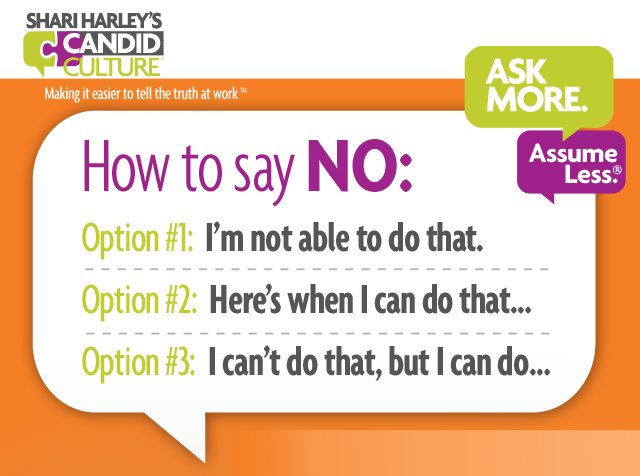
How to Say No Option One: Simply say no.
Example: “I really appreciate you asking me to write the proposal for the __________ RFP. I’m not able to do that. Can I recommend someone else who has the expertise and will do a great job?”
Don’t give a bunch of reasons for saying no. People aren’t interested in why we can or can’t do something. They just want to know if we will do it.
How to Say No Option Two: Agree and negotiate the time frame.
Example: “I’d be happy to do that. I can’t do it before the last week of the month. Would that work for you?” If the answer is no, negotiate further. Ask, “When do you really need it? I can certainly do pieces by then, but not the whole thing. Given that I can’t meet your timeline, who else can work on this in tandem or instead of me?”
How to Say No Option Three: Say no to the request but say what you can do.
Example: “I can’t do _______. But I can do ________. How would that work?”
A review of how to say no:
Acknowledge the request by getting back to the requestor within 24 hours.
Give yourself time to think about and respond to requests.
Negotiate requests to your and the requestor’s satisfaction.
Agree on what you can and are willing to do.
Keep your commitments.
Saying no is always hard. But it’s always better to say no than to ignore requests, or to say yes and do nothing.
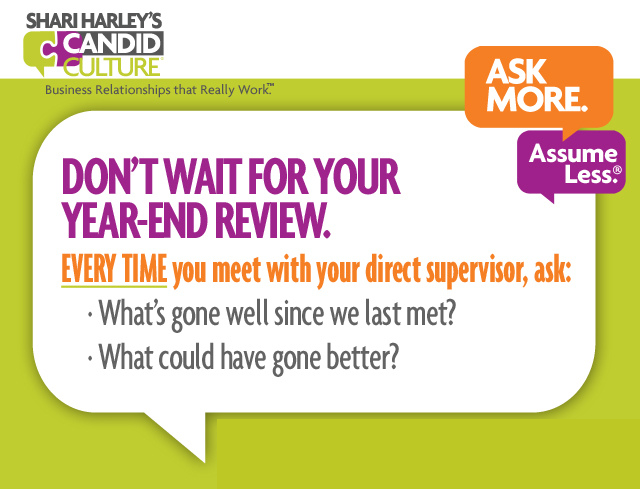
Most people wait way too long to give feedback. Instead of waiting to give feedback until you’re about to explode in frustration, or until a formal review, give feedback every time you meet with someone.
Managers, make it a practice to meet with each of your employees at least once a month. Short meetings twice a month or weekly would be better. But if you’re not doing one-on-one meetings now, start meeting monthly. If you’re meeting monthly, start meeting twice a month. Employees need one-on-one time with their boss. Team meetings and casual conversations do not replace individual meetings.
Direct Report One-on-One Meeting Agenda:
The direct report comes to the meeting ready to discuss:
1. What they are working on that is going well.
2. What they are working on that is not going well.
3. What they need help with.
4. Then the manager gives feedback on what went well since the last meeting and what could be improved.
5. The employee also gives the manager feedback on what has gone well since the last meeting and what could be improved.
Feedback goes both directions. Managers, if you want your employees to be open to your feedback, ask for feedback from your employees on what they need from you. Give feedback on both the work and your working relationship. A poor working relationship often motivates employees to leave a job, but it’s the last thing that gets discussed.
Feedback discussions should be short. You can say anything in two minutes or fewer. No one wants to be told they aren’t cutting it for 20 minutes. Say what you need to say and end the conversation or move on to another topic.
If you’re not giving your employees regular feedback, you can use this language to start:
“I’m realizing that I’m not giving you enough feedback. I want to be helpful to you. If I don’t provide regular, timely feedback, I’m not being as helpful as I could be. I’d like to start a regular practice of meeting monthly, getting an update from you on how things are going, and giving each other feedback on what went well and what could be improved since our last meeting.”
If you work for someone who is not forthcoming with feedback, ask for feedback. You’re 100% accountable for your career. Don’t wait for your manager, customers or peers to give you feedback. Ask for feedback on a regular basis.
Here’s how you can ask for feedback from your manager:
“Your feedback helps ensure I’m focused on the right work. Can we put a monthly meeting on the calendar, and I’ll tell you what I’m working on, where I do and don’t need help, and we can discuss how things are going?”
If meetings get cancelled, reschedule them. If your manager says these meetings aren’t necessary or they don’t have time, tell them, “Your regular input is helpful to me. What’s the best way to ensure we catch each other for a few minutes each month?” Meaning, push the issue.
If your manager still doesn’t make time for the meetings or doesn’t provide clear and specific feedback, even when you ask for examples, ask your internal and external customers and coworkers for feedback. The people you work closely with see you work and will likely give feedback, if asked.
No news is not necessarily good news. Waiting six months or a year to receive performance feedback is like going on a road trip from St. Louis to Los Angeles but not consulting a map until you arrive in New York, frustrated and far from your desired destination.
Managers: Meet with employees monthly, semi-monthly or weekly, and give feedback every time you meet.
Employees: Ask your managers, customers, and coworkers for regular feedback, and take control of your career.
Lots of organizations send out employee engagement surveys with the desire of improving employee engagement and retention; unfortunately, they often damage both in the process.
There are a few employee engagement survey pitfalls that luckily are easy to avoid.
Here are three practices to follow when sending out employee engagement surveys:
Shorter is better. I hate to say this, but no one wants to fill out your employee engagement survey. It’s time consuming, employees doubt the survey will yield results, and employees worry that their feedback isn’t really confidential.
Make your employee engagement survey easy to fill out by making it short. And by short, I mean 10 questions or fewer. You’ll get a better response rate to a 10-question survey than a 65-question one.
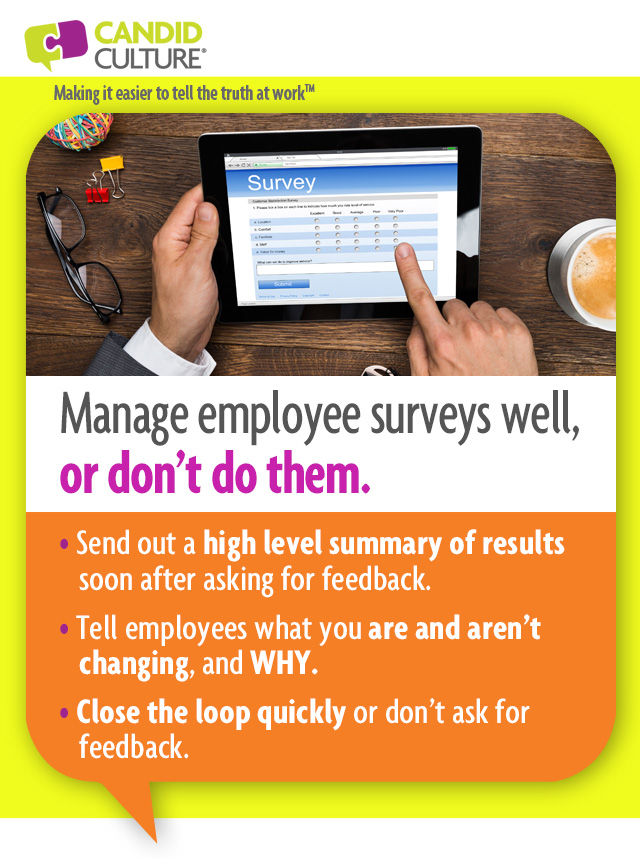
Provide employees with survey results quickly. Most organizations ask for too much information. Leaders are overwhelmed by the survey information, so they spend months and months reviewing it, while employees comment on yet another employee survey with no communication.
Send out a succinct communication sharing the top few learnings – the good and the not-so-good — within a few weeks of sending out the survey. You don’t need to take action at the same time. Simply keep employees in the loop by communicating a quick summary of what you learned. If you wait too long to share the feedback, it often never gets communicated. And the next time you send out a survey, employees will remember the absence of information and be hesitant to fill it out.
Within 90-days, tell employees what you will and won’t be changing, based on the survey feedback, and tell them why. Employees don’t need or expect all of their input to be utilized. Closing the loop with clear communication about what you are and aren’t changing, and why, is often sufficient.
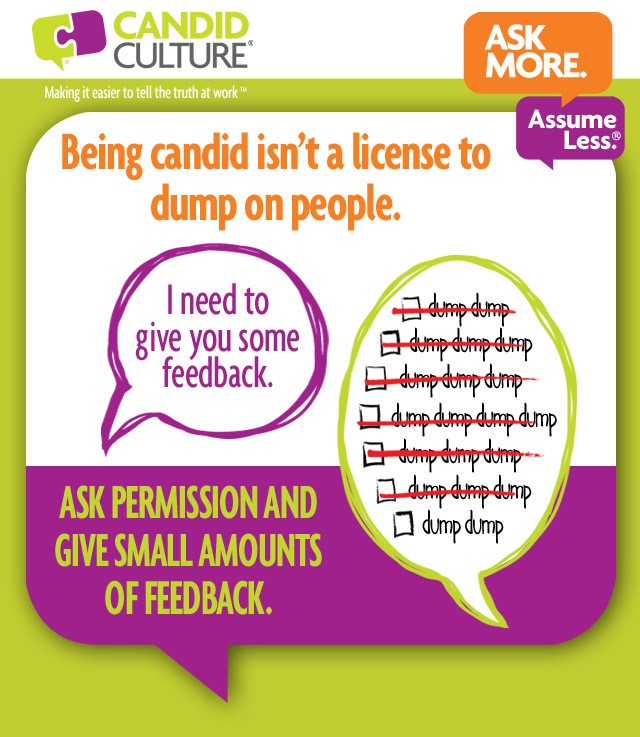
People leave feedback training armed with new skills and they unfortunately sometimes use those skills as a weapon. It goes something like this, “I need to have a candid conversation with you.” And then the person proceeds to dump, dump, dump. This couldn’t be more wrong, wrong, wrong.
When you give someone negative feedback you are essentially telling the person they did something wrong. And who likes to be wrong? The ego gets bruised, and people often start to question themselves. This normal reaction doesn’t mean you shouldn’t give feedback, you just need to do it judiciously.
Ask yourself these four questions when deciding whether or not to give someone feedback:
Do I have the relationship to provide feedback? Does the recipient trust me and my motives?
Do I have permission to give feedback? If the recipient doesn’t work for you, you need permission to give feedback.
Is this something the person can do something about? If it’s not a change the recipient can make, keep your thoughts to yourself.
Is the feedback helpful? Ultimately the purpose of all feedback is to be helpful.
Let’s say you’re on the receiving end of too much feedback. What should you do? It’s ok to say “no thank you” to feedback. Here’s what you could say:
“Thank you for taking the time to bring this to my attention. I really appreciate it. You’ve given me a lot of feedback today. I’d like something to focus on that I can impact right now. What’s the most important thing I should do?” You’ve validated the other person and demonstrated openness and interest. You’ve also set some boundaries and expectations of what you will and won’t do.
“Thank you for taking the time to share your requests about… We won’t be making any changes to that and here’s why.” It’s ok not to act on all feedback, simply tell people why you won’t.
“I appreciate your concern. I’m not looking for feedback on that right now.” Can you say that to someone? Yes. Should you? Sometimes. To your boss – no. To someone who offers unsolicited advice that’s outside of their lane, yes. They’ll get the message.
People can only act on and digest small amounts of feedback at a time. Be judicious and assess your motives. The purpose of feedback is to be helpful, when the feedback is requested, and when you have the relationship to give it.
If you receive too much feedback or unsolicited feedback, it’s ok to decline. You’re not the 7-11, aka you’re not always open.
The purpose of feedback isn’t to teach people a lesson, it’s to elicit certain behavior.
Below are six strategies for giving helpful and succinct upgrade feedback:
Write down your message. Save it as a draft. Re-read it later, when you’re not emotional, then cut the words in half. Shorter is better.
Remove emotion. Examples are helpful, emotion is not. Emotion: You embarrassed me. Example: You raised your voice at me in front of others.
Remove judgments. Vague words are judgmental. Judgment: Your behavior was unacceptable. Specific: You rolled your eyes at a coworker.
When you can deliver your message in about a minute, without emotion or judgment, you’re ready to speak.
Deliver all upgrade feedback in a private setting, behind a closed door.
Then, let it go. When the conversation is over, it’s over. Don’t stay angry or remind the person of the situation. If the behavior is repeated, discuss it then.
Say only what you need to. Deliver messages privately. Protect the ego, which is fragile. Let people save face.
“If you have nothing nice to say, don’t say anything at all.” Most of us grew up hearing these words. Last week I used them with my six-year-old son, and instantly regretted it. He said something hurtful to me and I told him to keep those thoughts to himself.
I want him to keep his thoughts to himself if he doesn’t like a kid at school or doesn’t want to play with someone. Walk away, find another place to play, is often my guidance. But with me? With me I want him to be honest, always, even if it hurts.
Every time we talk with people, we train them how to interact with us. If I tell my son not to tell me the truth, I teach him to protect my emotions and stifle his. I teach him I’m not strong enough to handle the truth and that I’m someone who needs protecting. I teach him that he can’t be honest with me.
If you want your coworkers, boss, family and friends to be honest with you, make it easy to tell you the truth. Take in what others say without visibly reacting. Say “thank you” for whatever feedback and input you get, even when you want to say everything but. Take the time to ‘get over’ hard messages and then discuss further, when you’re not angry.
People learn quickly. If we react to suggestions, input, and feedback negatively, people learn that we can’t take challenging data and they stop giving it to us. I don’t want to be the person the people I care about are afraid to talk with because my reaction is just too hard to deal with.
Should you care about everyone’s feedback? No. Should you ask everyone for feedback? No. Should you be open to everyone’s feedback? No. Be open to feedback from the people who matter most to you. Open your heart and your mind. Close your mouth. Even when you want to do everything but. Strengthen your relationships and train people that you can handle the truth.
How many times have you been sitting at your desk wondering, “Why won’t they ___________ ?” Perplexed, you talk with your buddy at work. The conversation goes something like, “I’ve got this person, and I can’t figure out why they won’t ______________.” Or perhaps you talked directly to the person, but after several conversations, they still haven’t done what you asked them to do.
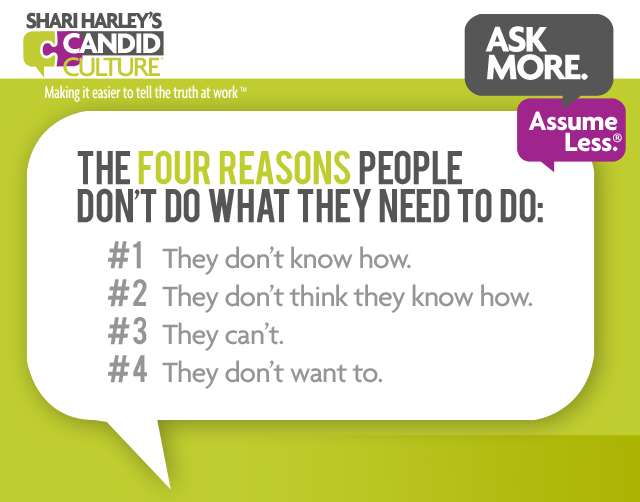
There are four reasons why people don’t do what you ask them to do:
They don’t know how.
They don’t think they know how.
They can’t.
They don’t want to.
Reason number one for a lack of employee performance, they don’t know-how, is the easiest to solve. People who don’t know how to do something need training, coaching, a mentor, a job aid or some other form of instruction. The hope is that with the right training and exposure, they will be able to do what you’re asking.
Reason number two for a lack of employee performance, they don’t think they know how, can be improved over time with patience and consistent coaching. You aren’t working with clean slates. Most people are recovering from or reacting to a past relationship or situation. If a person worked for a controlling manager who never let them make a decision or worked for someone who invoked punitive consequences for making mistakes, the person will likely be hesitant to make decisions. Hence why they continue to ask questions and repeatedly check in, but never make a decision independently.
If you work with someone who doesn’t think they know what to do, but you know they have the answer, encourage them to trust themself. When they come to you for validation or approval, ask questions, don’t give answers. Tell the person you trust their judgment and encourage risk-taking. Tell them you’ll support their decision, even if it proves to be the wrong one. And encourage them to make a decision next time without consulting you. Then keep your word. If they make a wrong call, you have to have their back and can’t invoke negative consequences.
Reason number three for a lack of employee performance, they can’t, is challenging but clear-cut. People who can’t do a task their brains aren’t wired for, will never do that responsibility well, regardless of how much coaching, training, and assistance you provide. If you have repeatedly and effectively, coached, trained, and provided support and the person still can’t do what is being asked, remove that responsibility and give the person something they can do well. If that responsibility is a large part of the job, you have someone in the wrong job. It’s time to make a change.
Reason number four for a lack of employee performance, they don’t want to, is annoying but manageable. There are lots of reasons people don’t do things they don’t want to do. Those reasons include, but aren’t limited to, boredom, lack of buy-in as to why something is important, insufficient time, feeling like a task is beneath them, etc. If you’ve got someone who can but doesn’t want to do something, you can either take the responsibility away, incent them to do it, or give feedback EVERY TIME the task doesn’t get done.
Giving negative feedback isn’t fun for the giver or the receiver. No one wants to hear that they aren’t meeting expectations and most people don’t want to tell you. But the discomfort of receiving negative feedback EVERY TIME the person doesn’t do what they need to do will create behavior change. They will either begin doing what you ask, quit, or ask for a transfer. Either way, your problem is solved.
The first step in getting people to do what you want them to do is to discover why they’re not doing what you ask. It’s impossible to appropriately manage employee performance if you don’t know why someone isn’t doing what needs to do be done. And the person to ask why a responsibility isn’t getting done isn’t you or your buddy, it’s the person not doing the work. So, get out of your head, leave your office or laptop, and go talk to the person not doing the work.
Here’s how to start an employee performance conversation:
“I’ve noticed you’re not doing ___________. Help me understand what’s happening.” Watch your tone, inquire from a place of genuine curiosity, and identify the reason they aren’t doing what they need to do. Then you can intervene appropriately and hopefully get what you want.


 It could sound something like this, “I just had a tough conversation with John in IT. You may get a call. Here’s what happened… I didn’t want you to be surprised.”
 she’s willing to have lunch with me, talk about what’s happened, and see if we can start again in a more positive way. What do you think of me doing that? Would you approach the conversation differently? I don’t know how it’s going to go, so I wanted you to know what I’m planning to do, just in case it backfires, and you get a call.”