A few years ago, I was facilitating a training when one of my client’s employees confided that she could see the train wreck coming on her team but wasn’t planning to say anything. She was going to watch the predicted mayhem happen, without saying a word.
Why wasn’t she planning to speak up about the breakdowns she could see were coming? Did she not care about her job or company? Was she not invested? The problem wasn’t any of those things. She simply didn’t believe that anyone wanted to hear what she had to say, the negative consequences for speaking up felt high, and quite simply, it was easier to say nothing.
When we were little, our parents likely told us, “If you have nothing nice to say, don’t say anything at all.” As young professionals, when we did speak up and someone didn’t like what we had to say, we got ‘in trouble’. And no one wants to hurt people’s feelings, damage relationships, or get labeled as the person who complains. The odds are stacked against speaking candidly.
The problem is, when employees don’t speak up about concerns, avoidable breakdowns happen, innovation is stifled, and dissatisfaction festers. We must find a way to speak up, even when we’re afraid or uncomfortable.
Many years ago, a colleague said to me, “The truth is one ingredient in the recipe, it’s not the whole meal.” I can’t take credit for this bit of wisdom, but it stuck with me. You don’t have to say everything you’re thinking, you can just say a little.
If you want to speak up at work but are hesitant, test the waters. Provide a little bit of information and see what happens. Was the person receptive? Did you face negative consequences? Were you treated unfairly? If the person handled your message well, provide a little more information. See how that goes. Be judicious in how much input you provide. Remember, every time you give someone negative feedback, you may bruise their ego and every person and organization has its own pace for change.
Silence leads to stale ideas, employee turnover, and cultures where people don’t want to work. Speak up, just a little.
When I led leadership development training for a large mutual fund company we offered a lot of training focused on helping people have hard conversations. Over time I realized that despite that I’d bought and offered the best training programs I could find, the training wasn’t helping. Managers didn’t give enough feedback, and when they did give feedback, employees were often left confused, wondering what they needed to do differently.
I decided that what was missing was the conversation before the crucial conversation. It wasn’t that managers didn’t know what they wanted to say; many managers felt they couldn’t say what they wanted to say. There wasn’t sufficient safety or permission for giving feedback, so managers said little or delivered messages that were so vague, employees were left wondering if there was a problem. This is how the idea for Candid Culture was born.
If you’re struggling with giving feedback, I doubt it’s the message that’s the challenge. The distinction between being able to tell the truth (as you see it) and saying nothing, is the quality of your relationship.
Think about the people – personal and professional – who can say anything to you. These are the people who can tell you the person you’re dating is wrong for you, that a piece of clothing is not flattering, or that you dropped the ball. You may not enjoy getting the feedback, but you’re able to hear what they have to say and take it in, because you know they care about you and have your best interests at heart. You trust their motives. When you trust people’s motives, they can say anything to you. When you don’t trust people’s motives, there is little they can say.
If you’re struggling to give feedback, evaluate your relationship by asking these questions:
Does this person trust me?
Does this person know that I have their back under any circumstances?
If the answer to either of the questions is no, it’s not giving feedback you’re struggling with, it’s the quality of your relationship. Work on building trust with this person and you’ll be able to say whatever you feel you need to say.
Here are four steps to building trusting relationships:
Ask questions to get to know people better than you know them now.
Tell people you want them to succeed and demonstrate that by being supportive of their efforts.
Set the expectation that you will give both positive and upgrade feedback as events happen, because you want the person to be successful.
When you deliver feedback, be extremely specific. Feedback that is specific will be received much better than vague feedback, which is typically judgmental.
When people know that you respect and support them, you have a great deal of freedom to speak up. When people don’t trust your motives, giving feedback is almost impossible. The recipient will become defensive and dismiss whatever you say, rationalizing that you don’t like them.
Worry less about giving feedback – for now. Instead, build trust. Get to know people better, then work on giving feedback.
People leave feedback training armed with new skills and they unfortunately sometimes use those skills as a weapon. It goes something like this, “I need to have a candid conversation with you.” And then the person proceeds to dump, dump, dump. This couldn’t be more wrong, wrong, wrong.
When you give someone negative feedback you are essentially telling them they did something wrong. And who likes to be wrong? The ego gets bruised and people often start to question themselves. This normal reaction doesn’t mean you shouldn’t give feedback, you just need to do it judiciously.
Ask yourself these four questions when deciding whether or not to give someone feedback:
Do I have the relationship to provide feedback? Does the recipient trust me and my motives?
Do I have permission to give feedback? If the recipient doesn’t work for you, you need permission to give feedback.
Is this something the person can do something about? If it’s not a change the recipient can make, keep your thoughts to yourself.
Is the feedback helpful? Ultimately the purpose of all feedback is to be helpful.
Let’s say you’re on the receiving end of too much feedback. What should you do? It’s ok to say “no thank you” to feedback. Here’s what you could say:
“Thank you for taking the time to bring this to my attention. I really appreciate it. You’ve given me a lot of feedback today. I’d like something to focus on that I can impact right now. What’s the most important thing I should do?” You’ve validated the other person and demonstrated openness and interest. You’ve also set some boundaries and expectations of what you will and won’t do.
“Thank you for taking the time to share your requests about… We won’t be making any changes to that and here’s why.” It’s ok not to act on all feedback, simply tell people why you won’t.
“I appreciate your concern. I’m not looking for feedback on that right now.” Can you say that to someone? Yes. Should you? Sometimes. To your boss – no. To someone who offers unsolicited advice that’s outside of their lane, yes. They’ll get the message.
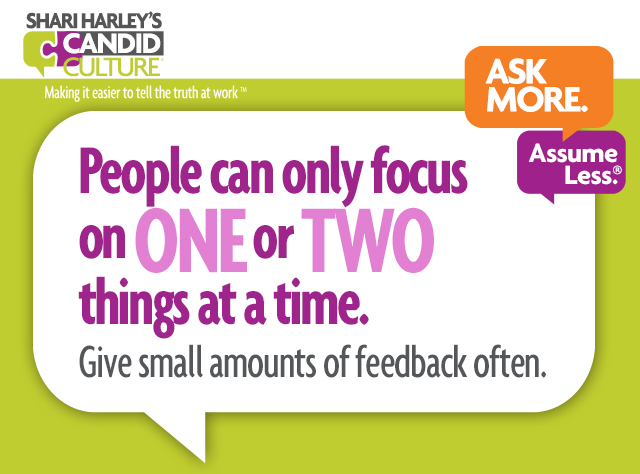
People can only act on and digest small amounts of feedback at a time. Be judicious and assess your motives. The purpose of feedback is to be helpful, when the feedback is requested and when you have the relationship to give it.
If you receive too much feedback or unsolicited feedback, it’s ok to decline. You’re not the 7-11, aka you’re not always open.
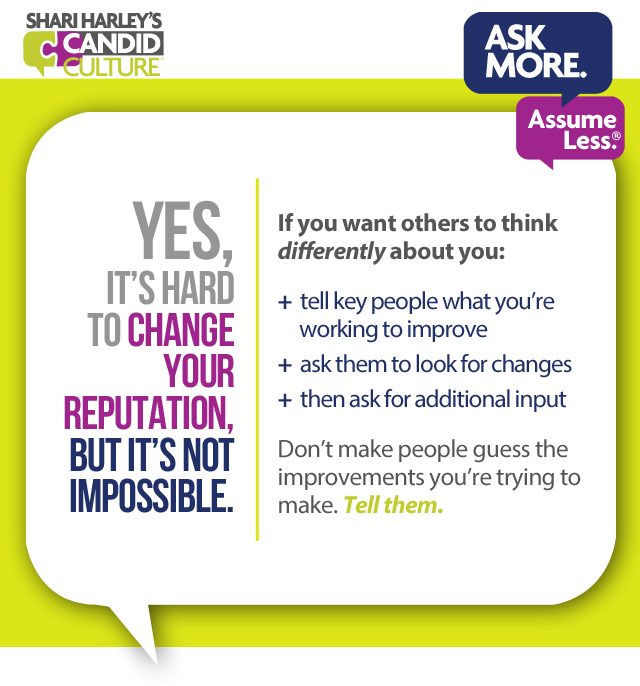
We know impressions are made quickly and are hard to change. But it’s not impossible to repair a damaged reputation. If you want to change how people see you, I’d suggest being very overt about the changes you’ve made. Don’t simply alter your behavior and wait for people to notice. They likely won’t.
Once people have formed an opinion about you, that’s often their opinion for as long as they know you. For example, if you have a tendency to be late, even if you periodically show up on time, your friends and coworkers will think of you as the person who is always late. If you work with someone who tends to miss deadlines, even if she periodically turns work in on time, you’ll think of her as someone who misses deadlines.
Once people make a decision about us, that’s often how they’ll see us for the duration our relationship. So if you want to repair your reputation, you’re going to have to do it overtly. Making changes and hoping people notice, won’t produce the desired result.
Here Are Eight Steps to Repair Your Reputation:
Ask people who can impact your reputation and whose judgment you trust for feedback.
Work hard to manage yourself and not get defensive. Respond to all feedback, no matter how hard it is to hear or how invalid it may feel with, “Thank you for telling me that. I’m going to think about what you said. I may come back to talk more later.”
Once you’ve absorbed the feedback, decide what, if any, changes you will make.
Change your behavior for a period of weeks.
Return to the people who gave you feedback, tell them about the behavior changes you’ve made, and ask them to observe your behavior.
Tell the people who gave you feedback that you’ll ask them for feedback again in a few weeks, and you want to know what they see.
Return to the people who gave you feedback and ask what changes they have or haven’t noticed.
Repeat steps 3 through 7 at least quarterly. Everyone periodically does things that can damage their reputation.
Overtly pointing out the behavior changes you’ve made, asking people who are important to you to pay attention, and give you additional feedback, is key to altering your reputation. Most people working to change their reputation don’t do this. They make behavior changes and hope others notice. If you want to alter your reputation and how others see you, you need to do so overtly. Tell people the changes you’ve made; don’t make them guess. Ask people to observe your behavior, and then ask for more feedback. And no matter how hard the feedback is to hear, don’t get defensive. Becoming defensive will ensure you don’t get feedback the next time you ask.
Posted under Career Management on June 20, 2023 by Shari Harley. 1 Comments
Fifteen years ago, I quit my corporate job to start Candid Culture. I had almost no business relationships or contacts outside of my corporate job. Thinking I should network, I registered to attend the Society for Human Resource Management (SHRM) National Conference in Las Vegas. It’s the largest HR conference in the world; approximately 15,000 people attend. I flew to Las Vegas to attend the conference but I was so terrified about my new undertaking, I spent three days in bed, ordering bad room service, paralyzed by fear. I barely left my hotel room and attended almost none of the conference.
Last week I spoke at that same conference – the SHRM National Conference – also in Las Vegas, to an in-person audience of 750 people. Things have come full circle.
When something feels big and I’m not sure what to do, I do nothing. And my hunch is I’m not alone. The key to getting through anything large, scary, or intimidating is to start. Any action will do. The key is simply taking action.
Here are five actions you and your manager can take to make taking action more likely:
Action #1: What often stands in the way of taking action is that we aren’t sure what to do. Perhaps we aren’t sure we can do the task at hand. Or we can’t see what the end result should look like. Or the project feels so big that even thinking about starting is tiring. Ask questions and ask for help.
Most managers aren’t great delegators. When assigning a project, managers often ask, “Do you have any questions?” This is an ineffective question because few people want to admit to having questions about a project that feels so big, all they want to do is avoid it. Or managers ask, “What do you need from me?” when most people have no idea what they need.
Don’t be afraid to ask questions until you’re clear about what a good job looks like, and ask for help.
Action #2: Managers, ask better questions. Rather than asking if employees have questions, ask, “What’s your plan? What are you doing to do first? What are you doing to do next?” These questions will tell you what employees know and don’t know. Asking, “Do you have any questions” or “does this make sense” tells you nothing.
Action #3: Do one small thing, anything, towards achieving the goal. And do it now. Don’t wait until the right time. There is no right time.
Action #4: Managers, delegate projects with multiple, short deadlines. Ask to review work as it’s completed versus when the entire project is due.
Action #5: Give yourself small windows of time to work on a project. If you give yourself 30 uninterrupted minutes to work, you’re likely to invest that time. If you dedicate a day, you’re likely to get distracted and fill the time with other things.
Trust that you can do what’s in front of you. Someone wouldn’t have asked you to do something if they’d didn’t have confidence that you could do it. And if this is a goal you set for yourself, and it’s something you really want, deep down, you know you’re capable of doing it.
If you’re overwhelmed or don’t believe you can do something, call someone who has more faith in you than you have in yourself. Let that person fill you with confidence until you can generate it for yourself. When I started Candid Culture, I was filled with fear and quite honestly, was convinced I was going to fail. But everyone around me believed I could do it. And their confidence carried me until I could generate my own.
Much of what comes through our phones is not important – emails we don’t really want to read, advertisements for things we won’t buy, and social media updates we don’t care about. And yet those little devices are so seductive. It’s hard not to check your email, texts, and social media updates constantly. Being so connected electronically and thus so continuously distracted has its benefits but it also has real costs.
Most of you know I have a small child and I’m committed to being a present and involved mom. I spend a lot of time with my son. But the best times are when I leave my phone behind. Without my phone I’m fully present with him, in the moment, enjoying him. When I have my phone, I’m distracted, often stressed, and typically torn. Can’t I read this email and reply quickly? What’s the harm? It will only take a second.
And each time I take a minute to read my email, I’m gone. I’m focused on my phone. And then I feel guilty and sad for not being as engaged as I want to be. Then I recommit to being fully present. And then read my email again. It’s a vicious cycle.
There is a huge cost to being distracted most of the time. Our relationships suffer. Car fatalities have increased tenfold. People are consistently tired.
Every productivity expert will tell you to check your messages three times a day, respond, and to not be constantly reading email. It’s fantastic advice. And I suspect no one, including productivity experts, follows it. It’s just too hard. We’re lured by our phones, tablets and laptops. Not checking them regularly makes us antsy, uncomfortable, and nervous.
What would happen if we set defined periods of time for each thing we did? I.e., Spend from 2:00 pm – 4:00 pm working on a project. At 4:00 p.m., check your phone. Take the weekend off and check your messages at 7:00 p.m. on Sunday. I suspect we’d get way more done and feel less stressed. But we have to give ourselves permission to put the phone away.
Here are three ways to be more focused and productive, and hopefully, happy:
1. Schedule work and personal activities for realistic, defined periods of time, and stick to them.
2. Agree on no cell phones or other electronics during personal meals and outings. I like the game people are playing in restaurants by putting cell phones face down in a pile on the table. The first person who touches their cell phone pays the entire bill.
3. Agree on no cell phones during group or one-on-one meetings. Your meetings will be shorter, easier to manage, and more productive. Meeting attendees want to tell their peers to put away their phones but feel like they can’t. Strong meeting facilitators who set and hold to this expectation earn others’ respect and run productive meetings.
In a nutshell, give yourself permission to focus. Do one thing at a time for a short period of time. Allow similar chunks of time to read and reply to messages and read Facebook updates you don’t care about. Then put the phone down and walk away. Your family and friends miss you.
When you use GPS in your car for driving directions, the GPS only provides one direction at a time. GPS tells you what to do now and what to do next. Your car can only go one direction at a time. And humans can likely only remember one or two directions at a time. When you coach people, you are their GPS, supporting them in achieving a desired goal efficiently.
Coach and give feedback like your GPS. Give one or two pieces of feedback at a time. Then give the person time to make changes and improve before giving more feedback.
What I hear every day, and every day it makes me shudder:
Manager: “One of my employees has been making a lot of mistakes. He seems disengaged (p.s. “disengaged” is Cap’n Crunch, vague and thus not real feedback). I’m not sure what’s happening.”
Most people hoard feedback. We wait for the right time, aka when we’re comfortable. That time will never come. The right time to give feedback is when something happens or shortly thereafter. Practice the 24-hour guideline and the one-week rule. Wait 24 hours to give feedback if you’re mad, but not longer than a week. Give feedback when you’re not upset, but soon after the event occurs, so people remember what you’re talking about.
Feedback is hard on the ego. The more feedback we receive in one conversation, the harder it is to hear. People need to feel successful. Receiving too much feedback at one time makes us feel we can’t be successful, so why bother. Pick the biggest and most impactful behaviors. Wait. And then give more feedback.
When it comes to feedback, keep this mantra in your head – recency, frequency. Recency, frequency. Short, weekly, feedback conversations – five minutes long – are better than sixty-minute feedback conversation once a month or quarter. You’ll see more behavior change and protect team member’s ego. Shorter and more frequent is better.
A few years ago, I facilitated a company-wide training program for an 80-person organization. Early in the program, we were talking about career deal breakers and I asked someone in the group to share a deal breaker, so I knew that everyone was clear on what is and is not a true deal-breaker. An employee spoke up. She said, “I’ve been here six weeks. I’m overwhelmed and exhausted. If I don’t get some help soon, I’m leaving.” People in the room gasped audibly. And everyone surely thought the same thing – “She’s done. She’ll be gone by Friday.”
I ran into the organization’s CEO at the Denver airport two weeks later and we had dinner together. Over dinner, I asked if I could give him some advice. I said, “That woman who spoke up during the training did you a huge favor. You spent time and money to become a more candid organization; she gave you the opportunity to demonstrate whether or not you really mean it. Make sure nothing (bad) happens to her.”
It can be really hard when people disagree with us. Leaders institute a new practice, employees resist. Employees say they agree with a policy during a meeting but managers hear otherwise after the meeting.
It may feel easier to introduce a practice and ask employees to follow it without asking what they think. And sometimes it makes sense to do that. You don’t need to involve employees in every decision. But in an organization, it has to be safe to offer a counter-point-of-view. It must be safe to disagree.
Disagreement is hard. But silence and the fear of speaking up is dangerous. Organizations full of yes people don’t innovate. They don’t solve problems or find new ways to save costs. They don’t grow, develop, or change. Hearing the truth takes courage and persistence. Put your ego aside and ask – again and again and again.
Every time I work with a new organization, at least one employee pulls me aside and tells me about the organization’s “list”. Employees who speak up and say things the leadership team disagree with get put on the “list”. And employees who make the “list” disappear from the organization. Mind you, no one has ever seen this “list”, but employees everywhere are convinced it exists. And this is a challenge for leaders.
Even leaders who do all the right things regarding asking for and being open to all kinds of input are up against the belief that it isn’t safe to tell the truth at work. There may be no consequences whatsoever for speaking up, but the perception of the negative consequence is what matters. And this perception is powerful and pervasive across organizations.
So what is to be done? How do leaders get the truth when employees are afraid, disbelieving, and perhaps cynical?
Below are seven practices for leaders and managers to get more truth in their organization:
Put your ego aside. It hurts when people disagree with our beliefs or approach, and we’ll be fine. Let curiosity rather than your ego run the show.
Ask for input. Ask again and again and again. Employees may eventually believe that you really want their input.
Ask for input in different ways – in-person roundtable discussions, email, and surveys.
Ensure there are no negative consequences for speaking up. You can coach employees on how they spoke up and make suggestions for diplomacy, but reward the courage it took to speak up.
Share what you learn after gathering data. Don’t be a black hole. Give more information than you think you need to.
Tell employees the ideas you’re accepting and those you’re rejecting and why. It’s ok not to accept and act on all feedback. But close the loop and explain the rationale for decisions.
Be human. Admit failure, fear, worry, and wins. People trust leaders who are human, and humans have feelings and make mistakes. I’ll follow a humble leader further than a polished and seemingly perfect one.
I’m embarrassed how often I do things I don’t want to do because I’m afraid of looking bad. I agree to things I don’t want to do. I even suggest doing things I don’t want to do, because I think it will look bad if I don’t. Then I have deep regrets.
If I’m aware of this practice, why do I keep doing it, over and over and over? I suspect the need to look good and be liked is so pervasive, it over-powers reason and self-talk. Telling myself, “Don’t do it. You will regret this,” doesn’t help. The need for approval is all-powerful (to me).
My old boss told me many years ago, “Your need to be liked will kill you as a manager,” and he was right. It’s why I can’t interview my own candidates. I want them to like me too.
I suspect I’m not alone here. I lot of us say yes when we want to say no. We extend ourselves and regret it later.
What can be done, at an organizational level, to prevent ourselves and fellow employees from over-extending?
Sanction, at a team and organizational level, that sometimes it’s ok to say no.
Suggest that at times people take 24-hours before agreeing to take on a new task or project.
Make room for negotiation, so people can say yes on terms that work for them.
Authenticity wins. Speak your truth and know that it’s ok.
I’m not sure why, I wish I could give you a good reason, but the vague phrases above are what come out of people’s mouth’s first when giving feedback. To prevent giving fake feedback, you have to prepare.
There is a reason you think the person is awesome or has a bad attitude. What did they do that created that impression? Until you can describe what the person did to create an impression, you’re not ready to give feedback. You’re better off saying nothing.
All of the phrases above are opinions with no facts. Opinions are judgments. Feeling judged makes people defensive. When people are defensive, it’s hard to listen.
The purpose of feedback is to help another person. Give the person enough information that they know what to replicate and what to change. Before you give feedback, write down three things the person did that created your impression. If you can’t give an example, wait to have the conversation until you can. It’s better to say nothing than to say something vague and unhelpful.
Vague positive feedback sounds inauthentic. Vague negative feedback is judgmental. Neither strengthens your relationship or are helpful.
If you really want to be heard and you want to be helpful, provide an example. No example, no feedback.