The inspiration for this week’s blog came from the most unlikely source, time with my son. I want each of his days to be exciting and fun. On the days we do nothing but hang out and play at home, I feel like I’ve failed just a little bit. It’s a lot of pressure. Not unlike work and creating an office culture.
I want each of my employees to be happy and to enjoy their jobs and enjoy working for me, every day. That can’t and won’t happen. Some days are hard. Some are dull. Sometimes I’m fun and easy to work for. Lots of days I’m not.
I had a manager years ago who told me that my need to be liked by my employees would take me down. He was right. Unfortunately, I’m not the only manager with this challenge.
Lots of managers tell me they’re hesitant to give feedback because they’re afraid employees will quit. Other managers do work they know they shouldn’t be doing, because they don’t want to burden their employees.
Not every day will be great. And that’s ok. Work is a roller coaster. Some days are awesome. Others are the pits. Your job isn’t to make people happy at every moment, it’s to create a supportive environment and ensure people have the tools to be successful.
My son has a clean and safe home full of fun toys. I’ve created a positive environment for him. My employees have all the tools they need to be successful. I work hard to set clear expectations and give timely positive and upgrade feedback. The rest is up to them. Some days I’m sure they’re happy. Most days, hopefully. And then I’m sure there are days that a job elsewhere sounds appealing.
Here are five actions to create a positive culture at work:
Office culture tip #1: Set clear expectations at the beginning of every new project and task. The root of frustration and unhappiness is thwarted expectations.
Office culture tip #2: Ask for and be open to feedback from your employees and coworkers. Ask for feedback regularly and work to respond with, “Thank you for telling me that.”
Office culture tip #3: Respond to feedback by changing what it makes sense to change. Giving feedback that is never acted upon creates cynicism and distrust.
Office culture tip #4: Provide rationale for your decisions. It’s fine to do things the way you want to do them, even if others disagree. Explain your rationale. You’ll get more buy in.
Office culture tip #5: Don’t be afraid to make decisions that are unpopular. There is a reason that you want to do what you want to do, the way you want to do it. Vet your plans, when appropriate. Be open to others’ input. And then do what you think is right (within the scope of your role).
Your job isn’t to please everyone and trying to do so will likely produce lesser results and be exhausting.
If you want to freak out the people you work with, tell them, “We need to talk.” If you really want to freak them out, say those four magical words on a Friday, or even better, the day before someone goes on vacation. “We need to talk” is rarely followed by, “and you’re awesome.” People know bad news is likely coming, and they’ll inevitably be on edge.
The antidote to asking for time to talk is to create opportunities to give feedback regularly.
There are many reasons giving feedback is hard. One of them is we wait too long. Something happens. We know we should address it, but we don’t want to. So, we wait to see if the behavior is really ‘a thing.’ Then it happens again. And now we know it’s ‘a thing.’ But we still don’t want to address it. Then the situation gets really bad, and now we have to say something. The conversation then takes 90 minutes, is painful, and everyone goes home unhappy.
Here are two keys to make giving feedback easier:
Giving feedback strategy one: Debrief everything. Do a quick plus/delta a regular basis to assess how things are going. Plus – what went well? Delta – what would we change if we could/what did we learn?
I recommend doing a quick debrief at the end of important meetings, hiring processes, projects, and when anything changes. Conduct a short debrief when you have staffing changes, gain or lose a client, launch or eliminate a product or service, etc. Change is an opportunity to evaluate how you work and to make adjustments.
When you debrief important events, you tell people that feedback is important and that it’s ok to be candid. Conducting regular debriefs also gives employees a chance to practice giving feedback, which is a hard skill. And like anything, the more we give feedback, the easier it becomes.
Conducting short, regular debriefs is one of the easiest ways to learn from the past and become a more candid culture.
Giving feedback strategy two: Schedule five to fifteen minutes each week to talk as a team and with direct reports. When you know you have time each week to talk with your manager, direct reports, and team members, you never have to ask for time to talk. Issues don’t build up or linger. Breakdowns and frustrations are discussed within of few days of their occurrence, and no one is worried that bad news is coming at their end of their vacation.
The key to being effective at giving feedback is to give feedback regularly. Short, frequent feedback conversations are much more effective than infrequent, long conversations that everyone dreads and leaves feeling exhausted and demoralized.
Debrief everything meaningful. Meet with people weekly. Ask for and give feedback as things happen, and watch your culture change.
Posted under Career Management on January 2, 2024 by Shari Harley. 0 Comments
People often hoard feedback until a situation becomes so frustrating that they can’t help but speak up. And because they waited too long to say what they think, many more words come tumbling out than is either necessary or helpful.
When it comes to giving feedback, less is more. Be specific, give an example or two, and stop talking.
If you want people to be receptive to your feedback, make it easier to hear by saying less. By saying less, I don’t mean don’t tell the truth or provide enough information that the person knows precisely what to do differently. I do mean, don’t provide more information than is necessary.
You are likely familiar with the phrase “let someone save face.” Allowing someone to save face requires saying just enough that the person knows what to do differently, but not so much that the person feels attacked.
Too much feedback: Last week you turned in a report that had five typos and had important pieces of information missing. I’m surprised you’d be so careless. It made our entire department look bad. I’m perplexed that you’d submit work without checking it first. What is leading you not to check your work and submit incomplete reports?
Don’t repeat feedback. Say it once and move on. And remove unnecessary judgments (careless) and share just the facts.
Just the right amount of feedback: The report you gave me last week had a few typos and was missing some important information. The report went to the client with those errors which didn’t reflect well on our department. What happened?
Too much feedback: I noticed you didn’t speak up during last week’s department meeting. People won’t know the value you provide if you don’t share what you’re working on. You need to be more vocal. People’s only exposure to you is often during our team meetings. If you don’t speak up, you won’t establish yourself as a leader in your department. People really need to know what you’re working on and the impact you’re making.
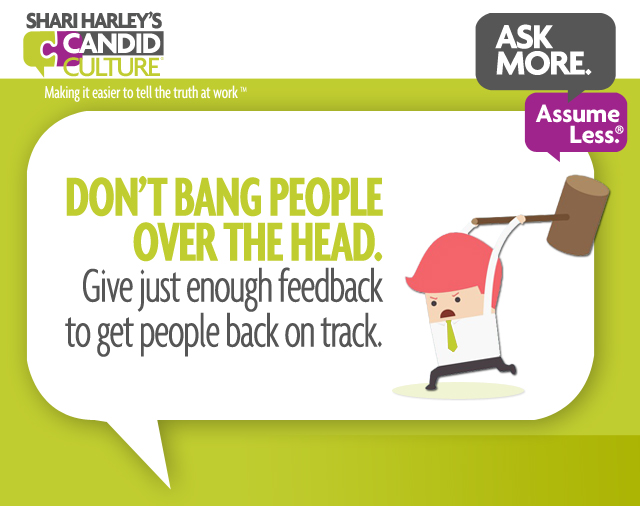
Redundant feedback feels critical and leaves the person feeling like they have been hit over the head with a mallet.
Just the right amount of feedback: I noticed you didn’t speak during last week’s department meeting. Often, team members’ only exposure to you is during our weekly meetings. How can I help you feel comfortable speaking up so you can establish yourself as a leader in the department?
It’s easy to get carried away when giving feedback. We’re likely frustrated. And when our emotions run the show, it’s easy to say too much.
Here are three practices for giving feedback:
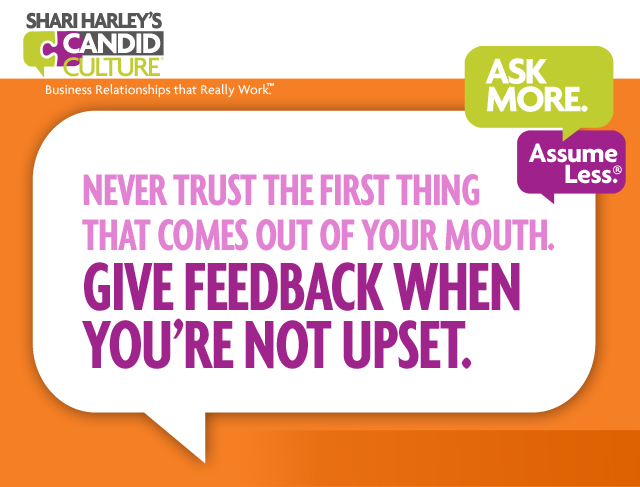
Practice the 24-hour guideline and the one-week-rule. If you’re upset, wait 24-hours to give feedback, but not longer than a week after an event.
Plan what you’re going to say both in writing and out loud. Practicing a conversation in your head is not the same as speaking it.
Let someone you trust hear what you’re planning to say and ask that person how you can improve the feedback. Ask what you can remove without losing any of the message.
Planning a conversation is like packing for a trip. When packing for a trip, many people put their clothes on the bed, then put the clothing in a suitcase. Realizing they have way more than they need, they start taking things out of the suitcase. Eventually they arrive at their destination with much less than they initially packed, but still more than they need.
Use the same principles when planning a feedback conversation. Put every thought you have on paper, and then remove what you don’t need, leaving only the necessary points that tell the person just what they need to do differently.
When giving feedback, less is more. Tell the person what happened, why it’s a problem, and what they need to do differently. Then stop talking and let the person save face.
Too often people sit at their laptops doing their minimal best while begrudging their boss, organization, or current job, hoping that something better will come along. Or people silently do good work and think that someday someone will notice, and they’ll get the role and recognition they deserve.
If you want to advance your career, you must know how to ask for more responsibility at work.
You may be rolling your eyes thinking, “More? I can’t do more. I already work evenings and weekends. I sleep with my phone and haven’t taken a vacation in two years, and you want me to do more?!?!” Actually, I want you to stop sleeping with your phone and go on vacation. But that’s a post for a different day.
When I say do more, I don’t mean to do anything anyone asks nor anything your organization needs. Offer to take on more work that is aligned with what you want to do AND is important to the leaders of your organization.
Before starting Candid Culture, I had a corporate job, leading an operations unit. Four years into my tenure with the company, one of my peers left, and his role wasn’t refilled. I felt his department was important to our organization’s success, so I offered to run his department, in addition to my own.
My new department was a change agent’s dream. I outlined a strategic plan and long and short-term goals. I re-wrote job descriptions and org charts. But six months into taking on the department, I couldn’t get one change approved. I was confused and frustrated.
I had initially been hired to turn another department around, and I’d been very successful at getting changes approved. Yet this time, I could get nothing approved. After six months of banging my head against a wall, I finally ‘got it.’ The owners of the company didn’t see the department as valuable, thus they weren’t willing to invest in it. Hence why the job sat vacant, until I offered to do it.
I’m embarrassed at how long it took me to see that the only person committed to my new department was me. When my colleague’s senior-level job wasn’t refilled and there was no hiring freeze, I should have known the department wasn’t seen as important.
If you want to know what’s important in your organization, look at where the money is being spent. What departments and/or leaders are getting resources?
When I say ask for more, I mean be strategic about what you ask for.
Ask yourself these questions:
What do I want to do?
Where in the organization are there opportunities to do that kind of work – that is important to the organization’s leaders?
Who will support me in doing this work? Who won’t?
How to ask for more responsibility at work. Tell your boss and/or department leader:
I really enjoy working here. I enjoy the people, the work and our industry.
I’m committed to growing my career with this organization.
I’m interested in learning more about ________________________.
I’d love to run ___________________________.
I think we have some opportunities to make improvements in _____________________.
How could I get some exposure to ____________________.
A project is starting in ______________. I’d love to be on the team. What are your thoughts about that? Would you be comfortable supporting my participation? If yes, how can we make it happen? If not, what would you need from me in order to support it?
The work you take on does not need to be high level. Everyone in an organization does grunt work. Just be sure that whatever you offer to do is seen as integral to the future of the organization. You’re not likely to get what you don’t ask for.
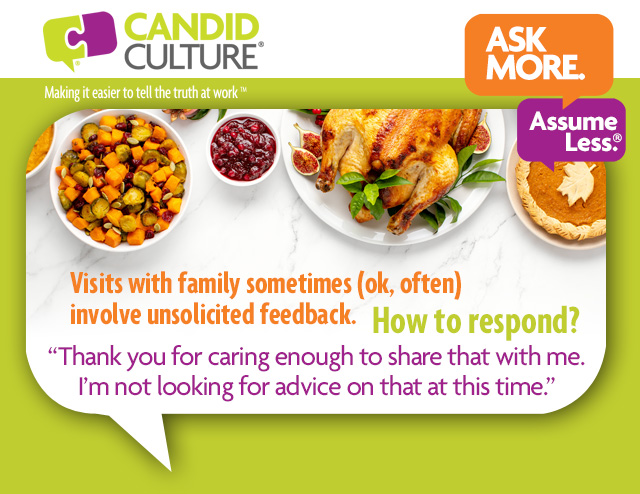
If you visit family and friends this holiday season. you may receive unsolicited feedback and advice. Sometimes people who care and want what’s best for us, provide input we didn’t ask for.
Unsolicited feedback at best feels like someone is trying to help, at worst it feels like criticism. Underneath the feedback might be the message, “If you were doing this right, I wouldn’t need to give you this advice.” I put unsolicited feedback and advice in the same bucket.
If you find yourself receiving unsolicited advice, you don’t have to smile politely and take it. It’s ok to put an end to unwanted feedback and advice.
Simply smile, tell the person you appreciate them caring enough to give you that advice, and say that you’re not looking for advice on that topic at this time. And then smile again. Smiling softens most messages. Say nothing more. Most people will stop talking. What else is there to say?
This method of acknowledging the person talking is respectful and firm. To pull it off, watch your tone. If you can safely add the words, “you dummy” to anything you say, you have a tone issue. Be genuinely appreciative and enforce boundaries. You’re not the 7/11. You don’t have to be open to feedback and others’ input all the time.
If the person continues giving you advice, simply say the same thing again. “Thank you for caring enough about me to share that with me. I really appreciate your concern. And I’m not looking for advice on that at this time.” If the person keeps talking, just say, “I’m going to get a drink.” Then get up and go get a drink.
If stopping unsolicited feedback feels uncomfortable, prevent it. Tell people before you see them, “I don’t want to talk about _____________ (fill in the blank). Please don’t bring it up over Thanksgiving.” You can soften that request any way you like.
Setting boundaries might be feel uncomfortable. But it’s likely not as uncomfortable as having a conversation you don’t want to have and then feeling like you need to avoid someone for the rest of the evening and possibly year. It’s ok to say, “No, thank you. Please pass the pie.”
At some point in our career, most of us have taken a class that told us to give feedback that sounds like, “I felt ___________ when you ___________.” I couldn’t disagree more.
Most people get defensive when they receive negative feedback. Becoming defensive is a normal and natural response to upgrade (my word for negative) feedback. It’s the ego’s way of protecting us. Defensiveness kicks in when the recipient feels judged, and it’s difficult to listen when we’re defensive.
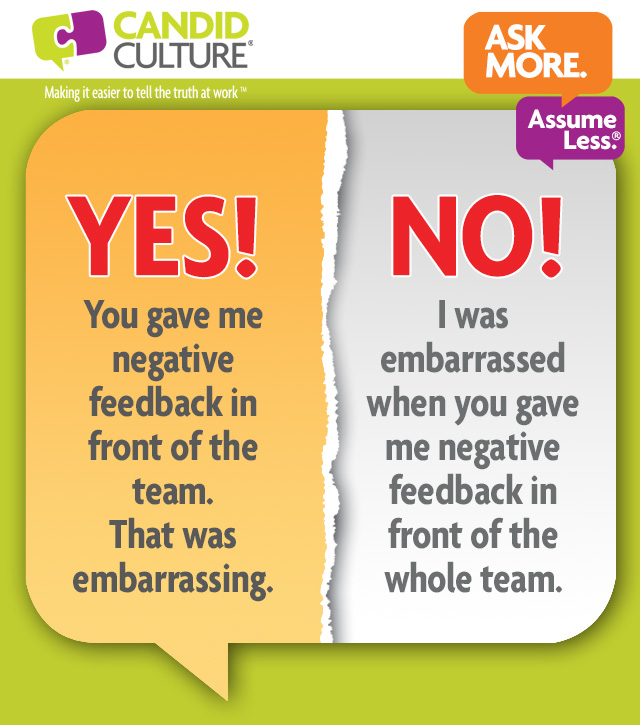
If you say to someone, “I felt embarrassed when you yelled at me in front of the team,” defensiveness kicks in at the word “embarrassed”. The recipient is now defensive (and is likely no longer listening) but does not yet know what they did to upset the person. Instead, lead with the facts, so when the listener becomes defensive, at least they know what they did.
If you say, “You yelled at me in front of the team. That was embarrassing,” at least when the defensiveness kicks in, the listener knows what they did that was upsetting. Then there is a chance that after processing the feedback, the person will change their behavior.
Yes to this:
“I need more regular feedback to stay on track with projects. Can we touch base weekly for ten minutes?”
No to this:
“You don’t make time for me. “I need more regular feedback to stay on track with projects.”
Lead with the facts. Tell the person what happened. Follow with why that matters. What happened, what’s the impact.
Factual, objective feedback may lead to change. Judgments lead to upset and damaged relationships.
Someone asks if you can (fill in the blank). You look at your calendar. That hour is open. You say, “yes.” You forgot that hour was designed for something you’ve been meaning to do, for yourself. You’re angry (with yourself) for forgetting. You promise to do better tomorrow.
The next day… repeat.
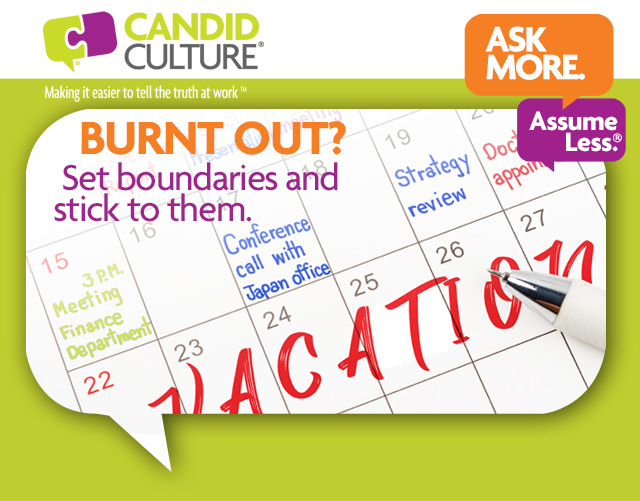
The only way I know out of tired-induced-people-pleasing is to set boundaries and stick to them. And this is hard, for me.
Examples of boundaries: Putting an hour in your calendar during the day to exercise; blocking 30-minutes between meetings to work; limiting one day each weekend to kids’ sports. Boundaries are parameters that guide our behavior. Putting a boundary in place doesn’t mean saying no. Boundaries create the conditions that tell us, without struggle, when to say yes.
Before I had my son, I traveled for work constantly. Some weeks I was on the road for six consecutive days, in three different states. And I loved every second of it. Audience + microphone = happiness. When I had a child, I knew that schedule wasn’t going to work. So, I set boundaries. I decided how many nights per week I would travel, the time I needed to be home from each trip, and how many hours I was willing to fly. And I didn’t violate those boundaries for 8 years. If a piece of work would require me to violate my travel boundaries, I said no without struggle, no matter how much I wanted to do that piece of work. The boundaries made the decisions easy. There was no deliberating or debating.
I’ll admit, I’m not as effective as setting boundaries in other areas of my life. Last week, I had a yoga class on my calendar. When I learned a repair person was able to be at my house during that hour, the yoga class was quickly deleted from my calendar. Yesterday, I asked my son what he wanted for breakfast, before flag football. He wanted scrambled eggs and a smoothie. I made both, knowing there wasn’t time. We were late for flag football. What was missing in both situations? Boundaries.
How does this apply to work? The key to preventing tired, burnt-out employees is to make it safe to speak up. As I wrote earlier in the year, burnout is a systemic issue, not a personal one. Burnout at work comes from too much to do, over time. One way out – make it safe to tell the truth at work.
For the most part, no one wants to admit to their boss that they are overextended or overwhelmed. Doing so feels like failure, and who wants to admit failure? If you want employees who are energized versus exhausted, focus on making it safe to tell the truth at work.
Five ways to make it safe to tell the truth at work:
Leaders and managers share their own truth. See the top of this blog for what that could sound like.
Ask employees meaningful questions. “How’s it going?” is not a meaningful question. Try: “What are your preferred working hours? What times a day would you prefer not to be contacted?”
Show appreciation when employees risk and say hard things.
Reward the truth. Make employees who are willing to say hard things a positive example.
Help employees problem solve to manage their time and priorities. Be ‘in it’ with them.
The good news about violating boundaries is you will get another chance to do it differently tomorrow. You can always reset a boundary. This time, tell the other people in your life about your boundaries. Tell your coworkers if you don’t do happy hours after meetings, 7:00 am Zoom calls, and back-to-back meetings, and tell them why. Then offer an alternative. Everything in life is a negotiation.
We’ve all received work from another person that wasn’t what we were expecting, hit reply, and told the other person what we thought. Then we dealt with the consequences.
A few tips for giving feedback to get more of what you want and less of what you don’t:
Don’t give feedback via email.Ever. You can’t manage your tone or see the person’s reaction.
Practice the 24-hour rule and the one-week guideline. Wait until you’re not upset to give feedback, but don’t wait longer than a week.
It’s almost impossible to give feedback without putting the other person on the defensive. Becoming defensive when receiving feedback is normal and natural. It’s a way to protect ourselves when we feel judged.
When people are defensive, it’s hard to listen and respond. The less defensive the other person becomes, the easier it is to communicate with that person. People will be less defensive if you give feedback when you’re calm and choose your words carefully.
Communicate in a way that the relationship needs versus what you need in the moment.
When we give feedback when we’re upset, we’re really communicating for us, not for the other person. I didn’t get what I want. I’m upset. And I’m going to tell you about it. Then the other person gets upset and now, in addition to you not getting what you wanted in the first place, you have to do damage control.
Communicating in a way the relationship needs means choosing the timing, words and method of communication that is likely to produce the result you want – the other person being able to hear you, while becoming minimally defensive, and taking action. Giving feedback when you’re upset, especially via email, will not produce the result you want. You’ll only damage your relationship.
Being an effective communicator and maintaining good business relationships requires patience and self-discipline. Wait to give feedback until you’re not upset. Don’t send an email. Pick up the phone or walk to the person’s desk. Deliver the feedback in a way the other person can hear you. Be ready for the person to become defensive. It’s human to become defensive. You can’t eliminate defensiveness, but how you deliver feedback can greatly reduce defensiveness. And you’ll get more of what you want and less of what you don’t.
I’m often asked, “Can I give my boss or the people above me feedback? Is that really realistic?” Giving people ‘above’ you feedback has everything to do with the quality of your relationship and less to do with the person’s title. If your relationship is good and your boss is open to feedback, then yes, you can give them feedback. If your relationship isn’t that solid or your boss isn’t open to your feedback, practice managing up by asking for what you want instead of giving direct feedback.
No one likes to be criticized or told that they are wrong. When giving someone direct feedback, no matter how kind the delivery, you are telling someone, “You’re doing ______ wrong. Please do _____ instead.” Being that direct is challenging when you don’t have a trusting relationship or when people are highly defensive. You can achieve the same desired results by simply asking for what you want.
Asking for what you want is less judgmental than giving direct feedback and is a subtle way of telling someone they are not giving you what you need. And people who are paying attention will get that. They don’t need it spelled out.
Here are a few ways to practice managing up with your boss and other leaders in your organization:
Example One:
Giving Direct Feedback: “You don’t make time for me. I’m getting behind on projects because you don’t take the time to review my work.”
Managing Up by Asking: “How can we ensure you get to review my work each week, so I can finish the projects I’m working on?”
Example Two:
Giving Direct Feedback: “Every time we have a meeting scheduled, you cancel it.”
Managing Up by Asking: “If meetings get cancelled, is it ok if I reschedule them?
Example Three:
Giving Direct Feedback: “You’re a micromanager. I feel like I can’t make a move without your permission.”
Managing Up by Asking: “I’d like to manage ________ project. What do you need to feel comfortable with me doing that?”
Telling someone at any level they are doing something wrong, will likely evoke defensiveness. And being direct requires both courage and a good relationship. If you don’t have the relationship to be so direct, simply ask for what you want.
Time is the only thing in life you can’t get back. You can make friends and lose friends. You can make money and lose money. You can gain weight and lose weight. But you never ever get back your time.
So where is your time going? What are you doing that you know someone else should be doing? What are you doing out of obligation that is devoid of enjoyment? Where do you invest more time than you need to, requiring you to give short shrift to other priorities?
It may seem odd that a communications expert is writing about time management. I don’t speak or train on time management. But I do teach coaching and delegation, and effective managers and coaches know when to give something away.
Here are five time-management questions:
What are you doing at work that you know someone else could or should do?
If you invested a few hours training someone, what could you give up, creating room for something new?
What personal relationships do you invest time in because you think you’re supposed to?
Which family events are you attending out of obligation?
What do you give 110% percent to that 70% would be more than sufficient, leaving more of your time and energy for something more important?
You only have so much time and energy. Where are you going to put it – on the things that matter most or on distractions that seem important?
I’m not suggesting you skip every family event you don’t want to go to. But perhaps go for less time or skip every third event. I’m not advocating cutting corners or doing mediocre work. But sometimes we spend much more time on things than we need to, when investing less time would deliver the same result.
Here are a few examples of what I mean by 70% being more than enough:
You spend 25 hours on the formatting of a presentation when the content is what’s really important. You create gorgeous tables and graphs when five bullets were what the client really wanted.
You host a party and make hand painted table tents describing each food, when your guests will have a great time with typed descriptions or no descriptions at all.
You maintain friendships you know should have ended long ago because it seems like the right thing to do.
You avoid calling friends if you don’t have an hour to talk instead of calling and saying, I only have ten minutes but really want to talk with you.
Invest your time in what produces the greatest results and maximizes your enjoyment. Work hard, do great work, invest in your family and friends, and know when “no thank you” is the right answer.