We’ve all received work via email from another person that wasn’t what we were expecting, hit reply, and told the other person what we thought. Then we dealt with the consequences.
A few tips for giving feedback to get more of what you want and less of what you don’t:
Don’t give feedback via email.Ever. You can’t manage your tone or see the person’s reaction.
Practice the 24-hour rule and the one-week guideline. Wait until you’re not upset to give feedback, but don’t wait longer than a week.
It’s almost impossible to give negative feedback without putting the other person on the defensive. Becoming defensive when receiving feedback is normal and natural. It’s a way to protect ourselves when we feel judged.
When people are defensive, it’s hard to listen and respond. The less defensive the other person becomes, the easier it is to communicate with that person. People will be less defensive if you give feedback when you’re calm and choose your words carefully.
Communicate in a way that the relationship needs versus what you need in the moment.
When we give feedback when we’re upset, we’re really communicating for ourselves, not for the other person. I didn’t get what I want, I’m upset, and I’m going to tell you about it. Then the other person gets upset and now, in addition to you not getting what you wanted in the first place, you have to do damage control.
Communicating in a way the relationship needs means choosing the timing, words, and method of communication that is likely to produce the result you want – the other person being able to hear you, while becoming minimally defensive, and taking action. Giving feedback when you’re upset, especially via email, will not produce the result you want. You’ll only damage your relationship.
Being an effective communicator and maintaining good business relationships requires patience and self-discipline. Wait to give feedback until you’re not upset. Don’t send an email. Pick up the phone, meet via video, or walk to the person’s desk. Deliver the feedback in a way the other person can hear you. Be ready for the person to become defensive. It’s human to become defensive. You can’t eliminate defensiveness, but how you deliver feedback can greatly reduce defensiveness, and you’ll get more of what you want and less of what you don’t.
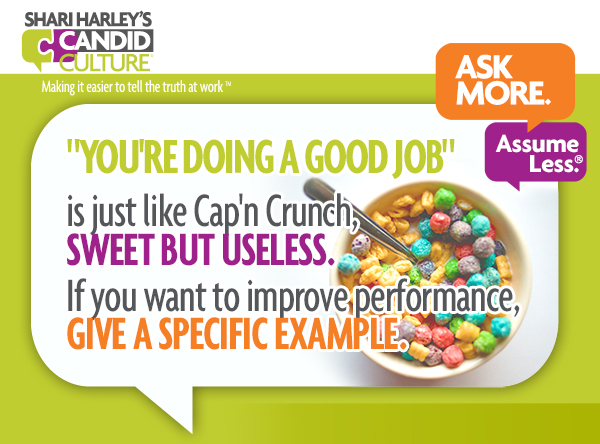
Most of the feedback people receive in the workplace isn’t feedback at all, it’s what I fondly refer to as Cap’n Crunch – vague and unhelpful words that put people on the defensive but don’t change behavior. If you want people to do something differently, give specific feedback.
Most of the fake Cap’n Crunchfeedback people get sounds like this:
“You did a great job on that.”
“You’re doing really good work.”
“You’re dressing inappropriately.”
“You’re difficult to work with.”
None of this is feedback. It’s all Cap’n Crunch. Vague, vague, and more vague.
The first words out of your mouth will invariably be Cap’n Crunch. Follow those words with, “for example” and you’ll be headed in the right direction.
“You did a great job on that. For example, I never had to ask about the status of the project. You gave me an update every Friday, and that made me feel comfortable that we were on track.”
“You dressed inappropriately for that meeting. For example, the client was dressed in business casual; you wore jeans and a t-shirt. Next time, please dress as the client dresses or a step above in khaki pants or slacks and a jacket.”
Most people are afraid to give feedback because they don’t want to deal with the defensive reaction they anticipate. The more vague you are, the more defensive people will be, because they don’t know what you’re talking about and they feel judged. Vague feedback is subjective. Subjective is judgmental. Feeling judged puts people on the defensive.
If employees shop your feedback around, asking what others think of the feedback you provided, it’s because you were vague, they disagree with you, or they’re being defensive. Feedback will be received better and resisted less if you’re specific.
Specific feedback can be captured on video. Meaning, you can video someone calling into a meeting late, rolling their eyes, and texting on their phone. I dare you to video “you were disrespectful in the meeting, you dressed inappropriately, or you’re difficult to work with.” If you can’t capture the feedback on video, you don’t yet have specific feedback. You have Cap’n Crunch.
When I teach managers to give feedback I ask the managers to, “Describe the situation to me. What did the person do?” Managers often reply with, “They were negative.” This is Cap’n Crunch. So, I keep asking questions. “What did they do that was negative? What did it look like?” After two or three questions the manager tells me, “I overheard them complaining to other employees about the decisions the company is making. I’d rather they ask me questions about the direction we’re going versus gossip to peers.” Now we have specific feedback.
Wait to give feedback until you have a specific example. If you don’t have a specific example, go get one. Without an example, employees will look at you in a confused way, question the validity of what you’re saying, and become defensive. And they’ll be justified in doing all of these things.
Most of us dread giving feedback because we don’t want to deal with people’s defensive responses. If you want more help, chapters nine through twelve of How to Say Anything to Anyone provide a clear and easy-to-follow formula for giving specific feedback.
Remember, if you’re not using the words “for example” you’re not giving specific feedback.
Wearing too much perfume, cologne, or other scented products will make people scatter or wish they could. Unfortunately, rather than tell you that you’re wearing too much, people will just avoid sitting near you. Scent is such a personal thing, like clothing choices, that people are hesitant to comment on it.
I suggest not wearing anything scented at work, on airplanes, or when you’ll be in close proximity with other people you don’t know well. But if I can’t persuade you to skip the scent, here are a few guidelines when putting on cologne and perfume:
• Spray the air ten inches in front of you, and walk through the mist, rather than spraying your skin.
• If you can smell the scent on yourself or people who are more than a few inches from you can smell it, you’re wearing too much.
• You should never be able to smell a person’s cologne after they’ve left a room.
No, I’m not an expert on how to wear perfume. I googled it. I’m an expert at how to talk about how scents impact you and your work environment.
The next step is to ask a few people you trust to tell you when you wear too much perfume or cologne. Give people permission to give you this feedback and promise you won’t bite their head off when they do. This could sound something like, “I want to be sure I’m not wearing too much perfume/cologne. Would you be willing to tell me when I do? I promise I won’t freak out or jump down your throat. I really want to know.”
Let’s say you work with someone who wears too much perfume, cologne or other scented products. They haven’t asked if they’re wearing too much, and you want to say something. You could say something like, “This is a bit awkward, but the perfume/cologne you wear is a bit overwhelming. Would you be willing to wear less or none when you’re in the office?” This is an awkward conversation that most people don’t want to have. Consider that you’re doing the person a favor. Would you rather know the amount of scent you wear keeps other people away, or would you rather alienate the people around you?
If the relationship is a personal one, you could say, “You wear the most lovely cologne/perfume. I’m very sensitive to scents. Would you be willing not to wear perfume/cologne when we’re together?” Again, this is an awkward conversation. But you won’t die from having it and the other person won’t either. When they get over being embarrassed and defensive, your relationship will be fine. And if it’s not, you didn’t have much of a relationship to begin with.
No one likes giving people negative feedback. Giving negative feedback often makes both the feedback deliverer and the recipient feel badly. To make everyone feel better, we dress negative feedback up with pickles and relish, otherwise known as The Empathy Sandwich.
The Empathy Sandwich in action: “You’re doing really great. Now you did almost cost the company $50,000, but in general, things are going great.”
The Empathy Sandwich leaves people unclear, wondering if there is a problem. Instead of softening negative feedback with positive platitudes on both ends, tell people you’ll be providing positive and negative feedback as things happen, and then separate both types of feedback.
Giving feedback to people you manage: “As your manager, my job is to help you be successful. As a result, I’ll tell you what I see, as I see it. I’ll give you both positive and upgrade (negative) feedback in a timely way. Because if I don’t, you won’t grow as a result of working with me.”
Paving the way to give feedback to peers and those at a higher level: “We see each other work and are in a unique position to provide each other with feedback. If you see me do something positive or not so positive, I’d like to know. I promise I’ll be receptive.”
Delivering feedback and avoiding The Empathy Sandwich: When you give feedback, separate the positive from the negative. You could say something like, “I want to talk about a few things today. Here are some things that are going well… Now, I also have something to talk with you about that is not going as well… After you deliver the negative feedback, say something like, “I know there is a tendency to dwell on negative feedback. I want to remind you of the positive things we talked about today.”
People can handle negative feedback. They won’t quit if you’re honest about their performance. They will likely become defensive and get upset for a time. That’s ok! Your job when giving feedback is to be clear, timely, and specific. Prepare and practice your delivery out loud. Ensure you have the relationship to deliver the feedback. Don’t worry so much about the response.
Get the words to say the hardest things in two minutes or less. If you work long enough, you’ll eventually be confronted with these situations. Giving feedback doesn’t have to be hard.
Sign Up
Career tips you won't get elsewhere. Sign up to get a free tip card.