Posts Tagged ‘giving feedback’
If I hear this one more time I might lose it.
Manager: “One of my employees has been making a lot of mistakes. He seems disengaged. I’m not sure what’s happening.”
Me: “Have you talked to him?”
Manager: “No. Performance appraisals are coming up, so I’ll just wait to give the feedback until then.”
Me: “When are performance appraisals?”
Manager: “In six weeks.”
Most people hoard feedback. We wait for the right time, aka when we’re comfortable. That time will never come. The right time to give feedback is when something happens or shortly thereafter. Practice the 24-hour rule and the one-week guideline. Give feedback when you’re not upset, but soon after the event occurs, so people remember what you’re talking about.
Most employees feel as if they’re treated unfairly during some portion of a performance appraisal. Employees receive feedback they’ve not previously heard, or receive feedback that is unbalanced – overly positive or negative, or the feedback is so vague employees aren’t sure what to do more, better or differently.
Good performance appraisals are a quick summary of all the performance conversations you’ve had during the year and planning for next year. To have an appraisal meeting like this one, managers need to meet with their employees regularly and give feedback every time you meet. And that is the management BEST suggestion I can make.
Meet regularly with your employees. If you never meet one-on-one with employees, start meeting monthly. If you meet monthly, meet twice a month. If you meet twice a month, consider meeting weekly for 30 minutes.
The one-on-one meeting agenda, which the employee owns:
- What is the employee working on that’s going well?
- What is the employee working on that is not going great, but she doesn’t want your help?
- What is the employee working on this isn’t going great and she wants your help?
- Give each other feedback: What went well since you last met? What could be improved?
** Give and receive feedback on the work and on your relationship. This will be hard the first few times you do it, but will become easier with each successive conversation.
Ask your employee to create a meeting agenda. Take notes on the agenda and keep your notes. The summary of these meetings becomes your annual performance appraisal.
Regardless of whether or not you’re meeting regularly, throughout the year and have performance notes, you can only give small pieces of feedback during the appraisal meeting. Discuss three SPECIFIC things the employee did well during the year and three things she should do next year. People can’t focus on more.
Think about the New Year’s resolutions you may have made last January. You might have promised yourself you’d save ten percent of your income, lose twenty pounds, take a two-week vacation without your phone, and apply to attend graduate school. How many of those things did you do? Setting too many aggressive goals sets us up to fail. And performance appraisals are not different.
Consider how each of your employees must impact your department and your organization’s annual goals. In that context, determine the most important things each employee did to contribute to those goals this past year and what she should have done more, better or differently? That’s your appraisal. Not more and not less.
During performance appraisals, force yourself to focus on and present ONLY the most important behaviors and outcomes, and your employees will bring the same focus to the ensuing year.

Most of the feedback people receive in the workplace isn’t feedback at all. It’s what I fondly refer to as Cap’n Crunch – vague and unhelpful words that make people defensive but don’t change behavior. If you want the people you work with to do some differently, give specific feedback.
Most of the fake feedback people get sounds like this:
“You did a great job on that.”
“You’re doing really good work.”
“You’re dressing inappropriately.”
“You’re difficult to work with.”
None of this is feedback. It’s all Cap’n Crunch. Vague, vague, and more vague.
The first words out of your mouth will invariably be Cap’n Crunch. Follow those words with, “for example” and you’ll be headed in the right direction.
“You did a great job on that. For example, I never had to ask about the status of the project. You gave me an update every Friday, and that made me feel comfortable that we were on track.”
You dressed inappropriately for that meeting. For example, the client was dressed in business casual and you were jeans and tennis shoes. Next time, please dress as the client dresses or a step above in khaki pants or slacks, a button down shirt, and a jacket.”
Most people are afraid to give feedback because they don’t want to deal with the defensive reaction they anticipate. The more vague you are, the more defensive people will be. Because they don’t know what you’re talking about.
If employees shop your feedback around, asking what others think of the feedback, it’s because you were vague, they disagree with you or they’re being defensive. Feedback will be received better and resisted less if you’re specific.
Specific feedback can be captured on video. Meaning, you can video someone walking into a meeting late, rolling his eyes, and texting on his phone. I dare you to video “you were disrespectful in the meeting, you dressed inappropriately, or you’re difficult to work with.” If you can’t capture the feedback on video, you don’t yet have specific feedback. You have Cap’n Crunch.
When I teach managers to give feedback I ask the managers to, “Describe the situation to me. What did the person do? Managers often reply with, “He was negative.” This is Cap’n Crunch. So I keep asking questions. “What did he do that was negative? What did it look like?” After two or three questions the manager tells me, “I overheard him complaining to other employees in his cube about the decisions the company is making. I’d rather he ask me questions about the direction we’re going versus gossip to his peers.” Now we have specific feedback.
Wait to give feedback until you have a specific example. If you don’t have a specific example, go get one. Without an example, employees will look at you in a confused way, question the validity of what you’re saying and become defensive. And they’ll be right in doing all of these things.
Most of us dread giving and receiving performance reviews. Last week, this week and next week’s blogs are designed to make the performance appraisal process easier. If you want more help, chapters nine through twelve of How to Say Anything to Anyone provide a clear and easy-to-follow formula for giving specific feedback.
I’ll be back next week with more tips on giving feedback that actually changes behavior. Until then, BE SPECIFIC. If you’re not using the words “for example” you’re not giving specific feedback.

 Giving negative feedback is hard. Asking for what you want will always be easier.
Set Expectations That Are Clear
We have all worked hard on a project, only to find out that what we created is not what our manager was expecting. When this happens, everyone is frustrated. Managers question whether or not employees listen. Employees wonder why managers who want something specific didn’t just say so when the work was assigned.
Managers would be well served by setting clear expectations at the beginning of working relationships and projects. Tell your employees what a good job looks like. Don’t make them guess.
If you want a weekly status update, tell employees that rather than being frustrated when you don’t know where projects stand. If you want a bulleted summary, tell people that rather than being annoyed when five paragraphs land in your inbox. If you envision a report with tables and charts, tell employees that versus being disappointed when they create a bulleted list.
Most of us assume people will do things the way we do. They won’t. Save time and reduce frustration by being crystal clear when you set expectations at the beginning of anything new.
When people see the title of my book How to Say Anything to Anyone, they think it’s a book about giving feedback and having difficult conversations. It’s not. How to Say Anything to Anyone is about asking more questions, so you know what your direct supervisor, coworkers, and customers need and don’t have to guess. How to Say Anything to Anyone is not about giving people bad news. It is about asking for what you want before challenges occur, and then talking about how you’ll deal with challenges when they arise.
If you work for someone who does not set expectations that are clear, then you, the employee, needs to set those expectations.
Set expectations by asking your manager:
• When do you want to see this, in what format, with how much detail?
• What does a good job look like?
• What’s your expectation of how this should look when it’s complete?
• Where does this fit, as a priority, in relation to other projects?
• How does this project fit into the department’s or organization’s goals?
Asking questions and telling people what you want is always easier than giving negative feedback. Everyone – employees and managers alike – are accountable for ensuring that the set expectations are clear and that work is done right the first time Ask more. Assume less.
Download the five questions managers must ask their employees to set expectations that are clear:
 Meetings go long. Attendees stealthily text under the table like no one can see them. One person talks the whole time, while everyone else rolls their eyes. The decision maker isn’t there, forcing you to have another meeting. All the while, the facilitator does nothing.
Sound familiar?
The amount of time wasted in unproductive meetings and the degree of frustration meeting participants feel is astronomical.
The solution is simple.
Set clear meeting expectations at the beginning of EVERY meeting and hold people accountable when they violate the guidelines.
Most meeting facilitators don’t set expectations at the beginning of meetings. Instead they expect attendees to follow the unstated, assumed guidelines. And when the meeting facilitators’ boss, peers or customers are on their phone, it’s too hard to say something. So facilitators ignore the behavior, hoping it will stop without intervention.
The key to getting what you want in meetings (and in life) is to ask, which for the most part, we don’t. We assume people will do things as we do.
Tips for Running a Good Meeting:
1. Set meeting expectations at your next meeting.
2. Write the expectations on a flip chart and hang them up at the beginning of every meeting. Or download our meeting expectations poster and hang it in your conference rooms.
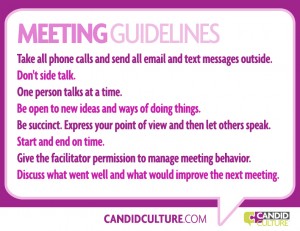
3. Review the meeting expectations every time you meet, even with groups who meet weekly.
4. Ask meeting participants’ permission to manage meeting behavior. Your role as the meeting facilitator gives you the right to address bad meeting behavior. Asking for permission and letting people know you will say something if you see their phone etc., makes it easier to speak up.
5. Tell participants they are expected to hold themselves and each other accountable.
6. Then hold people accountable for following the meeting expectations. If you ask people not to side talk, address side talking when you hear it. If you ask people not to be on their laptops or phones, ask people to put them away. If one person talks too long, interrupt him. You will have no credibility if you set expectations but don’t hold people accountable.
The reason facilitators don’t hold people accountable is that they feel uncomfortable. It’s hard to tell your peers, boss and other coworkers not to talk in circles. It’s almost impossible if you don’t set expectations about meeting behavior and set the expectation that you will say something when the meeting expectations are violated.
The simple act of setting meeting expectations and asking people’s permission to manage to those expectations makes doing so easier. Not easy, but easier. Asking your boss to put her phone away will never be easy, but it will be easier if you let her know BEFORE she pulls it out that you’ll do so.
You may be thinking, “I don’t run these meetings. I’m an innocent victim.”
As a meeting participant it is frustrating to go to poorly run meetings. But it’s also your role to speak up when you see things going poorly. Go to the meeting facilitator and give feedback. If you’re not sure what to say, follow The Feedback Formula outlined in my book How to Say Anything to Anyone.
Express empathy: “That Wednesday team meeting is tough. I wouldn’t want to run it.”
Ask permission to give feedback: “I’ve got a few observations and suggestions. Is it ok if I share them?”
Give feedback: “I’ve noticed that several people have been missing the meeting and others are on their phones and laptops during meetings. This definitely limits what we can get done and must be frustrating to you. What are your thoughts?”
Make a suggestion: “What do you think of setting meeting expectations at the next meeting and then telling people you’re going to hold them accountable?”
Offer help: “You’re not alone in this meeting. I’d be happy to tee up this discussion and explain why we need to set meeting expectations. What do you think?”
The facilitator knows the meetings aren’t going well. She just doesn’t know what to do. Offer to help. Don’t judge. She might be more receptive than you think. And you can stop suffering through poorly run meetings.
 Most people wait way too long to give feedback. We wait for the right time, aka when we’re comfortable. That day will not come.
Instead of waiting to give feedback until you’re about to explode in frustration, or until a formal review, give feedback every time you meet with someone.
Managers, make it a practice to meet with each of your employees at least once a month. Twice a month or weekly would be better. But if you’re not doing one-on-one meetings now, start meeting monthly. If you’re meeting monthly, start meeting twice a month. Employees need face time with their boss. Team meetings and casual conversations do not replace individual meetings.
Direct Report One-on-One Meeting Agenda:
The direct report comes to the meeting ready to discuss:
1. What she’s working on that is going well.
2. What she’s working on that is not going well.
3. What she needs help with.
4. Then the manager gives feedback on what went well since the last meeting and what could be improved.
5. And the employee gives the manager feedback on what has gone well since the last meeting and what could be improved.
Feedback goes both directions. Managers, if you want your employees to be open to your feedback, ask for feedback from your employees on what they need from you. Give feedback on both the work and your working relationship. A poor working relationship often motivates employees to leave a job, but it’s the last thing that gets discussed.
Feedback discussions should be short. You can say anything in two minutes or fewer. No one wants to be told she isn’t cutting it for 20 minutes. Say what you need to say and end the conversation or move on to another topic.
If you’re not giving your employees regular feedback you can use this language to start:
“I’m realizing that I’m not giving you enough feedback. I want to be helpful to you. If I don’t provide regular, timely feedback, I’m not being as helpful as I could be. I’d like to start a regular practice of meeting monthly, getting an update from you on how things are going, and giving each other feedback on what went well and what could be improved since our last meeting.”
 If you work for someone who is not forthcoming with feedback, ask for feedback. You’re 100% accountable for your career. Don’t wait for your manager, customers or peers to give you feedback. Ask for feedback on a regular basis.
Here’s how you can ask for feedback from your manager:
“Your feedback helps ensure I’m focused on the right work. Can we put a monthly meeting on the calendar, and I’ll tell you what I’m working on, where I do and don’t need help, and we can discuss how things are going?”
If meetings get cancelled, reschedule them. If your manager says these meetings aren’t necessary or she doesn’t have time, tell her, “Your regular input is helpful to me. What’s the best way to ensure we catch each other for a few minutes each month?” Meaning, push the issue.
If your manager still doesn’t make time for the meetings or doesn’t provide clear and specific feedback, even when you ask for examples, ask your internal and external customers and coworkers for feedback. The people you work closely with see you work and will likely give feedback, if asked.
No news is not necessarily good news. Waiting six months or a year to receive performance feedback is like going on a road trip from St. Louis to Los Angeles but not consulting a map until you arrive in New York, frustrated and far from your desired destination.
Managers: Meet with employees monthly, semi-monthly or weekly, and give feedback every time you meet.
Employees: Ask your managers, customers, and coworkers for regular feedback, and take control of your career.
The normal, human response to negative feedback is to become defensive. Becoming defensive is a survival instinct, like hitting your breaks when the car in front of you stops short. It’s almost unavoidable.
The challenge with becoming defensive is that the person who risked telling you the truth (as she sees it) doesn’t want to deal with your defensiveness. Your defensiveness is . . . scary, intimidating, annoying – fill in the blank.
So what’s the right answer?
Here’s my recommendation on how to respond to negative feedback:
When someone gives you feedback, listen. Listening doesn’t mean you do what the other person wants. Listening merely means take in the message. Hear what the other person has to say. And ask questions for greater understanding, if you can do so without being defensive. In my experience, asking questions, in the moment, without being defensive is VERY hard to do.
I got critiqued for admitting, in last week’s blog, that I broke one of my own rules by sending feedback via email. I study, teach and write about how to communicate well. And I’m human. Sometimes my emotions get the best of me. But when they do, I clean it up fast.
The last time I got feedback from a friend I got defensive. And during the conversation, right after I became defensive, I caught myself, apologized, and asked the person to tell me again. I said, “I’m sorry I got defensive. Tell me again and I’ll do a better job of listening.”
You won’t always communicate perfectly. It’s not possible. The key is to catch yourself quickly and clean up the messes you make. If you raise your voice, apologize. If you cry, remove yourself from the situation until you can speak calmly. If you push back and defend versus listen, own your behavior and do a better job of listening. You’ll earn respect by admitting when you fall short.
It’s easy to mistake listening to feedback and saying “Thank you for telling me that” as agreement. I’m not suggesting you agree or give in. When you’re calm and can interpret the feedback, without emotion, go back to the person to talk more. It’s ok to push back. It’s ok to say you disagree or that she is mistaken. But if you have this conversation when you receive the feedback, the other person will likely be so daunted by your reaction that she is not likely to give you feedback again, and that’s a loss for you.
So few people will risk being honest with you, make it easy on those who do.
A few weeks ago one of my friends asked for feedback on how he communicated. When I told him what I thought he responded with, “So, you’re telling me I did it all wrong.” Aka, he got defensive, so I back peddled. In that moment my brain got trained, this guy can’t take feedback. So the next time he asks me, I won’t give any.
It doesn’t take much to train people not to tell you the truth. One instance of defensiveness will do it. Don’t do that to yourself. You need the data. You don’t need to agree with what the person says or change your behavior, but you need to know what people think and say about your performance.
Let’s review how to respond to negative feedback:
- Ask for feedback.
- Listen.
- Don’t defend.
- Think about what the person said.
- Wait until you’re calm.
- When you can ask questions and discuss without being defensive, talk further.
Now that you know how to respond to negative feedback, use our Advancing Career Questions to get more feedback:

 We’ve all received work from another person that wasn’t what we were expecting, hit reply, and told the other person what we thought. Then we dealt with the consequences.
A few tips for giving feedback to get more of what you want and less of what you don’t:
Don’t give feedback via email. Ever. You can’t manage your tone or see the person’s reaction.
Practice the 24-hour rule and the one week guideline. Wait until you’re not upset to give feedback, but don’t wait longer than a week.
It’s almost impossible to give feedback without putting the other person on the defensive. Becoming defensive when receiving feedback is normal and natural. It’s a way to protect ourselves when we feel attacked.
When people are defensive, it’s hard to listen and respond. The less defensive the other person becomes, the easier it is to communicate with that person. People will be less defensive if you give feedback when you’re calm and choose your words carefully.
Communicate in a way that the relationship needs versus what you need in the moment.
When we give feedback when we’re upset, we’re really communicating for us, not for the other person. I didn’t get what I want. I’m upset. And I’m going to tell you about it. Then the other person gets upset and now, in addition to you not getting what you wanted in the first place, you have to do damage control.
Communicating in a way the relationship needs means choosing the timing, words and method of communication that is likely to produce the result you want – the other person being able to hear you, while becoming minimally defensive, and taking action. Giving feedback when you’re upset, especially via email, will not produce the result you want. You’ll only damage your relationship.
Being a good communicator and maintaining good business relationships requires patience and self discipline. This is something I work on ALL the time. Last week I sent one of my vendors feedback via email, when I was upset, and spent two days trying to recover. I sent a minor email with critique, he felt attacked, and I damaged our relationship.
It doesn’t take much to raise someone’s defensiveness to the point that you have to do damage control.
Wait to give feedback until you’re not upset. Don’t send an email. Pick up the phone or walk to the person’s desk. Deliver the feedback in a way the other person can hear you. Be ready for him to become defensive. It’s human to become defensive. You can’t eliminate defensiveness, but how you deliver feedback can greatly reduce it. And you’ll get more of what you want and less of what you don’t.
Read How to Say Anything to Anyone and get the words to have even the toughest conversations.
 Wearing too much perfume or cologne will make people scatter, or wish they could. Unfortunately, rather than tell you that you’re wearing too much, people will just avoid sitting near you. Scent is such a personal thing, like clothing, that people are hesitant to comment on it.
I suggest not wearing anything scented at work, on airplanes, or when you’ll be in close proximity with other people you don’t know well. But if I can’t persuade you to skip the scent, here are a few guidelines when putting on cologne and perfume:
• Spray the air ten inches in front of you, and walk through the mist, rather than spraying your skin.
• If you can smell the scent on yourself or people who are more than a few inches from you can smell it, you’re wearing too much.
• You should never be able to smell a person’s cologne after they’ve left a room.
No, I’m not an expert on how to wear perfume. I googled it.
The next step is to ask a few people you trust to tell you when you wear too much perfume or cologne. Give people permission to give you this feedback, and promise you won’t bite their head off when they do. This could sound something like, “I want to be sure I’m not wearing too much perfume. Would you be willing to tell me when I do? I promise I won’t freak out or jump down your throat. I really want to know.”
Let’s say you work with someone who wears too much perfume. She hasn’t asked if she’s wearing too much, and you want to say something. You could say something like, “This is a bit awkward, but the perfume you wear is a bit overwhelming. Would you be willing to wear less or none at all when you’re in the office?” This is an awkward conversation that most people don’t want to have. Consider that you’re doing the person a favor. Would you rather know the amount of scent you wear keeps other people away, or would you rather alienate the people around you?
If the relationship is a personal one, you could say, “You wear the most lovely perfume. And I’ve noticed that the smell is quite strong. Would you be willing to wear less of it?” Again, this is an awkward conversation. But you won’t die from having it and the other person won’t either. When she gets over being embarrassed and defensive, your relationship will be fine. And if it’s not, you didn’t have much of a relationship to begin with.

Use our Candor Questions to Advance Careers to find out what people say about you when you’re not there.
No one wants to tell you you’re dressed inappropriately for work.
The office dress code conversation seems to be feedback managers avoid and struggle with the most. Perhaps because attire is so personal, I’m not sure. But I do know that I’m getting more and more requests to train managers how to give employees feedback that their butt crack is showing. Yes, really.
Many employees push the envelope on the office dress code during the summer, breaking out tank tops, jeans and capri’s. The problem with dressing this casually is that some of the people you work with will judge you for it, but they are not likely to tell you. They’ll just decide you have poor judgment and that you may not be the right person to stand in for your boss at a meeting or conference.
A couple of office dress code guidelines to follow, unless you work in a very casual office environment where even the folks at the top wear jeans and t-shirts to work:
- Make friends with your iron, or a dry cleaner.
- If you put something on and ask “Can I get away with this,” the answer is most likely no.
- Ladies, your cleavage should never show at work. Never ever. It will only limit your career.
- T-shirts and cargo pants are not business casual.
- Capris and sandals are ok, if your company allows them. Spandex and shorts are not.
- Thongs and butt cracks are a no-no. Ladies, don’t wear low rides to work. Men, if your belt sits below your stomach, buy a bigger pair of pants and raise the belt. This will solve the butt crack problem.
- Ladies check your skirt length. If it’s too tight or too short, it’s not for the office.
- Lots of women are wearing really high heels to work. They look great, at a club.
- General rule of thumb, if can comfortably leave work and go to a club or a baseball game, you’re not dressed conservatively enough for work.
Most of these suggestions are aimed at women because women have more flexibility with clothing and thus a greater margin for error. Men have the man’s business casual uniform: khakis and a button down or golf shirt. That’s hard to screw up, unless of course you sleep in the khakis.
Here’s how you can give a woman feedback that she isn’t dressed appropriately for your office dress code:
“I’ve noticed that some of your clothing shows cleavage. When people look at you, I want them thinking about how smart you are and all that you add to our organization. I don’t want them distracted with something else.” Replace cleavage with whatever misstep the person is making.
Here’s another example: “I’ve noticed that you wear short skirts and pretty high shoes to work. We work in a pretty conservative environment. You always look great, but not for our office environment. I’m going to ask you to wear longer skirts, that aren’t as form fitting, with lower shoes. I know this conversation is awkward, and I appreciate that you’re willing to have it with me. When people look at you I want them thinking about how smart you are and all that you add to our organization. I don’t want them distracted with something else.”
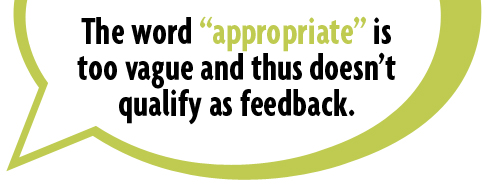
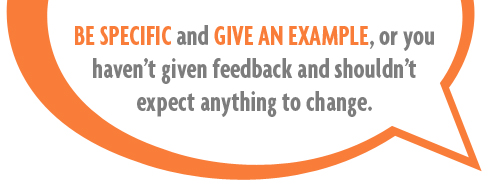
Notice, I didn’t say, “You’re not dressed appropriately for work.” The word “appropriate” is too vague and thus doesn’t qualify as feedback. Being vague doesn’t tell the person what to do differently. If your employees felt that what they are wearing to work was inappropriate, they’d wear something else. You need to spell it out. And this is true for all forms of feedback. Be specific and give an example, or you haven’t given feedback and shouldn’t expect anything to change.
Men, you can’t have this conversation with the women in your office. Ask a woman the employee has a relationship with to have the conversation on your behalf.
Read How to Say Anything to Anyone to get the words to have other difficult feedback conversations.
Some of you are currently gasping, thinking there is no way you can have this conversation. Yes you can. I have these office dress code conversations with clients regularly without damaging my relationships. So few people will tell someone when they’re wearing clothing that damages their reputation, when the feedback recipient gets over being shocked and embarrassed, s/he’ll thank you for caring enough to give such honest feedback.
Vague is useless. Being vague is actually worse than useless. Being vague instills doubt in the people around you and reduces your credibility.
When a customer service agent answers my questions with words like, “That sounds right, I think so, or that should work,” I hang up and call back, hoping to get someone who can give me an affirmative answer. People do this to you too, they just don’t tell you about it.
Watch your language. If the answer is yes, say “Yes.” If the answer is no, say “No.” “I think so,” says neither yes nor no. Saying, “I think so” tells people you don’t really know.
A few phrases to avoid and what to say instead:
Avoid: “That should be done by Friday.”
Instead, be specific and give a final date. “That will be complete by Friday. If I can’t get it done by Friday, I’ll call you to let you know by 5:00 pm on Thursday.”
Avoid: “Sounds right.”
Instead, be specific and say, “That’s correct.”
Avoid: “We should be able to do that.”
Instead, be specific and say, “We can do that.”
Avoid: “I guess.”
Instead, be specific and say, “Yes” or “No.”
When I teach feedback training, the biggest thing training participants struggle with is specificity. “You’re difficult to work with.” “Your clothing is inappropriate.” “I just find you to be negative.” “You did a good job on that.” “It’s a pleasure to have you on the team.” All of this is vague and thus unhelpful to the feedback recipient. And the same is true when answering questions and making promises.
Tell people exactly what to expect. Be specific. Even if they don’t like your answer, they’ll be happy to have a clear answer.