Posts Tagged ‘career management’
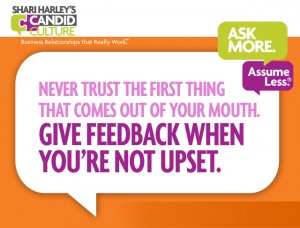 We’ve all received work from another person that wasn’t what we were expecting, hit reply, and told the other person what we thought. Then we dealt with the consequences.
A few tips for giving feedback to get more of what you want and less of what you don’t:
Don’t give feedback via email. Ever. You can’t manage your tone or see the person’s reaction.
Practice the 24-hour rule and the one week guideline. Wait until you’re not upset to give feedback, but don’t wait longer than a week.
It’s almost impossible to give feedback without putting the other person on the defensive. Becoming defensive when receiving feedback is normal and natural. It’s a way to protect ourselves when we feel attacked.
When people are defensive, it’s hard to listen and respond. The less defensive the other person becomes, the easier it is to communicate with that person. People will be less defensive if you give feedback when you’re calm and choose your words carefully.
Communicate in a way that the relationship needs versus what you need in the moment.
When we give feedback when we’re upset, we’re really communicating for us, not for the other person. I didn’t get what I want. I’m upset. And I’m going to tell you about it. Then the other person gets upset and now, in addition to you not getting what you wanted in the first place, you have to do damage control.
Communicating in a way the relationship needs means choosing the timing, words and method of communication that is likely to produce the result you want – the other person being able to hear you, while becoming minimally defensive, and taking action. Giving feedback when you’re upset, especially via email, will not produce the result you want. You’ll only damage your relationship.
Being a good communicator and maintaining good business relationships requires patience and self discipline. This is something I work on ALL the time. Last week I sent one of my vendors feedback via email, when I was upset, and spent two days trying to recover. I sent a minor email with critique, he felt attacked, and I damaged our relationship.
It doesn’t take much to raise someone’s defensiveness to the point that you have to do damage control.
Wait to give feedback until you’re not upset. Don’t send an email. Pick up the phone or walk to the person’s desk. Deliver the feedback in a way the other person can hear you. Be ready for him to become defensive. It’s human to become defensive. You can’t eliminate defensiveness, but how you deliver feedback can greatly reduce it. And you’ll get more of what you want and less of what you don’t.
Read How to Say Anything to Anyone and get the words to have even the toughest conversations.

 It’s hard to come back to work after a long weekend, no matter how much you like your job. As fun and fulfilling as work can be, we all struggle with back to work blues from time to time.
If you’re having a hard time getting back into it today, here are a few things to try:
- Be realistic about how much you’re going to do today. Move a few things on today’s to-do list to tomorrow, or maybe Wednesday. Setting unrealistic goals sets people up for frustration and feelings of failure.
- Pick one or two things you’re going to do today, and finish those two things.
- Do one thing at a time. Not five.
Stress occurs when we’re thinking about the past or the future. When we’re in the moment, there is nothing to stress about. You’re focused on what you’re doing, nothing else. This is easier said than done, which is why I do yoga. If I’m thinking about anything but the teacher’s instructions, I fall over.
- Plan something fun. When is your next vacation? What are you looking forward to? Having something fun and exciting on the horizon is motivating and keeps us going.
- If you’re not having fun at work or you’re feeling stuck, tell someone who can do something about it. Most people are so afraid of being fired, they don’t speak up at work. From my experience it’s not so easy to get fired. Look around. I suspect there are several people you work with who you think deserve to be fired, yet there they are. Worry less. Speak up more. No organization is going to fire you for wanting and being willing and able to do more.
If after all of these BRILLIANT suggestions you still find yourself in the back to work blues, gossip about a few people who haven’t made it in yet today, eat someone else’s lunch from the refrigerator that looks better than what you brought, and re-arrange the most organized person’s desk. And all will be well.
Advance your career and manage people with our top three sellers.



 A few weeks ago I received an email from a candidate for a job I recently filled. His grammar, in the email, wasn’t great. The job requires writing, so I asked for a writing sample. The writing sample I received was riddled with spelling and grammar errors.
When I rejected the candidate, because of his bad grammar and spelling, some of my friends defended the candidate saying that spelling didn’t predict how successful someone would be and that poor writing is incredibly common in this country.
Their comments reminded me of the graduate level leadership class I taught a few years ago. Many of my master’s level students’ grammar was so poor, when I handed back my students’ first papers, I gave them a grammar lesson. Some class members were so offended and annoyed by this, they reported me to the dean, telling her that they did not pay $1500 for a grammar lesson. My stand remains the same.
I don’t care how great a leader you are. If you discredit yourself in every email you send by using bad grammar, your career will be limited.
Here are some common examples of bad grammar in both written and spoken communication:
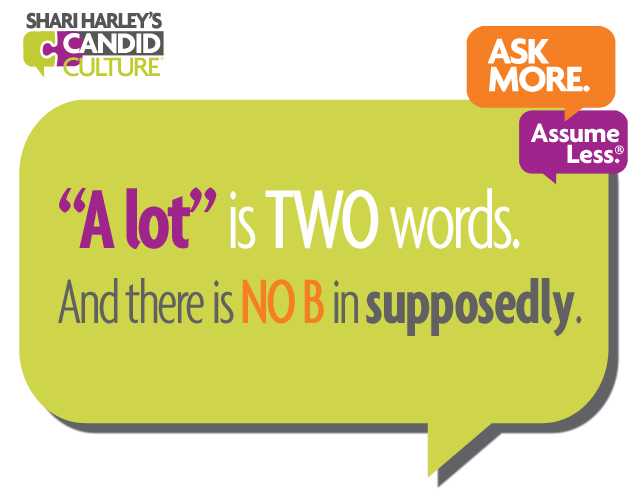
- “A lot” is two words.
- Incentify is not a word. Incent is.
- Too means also. To does not.
- There is no B in supposedly.
- Your crazy aunt can only visit once a year without you wanting to change your address, and this does not mean that you’re a bad person.
- You accept advice. You advise others.
- There is no X in especially.
- You lose your marbles when you don’t get enough sleep. Your jeans become loose when you stop eating Snickers bars.
- You accept advice, except when you think the other person isn’t the sharpest tool in the shed.
- Irregardless is not a word. Regardless is.
- “Where you at?” “Where are you,” will do.
- Please put your contact information on the bottom of your initial and reply emails. This is not a grammar thing, it would just be helpful.
Call me picky or old school. But I suspect that when you hear these errors made in conversation or see them in writing, you judge the other person. I know most hiring managers do. Hiring managers want to know employees can write reports and email clients without embarrassing the company.
You will be eliminated as a job candidate if your resume has typos. People will judge you when you use incorrect English. They won’t tell you they’re judging your bad grammar. They’ll do it quietly or talk about you when you’re not there.
I spoke at a conference a few weeks ago where an attendee asked how to tell an employee she was going to be fired because her writing was so poor. She maintained client files and wrote client correspondence. Clients’ names were often wrong, in her written notes, as was spelling and grammar. The typos and grammar errors were a deal breaker. And they may be in your job as well.
Have someone proofread a few of your emails and reports, and ask for feedback on your writing. Ask the coworkers you’re close to to tell you when you make grammar errors in meetings. Of course you want them to tell you privately, after the meeting.
I write a bi-monthly column for the Denver Business Journal. I’m grateful that my editor reads this blog and emails me the typos and errors I make. I am not exempt.
Clean up your bad grammar and your writing, and accelerate your career. I promise it will work.
 Unfortunately you probably already know that people have a tendency to talk about you, not to you. It’s human nature. Sometimes it’s gossip. Other times senior leaders talk about your future with the organization. If you want to advance your career, you need to know what the people whose opinions you care about say about you when you’re not there.
Unfortunately most people get very little feedback at work. If today was the day of your performance appraisal and I asked how your boss and whoever else provides input on your review would rate you, you probably don’t know. This lack of knowledge prevents you from advancing your career.
Not knowing someone’s opinion doesn’t mean you’re not subject to it. Akin to getting a speeding ticket when you didn’t know you were speeding. The cop doesn’t care. He adds four points to your driving record, despite that you didn’t know the speed limit.
You may work for a manager who gives feedback. You may not. It doesn’t matter. There are people in your life who will tell you the truth (as they see it), if you ask.
I recommend assembling a core group of people who you count on to tell you the truth. These are the people who know you well and have your back. They can be friends, family members, past coworkers, customers, or managers.
You might wonder, “What can my mom or friends from high school or college tell me about how I behave at work?” The answer–a lot.
We don’t become different people when we arrive at work. We are who we are. If you’re often late, break commitments, or wear clothing that’s not your friend, you do those things at home and at work. Likewise, if you have great attention to detail, never break commitments, and always look great (in public), you friends and family know.
Identify a few people, personal and/or professional, who care about you and will tell you the truth.
Tell these folks you want to eliminate your blind spots. Ask them for specific feedback, and promise that no matter what they say and how hard it is to hear, you will say “thank you.” Then be sure to manage yourself. It’s normal to become defensive when we get constructive feedback. But every time we become defensive, we train people it’s not safe to tell us the truth. If you want people to give you feedback, more than once, make it easy to tell you the truth.
You may be thinking that asking for feedback is unrealistic. People won’t be honest. And you can’t take it.
The people who really care about you will be honest, and you can take it. You’ll be fine. In fact you’ll be better off than before you had the conversations. You might hear things that pleasantly surprise you. And the things you don’t like? Just because no one talked to you about them before you asked, doesn’t mean those behaviors didn’t impact you. Now you can do something about them.
Get out of the dark and into control. Discover your reputation and advance your career.
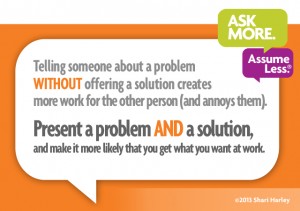 Despite what you may think, your manager has enough to do. So when you drop a problem at her door, she finds it annoying. Rather than just alerting your manager and the leaders in your organization to the things that need to be fixed, go one step further, and be a change agent by offering a solution yourself.
It’s fine to raise challenges. It’s better to raise challenges you’re willing to do something about. If you think two departments don’t talk to each other, bring them together. If you think a process is inefficient, propose a different way to get the work done. If you’re dissatisfied with software you’re using, offer to source three potential vendors and set up a demo. You’re doing the legwork and asking for a small investment of time.
When we ask for something at work, it often requires time, money, or both. Thus when an employee asks for something, it’s easier for a manager to say no than it is to say yes. “No” requires no work and no financial outlay. A “yes” may require both.
You make it easy to say yes to your requests when you’re acting as a change agent:
- Propose a solution to a problem.
- Offer to do the work to solve the problem.
- Ask for small things that are easy to approve.
If you’re overwhelmed and want to hire an additional person, but your boss isn’t convinced you need the headcount, ask for a temp for a finite number of hours. It’s much easier for a manager to say yes to a small and known investment amount than to the long-term commitment of hiring someone new. The point is to ask for something that is easy for your manager to approve.
The word “pilot” is your friend. If you want to make a major change, pilot a scaled down version of your proposed solution in one or two locations, rather than in your organization’s 10 locations. Again, asking for something small makes it more likely that you’ll be told yes.
The bottom line is to be part of the solution – as trite and overused as that phrase is. Don’t be the person who says, “That’s broken” without also saying, “and here’s how we can fix it. Can I give it a try?”
Last week some unknown person sent me emails predicting my future. According to the anonymous clairvoyant, in ten years my life will be going well. I’ll have a son who is bright but doesn’t apply himself (shocking), and I’ll be offered a job in Oshkosh that I shouldn’t take. After the third predictive email, the sender wanted to know if I had questions about my future. I didn’t.
- The whole thing was wildly creepy.
- No one should take advice from someone with this much discretionary time. The emailer needs a volunteer job.
- Why would I want someone else to tell me my future? That’s something I enjoy creating.
I’ve got a friend who feels a black cloud follows her. She feels bad things repeatedly happen to her and there’s nothing she does to create these situations, which is, of course, complete garbage.
It may be easier to blame someone or something for the bad things that happen to you, but if someone else is responsible, you have no control. And if you have no control over what happens to you, there is nothing you can do to create the life you really want.
I see myself as 100% responsible for everything that happens to me. As antithetical as it sounds, life is easier when I’m accountable. If I miss a plane because of traffic, I should have left for the airport earlier. If I get overcharged in a restaurant, I should have checked the bill more carefully. If I do a bunch of work for a client and later find out that the work I did isn’t what the client really wanted, I should have asked more questions upfront and asked for feedback earlier.
When I’m responsible for what happens to me, I have some control. When someone else is responsible, I have no control.
I’ll admit to going to a psychic…once. In 2001 I took a transfer from Denver to New York. Living in New York was fun and exciting, and great for my career, but I didn’t enjoy living in such an urban city. I agonized over what to do for two years – go back to Denver, stay in New York, or move someplace else?
Desperately unhappy, but not being able to make a decision, I went to see a psychic. Clearly I had given up. I was going to let someone I’d never met, who didn’t know anything about me, decide my future. Unless you’re at the Jersey Shore and decide to have your palm read for fun, seeing a psychic is abdicating responsibility for your life.
Instead of seeking answers about what might happen, pursue the things you want. If you want a different job in your organization, tell someone who can do something about it. If you got passed over for a job, ask the hiring manager for feedback of what would have made you a better candidate. If the hiring manager doesn’t give you any information, ask your current boss to get the information for you. If one of your co-workers excludes you from projects, ask him why. If someone you work with seems to dislike you, ask for feedback about what you did to damage the relationship. Regardless of how challenging the situation and how disappointing the results, there is ALWAYS something you did to either contribute to the situation or something you can do to change the situation.
I don’t mean to tell you what to do. Nor do I mean to minimize how hard some life circumstances are. But I do want you to see yourself as in charge of what happens to you.
Create the life you want by:
- Asking, “What do I really want, and what’s one thing I can do right now to get closer to that goal?” Then take one step. Then take one more, and so on.
- If negative things are happening, ask, “What could I have done differently to have a different outcome?” Or, ask, “If I could do this over again, what would I do differently.” Then next time, do it differently.
Regardless of how hard or bad something is, there is ALWAYS something you can do to make the situation better. Take your life, your career and your relationships into your own hands, where they belong.

Email us if you want this career management phrase on a poster, note card, notebook, or magnet.
Vague is useless. Being vague is actually worse than useless. Being vague instills doubt in the people around you and reduces your credibility.
When a customer service agent answers my questions with words like, “That sounds right, I think so, or that should work,” I hang up and call back, hoping to get someone who can give me an affirmative answer. People do this to you too, they just don’t tell you about it.
Watch your language. If the answer is yes, say “Yes.” If the answer is no, say “No.” “I think so,” says neither yes nor no. Saying, “I think so” tells people you don’t really know.
A few phrases to avoid and what to say instead:
Avoid: “That should be done by Friday.”
Instead, be specific and give a final date. “That will be complete by Friday. If I can’t get it done by Friday, I’ll call you to let you know by 5:00 pm on Thursday.”
Avoid: “Sounds right.”
Instead, be specific and say, “That’s correct.”
Avoid: “We should be able to do that.”
Instead, be specific and say, “We can do that.”
Avoid: “I guess.”
Instead, be specific and say, “Yes” or “No.”
When I teach feedback training, the biggest thing training participants struggle with is specificity. “You’re difficult to work with.” “Your clothing is inappropriate.” “I just find you to be negative.” “You did a good job on that.” “It’s a pleasure to have you on the team.” All of this is vague and thus unhelpful to the feedback recipient. And the same is true when answering questions and making promises.
Tell people exactly what to expect. Be specific. Even if they don’t like your answer, they’ll be happy to have a clear answer.
 When the people we work with don’t do their jobs, we might find ourselves saying, “He should be more on top of things.” “She shouldn’t make commitments she can’t keep.” “He doesn’t know what he’s doing, and that’s not my problem.” The challenge is, when your coworkers don’t perform, it is your problem.
When your coworkers don’t get you the information you need in a timely way, you miss deadlines. When you work from incorrect information, your reports are wrong. When others don’t work with you, you look bad. So you can be right all day about how others perform, and your reputation will still be negatively impacted.
I don’t suggest you enable your coworkers by doing the work others don’t. I do suggest you help your coworkers be successful by holding them accountable.
Here are a few things you can do to manage your career and get what you need from your business relationships:
- Don’t assume others will meet deadlines. Check in periodically and ask, “What’s been done so far with the XYX project?” Notice, I didn’t suggest asking, “How are things going with the XYZ project.” “How are things going” is a greeting, not a question.
- Set iterative deadlines. If March 20th is your drop dead deadline, ask to see pieces of work incrementally. “Can I see the results of the survey on March 5th, the write up on March 10th, and the draft report on March 15th?” One of the biggest mistakes managers and project managers make is not practicing good delegation by setting iterative deadlines and reviewing work as it’s completed.
- Don’t just email and ask for updates. The people you work with are overwhelmed with email. And email is too passive. Visit people’s offices or pick up the phone. Saying, “I emailed him and haven’t heard back” makes you look as bad as the other person who missed a deadline.
You might be thinking, “Holding my coworkers accountable is awkward. I don’t have the formal authority, and I don’t want my coworkers to think I’m bossy or damage my business relationships.”
It’s all in the how you make requests.
If you’ve seen me speak or have read the business book How to Say Anything to Anyone, you know I believe in setting clear expectations at the beginning of anything new. That could sound something like, “I’m looking forward to working with you on the XYZ project. How would you feel if we set iterative deadlines, so we can discuss work as it is completed? You’ll get just-in-time input, making any necessary adjustments as we go, and we’ll stay ahead of schedule. How does that sound? How are the 5th, 10th, and 15th as mini deadlines for you?”
Many people put large projects off until the last minute. People procrastinate less when large projects are broken into smaller chunks with correlating deadlines. You strengthen your business relationships and support people in meeting deadlines and not procrastinating when you agree on completion dates when projects begin. Also, most of us unfortunately know what it’s like to put a lot of work into a project, have someone review our completed work, and then be told we went down the wrong path and need to start over. It’s days like this that make being a Walmart greeter seem appealing.
Ask more. Assume less. Don’t assume your coworkers will do what they’re supposed to do. Ask upfront to see pieces of work on agreed upon dates. Pick up the phone versus rely on email to communication. And know that the people you work closely with are a reflection of you. Strengthen your business relationships. Get people working with you, and everyone will look good.
 When confronted with a challenging conversation or situation, everyone has a reaction of some type. Some people laugh nervously. Some people get quiet and retreat. Other people turn red. Others yell. And some people cry. All of these reactions are normal and natural.
If people didn’t have emotions we’d be androids. And while there are probably days you wish your coworkers acted more like Siri, if the people you work with don’t think more critically than your iPhone, they aren’t of much use to you.
The problem with expressing emotions at work is that it makes people uncomfortable. And often when people are uncomfortable, they don’t know what to do. They just want the situation to go away. And unfortunately in this situation, that means they want you to go away, which is not how you want your boss, coworkers, or customers to think about you.
Avoid crying at work. It makes the person across from you feel uncomfortable and helpless. Men and women alike don’t know what to do when someone they work with cries. They just want the person to stop crying or leave.
I’ve heard some people describe criers as manipulative, as if they cry to orchestrate a certain outcome. I don’t believe that. I think people who cry at work do so involuntarily. It’s their natural reaction to stress. That said, crying at work is not good for professional reputations or relationships.
Here’s what you should do if you have a crier in your office:
- Hand the person a tissue.
- Know that you are responsible for how you deliver information. You are not responsible for the person’s reaction.
- If the person can continue the conversation, keep talking.
- If s/he can’t continue the conversation, end it and talk another day. Say something like, “I can see this is very difficult, and I’m very sorry about that. Why don’t we finish the conversation another day.”
- If the person doesn’t leave your office, stand up and open your door. That will prompt the other person to stand up.
Here’s what you should do if you’re a crier:
- Don’t have difficult conversations when you’re tired, stressed, or are having a bad day.
- Practice potentially difficult conversations so you feel more prepared and in control.
- Know that nothing is personal.
- If you sense you are going to cry, get out of the meeting before you do.
- Take a walk outside to burn off stress.
- If you cry in a meeting, apologize and try to stop.
- If you can’t, excuse yourself from the meeting and circle back to the person when you’re more composed.
None of these suggestions are intended to sound cold or unempathetic. Instead, they’re intended to help criers manage their professional reputation and career. You don’t want someone to be afraid to give you bad news because they fear your reaction. Anything that gets in the way of telling you the truth makes it likely that you won’t get real feedback. And without consistent, candid feedback, you’re working in the dark.
Not knowing how you come across and how your work is perceived are the things that lead to being fired, overlooked for projects, and laid off. Make it easy to tell you the truth by managing your emotions during difficult conversations. As hard and at times seemingly unrealistic as it seems, leave your feelings in your car.
 Tis’ the season to over commit.
It’s almost January 1st, when many of us begin thinking about New Year’s Resolutions. We vow to lose 20 pounds, save 10% of our income, get promoted at work, take an exotic vacation, be a better partner, etc. etc. Also known as “how to set yourself up to fail” in five easy steps. The reality is we might do one or two of those things, if that.
Why not set yourself up to win instead? Instead of setting huge goals that are unlikely to happen, why not set more realistic goals that you can and will likely to do?
If you manage people, perhaps you’re thinking about how you can be a better manager in 2013. Or you may be thinking about how you can accelerate your career. You may decide to meet with your employees more frequently, or ask your boss for more feedback, or ask for new and different work. You may think that doing these things will help you strengthen your relationships with your employees and your reputation, and advance your career. Doing any of these things might help you strengthen your business relationships and help you get ahead. But they might not, if those things are not important to your employees, your boss and/or your organization.
In 2013, put energy and resources into the things that truly matter to the people you work with, rather than the things you think they think are important. And the only way to know what the people around you really want and need is to ask them. Don’t assume you know what is important to your boss, direct reports and coworkers, ask them. Ask more. Assume less.
There are countless examples of managers who went to great lengths to make their employees happy. They gave bonuses, cool projects, and time off. And their employees quit anyway. Or, trying to make a manager happy, employees stayed late, beat deadlines, and took on additional work, and still got a mediocre review. Rather than doing what you think others want, ask them!
How about this for a New Year’s resolution — ask your boss, direct reports and key customers these questions as you begin the New Year:
- What’s the most important work I did in the past 12 months?
- What’s an area, in 2012, I exceeded your expectations?
- How did I let you down?
- If I could do one thing differently this year that would make the biggest difference for you and/or the organization, what would it be?
- Where do you think I should focus my energy in 2013?
- It may be intimidating to ask for feedback from your peers and direct reports. But you won’t know what to do more, better, or differently if you don’t ask.
The right answer to feedback is always “thank you,” regardless of what you really want to say. Saying “thank you” makes you a safe person to whom to tell the truth and makes it more likely you’ll get more information in the future. So bite your tongue and respond to all feedback with, “Thank you for telling me that. I’m going to think about what you’ve said and may come back to you to discuss further.” They’ll be relieved, and you’ll strengthen your professional image.
It’s easy to assume what others want and are expecting from us. The problem is we’re not always correct. Thus we expend energy doing things that others don’t find valuable or important, otherwise known as wasting time and resources.
Your time and budget dollars are valuable. Use your time and money for things that others actually want, versus what you think they want. In 2013, dial it back. Make realistic, attainable goals that are aligned with what the people around want and need. And in return, you too will get what you want and need.
Take advantage of the last day to get a free box of Candor Questions with a purchase of $75 or more candor products.


