Posts Tagged ‘business relationships’
We added to our team at Candid Culture a few weeks ago, so we did what I teach other organizations to do –use Candor Questions to onboard our new team member, and help the entire team get to know each other better.
I sent my team the Candor Questions below and asked them to pick a few additional team building questions for everyone on the team to answer.
- What will keep you working here and what would make you leave?
- What’s the best way to get information to you – voicemail, text, or email?
- What time is too early?
- What time is too late?
- Do you leave your email and/or text alerts on at night/when you go to sleep?
- Would you prefer I send all emails and text messages during regular business hours?
- What frustrates you at work?
- What are your pet peeves?
- What’s something you want to learn, skill or business wise, that you haven’t had a chance to do?
- What’s something you wish I would start, stop, or continuing doing?
We run so fast at work and are so focused on completing goals, we often don’t take the time to really get to know the people we work with. I feel very strongly that asking the team building questions above will help people work better together. We’ll make fewer ‘mistakes’ with each other, and get more done with less stress and more ease. As William Ury said in his book, Getting to Yes, “Go slow to go fast.”

How many times have you sent someone five emails and become frustrated when none were returned? Or you thought an employee was happy, only to be surprised when she quit? Or you needed to talk with someone but couldn’t get her attention, so you walked by her office throughout the day, wondering if it was ok to knock? Working with other people doesn’t have to be so hard.
Taking the time to ask team building questions is much faster than recovering from missteps with other people. Ask the questions at the beginning of anything new – when you hire a new employee, get a new customer, or start a new project. And keep asking the questions as you work with people.
Asking questions about working style preferences and goals is an ongoing process, and it’s never too late. You can ask the team building questions during meetings or just slip them into your conversations. The process doesn’t have to be formal or time consuming. The point is simply, don’t guess what people need and are expecting from you, ask.

 I’ll never forget a coaching meeting I had about two years ago. I gave the manager I was coaching some tough feedback and he replied by saying, “I know I do that.” So I asked him, “If you know this is an issue, why are we having the discussion? He told me, “I just figured this is the way I am.” And I realized that knowing a behavior is ineffective doesn’t mean we know what to do to make things better.
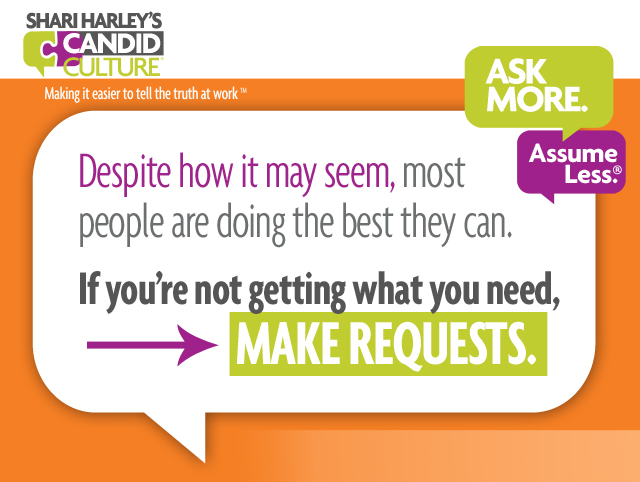
The people you work with want to do a good job. They want you to think well of them. Yes, even the people you think do little work and/or are out to get you. Give people the benefit of the doubt. Assume people are doing the best they know how to do. And when you don’t get what you want, make requests.
There are two ways to give feedback. One way is very direct.
Version one: “You did this thing and here’s why it’s a problem.”
The other way is less direct. Rather than telling the person what went wrong, simply make a request.
Version two: “Would you be willing to…” Or, “It would be really great to get this report on Monday’s instead of Wednesday. Would you be willing to do that?”
It’s very difficult to give feedback directly without the other person feeling judged. Making a request is much more neutral than giving direct feedback, doesn’t evoke as much defensiveness, and achieves the same result. You still get what you want.
When I teach giving feedback, I often give the example of asking a waitstaff in a restaurant for ketchup. Let’s say your waiter comes to your table to ask how your food is and your table doesn’t have any ketchup.
Option one: Give direct feedback. “Our table doesn’t have any ketchup.”
Option two: Make a request. “Can we get some ketchup?”
Both methods achieve the desired result. Option one overtly tells the waiter, “You’re not doing your job.” Option two still tells the waiter he isn’t doing his job, but the method is more subtle and thus is less likely to put him on the defensive.
You are always dealing with people’s egos. And when egos get bruised, defenses rise. When defenses rise, it’s hard to have a good conversation. People stop listening and start defending themselves. Defending oneself is a normal and natural reaction to negative feedback. It’s a survival instinct.
You’re more likely to get what you want from others when they don’t feel attacked and don’t feel the need to defend themselves. Consider simply asking for what you want rather than telling people what they’re doing wrong, and see what happens.
I will admit, asking for what you want in a neutral and non-judgmental way when you’re frustrated is very hard to do. The antidote is to anticipate your needs and ask for what you want at the onset of anything new. And when things go awry, wait until you’re not upset to make a request. If you are critical, apologize and promise to do better next time. It’s all trial and error. And luckily, because most of us aren’t great at setting expectations and human beings are human and make mistakes, you’ll have lots and lots of chances to practice giving feedback and making requests.
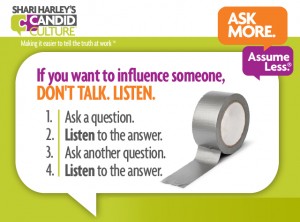 When selling a product, service, or idea, people often think that providing more information is better. The more data points, the more likely the other person is to be persuaded. This is not necessarily the case. Excluding data hounds, most people don’t like to be overloaded with information. But people do appreciate the opportunity to talk about what they want and need. So if you want to sell something, give people a chance to talk.
I’ll never forget one of my first sales calls, many years ago. I was selling Dale Carnegie Training. After calling a prospect for six months, he agreed to spend ten minutes with me. Feeling rushed, I laid out all of our training brochures and quickly told him about every program we offered. Then I asked if he wanted to buy anything. He didn’t.
If I had asked a few questions and listened to his answers, I could have provided information on just the training programs he needed, instead of giving him a list of likely irrelevant options.
Selling a product or service is no different from selling an idea. You are trying to persuade someone to your way of thinking. Resist the temptation to persuade solely by educating. Instead, ask questions, listen to the answers, and then tell the person what you heard her say. If you’ve taken a listening class, you learned the practice of paraphrasing what someone said. Paraphrasing is a very old technique, but still very effective.
People need to feel heard and understood. From my experience, asking relevant questions, demonstrating that you listened to the answers by paraphrasing what the person said, and providing pertinent and succinct information is what people need to make a decision.
Click here to download five free questions from our box of Candor Questions for Sales and Customer Service.

 You’ve heard countless times that you never get a second chance to make a first impression. So when something not-so-positive happens – a customer is upset, you missed a deadline or made an error – don’t let your boss find out about it from someone else. Manage your professional reputation and get there first to create the first impression of what happened.
Managers don’t like surprises. If your manager is going to get a call about something that isn’t positive, let her know before the call comes in. You will create her perception of the situation, and perceptions are hard to change. Don’t wait for the s*** to hit the fan. Get ahead of the problem by coming forward and giving your manager and other stakeholders a heads up.
 It could sound something like this, “I just had a tough conversation with John in IT. You may get a call. Here’s what happened… I didn’t want you to be surprised.”
Or, “I told Brian at Intellitec that we’re raising our prices in the second quarter. He wasn’t happy. You may get a call.”
Or let’s say you’re going to work on a strained relationship. Tell your manager before you take action. It could sound something like this, “I want to work on my relationship with Julie. Our relationship has been strained since we worked together on the software project last year. I’d like to approach her, tell her that I know our relationship is strained, and that I’d like a good working relationship with her. Then I’d like to ask if  she’s willing to have lunch with me, talk about what’s happened, and see if we can start again in a more positive way. What do you think of me doing that? Would you approach the conversation differently? I don’t know how it’s going to go, so I wanted you to know what I’m planning to do, just in case it backfires and you get a call.”
Manage your professional reputation assertively by taking responsibility for mistakes, working on damaged relationships, and telling your manager before someone else does!

No one likes to make mistakes. We want to do good work and have people think well of us.
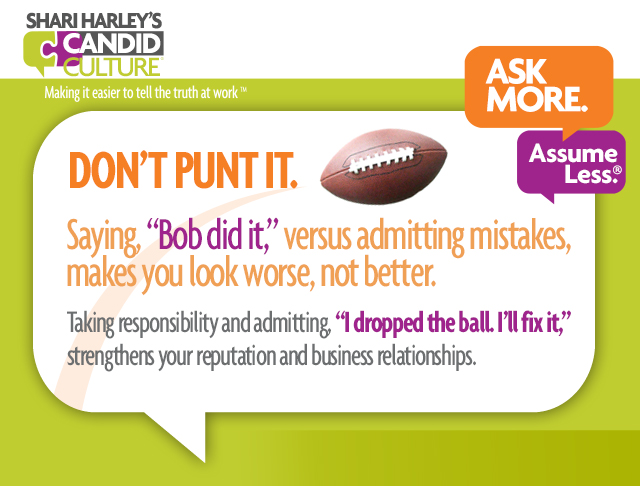
The key to maintaining your relationships and reputation, when you make a mistake, is to take responsibility and make things right as soon as possible. Saying something wasn’t your fault or becoming defensive will only damage your reputation and relationships. As counterintuitive as it sounds, you will gain respect and credibility by admitting fault and correcting problems.
I often get asked if people lose credibility by being humble – asking for feedback and admitting to making mistakes. It takes strength to ask for and be open to feedback and to admit when you drop the ball. So while it may seem counterintuitive, the more you ask for and respond to feedback, and admit when you make mistakes, the stronger you will appear.
I made a mistake at work. Now what?
When you make a mistake say something like:
“I dropped the ball on that. I apologize. I’ll fix it and let you know when it’s been handled.”
Or, “Thank you for the feedback. This clearly didn’t go as planned. I’ll make those changes and let you know when they’re done.”
Also, let people know the steps you’ll take to avoid similar challenges in the future.
You could say something like:
“Thanks for letting me know that our process is causing your department challenges. We certainly want the process to be smooth. My team will fix this month’s report, so your team doesn’t have to invest more time. We’ll update the process for next month and walk you through the changes before the report is due.”
Don’t provide a bunch of reasons for breakdowns. No one cares. Telling people why something occurred can sound like excuse management. People just want to know things will be made right.
Asking for feedback, taking responsibility, and telling people how you will correct errors may not be your natural or first reaction. The more you can train yourself to do these things, the easier you will be to work with and the better your reputation and business relationships will be.

Click here to download free questions to find out what your coworkers and internal and external customers are satisfied with about your performance and what they wish you would do differently.
 Most of us grapple with whether or not we should give feedback when someone else does or says something frustrating.
Here are a few criteria to help you decide whether or not you should give feedback or say nothing:
- Do you have a relationship with the person? Do you know each other well enough to share your opinion? Aka, have you earned the right?
- Has the other person requested your opinion? Unsolicited feedback often goes on deaf ears.
- If the other person has not requested your opinion, does he appear open to hearing feedback?
- Are you trying to make a difference for the other person or just make him look or feel badly?
- Do you want to strengthen the relationship?
Before you give feedback, do something I call, ‘check your motives at the door.’ If your motives are pure – you want to strengthen the person or the relationship, and you have a good enough relationship that you’ve earned the right to speak up — then do it.
People are more open to feedback when they trust our motives. If we have a good relationship with the person and he knows we’re speaking up to make a difference for him or for the relationship, you’ll be able to say way more than if your motives are questionable – aka you want to be right.

 Last week I was on plane and the woman in back of me kicked the back of my seat throughout the flight. It made me nutty. The guy next to her talked so loudly, I’m pretty sure the people six rows in front and behind him could hear the conversation. And no one said anything.
Many of us don’t return food in restaurants that isn’t good. We often say nothing when people drop the ball and make mistakes. We replace ineffective vendors and service providers rather than tell them where they’re falling short.
People usually claim they aren’t giving feedback because they don’t want to hurt the other person’s feelings, think the person is not likely to change, or because they’re not sure if their complaint is valid. I don’t buy most of these reasons.
I think the real reason we aren’t giving feedback is because we don’t want to deal with the other person’s reaction. We are concerned – often rightly so – that the person will kill us off. We will be given the cold shoulder, excluded from projects, or thrown under the bus.
You may be wondering why I, who wrote a book called How to Say Anything to Anyone and who teaches other people to give feedback, didn’t speak up on the plane last week. I too have been trained to pick my battles and that if I have nothing nice to say, say nothing at all. Each day I also grapple with when to speak up and when to let things go.
The concern over giving feedback will get better if the people in our lives – personal and professional relationships – agree it’s ok to tell the truth and agree that there will not be negative consequences for doing so. Open and direct conversations will be had. Disagreements will be discussed and resolved as best they can. And when the conversation is over, it’s over. People can’t hold the conversation over your head or hold a grudge.
It would be difficult to agree to open and honest communication with the people who sit behind you on planes, but you certainly can make that agreement in your office and with your family and friends. Agreeing to tell the truth without consequence can be one of your organization’s values and a practice you establish in your personal relationships.

You can hire people who understand they are expected to speak candidly and then let disagreements go. And you can manage people who don’t speak up, who hold grudges, and who punish people for giving feedback. You can tell friends and family that you want candid relationships in which challenges are dealt with quickly and then the disagreement is over.
Making the request for open and honest communication and assuring people there will be no negative consequence for doing so is the differentiator between being able to speak up when you’re frustrated or say nothing.
Last week I was upset, really upset. I worked hard to practice what I preach when giving feedback – wait to talk until I’m calm, ask questions, and no matter what happens, don’t send a text message. It was hard, really hard.
I was mad and wanted to say, “What the *&^#$@?” But I know that when people receive negative feedback they feel judged. And when people feel judged, they become defensive, making it very difficult to hear what the other person is saying and have a conversation.
When my emotions don’t get the best of me, I plan hard conversations by asking myself these questions:
- What do I want to have happen as a result of the conversation?
- How do I need to approach the conversation to get that result?
Knowing that if I want to have a good conversation, I need to reduce the other person’s defensiveness, I often start feedback conversations by asking the neutral question, “Help me understand; what happened the other day?”
Last week one of my employees tipped me off that the people who work for me are on to me. They’ve read my book. When I ask, “Help me understand; what happened the other day,” they know that feedback will follow.
You don’t want to approach your relationships and conversations in a formulaic and inauthentic way. Inauthenticity stinks and it can damage relationships more than freaking out will do. But it’s not a terrible thing to put someone on notice. If the people who work with me know that negative feedback follows the question “what happened,” they know the conversation is important. Yes, they’ve been tipped off and perhaps as a result they’re on the defensive, but I still think asking “what happened yesterday” is a heck of a lot better than raising your voice, accusing, and asking questions later.
Asking questions to discuss thwarted expectations is hard to practice. It takes great self-management, which I don’t always have. I mostly practice what I teach, and when I don’t, I clean up the mess I’ve made, apologize and recommit to doing so in the future. And you can do the same.
A Few Practices to Consider:
Holiday Promo – $12 a book for 7 or more books.
- Wait to give feedback until you won’t freak out, but don’t let situations fester and become bigger than they need to be. Have the conversation as soon after an event as possible.
- If something is important to you, ask for it. Trying to persuade yourself that it isn’t a big deal and might be your issue, probably won’t help. We want what we want. Be true to yourself.
- Consider starting hard conversations with “help me understand.”
And when you find that you’ve put the other person on the defensive and s/he feels judged, work to do better next time. But in the end, speaking up is always better than stuffing how you feel, even if you handle the conversations differently than you had planned.
Most of the feedback we give and receive puts people on the defensive. We don’t do this intentionally. It just happens. We say how we feel, usually when we’re upset, and the other person responds.
Most of the feedback we give and receive is judgy, like the examples below.
|
Judgy – Not Real Feedback
|
Just the Facts – Actual Feedback
|
| “You ignore me in meetings.” |
“When I raise my hand to participate in meetings, you don’t call on me.” |
| “You’re rude to me.” |
“When you pass me in the hallway, you don’t say hello.” |
| “You won’t work with me. You go around me.” |
“We were supposed to screen potential vendors together. You scheduled and held the appointments without me.” |
| “You’re not responsive.” |
“You usually reply to emails a week after they were sent.” |
| “It’s hard to get time on your calendar.” |
“It takes three weeks to schedule time to meet with you.” |
Becoming defensive when receiving feedback is a hard-wired response, like slamming on your brakes when the car in front of your does the same. The more people feel judged, the more defensive they become. If you want to be sure people become defensive when you give feedback, be vague. If you want people to be able to hear you and take action on your feedback, strip out the opinion (judgment) and give people just the facts.
Referring to the chart above, the sentences on the left are opinions. And opinions can be debated. The sentences on the right are facts. Facts are harder to debate. When giving feedback give just the facts, not your opinion. This will take practice.
The first thing out of our mouths will invariably be judgment/opinion. People who have participated in feedback training with me or who have read How to Say Anything to Anyone know I call the tendency to be vague Cap’n Crunch. Cap’n Crunch: “You’re doing a good job.” That’s sweet but useless.
When someone upsets you and you want to tell the person, prepare for the conversation by asking yourself these questions:
- What did the person do that frustrated me?
- What behaviors did s/he exhibit?
- What actions did s/he take?
- What was the impact on me?
Then practice giving feedback to someone outside of your workplace or group of friends (to reduce gossip and drama) and ask the person with whom you’re practicing what s/he heard. If your feedback is specific and clear, any lay person will interpret the feedback as you intended it.
Giving feedback, that others can hear, isn’t easy to do. It requires you to put your emotions aside, strip out judgments and opinions, and tell the other person the facts of what happened. The more you focus on the facts and less on how you feel about what happened, the better your conversations and relationships will go.
 My last few blog posts focused on giving feedback. The posts were designed to help managers get ready to write and deliver performance appraisals.
Giving feedback will always be hard. No one wants to hear that she isn’t doing a good job, thus no one wants to tell her. Part of the performance appraisal process is setting expectations for the next year. And asking for what you want, before problems happen, will always be easier than giving feedback.
If you’ve seen me speak or attended one of our training programs, you received a list of Candor Questions designed to eliminate the guessing at work. They may have been questions for leaders, managers, strengthening business relationships or managing careers. Regardless of which Candor Question Cards you received, the goal is the same. Ask more. Assume less.
The most frequent request I get is for feedback training. Managers tell me, “The communication in our company isn’t good. Can you help our managers and employees be more candid?” And I tell business leaders, “I teach people to be more comfortable giving feedback. But why start with something hard? Why not start by asking more questions and getting to know people better, which is much easier and will reduce the number of feedback conversations you need to have?”
When we know what people expect, we can give people what they need. We make fewer ‘mistakes’, requiring fewer feedback conversations. So start with what’s easy. Ask more questions.
Start with what I call Introductory Candor Questions:
- How do you like to receive information – email, voicemail or text message?
- Are you a detail-oriented or a big-picture person? How much information do you want to receive and in what format?
- What are your pet peeves at work? What would I do that would be frustrating, and I’d never know it?
Then move on to Candor Questions for Managers:
- What had you choose to work here, and what would make you question that decision?
- What kind of work do you love to do most? What kind of work do you like to do least?
- What do you wish I would start, stop, and continue doing?
You can download samples of our seven types of Candor Questions here.
People are not us and don’t do things the way we do. Don’t assume someone will create a report as you would, participate in a meeting as you would, or dress for an event as you would. Setting expectations before the event of what you want, gives them a chance to be successful.
Giving Feedback is Hard – Asking for What You Want is Easier. By Shari Harley.