Posted under Uncategorized on February 16, 2016 by Shari Harley. 0 Comments
Last week I was at an event where no one sat with the CEO. The whole organization was present, and the CEO’s table was empty. What a career advancement missed opportunity for the people who work for this company.
Perhaps no one likes the CEO, or employees are afraid of him, or employees are concerned they’ll get labeled as a suck up for sitting with him. None of these reasons are legit.
The CEO is just a regular person. S/he puts her pants on just like you do every day.
Most employees have limited exposure to their organization’s most senior leaders. Don’t miss an opportunity to build business relationships with your organization’s senior leaders.
Here are four career advancement strategies:
Career advancement strategy #1: Senior leaders have very limited access to most employees. Most will make quick decisions about employees with the limited access they have. If you’re at a meeting with a senior leader, speak up (provided you have something useful to say). If you don’t speak up, when appropriate, you might be (unfairly) labeled as having little to offer.
Career advancement strategy #2: If you’re at an event with senior leaders, talk and/or sit with them! It’s not necessarily a chance to wave the flag for your favorite cause or company initiative. It is a chance to get to know these folks and have them get to know you.
Career advancement strategy #3: Be less afraid. Tell the truth, tactfully. Be careful not to insult someone or something, and speak up more.
Most employees are afraid of being fired and are convinced that if they offer a counter point-of-view they’ll be at worst fired and at best marginalized and never given another cool project. I haven’t found that to be true.
It’s not so easy to get fired in this country. People who don’t do a lot of work or who do mediocre work are often not fired. And you’re worried about being fired for speaking up? Pick your battles, be wise about how you voice concerns and ideas, and worry less.
Career advancement strategy #4: Suggest solutions to problems. People who talk only about problems but don’t offer to do anything about those problems are seen as annoying complainers. Offer to be the person who spearheads the solution. Don’t worry about if it’s your job. Just don’t step on others’ toes in the process.
You make your career happen, no one else. You can talk with your coworkers and friends all day. Don’t miss opportunities to get to know the key decision makers in your organization. Fear less. Talk more.
Who have you fired lately? The person who cuts your hair or lawn? A doctor, accountant, or restaurant where you had a bad experience? Did you call any of those providers and tell them why you were replacing them? My hunch is no. There’s little incentive to do so. Why risk their defensiveness? It’s easier to just replace them. And the same is true for you.
There’s little incentive for the people you work with to tell you when you frustrate them. The perceived cost seems too high. The people you work (and live) with have experienced others’ defensive responses to negative feedback (which is no fun) and they don’t want to experience your reaction. As a result, when you disappoint or frustrate others, it’s easier to say nothing than tell you the truth.
The tendency for others to tell you things are fine when they’re not will prevent you from managing your career and relationships. People will go missing and/or you’ll be passed over for professional opportunities and never know why.
To make it more likely that people will tell you when you disappoint or frustrate them, make it easy to tell you the truth.
Here are a seven practices for receiving feedback:
Receiving Feedback Practice #1: When you begin new relationships, tell people you want their feedback.
Receiving Feedback Practice #2: Promise that no matter what people say, you’ll respond with “thank you.” This is very hard to do.
Receiving Feedback Practice #3: Tell people you already have relationships with that if you haven’t said it in the past, you really want their feedback and promise to respond graciously with “thank you.”
Receiving Feedback Practice #4: Ask people who matter to you for feedback regularly.
Receiving Feedback Practice #5: Resist the urge to get defensive.
Receiving Feedback Practice #6: Catch yourself when you start to become defensive and apologize. Say something like, “I’m getting defensive. I’m sorry. Tell me again. I’ll do a better job of listening.”
Receiving Feedback Practice #7: Take a break from conversations during which you find yourself responding defensively. Say something like, “I’m not responding as well as I’d like. How about we take a break? Give me a few minutes (hours or days) and I’ll come back to you to talk more. I really want to hear what you have to say.”
The aforementioned list provides recommendations for asking for and receiving feedback you want, not feedback you don’t. You are not a dumping ground. Don’t ask for feedback you don’t want. And when you do ask for feedback, qualify what type of feedback you’re looking for. Telling people “I want your feedback” doesn’t mean they’re welcome to say whatever they want.
The purpose of asking for feedback and making it safe to tell the truth is to give you more control over your career and relationships. It’s ok to be passed over for opportunities and relationships, but it’s unhelpful not to know why.
People are not us; they do things their way, not ours. This is so obvious. Yet violated expectations are consistently a source of lots of frustration and upset, both personally and professionally. “How could you not check your work before submitting information to a client?” “What do you mean you didn’t call that person back?” “You said what?!”
The most frequent request we get at Candid Culture is for feedback training. The call usually goes something like this, “The communication isn’t great at our company. Managers don’t give a lot of feedback. People don’t talk directly to each other when there are problems, they talk about each other. Can you help?”
Sure, we can help. But once we’re having this conversation people are already frustrated. Trust has been violated and relationships and reputations have been damaged. Instead of waiting for problems to occur, expect the unexpected. Set clear expectations before people don’t proofread reports, miss deadlines, and do other things you wouldn’t dream of doing.
How to avoid violated (often unstated) expectations? Ask more questions.
Here are five questions you should ask every person you work with. And if you do, your workplace will have fewer frustrations and violated expectations:
What’s most important that you’re working on right now? What are your goals this quarter?
What are we both working on that we can work on together? Or what should one of us stop working on?
How do you like to communicate? Phone, in-person, by appointment or drop by’s.
How do you like to receive information – email, voicemail, text message or instant messenger?
If I need information from you and I haven’t heard back from you, what should I do, and is it ok to do that?
What are your pet peeves at work? How will I annoy you and not even know it?
How do you like to be interrupted? (You’re going to be interrupted. You might as well have a preference.)
I know. That was seven questions, not five. I could keep going. But this is a good start.
Here’s the philosophy and practice: People aren’t you. Anticipate challenges, breakdowns, and violated expectations, and talk about them before they happen. Make requests. Ask questions.
It’s always easier to ask for what you want than to give feedback.
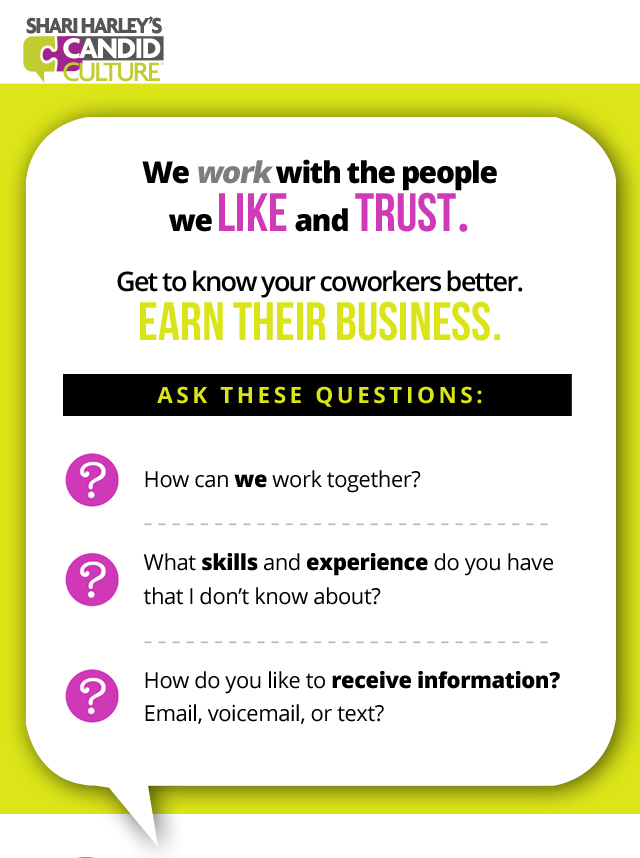
Regardless of who your company’s org chart says you should work with, people work with the people they want to work with and around those they don’t. One way to get people working with you (by choice) is to get to know your coworkers better, and I don’t mean personally.
Most people don’t know the people they work with very well. Coworkers often don’t know what fellow team members are tasked with doing for the company, their past work experience, education, or working style preferences. They often don’t know how fellow team members like to receive information, but get annoyed when they don’t return unopened emails.
If you’ve had any team building training with me, you know I advocate getting to know people better by asking more questions.
Organizations spend a lot of money on team building. Teams go bowling, out to happy hour, and have pot luck lunches, etc. All of those activities are fun and build comradery, and that’s important. But comradery and enjoying spending time together outside of work won’t help a team learn to communicate or overcome challenges.
If you’re really committed to team building and working well with people, ask more questions at the onset and throughout working relationships.
Here are five team building questions coworkers should be asking each other:
What are your pet peeves? How would I frustrate you and not even know it?
Are you a big picture or detail oriented person? Should I send you information in bullets or paragraphs?
What are you best at doing? What type of work could you be doing that you’re not doing now?
What are you working on now? What are your priorities for the next six months?
What’s something I could do differently that would make your job easier? (You will survive the answer. I promise)
Your manager may coordinate an activity that gives your team the ability to ask questions like this, and s/he might not. Either way, ask the questions and be forthcoming if others ask you for this information. It’s not just your manager’s job to get your team working well together.
Your daily experience at work – how much you get done, how easily you get that work done, and how much fun you have along the way – is largely dependent on the people you work with. Don’t leave your working relationships to chance. Be assertive. Get to know people better. Ask more questions and offer information about yourself.
It’s often not the work we do that makes work hard; sometimes it’s the people we work with that makes work harder than it has to be.
Below are seven practices that distinguish people we want to work with from those we wish would go work for a competitor.
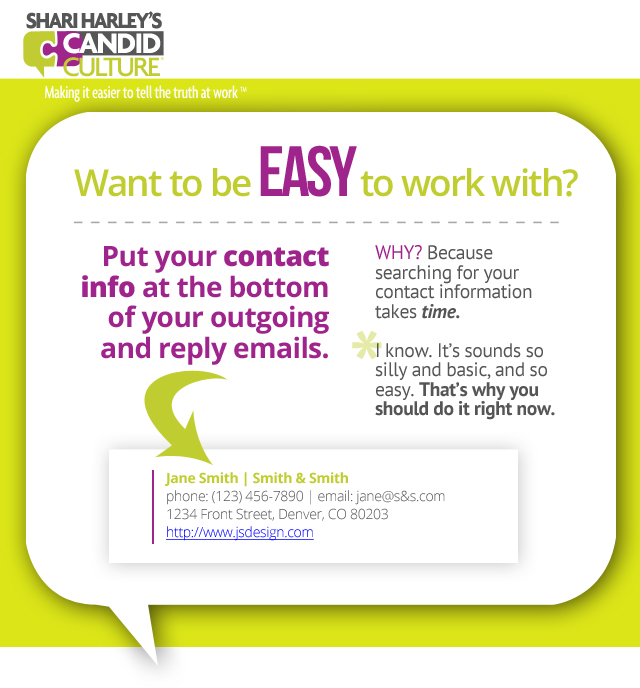
How to Be Easy to Work with Tip Number One: The simplest thing you can do right now to be easy to work with is to put all of your contact information in your email salutation in a format that can be easily copied and pasted or called from a cell phone, aka not an image.
How to Be Easy to Work with Tip Number Two; Update your out-of-office message when you return from a trip.
How to Be Easy to Work with Tip Number Three: Accept and deny meeting requests when you receive them, even if you’re not sure you’ll be able to attend. Knowing who can and can’t attend helps the meeting organizer plan. You can always update your status if something changes.
How to Be Easy to Work with Tip Number Four: Reply to emails within 48-hours, even if you don’t have the information for which you’re being asked. Tell people you got their message and when they can expect to receive the information they asked for.
How to Be Easy to Work with Tip Number Five: Don’t gossip. I could say a lot about this, but you don’t have time to read it. So I won’t. I’ll leave it at this, don’t talk about other people when they’re not present and you’ll be someone people will line up to work with.
How to Be Easy to Work with Tip Number Six: Do the things you say you will do, when you say you will do them. When you realize you can’t keep a commitment, tell people as soon as you know, so they can plan. Most of us don’t want to admit that we’re going to miss a deadline, so we wait until the 11th hour to tell the people who will be impacted. Waiting to renegotiate a deadline puts people in a worse position than telling people as soon as you know.
How to Be Easy to Work with Tip Number Seven: Avoid doing the things that you know annoy others. I’ll get us started with a list of the things that most commonly annoy people at work. Please add a comment to the blog with all the things I missed. It will be fun! Sanctioned venting. Who can turn that down?
Leaving dishes in the sink like mommy works there
Taking phone calls from a cubicle via speaker phone
Almost finishing a pot of coffee, but not making more
Listening to music and videos without headphones from your desk
Having lots of regular visitors or loud phone conversations from your cubicle
Surfing the internet versus working
Leaving your alerts on your cell phone, so everyone in your vicinity knows each time you get a text message
I could go on, but I’ll leave the rest to you. Add a comment with the simple things people can start or stop doing to be easy to work with!
As someone who writes and teaches about effective communication in the workplace, the people I work and socialize with are expecting me to model good communication skills all the time. The good news: I try really hard to always do the right thing and impact people positively. The bad news, I’m human and sometimes I don’t get it right.
One of the things I’m proud of about Candid Culture, is that we are real people, working with real people. We work very hard to practice effective communication in the workplace and to always model what we’re teaching. And yet, like all people, we get busy, rushed, and tired. We read emails we intend to reply to, but then forget to do so. We occasionally send emails, when we should pick up the phone.
In my world, a good communicator is not someone who always communicates perfectly.
A good communicator who practices effective communication in the workplace is someone who:
Cares about people and consistently works to communicate in the way others need.
Asks for and is open to feedback about how s/he impacts people.
Listens and watches other people’s verbal and non-verbal communication.
Alters his/her communication style to meet other people’s needs.
Takes responsibility when things don’t go well.
This week I’m advocating for picking up the phone, even when you want to do everything but, being patient, even when you’re frustrated, and asking questions, versus accusing. And I’m going to admit, I’m working to do these things too. Sometimes I get it right, and sometimes I don’t. I’m in the trenches with you, working to say and do the right things every day.
I promised you five tips to practice effective communication in the workplace and to be generous with people:
Only call people when you have adequate time, attention, and patience to have whatever conversation needs to be had.
If you need a few days to return a call, say so. Let the person know when you’ll call.
Prepare for conversations. Plan what you’re going to say and how you’re going to say it.
Don’t have hard conversations when you’re frustrated, tired, or busy. They won’t go well.
If the conversation goes poorly, call back later and clean it up.
Being a good communicator doesn’t mean being perfect. It means caring enough to notice when you miss the mark, cleaning up your messes, and working to do it better next time. I’ll be working on the above recommendations too this week. And when I screw it up, you can be assured that my mistakes will become examples in our training programs of what not to do, followed by a new technique that will hopefully work for all of us.
Avoiding having difficult conversations because you’re uncomfortable? Afraid you’ll hurt someone’s feelings? Worried you’ll damage your relationship? Why not just say so?
The people you work with want to work with other human beings. And part of being human is expressing how you feel.
It may seem that admitting that you’re nervous or uncomfortable weakens your position and diminishes your power. This couldn’t be further from the truth. Saying how you feel and being willing to be vulnerable are signs of strength. People with strong egos can admit when they are uncomfortable, people with weak egos feel too threatened to do so. Vulnerability and authenticity help other people see you as human, and make people feel closer to you. And people want to work with other human beings, not emotionless androids who never show their cards.
If you’re nervous, say you’re nervous. If you’re afraid you’ll negatively impact your relationship by speaking up, say so. If you’re not sure it’s your place to raise an issue, say that. You won’t lose anything by stating your concerns. You only stand to gain.
Starting difficult conversations could sound like this:
Having difficult conversationsoption one: “I’m not sure it’s my place to talk about our department’s Customer Service Survey results, but I care about our reputation and have a few thoughts. Is it ok if I talk about them with you?”
Having difficult conversations option two: “I’ve got some input for you that I’ve been hesitant to share, but I think the information could be helpful to you. I care about you and your career, and I want you to be successful. Is it ok if I share my thoughts?”
Having difficult conversations option three: “I’ve got a few things to talk with you about, but haven’t brought them up because I’m a bit concerned about how you’ll react. Is it ok if I share them with you? I’m saying these things because I care about our department, and I’m noticing a few things I think we can do differently, for better results.”
You probably noticed that in the examples above, I stated that I was concerned about speaking up, asked for permission to do so, and stated the reason I wanted to provide input. Your motive for having difficult conversations is very important. When people trust your motives you can say anything. When they don’t trust your motives, you can say little.
Don’t be afraid to say how you feel. If you’re afraid to speak up, saying so won’t reduce your credibility, it will likely increase it. State your concerns, explain why you’re speaking, and ask for permission to give feedback. Doing those three things will help any message be well received and is likely to make it easier for you to say what you want to say.
Most employees are afraid of getting fired. As a result, employees are often afraid of the most senior people in organizations, simply because of their titles. The better the title, the scarier people are. And if employees are scared of organizational leaders, they’re not going to be inclined to give those leaders negative feedback. The most senior people in an organization get the least information of anyone.
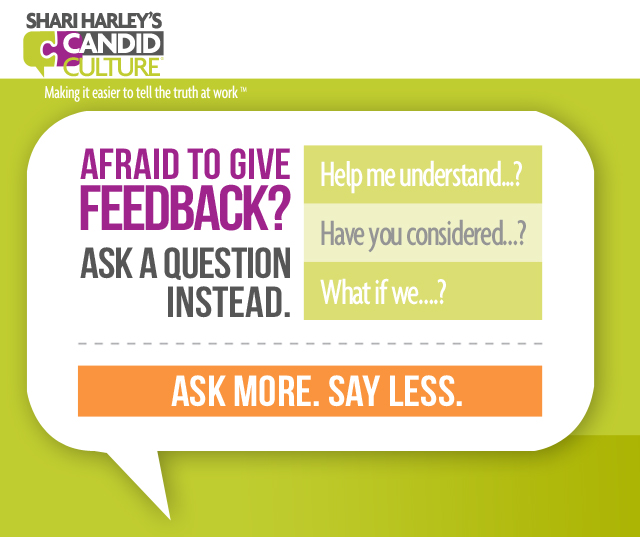
No one likes to be told that he is wrong. Negative feedback tells the person he did something wrong. But there is more than one way to give feedback. Asking questions can be equally as effective as giving direct feedback.
If you want to give a senior person negative feedback, but you’re afraid of the consequences, manage up by asking more and saying less..
Here are some ways to manage up by asking questions:
Rather than saying, “I disagree, I think you’re wrong, or this is a mistake,” consider managing up by asking questions like:
We’ve chosen to invest a lot in this software. I wasn’t here when the software was chosen. What’s the history of this initiative?
What were the criteria for selection?
How do you think it’s going?
What are you concerned about?
What are you satisfied with?
What else have we tried?
What are your thoughts about…?
What if we tried…?
Asking questions gets the person involved in a discussion, during which you can eventually express your point of view. When you ask questions, you say very little, and definitely don’t call the person’s decision-making into question.
Human beings are wired for survival. Receiving negative feedback kicks the need to defend oneself into gear, hence why people become defensive when they receive negative feedback. Negative feedback calls survival into question. If you don’t want people to become defensive, don’t require them to defend themselves. A discussion, during which you ask questions, is much less threatening than overtly disagreeing with someone’s point of view.
Asking questions takes more time and more patience than giving direct feedback. But it also takes less courage, and the quality of your relationship doesn’t have to be as good. You need a pretty good relationship to give direct feedback. If you don’t have that relationship, manage up by asking questions instead of being so direct.
If you do choose to ask questions, watch your tone. If you can safely add the words “you dummy” to a question, you aren’t really asking a question, you’re giving feedback, which is likely to evoke the defensive response you’re seeking to avoid.
It’s important to be able to express your point-of-view at work. Staying in a job or organization in which you can’t speak up, doesn’t feel great and doesn’t leverage the best of what you have to offer. But if you’re concerned about giving direct feedback, manage up by asking questions. Say less. Ask more.
Keeping with the theme of happiness and well-being during this holiday season, I’m hoping you’ll steer clear of the people and things that don’t make you feel good.
If you have a friend who talks only about herself, even after you’ve repeatedly given her this feedback, perhaps stop hanging out with her.
If you have a habit that you know isn’t in your best interest, perhaps break it.
The suggestions above are hard to do, but even harder is navigating relationships with people you can’t avoid. These are the people who when they show up on your caller ID, you often think, “not today,” and let the call go to voicemail.
Here are eight techniques for managing challenging relationships and conflict resolution in the workplace:
Conflict Resolution in the Workplace Technique #1: Know that there are difficult people in every organization. You can leave your job to get away from the person who makes you crazy. But I promise you, he will be waiting for you at the next organization in a different body.
Conflict Resolution in the Workplace Technique #2: Don’t ignore challenging relationships and expect things to get better without your intervention. They won’t. Deal with strained relationships head on.
Conflict Resolution in the Workplace Technique #3: Work on relationships in person or over the phone, not via email.
Conflict Resolution in the Workplace Technique #4: The time to fix a relationship is when there’s nothing wrong. Have hard conversations when things in your relationship are calm and you’re not upset, otherwise the conversations are likely to quickly escalate.
Conflict Resolution in the Workplace Technique #5: Give people the benefit of the doubt. People are doing the best they can. If people knew another way to do something, they would do it that way.
Conflict Resolution in the Workplace Technique #6: Let the other person save face. The more critical we are, the more the other person will feel compelled to defend himself. It’s almost impossible to have a useful conversation with someone who is in defense mode.
Conflict Resolution in the Workplace Technique #7: Ask for what you want. Rather than telling people everything they do wrong, make requests. That could sound something like, “Would you be willing to talk with me directly when my team is frustrating your team? I’ll do everything I can to make things right.” Or, “If you need something from me that you’re not getting, will you give me a call? I’d rather hear about challenges directly from you than from someone else.”
Conflict Resolution in the Workplace Technique #8: Be vulnerable. If you want a better relationship with someone, tell her. If a relationship is strained or broken, chances are, the other person knows. You could say something like, “I think we both know this relationship is strained. I want you to know that I’d really like a good working relationship with you. If you’d like to get together for lunch or coffee and talk about what has gone on, I’d really like that. Perhaps we can start in a new way.”
If you don’t want to be that direct, perhaps considering saying something like, “I just want you to know that I really want a good working relationship with you. What can I do to ensure you and your department get what you need from me? What’s one change I can make that would make the biggest difference for you?”
Damaged and strained relationships won’t get better without your intervention. Ask for what you want. Be positive, be yourself, and be honest. And if the person doesn’t play ball with you, you’ll know that you’ve done what you can.
Saying no is hard. We don’t want to disappoint or let people down. And yet, you can’t say yes to everything. You can say no and still sound like a responsible, easy-to-work-with, accommodating professional.
Here are four techniques for how to say no:
Thank the person for asking. “Thank you for asking me.”
Saying “thank you” acknowledges the other person and buys you time to think about his request.
2. Tell the person you need some time to think about his request. Ask, “Can I have a few days to think about it? I’ll get back to you by Friday.”
You don’t need to reply in the moment. I often regret things I agree to without thinking through the request thoroughly.
3. Consider what you really want and are willing to do. It’s much worse to over commit and under deliver than to simply say no or renegotiate requests.
4. Get back to the person in a timely way (when you said you would) and tell him what you’re willing to do.
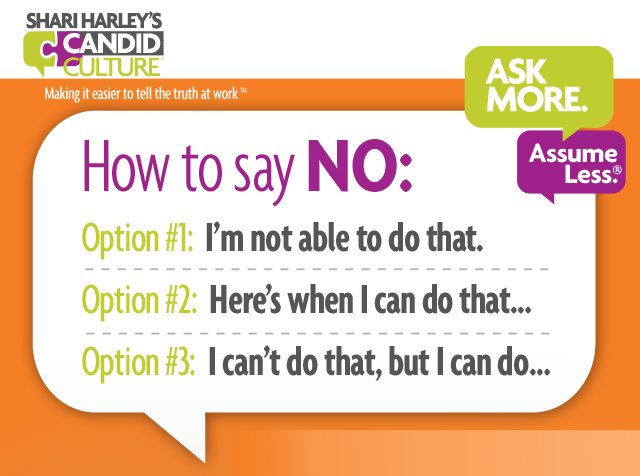
How to Say No Option One: Simply say no.
Example: “I really appreciate you asking me to write the proposal for the __________ RFP. I’m not able to do that. Can I recommend someone else who has the expertise and will do a great job?”
Don’t give a bunch of reasons for saying no. People aren’t interested in why we can or can’t do something. They just want to know if we will do it.
How to Say No Option Two: Agree and negotiate the time frame.
Example: “I’d be happy to do that. I can’t do it before the last week of the month. Would that work for you?” If the answer is no, negotiate further. Ask, “When do you really need it? I can certainly do pieces by then, but not the whole thing. Given that I can’t meet your timeline, who else can work on this in tandem or instead of me?”
How to Say No Option Three: Say no to the request but say what you can do.
Example: “I can’t do _______. But I can do ________. How would that work?”
A review of how to say no:
Acknowledge the request by getting back to the requestor within 24 hours.
Give yourself time to think about and respond to requests.
Negotiate requests to your and the requestor’s satisfaction.
Agree on what you can and are willing to do.
Keep your commitments.
Saying no is always hard. But it’s always better to say no than to ignore requests, or to say yes and do nothing.




 . And the same is true for you.
 communication isn’t great at our company. Managers don’t give a lot of feedback. People don’t talk directly to each other when there are problems, they talk about each other. Can you help?”

 It’s often not the work we do that makes work hard; sometimes it’s the people we work with that makes work harder than it has to be.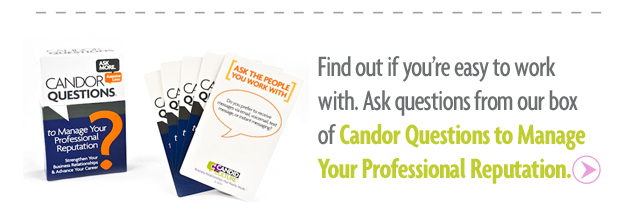
 As someone who writes and teaches about effective communication in the workplace, the people I work and socialize with are expecting me to model good communication skills all the time. The good news: I try really hard to always do the right thing and impact people positively. The bad news, I’m human and sometimes I don’t get it right.


 inclined to give those leaders negative feedback. The most senior people in an organization get the least information of anyone.
 people who when they show up on your caller ID, you often think, “not today,” and let the call go to voicemail.