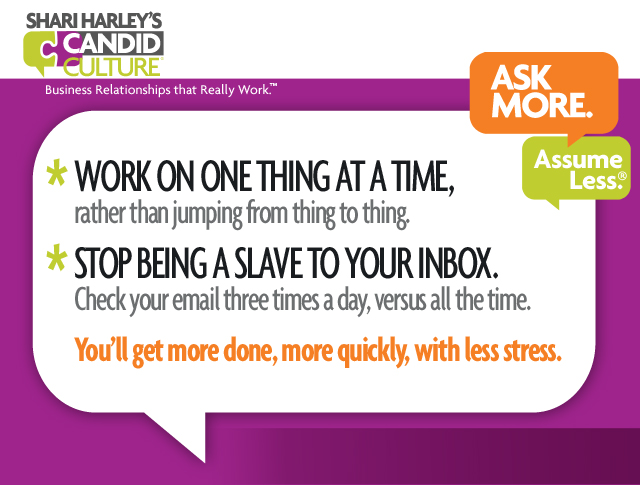
Reading emails as they come in is killing your productivity.
You’re at your desk working on a project. Aka, doing actual work. You think, “It’s been three minutes. I should check my email.” So you take your attention off your project and check your email. Then you read the next two emails that come in and check your voicemail. You then go back to the project you were working on and spend 10 to 20 minutes trying to get your head around what you were doing before reading all of those very important emails. Finally, you’re back in the groove. You do five minutes of work and think, “I should check my email.” Then it’s 5:30 pm and you realize, with frustration, that you finished nothing all day.
Sound familiar?
Living in our email inbox is why many of us start work at 5:00 pm or come into the office at 7:00 am to get “something done while it’s quiet.” It’s why we sleep and go on vacation with our phones, and are never really off.
I am most productive on airplanes without WIFI. Without WIFI I’m not tempted to check my email every three minutes or check Facebook to read about what people I barely know and don’t really care about are doing.
Without WIFI all there is to do is what I need to do. There are no other meaningful distractions, except for the B-grade movie I didn’t really want to see anyway. I am focused. And as a result, I get a lot done. I’m also less stressed. Because I’m focused, doing one thing a time, I’m not worried about everything I still need to do.
If you want to get more done and be less stressed, do one thing at a time, for a defined period of time. Decide how long you’re going to work on something, and work on that item for that period of time, with no distractions or interruptions. You may only work on something for ten or twenty minutes, but do only what you said you would do for that time period. Then you can check your email.
Productivity experts suggest you only check your email three times a day, for example, once in the morning, right before or after lunch, and at the end of the day. I find this hard to do. Like you, I feel pressured to check my inbox. Or I use my email to avoid the work I really need to do. But I know that constantly being in my email inbox has me distracted and not doing the work I really need to do. And as a result, I’m stressed and spend my evenings and weekends working on projects that require focused time.
Do one thing at a time, for a defined period of time. Just try it. If you’re going to read your email, give yourself 20 minutes, and do nothing but read, reply, and delete email. At the end of 20 minutes, do whatever you said you would do next, for as long as you decide, and nothing else.
See if you get more done, in less time, with less stress. You might just leave work earlier and have time to do something besides work.
I had a colleague at my last job who was a peer and a friend. We were at a similar level and would periodically sit in one of our offices, with the door closed, talking about the bad decisions our company’s senior leaders made. One day I realized that these conversations were exhausting to me. They were negative and didn’t make me feel better. In fact, they made me feel worse.
Some people distinguish between gossip and venting, asserting that venting is cathartic and makes people feel better. It doesn’t.
I’ll use an analogy I read in one of Deepak Chopra’s books. When you put a plant in the closet and don’t give it light or water, it withers and dies. When you put a plant in the sunlight and water it, it grows. And the same is true for people. Whatever you give attention will proliferate. Whatever you deprive attention will go away.
Your life is made up of the people you spend time with and what you talk about. What are you talking about?
In addition to draining you of energy and ensuring you focus on the things that frustrate you, gossip in the workplace kills the organization’s culture. If employees can’t trust that their peers won’t talk about them when they’re not there, there is no trust in the organization. And you can’t have real relationships without trust.
Gossip isn’t going anywhere. It’s a human phenomenon and is here to stay. But you can reduce gossip.
A few ways to reduce the gossip in the workplace:
Address the gossip head on.
“I’ve been hearing a lot of gossip, which is not good for our culture.”
Hold regular town hall meetings, and give employees information about initiatives, organizational changes, profitability, etc. Employees want to know how the company is really doing and what they can do to contribute.
Create a no gossip in the workplace policy.
“We want people talking directly to each other, rather than about each other. As a result, we’re putting a no gossip policy in place.”
Draw attention to gossip.
“Every time you hear gossip, wave two fingers in the air.” This will draw attention to the gossip in the workplace without calling anyone out.
Also, ask your peers and friends not to gossip with you. End conversations that contain gossip. This will be hard to do, but if everyone does it, it will become much easier.
Have an agreed-upon consequence for gossip.
“Every time we hear gossip in the workplace, the gossiper owes a dollar. Every quarter the gossipers will buy the office lunch from the gossip jar.”
The keys to reducing gossip in your office are to draw attention to the gossip, have a consequence for gossiping, and over communicate so your employees don’t have to make stuff up. Employees want to know what’s happening in the organization. In the absence of knowledge, people make stuff up, and it’s never good.
Venting and gossip are the same. Unless you’re planning a conversation with a coworker or friend to address a challenge or problem, you’re gossiping. And talking about what frustrates you will only make you more frustrated.
My advice: Do something about the things you can impact and let the other stuff go. Talk about the things that matter to you. Resist the temptation to speak negatively about the people around you. And know that anyone who will gossip about someone to you, will also gossip about you.
Posted under Career Management on April 14, 2013 by Shari Harley. 0 Comments
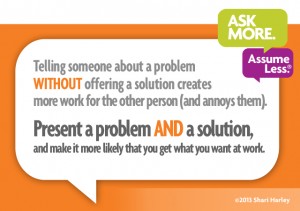
Despite what you may think, your manager has enough to do. So when you drop a problem at her door, she finds it annoying. Rather than just alerting your manager and the leaders in your organization to the things that need to be fixed, go one step further, and be a change agent by offering a solution yourself.
It’s fine to raise challenges. It’s better to raise challenges you’re willing to do something about. If you think two departments don’t talk to each other, bring them together. If you think a process is inefficient, propose a different way to get the work done. If you’re dissatisfied with software you’re using, offer to source three potential vendors and set up a demo. You’re doing the legwork and asking for a small investment of time.
When we ask for something at work, it often requires time, money, or both. Thus when an employee asks for something, it’s easier for a manager to say no than it is to say yes. “No” requires no work and no financial outlay. A “yes” may require both.
You make it easy to say yes to your requests when you’re acting as a change agent:
Propose a solution to a problem.
Offer to do the work to solve the problem.
Ask for small things that are easy to approve.
If you’re overwhelmed and want to hire an additional person, but your boss isn’t convinced you need the headcount, ask for a temp for a finite number of hours. It’s much easier for a manager to say yes to a small and known investment amount than to the long-term commitment of hiring someone new. The point is to ask for something that is easy for your manager to approve.
The word “pilot” is your friend. If you want to make a major change, pilot a scaled down version of your proposed solution in one or two locations, rather than in your organization’s 10 locations. Again, asking for something small makes it more likely that you’ll be told yes.
The bottom line is to be part of the solution – as trite and overused as that phrase is. Don’t be the person who says, “That’s broken” without also saying, “and here’s how we can fix it. Can I give it a try?”
Posted under Career Management on April 7, 2013 by Shari Harley. 5 Comments
Last week some unknown person sent me emails predicting my future. According to the anonymous clairvoyant, in ten years my life will be going well. I’ll have a son who is bright but doesn’t apply himself (shocking), and I’ll be offered a job in Oshkosh that I shouldn’t take. After the third predictive email, the sender wanted to know if I had questions about my future. I didn’t.
The whole thing was wildly creepy.
No one should take advice from someone with this much discretionary time. The emailer needs a volunteer job.
Why would I want someone else to tell me my future? That’s something I enjoy creating.
I’ve got a friend who feels a black cloud follows her. She feels bad things repeatedly happen to her and there’s nothing she does to create these situations, which is, of course, complete garbage.
It may be easier to blame someone or something for the bad things that happen to you, but if someone else is responsible, you have no control. And if you have no control over what happens to you, there is nothing you can do to create the life you really want.
I see myself as 100% responsible for everything that happens to me. As antithetical as it sounds, life is easier when I’m accountable. If I miss a plane because of traffic, I should have left for the airport earlier. If I get overcharged in a restaurant, I should have checked the bill more carefully. If I do a bunch of work for a client and later find out that the work I did isn’t what the client really wanted, I should have asked more questions upfront and asked for feedback earlier.
When I’m responsible for what happens to me, I have some control. When someone else is responsible, I have no control.
I’ll admit to going to a psychic…once. In 2001 I took a transfer from Denver to New York. Living in New York was fun and exciting, and great for my career, but I didn’t enjoy living in such an urban city. I agonized over what to do for two years – go back to Denver, stay in New York, or move someplace else?
Desperately unhappy, but not being able to make a decision, I went to see a psychic. Clearly I had given up. I was going to let someone I’d never met, who didn’t know anything about me, decide my future. Unless you’re at the Jersey Shore and decide to have your palm read for fun, seeing a psychic is abdicating responsibility for your life.
Instead of seeking answers about what might happen, pursue the things you want. If you want a different job in your organization, tell someone who can do something about it. If you got passed over for a job, ask the hiring manager for feedback of what would have made you a better candidate. If the hiring manager doesn’t give you any information, ask your current boss to get the information for you. If one of your co-workers excludes you from projects, ask him why. If someone you work with seems to dislike you, ask for feedback about what you did to damage the relationship. Regardless of how challenging the situation and how disappointing the results, there is ALWAYS something you did to either contribute to the situation or something you can do to change the situation.
I don’t mean to tell you what to do. Nor do I mean to minimize how hard some life circumstances are. But I do want you to see yourself as in charge of what happens to you.
Create the life you want by:
Asking, “What do I really want, and what’s one thing I can do right now to get closer to that goal?” Then take one step. Then take one more, and so on.
If negative things are happening, ask, “What could I have done differently to have a different outcome?” Or, ask, “If I could do this over again, what would I do differently.” Then next time, do it differently.
Regardless of how hard or bad something is, there is ALWAYS something you can do to make the situation better. Take your life, your career and your relationships into your own hands, where they belong.
Email us if you want this career management phrase on a poster, note card, notebook, or magnet.
Vague is useless. Being vague is actually worse than useless. Being vague instills doubt in the people around you and reduces your credibility.
When a customer service agent answers my questions with words like, “That sounds right, I think so, or that should work,” I hang up and call back, hoping to get someone who can give me an affirmative answer. People do this to you too, they just don’t tell you about it.
Watch your language. If the answer is yes, say “Yes.” If the answer is no, say “No.” “I think so,” says neither yes nor no. Saying, “I think so” tells people you don’t really know.
A few phrases to avoid and what to say instead:
Avoid: “That should be done by Friday.”
Instead, be specific and give a final date. “That will be complete by Friday. If I can’t get it done by Friday, I’ll call you to let you know by 5:00 pm on Thursday.”
Avoid: “Sounds right.”
Instead, be specific and say, “That’s correct.”
Avoid: “We should be able to do that.”
Instead, be specific and say, “We can do that.”
Avoid: “I guess.”
Instead, be specific and say, “Yes” or “No.”
When I teach feedback training, the biggest thing training participants struggle with is specificity. “You’re difficult to work with.” “Your clothing is inappropriate.” “I just find you to be negative.” “You did a good job on that.” “It’s a pleasure to have you on the team.” All of this is vague and thus unhelpful to the feedback recipient. And the same is true when answering questions and making promises.
Tell people exactly what to expect. Be specific. Even if they don’t like your answer, they’ll be happy to have a clear answer.
I’m frequently asked the question, “Is there such a thing as too much candor?” Clients ask this question when an employee or coworker is telling anyone who will listen exactly what she thinks of just about everything. Incidents like these make managers and leaders hesitant to ask employees for feedback, not knowing how to turn off the well.
Yes, there can be too much candor. The truth is one ingredient in the recipe; it’s not the whole meal.
A few guidelines of when to give feedback:
1. You have a relationship with the feedback recipient, and he will be able to hear you without becoming overly defensive.
2. You’ve been asked for your opinion.
3. You feel very strongly about an impending decision that has not yet been made.
When not to give feedback:
1. The feedback recipient can’t change what you’re concerned about.
If you’re concerned about a policy that isn’t changing, expressing an opinion is just complaining, which will negatively impact your reputation.
The person you have feedback for can’t change that aspect of herself. For example, you comment that someone has a high, squeaky voice. That’s just an insult. And an insult isn’t feedback, no matter how hard you try to persuade yourself otherwise.
2. You don’t have a relationship with the feedback recipient and thus your message is likely to go on deaf ears.
3. You have not been asked for your opinion.
4. A decision has been made and at that point you’d just be talking to talk.
When managers ask me, “Is there such a thing as too much candor,” I suspect what they’re really asking me is, “How do I get my employees to be more discerning with the feedback they share, to whom, and how.”
Here are a few ways to guide employees who over communicate:
1. When you ask for feedback, tell people specifically on what you want feedback, in what format, and during what time horizon.
For example, tell employees, “We are looking for feedback on the new time-off policy. We’ll be asking for input at Friday’s town hall meeting. Please come to the meeting and share your thoughts. This will be the only opportunity to provide input.”
2. Tell employees who have a tendency to overwhelm with feedback or violate some of the guidelines listed above, “Your input is valuable. The more feedback you give, the harder it is to discern what’s important. Pick your battles. Give feedback on the things you feel really strongly about, and perhaps save other feedback for future opportunities.”
3. Tell employees who have a tendency to insult people with critical feedback, “How you deliver feedback influences whether or not people can hear your feedback and take action. No one likes to be told that she is wrong. Be careful not to attack people. Focus on the problem, not the person. Ask questions and make requests versus telling someone why what she is doing is wrong. Then, of course, tell the person to read chapters nine through twelve of my bookHow to Say Anything to Anyone.
Just because you can say something, doesn’t mean you should. None of us wants to damage relationships by insulting people or be labeled as a complainer. Pick your battles. Give feedback when you feel really strongly, a final decision has not been made, and you have a relationship with the recipient. And if you find yourself talking to talk, stop.
Posted under Uncategorized on March 1, 2013 by Shari Harley. 0 Comments
You can say more than you think you can at work. You just need to lay some groundwork, and most people don’t. So difficult conversations remain…difficult. Change your business communication and improve your business relationships.
Listen to my conversation with colleague Heather Stagl on her radio show, A Change Agent’s Dilemma and get the words to use to say anything to anyone.
When you feel you’ve been wronged, it’s natural to lay into the offending person, give negative feedback, and tell him exactly what you think. The problem with doing this is that as soon as a person feels accused, he becomes defensive. And when people are put on the defensive and feel threatened, they stop listening. And you’ve potentially damaged your workplace relationship.
When someone does somethingfor the first time that violates your expectations, use the lowest level of intervention necessary. Allow the person to save face, and ask for what you want, without giving an abundance of negative feedback and pointing out all the things he’s done wrong.
Likewise, when you cut your finger while cooking, you put a Band-Aid on your finger. You don’t cut off the finger. This is true with business communication too.
When you’re facilitating a meeting, you can ask the two people who are side talking to stop, or you can go third grade on them and ask, “Is there something you want to share with the rest of us?” Both methods will stop the behavior. But one embarrasses the side talkers a lot, the other only a little.
Likewise, when one of your coworkers takes credit for your work, you can give feedback and say, “I noticed you told Mike that you worked on that project, when we both know that you didn’t. Why did you do that?” Or you can skip the accusation and ask a question instead, saying, “I noticed you told Mike you worked on that project. Can I ask why you did that?” From there you can have a discussion, give feedback if you need to, and negotiate.
When your boss doesn’t make time to meet with you, rather than saying, “You don’t make time for me. That makes it hard for me to do my job and makes me feel unimportant.” Instead consider saying, “I know how busy you are. Your input is really important in helping me move forward with projects. How can we find 30 minutes a week to connect so I can get your input and stay on track?”
In each of the situations above, you’d be justified in calling the person out and giving negative feedback. And it might feel good in the moment. But being right doesn’t get you closer to what you want, and it can damage your workplace relationships.
Practice good business communication –say as little as you have to, to get what you want. If this method doesn’t work, then escalate, communicate more directly, and give feedback. The point is to get what you want, not to make the other person look bad. The better the ‘offender’ feels after the conversation, the more likely you are to get what you want in the future.
Every time I get on a plane I’m grateful that skype isn’t allowed and that cell phones haven’t made it to the friendly skies. I can’t imagine sitting in a relatively small, contained space for that long, while numerous people chat away.
There was no such luck in jury duty last week when people passed the time watching TV on their phones and iPads, WITHOUT headphones. Does anyone think this is acceptable business etiquette? Please post a comment here. I’d really like to know.
Watching TV on an iPad and phone are still somewhat of a novelty. My fear is that soon, watching TV in public places without headphones will be like talking on the phone in a coffee shop – the norm. I am apparently, one of the few people who finds talking on a cell phone in restaurants and coffee shops rude. And one of my employees let me know that this makes me sound old and cranky. I can accept that I’m both old and cranky.
If you find yourself in a public place with someone watching TV or listening to music without headphones, here’s what you can say: “Would you mind using headphones?” It’s as simple as that.
If s/he tells you s/he doesn’t have any, then you can say, “Would you mind not listening to music or watching TV without headphones? It’s distracting.” The worst the person can say is no. And if you don’t want to make the request directly, then ask someone working in the location you’re spending time.
If you say nothing, and it bothers you, you’re training people to that it’s OK to fill public spaces with TV and music that you don’t want to be watching and listening to. And both will quickly become the norm.
When confronted with a challenging conversation or situation, everyone has a reaction of some type. Some people laugh nervously. Some people get quiet and retreat. Other people turn red. Others yell. And some people cry. All of these reactions are normal and natural.
If people didn’t have emotions we’d be androids. And while there are probably days you wish your coworkers acted more like Siri, if the people you work with don’t think more critically than your iPhone, they aren’t of much use to you.
The problem with expressing emotions at work is that it makes people uncomfortable. And often when people are uncomfortable, they don’t know what to do. They just want the situation to go away. And unfortunately in this situation, that means they want you to go away, which is not how you want your boss, coworkers, or customers to think about you.
Avoid crying at work. It makes the person across from you feel uncomfortable and helpless. Men and women alike don’t know what to do when someone they work with cries. They just want the person to stop crying or leave.
I’ve heard some people describe criers as manipulative, as if they cry to orchestrate a certain outcome. I don’t believe that. I think people who cry at work do so involuntarily. It’s their natural reaction to stress. That said, crying at work is not good for professional reputations or relationships.
Here’s what you should do if you have a crier in your office:
Hand the person a tissue.
Know that you are responsible for how you deliver information. You are not responsible for the person’s reaction.
If the person can continue the conversation, keep talking.
If s/he can’t continue the conversation, end it and talk another day. Say something like, “I can see this is very difficult, and I’m very sorry about that. Why don’t we finish the conversation another day.”
If the person doesn’t leave your office, stand up and open your door. That will prompt the other person to stand up.
Here’s what you should do if you’re a crier:
Don’t have difficult conversations when you’re tired, stressed, or are having a bad day.
Practice potentially difficult conversations so you feel more prepared and in control.
Know that nothing is personal.
If you sense you are going to cry, get out of the meeting before you do.
Take a walk outside to burn off stress.
If you cry in a meeting, apologize and try to stop.
If you can’t, excuse yourself from the meeting and circle back to the person when you’re more composed.
None of these suggestions are intended to sound cold or unempathetic. Instead, they’re intended to help criers manage their professional reputation and career. You don’t want someone to be afraid to give you bad news because they fear your reaction. Anything that gets in the way of telling you the truth makes it likely that you won’t get real feedback. And without consistent, candid feedback, you’re working in the dark.
Not knowing how you come across and how your work is perceived are the things that lead to being fired, overlooked for projects, and laid off. Make it easy to tell you the truth by managing your emotions during difficult conversations. As hard and at times seemingly unrealistic as it seems, leave your feelings in your car.


 Sound familiar?
 I had a colleague at my last job who was a peer and a friend. We were at a similar level and would periodically sit in one of our offices, with the door closed, talking about the bad decisions our company’s senior leaders made. One day I realized that these conversations were exhausting to me. They were negative and didn’t make me feel better. In fact, they made me feel worse.
 Despite what you may think, your manager has enough to do. So when you drop a problem at her door, she finds it annoying. Rather than just alerting your manager and the leaders in your organization to the things that need to be fixed, go one step further, and be a change agent by offering a solution yourself.