Posts Tagged ‘business communication’
I’ve always thought it was weird to sit next to someone on a plane and not say hello. I don’t mean a long chat, “Where are you going? Do you live there? What do you do for work,” merely a hello. Or to pass someone on the street or at the gym who pretends not to see me. It’s downright weird. And it’s even worse at work.
Passing someone in the hallway at work who you may or may not know and not saying hello can be off putting to many people. Admittedly, some people don’t care. But more do.
Many of the people you work with are affronted if you pass them in the hallway and don’t smile and/or say hello. They’ll never tell you they’re put off by the lack of social graces, they’ll just make decisions and assume they’re right. They’ll tell themselves, “We sit in multiple meetings together, and that guy doesn’t even know who I am.” Or, “I’ve walked past this woman every day for five years and it’s like she’s never seen me before.” Or, “Bob never says hello when he sees me in the hallway. I wonder why he doesn’t like me?”
Chances are you’re not thinking any of these things about the people you work with. You’re busy and focused on other things, and your mind is not on making small talk when you pass people in the hallway. But know that not saying hello can have an impact on the people around you and your corporate culture.
 Start this simple practice: Smile and say hello to everyone you pass at work. Saying hello in the hallway won’t cost you anything or take any more time. And you never know the doors it might open. Maybe the person in accounts payable who’s been kicking back your expense reports will cut you a reimbursement check even when you fill out the wrong form. Or maybe IT will come to your desk first versus eighth when your laptop decides it’s taking a vacation day.
Last week I had lunch with a client. When I returned from the lunch I saw a friend who told me I had something stuck in my teeth. I was embarrassed and wondered why my client hadn’t told me.
It’s quite possible he hadn’t noticed. In fact, knowing this guy and how much work I’ve done with his firm on being candid, it’s probable he hadn’t noticed. But we all know people who notice and say nothing. We could walk around all day with toilet paper on our shoe, lipstick on our teeth, or our fly down, and the people around us won’t tell us.
If you read my blog weekly, you already know that people have been trained not to tell you the truth.
But I think there is more preventing people from telling us the truth. Complete this sentence: “If you have nothing nice to say, _________________________________. Who told you that? Your mother!!!
I do think there’s something to this. We’re raised to believe that it isn’t nice to say something to another person that isn’t positive. And in the past, when we did speak up, it’s likely the other person got defensive. So it’s no wonder that we don’t readily give people bad news.
Here are five tips for getting feedback from the people around you:
- Establish a core team of people who will always tell you the truth. These can be friends, coworkers, clients, vendors, you boss, etc.
- Give people permission to be honest with you. “Let’s make a deal. I always want you to tell me the truth. If I have something stuck in my teeth, or I’m inappropriately dressed for a meeting, or I’m doing something that damages my reputation, I want you to tell me.”
- Make it easy to tell you the truth. “I promise no matter what you tell me and how hard it is to hear, I will say thank you. I won’t get defensive. And if I do, I’ll apologize and try to do better next time.”
- Offer to do the same for them. “And if you want me to do the same thing for you, I’m happy to do it.”
- Periodically check in with people and ask for feedback. “A few months ago I asked you to tell me anything I said, did, or wore that got in the way of my success. Is there anything you’ve seen that you want to tell me?”
Every time you ask for feedback and take it graciously, you train the person to give you more feedback. On the contrary, every time you get defensive, you make it hard for people to give you feedback, making it likely they won’t do it again.
If you don’t want to walk around looking silly all day, make it safe to tell you the truth.
 Sue: “I shouldn’t have to tell him what I want. He should just know.”
Bob: “She expects me to read her mind. I’m not a mind reader.”
This age-old romantic relationship complaint is as common at work as it is at home.
Several years ago, before I started Candid Culture, I wrote down my annual performance goals, and asked my manager to approve the goals, which he did. But we didn’t weigh the goals. Neither I nor my manager articulated what percent of my bonus should be dedicated to each goal. The company practiced pay-for-performance and paid bonuses based on goal achievement.
At the end of the year, my boss reviewed my performance goals as part of my performance appraisal. There was one very small project that I didn’t finish. And when I say small, I mean, really, really small. So small, that detail-oriented me shouldn’t have included the project on my list of performance goals. My boss dinged me 15% of my annual bonus for not completing that one very small project. Apparently he thought the project was important. And I lost a chunk of change.
I was really upset. But it was my fault. I didn’t work with my boss to weight my projects or performance goals. So when it came time to determine bonuses, the decision was subjective, which is not what you the employee wants.
When evaluating performance, Managers don’t really want subjectivity either. When there are no clear criteria for awarding bonuses, pay increases, or company stock, managers can have a hard time making decisions, and employees often feel treated unfairly. Written guidelines for how compensation is allocated reduce the feeling that compensation decisions are unfair and subjective.
Your manager may or may not verbalize his expectations for the year, but that doesn’t mean he doesn’t have expectations. A professional athlete would never get on the field without knowing the rules of the game, and neither should you. Don’t go to work without knowing what, specifically, is expected of you.
Ask your manager these questions each quarter. Don’t guess!
- What projects are most important this quarter?
- How is my work being evaluated? What are the criteria for a good job?
- How often would you like to review work in progress so you can give feedback, and I can make adjustments as projects progress?
The bottom line is:
- Don’t wait for someone to tell you what to do at work.
- Like speeding limits, not knowing the rules doesn’t mean you’re not subject to them.
- Write down your performance goals and get them approved in writing by your manager, even if your manager is difficult to schedule with. While it’s not ideal, you can write your performance goals down and email them for edits and approval, without discussing live.
- Review performance goals quarterly, at a minimum. Monthly would be better. Bring your goals to your one-on-one meetings with your manager and discuss progress regularly. Don’t make your manager ask you for updates.
- If you’re not having one-on-one meetings with your manager, start. Employees are accountable for asking their manager for feedback.
- Make changes, in writing, to goals that change or become irrelevant.
- If your compensation or annual performance rating is tied to goal achievement, write down specifically how each goal contributes to your compensation or annual rating. Giving each goal a numerical value (a percentage) is ideal.
These guidelines may sound like a lot of work or overly formal. In my experience writing agreed-upon performance goals give employees a sense of control. When I know what I need to do, and I know how I’m being evaluated, I feel like I am in charge of where I put my time. If I elect not to finish a project, I know how I will be affected. And that makes me feel like I’m running the show.

You need something from Suzanne. Suzanne tends to ignore your emails. So in frustration, when sending Suzanne requests, you begin Cc’ing your boss and Suzanne’s boss. This has happened to most of us.
People Cc people who don’t really need to receive communications for a few reasons:
1) Sometimes people really aren’t sure who needs to know the information. So just to be safe, they include others. This can be quite innocent.
2) Sometimes people want others to know what they’re up to (a.k.a. they’re seeking recognition). This is not necessarily bad. It’s important to share what you’re doing for the organization, and cc’ing ancillary people on emails can be a very smart thing to do.
3) Lastly, sometimes people are afraid they won’t get what they need from the email recipient, so they Cc lots of people. This is typically not so innocent.
What should you do when someone Cc’s the world when emailing you, and you fear that it makes you look bad?

I suggest speaking directly with people who Cc others on emails. The conversation could sound something like this, “I noticed that when you email me you have a tendency to Cc other department heads. For example, last week when you asked me for the year-end numbers, you Cc’d my boss, Lisa in Marketing, and Bob in Sales. I was wondering why you’re doing that?”
Then stop talking and listen to what the person says.
Depending on what s/he says, you can respond with something like, “I will always strive to provide you with what you need. If you don’t get what you need from me in a timely way, by all means escalate your request, and go to the people above me. But I’d really appreciate if you’d come to me first and give me a chance to fulfill your request. Would you be willing to do that?”
If the person says something like, “I just think Lisa and Bob need to have this information. I have no other agenda,” you can respond with something like, “I don’t think they need this information, but why don’t we ask them. Would you be comfortable with that? I’ll send them both a message and Cc you, letting them know we talked about this email chain, and ask if they want to continue to receive the messages. How does that sound?”
You never know why someone is doing something, even if you think you know. Ask!

I encourage you to say something versus nothing. If you say nothing you’ll likely make decisions about the person and about your working relationship that may or may not be accurate. If you say nothing, the behavior is bound to continue.
People change their behavior for two reasons, positive and negative consequences. No consequences, no behavior change. No one likes to be ‘called on’ their behavior. Often a conversation like the one above will make the person uncomfortable enough to stop doing what they’re doing.
Reply All Etiquette:
More innocent than Cc’ing the world, but equally annoying, is the reply-to-all email. Someone in your office sends around a joke. Seventy-five people feel compelled to reply to all with their feelings about the joke. When I see things like this, I count how much money in lost wages companies are spending, that is, after I’ve put a pen in my eye.
To prevent reply to all emails, the person who initiates the first email can put in LARGE FONT, “Please reply only to me!”
You can also bcc people on the initial email so the reply’s don’t go to everyone.
It also takes only one person who asks people to stop replying to all, for the email chain to stop. And it’s perfectly appropriate to do this. The email could sound something like, “Going forward, please only reply to Brian, versus replying to all. Thank you!”
When things in the workplace frustrate you, it can be easier to say nothing than to say something. Saying nothing will also help nothing. The frustration is still there. The relationships are still damaged. Gather your courage, and save your office mates a lot of time.

Sometimes we ask people for feedback when we don’t really want the answer.
• Do I look fat in these pants?
• Do you think ______ (insert name of person you’re dating) is right for me?
• Was I rude to ______ (insert name of person who annoyed you)?
• Did I do a good job on ______ (insert project)?
Don’t ask questions you don’t want answered. If you do ask, don’t get defensive when you get an answer you don’t like.
If you ask for feedback, people may just give it to you. When they do, make it easy on them. So they’re willing to do it again. Don’t get defensive!
Every time we get defensive, we train people not to tell us the truth. And it doesn’t take many instances of dealing with our defensiveness before people learn that telling the truth (as they see it) is just too hard. So they stop. And we continue dating the wrong people, while wearing the wrong pants.
The right answer to feedback is always “thank you”, regardless of what you think of the feedback. It could sound something like, “Wow, that’s really disappointing. Thanks for telling me.”
If you want someone’s opinion, ask for it. And accept whatever they say graciously, regardless of what you actually think. And if you don’t want honest feedback or can’t take it without saying “thank you”, don’t ask.
A few months ago, a participant in one of my programs asked me if introverted leaders are at a disadvantage in the workplace? The answer is a resounding YES!
Her question reminded me of a conversation I had with a manufacturing plant manager years ago. He was frustrated with his safety manager who was quiet and didn’t speak up in meetings. The plant manager was gregarious and hired people who matched his style. Everyone on his leadership team, excluding the safety manager, was outspoken. Their team meetings were boisterous events in which everyone talked, excluding the safety manager. The plant manager felt that if the safety manager didn’t start speaking up in public settings, his contribution and career would be limited.
Often the only exposure most employees get to their organization’s senior leaders is in meetings. And introverts often don’t speak up in meetings. Senior leaders often decide that because they’ve never heard ______ (insert name) speak, s/he must have nothing to say. This isn’t true, of course. And it isn’t fair. But it is how it is.
Extroverts think as they’re speaking, hence the expression think out loud. Introverts typically think through their thoughts before they share them.
Introverts have a lot to say. And because they process before they speak, what they have to say can be more thoughtful than what extroverts say. But the senior people in your organization are busy. While they may want to get to know each employee personally, they simply can’t. Busy schedules and limited exposure force senior people to form quick and sometimes inaccurate impressions and judgments about employees.
Introverted leaders need to find ways to make their opinions and contributions known. And they can do that in a variety of ways that are aligned with their personal styles. None of us are going to, nor should we, become a different person to fit in at work. We can adapt and adopt different behaviors, but we are who we are. And if we try to be someone we’re not, that façade will eventually become unbearable, and we’ll quit.
My advice is to be yourself, and find ways to share your contributions in a way that resonates with your personal style.
Here are a few suggestions for introverted leaders:
- If you’re uncomfortable speaking up in meetings, email your ideas to senior leaders, where appropriate.
- Ask for a one-on-one meeting with your boss’s boss. Ask your boss to support the meeting and tell him/her that you know you’re quiet and you want to increase your exposure in the organization. Don’t go around your boss. This will never bode well. Simply demonstrate self awareness, commitment to your career and to the organization, and ask for your boss’s support. Prepare an agenda for the meeting that includes potential solutions to organizational challenges.
- Make sure you are meeting with your direct supervisor at least once a month. During the meetings share your most recent accomplishments. These meetings are an appropriate place to self promote. If you don’t tell your boss all the great things you’re doing, s/he may not know. And if s/he doesn’t know what you’re doing, she definitely can’t share your accomplishments with others. If your boss doesn’t schedule one-on-one meetings, ask for the meetings. That request can sound like, “I know how busy you are. I want to be sure you know what I’m working on and that I get your input on projects. Can we meet once a month to discuss?” There are more examples of how to get more face time with and feedback from your boss in chapters five and nine of my new book How to Say Anything to Anyone.
- Push yourself. If you’re asked to present at a meeting, do it, even if you’re uncomfortable. Make notes and practice out loud until you’re more comfortable.
- Ask for exposure to different types of work and departments in the organization. Cross train where appropriate. Offer to help on projects outside of your role. Meet people in other departments. Get to know more about what others do and how you can add value to their department and projects. This will demonstrate your commitment to your career and to the company, and will give you exposure to different people and parts of your organization.
In other words, push yourself. Your job will feel richer and you’ll be positioned to do more.
Even after working in the corporate arena for 18 years, I am amazed at how much people talk about other people. I’m a little embarrassed that gossip in the workplace still catches me off guard. I used to live in New York City. How can I be this naïve?
Last week I talked with a friend I used to work with. She still works for the company where we worked together. She told me that Michael, one of our old coworkers, was job hunting. “How do you know that?” I asked. She said Bob the IT manager had told her, and Lisa the marketing director had told Bob. Lisa is friends with Michael. Michael must have confided in Lisa, who told Bob, who told my friend, who told me. I have, by the way, changed everyone’s names, so as not to tell the rest of the world that Michael is job hunting. But in the event that you have an open job that would be a good fit for Michael, perhaps I should put his real name and email address here.
Michael trusts Lisa. But Lisa clearly isn’t trustworthy. I’m sure she thinks she is, but clearly, she can’t keep information to herself. Lisa trusts Bob to keep a secret, but clearly Bob can’t and neither can my friend.
So what does this say? Everyone is a liar and no one keeps confidences? No, I’m actually saying neither of these things.
I really believe that people think they keep a confidence when they share information like this. We rationalize telling ourselves, “I only told one person, and Bob won’t say anything. I trust him. And Michael wouldn’t mind if I told Bob. They’re friends. And even if he did mind, Bob needs to know because if Michael leaves it will impact IT.” And so it goes.
I’m not telling you this to make you paranoid. I’m saying it to make you careful.
I have started to assume that whatever I tell someone will be told to someone else. And it makes me more careful about what I say and write, especially what I write. Don’t put anything in an email you wouldn’t be comfortable being forwarded to someone else.
You may be wondering how this is possible. There is no one who keeps a confidence? How can you run a business like that? Anything I tell someone will be told to someone else? Not if you’re talking to an outside consultant, a business coach, your attorney or accountant, but inside your organization, yes. People have a tendency to share gossip in the workplace with their inner circle –the people in the organization they’re close to. So be careful. Watch what you say and to whom. And assume that whatever you tell someone may go elsewhere. Consider the upside –you can use your coworkers to share news that you don’t have time to broadcast yourself.
A few weeks ago I flew an airline whose employees were universally nasty. Every person I interacted with –from the person who checked me in for the flight, to the gate agent who scanned tickets, to the flight attendant on the plane–was nasty without being provoked.
There are two reasons why employees in various roles and locations are universally nasty to customers. Either employees feel they are treated poorly by the organization’s leaders, and they knowingly or unknowingly take their frustration out on customers, or there are insufficient expectations for good customer service. Given the competitive nature of the airline industry, I’m going to assume customer service standards are in place, and employees are reacting to how they feel they’re treated by the organization.
Your employees will not treat customers better than you treat your employees. You get what you give. Expecting employees to treat customers better than the employees feel treated is akin to buying subpar building materials and expecting superior construction. It isn’t going to happen.
Your organization’s handbook and customer service training programs can outline explicit instructions for how customers should be treated, but if the practices for treating employees are markedly different, don’t expect great customer service.
This begs the question, what does it mean to treat employees well? Don’t all employees need different things to be happy? What about the differences between Baby Boomers, Generation X, and Generation Y employees?
In my experience people of all ages need many of the same things to be satisfied in a job. Employees want to learn, grow, and feel challenged. They want to work in an environment in which they feel comfortable–they like the people and feel accepted and respected. They want to make a difference and contribute to something bigger than themselves. And they want the flexibility to control their schedule and personal lives. Depending on an employee’s stage in life and career, some of these things become more important than others.
The difference between Baby Boomers, Generation X, and Generation Y: I don’t think each group needs drastically different things to be satisfied at work. In my experience, the key difference between the groups is that Baby Boomers and Gen X’ers will put up with not having everything they want. Gen Y’ers will not. Baby Boomers and Generation X will put up with a boss or job they don’t like for two years, waiting to see if things improve. Millennials are more impatient. If they don’t think they can get what they want from a job or organization, they move on quickly.
The quickest and easiest thing managers can do to engage and retain employees of all ages and stages in their careers is to ask what employees need to be satisfied. And no, employees may not tell you. There is an almost universal and pervasive fear in organizations to speak candidly with one’s manager. But employees definitely won’t tell you what they need to stay with your organization if you don’t ask. And even if employees aren’t candid about their desires, you still get points for asking the questions most managers don’t.
In every leadership, management and coaching class I teach, I ask managers to answer these questions:
• What are your employees’ career deal breakers? What would make your employees leave your organization?
• What kind of work do your employees like to do most? What kind of work do they like to do least?
• So you can provide personalized recognition they’ll appreciate, what are your employees’ favorite
hobbies, foods, and places to eat or shop?
• What are employees’ pet peeves at work?
I’ve asked these questions of thousands of managers, and few can answer the questions. If you can’t, without absolute certainty, answer these questions about your employees, don’t be surprised that you aren’t getting the performance you desire. How can you manage and motivate employees if you don’t know what’s important to them?
The easiest thing to do today to raise employee performance, and in turn improve customer service, is to ask your employees what they need, and when appropriate, give employees those things. If you can’t provide what employees what, tell employees why you can’t honor their requests. Rationale, the answer to the question why not, goes a long way.
You may be wondering, isn’t it worse to ask employees what they want and have to say no, than not to ask at all?” Quite simply, no. Not asking about employees’ needs because we may not be able to tell them yes is akin to the fallacy that if we don’t talk about something it doesn’t really exist.
Employees want what they want, regardless of whether you talk about those desires or not. I’d much rather have an open discussion about not being able to meet an employee’s needs, and know they will job hunt, then be surprised when they quit. If employees’ desires are truly deal breakers, you’ll lose them anyway. If you know what employees want, you can negotiate and attempt to meet some or all of their needs, giving you more control over employee engagement and retention.
Ask what employees need to stay with your organization and be satisfied, and watch performance, morale, and customer service rise.
PowerPoint is the worst thing that ever happened to speakers and presenters. When used well PowerPoint adds depth to presentations and a visual component that many people need to digest information. But most presenters misuse PowerPoint, overloading slides with too much data and text that is too small to read, that they cover too quickly.
Presenters are thinking through and designing their presentations in PowerPoint. Meaning, most people open a blank presentation and type as they’re thinking about what they want to say. This is not a bad practice in and of itself. It’s only bad if presenters don’t remove the words they should say during a presentation, but not put on the slides.
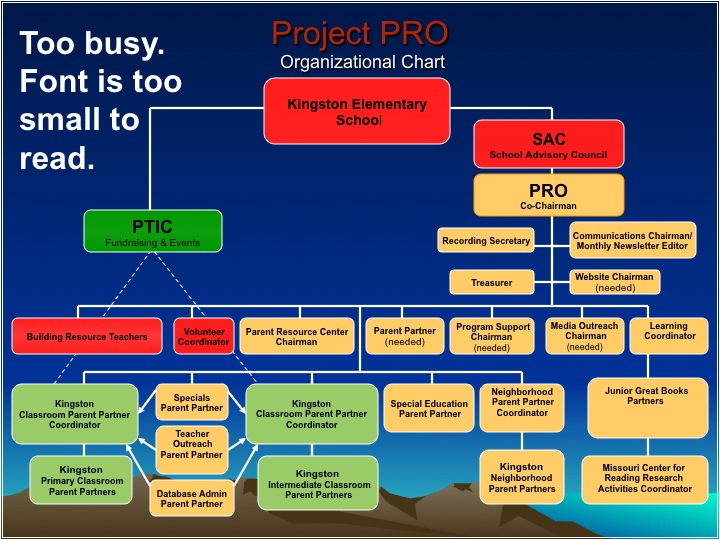
Examples of common but ineffective slides are below.
Creating a presentation should mimic packing for a trip. We throw everything we want to take with us on the bed. Then we stuff everything in a bag. When we see it’s not all going to fit, we take stuff out. Then we realize we’re going to pay an overweight fee, so we take more stuff out, admitting that we don’t need eleven t-shirts. We then get where we’re going with much less stuff than we started with, but still more than we need. Creating a presentation should follow the same process.
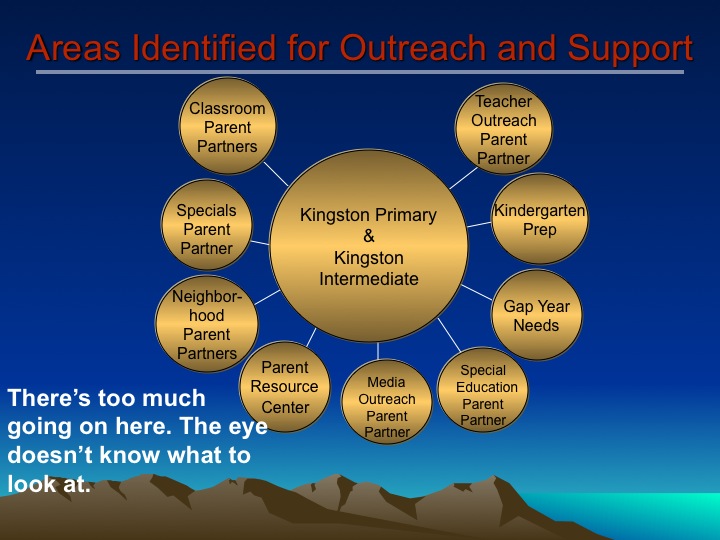
Create your presentations in PowerPoint and then remove everything but the necessary points your audience needs to follow your presentation. Leave bullets that you will discuss in greater detail, important numbers, and statistics. Delete the rest. If your slides mimic every word you’re going to say, the audience doesn’t need you. If you’re going to read your slides, save your audience some time, email the presentation, and cancel your meeting.
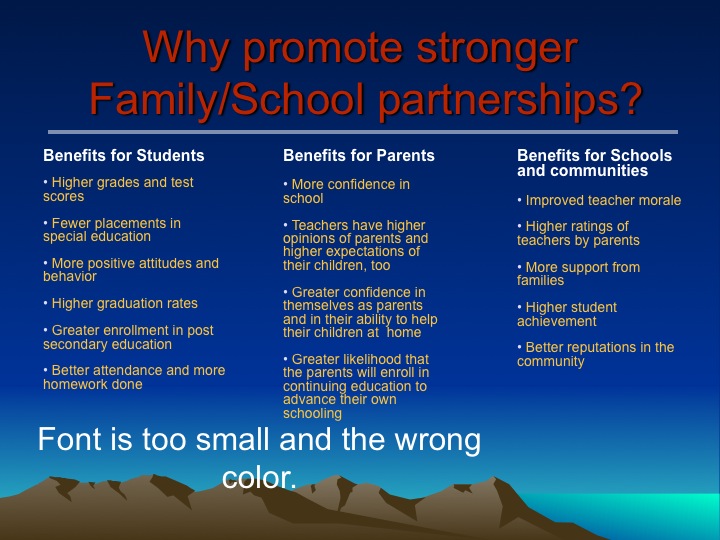
If you want to hand out or use a more detailed version of the presentation to prompt you while you’re speaking, save two versions –version one with all the detail and a parsed down version two to project while you’re speaking. The notes feature is a good place to put extra detail you want to be sure to cover, but don’t want on your slides.
The objection I often get to the suggestion above is, “I have to provide a lot of information. I know it’s too much data for one slide and the text is too small to read. But I have to provide that level of detail.” When you have a lot of information you can put it on a slide, but you should also provide the slide as a handout. Tell people you know they can’t read all the information on the slide, and tell them to follow along on their handout. Use a pointer or a different color to highlight the sections of the slide you’re talking about. If you aren’t going to give a handout, then remove the slide from the deck and email it as follow up. Showing slides that are too small or too detailed to read is frustrating for your audience and doesn’t put you in the most positive light.
Avoid Death By PowerPoint and Make PowerPoint Work For You:
- Use 24-point font or larger. People can’t read 14 or 16 point font on a slide.
- Put 6 to 7 lines of text on a slide, not more.
- Avoid distractions on slides –like images that float in or explode. Make your slides more interesting by adding relevant pictures and videos, versus unrelated images.
- Always speak with the lights full up. NEVER speak in a dim or dark room. YOU are the presentation, not your PowerPoint slides.
- Use a white background and a dark font, so you NEVER have to dim the lights.
- Use fewer slides than you think you need to, and give your audience time to read each slide. If the audience doesn’t have time to read a slide, they will feel ripped off and frustrated, and wonder what they’re missing.
PowerPoint can be a great tool, when used well. If your slides add to, but don’t replace your message, and if everyone in the room can and has time to reach every word on your slides, you’re using PowerPoint as it was intended. If your slides can be followed by the words, “I know you can’t read this but…,” it’s time to start deleting.