Uncategorized Archive
Since having a baby a year ago, the words “I’m sorry” have taken over my life. “I’m sorry I missed your birthday.” “I’m sorry I’m delayed in replying.” “I’m sorry I missed your call.” “I’m sorry it took me four months to send you a thank you card.” These two words come out of my mouth so often that they’ve taken over my vocabulary.
I’m a big fan of taking responsibility and personal accountability. I think being accountable is easier than passing the buck. When I’m accountable, I have more power and control. When someone else is accountable, I have neither. But there’s a difference between being accountable and apologizing for yourself. Of late, I’ve been apologizing for myself, and it’s demoralizing.
Even telling you this, my clients, feels risky. Don’t worry. I arrived at every speaking engagement this year early and got great feedback. But anyone who knows me well knows I’m working on all the things I write about.
Last week I vowed to stop saying, “I’m sorry.” And yet, the next words out of my mouth were apologetic. Apologizing for oneself is so natural, it’s pervasive, aka, a hard habit to break.
Below are a few strategies for being accountable but not apologetic:
- Be accountable: Establish clear priorities and boundaries. When I had a baby, I set very clear guidelines for myself on work hours and travel practices. And I stick to those 99% of the time. Having clearly established boundaries makes decision making easy.
- Be accountable: Only commit to things you know you will do. For personal situations, only commit to things you genuinely want to do.
- Be accountable: Tell the truth. If you don’t plan to do something, say so, without apology. “Thank you but no” has a lot of power.
- Be accountable: Know your limits and what you need to be healthy and functioning at an optimum level. If you need eight hours of sleep, structure your life to get it. If you need weekends focused on your family, do that. If a trip home over the holidays feels like too much, don’t go. Taking care of yourself enables you to take care of others.
- Be accountable: Renegotiate when you need to. If you realize something you agreed to isn’t feasible or in your best interest, renegotiate versus suffer through it. Or, keep your commitment, but don’t recommit the next time a similar opportunity or request comes around.
- Be accountable: Don’t sweat the small stuff. I love you all and you will never get a printed holiday card from me. Ever. I want to send you one. I really do. Just pretend you got it and it has a really cute picture of me and the baby on it.
- Be accountable: Give yourself a break. You’re doing the best you can. You’re a human like everyone else. We’re all doing the best we can.
Being accountable isn’t being perfect. It’s being human with points for effort. Be yourself. Take care of yourself. And do your best, unapologetically.

Many of us have seen our friends, coworkers and even manager do really dumb things at the company holiday party.
Here are list of my favorites:
- Having a few too many drinks and sharing confidential information.
- Wearing a dress that shows the people you work with more of your body than they should see.
- Showing moves on the dance floor that you don’t have.
- Hooking up with coworkers.
Your company holiday party is a company event, and anything you wear, do, or say is grounds for gossip the next day at work.
Don’t become the topic of conversation the day after your company holiday party.
A few rules to live by at your company holiday party:
- If you wouldn’t want a picture of you wearing it hung up in a conference room, don’t wear it to the holiday party.
- Don’t get drunk at a company event, ever. If you get ‘chatty’ after two drinks, then two is too many.
- If you wouldn’t say something to someone at work, don’t say it at the holiday party.
The last rule: Help your friends and coworkers by stopping them from making career limited moves at company events. Rather than watching the train wreck go by as your friends say and do things they shouldn’t, gather your courage, and tell them it’s time to switch to club soda.
You may feel like you can’t give this type of feedback. It is hard to do, unless you’ve made an agreement before the party starts to do so. And even if you do make an agreement to tell people when they do something dumb, it’s still hard to do. But it will probably feel almost impossible if you haven’t set the expectation in advance.
So make a deal with your friends at work. If anyone says, does, or wears something really misguided to the holiday party, you will tell each other without negative recourse. And if all else fails, and you break every ‘rule’ listed here, just call out sick for two weeks after the company holiday party, because that won’t raise any red flags at all.
Most of what comes through our phones is probably not all that compelling – emails we don’t really want to read, advertisements for things we won’t buy, and social media updates we don’t really care about. And yet those little devices are so seductive. It’s hard not to check your email, texts, and social media updates constantly. Being so connected electronically and thus so continuously distracted has its benefits but it also has real costs. 
Most of you know I had my first child last year. And I’m committed to being a present and involved mom. I spend a lot of time with my son. But the best times are when I leave my phone behind. Without my phone I’m fully present with him, in the moment, enjoying him. When I have my phone, I’m distracted, often stressed, and typically torn. Can’t I read this email and reply quickly? What’s the harm? It will only take a second.
And each time I take a minute to read my email, I’m gone. I’m focused on my phone. And then I feel guilty and sad for not being as engaged as I want to be. Then I recommit to being fully present. And then read my email again. It’s a vicious cycle.
There is a huge cost to being distracted most of the time. Our relationships suffer. Car accidents have increased. People are tired.
Every productivity expert will tell you to check your messages three times a day, respond, and to not be constantly reading email. It’s fantastic advice. And I suspect no one, including productivity experts, follows it. It’s just too hard. We’re lured by our phones, tablets and laptops. Not checking them regularly makes us antsy, uncomfortable, and nervous.
What would happen if we set defined periods of time for each thing we did? I.e., Spend from 1:00 pm – 4:00 pm with your children. At 4:00 p.m., check your phone. Take the weekend off and check your messages at 7:00 p.m. on Sunday. Work on a project without interruption from 9:00 a.m. to 10:00 a.m. I suspect we’d get way more done and feel less stressed. But we have to give ourselves permission to put the phone away.
Here are three ways to be more focused and productive, and hopefully, happy:
1. Schedule work and personal activities for realistic, defined periods of time, and stick to them.
2. Agree on no cell phones or other electronics during personal meals and outings. I like the game people are playing in restaurants by putting cell phones face down in a pile on the table. The first person who touches their cell phone pays the entire bill.
3. Agree on no cell phones during group or one-on-one meetings. Your meetings will be shorter, easier to manage, and more productive. Meeting attendees are dying to tell their peers to put away their phones. Strong facilitators who set and hold to this expectation earn others’ respect and get more done.
In a nut shell, give yourself permission to focus. Do one thing at a time for a short period of time. Allow similar chunks of time to read and reply to messages and read Facebook updates you don’t care about. Then put the phone down and walk away. Your family and friends miss you.
Want to improve your relationships? Read How to Say Anything to Anyone. The book is on sale for $15 to celebrate our 4th printing. It’s the perfect holiday gift. Get your copies now! Offer ends 12/31/16.
Hire people using whatever (legal) criteria you like. Compensate employees however you like. Charge for your products and services however you like. Run your business however you like. But be transparent about your practices. People want to work with those they trust. Transparency builds leadership trust.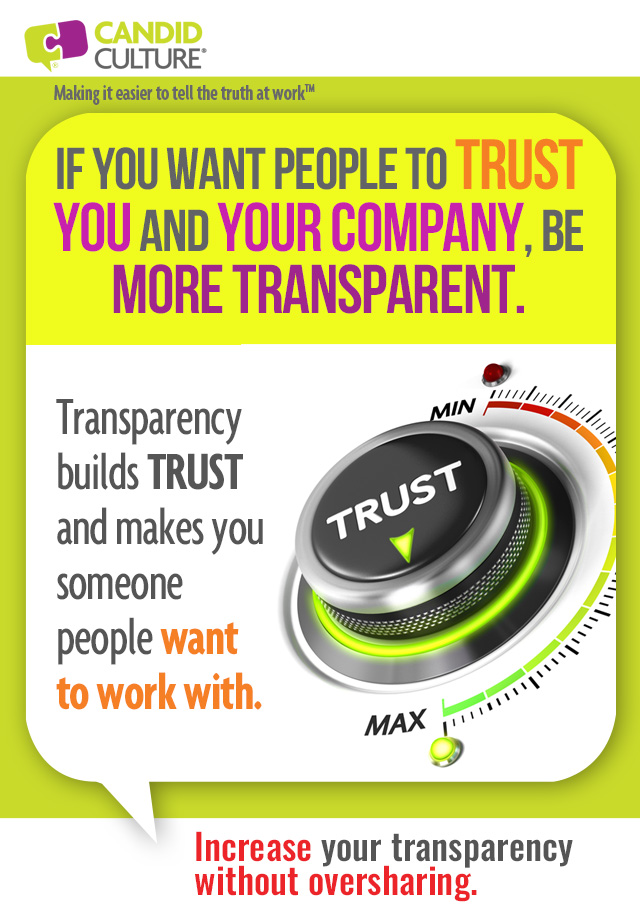
A few weeks ago one of our vendors gave me a bill that was higher than what I expected, so I asked for an itemized invoice. I never heard from the company again. Poof; they disappeared. Not a great way to build leadership trust nor a reputation.
Another vendor was very delayed in filling our product orders. When I asked questions about how such a thing could happen, I got a vague answer. “I guess we have communication issues and you got lost in the shuffle.” It was an insufficient and thus bad answer that didn’t instill confidence in the company. Instead, it created doubt that they could reliably meet our needs and we’re going to replace them.
One of my friends recently got turned down for an internal job. She was told, “She just wasn’t the right fit.” An unhelpful and yet typical way to decline an internal candidate.
You don’t owe your employees or customers answers, but if you want people to want to work with you, have confidence in you, and trust you, you’ll provide more information than you think you need to.
Employees and customers can handle the truth. And while you may not think you need to provide it, people want to work with those they trust. We trust people who give us the whole truth. Or at least more of it than, “I guess you got lost in the shuffle.”
Increase business trust: Outline how you derive your pricing. Be clear and transparent about your pricing.
Increase corporate trust: Tell employees how and why you make the hiring decisions you do. They’ll refer friends to work for you, even when you decline them.
Increase leadership trust: Tell employees how the organization makes money, the feedback you’re getting from prospects and customers, and why you’re making the business decisions you’re making. Employees will feel more connected and thus committed to the organization.
Knowledge makes people feel comfortable. The people who work for and with you want to understand how and why decisions are made. If you want your customers and employees to trust you, give them a little more truth than you might think necessary.
No one (I know) enjoys writing, delivering or receiving performance feedback. It’s time consuming to write, challenging to deliver, and can be difficult to hear. Unfortunately, most performance management systems – goal setting forms, performance appraisal templates and online templates – don’t make the process easier. Ins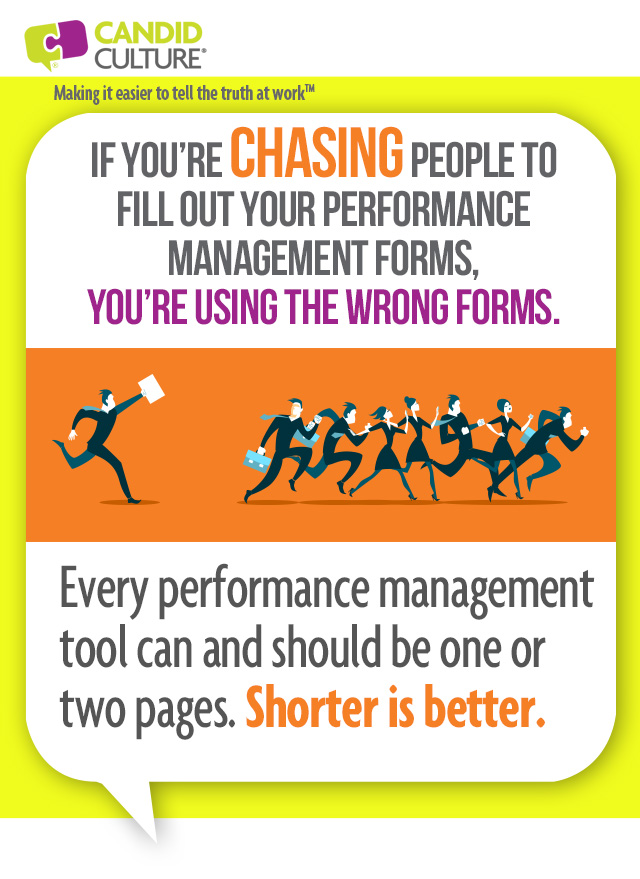 tead, they make it harder. Short and simple is best.
When I started managing leadership development for a large company, I inherited a 12-page performance appraisal form and what seemed like 89 competencies. One of the business leaders I supported told me, “I’m not asking my people to use this form. If you can give me something that’s one page, I’ll have my managers use it.” That conversation sent me on a mission to make all performance management forms one or two pages. And really, why shouldn’t they be? People can only focus on leveraging and changing a few things at a time. Why give more feedback than that at any given time?
If you’re chasing people to use your performance management tools and templates, you have the wrong forms. In my experience, when people find something easy to use and valuable, they’ll use it. If something is difficult to use or doesn’t seem to add value, people drag their heels.
Here are a few ideas for making your performance management process easier:
Make your forms and templates simple. No performance management tool should be more than two pages. In a performance appraisal – quarterly, annual, or otherwise – identify up to three things the person did well and a max of three things s/he can either do more, better, or differently next year. Anything more is overwhelming and a set up for disappointment, frustration, and overwhelm.
If you have additional areas for the person to work on, meet again in 90-days and assess how the person has done with the three pieces of feedback already provided. If s/he has made significant progress on the things they were already working on, add a few new things to work on. If significant progress hasn’t been made on the existing feedback, wait to add more.
I know your existing performance management templates may not allow for what I’m suggesting. If you’re working with a template that requires more input, write up to three clear, succinct, and actionable bullets in each required area and not more. Bullets are better than paragraphs. Be specific. “Great job” is not feedback. Neither is, “needs improvement.” Give a specific example or two. No example, no feedback.
Resist the urge to write paragraphs of vague feedback or to accept that type of feedback in a self-appraisal. Paragraphs of feedback take too long to write and often say little. I’d suggest spending less time writing performance feedback and instead spend the time observing performance, asking others for input on the person’s performance, and writing three succinct, specific bullets that describe an action taken or outcome produced. Specific feedback is meaningful, useful, and received with less defensiveness.
Click below to see our suite of one and two-page performance management templates. And watch for our upcoming webinar on how to write and deliver performance appraisals that are less painful, more useful, and quicker to write and deliver.
 Lots of organizations send out employee engagement surveys with the desire of improving employee engagement and retention; unfortunately they often damage both in the process.
There are a few employee engagement survey pitfalls that are luckily easy to avoid.
Here are three practices to follow when sending out employee engagement surveys:
- Shorter is better. I hate to say this, but no one wants to fill out your employee engagement survey. It’s time consuming, employees doubt the survey will yield results, and employees worry that their feedback isn’t really confidential.
Make your employee engagement survey easy to fill out by making it short. And by short, I mean 10 questions or fewer. You’ll get a better response rate to a 10-question survey than a 65-question one. And do you really need more information than the answers to ten well-written questions?
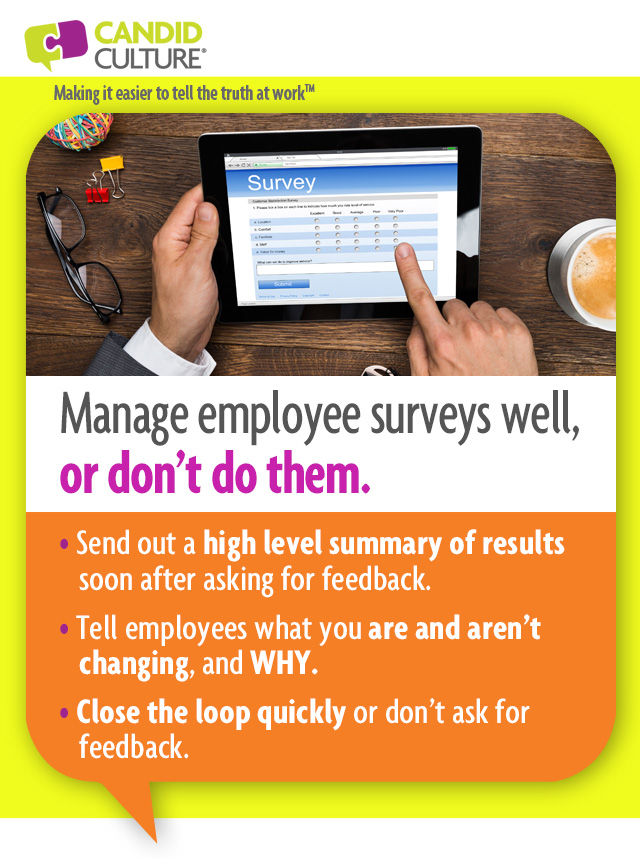
- Provide employees with survey results quickly. Most organizations ask for too much information. Leaders are overwhelmed by the survey information, so they spend months and months reviewing it, while employees comment on yet another employee survey with no communication.
Send out a communication sharing the top few learnings – the good and the not-so-good — within a few weeks of sending out the survey. You don’t need to take action at the same time. Simply keep employees in the loop by communicating a quick summary of what you learned. If you wait too long to share the feedback, it often never gets communicated. And the next time you send out a survey, employees will remember the absence of information and be hesitant to fill it out.
- Within 90-days, tell employees what you will and won’t be changing, based on the survey feedback, and tell them why. Employees don’t need or expect all of their input to be utilized. Closing the loop with clear communication about what you are and aren’t changing, and why, is often sufficient.
All of that being said, I’m going to recommend you send out fewer surveys. Employee engagement surveys are a good way to quickly collect lots of information. Engagement surveys are not a good way of building trust and relationships with employees, which is what leads to employee engagement and retention. Employees don’t feel closer to an organization’s leadership team after filling out an employee engagement survey. Trust isn’t built. Instead of sending out so many surveys, I’d suggest cutting the number in half and have leaders and managers hold roundtable discussions with groups of 6-8 employees a few times a year instead. Roundtable discussions achieve several goals at once—they give leaders visibility, which builds trust, they help leaders build rapport and relationships, and gather the same data that a written survey provides.
When leaders participate in our Be a Best Place to Work program, we teach the five things leaders need to do to engage and retain employees. Holding roundtable discussions and asking these questions is a key recommendation of the training. Sending out written surveys is not. Engage and retain employees by talking with employees. Ask employees for their input. Listen. And watch your employee engagement survey scores sky rocket.
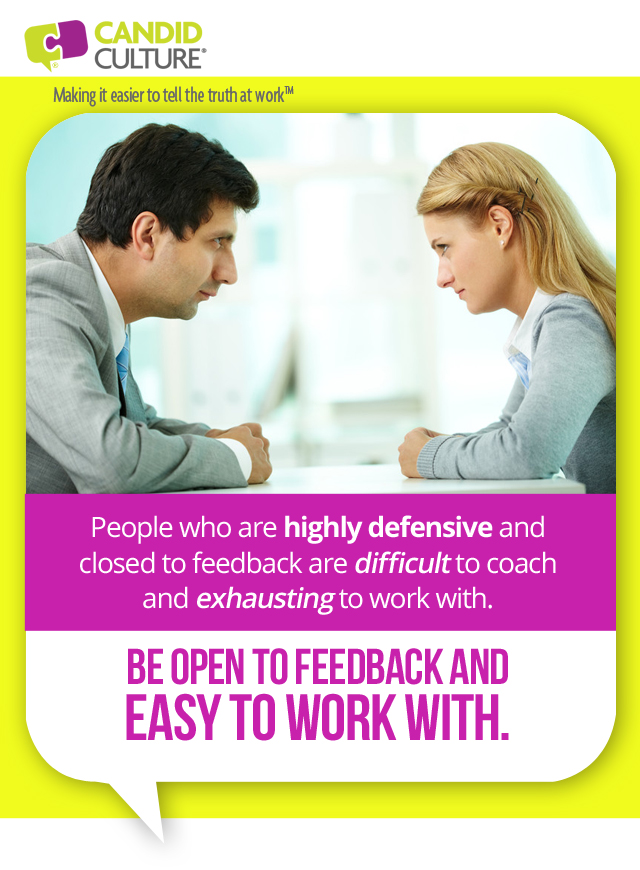
As crazy as it sounds, your manager is afraid of you – afraid of your defensive reaction to feedback.
The normal reaction to feedback is to get upset. The problem is, no one wants to deal with our upset. It makes them uncomfortable. So managers and peers alike start to pick and choose what to tell us. Not wanting to deal with our reaction, they start to pick their battles. The more defensive we are, the less feedback we get. The less feedback we get, the less information about our performance we have. The less information we have about our performance, the less control we have over our career.
All of us have been passed over for an opportunity at work – a promotion, raise, project, etc. – and for the most part, we have no idea why, because no one wants to risk our defensive response to tell us. This lack of knowledge makes it hard to manage your career. And to be frank, defensive people are extraordinarily difficult to work with. Having to watch every word, walk on egg shells, and be choosy about what to address and what to avoid is exhausting. Be receptive and thus easier to work with.
I teach managers to screen out candidates who aren’t coachable and receptive to feedback. Work is hard enough without hiring people who aren’t coachable. Being open to feedback makes you easier to work with.
Here are three ways to be open to feedback and increase receptiveness:
Tip one to be open to feedback and increase receptiveness: Don’t underestimate the power of your emotions and the intrinsic drive to defend yourself when receiving feedback. Not defending oneself is extremely challenging. And even the most minor reaction sounds defensive. I.e., “Thank you for the feedback. Here’s why we did it that way…”
Tip two to be open to feedback and increase receptiveness: Wait a few minutes, hours or days, and respond to feedback when you’re calm. That could sound like, “Thanks for telling me. I’m sorry that happened. I’m going to think about what you said and get back to you by the end of the day.”
Tip three to be open to feedback and increase receptiveness: Come from a place of curiosity when seeking feedback versus thinking “there’s something wrong here” and “I’m bad.” Be curious about how you impact others and the impression you make. Seek feedback to understand both.
When I landed my first ‘real’ job after graduating from college I was so scared, I almost turned  the job down. It took me five years to finish my first book, How to Say Anything to Anyone, in part because I was afraid no one would like it.
It seems anything worth doing is worth fearing.
I’m not talking about taking risks for the sake of risk – driving as fast as your car can take you, not paying your bills to see what will happen, or offering a counter point of view at work for the sake of doing so. I’m talking about pursuing the things you really want, that speak to your true purpose.
Being afraid doesn’t mean you can’t do something, nor does it mean that you shouldn’t. Feeling some fear just means what you want is outside of what you know you can do. But it’s the edge and the unknown that is juicy and rich.
During the past few years I’ve pursued things I’m terrified of, that I don’t know I can do. Yet I want these things, so I pursue them in the face of fear. And I have to admit, that as I get closer to getting what I want, the fear doesn’t dissipate, it actually gets worse. As I can almost taste having what I want, I get more scared. And sometimes I pull back, thinking, maybe I don’t really won’t those things. Maybe I was wrong. Then I remember why I want what I want and step back into the pursuit, despite the fear.
Don’t misinterpret fear as a reason not to do something.
A few suggestions for how to face your fears at work:
1. Write your desires down and/or tell people what you want.
- You’re more likely to get what you talk about wanting.
2. Take one step towards having what you want.
- Talk to someone who either has what you want or can help you get what you want.
3. Put yourself in the place of most potential, where you can get what you want.
- If you want to work in a certain department, express interest in working on a project that serves that department.
- Tell your boss and people in leadership in your desired work area of your interest.
- Apply for a job in that area.
4. Be positive and persistent.
- No one wants to give a complainer an opportunity, and it takes time to make a shift.
The key is to take one step, then another, then another. And when you feel fear, don’t let it stop you. Fearing the next job or opportunity doesn’t mean you can’t do it well, it just means you haven’t done it yet.
When you need encouragement to face your fears, hang our inspiring magnets at your desk. You have to believe in yourself just as much as the people around you believe in you.

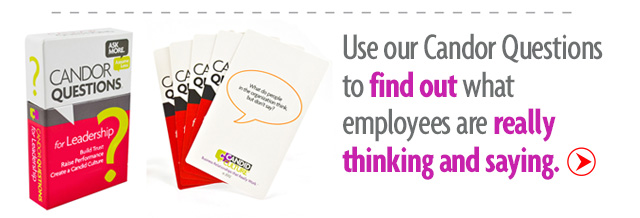
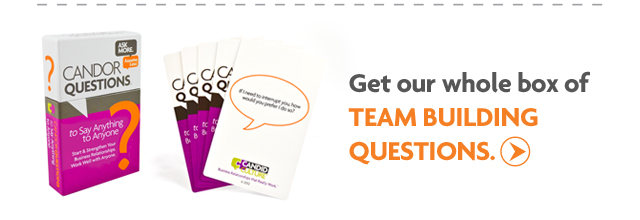
We added to our team at Candid Culture a few weeks ago, so we did what I teach other organizations to do –used Candor Questions to onboard our new team member, and help the entire team get to know each other better.
I sent my team the Candor Questions below and asked them to pick a few additional team building questions for everyone on the team to answer.
- What will keep you working here and what would make you leave?
- What’s the best way to get information to you – voicemail, text, or email?
- What time is too early?
- What time is too late?
- Do you leave your email and/or text alerts on at night/when you go to sleep?
- Would you prefer I send all emails and text messages during regular business hours?
- What frustrates you at work?
- What are your pet peeves?
- What’s something you want to learn, skill or business wise, that you haven’t had a chance to do?
- What’s something you wish I would start, stop, or continuing doing?
We run so fast at work and are so focused on completing goals, we often don’t take the time to really get to know the people we work with. I feel very strongly that asking the team building questions above will help people work better together. We’ll make fewer ‘mistakes’ with each other, and get more done with less stress and more ease. As William Ury said in his book, Getting to Yes, “Go slow to go fast.”

How many times have you sent someone five emails and become frustrated when none were returned? Or you thought an employee was happy, only to be surprised when she quit? Or you needed to talk with someone but couldn’t get her attention, so you walked by her office throughout the day, wondering if it was ok to knock? Working with other people doesn’t have to be so hard.
Taking the time to ask team building questions is much faster than recovering from missteps with other people. Ask the questions at the beginning of anything new – when you hire a new employee, get a new customer, or start a new project. And keep asking the questions as you work with people.
Asking questions about working style preferences and goals is an ongoing process, and it’s never too late. You can ask the team building questions during meetings or just slip them into your conversations. The process doesn’t have to be formal or time consuming. The point is simply, don’t guess what people need and are expecting from you, ask.
Most people avoid giving feedback because they’re concerned about (don’t want to deal with) the other person’s defensive response. It’s easier to say nothing than deal with someone’s defensiveness. So we say things are fine when they’re not.
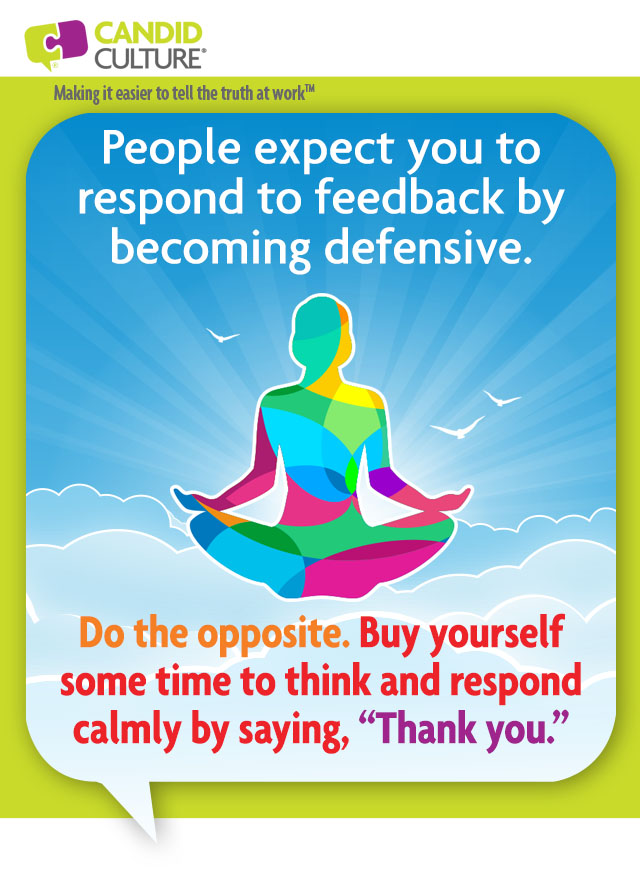
If you want people to tell you the truth, do the opposite of what they expect when responding to feedback. Rather than become defensive, say, “thank you.”
Saying “thank you for the feedback” is not intended to be a pollyanna response, nor does it mean you agree and that the person is right. Saying “thank you” catches the other person off guard (in a good way) and buys you time to think and respond calmly, making it more likely that you’ll get feedback in the future.
Each of us wants to be thought well of and be seen as competent. Negative feedback calls both into question and the brain responds defensively. The challenge is that defensive responses scare other people into silence. And you only need to get defensive once for people to believe that you don’t deal well with feedback.
Don’t underestimate the power of your emotions and ego. You are likely to respond to feedback defensively, even if you don’t see yourself do it. A seemingly benign ‘explanation’ of why you did something as you did it, is seen as defensive and is thus off putting to others.
Here are six strategies for responding to feedback well:
- Responding to feedback strategy one: Have feedback conversations when you have the time to listen and are rested. If you’re tired, on a deadline, or rushing to your next meeting, the conversation will not go well.
- Responding to feedback strategy two: If someone catches you off guard with feedback and you know you won’t respond well, interrupt the person. Tell him that you appreciate him bringing this to your attention and you want to give the conversation the attention it deserves, but now isn’t a good time. Schedule a time to finish the conversation within a few days.
- Responding to feedback strategy three: Have a plan for how you’re going to respond to scheduled/planned feedback conversations before the conversations start. Tell yourself, “I will say thank you, end the conversation, and ask for another time to talk.”
- Responding to feedback strategy four: If you receive feedback that doesn’t feel accurate, ask others, who you trust, what they think. Just be prepared to hear what they have to say, and, of course, respond with “thank you.”
- Responding to feedback strategy five: Don’t respond to negative feedback in the moment, even if the other person wants you to and you think you can do so without being defensive. Don’t underestimate the power of your emotions. You will be upset, even if you don’t feel upset, and your response will be better after you’ve had time to process. Tell the person who gave you feedback that you take their feedback seriously and want to respond thoughtfully, and thus you’re going to think about what s/he said before responding. People may be frustrated with this response at first, but they’ll be appreciative later.
- Responding to feedback strategy six: Be sure to get back to the person, who has feedback for you, within a few days. Tell him you thought about what he said and then tell him how you feel. You can speak candidly. Your words will be calmer and more thoughtful then when you received the initial feedback.
We know people are hesitant to give feedback. Make giving you feedback easier by responding calmly. No one expects to hear “thank you for the feedback.” Your unemotional response will strengthen your reputation and relationships, and make it more likely that you get more feedback in the future.