Uncategorized Archive
Each time we go to the pediatrician’s office, my son’s doctor tells me to relax and enjoy my son more. And each appointment, I’m surprised. “What do you mean,” I ask? “Don’t all parents come to each appointment with a typed list of questions?” Apparently not.

It’s unfathomable that last year at this time, I was getting ready to have a baby. Grayson’s first year has flown by, but not without a lot of lessons. The learning has been fast and at times painful.
Working parent lesson one: Stop trying to be perfect. I’m annoyed with myself, in all aspects of my life, for not being perfect. Regret is amplified with my son. Tonight he fell and shed blood for the first time in his young life. And I was standing right there. He hurt himself on my watch. As I replay the incident in my mind, all I can think is, “How did I let that happen and how do I prevent it happening again?” My family reassured me that every kid hurts himself and it will happen again and again. Intellectually I know this, and yet, I’m in denial about it, thinking if I’m vigilant enough, I can protect Grayson, ensuring that everything is always…perfect.
Working parent lesson two: Go to bed earlier. When Grayson was born I was given the sage advice, “Sleep when he sleeps.” I didn’t. And I’m writing this when I should be asleep. I’m more patient and present when I sleep. I’m a better parent, manager, leader, and business owner when I sleep.
Close out the email. Get off the internet. Go to sleep.
Working parent lesson three: One of my friends told me that most babies’ emergency room visits are for things the parents didn’t know the child could do. Yesterday Grayson crawled out of the tub unassisted. I didn’t know he could do that. He’d never done it before. Each time he does something he’s never done before, I’m caught off guard. He’s fast, agile, curious and smart. I can’t underestimate him. And this isn’t too different from work.
Don’t underestimate the people you work with. They’ll do great things, if you let them. Set big goals. Be clear in your expectations. Coach, support, and get out of the way.
Several people have asked me about my greatest surprise in parenting. I have to say, it’s the love. The huge, limitless, crazy love. Perhaps I need to extend it to myself, and stress less and enjoy more.
Happy first birthday to Grayson. My greatest love and teacher.






If you want to freak out the people you work with, tell them, “We need to talk.” If you really want to freak them out, say those four magic words on a Friday, or even better, the day before someone goes on vacation. “We need to talk” is rarely followed by, “and you’re awesome.” People know bad news is likely coming, and they’ll inevitably be on edge.
The antidote to asking for time to talk is to create opportunities to give feedback regularly.
There are many reasons giving feedback is hard. One of them is we wait too long. Something happens. We know we should address it, but we don’t want to. So we wait to see if the behavior is really ‘a thing.’ Then it happens again. And now we know it’s ‘a thing.’ But we still don’t want to address it. Then the situation gets really bad, and now we have to say something. The conversation then takes 90 minutes, is painful, and everyone goes home unhappy.
Here are two key to make giving feedback easier:
Giving feedback strategy one: Debrief everything. Do a quick plus/delta on a regular basis to assess how things are going. Plus – what went well? Delta – what would we change if we could/what did we learn?
I recommend doing a quick debrief at the end of important meetings, hiring processes, projects, and when anything changes. Conduct a short debrief when you have staffing changes, gain or lose a client, launch or eliminate a product or service, etc. Change is an opportunity to evaluate how you work and to make appropriate adjustments.
When you debrief important events, you tell people that feedback is important and that it’s ok to be candid. Conducting regular debriefs also gives employees a chance to practice giving feedback, which is a hard skill. And like anything, the more we give feedback, the easier it becomes.
Conducting short, regular debriefs is one of the easiest ways to learn from the past and become a more candid culture.
Giving feedback strategy two: Schedule five to fifteen minutes each week to talk as a team or with direct reports. When you know you have time each week to talk with your manager, direct reports, and/or team members, you never have to ask for time to talk. Issues don’t build up or linger. Breakdowns and frustrations are discussed within of few days of their occurrence, and no one is on edge that bad news is coming at their end of their vacation.
The key to being effective at giving feedback is to give feedback regularly. Short, frequent feedback conversations are much more effective than infrequent, long conversations that everyone dreads and leaves feeling exhausted and demoralized.
Debrief everything meaningful. Meet with people weekly. Ask for and give feedback as things happen, and watch your culture change.

The first time my now eleven-month old son stood up in his crib, I didn’t see it. I was sitting in his room watching him at the time. I was literally watching him in his crib, and yet I didn’t notice when he stood up for the first time. I wasn’t looking at my phone or talking with someone else. It was just he and I in the room, and yet I was so distracted with whatever I was thinking about, I didn’t ‘see’ him stand up for the first time.
When he was born, I was given the advice to stay present. And I scoffed at that advice. Of course I would stay present.
Living in the present sounds so simple. When you walk, walk. When you eat, eat. When you work, work. We’ve all heard this advice, and yet, it’s so hard to do.
Before having a baby, I would lie awake in bed at night worrying about the vendor who wasn’t the right fit, a decision I needed to make, or something I needed to finish. Now I think about those things when I’m ‘with’ my son – watching him, but not seeing.
If we’re thinking about anything other than then what we’re doing, we’re not living in the present moment. Instead, we’re focused on either the past or the future. And this is where stress and anxiety live. If we only think about what’s happening now, it’s impossible to be stressed, anxious, or worried. The question is how to stay present when our brains want to do anything but.
Here are seven strategies for living in the present moment:
Live in the present strategy one: Write down everything you need to do, so you can free your brain from thinking about it.
Live in the present strategy two: Don’t over commit or over plan. Plan days with a schedule that you can easily achieve. Over committing causes stress and worry.
Live in the present strategy three: Only commit to do things you really plan (and at least in your personal life, really want) to do.
Live in the present strategy four: Give yourself a limited and prescribed time to talk about a problem and/or to worry about it. When the time is up, let it go and think about something else. Ask the people around you to help hold to this time limit. If you bring the topic up in conversation, ask your colleagues to point out that you’re still focused on the problem and refuse to have the conversation with you.
Live in the present strategy five: Remind yourself (from moment to moment) to be present. When I’m with my son, I remind myself to really be with him and not thinking about or doing something else.
Live in the present strategy six: Compartmentalize your time. Determine how long you’re going to do something, and only do that activity during that time period. When the time is up, move on to something else. When I’m not with clients, I spend half of each workday with my son. And when I’m with him, I don’t have my phone so I’m not tempted to check my email. When I’m with him, I’m really with him.
Live in the present strategy seven: Leave your phone some place you can’t see it. We are addicted to these little people separators. I find that one of the only ways I don’t check my phone, is not to carry the phone with me.
Being in the present moment requires discipline. If you want to feel more peaceful and less stressed, think only about what you’re doing. Let everyone else worry about the rest.

When I had knee surgery a bunch of years ago, the surgeon told me, “I didn’t fix your knee. I altered it.” He was trying to set the expectation that my knee wouldn’t be perfect, it would be different.

Violated expectations are at the root of disappointment, frustration, and broken relationships. We think, “I expect you to do or be a certain way and you’re not, so I’m unhappy.” If you want to be more satisfied and less frustrated, change your expectations. I don’t mean lower your expectations. I really do mean change them.
I had a baby last year and had no idea how difficult it would be have someone I barely knew (our new nanny) take care of him. It was tortuous until I got the sage advice, “You’re not going to get everything you want. Pay attention to the big things and be ok with good enough.” That’s hard for me. I have high standards and I want things done a certain way (my way). But I also don’t want to do everything myself. So I find myself altering my expectations and being ok with good enough. And it’s very, very difficult.
You likely want each of your employees, coworkers, boss, clients, and vendors to do things a certain way. Sometimes they’ll meet those expectations and sometimes they won’t. Decide what you must have, communicate those expectations (repeatedly if necessary), and let the rest go.
Here are four steps for setting expectations at work:
Setting expectations step one: Consider everything you need or want from a person. Make a list, even if it’s just for you.
Setting expectations step two: Determine what that person is capable of providing. What’s realistic given who they are and the constraints they’re under (financial, time, skills, experience, etc.)?
Setting expectations step three: Reset your expectations, if necessary.
Setting expectations step four: Ask for what you want and be specific about your request. Telling someone, “This needs to get better,” will get you nothing. Telling someone, “I’d like to be included in each meeting that relates to this project and cc’d on all pertinent emails,” may just get you what you need.
As William Ury said in his book Getting to Yes, be hard on the problem and easy on the person. When you address violated expectations, simply share what you expected to have happen and what actually did happen. That could sound like, “I thought we agreed I would be invited to each meeting pertaining to this client. There was a meeting last week I wasn’t invited to. What happened?” Watch your tone of voice when asking this question. Be neutral and curious.
Changing your expectations will likely be a daily occurrence. People won’t necessarily do things your way or even in the way you hoped. Decide what you must have, and let the rest go. Just think of all the time and aggravation you’ll save.

Breakdowns happen. There will be days people won’t give you what you need to complete projects. Things will break. And you will look bad. When breakdowns happen, I always ask myself, “What could I have done to prevent this situation?” or “What did I do to help create this situation?” I see myself as accountable for whatever breakdowns occur.
It may sound odd that I always look at myself when breakdowns occur, even when it’s someone else who didn’t do her job, but it’s just easier. I can’t control anyone else. But I can control me (admittedly, some days I do a better job at this than others). When I can identify something I could have done to make a situation go differently, I feel more in control – aka better.
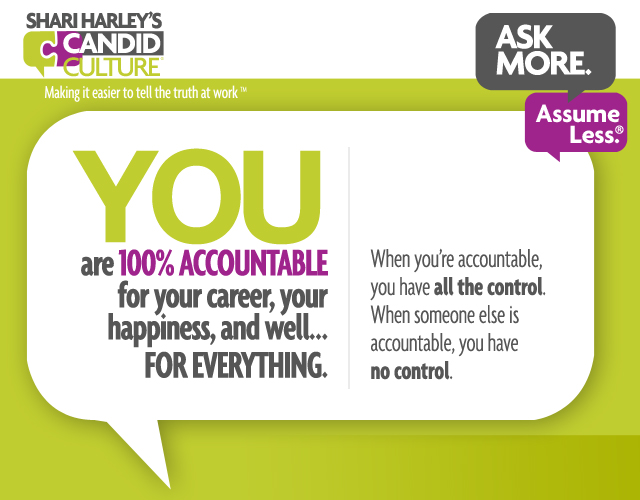
It’s like getting off a highway versus sit in bumper-to-bumper traffic. The alternate route may take longer, but at least I’m moving. I feel like I’m doing something and thus have more control. Taking responsibility for everything that happens to you is similar. When you’re accountable, you can do something to improve your situation. When someone else is accountable, you’re at the mercy of other people and have very little control.
There are, of course, exceptions to the practice that “we’re always accountable.” Terrible acts of violence, crime, and illness happen to people, about which they have no control. But in general, in our day-to-day lives, there is typically something we did to contribute to a bad situation or something we can do to improve it.
Here are four practices for improving difficult situations, even when you didn’t create the mess (alone).
1) Increasing accountability in the workplace: Ask more questions. If you’re not clear about what someone is expecting from you, ask. You’re responsible for doing good work, regardless of the type of direction you receive.
2) Increasing accountability in the workplace: Tell people what you think they’re expecting and what you’re planning to do, to ensure everyone’s expectations are aligned. Clarifying expectations beats doing several weeks worth of work, only to discover what you created isn’t what someone else had it mind.
3) Increasing accountability in the workplace: Ask for specific feedback as projects progress. Don’t wait until the end of a project to find out how you performed.
4) Increasing accountability in the workplace: Say “thank you” to whatever feedback you receive versus defending yourself. People will be pleasantly surprised and their upset will dissipate more quickly. That could sound like, “That’s good feedback. I’m sorry that was your experience. Thank you for telling me.”
5) Increasing accountability in the workplace: Admit when you make a mistake or when you wish you had done something differently. Don’t wait for someone to tell you. Saying, “I’m sorry. How can I make this right with you?” goes a long way.
I am always asking the following questions:
“What could I have done differently?”
“What did I do to contribute to this situation?”
“What can I do now to make this situation better?”
I encourage you to ask these questions, even when someone else drops the ball. You can’t control others, but you can control you. And your happiness and success is your responsibility.

I think Instacart is a brilliant idea. I make a grocery list online, someone else goes shopping for me, and drops my groceries on my porch. What a  great way to save time, unless I want a certain brand of canned tomatoes with no rosemary, and two green bananas and three that are almost ripe and one that is ripe right now. Meaning, if I want my groceries a certain way, I need to go shopping myself. No one else will pick precisely what I would. And delegating work and managing people is the same.
No one will do something just like you will. They might do it better or worse, but either way, work won’t be done just as you would do it. If you want something done precisely your way, you’re likely going to need to do it yourself.
There is little more demoralizing than working hard on a document and having your manager red line it with edits that aren’t wrong, they’re just not her way. This kind of feedback makes employees wonder why they bothered doing the work in the first place. Employees find themselves thinking and possibly saying, “If you’re going to change my work to be more your way, you should just do it yourself.”
This isn’t to say that if you have a vision for how work should be done that you shouldn’t delegate. Managers need to delegate work or they will be focused on the wrong things, exhausted, and resentful, and employees won’t grow, develop, and be properly utilized.
Managers need to set clear expectations, follow up to review work, provide regular feedback as the work is in process, and then expect and accept that completed projects won’t look just like what they would have done. Employees might produce great work, but it likely won’t be a mirror image of what the manager would have done herself.
If getting work that is slightly askew from what you would have done works for you, delegate the work. If work produced must be a certain way, you should likely do it yourself, or risk both you and your employees’ frustration.
Here are six steps on how to delegate, a skill I think most managers can strengthen:
How to delegate step one: Provide clear instructions to the person to whom you’re delegating. If you have an image of what something should look like, provide a sample document.
How to delegate step two: Ask the person to whom you delegated to tell you what you’re expecting. Don’t ask, “Do you have any questions?” The right answer to that question is, “No,” and gives you no insight about the person’s understanding of your expectations. Instead, ask, “So I know I’ve been clear, what am I asking you to do?” Or you could ask, “Based on what I’ve said, what do you think I’m looking for?” There are lots of ways to assess a person’s understanding. You simply need to get the person talking.
How to delegate step three: Don’t assume people know what to do. We have all left someone’s office with a new project thinking, “I have no idea where to start.” And then that project goes on the bottom of the pile.
Ask the person, “What are you going to do first?” If they give you an answer that tells you they know what to do, step back. They’ve earned some freedom. If they give you an answer that will not lead to the results you want, step in and offer help.
How to delegate step four: Ask to see work as the work is completed versus reviewing all of the work when the project is done. Giving a lot of upgrade feedback after work is completed is demoralizing to employees and wastes a lot of time. Tell employees, “I’d like to see your progress every Friday (or whatever interval is appropriate depending on the length and complexity of the project). This isn’t to micromanage you, it’s to ensure you don’t do a bunch of work that I will want changed. I don’t want you to waste your time.”
How to delegate step five: Give candid feedback when you review work. Don’t say something is fine if it’s not. Make changes while the work is in its early stages versus when it’s almost complete.
How to delegate step six: Resist the temptation to edit work or give feedback on work that is correct but wasn’t done your way. Remember, if you want something done your way, sometimes it makes sense to do it yourself.
When it makes sense to do something yourself: When you must have something a certain way and you’re the only person who can and will do it that way. If you’re ok with things not having the same words, formatting or flavor you’d put on them, delegate. If you need your bananas to look a certain way, go pick them up yourself. And both options are right answers. It’s ok to want what you want.

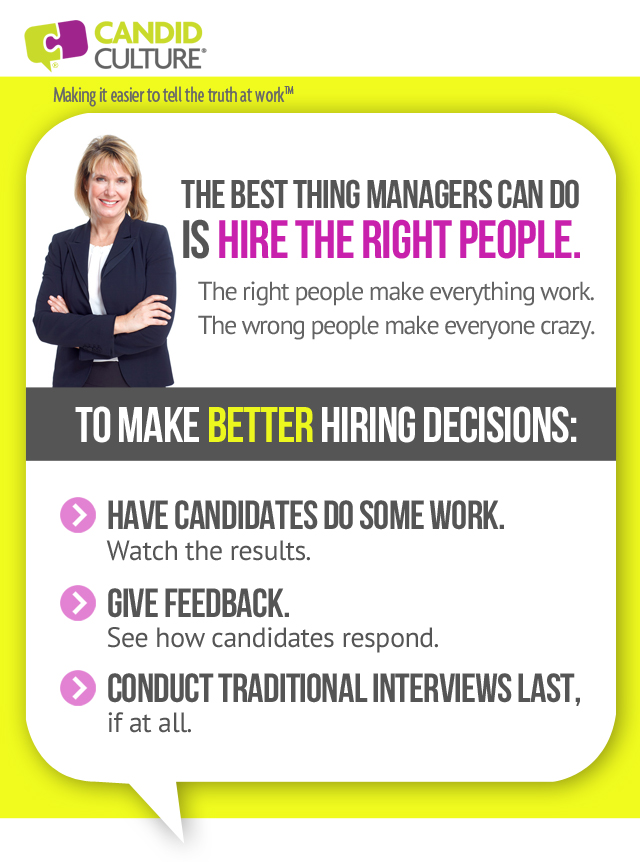
Want to spend less time managing performance issues? Hire the right people. The right people make everything work. The wrong people drain your time, patience, and resources.
Instead of spending 60-90 minutes doing in-person interviews, which tell you little, give candidates a chance to experience the job, and see how they do. I used to conduct thorough, in-person interviews. I’d ask a lot of questions, and I still hired the wrong people. And as a result, we’ve changed our hiring practices at Candid Culture. We no longer do traditional, in-person interviews after phone screens. Instead, we watch candidates do parts of the job. Then we decide if we want to talk with them further.
Too many companies spend too much time interviewing candidates they won’t hire. You might have multiple employees interview a candidate. It’s not uncommon for candidates to meet six or seven people and spend an entire day interviewing. The ultimate decision maker(s) often interviews the person last, cuts the candidate, and thus wasted her employees’ and the candidate’s time. If you want your employees to be involved in the hiring process, have them interview only the candidates the decision maker(s) would be willing to hire. Why waste everyone’s time?
Here Are Seven Interviewing Techniques to Make Better Hiring Decisions:
Interviewing Techniques Number One: Consider hiring a recruiting firm to source and screen candidates. Reading 100 resumes is likely not how you want to spend your time.
Interviewing Techniques Number Two: If you choose not to outsource recruiting, create a few steps for candidates to follow when applying for a job with your company to weed out the people who aren’t serious. It’s better to see 20 resumes from serious candidates than 100 resumes from candidates who potentially aren’t really interested in your company.
Interviewing Techniques Number Three: If you’re sourcing and screening your own candidates, conduct thorough phone screens. Assess culture fit and candidates’ ability to do the job, and eliminate candidates who don’t meet your criteria.
Interviewing Techniques Number Four: Schedule in-person interviews with the candidates you’re interested in. Tell candidates they’ll be participating in a practical interview during which they’ll get to do parts of the job, so they can see if they’ll enjoy the work.
Interviewing Techniques Number Five: Have candidates do some of the work, observe them and/or the work they produce, and provide some positive and improvement feedback. If, after observing candidates do some work, you think they can do the job, and the candidate accepted your feedback without becoming defensive, conduct an in-person interview. If you don’t think they can do the job, end the interview.
During interviews, I screen for a candidate’s willingness to accept coaching and feedback. People who aren’t coachable or open to feedback are exhausting and difficult to work with.
Interviewing Techniques Number Six: If you’re interested in a candidate after both the practical and in-person interview, conduct detailed reference checks. Never, ever skip the reference check.
Interviewing Techniques Number Seven: Lastly, if you’re going to extend an offer, ask your finalists to spend a day or half a day job shadowing. Candidates and employers are on their best behavior during an interview and become more relaxed outside of the traditional interview. You want candidates to get a feeling for what it’s really like to work in your organization. Culture fit is the hardest thing for candidates and hiring managers to predict. Job shadowing helps.
Slow down your interviewing, be more thorough, and make better hiring decisions.
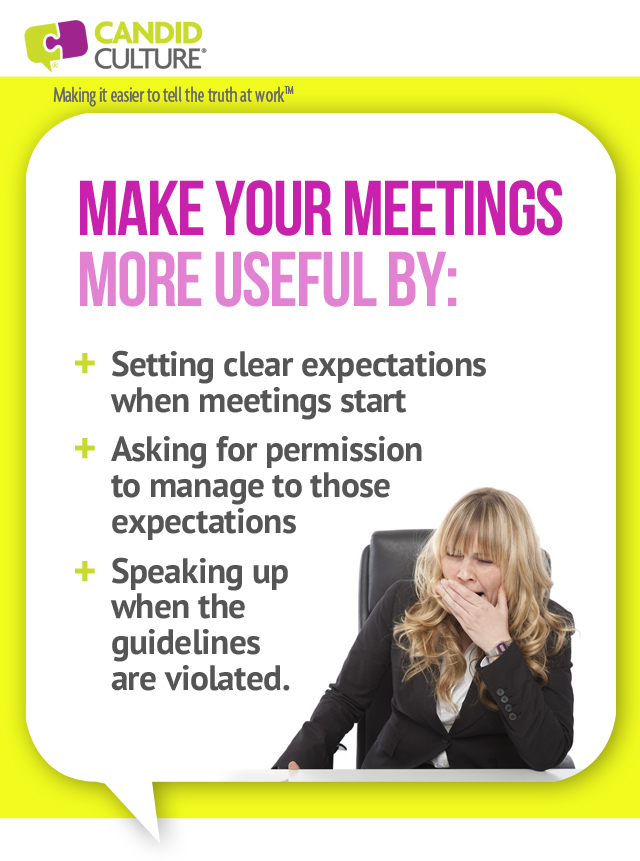
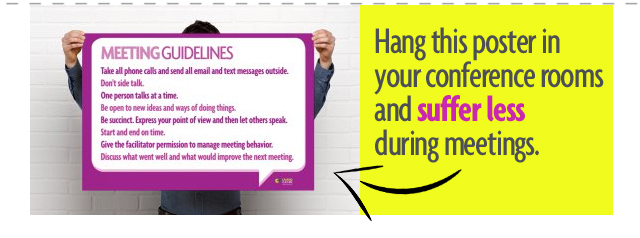
Running effective meetings is hard. It takes courage. Who wants to tell their boss, peers, and customers to put away their phones, stop side talking, and laser their communication? No one. But if you don’t manage ‘bad’ meeting behavior, you look bad and you won’t get the results you want.
If you run meetings, work with the meeting participants to set expectations everyone agrees to follow. Standard meeting guidelines for running effective meetings include not side talking, putting away or silencing electronics, tabling tangents, not interrupting others, speaking succinctly, etc. You can set any behavior guidelines you like as long as the meeting participants agree to those expectations. Ask meeting participants what behavior guidelines they want to follow. The more control you give people, the more buy in you’ll get.
Possibly even more frustrating than running a meeting in which participants break all the ‘rules’, is participating in inefficient meetings when you aren’t the facilitator. It’s difficult to sit through a poorly run meeting feeling there isn’t anything you can do to make it better.
Luckily, there are things you can do to improve the meetings you don’t run. None of my suggestions will be comfortable. But think of all the time you’ll save.
Conversation one – running effective meetings: If you want to impact the meetings you attend, approach the facilitator(s), empathize about what a challenging meeting it is to run, tell the person you want to be supportive, and ask if s/he wants to discuss some different ways to manage the meeting. That conversation could sound something like, “Wednesday’s staff meeting is tough to run. I empathize with you. Would you be interested in talking through some different ways to manage participant behavior? I have some ideas and would be happy to discuss. I’d like to be supportive.”
Conversation two – running effective meetings: If you want to be more direct, you could say something like, “Can we talk about Wednesday’s staff meeting? It can’t be an easy meeting to run. I empathize with you. Key decision makers are missing meetings and a few people tend to take over the conversation and take us off track. Can I make a few suggestions that might help? What do you think of working with the group to set some expectations people agree to be managed to and then holding people to those agreements? We can share the facilitation responsibilities by assigning jobs during the meeting – back up facilitator, note taker, time keeper, etc. – so all of the responsibility doesn’t fall to you. What do you think?”
The person running the meetings knows they’re not going well. They just don’t know what to do about it. Offer support. Don’t judge. Be helpful and possibly they’ll be receptive.
The key to running an effective meeting is to set clear expectations people agree to follow and be managed to, hang up and review those expectations at the beginning of every meeting, and speak up when the expectations are violated. All of these things take courage. But meeting participants will be grateful to you for being strong.
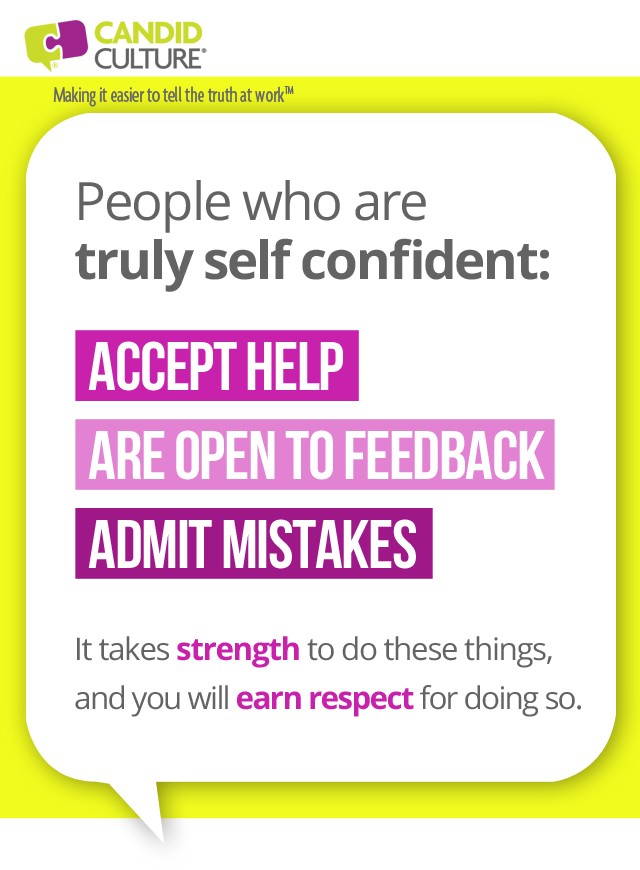
Most of us aren’t eager to admit when we don’t know something, need help, or make a mistake. We fear these things will damage our reputation and make us appear less than to others. But neither are true. It takes strength and self confidence to admit mistakes, accept feedback, and ask for help. Strong, self confident people do all of these things.
When someone who works for me is willing to admit mistakes, I think more of them. When employees ask for help rather than spin their wheels unnecessarily, I’m appreciative. When they’re open to feedback, I’m grateful they’re easy to work with. And the same is likely true for you.
Arrogance masquerades as self confidence. People who are arrogant come off as strong and self confident, but it’s a façade.
It may seem like your personal power and reputation will be diminished by admitting mistakes and accepting help. But this couldn’t be further from the truth. It takes strength to say we don’t know how to do something, to embrace feedback that stings, and to admit bad choices. And strong, self confident people do all of these things, regularly.
You won’t lose credibility or damage your reputation by being humble, instead you’ll be seen as real, relatable and willing to admit a lack of perfection. And all of those things take strength that ingratiate you to others. So be yourself. Don’t pretend you’re better or more knowledgeable than you are. Authenticity goes a long way.

Posted under
Uncategorized on March 7, 2016 by Shari Harley. Comments

You’re talking with someone. He asks a question demonstrating he didn’t understand or hear what you said. You let out an exasperated silent or audible sigh and say, “Like I just said…” Saying “like I just said” or “as I just explained” tells the person that you think he’s stupid or doesn’t listen. Both might be true, but saying so won’t help your relationship.
I consider myself reasonably smart. And for the most part, I listen. If I ask a question about something you said, consider the possibility that your explanation wasn’t clear and find a way to rephrase what you said the first time. Resist the temptation to tell me and the people you work with that we’re stupid.
Letting people save face is an art that takes patience, good communication, and the desire to have good relationships.
Here are five good communication tips that will strengthen you relationships versus alienate you from others:
Good communication tip number one: Give people the benefit of the doubt. Assume good. People are doing what they know to do.
Good communication tip number two: If someone doesn’t understand what you said, take responsibility for delivering unclear information. It’s easier to change your communication style than alter someone else’s style.
Good communication tip number three: Put your desire to have good business relationships above the desire to be right.
Good communication tip number four: Consider that you may not explain things in the way others learn. Vary your communication methods. Most people don’t learn solely by hearing. Make your explanations hands on and/or visual, and you’ll reach more people.
Good communication tip number five: Bring your patience to work.
It’s tempting to tell people where they’re lacking, but it won’t get you very far. Say what you need to in order to get your point across. And if people are unclear, know the easiest thing is to alter your message. Take the path of least resistance; let people save face.