Uncategorized Archive
Posted under
Uncategorized on February 29, 2016 by Shari Harley. Comments

A professional athlete would never get on the court or field without knowing exactly what will score him points and penalties. But many of us go to work every day without knowing how we’re being evaluated.
If you’ve ever had a performance review or received feedback that caught you off guard, or have completed a project and were told your work wasn’t quite what was expected, you didn’t have enough information upfront. Don’t wait for people to tell you what they need and expect (which often happens after breakdowns occur), set clear expectations at the beginning of anything new and as you make progress.
The people you work for and with should tell you what they expect. They should give you feedback along the way. And many won’t. Your career management is in your hands, and that’s a very good thing.
When you start a new job, project, or any responsibility ask the person delegating the work some of these questions:
Career Management Question one: What does a good job look like?
Career Management Question two: What’s the criteria for success?
Career Management Question three: How will you know you picked the right person for the job?
Career Management Question four: Why is this project a priority right now? How will it impact the organization?
Career Management Question five: What kind of updates would you like? In what format, how frequently, and with what level of detail?
Career Management Question six: How often do you want to review my work?
Career Management Question seven: Who in the organization should I include or work with on this project?
Career Management Question eight: What history, pitfalls, or landmines do I need to be aware of? Has anyone tried to do this before, with what outcomes? Who in the organization supports this project? Who doesn’t?
If you’ve been in your job for a long time or have been working on a project for a while, it’s not too late to ask these questions. Simply approach the person with whom you’re working and say, “I want to be sure I’m doing great work on _____________ project. Can I ask you a couple of questions about the desired end results and how we should be communicating as I make progress?”
Lots of people aren’t the best delegators. They give us a project, ask if we have any questions, and provide a due date. Don’t fall into the trap of completing an entire project and then asking for feedback. Even if the person delegating the work doesn’t want to see your progress, ask for that feedback. Schedule weekly or monthly review meetings, present the work you’ve done, and ask for feedback. If you get to the end of a project or responsibility and are surprised by the reaction, you didn’t ask enough questions at the beginning and middle of the project.
People will tell you everything you need to do a good job, if you ask. Take control of your career. Ask more. Assume less.
Posted under
Uncategorized on February 21, 2016 by Shari Harley. Comments
 I’m often asked, “Can I give my boss or the people above me feedback? Is that really realistic?” Giving people ‘above’ you feedback has everything to do with the quality of your relationship and less to do with the person’s title. If your relationship is good and your boss is open to feedback, then yes, you can practice the feedback formula with him/her. If your relationship isn’t that solid or your boss isn’t open to your feedback, practice managing up by asking for what you want instead of giving direct feedback.
No one likes to be criticized or told that s/he is wrong. When giving someone direct feedback, no matter how kind the delivery, you are telling someone, “You’re doing ______ wrong. Please do _____ instead.” Being that direct is challenging when you don’t have the best relationship or when people are highly defensive. You can achieve the same desired results by simply asking for what you want.
Asking for what you want is less judgmental than giving direct feedback and is a subtle way of telling someone s/he is not giving you what you need. And people who are paying attention will get that. They don’t need it spelled out.
Here are a few ways to practice managing up with your boss and other leaders in your organization:
Example One:
Giving Direct Feedback: “You don’t make time for me. I’m getting behind on projects because you don’t take the time to review my work.”
Managing Up by Asking: “How can we ensure you get to review my work each week, so I can finish the projects I’m working on?”
Example Two:
Giving Direct Feedback: “Every time we have a meeting scheduled, you cancel it.”
Managing Up by Asking: “If meetings get cancelled, is it ok if I reschedule them?
Example Three:
Giving Direct Feedback: “You’re a micromanager. I feel like I can’t make a move without your permission.”
Managing Up by Asking: “I’d like to manage ________ project. What do you need to feel comfortable with me doing that?”
Telling someone at any level s/he is doing something wrong, which will likely evoke defensiveness. And being direct requires both courage and a good relationship. If you don’t have the relationship to be so direct, simply ask for what you want.
Posted under
Uncategorized on February 16, 2016 by Shari Harley. Comments

Last week I was at an event where no one sat with the CEO. The whole organization was present, and the CEO’s table was empty. What a career advancement missed opportunity for the people who work for this company.
Perhaps no one likes the CEO, or employees are afraid of him, or employees are concerned they’ll get labeled as a suck up for sitting with him. None of these reasons are legit.
The CEO is just a regular person. S/he puts her pants on just like you do every day.
Most employees have limited exposure to their organization’s most senior leaders. Don’t miss an opportunity to build business relationships with your organization’s senior leaders.
Here are four career advancement strategies:
Career advancement strategy #1: Senior leaders have very limited access to most employees. Most will make quick decisions about employees with the limited access they have. If you’re at a meeting with a senior leader, speak up (provided you have something useful to say). If you don’t speak up, when appropriate, you might be (unfairly) labeled as having little to offer.
Career advancement strategy #2: If you’re at an event with senior leaders, talk and/or sit with them! It’s not necessarily a chance to wave the flag for your favorite cause or company initiative. It is a chance to get to know these folks and have them get to know you.
Career advancement strategy #3: Be less afraid. Tell the truth, tactfully. Be careful not to insult someone or something, and speak up more.
Most employees are afraid of being fired and are convinced that if they offer a counter point-of-view they’ll be at worst fired and at best marginalized and never given another cool project. I haven’t found that to be true.
It’s not so easy to get fired in this country. People who don’t do a lot of work or who do mediocre work are often not fired. And you’re worried about being fired for speaking up? Pick your battles, be wise about how you voice concerns and ideas, and worry less.
Career advancement strategy #4: Suggest solutions to problems. People who talk only about problems but don’t offer to do anything about those problems are seen as annoying complainers. Offer to be the person who spearheads the solution. Don’t worry about if it’s your job. Just don’t step on others’ toes in the process.
You make your career happen, no one else. You can talk with your coworkers and friends all day. Don’t miss opportunities to get to know the key decision makers in your organization. Fear less. Talk more.
Posted under
Uncategorized on February 8, 2016 by Shari Harley. Comments
 One of the hardest things I’ve ever done is hire someone to care for my infant son. “Here is the person most important to me in the world. Keep him alive.” I had no idea how difficult it would be to trust a relative stranger so implicitly. And as a result, let’s just say I’ve not been the easiest for a nanny to work with.
I’m embarrassed to admit that I wrote sixteen-pages of instructions of how to take care of my infant son. And I gave that ‘booklet’ to a nanny with much more childcare experience than I have. When I work from home and hear my son crying, I tell myself not to walk into the room and check on him, knowing it undermines the nanny, but I do it anyway. When the nanny sends me an update of when my son last ate, I reply telling her when he should eat again, even though I know she knows. Yes, I’ve really been doing these things.
Each time I over instruct, monitor, and advise, I regret it. I know micromanaging the nanny makes me difficult to work with, which is not how I want to be. It reminds me of a comment an old boss said to me after we interviewed a candidate for a job together. He said, “Shari, your job as the interviewer is to make the candidate feel comfortable and ensure she leaves feeling good, regardless of how well or poorly she interviewed.” My face must have said anything but, “I want you to feel comfortable and you’re doing a great job.” His words stuck with me and I’m reminded of them each time I over manage our nanny.
Many people attend training on how to manage others; I’d suggest we also look at how we manage ourselves. How does working with you make people feel? Do your questions, requests, and interactions make people feel more self-confident and valued or do people feel questioned and undermined? Do you pick your battles? Do you give just enough direction but not so much as to squelch the other person’s ideas, initiative and spirit, especially when the stakes are high?
As you know, I’m evaluating how I do these things too. We are always a work in progress.
Here are four ways to build confidence in the people you work with:
Build Confidence 1: Ask people for their ideas and implement those ideas whenever possible. And if you aren’t open to others’ ideas, don’t ask for them. It’s better not to ask for ideas than to ask when you’re really not interested.
Build Confidence 2: Ask for and be open to others’ feedback. People will be more receptive to your feedback when you’re receptive to theirs.
Build Confidence 3: Say “thank you” regularly and mean it. Give specific examples about what you’re thankful for.
Build Confidence 4: Admit when you’re wrong. Strong people admit mistakes, weak people don’t.
People can work with you, around you, and against you. Earn loyalty and respect by respecting others’ talents and knowing when to take a step back.
P.S. Congratulations to our Denver Broncos!

Posted under
Uncategorized on January 31, 2016 by Shari Harley. Comments
 Most of us avoid giving negative feedback because we don’t want to deal with the recipient’s defensive behavior. We’re waiting for what I call, The Freak Out. The Freak Out is the predictable response to negative feedback.
Everyone wants to be seen as competent and adding value. When we give people negative feedback, we call those two things into question and the brain instinctively reacts. It’s as if you were driving down the road and the person in front of you slammed on their brakes. As an act of survival, you’d hit your brakes too. Becoming defensive when receiving negative feedback is the same instinctual response. We (almost) can’t help ourselves. So rather than dread and avoid others’ defensive behavior, expect it and have a plan.
Here are five ways to deal with defensive behavior:
- Plan your conversation by writing notes and bringing them to your conversation. I’m a fan of typed, double-spaced bullets that are easy to follow.
- Practice what you want to say out loud. What you say in your head is often different than what comes out of your mouth.
- Ask others for help. Change names and details to protect the feedback recipient and ask how someone else might deliver the feedback. Someone who is not emotionally involved will likely handle the conversation better.
- When the feedback recipient exhibits defensive behavior, take a breath and pause. Remember that you expected this. Don’t retract what you’ve said. Just let the person speak.
- Stay on track. Defensive behavior is designed to derail conversations. Keep the conversation focused on the feedback. Don’t become distracted.
What to say when people respond to feedback defensively:
Defensive behavior: “Why are you talking to me? I’m not the only one doing this.”
Appropriate response: “If others are doing this, be assured that I’m managing it. Right now we’re talking about you. I know this is difficult. Let’s stay focused.”
Defensive behavior: “You’re wrong. Everyone else thinks I’m awesome.”
Appropriate response: “I know this is difficult. I’m asking you to __________. Please do that.”
Defensive behavior: “You don’t like me and you’re picking on me.”
Appropriate response: “I’m sorry you feel that way. The reason I’m asking you to ________ is _______.”
Defensive behavior: “I disagree.”
Appropriate response: “I know that we disagree. And I’m asking you to __________.”
The key is not to get baited by defensive behavior. This is why I suggest preparing and bringing notes. When I’m having a particularly difficult conversation and the other person becomes defensive, I often become flustered and either forget what I want to say or back pedal. Do neither. Expect defensive behavior. Don’t get distracted. Stay on track. You can handle anything someone says.
Posted under
Uncategorized on January 25, 2016 by Shari Harley. Comments
People get defensive when they receive negative feedback. It’s hard not to. Everyone wants to be seen as competent, and when we receive negative feedback, our competence is called into question. So we react.
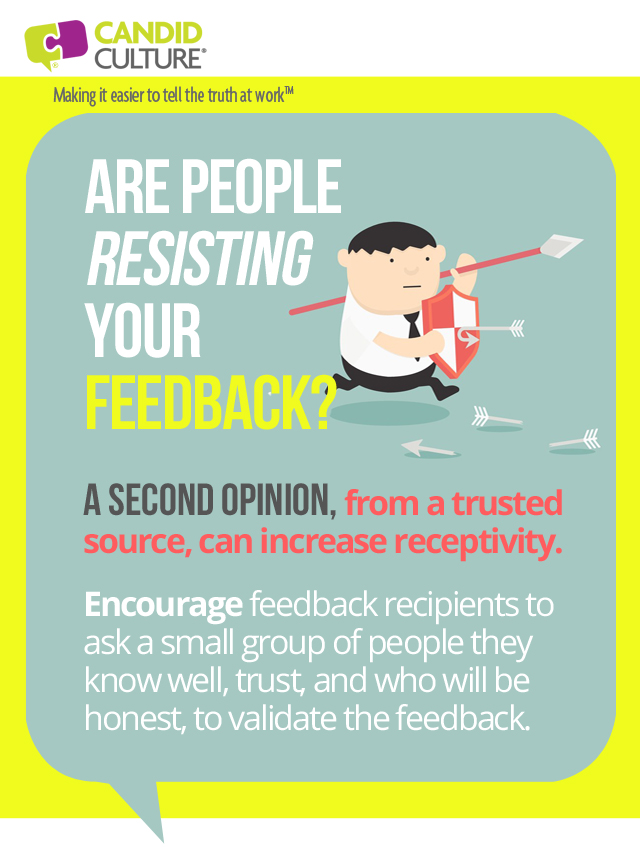
There are several things you can do to reduce others’ defensiveness – ensure you have trusting relationship and thus have earned the right to give feedback, watch your words, deliver feedback in a private setting, etc. But for today, I’m going to focus on getting a second opinion.
If you want people to be more receptive to your feedback, consider encouraging them to get a second, third, or fourth opinion. I’m a fan of casual 360 degree feedback – when we ask for feedback from people we work with both inside and possibly outside the organization. Think of 360 degree feedback like an orange, it’s all the way around, like a sphere. When you get 360 degree feedback, you gather input from all the different types of people you interact with, thus getting a more comprehensive and accurate picture of performance. There are different types of 360 degree feedback. 360 degree feedback ranges from the formal – an online, anonymous survey (I’m not a fan) – to casual conversations (which I recommend). In this instance I’m suggesting something I call The Core Team.
I suggest everyone has a Core Team of about five people who love you, know you well, and have your back. Most important is that you trust these people. You Core Team may be personal or professional relationships, or a mixture of both. You may have worked with Core Team members or not. What all Core Team members have in common is that they know you well, want what’s best for you, and will tell you the truth when asked.
My core team consists of a friend from high school, two people I used to work with, and my parents. When I get feedback that I’m having a hard time reconciling, I ask people on my Core Team to validate the feedback. It doesn’t matter if they’ve worked with me or not. I am who I am. I do the same annoying stuff in my personal and professional relationships. So a personal Core Team member can provide valid, professional feedback and vice versa. Sometimes they agree with the feedback I’ve been given and sometimes they don’t. But I always get compelling information to think about. And because I trust the people on my Core Team, I listen to what they have to say.
Don’t be disheartened if people don’t trust your feedback and aren’t receptive. Instead, see their resistance as human and encourage them to get a second opinion. And then talk again. Listening to and incorporating feedback is a process. It takes time, courage, and patience.
Posted under
Uncategorized on December 27, 2015 by Shari Harley. Comments
 I always want to do things right and hate making mistakes. When I say or do things I wish I hadn’t done, I relive those scenarios way more than I care to admit, also known as obsessing. But maybe life isn’t about doing everything right. What if our primary job in life is to be happy?
I’m not making a list of 2016 personal goals, although I don’t think doing so is bad. Lots of people will set 2016 goals. If setting specific goals works for you, do it. Just don’t set yourself up to fail. You’re not likely to lose 30 pounds, save 20% of your income, start a not-for-profit, visit five new countries, and become a fantastic cook in one year. Maybe dial those 2016 goals back and pick two of them, but only if you enjoy working towards those goals.
Perhaps life isn’t about getting more done. Perhaps life is really about enjoying more.
If you want to set 2016 goals, I wouldn’t be opposed if they are:
- Have a job you love.
- Spend time with people who make you feel good.
- Speak your truth (nicely).
2016 Goal: Have a job you love. You don’t need to keep a job that doesn’t allow you to do work you enjoy and are good at. There are lots of jobs out there. Go get one you like.
2016 Goal: Spend time with people who make you feel good. Stop spending time with people you don’t like or who you don’t feel better after leaving their presence. Your discretionary time is limited. “I should maintain this friendship because we’ve known each other so long.” Or, “I should spend time with family members I don’t enjoy because it’s the right thing to do” is diminishing your happiness. Text those people occasionally and spend your time elsewhere.
2016 Goal: Speak your truth (nicely). People are more likely to quit a job and a relationship than to say what isn’t working and to ask for what they want. Fear less; speak more. When you speak from a desire to make things better and to strengthen relationships, there is little you can’t say, so start talking.
I won’t tell you not to save money, travel more, or become a gourmet cook. But what if your job in 2016 isn’t to do more? What if your primary job is to be happy? What would your 2016 goals be then?

Think about all the people and situations that frustrate you. Now consider what you’re asking for. My hunch is, you’re getting what you ask for.
While most of us aren’t great at telling people when they violate our expectations, we’re not any better at asking for what we want. You might be afraid of appearing demanding or may not feel you have the right to make requests. When you tell people what you expect, you make their lives easier. Think about when someone invites you to their house for dinner. If you have any manners (and I’m sure you do), you ask what you can bring. When the other person says nothing, it makes your job (to be a good guest) harder. Now you have to guess what the other person wants. It would be so much easier if he would just tell you. This also applies to birthday gifts and where to meet for lunch. When people tell you what they want as a gift and where they want to eat, you don’t have to guess and they are easier to please.
It’s much easier to live and work with people when we know what they expect from us. And setting expectations is always easier than giving negative feedback. Negative feedback implies someone did something wrong. And no one likes to be told he is wrong. Setting expectations provides a road map to success, making it easier to win with you.
Here are a few phrases to make setting expectations easier:
Setting expectations example one: Consider saying, “I need time to get settled when I come in in the morning. Will you hold all questions and requests until 10:00 am?” You’re not telling someone she barrages you with questions before you’ve even gotten to your desk in the morning; you’re simply asking for what you need.
Setting expectations example two: You could say, “I like to have things done well before they are due. Will you send me all input for the weekly status report by Wednesday of each week so I have a few days to review your input before I have to submit it?” You’re not telling the person that working with him requires a weekly fire drill; you’re simply making a non-judgmental request.
Setting expectations example three: You could ask, “Would it be possible to touch base once a week via phone during your morning commute so I can get your input on projects?” You’re not telling the person she is impossible to get time with; you’re simply proposing an idea.
One of the keys to getting what you want is make requests in a neutral, non-judgmental way. The more you ask for and the more specific your requests, the easier you are to work with. What you need and want will be clear; there will be no guessing. People may choose to ignore your requests and violate your expectations, and then you’ll provide feedback. But start with making clear and specific requests, and see how many fewer feedback conversations you need to have.

Many people worry about giving feedback because they fear they don’t have the ‘right’ words. They’re concerned they’ll say ‘it’ wrong and damage their relationships.
Feedback is hard enough to give without worrying about saying everything perfectly. Worry less about having all the right words and more about whether or not people trust your motives.
When people trust your motives – why you’re giving feedback – you can say almost anything. When they don’t trust your motives you can say almost nothing.
Getting negative feedback is hard. It’s easier to listen to feedback when we trust the person who’s giving us the feedback – we know their intentions are to help versus to judge or hurt us.
Speak from the heart, be authentic, and worry less. Be yourself. If you’re nervous to say what you want to say, tell the other person you’re nervous. If you’re struggling to find the right words, say so. If you’re worried you’ll damage the relationship or that it isn’t your role to give the feedback, say that. Authenticity goes a long way.
How’s how to give feedback you’re apprehensive about:
How to give feedback phrase one: Consider saying, “There’s something I need to talk with you about but I’m concerned that I won’t use the right words and will damage our relationship.”
How to give feedback phrase two: “There’s something I want to talk with you about, but I’m concerned how it will come across. Is it ok if I say what I need to say?”
How to give feedback phrase three: “I want to give you my thoughts on something but I’m concerned that it’s not my place to do so. Is it ok if I share my ideas about _________?”
Other people aren’t expecting you to be perfect. But they do want to know they’re working with a human being. And human beings are fallible. We have fears. We make mistakes. And sometimes we don’t say things perfectly.
You don’t have to be perfect, you just have to be real.
Posted under
Uncategorized on August 9, 2015 by Shari Harley. Comments
 It’s not easy to admit when we’re overwhelmed and need help. In fact, it’s such a hard thing to say that instead of asking for help, most of us either work harder or longer or job hunt.
Admitting work overload isn’t a weakness and it isn’t bad. It’s all in how you handle it.
If you find yourself with work overload and you aren’t sure what to do, consider taking these four steps.
Eliminate work overload step one: Every time you find yourself doing something that someone else could and should do, write it down, including how much time the task took. Doing this will create awareness of how much time you spend doing things that may not be the best use of your skills and experience. Then work with whomever you need to in your organization to align that work where it belongs. This practice isn’t to make you sound like an entitled prima donna. It’s an entrepreneurial way to approach your work.
The highest and best use of my time at Candid Culture is talking to current or future clients, writing new material, and delivering keynote presentations or training programs. I really shouldn’t do anything else. I can do a lot of things – like talk to vendors, count inventory, order supplies, and pack product orders – but none of those things add value to the business the way speaking, training, writing and spending time with clients does.
The business owner’s mantra is, “If I can pay someone less than I get paid to do something, I should do that.” Consider how you can apply that practice to your workplace, without appearing to be someone who won’t ‘wash windows.’ Meaning, you don’t want to be or appear to be someone who isn’t willing to do grunt work. Every job has it. But those lower level tasks shouldn’t be where you spend most of your time, unless your job description and annual goals say so.
Eliminate work overload step two: Watch out for and eliminate time suckers. This includes people, problems, and processes. If you find yourself in meetings all day long, consider which meetings you can skip or send someone else on your team. If someone in your office swings by daily to have personal conversations, tell the person, “I’d love to talk with you and I’m working under a deadline. Can we catch up later?”
Lots of people are at work longer than they need to be because of time spent talking with coworkers they don’t know how to ask to go away. You’re doing everyone a favor when you end conversations that are distracting. If you really want to talk about what’s happening with your coworkers’ kids, mother-in-law, and home renovation, go to lunch or happy hour.
Eliminate work overload step three: Sometimes doing 110% percent isn’t important. Notice when you’re doing more than you need to and when that additional work doesn’t add significant value. I.e., you put together a PowerPoint presentation and then spent five more hours printing and stuffing folders to put the presentation in. Next time, focus on the content and worry less about the aesthetics.
Eliminate work overload step four: Lastly, know when and how to ask for help. The last organization where I worked, before starting Candid Culture, was very fast paced and lean. I worked all the time and consistently felt overwhelmed. I eventually went to my boss to ask for help. I made a list of everything I was working on and asked him to rate each item based on how important he saw the project/task. He put an “A” next to the things that needed to get done first, a “B” next to the things that came next, and a “C” next to the things that were the least important. He told me to do the A’s first, then the B’s, and if I got to the C’s, great, if not, no problem.
The meeting was eye opening for me. I assumed he thought everything on my list was an “A” and that left me stressed with an inability to prioritize. Hearing how he perceived my workload reduced my anxiety and gave me permission to ease up on projects I’d previously considered timely.
Don’t suffer in silence. But do approach reducing work overload in a positive way. Rather than whining to your boss and coworkers, end conversations that you know are a time drain, limit work that doesn’t add significant value, and ask for help prioritizing when you can’t do it for yourself.